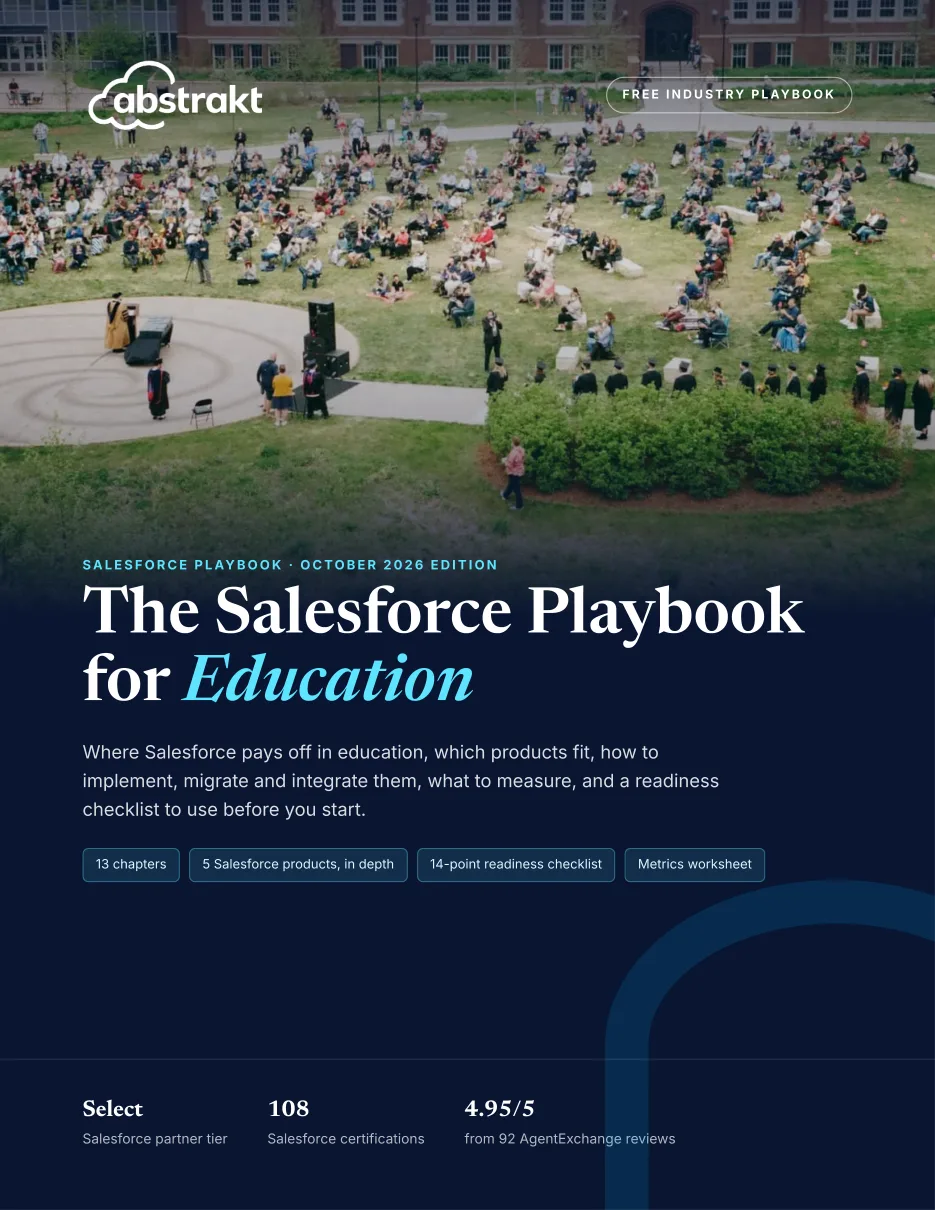
The Salesforce playbook for education.
Education institutions usually hold more data about a student than any commercial business holds about a customer, and can usually do less with it. Admissions, financial aid, advising, student life and advancement each run their own system, so nobody sees the whole student. The institutions pulling ahead have made the student record singular, and made it available to everyone who touches that student.
- 13 chapters
- 5 Salesforce products in depth
- 14-point readiness checklist
- 9,794 words
What's inside.
Written by our Salesforce consultants for education. Read it start to finish or go straight to the chapter you need.
Salesforce in education: where it pays off
6 patterns that work, and the stack we typically deploy.
The challenges Salesforce has to solve
The 6 problems a design has to solve, plus 4 methods we use on them.
Which Salesforce products fit, and how
Salesforce Marketing Cloud, Salesforce Service Cloud, Salesforce Experience Cloud, Tableau, Salesforce Sales Cloud: use cases, data model and buyer questions for each.
How to implement it
Who needs to be in the room, what the first release includes, and the questions to settle before kickoff.
Moving from your current system
What moves from your current system, how to plan it, and the decisions to make early.
The systems to connect
9 systems to connect and what flows between them.
Regulation and compliance
6 rules and obligations the design has to account for.
Readiness checklist
14 decisions to make before you sign a statement of work.
What to measure
6 metrics to baseline before the build, with a worksheet.
After go-live: support and health checks
What ongoing support covers and when to run a health check.
If a project has stalled
How stalled projects get back on track, and how to get more from the org you have.
Where the industry is concentrated, and local guides
local guides for 2 metros.
Next steps
Free assessments and how to reach a consultant.
From the readiness checklist.
Three of the 14 decisions the playbook asks you to make before you sign a statement of work. The full checklist, with the rest of the playbook, is in the PDF.
Get the full playbook →- Build FERPA into sharingAccess to education records should follow legitimate educational interest. Design roles, permission sets and field-level security with the registrar and compliance office. Log access to sensitive fields and document the rationale, because audits and student requests will eventually test whether the configuration matches the written policy.
- Agree on shared definitionsWords like applicant, admitted, enrolled and active mean different things to different offices. Settle them before building reports, or dashboards will disagree with official census counts and leadership will quietly return to institutional research spreadsheets when real decisions need to be made.
- Plan around the academic calendarApplication deadlines, orientation, add/drop and commencement are immovable. Agree release windows that avoid each office's peak period. Training works best when staff have breathing room, which may mean different go-live dates for admissions and advising even inside the same program of work.
The Salesforce products it covers.
Each product chapter covers use cases, how the data is modeled and the questions buyers ask. Shorter versions are on our site.
- Salesforce Marketing Cloud for EducationMarketing Cloud lets admissions, enrollment and student success teams send timely, relevant messages instead of one newsletter to everyone.
- Salesforce Service Cloud for EducationService Cloud lets colleges and universities run student services as a coordinated operation rather than a collection of separate offices.
- Salesforce Experience Cloud for EducationExperience Cloud gives schools, colleges and continuing education providers secure sites for the people they serve beyond their own staff.
- Tableau for EducationTableau helps colleges, universities and other education organizations analyze data spread across the CRM, student information system, learning management system, financial aid and advancement platforms.
- Salesforce Sales Cloud for EducationSales Cloud fits the parts of an institution that sell to organizations or run enrollment like a pipeline.
Who wrote it.
Abstrakt Solutions is a Salesforce Select partner based in St. Louis, with 108 Salesforce certifications, 7 Salesforce accreditations and a 4.95 out of 5 rating from 92 reviews on Salesforce AgentExchange (formerly AppExchange).
The playbook draws on the guidance we publish for education.