
Salesforce consulting for St. Louis companies
Abstrakt Solutions is a Salesforce Consulting Partner headquartered in downtown St. Louis. We implement, integrate, fix and manage Salesforce for St. Louis manufacturers, financial firms, healthcare organizations and distributors, with an onshore team that can be in your office for workshops, go-lives and training. St. Louis is our home market.
The St. Louis business landscape
St. Louis has an unusually large base of corporate headquarters for its size. Greater St. Louis, Inc. names aerospace, geospatial intelligence, and pharmaceuticals and medical devices among the region’s target sectors.
The regional economy is more industrial than most metros its size. Manufacturing is the largest private sector by output, followed by health care and financial services, and the region’s development organization targets aerospace, geospatial intelligence, plant science and agtech, and pharmaceuticals and medical devices. The 39 North innovation district in Creve Coeur, anchored by the Donald Danforth Plant Science Center, is the center of the agtech cluster.
Figures cover the St. Louis, MO-IL Metro Area (MO–IL).
- Manufacturingat least 11.1%Share of 2024 metro GDP Salesforce for manufacturing →
- Health care and social assistanceat least 9.5%Share of 2024 metro GDP Salesforce for health & life sciences →
- Finance and insurance8.5%Share of 2024 metro GDP Financial Services Cloud →
- Wholesale tradeat least 7.5%Share of 2024 metro GDP Experience Cloud →
- Professional, scientific, and technical servicesat least 7.5%Share of 2024 metro GDP
Regional target sectorsAerospace, Geospatial/GEOINT, Plant Science / AgTech, Food & Beverage, Pharmaceuticals & Medical Devices, Finance & Insurance, Corporate OperationsGreater St. Louis, Inc.
Where Salesforce fits in St. Louis’s economy (4)
The largest private sectors by share of 2024 metro GDP, and what Salesforce work usually looks like in each.
| Sector | Share of 2024 GDP | Where Salesforce fits |
|---|---|---|
| ManufacturingSalesforce for manufacturing → | at least 11.1% | Manufacturers here often sell through distributors and dealers and quote from ERP data. Salesforce helps when account, pricing and service history finally sit in one place, with ERP integration and, where crews go on site, Field Service. |
| Health care and social assistanceSalesforce for health & life sciences → | at least 9.5% | Health systems, medical-device makers and life-sciences firms use Salesforce for referral and patient engagement, field sales and service, where access controls and data privacy shape the design from the start. |
| Finance and insuranceFinancial Services Cloud → | 8.5% | With wealth managers, insurers and lenders headquartered here, relationship data, compliance-aware marketing and advisor productivity are recurring needs, which is where Financial Services Cloud and Account Engagement fit. |
| Wholesale tradeExperience Cloud → | at least 7.5% | Distributors need order history, rep territories and customer portals connected to the ERP that runs the warehouse, which makes integration and Experience Cloud as important as the CRM itself. |
Source: U.S. Bureau of Economic Analysis, GDP by county (CAGDP2), 2024, summed to the metro area; private sectors only, excluding real estate and government. “At least” marks sectors where BEA suppresses some county figures.
St. Louis by the numbers: the trend, not just the size (3)
St. Louis, our headquarters market, has grown steadily rather than quickly since 2019, with new business formation close to the national pace.
Business applications rose 54.1%, a little under the national 62.2%. New firms add first Salesforce implementations to a market where most work involves established manufacturers, health systems and financial firms.
Census Business Formation Statistics, county data summed to the metro, 2019–2025Real output grew 11.0%, slightly behind the national 12.8%. Steady growth tends to mean ongoing optimization and integration work more than large greenfield programs.
BEA real GDP by county (CAGDP9), summed to the metro, 2019–2024Private employment is close to its 2019 level (−0.3%). Salesforce investments here are usually justified by efficiency and better reporting rather than headcount growth.
BLS Quarterly Census of Employment and Wages, 2019 and 2024Leading private sectors in St. Louis, 2024: concentration, growth and pay
| Sector | Concentration vs U.S. | Job growth 2019–2024 | U.S. job growth | Average annual pay |
|---|---|---|---|---|
| Finance and insurance | 1.13 | -8.1% | +4.4% | $112,896 |
Finance and insurance is more concentrated here than nationally (1.13), though its employment fell 8.1% since 2019. BLS withholds several other St. Louis sector figures; the GDP shares above show manufacturing and health care as the region's other anchors.
BLS Quarterly Census of Employment and Wages for St. Louis, 2019 and 2024 · How these measures work
Across the St. Louis metro (17)
We work with companies throughout the metro area as the Census Bureau defines it, which spans 2 states.
Principal cities (2)
- St. Charles, MO
- St. Louis, MO
Counties (15)
- Bond County, IL
- Calhoun County, IL
- Clinton County, IL
- Jersey County, IL
- Macoupin County, IL
- Madison County, IL
- Monroe County, IL
- St. Clair County, IL
- Franklin County, MO
- Jefferson County, MO
- Lincoln County, MO
- St. Charles County, MO
- St. Louis County, MO
- Warren County, MO
- St. Louis city, MO
Salesforce in St. Louis, service by service (7)
Each service has its own page for St. Louis: what the work involves here, the industries it applies to and the questions local teams ask.
Implementation
Salesforce implementation for St. Louis manufacturers, financial firms and agtech companies, phased and led by consultants based in St. Louis.
See St. Louis implementation →Managed Services
Ongoing Salesforce administration, release reviews and backlog work for St. Louis health, distribution and corporate teams, from a local partner.
See St. Louis managed services →Integration
Connect Salesforce to ERP, order, inventory and quality systems for St. Louis distributors, manufacturers and life-sciences companies.
See St. Louis integration →Optimization
Improve adoption, clean up automation and rebuild reporting in an existing Salesforce org, for St. Louis manufacturers and professional firms.
See St. Louis optimization →Health Check
Review Salesforce security, data quality and technical debt before adding Agentforce, for St. Louis health, financial and geospatial organizations.
See St. Louis health check →Migration
Move St. Louis financial, agtech and professional-services firms from legacy CRMs and spreadsheets into Salesforce with clean, reconciled data.
See St. Louis migration →Implementation Rescue
Triage, stabilization and completion for stalled Salesforce builds at St. Louis aerospace suppliers, manufacturers and health organizations.
See St. Louis implementation rescue →Salesforce products we implement for St. Louis teams
Grounded AI uses for St. Louis manufacturers and hospitals
Three sectors carry the St. Louis economy, and the smallest of them, finance and insurance, still reached 8.5% of metro GDP in 2024, behind manufacturing and health care. Across that mix, the common thread is paperwork. Plants and distributors field quote requests that arrive as attachments; an agent can extract quantities and specs and stage an opportunity for a rep to check. Hospital and clinic groups often want patient-facing answers about billing or referrals, which only works when the content is approved and current. Insurers and banks can use call summaries to cut after-call work. We scope these pilots around one queue, measure accuracy against human handling, and expand only when the data holds up.
- Quote request attachment extraction
- Billing and referral answers
- Call summaries for insurers
Salesforce for St. Louis’s leading industries (4)
Manufacturing
Salesforce for St. Louis machinery, chemical, aerospace and food manufacturers: dealer networks, aftermarket parts and orgs rebuilt on ERP data.
See Salesforce for manufacturing in St. Louis →Health & Life Sciences
Salesforce for St. Louis health systems, pharmaceutical and medical device companies: referrals, account-based selling and regulated service data.
See Salesforce for health & life sciences in St. Louis →Wealth Management
Salesforce for St. Louis advisors, RIAs and brokerage teams: household views, faster account opening and supervised outreach, from a local partner.
See Salesforce for wealth management in St. Louis →Insurance
Salesforce for St. Louis agencies and insurers: commercial renewals for industrial clients, producer management and policyholder service.
See Salesforce for insurance in St. Louis →Common Salesforce challenges in these industries (3)
- 01
CRM and ERP that do not talk
In a manufacturing and distribution economy, the most common gap we see is sales working in Salesforce while orders, pricing and inventory live in an ERP. Reps re-key data and leaders reconcile two sets of numbers.
- 02
Orgs built up over many years
Long-established companies often have Salesforce orgs shaped by several admins and partners. Low adoption and untrusted dashboards are usually symptoms of that history, not of the platform.
- 03
Regulated customer data
Financial services and healthcare firms need Salesforce designs where sharing, audit and marketing consent are right before anything goes live.
What Salesforce should look like for St. Louis companies (2)
Starting points for the industries that lead this market, not templates. Every org differs; these show the systems and the order they usually connect in.
A St. Louis manufacturer selling through distributors
- ERP: orders, pricing, inventory
- MuleSoft or direct APIs
- Sales Cloud: accounts, opportunities, quotes
- Experience Cloud portal for distributors
- Service Cloud and Field Service for installed equipment
- Agentforce for quote intake, with a rep approving
The ERP stays the system of record for price and inventory; Salesforce shows that data rather than copying it into fields people edit. Decide who owns each field before building, because older St. Louis orgs often have two versions of the same price list.
A St. Louis wealth or insurance firm with a large advisor network
- Custodian, policy and planning systems
- Integration layer with nightly and event feeds
- Financial Services Cloud: households and relationships
- Account Engagement with compliance review
- Service Cloud for client and agent service
- Agentforce meeting prep, reviewed before use
Advisor networks generate the sharing-model questions: which branch, team or advisor sees which household. Settle that design first. AI drafting comes last and stays behind supervision rules.
How St. Louis revenue teams connect Salesforce to the rest of the stack (4)
Many St. Louis companies have run Salesforce for a decade or more, and the stack around it grew one tool at a time. The work is usually less about adding software than agreeing where each handoff lives: what makes a lead sales-ready, when a closed deal becomes a service or install record, and which system finance trusts for renewals.
- 1
Marketing → Sales
Lead definitions and routing (Account Engagement, Chili Piper) so distributor and direct leads reach the right rep.
- 2
Sales → Service
Closed orders create install, warranty or onboarding work in Service Cloud or Field Service, with the equipment record attached.
- 3
Service → Finance
Contracts and renewals reconcile with the ERP so revenue reports match the books.
- 4
All teams → Leadership
Call insight from Gong and reporting in Tableau or Snowflake, built on the same account and product definitions.
Our work in these industries (3)
Client names are anonymized and these projects are not specific to St. Louis.
Salesforce guides from our team (3)
Written by the consultants delivering the work.

Salesforce for wholesale distributors: accounts, pricing and ERP data
How wholesale and industrial distributors set up Salesforce for ship-to hierarchies, inside and outside sales, ERP pricing, order history, reorder signals, rebates, portals and returns.
Salesforce assets and preventive maintenance: installed base and plans
How equipment companies track installed assets, warranties, service contracts and entitlements in Salesforce, and use Field Service maintenance plans to schedule work by date, usage or condition.
Sales CloudSalesforce mobile app for field sales: setup that reps will use
How to set up the Salesforce mobile app so outside reps log visits and deals: phone pages, compact layouts, quick actions, sync, offline, maps, security, piloting and adoption.
Industry guides for St. Louis companies (4)
- Manufacturing Salesforce Manufacturing Cloud: when it fits and how to implement it
- Health & Life Sciences Health Cloud implementation: patient data, care teams and compliance
- Wealth Management Salesforce for wealth management firms: RIAs and broker-dealers
- Insurance Salesforce for insurance agencies: policies, renewals and producers
Cost, staffing and partner choice in St. Louis (3)
What drives the cost
In St. Louis the biggest cost swings come from integration and history: how many ERPs a company runs after acquisitions, how much custom automation a long-lived org has collected, and whether health or financial data adds review steps. A health check before a rebuild often narrows the scope.
How Salesforce consulting is priced →Hire, outsource or both
Headquarters-heavy St. Louis companies often already employ an admin or two. One admin can run day-to-day configuration well; architecture, integration and release testing are where a managed services partner usually supplements rather than replaces that person.
Managed services vs. an in-house admin →Choosing a partner
Ask any partner for manufacturing and ERP integration references, Financial Services Cloud experience if you are a financial firm, and the names of the people who will do the work. In St. Louis, you can also ask to meet the delivery team in person.
Compare partners with the free scorecard →What Salesforce-related talent costs in St. Louis (5)
These are the related occupations federal wage data measures in the St. Louis metro, beside the national averages; Salesforce roles have no occupation code of their own.
Annual wages for related occupations, St. Louis and United States, May 2025
| Occupation (SOC code) | St. Louis mean | St. Louis median | U.S. mean | St. Louis jobs |
|---|---|---|---|---|
| Computer systems analysts(15-1211) | $100,950 | $96,290 | $114,610 | 3,920 |
| Network and computer systems administrators(15-1244) | $92,840 | $88,940 | $103,680 | 2,840 |
| Database administrators(15-1242) | $106,910 | $104,650 | $110,090 | 550 |
| Software developers(15-1252) | $126,090 | $129,030 | $148,100 | 9,820 |
| Computer and information systems managers(11-3021) | $166,380 | $167,130 | $192,160 | 6,160 |
BLS Occupational Employment and Wage Statistics, May 2025: St. Louis metro and U.S. estimates · About these figures
St. Louis pays below the national mean in every row, from about 3% less for database administrators to about 15% less for developers and 13% less for IT managers. Hiring in-house costs less here than in most large markets, which makes a local administrator plus outside specialists a common setup.
Planner: in-house admin or outside support?
Compare the yearly cost of employing Salesforce staff in St. Louis with a quote you have for outside support · How the planner works
In-house cost per year:$132,668
Enter an outside quote to compare.
Managed services vs an in-house admin → · Managed services in St. Louis →
The St. Louis Salesforce market brief, Q4 2026.
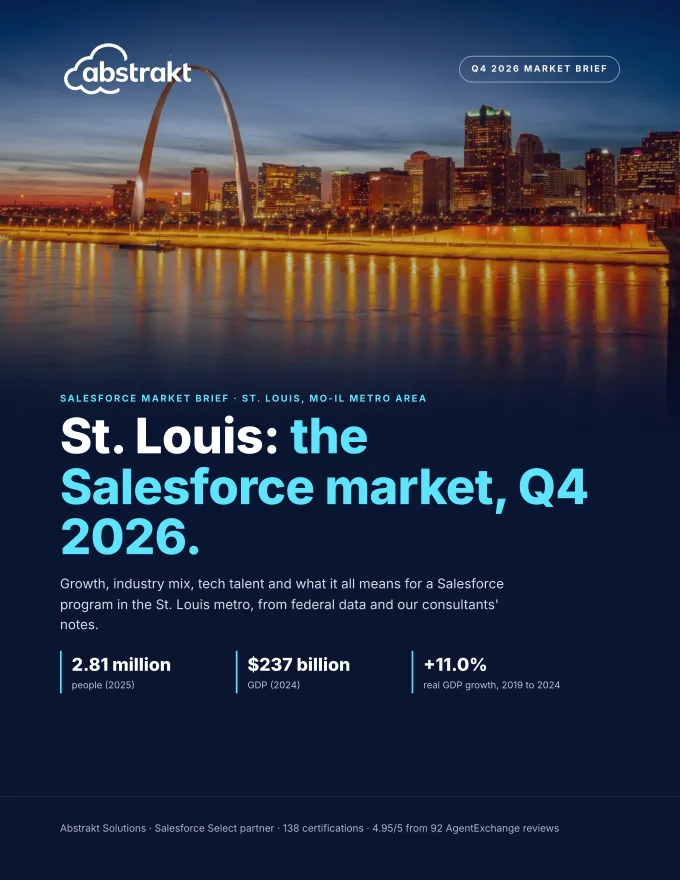
Everything on this page and more in one 24-page download for your planning: St. Louis's growth since 2019 ranked against 100 metros, its industry mix, what related tech roles pay here compared with the U.S., the St. Louis industry and service guides, and how St. Louis compares with nearby metros.
A new edition of the St. Louis brief is posted here each quarter, after the federal data refresh.
Salesforce consulting in St. Louis: questions (11)
Which Salesforce products fit a St. Louis manufacturer or distributor?
Most start with Sales Cloud connected to their ERP, so reps see pricing, orders and inventory beside each account. Manufacturing Cloud contributes sales agreements and account forecasting for buyers that commit to volumes across a contract term. Distributors and dealers can get an Experience Cloud portal for orders and cases, and Field Service suits companies with crews servicing installed equipment. Manufacturing is the region's largest private sector, at about 11.1% of GDP, so ERP integration usually shapes the first phase.
How can an agtech or plant science company in the 39 North district use Salesforce?
Agtech firms often manage several kinds of relationships at once: growers and farm operators, seed or input distributors, research partners and investors. Model each as a distinct account type with its own record page, and track field trials or pilot programs as custom objects linked to the grower and season. Experience Cloud can give distributors a portal for orders and agronomy resources. We usually recommend keeping trial data in your research system and surfacing summaries in Salesforce so commercial teams see results without touching raw datasets.
What Salesforce setup fits a St. Louis wealth management or insurance firm with a large advisor network?
Financial Services Cloud is the usual foundation because it models households, financial accounts and relationship groups out of the box. The harder decisions are about data ownership and access. Decide which records sync from custodial, planning or policy systems, how often, and which advisor or branch can see them. Compliance review of client communications should be designed in from the start. We typically pilot with one region or team, refine the page layouts and automation with real advisors, then roll out across the network.
How much does Salesforce consulting cost in St. Louis?
It depends on scope more than geography. The drivers we see most in St. Louis are the number of systems to integrate, especially ERPs added through acquisitions, the amount of older automation to clean up, and regulated data that adds design and testing time. A fixed-scope health check or discovery phase is the usual way to get a reliable estimate before committing to a full project.
Should a St. Louis company hire a Salesforce administrator or use managed services?
If you need someone on site every day for small changes and user support, hire. If you need release testing, integrations, development and architecture as well, one person rarely covers it, and a managed services team fills those gaps. Many St. Louis companies combine an internal admin with a partner for the specialist work.
Does our Salesforce consultant need to be in our office?
Most of the build happens in your Salesforce org through scheduled working sessions, so daily presence is not required. Because our office is downtown, St. Louis clients can also have the team on site for discovery workshops, go-live support and training.
Can Salesforce connect to the ERP our plant or distribution center runs on?
Usually, yes. The design question is which system owns each piece of data. Typically the ERP keeps orders, pricing and inventory, and Salesforce shows them to sales and service through MuleSoft or direct APIs, so nobody re-keys orders.
Is Agentforce realistic for a mid-sized St. Louis manufacturer?
Yes, if you start with one contained job such as reading inbound quote requests or summarizing warranty cases, keep a person approving the output, and fix product and account data first. A broad assistant on top of messy records is the version that disappoints.
Our Salesforce org is more than ten years old. Should we rebuild it?
Not by default. Start with a health check that inventories automation, unused fields, security and technical debt. Many long-lived orgs only need targeted cleanup and consolidation; a rebuild makes sense when the data model itself no longer fits how the business sells.
How do we rescue a Salesforce project that stalled?
Freeze new scope, find out what users need working now, and stabilize that first. Then document what was built, what was promised and what is missing, and finish in phases. We take over work another partner started regularly; the first step is a short triage.
Is Abstrakt Solutions the same company as Abstrakt Marketing Group?
No. Abstrakt Solutions, formerly Abstrakt Cloud Solutions, is a separate Salesforce consulting, implementation, integration and AI services firm headquartered at 727 N 1st St, Suite 340, in downtown St. Louis. Our founding team first implemented and scaled Salesforce inside Abstrakt Marketing Group, a St. Louis sales and marketing company, and that experience shaped how we consult. Today the two are separate companies, and Abstrakt Marketing Group is one of our clients.
Planning a Salesforce project? Read how Salesforce consulting is priced, the questions to ask a Salesforce consulting partner, or compare partners with our free scorecard.
Salesforce community groups in St. Louis (3)
Salesforce's Trailblazer Community lists these local groups, where admins, developers and Salesforce owners meet to compare notes.
- Salesforce Admin Group, St Louis, United States · last meetup September 11, 2026
- Salesforce Nonprofit User Group, St Louis, United States · last meetup September 25, 2026
- Salesforce Women in Tech Group, St. Louis, United States · last meetup September 24, 2026
Events and meetup dates checked on the official group pages on October 15, 2026.
Working across the Midwest? (3)
The same team works with companies in these nearby metros. All 100 markets →
Kansas City
2.27M people · Professional, scientific, and technical services, at least 10.0% of GDP
Salesforce consulting in Kansas City →Chicago
9.43M people · Manufacturing, 10.9% of GDP
Salesforce consulting in Chicago →Indianapolis
2.21M people · Manufacturing, 17.1% of GDP
Salesforce consulting in Indianapolis →Sources and review (12)
Sources for the figures on this page
- U.S. Census Bureau, Population Estimates Program, Vintage 2025 (cbsa-est2025-alldata), July 1, 2025 estimate (accessed 2026-09-25)
- U.S. Bureau of Economic Analysis, CAGDP2 GDP by county (line 1, All industry total, current dollars), 2024; summed over the CBSA's component counties per Census Vintage 2025 delineation (accessed 2026-09-25; metro total summed from county figures)
- U.S. Census Bureau, County Business Patterns 2023, MSA file (NAICS total '------', ESTAB) (accessed 2026-09-25)
- Greater St. Louis, Inc.
- Greater St. Louis, Inc.
- U.S. Census Bureau, Core Based Statistical Areas delineation files (July 2023), lists 1 and 2
- U.S. Census Bureau, Business Formation Statistics, county-level annual business applications (2019-2025; retrieved 2026-10-20; Sum of component-county applications; growth computed as latest/base - 1. Published only when every component county matches.)
- U.S. Bureau of Economic Analysis, CAGDP9 Real GDP by county, chained 2017 dollars, all industry total (2019-2024; retrieved 2026-10-15; Sum of component-county real GDP; growth computed as latest/base - 1. Published only when every county matches (independent cities and combined areas need manual mapping).)
- U.S. Bureau of Labor Statistics, Quarterly Census of Employment and Wages, annual averages, private ownership (2019 and 2024 annual averages; retrieved 2026-10-15; Employment growth computed as latest/base - 1. Location quotients and pay as published by BLS. Suppressed values stored as null.)
- U.S. Bureau of Labor Statistics, Occupational Employment and Wage Statistics, May 2025 (May 2025; retrieved 2026-10-20; Related occupations only. BLS publishes no Salesforce Administrator occupation; these figures are not Salesforce salaries.)
- U.S. Bureau of Labor Statistics, Employer Costs for Employee Compensation, private industry workers (2026 2nd Quarter; retrieved 2026-10-15; benefitsOnWages = benefits cost per hour / wages and salaries cost per hour (national average, all private industry).)
- Salesforce Trailblazer Community Groups, Official group pages (public, robots.txt-permitted paths only) (verified 2026-10-15)
Last reviewed October 5, 2026. See how St. Louis compares with the other 99 markets in the U.S. Salesforce market report.