
Salesforce consulting for Chicago companies
As a Salesforce Consulting Partner, Abstrakt Solutions works with manufacturers, insurers, distributors and professional services firms throughout the Chicago area. We implement, integrate, optimize and manage Salesforce for organizations across Chicagoland. Chicago is one of our focus markets.
The Chicago business landscape
The Chicago metro is one of the country’s largest and most diversified economies. World Business Chicago names finance and insurance, transportation and logistics, technology, life sciences, manufacturing and professional services as its core industries.
Manufacturing is still the metro’s largest private sector by output, with professional services and finance close behind. The technology ecosystem includes 1871, mHUB, the Discovery Partners Institute and MATTER, and World Business Chicago cites several of the largest cloud and software companies as expanding their Chicago presence. The Illinois Quantum and Microelectronics Park broke ground on the South Side in September 2025.
Figures cover the Chicago-Naperville-Elgin, IL-IN Metro Area (IL–IN).
- Manufacturing10.9%Share of 2024 metro GDP Salesforce for manufacturing →
- Professional, scientific, and technical servicesat least 10.0%Share of 2024 metro GDP Salesforce for professional services →
- Finance and insurance8.6%Share of 2024 metro GDP Financial Services Cloud →
- Wholesale tradeat least 7.9%Share of 2024 metro GDP Integration →
- Health care and social assistanceat least 7.1%Share of 2024 metro GDP
Regional target sectorsFinance and Insurance, Transportation, Distribution, and Logistics, Innovation and Technology, Life Sciences, Manufacturing (incl. Food Manufacturing), Professional ServicesWorld Business Chicago
Where Salesforce fits in Chicago’s economy (4)
The largest private sectors by share of 2024 metro GDP, and what Salesforce work usually looks like in each.
| Sector | Share of 2024 GDP | Where Salesforce fits |
|---|---|---|
| ManufacturingSalesforce for manufacturing → | 10.9% | Chicagoland manufacturers, including food manufacturers, usually run complex dealer and distributor channels. Salesforce projects here tend to center on account planning, quoting from ERP data and service after the sale. |
| Professional, scientific, and technical servicesSalesforce for professional services → | at least 10.0% | Consultancies, agencies and engineering firms need pipeline, resourcing and client reporting in one place, and often move to Salesforce from a lighter CRM as they grow. |
| Finance and insuranceFinancial Services Cloud → | 8.6% | Exchanges, asset managers, insurers and brokers bring strict data and supervision requirements. Financial Services Cloud, compliance-aware marketing and well-designed sharing models are common starting points. |
| Wholesale tradeIntegration → | at least 7.9% | As a national distribution hub, Chicago has many wholesalers whose sales teams depend on ERP order and inventory data. Integration is usually the difference between a CRM reps use and one they ignore. |
Source: U.S. Bureau of Economic Analysis, GDP by county (CAGDP2), 2024, summed to the metro area; private sectors only, excluding real estate and government. “At least” marks sectors where BEA suppresses some county figures.
Chicago by the numbers: the trend, not just the size (3)
Chicago is a large, mature economy whose output and employment have grown slowly since 2019, while new business formation held up comparatively well.
Business applications rose 54.2%, closer to the national 62.2% than the region's slower job and output growth would suggest. New and small firms remain a real source of first Salesforce implementations here.
Census Business Formation Statistics, county data summed to the metro, 2019–2025Real output grew 5.2%, well behind the national 12.8%. Established manufacturers and financial firms in a slow-growth market usually prioritize making existing Salesforce orgs earn their cost.
BEA real GDP by county (CAGDP9), summed to the metro, 2019–2024Private employment is 2.4% lower than in 2019. With fewer people doing the same work, automation and clean handoffs between sales, service and operations matter more than adding licenses.
BLS Quarterly Census of Employment and Wages, 2019 and 2024Leading private sectors in Chicago, 2024: concentration, growth and pay
| Sector | Concentration vs U.S. | Job growth 2019–2024 | U.S. job growth | Average annual pay |
|---|---|---|---|---|
| Manufacturing | 1.09 | -3.8% | -0.3% | $92,481 |
| Finance and insurance | 1.22 | -3.4% | +4.4% | $174,104 |
Finance and insurance (1.22) and manufacturing (1.09) are both more concentrated here than nationally, though each has fewer jobs than in 2019. Both lean on Salesforce for distributor, broker and account relationships tied to ERP and policy systems. BLS withholds several Chicago sector figures, including computer systems design, so they are not shown.
BLS Quarterly Census of Employment and Wages for Chicago, 2019 and 2024 · How these measures work
Across the Chicago metro (22)
We work with companies throughout the metro area as the Census Bureau defines it, which spans 2 states.
Principal cities (9)
- Bolingbrook, IL
- Chicago, IL
- Des Plaines, IL
- Downers Grove, IL
- Elgin, IL
- Evanston, IL
- Naperville, IL
- Schaumburg, IL
- Skokie, IL
Counties (13)
- Cook County, IL
- DuPage County, IL
- Grundy County, IL
- McHenry County, IL
- Will County, IL
- DeKalb County, IL
- Kane County, IL
- Kendall County, IL
- Lake County, IL
- Jasper County, IN
- Lake County, IN
- Newton County, IN
- Porter County, IN
Salesforce in Chicago, service by service (7)
Each service has its own page for Chicago: what the work involves here, the industries it applies to and the questions local teams ask.
Implementation
Channel-aware data models, quoting design and phased go-lives when Chicago manufacturers, insurers and financial firms roll out Salesforce.
See Chicago implementation →Integration
Chicago distributors, manufacturers and insurers get ERP, TMS and agency-system data flowing into Salesforce via MuleSoft or direct APIs.
See Chicago integration →Migration
Chicago migrations to Salesforce from older CRMs, distributor lists and startup tools: data mapping, merged accounts and a well-timed cutover.
See Chicago migration →Managed Services
Ongoing Salesforce administration for Chicago financial, services and logistics firms: backlog delivery, release testing and access control.
See Chicago managed services →Optimization
Tuning Salesforce for Chicago professional services, manufacturing and technology firms: better adoption, cleaner automation and trusted reports.
See Chicago optimization →Health Check
A ranked review of Salesforce access, technical debt and Agentforce readiness, built for Chicago financial, life-sciences and manufacturing firms.
See Chicago health check →Implementation Rescue
Chicago manufacturers, logistics firms and insurers with stalled Salesforce projects: triage, stabilization, completion and a clean relaunch.
See Chicago implementation rescue →Salesforce products we implement for Chicago teams
Practical AI for Chicago plants, firms and insurers
BEA figures show manufacturing at about 10.9% of Chicago's metro GDP in 2024 and finance and insurance at 8.6%. Those two sectors, plus a deep bench of professional services firms, generate large volumes of repetitive written work. On the factory side, an agent can summarize warranty and quality cases so engineers spot the pattern before reading every note. Insurers and lenders can let it draft replies to policy or account questions, with a licensed person approving each one. Consulting and legal practices tend to value lead triage that scores inbound inquiries against past engagements. None of this works on messy account records or loose sharing rules, so we fix data quality and permission sets before switching any agent on.
- Warranty and quality case summaries
- Reviewed replies to policy questions
- Scoring inbound professional-services inquiries
Salesforce for Chicago’s leading industries (4)
Manufacturing
Salesforce for Chicago-area manufacturers, including food producers: distributor and dealer portals, ERP-backed quoting and rebate tracking.
See Salesforce for manufacturing in Chicago →Professional Services
Salesforce for Chicago consulting, accounting, engineering and legal firms: industry practice pipelines, cross-selling and utilization reporting.
See Salesforce for professional services in Chicago →Insurance
Salesforce for Chicago insurers, brokers and MGAs: commercial renewals, submission intake and producer oversight across Illinois and Indiana.
See Salesforce for insurance in Chicago →Private Equity
Salesforce for Chicago private equity sponsors and portfolio companies: standard pipeline definitions, add-on consolidation and portfolio reporting.
See Salesforce for private equity in Chicago →Common Salesforce challenges in these industries (3)
- 01
Several systems, one customer
Diversified companies often run separate CRMs or instances by business unit. Consolidating them, or connecting them cleanly, is a frequent reason Chicago-area firms bring in a partner.
- 02
Supervision and audit in financial services
Firms in regulated finance need record access, communications and marketing workflows that stand up to compliance review.
- 03
Channel sales visibility
Manufacturers and distributors selling through partners often lack a shared view of pipeline and service. Partner portals and clean account hierarchies address that.
What Salesforce should look like for Chicago companies (2)
Starting points for the industries that lead this market, not templates. Every org differs; these show the systems and the order they usually connect in.
A Chicagoland manufacturer with a dealer and distributor channel
- ERP: orders, pricing, inventory
- MuleSoft or direct APIs
- Sales Cloud with account plans by dealer
- Revenue Cloud or standard quotes, depending on pricing complexity
- Experience Cloud dealer portal
- Service Cloud for warranty and quality cases
- Agentforce warranty and quality summaries
Food and industrial manufacturers here often price by customer, region and volume. That pricing logic decides whether you need Revenue Cloud or whether standard quotes pulling ERP prices are enough; settle it before buying licenses.
A Chicago consulting, legal or engineering firm
- Sales Cloud: pursuits, relationships across offices
- PSA or project system for resourcing and time
- Finance system for billing
- Gong for pursuit calls
- Tableau or CRM Analytics for client and practice reporting
- Agentforce lead triage against past engagements
The handoff from won pursuit to staffed project is where these firms lose information. Connect Salesforce to the project system so the engagement inherits scope, contacts and pricing.
How Chicago revenue teams connect Salesforce to the rest of the stack (4)
Chicago's mix of manufacturers, distributors, insurers and consultancies means many stacks combine an ERP-heavy operations side with a modern sales toolset. RevOps work here is mostly about connecting the two so sales, service and finance read the same numbers.
- 1
Marketing → Sales
Campaign and inbound leads routed by territory or dealer, with Account Engagement or HubSpot synced to Salesforce where marketing already runs there.
- 2
Sales → Operations
Quotes and orders pass to the ERP or TMS through MuleSoft, with status flowing back so reps can answer customers.
- 3
Service → Engineering
Warranty and quality cases grouped by product so engineers see patterns, not single tickets.
- 4
All teams → Leadership
Gong conversation data and Snowflake or Tableau reporting built on shared account and product definitions.
Our work in these industries (3)
Client names are anonymized and these projects are not specific to Chicago.
Salesforce guides from our team (3)
Written by the consultants delivering the work.

Salesforce mobile app for field sales: setup that reps will use
How to set up the Salesforce mobile app so outside reps log visits and deals: phone pages, compact layouts, quick actions, sync, offline, maps, security, piloting and adoption.
Salesforce Manufacturing Cloud: when it fits and how to implement it
What Manufacturing Cloud adds over Sales Cloud, when Sales Cloud is enough, and how to implement it: run-rate modeling, sales agreements, forecasting, ERP integration, partner portals and phase-one scope.
Industry GuidesSalesforce for wholesale distributors: accounts, pricing and ERP data
How wholesale and industrial distributors set up Salesforce for ship-to hierarchies, inside and outside sales, ERP pricing, order history, reorder signals, rebates, portals and returns.
Industry guides for Chicago companies (3)
Cost, staffing and partner choice in Chicago (3)
What drives the cost
Chicago cost drivers usually come from the operations side: how many ERP, TMS or agency-management systems Salesforce must talk to, whether pricing needs Revenue Cloud, and how many dealers or brokers need portal access. Professional services firms spend more on the PSA and finance handoff than on the CRM itself.
How Salesforce consulting is priced →Hire, outsource or both
Large Chicago companies often have internal Salesforce teams and need a partner for architecture, integration or a specific rollout. Mid-sized firms more often outsource administration entirely until volume justifies a hire.
Managed services vs. an in-house admin →Choosing a partner
Ask for references with ERP and dealer-channel integration, insurance or financial services data models if relevant, and evidence of quoting design. Ask how the partner hands documentation and ownership to your team.
Compare partners with the free scorecard →What Salesforce-related talent costs in Chicago (5)
Federal wage data does not separate Salesforce roles, so here are the related occupations the Bureau of Labor Statistics measures in the Chicago metro, against the national averages.
Annual wages for related occupations, Chicago and United States, May 2025
| Occupation (SOC code) | Chicago mean | Chicago median | U.S. mean | Chicago jobs |
|---|---|---|---|---|
| Computer systems analysts(15-1211) | $107,270 | $103,490 | $114,610 | 14,660 |
| Network and computer systems administrators(15-1244) | $108,870 | $103,170 | $103,680 | 6,950 |
| Database administrators(15-1242) | $111,210 | $109,680 | $110,090 | 1,870 |
| Software developers(15-1252) | $141,640 | $134,380 | $148,100 | 40,370 |
| Computer and information systems managers(11-3021) | $184,810 | $173,760 | $192,160 | 24,950 |
BLS Occupational Employment and Wage Statistics, May 2025: Chicago metro and U.S. estimates · About these figures
Chicago is close to the national averages: network and systems administrators earn a little more, while systems analysts, developers and IT managers earn somewhat less. Budgets here can use national benchmarks with only small adjustments.
Planner: in-house admin or outside support?
Compare the yearly cost of employing Salesforce staff in Chicago with a quote you have for outside support · How the planner works
In-house cost per year:$155,575
Enter an outside quote to compare.
Managed services vs an in-house admin → · Managed services in Chicago →
The Chicago Salesforce market brief, Q4 2026.
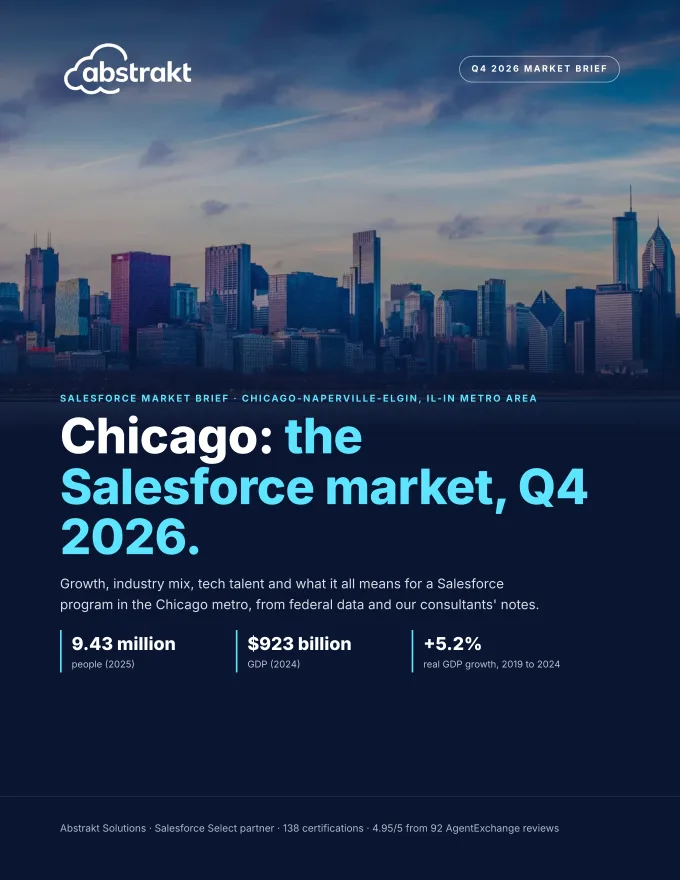
Everything on this page and more in one 23-page download for your planning: Chicago's growth since 2019 ranked against 100 metros, its industry mix, what related tech roles pay here compared with the U.S., the Chicago industry and service guides, and how Chicago compares with nearby metros.
A new edition of the Chicago brief is posted here each quarter, after the federal data refresh.
Salesforce consulting in Chicago: questions (10)
We are a commercial insurance broker in Chicago. How should Salesforce handle renewals and placements?
Brokerage revenue depends on renewals, so build the pipeline around expiration dates. Generate renewal opportunities automatically months before expiry, track each placement with the carriers approached, quotes received and binding status, and hold coverage lines on a related object. Financial Services Cloud insurance objects help, though many brokers integrate their agency management system rather than replace it. Account teams then see every line for a client in one view.
Chicago-area manufacturers often sell through distributors and independent reps. How can Salesforce give us channel visibility?
Partner Relationship Management on Experience Cloud gives distributors and reps a portal for deal registration, leads and shared forecasts. Deal registration prevents channel conflict when two partners chase the same account, and point-of-sale data loaded from distributors shows what actually sold through. Pair that with Manufacturing Cloud sales agreements if key accounts buy against annual volume commitments. Launch with your top partners first, then expand once the process holds.
How can a Chicago trading-technology or market-data firm manage subscriptions and entitlements in Salesforce?
Market data and trading technology are usually sold as subscriptions with user-level entitlements, exchange fees and frequent add-ons. Revenue Cloud or CPQ handles subscription quoting, co-terming and amendments, and a billing integration keeps invoices aligned with contracts. Track licensed users or entitlements on assets so support can verify access quickly. Buyers' compliance teams often expect audit trails, so enable Shield Field Audit Trail or field history tracking on contract data.
What does Salesforce consulting cost for a Chicago manufacturer?
Scope drives it: the number of systems to integrate, whether complex pricing needs Revenue Cloud, and how many dealers or distributors need a portal. Proposals that skip those questions are guessing. A paid discovery phase usually produces a firm estimate and a phased plan.
Do we need Revenue Cloud, or are standard Salesforce quotes enough?
Standard quotes work when prices come from the ERP or a price book and approvals are simple. Revenue Cloud earns its cost when you have configurable products, layered discounts, bundles or usage-based billing. Map your real pricing rules before deciding.
Does a Salesforce consultant need to be in our office?
No. The work happens in your Salesforce org through scheduled working sessions with your team, so day-to-day presence in your office isn't needed.
How should a Chicago distributor connect Salesforce to its ERP and TMS?
Show reps the order, inventory and shipment status they need without leaving Salesforce, and keep the ERP and TMS as systems of record. MuleSoft suits several systems and reuse; direct APIs can be enough for one ERP with a few flows.
How should a Chicago consulting or legal firm structure Salesforce?
Track pursuits and client relationships across offices in Sales Cloud, then hand won work to your project or PSA system with scope and contacts attached. Practice-level reporting should come from one account and matter definition shared across systems.
Should we use managed services or build an internal Salesforce team?
Build internally when Salesforce is core to daily operations and you can keep specialists busy. Use managed services when you need breadth, such as admin, developer and architect skills, without hiring each role. Many Chicago firms do both: internal ownership, partner capacity.
Where should a Chicago insurer start with AI in Salesforce?
With drafting and summarization that a licensed person reviews, such as replies to policy questions or summaries of a claim's history. Fix sharing rules and data quality first, since an agent reads whatever the user can.
Planning a Salesforce project? Read how Salesforce consulting is priced, the questions to ask a Salesforce consulting partner, or compare partners with our free scorecard.
Salesforce community groups in Chicago (6)
Salesforce's Trailblazer Community lists these local groups, where admins, developers and Salesforce owners meet to compare notes.
- Salesforce Admin Group, Chicago, United States · last meetup August 5, 2026
- Salesforce Admin Group, Downers Grove, United States · last meetup August 13, 2026
- Salesforce Architect Group, Chicago, United States · last meetup September 25, 2026
- Salesforce Marketer Group, Chicago, United States · last meetup June 25, 2026
- Salesforce Nonprofit User Group, Chicago, United States · last meetup September 1, 2026
- Salesforce Women in Tech Group, Chicago, United States · last meetup August 5, 2026
Events and meetup dates checked on the official group pages on October 15, 2026.
Working across the Midwest? (3)
The same team works with companies in these nearby metros. All 100 markets →
Sources and review (13)
Sources for the figures on this page
- U.S. Census Bureau, Population Estimates Program, Vintage 2025 (cbsa-est2025-alldata), July 1, 2025 estimate (accessed 2026-09-25)
- U.S. Bureau of Economic Analysis, CAGDP2 GDP by county (line 1, All industry total, current dollars), 2024; summed over the CBSA's component counties per Census Vintage 2025 delineation (accessed 2026-09-25; metro total summed from county figures)
- U.S. Census Bureau, County Business Patterns 2023, MSA file (NAICS total '------', ESTAB) (accessed 2026-09-25)
- World Business Chicago
- World Business Chicago - Innovation & Technology
- IQMP
- U.S. Census Bureau, Core Based Statistical Areas delineation files (July 2023), lists 1 and 2
- U.S. Census Bureau, Business Formation Statistics, county-level annual business applications (2019-2025; retrieved 2026-10-20; Sum of component-county applications; growth computed as latest/base - 1. Published only when every component county matches.)
- U.S. Bureau of Economic Analysis, CAGDP9 Real GDP by county, chained 2017 dollars, all industry total (2019-2024; retrieved 2026-10-15; Sum of component-county real GDP; growth computed as latest/base - 1. Published only when every county matches (independent cities and combined areas need manual mapping).)
- U.S. Bureau of Labor Statistics, Quarterly Census of Employment and Wages, annual averages, private ownership (2019 and 2024 annual averages; retrieved 2026-10-15; Employment growth computed as latest/base - 1. Location quotients and pay as published by BLS. Suppressed values stored as null.)
- U.S. Bureau of Labor Statistics, Occupational Employment and Wage Statistics, May 2025 (May 2025; retrieved 2026-10-20; Related occupations only. BLS publishes no Salesforce Administrator occupation; these figures are not Salesforce salaries.)
- U.S. Bureau of Labor Statistics, Employer Costs for Employee Compensation, private industry workers (2026 2nd Quarter; retrieved 2026-10-15; benefitsOnWages = benefits cost per hour / wages and salaries cost per hour (national average, all private industry).)
- Salesforce Trailblazer Community Groups, Official group pages (public, robots.txt-permitted paths only) (verified 2026-10-15)
Last reviewed October 5, 2026. See how Chicago compares with the other 99 markets in the U.S. Salesforce market report.