Salesforce Integration · Oklahoma City

Salesforce integration consulting in Oklahoma City.

Integration work for Oklahoma City organizations that need Salesforce reading from and writing to the land, accounting, clinical and dispatch systems already running the business.

4.95/5 from 92 AgentExchange reviews Salesforce Select partner since 2017 138 certifications, client case studies

Salesforce Integration for Oklahoma City companies

Most Salesforce integration work in Oklahoma City connects the CRM to systems that arrived first: land and revenue accounting for producers, electronic health records for providers, transportation and warehouse platforms for logistics firms. We map which system owns each field, choose between native connectors, direct APIs and MuleSoft based on volume and system count, then build with error logging and retry handling. The aim is that nobody re-keys data, and when a sync fails, a named owner knows before a customer does.

Local industries

How integration plays out in Oklahoma City.

Energy

The Greater Oklahoma City Chamber lists energy among its target sectors. An energy integration usually brings ownership, well and payment summaries from land and revenue systems into Salesforce as read-only data, so owner relations staff answer questions without opening three applications. Sensitive payment detail stays in the source system, and agents see only what they need. Field data can flow the other way, with work orders created in Salesforce and their costs posted back to the accounting platform.
Logistics

Logistics is another GreaterOKC target sector, and carriers, brokers and warehouses here run daily operations on transportation management and warehouse systems. Integrating those with Salesforce gives sales and customer service a view of shipments, exceptions and billing disputes on the account record. We usually push status events into Salesforce as they occur and pull only summaries of older history, which keeps API consumption predictable and storage from ballooning as shipment volumes grow.

Health care and social assistance

Providers in the metro rarely want clinical data duplicated into a CRM. The pattern that works is narrow: referral and scheduling events flow into Salesforce to drive intake and outreach, while charts stay in the electronic health record. We document every field that crosses that boundary for the privacy officer, get the mapping signed off before build begins and confirm the business associate agreement with Salesforce covers the data involved.

Integration for Health & Life Sciences →
Plan for it

What to plan for in Oklahoma City.

01

Choose middleware by system count

Connecting Salesforce to one accounting platform may need nothing more than a native connector or a well-built API integration. Once three or four systems share customer data, MuleSoft or a similar layer earns its keep by holding mappings, monitoring and error handling in one place instead of scattered scripts.

02

Build alerts for silent failures

Most integration failures make no noise; a rotated password, a retired API version or a renamed field simply stops records from arriving. Send alerts to a named owner and keep a queue of failed records that can be reprocessed, so operations staff are not the first to notice that yesterday's data never arrived.

03

Respect source-system upgrade calendars

Land, clinical and ERP platforms are often maintained by separate teams or vendors on their own upgrade schedules. Coordinate integration testing with those calendars early, because an upgrade on the other side can change payloads without warning and hold up a planned Salesforce release.

Free 21-page PDF

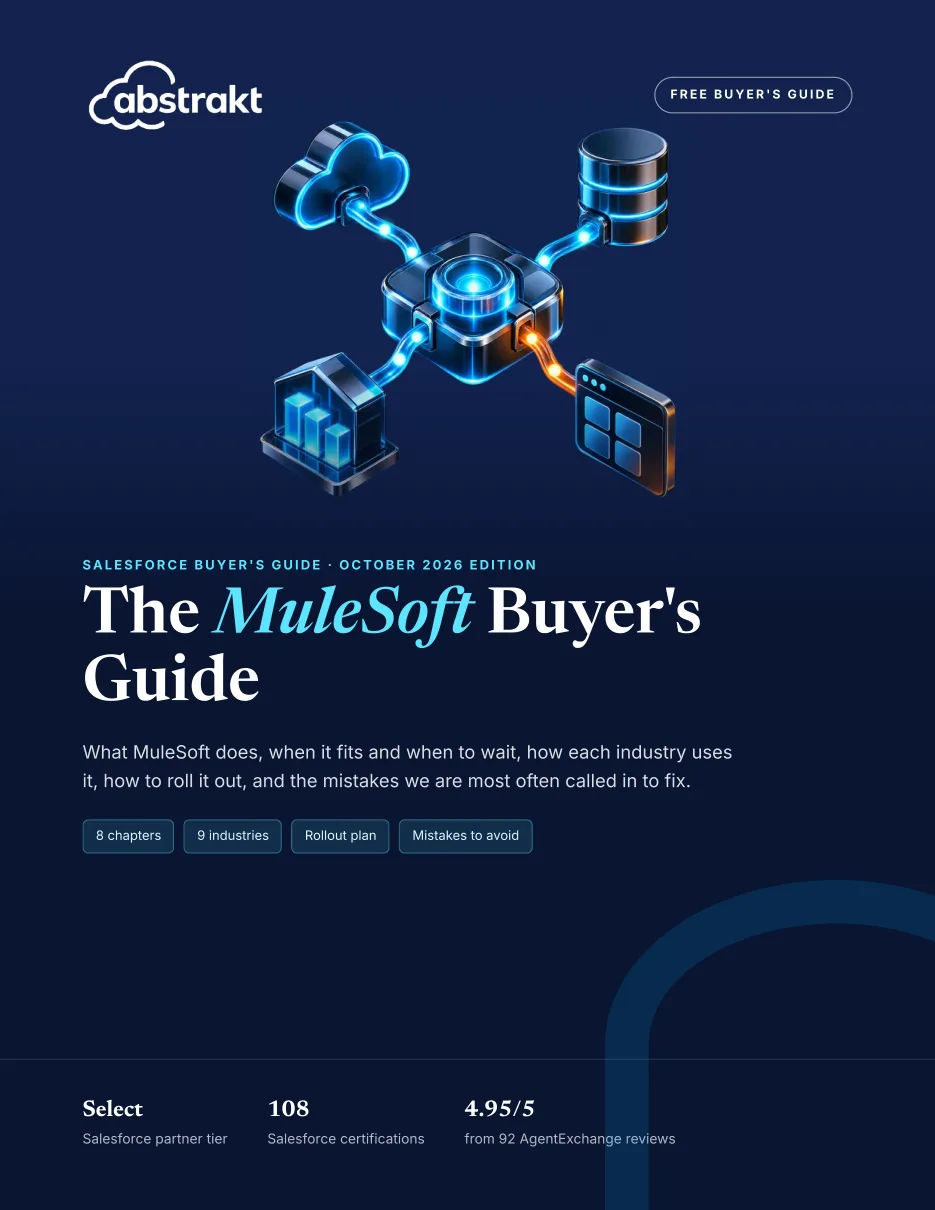
The MuleSoft Buyer's Guide

Connecting Salesforce to other systems at a Oklahoma City company?What MuleSoft does, when it fits and when to wait, the rollout plan and the mistakes to avoid, free for Oklahoma City teams like yours.

Get the guide →
Also freeOklahoma City's Salesforce market brief22 pages on Oklahoma City's growth, industry mix and tech talent costs, for planning integration work.
Scope

What our integration covers.

  • Integration design
  • ERP integration
  • Middleware
  • Marketing and support tools
  • Monitoring

How our salesforce integration works →

Salesforce products

FAQ

Integration in Oklahoma City: questions.

Is MuleSoft required to link Salesforce with our accounting platform?

Not always. A single ERP connection with moderate volume can run on a native connector or custom APIs. The case for MuleSoft grows with the number of connected systems, with plans to reuse APIs on later projects, and with strict monitoring requirements. We compare options against your actual system list and volumes, and we will say plainly if a lighter approach is enough.

Can Salesforce show royalty owners' payment history without storing it?

Yes. External objects or on-demand lookups can display statement and payment data from your revenue system inside Salesforce when an agent opens the owner's record, without copying it permanently. That preserves a single source of truth and limits what sits in the CRM. The trade-off is that reports cannot aggregate that data, so we decide together which summaries are worth storing.

After launch, who owns monitoring and fixes for each interface?

You decide. We hand over documentation, monitoring dashboards and runbooks so your IT team can own them, or we support them within a managed services engagement. Either way, alerts reach a named person, and failed transactions land in a queue that can be reviewed and resubmitted rather than disappearing into a log that nobody reads.

Planning integration in Oklahoma City? Let’s talk it through.

Tech Talk · monthly newsletter

Valuable insights on technology, CRM and AI, once a month.

Written by the consultants who do the work. One email a month, and you can unsubscribe anytime.

We never share your email. See past issues →

Call (314) 916-4095 Book a consultation
Call (314) 916-4095 Book a call