What Claude is, and who this guide is for
Before you download
Claude, powered by Anthropic, is a family of AI models that Salesforce teams use in several ways: as an assistant connected to org data through Salesforce hosted MCP servers, inside custom applications through the API, as a reasoning model within Agentforce where an org supports it, and as a coding assistant through Claude Code. Each path carries different security and ownership implications.
This guide combines seven kinds of Claude work, from CRM integration and AI readiness assessments to compliance automation, advisor productivity, ongoing support and data governance. It is written for business and technology leaders who want to know what is realistic, what must be true about their data and permissions first, and how to keep people in control of anything Claude writes.
Get the free Claude guide
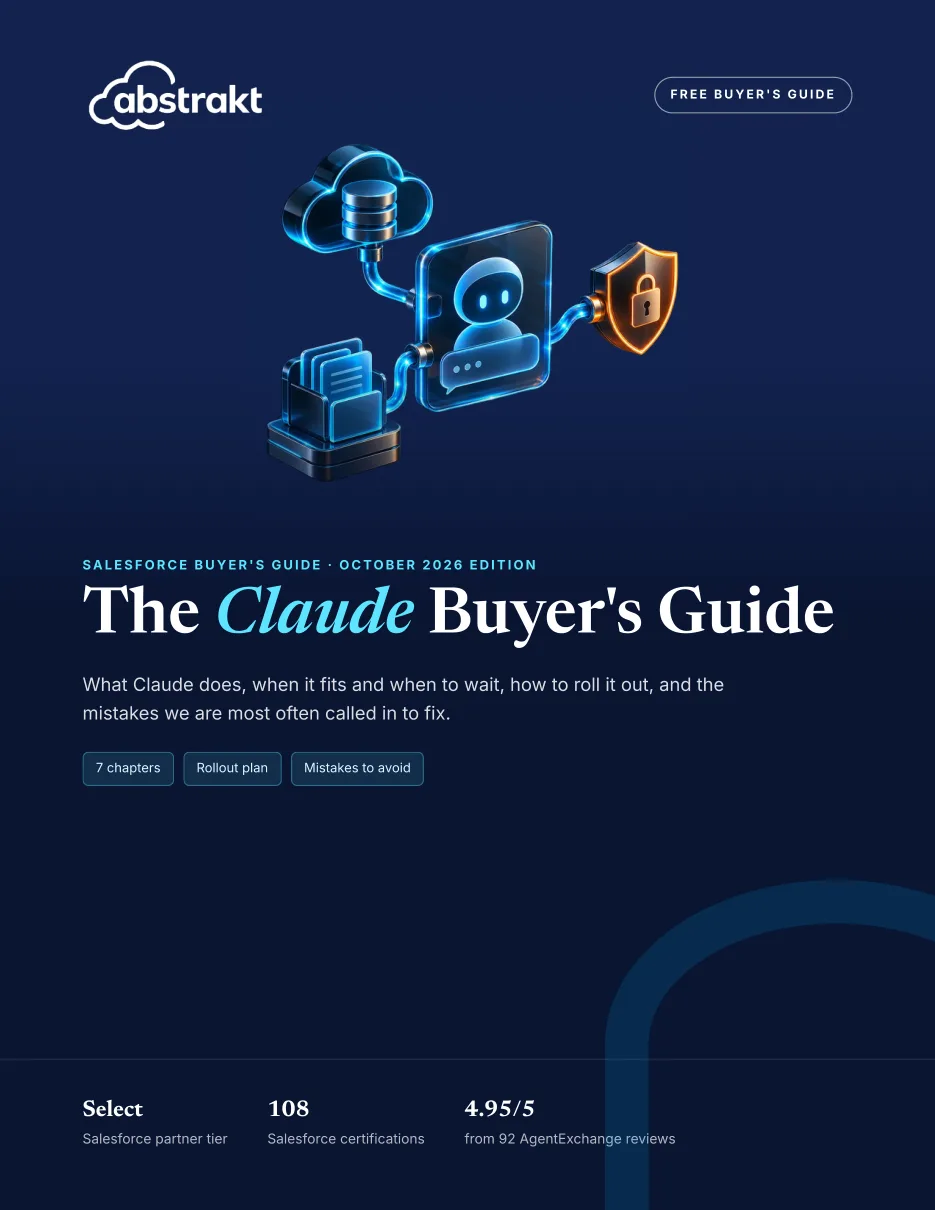
- 35 pages
- 7 chapters
- Free PDF
What's inside the Claude guide (7)
- 01
What Claude work covers
Claude, Claude + CRM Integration, AI Maturity Assessment, Compliance Workflow Automation, Advisor Productivity Enhancement, Ongoing Support & Optimization and Data Quality and Governance.
- 02
When Claude fits, and when to wait
35 signs Claude fits and 28 reasons to wait or choose something else.
- 03
How to roll it out
A rollout plan for each of the 7 kinds of Claude work.
- 04
Mistakes to avoid
34 mistakes, from “Connecting with an over-privileged user” to “Ignoring instructions hidden in record text”.
- 05
Questions buyers ask
45 questions, starting with “Should we use Agentforce, Claude or both?”
- 06
Results from our projects
2 Claude projects, summarized.
- 07
Next steps
Free assessments and how to reach a Claude consultant.
Worksheets you keep (4)
Fit scorecard
63 statements to tick, showing whether Claude fits your team now or later.
Decisions worksheet
4 Claude decisions with room for your answer and an owner.
Partner interview scorecard
5 questions to rate up to three Claude partners side by side.
30-day plan
Four weeks from reading the Claude guide to a written scope.
When Claude fits, and when to wait (7)
Good signs
- People want to ask questions across Salesforce records and other tools in one conversation, within their own permissions.
- Emails, contracts, transcripts or case notes need to be summarized or turned into structured fields.
- Developers want an agentic coding assistant for Apex, Lightning web components and tests inside source control.
- Several teams are proposing AI tools and leadership needs one prioritized plan.
Reasons to wait
- The requirement is fixed-rule automation such as assignment or approvals, which Flow handles cheaply and auditably.
- Salesforce data is full of duplicates and stale owners, so any model would answer confidently from bad records.
- No one can own prompts, evaluation sets and monitoring after launch.
The Claude rollout plan, in brief (5)
- 01
Choose tasks and draw the data boundary
Pick two or three tasks, such as account briefs or case summaries, list the exact objects and fields each needs, and classify that data with your security team before any connection is made.
- 02
Match the connection path to the job
Hosted MCP servers suit assistants working as the signed-in user, the API with tool use suits custom applications, and Agentforce suits agents inside Salesforce. Scope the access for each path separately.
- 03
Begin read-only with an evaluation set
Collect real questions and records with expected answers, score accuracy and appropriate refusals, and rerun the set after every prompt, model or permission change.
- 04
Add writes behind approval
Introduce one write action at a time, have a person approve each change, validate values against picklists in code, and log the prompt, tool call, approver and record ID.
- 05
Monitor before expanding
Review a sample of conversations and writes each week, retire unused prompts and widen access only when evidence shows the current scope behaves reliably.
Claude mistakes we are called in to fix (3)
Connecting through an administrator account
A single misread instruction could then update hundreds of records. Use per-user OAuth or a narrowly scoped integration user that holds only what each approved task requires.
Trusting text inside records
Emails, web-to-case submissions and chat transcripts are written by outsiders and can contain text meant to redirect an assistant. Treat record content as untrusted and keep writes behind approval.
Letting AI output become the official record
Summaries and classifications written straight into live fields spread errors into reports and customer messages. Keep them in labeled draft fields until a person confirms them.
Decisions to make early (4)
| Agentforce, Claude or both | Agentforce fits agents inside Salesforce channels with their own subagents and the Einstein Trust Layer. Claude on its own fits cross-tool assistants, document-heavy work and custom apps, and many organizations combine the two. |
|---|---|
| Per-user or integration-user access | Hosted MCP servers authenticate as the signed-in user, so sharing and field-level security apply. A single integration user sees whatever it can see, which may be far more than the person asking. |
| Which steps always need a person | In compliance workflows, Claude prepares and flags while people approve wherever regulators expect judgment. Write down which steps can be sampled and which can never be automated. |
| How quality is governed after launch | Weekly sampling, a fixed test set and deliberate evaluation of model updates keep answers from drifting. Decide who owns that cycle before the first use goes live. |
Questions to ask a Claude partner (5)
- Which connection path would you use for each of our tasks, and why?
- How will Claude’s access be limited to what each user may already see?
- What will our evaluation set contain, and who maintains it?
- Which write actions will require approval, and how will they be logged?
- How will you test for instructions hidden in emails or case text?
Claude buyer questions (5)
Will our Salesforce data be used to train Claude models?
Anthropic’s commercial terms say it may not train models on customer content from its commercial services, which include the API and business plans. Personal consumer accounts are governed by different terms, so customer data should never be pasted into them. Confirm the current policy with Anthropic and your cloud provider.
Can Claude see records a user cannot?
Not when it connects as the signed-in user through Salesforce hosted MCP servers, because sharing and field-level security apply just as they do in Salesforce. A custom integration running as one integration user is different, which is why we prefer per-user authentication for employee assistants.
Can Claude run inside Agentforce?
Salesforce and Anthropic announced in 2026 that Claude models are available to Agentforce through Amazon Bedrock inside the Salesforce trust boundary, with Einstein Trust Layer controls applied. Check availability for your org and edition with Salesforce before planning around it.
Do we need perfect data before using Claude?
No. Each use needs data good enough for that particular job, measured against a standard that fits it. A meeting brief and a regulatory report need different levels of confidence, so some uses can start while data for others improves.
What is your relationship with Anthropic?
Abstrakt Solutions is Certified in the Claude Partner Network. Our work centers on the Salesforce side: connection paths, permissions, evaluation sets, approval steps and where Agentforce or Claude belongs. Model availability and contract terms remain Anthropic’s and Salesforce’s to confirm.
Who wrote it
Abstrakt Solutions is Certified in the Claude Partner Network with 12 Claude certifications on the team, and a Salesforce partner since 2017 that connects Claude, powered by Anthropic, to the systems companies already run.
 Salesforce Sales Cloud
 Salesforce Service Cloud
 Salesforce Field Service
 Salesforce Marketing Cloud
 Salesforce Revenue Cloud / CPQ
 Salesforce Experience Cloud
 Salesforce Agentforce
 Data 360
 Tableau
 MuleSoft
 Gong