
Salesforce consulting for Omaha companies
Abstrakt Solutions, a Salesforce Consulting Partner, supports insurers, lenders, health systems and builders in Omaha, Papillion and the rest of Douglas and Sarpy counties, plus Pottawattamie and Mills counties on the Iowa side of the Missouri River. Omaha is one of our focus markets.
The Omaha business landscape
Finance and insurance dominates Omaha’s private economy in BEA figures, far ahead of health care in second place and manufacturing in third. The Greater Omaha Chamber, whose Select Greater Omaha site promotes an eight-county area spanning Nebraska and Iowa, describes a corporate base weighted toward finance and insurance, transportation, and engineering and construction.
The chamber’s target industries lean hard toward money and data: finance and fintech, insurance and insurtech, AI and software development, medical and health technology, and warehouse, distribution and logistics. Its defense and cybersecurity sector is anchored by a major Air Force base and a national military command headquartered there. According to the chamber, local depth in data science, software engineering and computer engineering grew out of decades of enterprise demand from insurers, financial firms and logistics companies. A nonprofit data center and incubator offers GPU computing, and the Omaha Data Science Academy trains people to build production AI systems.
Figures cover the Omaha, NE-IA Metro Area (NE–IA).
- Finance and insurance17.5%Share of 2024 metro GDP Salesforce for insurance →
- Health care and social assistanceat least 7.5%Share of 2024 metro GDP Salesforce for health & life sciences →
- Manufacturing6.8%Share of 2024 metro GDP Salesforce for manufacturing →
- Retail trade5.6%Share of 2024 metro GDP
- Construction5.4%Share of 2024 metro GDP Salesforce for construction →
Regional target sectorsFinance & Fintech, Insurance & Insurtech, Artificial Intelligence / Software Development & Technology, Military Defense & Cybersecurity, Logistics (Warehouse, Distribution & Logistics), Medical & Healthcare TechGreater Omaha Chamber / Select Greater Omaha
Where Salesforce fits in Omaha’s economy (4)
The largest private sectors by share of 2024 metro GDP, and what Salesforce work usually looks like in each.
| Sector | Share of 2024 GDP | Where Salesforce fits |
|---|---|---|
| Finance and insuranceSalesforce for insurance → | 17.5% | Money is Omaha's specialty: banks, carriers and payment processors add up to 17.5% of 2024 metro output, and the chamber actively recruits fintech and insurtech firms. Firms in this sector need agent and advisor views of each household or business, service consoles for account and policy questions, and strict limits on who can see financial data. |
| Health care and social assistanceSalesforce for health & life sciences → | at least 7.5% | Health care and social assistance is Omaha's second-largest private sector, at no less than 7.5% of 2024 GDP, and the chamber also courts medical and health technology companies. Providers and health-tech vendors alike need referral, patient outreach and account records that keep protected information private. |
| ManufacturingSalesforce for manufacturing → | 6.8% | Advanced manufacturing and agricultural innovation both appear on Greater Omaha’s target list, and producers in each group tend to sell through dealers and distributors. Tying Salesforce to ERP lets reps see orders, shipments and open issues before they call a customer. |
| ConstructionSalesforce for construction → | 5.4% | Contractors account for 5.4% of Omaha's 2024 output, and the chamber's logistics and defense targets keep new facility and expansion work coming. General contractors and specialty subcontractors use Salesforce to follow a job from bid and estimate through crew scheduling and closeout. |
Source: U.S. Bureau of Economic Analysis, GDP by county (CAGDP2), 2024, summed to the metro area; private sectors only, excluding real estate and government. “At least” marks sectors where BEA suppresses some county figures.
Omaha by the numbers: the trend, not just the size (3)
Omaha's output has grown faster than the nation's since 2019 even as employment rose only slightly, led by finance, insurance and construction.
Business applications rose 54.1%, below the 62.2% national rate. Large insurers and financial firms account for much of the Salesforce demand.
Census Business Formation Statistics, county data summed to the metro, 2019–2025Real GDP increased 18.4%, well above the national 12.8%. Output growth with modest hiring points to Salesforce work centered on productivity and automation.
BEA real GDP by county (CAGDP9), summed to the metro, 2019–2024Private employment rose 1.6%, about a third of the U.S. rate. Automation and self-service carry most Salesforce cases.
BLS Quarterly Census of Employment and Wages, 2019 and 2024Leading private sectors in Omaha, 2024: concentration, growth and pay
| Sector | Concentration vs U.S. | Job growth 2019–2024 | U.S. job growth | Average annual pay |
|---|---|---|---|---|
| Finance and insurance | 1.38 | -20.4% | +4.4% | $108,091 |
| Manufacturing | 0.89 | +6.6% | -0.3% | $67,252 |
| Retail trade | 1.05 | -2.1% | -0.8% | $38,616 |
| Construction | 1.26 | +8.2% | +9.2% | $73,261 |
| Computer systems design and related services | 0.79 | +11.1% | $117,523 |
Finance and insurance is 1.38 times the national concentration even after a 20.4% employment drop, and construction (1.26) grew 8.2%. Insurers and financial services firms are the anchor Salesforce buyers. Computer systems design is 0.79 times the national concentration.
BLS Quarterly Census of Employment and Wages for Omaha, 2019 and 2024 · How these measures work
Across the Omaha metro (9)
We work with companies throughout the metro area as the Census Bureau defines it, which spans 2 states.
Principal cities (1)
- Omaha, NE
Counties (8)
- Harrison County, IA
- Mills County, IA
- Pottawattamie County, IA
- Cass County, NE
- Douglas County, NE
- Sarpy County, NE
- Saunders County, NE
- Washington County, NE
Salesforce in Omaha, service by service (7)
Each service has its own page for Omaha: what the work involves here, the industries it applies to and the questions local teams ask.
Integration
Omaha carriers, banks, payment processors and shippers: Salesforce tied to the platforms holding policies, balances and freight, with monitoring.
See Omaha integration →Implementation
Omaha carriers, lenders, payments firms and shippers: a Salesforce build where field access, record ownership and release order are settled up front.
See Omaha implementation →Optimization
Salesforce optimization for Omaha financial, retail and logistics companies: less clutter, streamlined automation and reports leadership can rely on.
See Omaha optimization →Managed Services
Monthly Salesforce administration, release management and backlog delivery for Omaha insurers, lenders, builders and logistics firms.
See Omaha managed services →Health Check
Omaha banks, carriers, health and defense firms: an outside audit of Salesforce permissions, integrations, portals and data ahead of exams or AI.
See Omaha health check →Migration
From agency systems, loan tools and rep spreadsheets to Salesforce: Omaha migrations that keep consent flags intact and rehearse every cutover.
See Omaha migration →Implementation Rescue
Rescue for Omaha Salesforce projects that stalled or went live unusable: independent triage, a realistic recovery plan and a stable, adopted org.
See Omaha implementation rescue →Salesforce products we implement for Omaha teams
How Omaha insurers and lenders can put AI to work
Finance and insurance generated 17.5% of Omaha metro GDP in 2024, a larger share than any other private sector there. Insurance carriers, lenders and payment processors are well placed for three AI tasks: reading submitted documents, summarizing policyholder or borrower cases, and drafting correspondence for an adjuster or officer to approve. Health care, at least 7.5% of output, can apply similar summaries to patient access and billing questions under stricter controls. Manufacturers, 6.8%, may focus on dealer lead triage. The work that matters most happens before the pilot: reconciling customer records across policy systems, tagging sensitive fields, and writing the knowledge articles the agent will cite.
- Reading submitted policy and loan documents
- Adjuster-approved correspondence drafts
- Dealer lead triage for manufacturers
Salesforce for Omaha’s leading industries (4)
Insurance
Salesforce for Omaha-area insurers and insurtechs: agent onboarding, claims service visibility and analytics-ready customer data for in-house teams.
See Salesforce for insurance in Omaha →Mortgage & Lending
Salesforce for Omaha-area banks, credit unions and fintech lenders: referral partner pipelines, LOS integration and consent-aware borrower marketing.
See Salesforce for mortgage & lending in Omaha →Health & Life Sciences
Salesforce for Omaha providers and health technology firms: regional referral networks, patient access, and selling software to hospitals and payers.
See Salesforce for health & life sciences in Omaha →Construction
Salesforce for Omaha contractors: data center and industrial pursuits, heavy civil bids, subcontractor records and crews across Nebraska and Iowa.
See Salesforce for construction in Omaha →Common Salesforce challenges in these industries (3)
- 01
Financial data with many audiences
Insurers, banks and payments firms usually need field-level security, audit history and retention rules settled before agents, advisors and service reps share one Salesforce org.
- 02
Core systems older than the CRM
Policy administration, core banking and payment platforms often predate Salesforce by decades, so the integration plan decides whether a service rep sees the whole customer or only a slice.
- 03
Shipper accounts split across tools
Warehousing and distribution companies commonly quote, onboard and support shippers in separate systems, which slows onboarding and hides which accounts are actually profitable.
What Salesforce should look like for Omaha companies (2)
Starting points for the industries that lead this market, not templates. Every org differs; these show the systems and the order they usually connect in.
An Omaha insurance carrier serving agents and policyholders
- Policy administration system as the record of truth
- MuleSoft sync of policy and claim summaries
- Financial Services Cloud: households, policies and coverages
- Experience Cloud agent portal
- Service Cloud console for policy questions
- Data 360 for a reconciled customer profile
- Agentforce document reading and adjuster-approved drafts
Customer records usually exist in several policy systems with no shared key. Reconciling them before any pilot decides whether a service rep sees the whole household or a single policy.
An Omaha health technology vendor selling to hospitals and payers
- Sales Cloud: hospital and payer accounts with buying committees
- Stages for security review and vendor-risk questionnaires
- Revenue Cloud for subscription tiers
- Gong for discovery and demo calls
- Service Cloud for implementation and support cases
- Snowflake usage summaries to time renewals
Health systems and payers ask for security evidence long before pricing is settled. Treating those reviews as tracked work with owners keeps the forecast honest and shortens the stretch after verbal approval.
How Omaha revenue teams connect Salesforce to the rest of the stack (4)
Omaha's revenue stacks reflect its finance and insurance base: core policy, banking and payment platforms that predate Salesforce, surrounded by sales and service teams that need one customer view. Integration and data governance decide most outcomes here, and health technology and logistics firms follow the same pattern with their own operational systems.
- 1
Marketing → Agents and advisors
Consent-aware campaigns from Marketing Cloud or Account Engagement, with responses routed to the agent or banker who owns the household.
- 2
Core systems → Service
Policy, account and claim summaries delivered by MuleSoft into Service Cloud so reps answer without switching screens.
- 3
Sales → Implementation
Signed fintech and health-tech deals handed off from Sales Cloud with scope, contacts and Revenue Cloud pricing attached.
- 4
All teams → Data and analytics
Data 360 and Snowflake holding reconciled customer records for in-house analysts, with Tableau for leadership reporting.
Our work in these industries (3)
Client names are anonymized and these projects are not specific to Omaha.
Salesforce guides from our team (3)
Written by the consultants delivering the work.
Insurance producer management software and Salesforce: an RFP checklist
What to put in an RFP for insurance producer management software when Salesforce is your CRM: licensing and appointment data, NIPR connections, commissions, onboarding, compliance evidence, and how the integration should work.
Salesforce for insurance agencies: policies, renewals and producers
How insurance agencies and brokers use Salesforce for households, policies, renewals, producer routing, consent and agency system integration, and what belongs in phase one.
White PaperThe Connected Financial Firm: Salesforce, Data and AI Across Banking, Lending, Wealth and Insurance
Why financial firms struggle to get value from Salesforce, the relationship, compliance and data design that fixes it, where AI fits under supervision, and a phased roadmap for banks, lenders, wealth managers and insurers.
Industry guides for Omaha companies (3)
- Mortgage & Lending Salesforce for mortgage lenders: leads, referrals and LOS handoffs
- Health & Life Sciences Health Cloud implementation: patient data, care teams and compliance
- Construction Salesforce for construction companies: bids to backlog
Cost, staffing and partner choice in Omaha (3)
What drives the cost
Omaha costs are driven by the age and number of core systems Salesforce must read from, the field-level security and audit rules financial data requires, and how many agents or advisors need external access. Reconciling customer records across policy or banking platforms is often the largest single piece of work.
How Salesforce consulting is priced →Hire, outsource or both
Many Omaha financial firms have deep internal data and engineering talent but few Salesforce architects. A partner typically designs the data model, sharing and integrations, while internal teams own analytics and infrastructure and eventually take over administration.
Managed services vs. an in-house admin →Choosing a partner
Ask for Financial Services Cloud references, how the partner handles field-level security and audit history, and how they work alongside an in-house data team. Fintech and health-tech vendors should ask how the partner designs pipelines for long institutional sales.
Compare partners with the free scorecard →What Salesforce-related talent costs in Omaha (5)
No Salesforce occupation exists in federal wage data; these are the closest occupations measured in the Omaha metro with U.S. figures.
Annual wages for related occupations, Omaha and United States, May 2025
| Occupation (SOC code) | Omaha mean | Omaha median | U.S. mean | Omaha jobs |
|---|---|---|---|---|
| Computer systems analysts(15-1211) | $98,920 | $96,310 | $114,610 | 1,220 |
| Network and computer systems administrators(15-1244) | $96,220 | $89,090 | $103,680 | 860 |
| Database administrators(15-1242) | $110,470 | $106,270 | $110,090 | 350 |
| Software developers(15-1252) | $119,910 | $125,220 | $148,100 | 3,920 |
| Computer and information systems managers(11-3021) | $154,130 | $145,500 | $192,160 | 2,970 |
BLS Occupational Employment and Wage Statistics, May 2025: Omaha metro and U.S. estimates · About these figures
Database administrators in Omaha earn the national mean, while analysts, developers and IT managers earn 14% to 20% less. An in-house administrator costs well under national salary guides.
Planner: in-house admin or outside support?
Compare the yearly cost of employing Salesforce staff in Omaha with a quote you have for outside support · How the planner works
In-house cost per year:$137,498
Enter an outside quote to compare.
Managed services vs an in-house admin → · Managed services in Omaha →
The Omaha Salesforce market brief, Q4 2026.
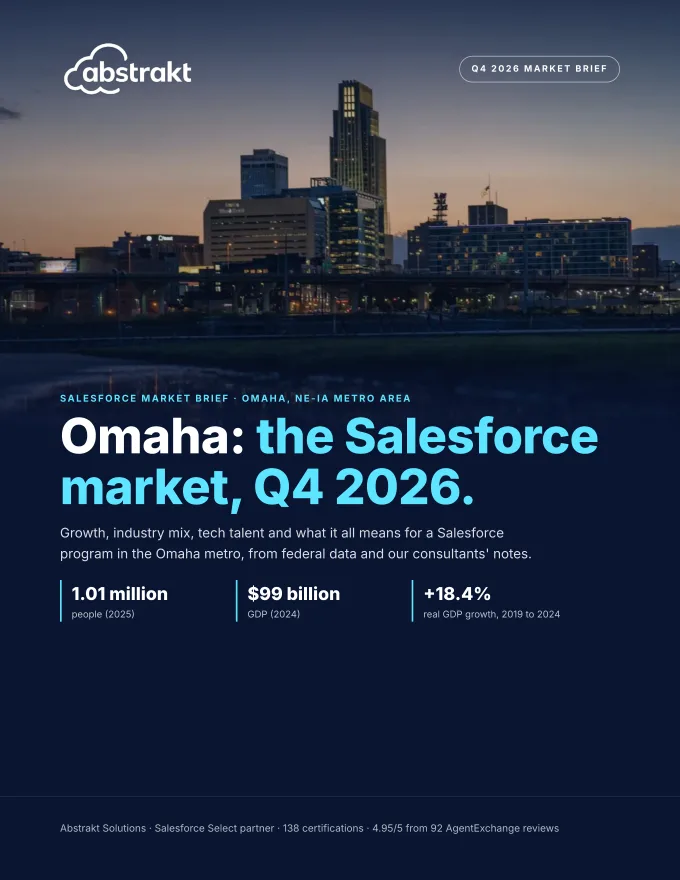
Everything on this page and more in one 23-page download for your planning: Omaha's growth since 2019 ranked against 100 metros, its industry mix, what related tech roles pay here compared with the U.S., the Omaha industry and service guides, and how Omaha compares with nearby metros.
A new edition of the Omaha brief is posted here each quarter, after the federal data refresh.
Salesforce consulting in Omaha: questions (10)
Greater Omaha promotes insurance and insurtech as a target industry. How should an Omaha insurer or agency structure Salesforce?
Begin with the data model. Financial Services Cloud’s insurance objects hold policies, coverages and claims against a household or business account, so an agent sees the whole relationship on one page. Leave the policy administration system as the record of truth and sync summaries through an integration instead of rekeying them. Sharing rules should limit each agent to their own book, while Service Cloud handles inbound policy questions. Piloting with a single line of business keeps the first release manageable.
Our fintech firm near Omaha sells software to banks and card issuers. How do we keep long financial-institution deals moving in Salesforce?
Bank deals stall in security reviews, vendor-risk questionnaires and legal redlines, so give those steps their own opportunity stages. Track each questionnaire as a related record with an owner and due date, and add risk, procurement and compliance contacts to the opportunity rather than only the business sponsor. Revenue Cloud can price tiers by transaction volume. Once a contract is signed, a structured onboarding record hands the account to implementation without relying on email threads.
Warehousing and distribution is one of the chamber’s target sectors. What does Salesforce look like for a third-party logistics provider in the Omaha area?
Treat each shipper as an account with its facilities, lanes and service agreements as related records, so sales and operations quote from the same terms. CPQ handles storage, handling and transport rates that vary by customer. Service Cloud cases capture damage claims, inventory discrepancies and missed deliveries with service-level timers. Connecting the warehouse management system lets account managers review volume and exception trends before each quarterly business review.
Which factors drive Salesforce consulting cost for an Omaha bank, insurer or payments firm?
The number and age of core systems to integrate, the security model financial data requires, and the volume of duplicate customer records across platforms. External users such as independent agents add licensing and sharing design. Ask partners to price data reconciliation separately, since it is the hardest part to estimate.
For an Omaha insurer, does an internal admin or a managed services partner make more sense?
Insurers with a steady stream of agent and service requests usually benefit from at least one internal admin who knows the business. A managed services partner then covers architecture, integration monitoring and release testing. Smaller agencies can outsource the whole function until volume grows.
Is a consultant expected to work from our Omaha office?
No. Design and build take place in your Salesforce org, coordinated through working sessions on a set schedule, so having someone in your office every day is unnecessary. Compliance and security reviewers join the sessions where access and data decisions are made.
How should an Omaha carrier bring policy administration data into Salesforce?
Sync summaries, not everything: policy status, coverages, recent claims and billing state are what reps and agents need. Keep the policy system as the record of truth and use MuleSoft with monitoring so a failed sync is noticed the same day. Agree on one customer key first, or each system will create its own version of the household.
What is a sensible first Agentforce use for an Omaha lender or payments processor?
Reading submitted documents and pulling key fields into the case, with a person confirming before anything moves forward. Drafting borrower or merchant correspondence for an officer to approve is a close second. Tag sensitive fields and restrict access before turning either on.
Can Data 360 help Omaha analytics teams work with Salesforce data?
Yes, when customer records are scattered across policy, banking and service systems and your analysts want one reconciled profile. Data 360 can unify those records and share them with Snowflake so in-house teams model on the same data Salesforce uses. Define match rules with your data team rather than accepting defaults.
Our Omaha contractor pursues data center and industrial work in Nebraska and Iowa. How should Salesforce track it?
Follow each pursuit from first contact through bid, award and closeout, with contact roles for the owner, engineer and general contractor. Subcontractor records can hold insurance, safety and prequalification dates so expirations surface before a bid. A state field on every job keeps reporting clean on both sides of the river.
Planning a Salesforce project? Read how Salesforce consulting is priced, the questions to ask a Salesforce consulting partner, or compare partners with our free scorecard.
Salesforce community groups in Omaha (2)
Salesforce's Trailblazer Community lists these local groups, where admins, developers and Salesforce owners meet to compare notes.
- Salesforce Admin Group, Omaha-Lincoln Metro, United States · last meetup October 9, 2026
- Salesforce Developer Group, Omaha, United States · last meetup October 9, 2026
Events and meetup dates checked on the official group pages on October 15, 2026.
Working across the Midwest? (3)
The same team works with companies in these nearby metros. All 100 markets →
Des Moines
758,539 people · Finance and insurance, 30.8% of GDP
Salesforce consulting in Des Moines →Kansas City
2.27M people · Professional, scientific, and technical services, at least 10.0% of GDP
Salesforce consulting in Kansas City →Wichita
663,809 people · Manufacturing, 23.1% of GDP
Salesforce consulting in Wichita →Sources and review (17)
Sources for the figures on this page
- U.S. Census Bureau, Population Estimates Program, Vintage 2025 (cbsa-est2025-alldata), July 1, 2025 estimate (accessed 2026-09-25)
- U.S. Bureau of Economic Analysis, CAGDP2 GDP by county (line 1, All industry total, current dollars), 2024; summed over the CBSA's component counties per Census Vintage 2025 delineation (accessed 2026-09-25; metro total summed from county figures)
- U.S. Census Bureau, County Business Patterns 2023, MSA file (NAICS total '------', ESTAB) (accessed 2026-09-25)
- Greater Omaha Chamber / Select Greater Omaha
- Greater Omaha Chamber / Select Greater Omaha
- Greater Omaha Chamber / Select Greater Omaha
- Greater Omaha Chamber / Select Greater Omaha
- Greater Omaha Chamber / Select Greater Omaha
- Greater Omaha Chamber / Select Greater Omaha
- Greater Omaha Chamber
- U.S. Census Bureau, Core Based Statistical Areas delineation files (July 2023), lists 1 and 2
- U.S. Census Bureau, Business Formation Statistics, county-level annual business applications (2019-2025; retrieved 2026-10-20; Sum of component-county applications; growth computed as latest/base - 1. Published only when every component county matches.)
- U.S. Bureau of Economic Analysis, CAGDP9 Real GDP by county, chained 2017 dollars, all industry total (2019-2024; retrieved 2026-10-15; Sum of component-county real GDP; growth computed as latest/base - 1. Published only when every county matches (independent cities and combined areas need manual mapping).)
- U.S. Bureau of Labor Statistics, Quarterly Census of Employment and Wages, annual averages, private ownership (2019 and 2024 annual averages; retrieved 2026-10-15; Employment growth computed as latest/base - 1. Location quotients and pay as published by BLS. Suppressed values stored as null.)
- U.S. Bureau of Labor Statistics, Occupational Employment and Wage Statistics, May 2025 (May 2025; retrieved 2026-10-20; Related occupations only. BLS publishes no Salesforce Administrator occupation; these figures are not Salesforce salaries.)
- U.S. Bureau of Labor Statistics, Employer Costs for Employee Compensation, private industry workers (2026 2nd Quarter; retrieved 2026-10-15; benefitsOnWages = benefits cost per hour / wages and salaries cost per hour (national average, all private industry).)
- Salesforce Trailblazer Community Groups, Official group pages (public, robots.txt-permitted paths only) (verified 2026-10-15)
Last reviewed October 5, 2026. See how Omaha compares with the other 99 markets in the U.S. Salesforce market report.