

How Salesforce work starts in Omaha
Abstrakt Solutions, a Salesforce Consulting Partner, supports insurers, lenders, health systems and builders in Omaha, Papillion and the rest of Douglas and Sarpy counties, plus Pottawattamie and Mills counties on the Iowa side of the Missouri River. Omaha is one of our focus markets.
What buyers here usually run into
- 1
Financial data with many audiences
Insurers, banks and payments firms usually need field-level security, audit history and retention rules settled before agents, advisors and service reps share one Salesforce org.
- 2
Core systems older than the CRM
Policy administration, core banking and payment platforms often predate Salesforce by decades, so the integration plan decides whether a service rep sees the whole customer or only a slice.
- 3
Shipper accounts split across tools
Warehousing and distribution companies commonly quote, onboard and support shippers in separate systems, which slows onboarding and hides which accounts are actually profitable.
Budget, team and partner questions
What drives cost
Omaha costs are driven by the age and number of core systems Salesforce must read from, the field-level security and audit rules financial data requires, and how many agents or advisors need external access. Reconciling customer records across policy or banking platforms is often the largest single piece of work.
Admin or partner
Many Omaha financial firms have deep internal data and engineering talent but few Salesforce architects. A partner typically designs the data model, sharing and integrations, while internal teams own analytics and infrastructure and eventually take over administration.
What buyers ask a partner
Ask for Financial Services Cloud references, how the partner handles field-level security and audit history, and how they work alongside an in-house data team. Fintech and health-tech vendors should ask how the partner designs pipelines for long institutional sales.
The local economy and its biggest industries (4)
| Sector | Share of 2024 GDP | Where Salesforce fits |
|---|---|---|
| Finance and insurance Salesforce for insurance → | 17.5% | Money is Omaha's specialty: banks, carriers and payment processors add up to 17.5% of 2024 metro output, and the chamber actively recruits fintech and insurtech firms. Firms in this sector need agent and advisor views of each household or business, service consoles for account and policy questions, and strict limits on who can see financial data. |
| Health care and social assistance Salesforce for health & life sciences → | at least 7.5% | Health care and social assistance is Omaha's second-largest private sector, at no less than 7.5% of 2024 GDP, and the chamber also courts medical and health technology companies. Providers and health-tech vendors alike need referral, patient outreach and account records that keep protected information private. |
| Manufacturing Salesforce for manufacturing → | 6.8% | Advanced manufacturing and agricultural innovation both appear on Greater Omaha’s target list, and producers in each group tend to sell through dealers and distributors. Tying Salesforce to ERP lets reps see orders, shipments and open issues before they call a customer. |
| Construction Salesforce for construction → | 5.4% | Contractors account for 5.4% of Omaha's 2024 output, and the chamber's logistics and defense targets keep new facility and expansion work coming. General contractors and specialty subcontractors use Salesforce to follow a job from bid and estimate through crew scheduling and closeout. |
Source: U.S. Bureau of Economic Analysis, GDP by county (CAGDP2), 2024, summed to the metro area; private sectors only, excluding real estate and government. “At least” marks sectors where BEA suppresses some county figures.
Regional target sectors named by local economic development groups: Finance & Fintech, Insurance & Insurtech, Artificial Intelligence / Software Development & Technology, Military Defense & Cybersecurity, Logistics (Warehouse, Distribution & Logistics), Medical & Healthcare Tech.
Salesforce products that fit Omaha (6)
In the order we lead with them here, from the industries above.
Salesforce Financial Services Cloud
Industry CRM for wealth management, banking, insurance, and lending, built for compliance from the start.
Salesforce Service Cloud
The operating system for modern customer service, case, knowledge, voice, and AI agent assist together.
Salesforce Sales Cloud
The CRM where sales pipeline lives, when it is built right.
Salesforce Experience Cloud
Customer, partner, and employee portals built on Salesforce.
MuleSoft
Enterprise API platform, for connecting Salesforce, ERP, data warehouses, and the rest of your stack.
Salesforce Data 360 (Data Cloud)
Unify customer data into a real-time profile that powers segmentation, analytics, and AI.
How Omaha insurers and lenders can put AI to work
Finance and insurance generated 17.5% of Omaha metro GDP in 2024, a larger share than any other private sector there. Insurance carriers, lenders and payment processors are well placed for three AI tasks: reading submitted documents, summarizing policyholder or borrower cases, and drafting correspondence for an adjuster or officer to approve. Health care, at least 7.5% of output, can apply similar summaries to patient access and billing questions under stricter controls. Manufacturers, 6.8%, may focus on dealer lead triage. The work that matters most happens before the pilot: reconciling customer records across policy systems, tagging sensitive fields, and writing the knowledge articles the agent will cite.
- Reading submitted policy and loan documents
- Adjuster-approved correspondence drafts
- Dealer lead triage for manufacturers
Services buyers here usually need (7)
Salesforce Integration in Omaha
Integration is often the deciding factor in whether an Omaha Salesforce project succeeds, because the customer truth lives in long-established platforms: policy administration, core banking, payment processing, claims and warehouse management. We catalogue each system, what it can expose and how current the data must be, then design flows through MuleSoft or other middleware with a clear owner for every field. Every flow ships with alerts, automatic retries and a named person who answers them.
By industry in Omaha
- 1
Insurance & Insurtech
For carriers and insurtech firms, the core integration connects Salesforce to policy administration, billing and claims so service reps see coverage, payments and claim status on one screen. We usually display most of that data rather than copying it, and we write back only a few things, such as contact changes or service requests. Event-driven updates for high-value moments, like a new claim or a lapsed payment, let Salesforce trigger outreach at the right time.
- 2
Finance & Fintech
Banks, credit unions and payments firms need Salesforce to reflect accounts, balances, merchant activity and loan status held in core and processing platforms. Integration design here is shaped by security review as much as by technology: which fields may leave the core, how integration users authenticate, and how every call is logged. MuleSoft's API-led approach fits institutions connecting several platforms, because it separates system access from the business processes using it.
- 3
Logistics
Warehouse and transportation companies need shipment, inventory and billing data connected to the shipper account so sales and service stop working from different pictures. We integrate the warehouse or transportation management system with Salesforce for account-level summaries, exceptions and service triggers, while detailed tracking stays in operational systems. New shipper setups can flow the other way, so onboarding completed in Salesforce creates the accounts operations needs without anyone re-entering them.
Raise before scoping
Get security sign-off before building
Financial and insurance security teams will review every integration that moves customer data. Involve them at design, document the fields, protocols and credentials for each flow, and get approval before development, so a late review does not force a redesign weeks before launch.
Match sync timing to the decision
Some data must be current within minutes, such as a claim just filed; much can refresh overnight. Classify each flow by how quickly users act on it, and use events or scheduled batches accordingly, which keeps API consumption and costs under control.
Plan for vendor-owned platforms
Many core and policy platforms are hosted and upgraded by vendors on their own schedule. Confirm what APIs your contract includes, how changes are announced and who tests after an upgrade, because those answers shape how resilient your integration can be.
Salesforce Implementation in Omaha
Implementing Salesforce in Omaha typically means fitting a CRM into businesses where the policy, loan or payment platform already defines the customer. Our design starts there: which records Salesforce will own, which it will reference, and who may see each field. Agents, advisors, service reps and brokers get separate permission models from the outset. We then release in phases, usually a core service or sales process first, and train each group on its own workflows before its go-live.
By industry in Omaha
- 1
Finance and insurance
Finance and insurance generated about 17.5% of the metro's 2024 GDP, and the Greater Omaha Chamber targets finance and fintech as well as insurance and insurtech. Implementations for carriers, banks and payments firms hinge on Financial Services Cloud decisions: how policyholders, borrowers and business clients are represented, how agents and brokers relate to them, and which data is displayed from core systems rather than stored. Settling those answers in design keeps later phases from reworking the foundation.
- 2
Logistics
Warehousing, trucking and distribution companies in the region often handle a shipper from first quote through onboarding and support in several disconnected tools. A Salesforce implementation brings those stages into one account record: opportunities for lanes or contracts, onboarding tasks tracked to completion, and service cases linked to shipments. We phase it so sales and onboarding launch first, then connect operational systems once the account structure has proven itself with real users.
- 3
Military Defense & Cybersecurity
Companies serving the defense and cybersecurity market, which the chamber anchors to the region's military installations, sell long, relationship-driven programs to government buyers and prime contractors. Implementation for them focuses on modeling contract vehicles, teaming partners and capture pipelines, with tight role-based access so sensitive opportunity details stay limited. Before any build, we also confirm whether your contracts call for a government-specific Salesforce environment, because that choice shapes the architecture from day one.
Raise before scoping
Separate what Salesforce stores from shows
Core banking, policy and payment platforms stay the systems of record. Decide field by field whether Salesforce keeps a copy, displays live data or links out, since that choice drives storage, integration effort and how current a service rep's view of the customer will be.
Design permissions per audience early
Agents, underwriters, advisors, service reps and outside brokers each need different visibility into the same customer. Build the role hierarchy, permission sets and sharing rules during design and test them with real personas, rather than tightening access after users complain or an auditor asks.
Launch where the pain is sharpest
Choose the first phase by business pain, not by product. If service reps juggle several screens per call, start with Service Cloud; if brokers wait days for quotes, start with sales and a partner portal. Early relief builds support for the phases that follow.
Salesforce Optimization in Omaha
Omaha orgs that need optimization usually show the same symptoms: service reps toggling between Salesforce and the core system, agents or loan officers skipping required fields, and dashboards that finance quietly re-creates in spreadsheets. We start by watching real work and reviewing usage data, then remove unused fields and layouts, consolidate automation, surface the core-system data reps actually need on one page and rebuild key reports on agreed definitions. Improvements roll out in short releases with brief training.
By industry in Omaha
- 1
Retail trade
Retail trade produced about 5.6% of the metro's 2024 GDP. Retailers and consumer businesses using Service Cloud often find agents working several tabs to answer one customer: order history in one place, loyalty data in another, returns in a third. Optimization brings the essentials onto a single case view, prunes macros and queues that no longer match how the team is organized, and rebuilds service dashboards around resolution and repeat-contact measures managers trust.
- 2
Finance & Fintech
Lenders, banks and fintech companies often have Salesforce pipelines that stopped mirroring reality: stages copied from a template, loans stalled in statuses nobody updates, and referral sources left blank. Optimization reworks stages to match the actual origination process, automates reminders and status updates from the loan system where possible, and trims required fields to those that feed reports. Loan officers spend less time on data entry, and leadership regains a forecast it can use.
- 3
Logistics
Logistics companies often have Salesforce for sales but track onboarding and account issues elsewhere, so nobody sees a shipper's full picture. Optimization adds simple onboarding checklists to the account, turns shipper complaints into cases instead of emails, and builds reports that combine revenue, service volume and onboarding time by customer. With that view, sales and operations leaders can see which accounts are profitable to serve rather than guessing from volume alone.
Raise before scoping
Bring core data to the page
Reps who leave Salesforce to check a policy, loan or payment status lose time on every call. Surfacing a few key values from the core system on the account page often does more for adoption than any amount of training or new functionality.
Trim required fields ruthlessly
Every required field should feed a report, a process or a regulatory need. Fields that do none of those slow users down and invite placeholder values. Review each one with its owner and remove or relax those nobody can justify.
Check automation for silent failures
Flows that fail quietly, sending no email or skipping an update, erode trust slowly. Review error logs and fault paths as part of optimization, and add alerts, so broken automation is found by the admin instead of by an unhappy customer.
Salesforce Managed Services in Omaha
For Omaha organizations, managed services mostly means keeping Salesforce aligned with businesses that change under regulation and growth: new products at a carrier, new branches at a bank, new shippers at a logistics firm. We work a shared backlog each month with your business owners, handle user and permission changes, reporting and Flow work, fix integration errors, and prepare for Salesforce's seasonal releases. Omaha and St. Louis keep identical hours, so a request logged at breakfast can be in progress before lunch.
By industry in Omaha
- 1
Construction
Builders and specialty contractors generated roughly 5.4% of the metro's 2024 GDP, and their Salesforce needs follow the calendar of the building season. Contractors and builders using Salesforce to track bids, projects and warranty service keep asking for changes as work ramps up: new estimating fields, project stages, subcontractor contacts and reports for leadership. A managed team handles those requests as they come, keeps the pipeline dashboards honest and makes sure the field and office teams see the same project status.
- 2
Insurance & Insurtech
Carriers and insurtech firms change products, rating territories and distribution partners often, and each change touches Salesforce. With managed services, those updates arrive in a groomed backlog, are built and tested in a sandbox and deploy in scheduled releases, with release notes that compliance can file. Agent portal support, including new agency onboarding and access changes, becomes routine work handled by consultants who already understand the sharing model and its exceptions.
- 3
Finance & Fintech
Banks, lenders and fintech companies here often run Salesforce alongside core and payment platforms whose integrations break quietly when either side updates. A managed services arrangement puts someone on watch: reviewing integration errors, fixing sync failures, and coordinating changes with the vendors involved. The same team handles steady admin work such as new branch users, loan pipeline reports and permission reviews, so internal staff can focus on the business rather than on the CRM.
Raise before scoping
Coordinate with core system upgrades
When a policy, banking or payment platform upgrades, Salesforce integrations can break. Ask for vendor release calendars, include them in your managed services planning, and schedule regression tests of each affected integration so problems surface in a sandbox, not in front of customers.
Review access on a schedule
In regulated financial businesses, access creep is a finding waiting to happen. Build a periodic permission review into the managed services routine, removing departed users and unneeded rights, and keep the evidence so examiners and auditors can see the control working.
Document as you change
A managed team that leaves no documentation creates a new dependency. Require that each change updates a living record of objects, automation and integrations, so an internal hire or another partner could pick up the org without starting from scratch.
Salesforce Health Checks in Omaha
Most Omaha health checks are requested for a few recurring reasons: a regulatory exam or audit ahead, an Agentforce or Data 360 (formerly Data Cloud) initiative under consideration, or unease about how the org was built. We look at who can see and export what, how clean the key customer records are, what automation and code exist and how integrations with core, policy and payment platforms authenticate and fail. The deliverable ranks each finding by risk and effort, with a suggested order of work.
By industry in Omaha
- 1
Health care and social assistance
BEA data puts health care and social assistance at no less than 7.5% of 2024 metro output, and the chamber counts medical and health care technology among the industries it recruits. Providers and health technology companies using Salesforce hold protected information that must be carefully scoped. A health check verifies sharing, portal and guest access, encryption and field history, reviews which integrations can read patient data, and checks whether automated messages could reach the wrong person or reveal more than intended.
- 2
Military Defense & Cybersecurity
Defense and cybersecurity firms, a sector the chamber ties to the region's military anchors, face heightened expectations about access control and data handling. A health check for them reviews login policies, multi-factor enforcement, IP restrictions, connected apps and integration users, and it checks whether sensitive opportunity or program details are restricted to the people who need them. The report also documents configuration evidence that supports customer security questionnaires and compliance assessments.
- 3
Finance & Fintech
Banks, lenders and payments companies considering Agentforce need clarity on what an AI agent would be able to see. A health check maps permissions and sharing for the records an agent would use, measures duplicates and missing values on customer data, and reviews how accurately core-system data lands in Salesforce. The results show which use cases are ready to pilot and which require cleanup first, so AI plans rest on facts rather than assumptions.
Raise before scoping
Trace each system's API access
List every external system that logs into Salesforce, what credentials it uses and which objects it can read or change. Compare that with what each integration genuinely requires, then tighten scopes and rotate secrets as part of the remediation plan.
Align findings with exam priorities
Financial institutions should map health check findings to the controls their examiners and auditors emphasize, such as access reviews, change management and data retention. That framing helps leadership fund the right fixes first and gives compliance staff material they can reference directly.
Reassess after major changes
Findings describe the org on the day of review. Schedule a lighter follow-up review after major events, such as a new cloud, an acquisition or a change of partner, so the org's risk picture stays current without repeating the full assessment every time.
Salesforce Migration in Omaha
Migrations for Omaha organizations tend to involve more than one source: an agency or loan system holding customers, a marketing tool holding contacts, and spreadsheets filling the gaps between them. Our work begins with profiling each source, agreeing which one wins when records conflict and designing how data lands in Salesforce objects. After cleanup and deduplication, we run trial loads, have your staff verify samples and cut over in a planned window, keeping the legacy system readable for reference.
By industry in Omaha
- 1
Manufacturing
Manufacturing made up about 6.8% of 2024 metro GDP, and advanced manufacturing and ag innovation both appear on the chamber's list of industries. Manufacturers moving to Salesforce often have customer, dealer and service records scattered across an ERP module, an old CRM and spreadsheets. Migration consolidates them into accounts with clear parent-child structures, preserves installed product and warranty history where it exists, and leaves transactional detail in the ERP where it belongs.
- 2
Insurance & Insurtech
Agencies, brokers and carriers migrating to Salesforce often come from agency management systems that combine contacts, policies and activities in one structure. The move requires splitting those into Salesforce accounts, contacts and policy records under Financial Services Cloud, while keeping household relationships intact. Consent, do-not-call and communication preferences receive special handling, because a migration that drops them can create regulatory exposure long after the project itself has closed and the team has moved on.
- 3
Artificial Intelligence / Software Development & Technology
Software and technology firms in Greater Omaha, a sector the chamber actively promotes, often begin on a starter CRM and move when forecasting, subscription renewals or support processes outgrow it. Migration converts deal stages and custom properties into a Salesforce data model built for recurring revenue, moves support tickets into Service Cloud cases and brings email history selectively. Contact lists get deduplicated and checked against opt-out records before anyone sends a campaign from the new system.
Raise before scoping
Protect consent and preferences
Opt-outs, do-not-call flags and communication preferences must survive the move exactly. Map them explicitly, validate them after each trial load and test marketing sends against migrated records, so a campaign in the first week does not reach people who asked not to be contacted.
Match households before loading
Financial and insurance records often list the same family several times with small spelling or address differences. Resolve households and relationships before loading, with business users approving match rules, rather than cleaning them up inside Salesforce after agents start relying on them.
Enforce a hard legacy cutoff
Announce the exact moment the legacy system becomes read-only, then remove edit rights so it stays that way. Records created after the last extract otherwise need a second migration, and teams quickly lose track of which system holds the latest version of a customer.
Salesforce Implementation Rescue in Omaha
Rescued Omaha projects frequently share a pattern: a Financial Services Cloud or Service Cloud program that assumed core-system integration would be straightforward, then stalled when it was not. Others went live with permissions so tight that users could not work or so loose that compliance paused rollout. Triage comes first: sponsors and frustrated users describe what went wrong, and we compare their accounts with what the org, interface logs and open tickets actually show. Then we stabilize, reset scope to a deliverable release and complete the program in phases.
By industry in Omaha
- 1
Insurance & Insurtech
A carrier or insurtech project in trouble often has a partly built policy integration, an agent portal nobody launched, and a service team still working in old screens. Rescue sorts those pieces by value and risk. Frequently the fastest recovery is a limited release: service reps get read-only policy data in Salesforce and core case handling, while the portal and write-back functions wait for a later phase with realistic estimates.
- 2
Finance & Fintech
Banking and fintech rescues often begin with a security problem, such as a compliance review that halted launch because sharing or data retention was never designed properly. We redesign the access model first, confirm it with compliance, and then reapply the working parts of the build under the new rules. Only once security is settled do we return to the unfinished features, so the program cannot be halted again for the same reason.
- 3
Construction
Contractors and builders sometimes buy Salesforce with a plan to run bidding, project tracking and warranty service in one place, then stall when the design tries to replace project management software too. Rescue narrows Salesforce back to what it does well for them, such as bids, customer relationships and service, and connects to the project tools already in use. That usually gets estimators and project managers working in the system within weeks instead of months.
Raise before scoping
Get an independent view first
Sponsors, the previous partner and end users will each explain the failure differently. An outside review of the org, code, documentation and backlog establishes what actually exists, so recovery decisions rest on evidence and nobody spends weeks defending an earlier plan.
Protect data during the recovery
Stalled projects sometimes leave partial migrations, duplicate records or integrations still writing bad data. Pause or contain those processes, back up the current state and agree which system holds the truth until the recovery release lands, so cleanup happens once rather than repeatedly.
Keep compliance in the loop
If a compliance or security review stopped the project, bring those reviewers into the recovery plan from the first week. Share the redesigned access model early and agree on the evidence they need, so the same objection does not reappear at the next launch attempt.
Industry plays in Omaha (4)
Salesforce for Omaha Insurers and Agencies
Omaha's insurance sector ranges from long-established carriers to insurtech firms, and many organizations run strong internal data and analytics teams. Salesforce projects here often aim to give agents and service staff a better front end while feeding cleaner customer data to those analysts. We configure Financial Services Cloud for distribution and service, integrate policy and claims platforms, and design data models and Data 360 (formerly Data Cloud) pipelines that the analytics team can trust, extend and reuse.
Omaha's economy tilts toward money and risk: Bureau of Economic Analysis county data puts finance and insurance at 17.5% of 2024 metro GDP, far ahead of any other private sector. The Greater Omaha Chamber, through Select Greater Omaha, lists insurance and insurtech and finance and fintech among its target industries. It also credits decades of enterprise demand from financial services, insurance and logistics with building deep regional talent in data science, analytics and software engineering. Projects here should plan for that internal expertise to own and extend the Salesforce org once it launches.
Use cases to open with
- 1
Agent onboarding and licensing
Carriers recruiting agents need contracting, license verification, appointments and training tracked from application to first sale. A Salesforce onboarding process with checklists, document collection through an Experience Cloud portal and license data pulled from producer databases shortens time to first policy, and gives distribution leaders visibility into exactly where recruits stall or drop out of the pipeline. Recruiters can see which sources produce agents who stay productive.
- 2
Claims service visibility
Policyholders calling about claims want status, next steps and adjuster contact details. Pulling claim summaries from the claims platform into Service Cloud lets representatives answer without transferring calls, log follow-up requests and escalate delays to the adjuster's queue, while leaders see which claim types generate the most repeat contacts and where a proactive status text or email would prevent the call entirely.
- 3
Analytics-ready customer data
Analysts often spend more time reconciling customer records than modeling them. Designing Salesforce with consistent identifiers, clean household and business relationships and Data 360 (formerly Data Cloud) connections to policy and billing data gives analytics teams a reliable customer layer, and lets model outputs such as retention risk return to agents' screens as fields they can act on during the next call. Feedback on those scores flows back to the modelers.
Raise before scoping
Involve internal data teams
Analytics and data engineering teams will consume Salesforce data and may build their own integrations. Bring them into design sessions, agree on identifiers and data ownership, and document the model thoroughly, so the org supports their pipelines rather than becoming another source they must clean.
Retention and privacy rules
Insurance records carry retention requirements, and consumer data falls under GLBA and state privacy rules. Define retention periods, deletion processes and data masking for sandboxes before loading production data, and have your compliance team confirm the obligations for each line of business you write.
Phase the rollout by channel
Launching for agents, service staff and underwriting simultaneously stretches training and support. Most insurers start with one channel, refine the data model under real use, then add the next, which keeps integration changes manageable and builds internal champions for later waves.
Salesforce for Omaha Lenders
Lending in Omaha spans community banks, credit unions, mortgage companies and fintech firms. Salesforce should manage what the loan origination system does not: referral partners, prospects not yet in an application, borrowers after closing, and marketing that respects consent. We build on Financial Services Cloud, integrate the LOS so loan milestones appear on the borrower record, and use Marketing Cloud for rate alerts and retention campaigns, keeping underwriting and disclosures in the systems built for them.
Lenders operate inside Omaha's biggest private sector, since finance and insurance produced 17.5% of 2024 metro GDP in Bureau of Economic Analysis county figures. Select Greater Omaha, the Greater Omaha Chamber's economic development arm, targets finance and fintech as its own industry and separately cites software development and AI as regional strengths. Construction, at 5.4% of 2024 GDP, ranks among the metro's top five private sectors, which keeps builders and real estate professionals active as referral sources for mortgage and construction lenders. The chamber also describes a labor pool deep in data science and analytics.
Use cases to open with
- 1
Referral partner management
Real estate agents, builders and financial advisors send much of a lender's purchase business. Salesforce partner records track referral volume, conversion, co-marketing activity and relationship owner, so loan officers know which partners deserve attention and managers can spot relationships cooling off before referrals disappear. Builder partners can also receive automatic milestone updates for buyers in their communities, which saves calls.
- 2
Pipeline before the application
Many prospects are months from applying: renters saving for a down payment, owners watching rates, business owners planning an expansion. Financial Services Cloud captures these leads with timelines and goals, schedules follow-up tasks for loan officers, and triggers Marketing Cloud journeys when rates or circumstances change, so early interest is not lost before an application ever reaches the LOS. Credit-building milestones can trigger officer check-ins.
- 3
Retention after the closing
Closed borrowers are prime candidates for refinance, home equity, business credit or deposit relationships later. Keeping loan details and servicing status in Salesforce enables retention alerts when a borrower's rate, equity or life events make a new conversation worthwhile, and helps lenders hold on to customers who might otherwise drift away after a servicing transfer. Anniversary check-ins keep the loan officer's name in front of the borrower.
Raise before scoping
LOS integration boundaries
Applications, disclosures and underwriting conditions live in the origination platform, and Salesforce should respect that line. Decide which milestones and fields Salesforce receives, how quickly, and whether any data flows back, and avoid editing loan data in two places, which creates audit and reconciliation problems.
Consumer lending compliance
Borrower data is covered by GLBA, marketing calls and texts carry TCPA consent requirements, and fair lending expectations apply to targeting. Store consent in Salesforce, review segmentation criteria with compliance, and keep adverse action and disclosure processes in systems designed for them, with advisers confirming requirements.
Loan officer mobility
Loan officers spend time at open houses, builder sites and client homes. Configure the Salesforce mobile app with quick lead capture, task lists and partner contact details, and keep required fields minimal, or officers will keep running their pipelines from personal phones and spreadsheets.
Salesforce for Omaha Health Care and Health Tech
Omaha's health economy combines a large academic medical center and hospital systems with a growing group of health technology companies, many of which sell to providers and insurers. The first group needs Salesforce for patient access, referral coordination and outreach across a wide rural catchment; the second needs it to run long enterprise sales cycles and implementation projects. We configure Service Cloud and Experience Cloud for providers, Sales Cloud and Service Cloud for health tech vendors, and integrate EHR and product data carefully under HIPAA-appropriate controls.
Among Omaha's private industries, only finance and insurance (17.5%) outproduces health care and social assistance, which the BEA credits with no less than 7.5% of 2024 metro output. The Greater Omaha Chamber, whose economic development site covers eight counties in Nebraska and Iowa, includes medical and healthcare technology among its target industries. It also describes deep local talent in data science, analytics and software engineering, built on decades of enterprise demand. That mix of clinical institutions and data-savvy insurers makes health technology a natural fit here.
Use cases to open with
- 1
Regional referral coordination
Patients arrive in Omaha from smaller communities across Nebraska and Iowa, often referred by rural clinics and critical-access hospitals. Service Cloud can track each referral from receipt through scheduling, show outreach staff which referring providers send the most patients, and flag referrals that have waited too long. Liaisons can plan visits to referring clinics using real volume trends rather than impressions.
- 2
Health tech enterprise sales
Companies selling software or services to hospitals and insurers face long cycles with security reviews, clinical sponsors and procurement committees. Sales Cloud can model buying groups, track security questionnaire and contract stages, and forecast by customer type. Once deals close, implementation projects and support cases in Service Cloud keep the account team aware of go-live risks that could affect renewals.
- 3
Patient access and scheduling support
Access centers field calls about appointments, directions, bills and records. Service Cloud with integration to scheduling and billing systems lets agents resolve questions from one screen, while an Experience Cloud portal or Agentforce assistant handles routine requests such as appointment reminders and form completion. Leaders see call reasons and resolution times by clinic and hour of day, and can staff the access center accordingly.
Raise before scoping
Wide catchment, many locations
Health organizations here serve patients across two states and many small towns. Build location, referral source and service area into the data model so leaders can see access by county and community, and so outreach can be targeted where gaps exist.
HIPAA and business associates
A hospital putting PHI into Salesforce first signs Salesforce's business associate addendum, then restricts each role to the minimum it needs. Health tech vendors handling client data should confirm what their own agreements with hospitals and insurers allow before loading any patient-level information into their sales or support org.
Separate vendor and provider needs
A health tech company's Salesforce org is a sales and customer success system, not a clinical one. Keep patient data out unless the product truly requires it, which simplifies the security reviews run by the hospitals and insurers you sell to and shortens the questionnaires your team must answer.
Salesforce for Omaha Construction Firms
Omaha contractors work a regional market that stretches from Sarpy County into Council Bluffs and beyond, with project types ranging from heavy civil and infrastructure to large industrial and data center builds. Salesforce is useful when it tracks the long runway before a bid, the bid itself and the service work afterward. We configure Sales Cloud for owner relationships and project pursuits, CPQ for repeatable trade scopes, and Field Service for service crews, integrated with estimating and accounting systems so nothing is keyed twice.
Builders and trade contractors rank fifth among Omaha's private sectors, producing 5.4% of metro output in 2024 per the BEA, a sizable share for an economy best known for its insurers and banks. The Greater Omaha Chamber's homepage features a technology company's decision to locate a $600 million facility in Papillion in Sarpy County. The Chamber also lists logistics, advanced manufacturing and military defense among its target industries, each of which depends on new facilities, expansions and maintenance work from local contractors.
Use cases to open with
- 1
Large project pursuits
Data center, logistics and defense-related projects are often known long before they bid. Each pursuit in Sales Cloud carries the owner, site, sector and likely letting date, along with the architects, engineers and general contractors attached so far, so preconstruction leaders can decide which ones deserve estimating hours. Relationship history makes it clear who at the firm knows each owner.
- 2
Heavy civil and public bids
Public infrastructure work follows formal bid calendars, prequalification rules and bonding requirements. Salesforce can track upcoming lettings by agency, record prequalification status and bonding capacity, and log bid results, including competitors and prices where public. Over time, win-rate and margin reports by agency, project type and region guide which bids are worth pursuing and which agencies consistently award below your cost.
- 3
Service crews after turnover
Mechanical, electrical and controls contractors often maintain the systems they install, especially in mission-critical facilities where downtime is costly for the owner. Field Service schedules technicians by skill and certification, tracks response against service agreements, and records work on each piece of equipment. Service history then supports renewal conversations with facility managers, documents compliance for demanding clients, and flags aging equipment for replacement proposals.
Raise before scoping
Two states, different rules
Work in Nebraska and Iowa involves different contractor licensing, sales tax treatment and public bidding rules. Capture state and jurisdiction on opportunities, subcontractors and service agreements, and track license, insurance and certificate expirations by state so no crew shows up on a site without current paperwork.
Connect estimating and job cost
Estimates, schedules and job costs belong in construction-specific systems that project teams already trust. Sync only the key figures Salesforce needs, such as bid amount, contract value, change orders and percent complete, so leadership sees pipeline and backlog together without anyone keying the same numbers twice.
Mission-critical service standards
Data center, hospital and defense clients expect strict response times and thorough documentation for every visit. Configure entitlements, escalation rules and service reports to match each signed agreement, and test them with real scenarios before promising clients a level of service your dispatchers cannot consistently meet.
Case studies to send (3)
From the industries this market leans on. Client names are anonymized and these projects are not specific to Omaha.
The Omaha Salesforce market brief, Q4 2026
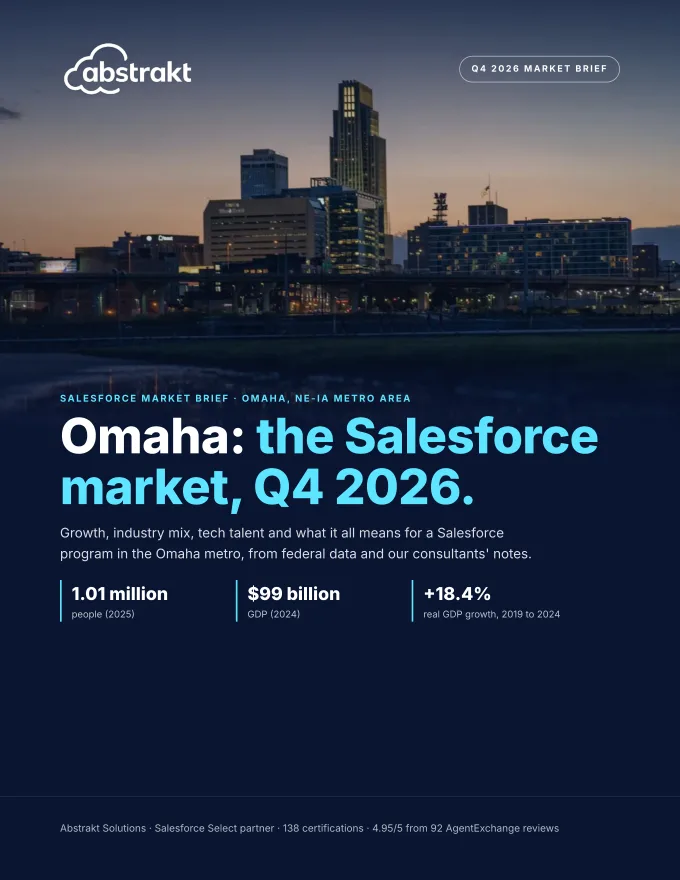
A free 23-page PDF with Omaha's growth ranked against 100 metros, its industry mix, tech wages and nearby markets. It is offered on the public Omaha page; send your customer there or get a copy for your own prep.
Get the Omaha brief →Co-sell with Abstrakt in Omaha
Working a Omaha account? Bring in a named consultant for discovery, scoping or a health check. We reply within 4 business hours.