Salesforce Integration · Salt Lake City

Salesforce integration consulting in Salt Lake City.

Integration between Salesforce and the custom platforms, billing systems, product databases and ERPs that Salt Lake City companies depend on every day.

4.95/5 from 92 AgentExchange reviews Salesforce Select partner since 2017 138 certifications, client case studies

Salesforce Integration for Salt Lake City companies

In Salt Lake City, integration projects often connect Salesforce to systems a company built itself: loan platforms, payment engines, product usage databases and internal admin tools, alongside billing and ERP. We document which system owns each field, design APIs or events with consent and audit controls where regulated data is involved, build with MuleSoft or lighter tooling as volumes justify, and set up monitoring with named owners so failures surface before customers or examiners notice them.

Local industries

How integration plays out in Salt Lake City.

Financial Services / FinTech

Fintech and lending firms run core platforms their own engineers maintain. Integrating those with Salesforce calls for versioned APIs, careful handling of identifiers such as account and tax numbers, and clear rules about which systems may write to which fields. We often place MuleSoft or a thin API layer between them, so product teams can change the platform without breaking CRM processes, and we log every call for audit review.
Manufacturing

At about 8.0% of 2024 metro output, manufacturing ranks third among the Salt Lake City area's private sectors. Producers of engineered parts, including aerospace and advanced materials suppliers, need ERP inventory, lead times and order status visible on Salesforce opportunities and cases. We design the sync around the ERP as the master for products and prices, push booked orders back automatically, and add alerts when an open quote references a part the ERP has since changed or retired.

Integration for Manufacturing →

Life Sciences & Healthcare

Life sciences and healthcare is a targeted industry for Utah's economic development office. Healthcare technology and device companies here usually connect Salesforce to product analytics, contract systems and support tools, while keeping protected health information out of the CRM. We design integrations that carry account-level usage and contract status, strip or never collect patient identifiers, and give customer success teams a single view of adoption across hospital and clinic customers.

Integration for Health & Life Sciences →
Plan for it

What to plan for in Salt Lake City.

01

Treat your platform as a product

When the other system is one your engineers build, integration contracts need version control and change notices just as external APIs do. Agree how breaking changes are announced, tested in a Salesforce sandbox and released, or the CRM will fail quietly after a routine deploy.

02

Size for real volumes

Consumer lenders, payment firms and retailers can generate far more events than a typical B2B org. Test integrations with production-scale data, check Salesforce API and storage limits, and decide which detail belongs in Data 360 (formerly Data Cloud) or a warehouse instead of standard objects.

03

Log for audit, not debugging

Regulated firms may need to show who changed a customer record and which system sent the update. Design integration logs to keep that lineage, with retention agreed with compliance, rather than relying on error logs that are cleared after a few days.

Free 21-page PDF

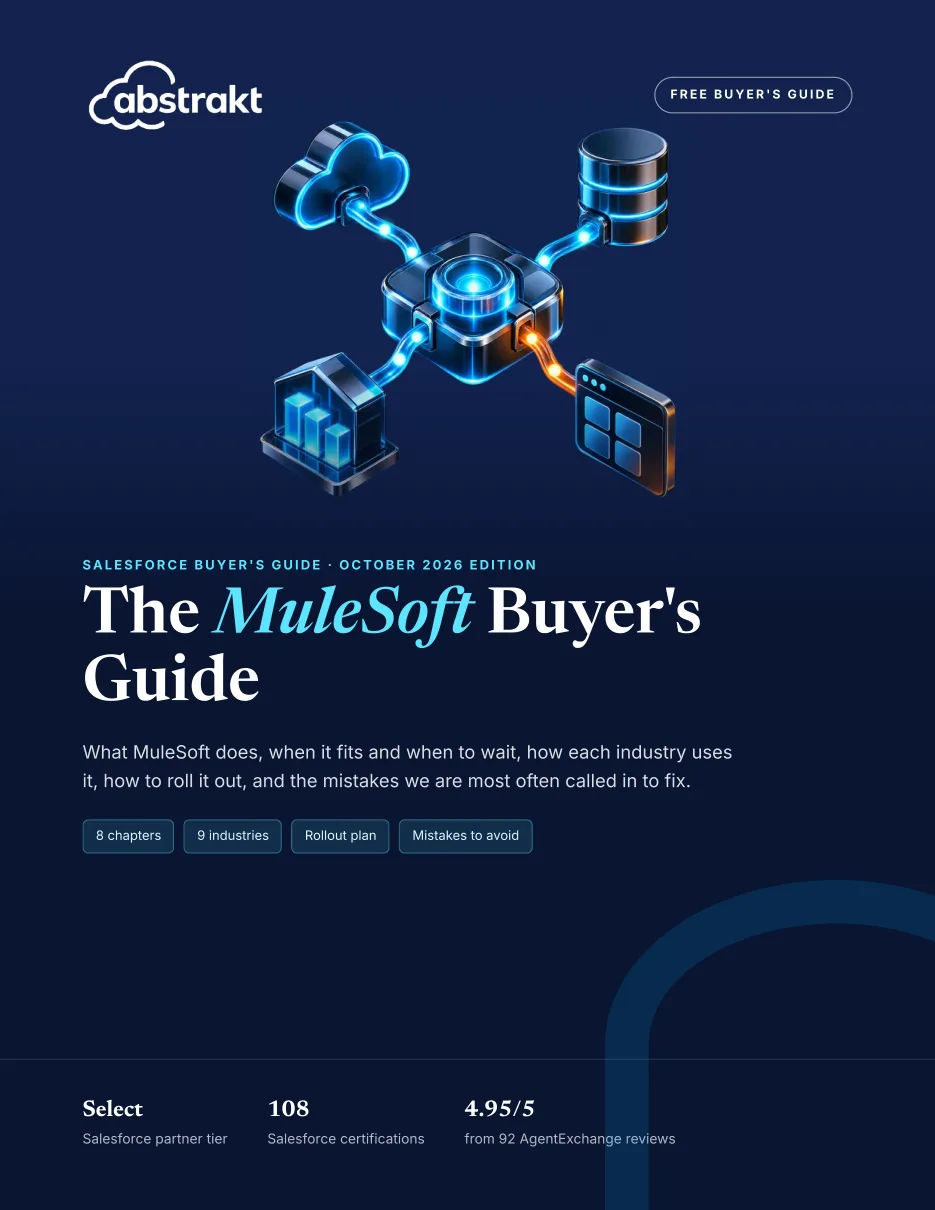
The MuleSoft Buyer's Guide

Connecting Salesforce to other systems at a Salt Lake City company?What MuleSoft does, when it fits and when to wait, the rollout plan and the mistakes to avoid, free for Salt Lake City teams like yours.

Get the guide →
Also freeSalt Lake City's Salesforce market brief24 pages on Salt Lake City's growth, industry mix and tech talent costs, for planning integration work.
Scope

What our integration covers.

  • Integration design
  • ERP integration
  • Middleware
  • Marketing and support tools
  • Monitoring

How our salesforce integration works →

Salesforce products

FAQ

Integration in Salt Lake City: questions.

Can Salesforce integrate with the loan or payments platform our Utah engineers built?

Yes, provided the platform exposes an API or can publish events. We work with your engineers to agree payloads, authentication and error handling, then build the Salesforce side, often through MuleSoft so the contract between systems is managed in one place. Where the platform lacks an API, we can start with scheduled file exchange and move to real-time integration once one becomes available.

Should product usage data go into Salesforce or Data 360?

Summaries belong on the account, such as active users, last login or feature adoption scores, because reps and success managers use them daily. Detailed event streams belong in Data 360 (formerly Data Cloud) or a warehouse, where they can be segmented without filling Salesforce storage. Data 360 can then feed calculated insights back onto records, giving teams the signal without the raw volume.

Once the connectors are live, does our Utah engineering team own them or do you?

Whoever fits your team. We deliver a runbook, monitoring dashboards and documented mappings so your engineers or admin can support it. If your engineers are fully committed to the product, we can carry the integrations in a managed services arrangement: watching for failures, applying fixes and adjusting mappings when either system changes. We agree the handover path at kickoff so ownership is never unclear after launch.

Planning integration in Salt Lake City? Let’s talk it through.

Tech Talk · monthly newsletter

Valuable insights on technology, CRM and AI, once a month.

Written by the consultants who do the work. One email a month, and you can unsubscribe anytime.

We never share your email. See past issues →

Call (314) 916-4095 Book a consultation
Call (314) 916-4095 Book a call