
Salesforce consulting for Salt Lake City companies
Our Salesforce consulting in this market covers Salt Lake City, Murray, the wider Salt Lake Valley and Tooele County west of the Oquirrh Mountains, with a focus on finance, technology and shared-services organizations. Salt Lake City is one of our focus markets.
The Salt Lake City business landscape
In BEA output figures for the Salt Lake City metro, finance and insurance comes out on top, professional and technical services is runner-up, and manufacturing edges out retail for third. The regional development sources are statewide rather than metro-specific. EDCUtah’s information technology profile, updated June 2024, reports an IT employee base of more than 84,000 and over 10,500 IT-related establishments across Utah, and describes Silicon Slopes as a 50-mile corridor south of Salt Lake City. Software companies across several segments are headquartered in the state, and much of Utah’s larger software activity sits in Utah County, just south of the metro.
Utah’s Governor’s Office of Economic Development targets tech (AI, quantum and blockchain), life sciences and healthcare, aerospace and defense, and energy and minerals, and runs a Startup State Initiative. EDCUtah publishes industry profiles on financial services, fintech, and headquarters and shared services, among others. The Silicon Slopes Industry Association, Women Tech Council, founded in 2007, and Tech Moms are named as groups linking education with industry.
Figures cover the Salt Lake City-Murray, UT Metro Area (UT).
- Finance and insurance14.5%Share of 2024 metro GDP Salesforce for mortgage & lending →
- Professional, scientific, and technical services8.7%Share of 2024 metro GDP Salesforce for professional services →
- Manufacturing8.0%Share of 2024 metro GDP Salesforce for manufacturing →
- Retail trade6.9%Share of 2024 metro GDP Salesforce for retail & consumer goods →
- Wholesale tradeat least 6.3%Share of 2024 metro GDP
Regional target sectorsTech (AI, Quantum, Blockchain), Life Sciences & Healthcare, Aerospace & Defense, Energy & Minerals, Financial Services / FinTech (EDCUtah industry profiles), Headquarters and Shared Services (EDCUtah industry profile)Utah Governor's Office of Economic Development (business.utah.gov) (statewide; not Salt Lake metro specific)
Where Salesforce fits in Salt Lake City’s economy (4)
The largest private sectors by share of 2024 metro GDP, and what Salesforce work usually looks like in each.
| Sector | Share of 2024 GDP | Where Salesforce fits |
|---|---|---|
| Finance and insuranceSalesforce for mortgage & lending → | 14.5% | Finance and insurance is the metro’s largest private sector, and EDCUtah profiles both financial services and fintech statewide. Lenders, card issuers, payment companies and insurers need servicing consoles, compliant outreach and clear audit trails. |
| Professional, scientific, and technical servicesSalesforce for professional services → | 8.7% | Consulting, engineering and custom software firms fall in this sector, and many of them work alongside Utah’s Silicon Slopes tech community. Subscription businesses need product usage, renewals and expansion revenue in view alongside new-logo pipeline. |
| ManufacturingSalesforce for manufacturing → | 8.0% | Aerospace and advanced materials each have an EDCUtah industry profile, and the governor’s office lists aerospace and defense as a target. Producers selling engineered parts need configured quotes, program tracking and customer service linked to ERP data. |
| Retail tradeSalesforce for retail & consumer goods → | 6.9% | Retail trade ranks fourth among the metro’s private sectors in BEA data, just behind manufacturing. Store chains, e-commerce sellers and consumer brands depend on customer data, service and marketing working from the same profile. |
Source: U.S. Bureau of Economic Analysis, GDP by county (CAGDP2), 2024, summed to the metro area; private sectors only, excluding real estate and government. “At least” marks sectors where BEA suppresses some county figures.
Salt Lake City by the numbers: the trend, not just the size (4)
Salt Lake City has grown well ahead of the country since 2019, led by technology, finance and professional services.
Business applications grew 42.6%, below the 62.2% national rate. Salesforce demand comes more from expanding established companies than from new firms.
Census Business Formation Statistics, county data summed to the metro, 2019–2025Real GDP is up 18.4%, well above the U.S. 12.8%. Growing firms often need orgs reorganized for new teams, products and territories.
BEA real GDP by county (CAGDP9), summed to the metro, 2019–2024Private employment increased 11.0%, more than double the national rate. User onboarding and access design are recurring Salesforce needs.
BLS Quarterly Census of Employment and Wages, 2019 and 2024Computer systems design is 1.52 times the national concentration, grew 21.8% and pays an average above $161,000. The Silicon Slopes talent pool is deep and competitive.
BLS QCEW, NAICS 5415, 2019 and 2024Leading private sectors in Salt Lake City, 2024: concentration, growth and pay
| Sector | Concentration vs U.S. | Job growth 2019–2024 | U.S. job growth | Average annual pay |
|---|---|---|---|---|
| Finance and insurance | 1.55 | +6.0% | +4.4% | $111,668 |
| Professional, scientific, and technical services | 1.35 | +25.8% | +13.0% | $119,174 |
| Manufacturing | 0.93 | +6.5% | -0.3% | $80,170 |
| Retail trade | 0.92 | -1.2% | -0.8% | $49,293 |
| Computer systems design and related services | 1.52 | +21.8% | +11.1% | $161,285 |
Finance and insurance is 1.55 times the national share, and professional services (1.35) added 25.8% more jobs. Software companies and financial services firms drive much of the region's Salesforce work.
BLS Quarterly Census of Employment and Wages for Salt Lake City, 2019 and 2024 · How these measures work
Across the Salt Lake City metro (4)
We work with companies throughout the metro area as the Census Bureau defines it.
Principal cities (2)
- Murray
- Salt Lake City
Counties (2)
- Salt Lake County
- Tooele County
Salesforce in Salt Lake City, service by service (7)
Each service has its own page for Salt Lake City: what the work involves here, the industries it applies to and the questions local teams ask.
Optimization
Salesforce optimization for Salt Lake City orgs built fast: automation cleanup, trusted revenue dashboards and higher adoption without a rebuild.
See Salt Lake City optimization →Implementation
Salesforce builds for Utah lenders, fintechs, software firms and manufacturers, with clear data ownership, tight security and a phased launch.
See Salt Lake City implementation →Integration
Connect Salesforce to fintech platforms, billing, product data and ERP for Salt Lake City companies, using MuleSoft or APIs with monitoring.
See Salt Lake City integration →Migration
Migration to Salesforce from HubSpot, starter CRMs and spreadsheets for Salt Lake City software, finance and retail firms, with history intact.
See Salt Lake City migration →Health Check
Salt Lake City Salesforce health checks covering access, data quality, technical debt and Agentforce readiness for finance and software companies.
See Salt Lake City health check →Managed Services
A shared backlog, sandbox-tested releases and steady enhancements for Salt Lake City fintech, software and shared-services Salesforce orgs.
See Salt Lake City managed services →Implementation Rescue
When a Salt Lake City fintech, software or manufacturing Salesforce project fails, we triage the org, stabilize daily work, then finish it.
See Salt Lake City implementation rescue →Salesforce products we implement for Salt Lake City teams
Agentforce jobs worth piloting in Salt Lake City
Salt Lake City has an unusually large financial sector for its size, 14.5% of metro GDP in 2024, and the region lists financial services and fintech among its target industries. Those teams live in documents and queues. Agentforce can read loan paperwork and flag missing items, summarize disputes before a specialist picks them up, and suggest replies that a reviewer edits. Professional and technical services (8.7%) tend to value lead triage that separates qualified inquiries from noise. Manufacturers (8.0%) can give technicians an assistant that surfaces equipment history and procedures on a work order. Each use relies on permission sets scoped tightly and knowledge content that compliance has approved.
- Flagging gaps in loan paperwork
- Dispute summaries for specialists
- Technician assistant on work orders
Salesforce for Salt Lake City’s leading industries (4)
Mortgage & Lending
Salesforce for Salt Lake City lenders and fintechs: digital application funnels, partner channels, servicing retention and consent-aware marketing.
See Salesforce for mortgage & lending in Salt Lake City →Professional Services
Salesforce for Salt Lake City IT services, engineering and consulting firms: pipeline by practice, subscription renewals and partner co-selling.
See Salesforce for professional services in Salt Lake City →Health & Life Sciences
Salesforce for Salt Lake City health data companies, device makers and providers: subscription renewals with health systems, rep networks, access.
See Salesforce for health & life sciences in Salt Lake City →Retail & Consumer Goods
Salesforce for Salt Lake City online retailers, marketplaces and direct-to-consumer brands: contact centers, seller support and unified profiles.
See Salesforce for retail & consumer goods in Salt Lake City →Common Salesforce challenges in these industries (3)
- 01
Startups that outgrew their first org
Fast-growing software companies often build Salesforce quickly, then find duplicate objects, brittle automation and unreliable renewal data blocking their next stage.
- 02
Regulated finance on modern stacks
Fintech and lending firms tend to run custom platforms, so connecting them to Salesforce securely, with the right consent and audit controls, takes deliberate integration design.
- 03
Shared-services centers serving a whole company
Headquarters and shared-services operations commonly support customers and staff nationwide, which calls for routing, knowledge and reporting built for volume across time zones.
What Salesforce should look like for Salt Lake City companies (2)
Starting points for the industries that lead this market, not templates. Every org differs; these show the systems and the order they usually connect in.
A Salt Lake City lender, card issuer or payments company
- Core servicing or custom fintech platform
- MuleSoft or a lighter API layer with audit logging
- Financial Services Cloud: applicants, households, financial accounts
- Service Cloud console for disputes and servicing requests
- Marketing Cloud with consent recorded per contact
- Agentforce flags for missing loan documents
Finance and insurance is 14.5% of metro output here, and many of these firms run custom platforms rather than packaged cores. Decide which system owns each customer field before integration starts, or balances and statuses will disagree across screens.
A Salt Lake City producer of engineered aerospace and advanced-materials parts
- ERP: routings, inventory, shipments
- Revenue Cloud for configured quotes with margin approvals
- Sales Cloud with program tracking by customer
- Field Service for technicians on customer equipment
- Service Cloud for customer inquiries and returns
- Agentforce technician assistant on work orders
Aerospace producers sell engineered parts into long programs, so quotes, program history and service need to sit on the same account. Settle how configured pricing and approvals work before choosing between Revenue Cloud and standard quotes.
How Salt Lake City revenue teams connect Salesforce to the rest of the stack (4)
Salt Lake City's largest private sector is finance and insurance, followed by professional and technical services and manufacturing, and many firms here grew up as software or fintech companies. Stacks tend to be modern but loosely governed, so the work is connecting custom platforms to Salesforce with proper audit controls and cleaning up revenue data.
- 1
Product → Customer success
Product usage brought into account views through Data 360, so success managers see adoption risk before renewal.
- 2
Marketing → Sales
HubSpot or Account Engagement leads scored and routed in Sales Cloud, with Chili Piper booking demos and Orum supporting outbound calling.
- 3
Servicing platform → Service
Account status and disputes synced through MuleSoft so Service Cloud agents work from current balances.
- 4
All teams → Leadership
Gong call data and Snowflake or Tableau reporting on pipeline, renewals and servicing volume, built on shared account definitions.
Our work in these industries (3)
Client names are anonymized and these projects are not specific to Salt Lake City.
Salesforce guides from our team (3)
Written by the consultants delivering the work.

Salesforce mobile app for field sales: setup that reps will use
How to set up the Salesforce mobile app so outside reps log visits and deals: phone pages, compact layouts, quick actions, sync, offline, maps, security, piloting and adoption.
Salesforce web-to-lead and lead capture: getting clean leads in
How to get clean website leads into Salesforce: Web-to-Lead, Account Engagement and API capture, spam and duplicate controls, UTM and source fields, consent, testing and monitoring.
Industry GuidesSalesforce for mortgage lenders: leads, referrals and LOS handoffs
How mortgage lenders, banks and business lenders use Salesforce for speed-to-lead, loan officer routing, referral partners, LOS integration, consent, nurture and AI scoring, and what phase one covers.
Industry guides for Salt Lake City companies (3)
- Professional Services Salesforce for professional services firms: pipeline to delivery
- Health & Life Sciences Health Cloud implementation: patient data, care teams and compliance
- Retail & Consumer Goods Salesforce for retail and consumer goods: shoppers, orders, trade
Cost, staffing and partner choice in Salt Lake City (3)
What drives the cost
Salt Lake City scope is usually set by how much cleanup an existing org needs, how many custom platforms must connect, and how much consent, encryption and audit design lenders and fintechs require. Shared-services centers add routing and knowledge work for high case volume.
How Salesforce consulting is priced →Hire, outsource or both
Software and fintech companies here often have engineers who can build on Salesforce but no one who owns its design. A partner typically supplies architecture and governance while internal teams handle smaller changes, and smaller firms outsource administration entirely.
Managed services vs. an in-house admin →Choosing a partner
Ask how the partner restructures an org that grew without a plan, for Financial Services Cloud references with custom-platform integration, and how they document consent and audit controls. Ask what they would remove before adding anything.
Compare partners with the free scorecard →What Salesforce-related talent costs in Salt Lake City (4)
These are the federal occupations closest to Salesforce work, measured for the Salt Lake City metro beside U.S. averages.
Annual wages for related occupations, Salt Lake City and United States, May 2025
| Occupation (SOC code) | Salt Lake City mean | Salt Lake City median | U.S. mean | Salt Lake City jobs |
|---|---|---|---|---|
| Computer systems analysts(15-1211) | $99,100 | $98,400 | $114,610 | 2,010 |
| Network and computer systems administrators(15-1244) | $103,840 | $99,110 | $103,680 | 1,130 |
| Software developers(15-1252) | $131,400 | $129,600 | $148,100 | 19,040 |
| Computer and information systems managers(11-3021) | $168,450 | $160,810 | $192,160 | 5,620 |
BLS Occupational Employment and Wage Statistics, May 2025: Salt Lake City metro and U.S. estimates · About these figures
Salt Lake City analysts and IT managers earn about 12% to 14% under the national mean, with administrators at par; BLS withholds the database administrator wage. Software employers' demand may lift real offers above these figures.
Planner: in-house admin or outside support?
Compare the yearly cost of employing Salesforce staff in Salt Lake City with a quote you have for outside support · How the planner works
In-house cost per year:$148,387
Enter an outside quote to compare.
Managed services vs an in-house admin → · Managed services in Salt Lake City →
The Salt Lake City Salesforce market brief, Q4 2026.
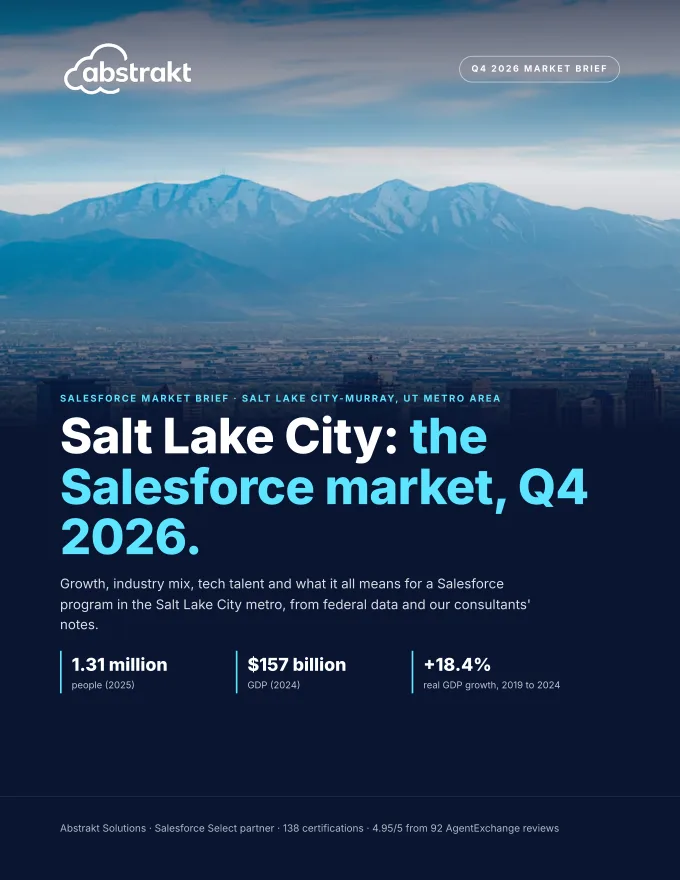
Everything on this page and more in one 24-page download for your planning: Salt Lake City's growth since 2019 ranked against 100 metros, its industry mix, what related tech roles pay here compared with the U.S., the Salt Lake City industry and service guides, and how Salt Lake City compares with nearby metros.
A new edition of the Salt Lake City brief is posted here each quarter, after the federal data refresh.
Salesforce consulting in Salt Lake City: questions (10)
Our SaaS company grew up in the Silicon Slopes scene around Salt Lake City and our Salesforce org is a mess. Where should cleanup start?
Start with a health check that inventories objects, fields, flows and installed packages, then flag what nobody uses. Fix the revenue data model next: clean account hierarchies, one subscription or contract structure, and renewal opportunities created automatically. Retire overlapping automation before adding new features. Once the basics hold, Data 360 (formerly Data Cloud) can bring product usage into account views, so customer success teams see adoption risk before a renewal comes due.
EDCUtah profiles financial services and fintech as Utah industries. Before a Salt Lake City lender or fintech firm switches Salesforce on, which questions need answers?
Settle ownership first: for every customer field, name the single platform that is authoritative. Loan or account servicing usually stays in the core platform, with Salesforce holding relationships, applications in progress and service history. Financial Services Cloud supplies objects for financial accounts and households. Agree on consent tracking for marketing, field-level encryption for sensitive identifiers, and retention rules with compliance early. MuleSoft or a lighter API layer then keeps balances and statuses current without nightly spreadsheet uploads.
We sell analytics software to hospitals and health systems from the Salt Lake area. What belongs in Salesforce when a health-system deal takes a year or more to close?
Health system purchases involve clinical, IT, security and finance stakeholders, so map buying committees with contact roles and track security questionnaires and business associate agreements as milestones. Keep protected health information out of the sales org entirely; it rarely belongs there. After signing, an implementation project record with go-live dates and success metrics hands off to customer success, and renewal forecasts draw on product adoption data brought in through an integration.
What raises or lowers the effort of a Salt Lake City Salesforce project?
Existing org condition is often the largest factor, since duplicate objects and brittle automation must be sorted out before new work. Integrations with custom lending, payments or product platforms come next. Regulated firms add consent, encryption and retention design that must be agreed with compliance early.
Our Salt Lake City company has engineers who can code. Do we still need a Salesforce admin or partner?
Engineers can build, but someone still has to own the data model, permissions and release process. A dedicated admin fits when request volume is steady; managed services fits when you need architecture and admin skills without hiring each. Leaving it to whoever is free is how orgs end up needing a rebuild.
Should we expect a consultant to be stationed at our Salt Lake City office?
That isn't how the work runs. Configuration, integration and testing happen in your Salesforce org during scheduled working sessions with your team, so a consultant at your office each day isn't necessary.
How should a Salt Lake City lender connect its loan origination platform to Salesforce?
Keep the origination and servicing platform authoritative for loan data and bring application status, missing items and key dates into Salesforce for loan officers and service staff. Use MuleSoft or a lighter API layer with logging of every sync. Encrypt sensitive identifiers and limit who can view them.
Can Agentforce review loan files for a Utah lender or fintech?
It can check a file against a required-documents list, flag what is missing and draft a request to the borrower for a person to send. It should not decide on credit. Tight permission sets and compliance-approved knowledge content come first.
How should a Salt Lake City shared-services center set up Service Cloud for nationwide volume?
Route cases by skill, product and customer time zone, and build knowledge articles for the questions that make up most of the volume. Measure handle time and first-contact resolution by queue. Summaries on handoff save the next agent from rereading long threads.
How can a Salt Lake City retailer bring store, online and service data together?
Data 360 can unify customer records from commerce, point of sale and service into one profile. Marketing Cloud then uses that profile for messages, and Service Cloud agents see recent orders on each case. Start with identity matching rules, since the same shopper often appears under several emails.
Planning a Salesforce project? Read how Salesforce consulting is priced, the questions to ask a Salesforce consulting partner, or compare partners with our free scorecard.
Salesforce community groups in Salt Lake City (2)
Salesforce's Trailblazer Community lists these local groups, where admins, developers and Salesforce owners meet to compare notes.
- Salesforce Admin Group, Salt Lake City, United States · last meetup August 11, 2026
- Salesforce Women in Tech Group, Salt Lake City, United States · last meetup September 22, 2026
Events and meetup dates checked on the official group pages on October 15, 2026.
Working across the West? (3)
The same team works with companies in these nearby metros. All 100 markets →
Sources and review (13)
Sources for the figures on this page
- U.S. Census Bureau, Population Estimates Program, Vintage 2025 (cbsa-est2025-alldata), July 1, 2025 estimate (accessed 2026-09-25)
- U.S. Bureau of Economic Analysis, CAGDP2 GDP by county (line 1, All industry total, current dollars), 2024; summed over the CBSA's component counties per Census Vintage 2025 delineation (accessed 2026-09-25; metro total summed from county figures)
- U.S. Census Bureau, County Business Patterns 2023, MSA file (NAICS total '------', ESTAB) (accessed 2026-09-25)
- Utah Governor's Office of Economic Development (business.utah.gov) (statewide; not Salt Lake metro specific)
- EDCUtah (statewide; not Salt Lake metro specific)
- EDCUtah
- U.S. Census Bureau, Core Based Statistical Areas delineation files (July 2023), lists 1 and 2
- U.S. Census Bureau, Business Formation Statistics, county-level annual business applications (2019-2025; retrieved 2026-10-20; Sum of component-county applications; growth computed as latest/base - 1. Published only when every component county matches.)
- U.S. Bureau of Economic Analysis, CAGDP9 Real GDP by county, chained 2017 dollars, all industry total (2019-2024; retrieved 2026-10-15; Sum of component-county real GDP; growth computed as latest/base - 1. Published only when every county matches (independent cities and combined areas need manual mapping).)
- U.S. Bureau of Labor Statistics, Quarterly Census of Employment and Wages, annual averages, private ownership (2019 and 2024 annual averages; retrieved 2026-10-15; Employment growth computed as latest/base - 1. Location quotients and pay as published by BLS. Suppressed values stored as null.)
- U.S. Bureau of Labor Statistics, Occupational Employment and Wage Statistics, May 2025 (May 2025; retrieved 2026-10-20; Related occupations only. BLS publishes no Salesforce Administrator occupation; these figures are not Salesforce salaries.)
- U.S. Bureau of Labor Statistics, Employer Costs for Employee Compensation, private industry workers (2026 2nd Quarter; retrieved 2026-10-15; benefitsOnWages = benefits cost per hour / wages and salaries cost per hour (national average, all private industry).)
- Salesforce Trailblazer Community Groups, Official group pages (public, robots.txt-permitted paths only) (verified 2026-10-15)
Last reviewed October 5, 2026. See how Salt Lake City compares with the other 99 markets in the U.S. Salesforce market report.