Salesforce Integration · Wichita

Salesforce integration consulting in Wichita.

Aimed at Air Capital suppliers and freight operators who want the customer-facing side of the business to stop phoning the plant or dispatch desk for answers.

4.95/5 from 92 AgentExchange reviews Salesforce Select partner since 2017 138 certifications, client case studies

Salesforce Integration for Wichita companies

In Wichita, integration work is dominated by manufacturing: ERP orders, pricing and invoices, quality and certification records, and sometimes shop-floor status. Ownership of each record type is settled up front; tool choice between MuleSoft, Workato and hand-built APIs follows from how many systems talk and how much data moves; and alerting plus reconciliation are built in rather than bolted on. Account managers then see order history and delivery performance in Salesforce, and service teams can answer customers without calling the plant.

Local industries

How integration plays out in Wichita.

Aerospace

Aerospace suppliers in what GWP calls the Air Capital of the World depend on connecting Salesforce with program, part and quality data. We integrate ERP so quotes use current pricing and accepted quotes create orders, and we bring in delivery performance and certification status so account managers arrive prepared for customer reviews. Serialized parts can be synced as asset records for repair work, with the quality system remaining the source of traceability.
Advanced Manufacturing & Materials

Advanced manufacturing and materials is one of GWP's key industries, covering composites, machining and specialty materials makers. Their integrations typically connect product masters, price lists and order status from ERP, plus capacity or lead-time data where planning systems provide it. We use MuleSoft when several plant and business systems are involved, since reusable APIs pay off as more connections are added, and lighter tools where just a handful of links are needed.

Integration for Manufacturing →

Transportation & Logistics

For a logistics firm in one of GWP's key industries, the valuable connection is between customer-facing teams and the systems that track loads, shipments and warehouse activity. We bring exception alerts, proof of delivery and claim status onto the Salesforce account and case, and route new customer setups from Salesforce to operations with the fields dispatch needs. Batch updates cover routine data, while delays and damage claims move as they occur.

Plan for it

What to plan for in Wichita.

01

Design around plant systems

Shop-floor and quality systems in Wichita plants were rarely built to share data. Assess what each can export or expose before designing, and choose file exchange, database views or APIs based on what the system supports reliably under production load.

02

Protect controlled technical data

Defense-related and export-controlled information should not flow into general Salesforce objects. Filter integrations so only commercial and status data reaches Salesforce, document the boundary for your security and compliance teams to review, and retest it whenever a field mapping or source system changes.

03

Reconcile, then trust

Before account managers rely on integrated order data, compare totals between ERP and Salesforce for a representative period. Schedule that reconciliation to run automatically afterward, with results sent to a named owner, so drift is caught before it reaches a customer conversation or a quarterly review.

Free 21-page PDF

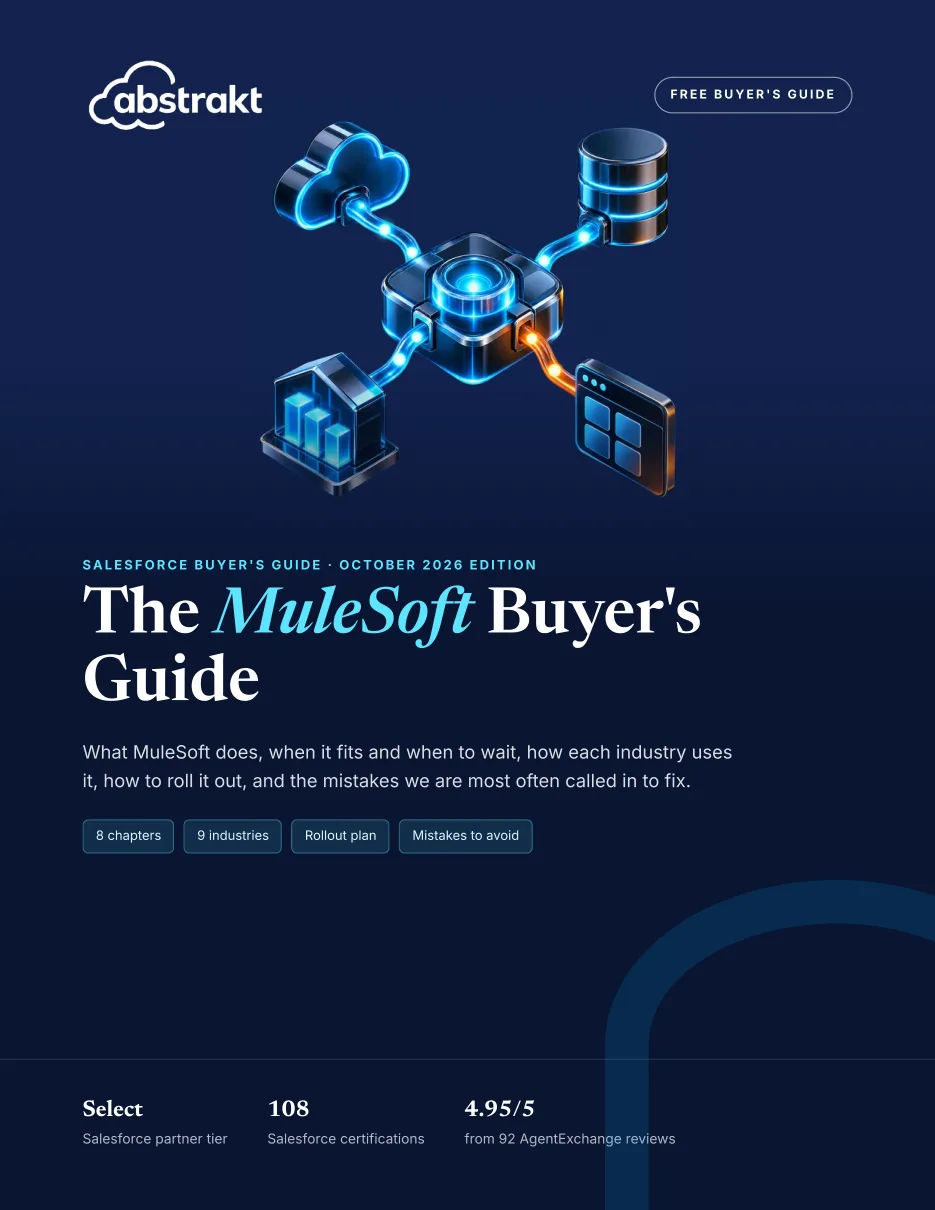
The MuleSoft Buyer's Guide

Connecting Salesforce to other systems at a Wichita company?What MuleSoft does, when it fits and when to wait, the rollout plan and the mistakes to avoid, free for Wichita teams like yours.

Get the guide →
Also freeWichita's Salesforce market brief20 pages on Wichita's growth, industry mix and tech talent costs, for planning integration work.
Scope

What our integration covers.

  • Integration design
  • ERP integration
  • Middleware
  • Marketing and support tools
  • Monitoring

How our salesforce integration works →

Salesforce products

FAQ

Integration in Wichita: questions.

Would a mid-sized Wichita parts maker actually get value from MuleSoft?

Probably, if ERP is only the first of several connections. MuleSoft pays off when ERP, quality, planning and logistics systems all need to exchange data with Salesforce and each other, because reusable APIs reduce the cost of each new connection. For a single ERP link, a lighter tool or direct integration is often more economical. We map your systems and plans before recommending a platform.

Can Salesforce show delivery performance for our aircraft program customers?

Yes, by integrating shipment and order data from ERP. We sync order lines, promised and actual ship dates and quality holds to Salesforce, then build program-level dashboards showing on-time delivery and open issues. Account managers can review that before customer meetings. The ERP remains the system of record, and Salesforce shows a reconciled copy refreshed on an agreed schedule.

A new ERP is somewhere on our roadmap. Is connecting Salesforce to the current one wasted effort?

Not if the integration is designed for the change. We place a middleware layer, often MuleSoft, between Salesforce and ERP, so Salesforce talks to stable APIs rather than to the ERP directly. When the new ERP arrives, the connections behind those APIs are rebuilt while Salesforce processes stay the same. That lets Wichita teams get the benefit of connected data now without paying for the same work twice.

Sources for the figures on this page
  1. Greater Wichita Partnership, Key Industries

Last reviewed September 26, 2026.

Planning integration in Wichita? Let’s talk it through.

Tech Talk · monthly newsletter

Valuable insights on technology, CRM and AI, once a month.

Written by the consultants who do the work. One email a month, and you can unsubscribe anytime.

We never share your email. See past issues →

Call (314) 916-4095 Book a consultation
Call (314) 916-4095 Book a call