

How Salesforce work starts in Denver
Abstrakt Solutions is a Salesforce Consulting Partner for Denver-area professional services, software and aerospace companies. We implement, integrate, optimize and manage Salesforce across metro Denver. Denver is one of our focus markets.
What buyers here usually run into
- 1
Fast-growing tech companies outgrowing their CRM
Software and services companies that started on lighter tools reach a point where territories, renewals and reporting need Salesforce. Migrating carefully avoids carrying old data problems forward.
- 2
Subscription revenue
Recurring-revenue businesses need quoting, renewals and billing data aligned, or forecasts drift from reality.
- 3
Long, technical sales cycles
Aerospace and engineering firms sell over long cycles with many stakeholders, which calls for account planning rather than simple pipelines.
Budget, team and partner questions
What drives cost
Denver costs depend on subscription and renewal complexity for software and telecom firms, integration with ERP or project systems, and how much cleanup a migration from a lighter CRM needs. Energy and aerospace work adds custom objects and audit requirements.
Admin or partner
Engineering and software firms here often have an operations lead who owns Salesforce part time. A partner usually covers architecture, Revenue Cloud and integration, while the internal owner sets priorities and supports users.
What buyers ask a partner
Ask for Revenue Cloud and subscription references, migration plans from lighter CRMs, and experience with long technical sales cycles. Ask who is assigned and how knowledge is handed over at the end of the project.
The local economy and its biggest industries (4)
| Sector | Share of 2024 GDP | Where Salesforce fits |
|---|---|---|
| Professional, scientific, and technical services Salesforce for professional services → | 12.2% | Engineering, consulting and technical services firms, including many serving aerospace and energy, need pursuit pipelines, resourcing and client history across projects. |
| Information Revenue Cloud / CPQ → | at least 7.3% | Software, telecom and media companies run subscription sales, renewals and support, where Sales Cloud, Service Cloud and CPQ need one view of each customer. |
| Wholesale trade Integration → | 7.0% | Distributors across the Mountain West depend on order and inventory data, which is most useful when reps see it inside Salesforce. |
| Finance and insurance Financial Services Cloud → | at least 6.7% | Brokerages, payments and insurance companies need relationship data, onboarding and service at scale, with the controls regulated firms require. |
Source: U.S. Bureau of Economic Analysis, GDP by county (CAGDP2), 2024, summed to the metro area; private sectors only, excluding real estate and government. “At least” marks sectors where BEA suppresses some county figures.
Regional target sectors named by local economic development groups: Aerospace, Bioscience, Energy & Natural Resources, Financial Services, Information Technology and Software, Aviation.
Salesforce products that fit Denver (6)
In the order we lead with them here, from the industries above.
Salesforce Sales Cloud
The CRM where sales pipeline lives, when it is built right.
Salesforce Service Cloud
The operating system for modern customer service, case, knowledge, voice, and AI agent assist together.
Salesforce Revenue Cloud / CPQ
Configure-price-quote, billing, subscription management, and quote-to-cash on Salesforce.
Salesforce Data 360 (Data Cloud)
Unify customer data into a real-time profile that powers segmentation, analytics, and AI.
Salesforce Agentforce
AI agents that handle real work inside Sales Cloud, Service Cloud, and Marketing Cloud.
MuleSoft
Enterprise API platform, for connecting Salesforce, ERP, data warehouses, and the rest of your stack.
Denver's services firms and the AI they can use
In the 2024 BEA data, Denver's engineering, consulting and other technical service firms held roughly 12.2% of metro output, ahead of every other private sector, while wholesale trade added about 7%. For engineering, consulting and software firms, the strongest early use is summarizing long client case threads and drafting status updates that a project lead edits before sending. Wholesale distributors tend to benefit from forecasting support, where an agent explains pipeline movement and flags deals slipping against last quarter. Energy and aerospace suppliers with field crews can give technicians a knowledge-grounded assistant for procedures. Each depends on disciplined opportunity data, a current article library and a person checking outputs during the first months.
- Client thread summaries and status drafts
- Explaining pipeline and slipping deals
- Procedure lookup for field technicians
Services buyers here usually need (7)
Salesforce Implementation in Denver
Salesforce implementations in metro Denver often combine selling and delivery in one design. Professional services, software and aerospace companies here win work through proposals and then deliver it over months or years, so the data model needs projects, renewals or programs connected to accounts and opportunities. We run discovery workshops with sales and delivery leads, agree the objects and security model, build in a sandbox, and release in phases, starting with pipeline and account data before adding service, quoting and delivery tracking.
By industry in Denver
- 1
Professional, scientific, and technical services
No private sector in metro Denver is larger than professional, scientific and technical services, which produced about 12.2% of 2024 GDP. For engineering, consulting and technical firms, the implementation question is how far Salesforce should reach past the sale. Some need only pursuits and client history; others want staffing, project milestones and utilization alongside. We settle that scope in design and connect the CRM to any existing project or time system rather than duplicating what those tools already do well.
- 2
Aerospace
Aerospace is a Metro Denver EDC target sector, and the Front Range cluster spans launch providers, satellite builders and component suppliers. Companies implementing Salesforce in this space need account structures for primes, agencies and commercial operators, opportunity processes that reflect proposals, awards and options, and strict boundaries on technical data. We design those structures and the permission model before building, since both are difficult to change once pursuit records start to accumulate.
- 3
Finance and insurance
Finance and insurance contributes at least 6.7% of metro GDP, and financial services is among the EDC's target sectors. Brokerages, payments companies and insurers here face early choices: Financial Services Cloud or Sales Cloud, how households and business relationships are modeled, and how compliance teams review access. Those choices go into the first design review, alongside sample records from your current systems, so the model is tested against real clients before configuration begins.
Raise before scoping
Connect the sale to delivery
Denver firms that sell projects or programs need a clear handoff from won opportunity to delivery record. Define what data carries over, who owns the account after signing, and how delivery status flows back to sales, so account teams see the whole relationship in one place.
Design the product catalog early
Software and services companies change packaging often. Settle product, price book and bundle structures in the first phase, even if quoting comes later, because opportunity products and revenue reports depend on them from the day users start entering deals, and changing them later means reworking history.
Make adoption a delivery metric
Denver teams that live in proposals and client work will skip any system that feels like extra reporting. Measure logins, updated opportunities and delivery records per role in the weeks after launch, and fix the screens people avoid rather than repeating the training.
Salesforce Migration in Denver
Denver migrations commonly involve software and services companies leaving a starter CRM, financial firms consolidating after acquisitions, and distributors replacing an aging sales database. We inventory each source, map it to the target data model, clean and deduplicate in staging, decide what history is worth carrying, and load in dependency order. Trial loads in a sandbox let your team check records they know, and the cutover plan keeps selling and service running throughout the switch.
By industry in Denver
- 1
Information Technology and Software
Software companies in this Metro Denver EDC target sector often migrate once reporting and territory needs exceed what a lightweight CRM can do. The hard parts are subscription history and product usage records, which rarely map cleanly. We decide which contracts and renewals must become structured records in Salesforce, which history can be summarized, and how opportunities, quotes and renewal dates connect after the move, so the first renewal forecast is trustworthy.
- 2
Financial Services
Financial firms consolidating through acquisition may inherit several client databases with different household definitions and compliance fields. Migration requires a single relationship model first, then careful matching of clients who appear in more than one source. We preserve required records of communication and consent, restrict access to staging data, and reconcile record counts with compliance before the old systems are retired or placed in read-only archive, and we keep a mapping document auditors can follow.
- 3
Bioscience
Bioscience is on the Metro Denver EDC's target list. Early-stage companies often track research partners, investors and first customers across spreadsheets and email. Migration organizes those into accounts for institutions and companies, relates each contact to the right organization, and separates partnership, grant and sales opportunities, so the new org supports both fundraising updates and commercial reporting from the day the team starts using it, rather than after a painful restructuring a year later.
Raise before scoping
Map before extracting
Design the target data model and field mapping before exporting anything. Denver teams that export first often load data into the wrong structure, then pay twice to restructure it once real usage exposes the problems they could have designed out.
Assign data owners
Each object needs someone who decides what to keep, merge or drop. Without owners, cleanup decisions stall or default to moving everything, which carries clutter into the new org and slows every search and report that users run. Name owners at kickoff.
Plan user cutover by team
Switching every team on the same day is not required. Move sales first, then service or partners, with clear dates for when each old system becomes read-only, so nobody keeps updating records in two places after their team has moved.
Salesforce Integration in Denver
Denver integration work usually connects Salesforce to the systems that own money and product data: ERP for distributors, billing and subscription platforms for software companies, and core or portfolio systems for financial firms. We decide which system owns each record, design the pattern, whether real-time APIs, events or scheduled sync, choose MuleSoft or lighter tools to fit, and build monitoring and error handling so problems are visible quickly. The goal is accurate data without switching screens.
By industry in Denver
- 1
Wholesale trade
At roughly 7.0% of 2024 metro GDP, wholesale trade gives Denver a sizable base of distributors whose reps need ERP data in front of them. The core connection brings accounts, credit holds, open orders, invoices, inventory and customer-specific pricing into Salesforce, and sends quotes and new customers back. We define field ownership so no one edits the same value in two places, and build alerts for sync failures that would otherwise leave reps quoting stale prices to customers who notice the difference.
- 2
Information
Software, telecom and media companies typically connect Salesforce to billing, product usage and support platforms. Integration puts subscription status, usage trends and open tickets on the account page, and sends closed deals to billing automatically. Detailed usage events belong in Data 360 (formerly Data Cloud) or a warehouse, with only meaningful signals, such as a sharp drop in activity before renewal, passed into Salesforce where a customer success manager can act on them.
- 3
Financial Services
Financial services firms, one of the EDC's target sectors, need Salesforce to reflect data held in core, custodial, policy or payments systems. Integrations bring balances, holdings, policies or transaction summaries into Financial Services Cloud views, usually read-only, while onboarding and service requests flow outward. Security design matters as much as data mapping: service accounts, encryption and logging are reviewed with compliance before anything goes live, and read-only views keep advisors from editing data that another system masters.
Raise before scoping
Choose real-time only where needed
Not every data flow needs to be instant. Credit holds and order status may need near-real-time updates, while invoice history can sync nightly. Matching timing to business need keeps integrations simpler, cheaper to run and far easier to troubleshoot when something fails.
Standardize identifiers first
Integrations fail when systems disagree about who a customer is. Agree on a shared customer ID across ERP, billing and Salesforce, and clean existing duplicates before connecting anything, or every sync will create new mismatches for someone to resolve by hand.
Document every connection
Record what each integration moves, in which direction, on what schedule and under which user. Denver companies that change vendors or absorb acquisitions often lose this knowledge, which makes later upgrades far riskier than they need to be. A short page per connection, kept current, prevents that.
Salesforce Managed Services in Denver
Denver companies that choose managed services often run orgs with more moving parts than a single admin can cover: Revenue Cloud pricing rules, integrations with billing and product systems, and frequent changes to territories and packaging. We manage the request backlog, user administration, Flow and Apex changes, integration monitoring and release testing, and we plan enhancements with your business owner. You get admins, developers and architects as tasks require, working during hours that overlap almost entirely with yours.
By industry in Denver
- 1
Information
The information sector accounts for at least 7.3% of 2024 metro GDP, spanning software, telecom and media companies. These businesses change price books, bundles and renewal terms often, and each change touches quoting rules, approval flows and reports. A managed services team handles those updates through a tested release process, so a new plan or promotion reaches reps without breaking existing quotes, subscription records or the renewal forecasts finance depends on.
- 2
Financial Services
Financial services is one of the Metro Denver EDC's target sectors, and firms in it work under steady compliance scrutiny. Managed services for them includes documented change approvals, periodic permission reviews, attention to audit trail and field history settings, and careful handling of any change to client data. Requests from advisors or service teams are prioritized within those controls, not around them, and every production change leaves a record compliance can review later.
- 3
Wholesale trade
Distributors in the metro rely on Salesforce data fed from ERP systems for orders, pricing and inventory. Ongoing support watches those integrations for errors, updates account ownership as territories change, and maintains price books and product records so reps quote correctly. When the ERP or Salesforce itself changes, the team tests the connected fields before users notice anything, protecting the order visibility that inside and outside sales teams depend on.
Raise before scoping
Protect quoting configuration
Quoting rules are among the most fragile parts of a Denver software or services org. Require that pricing and product changes go through sandbox testing and a quick business sign-off, even for small requests, so an urgent discount rule does not quietly break renewals.
Plan capacity around your calendar
Quarter-end, renewal season and annual planning bring surges of requests. Tell your managed services team the dates in advance, schedule bigger changes before or after those windows, and keep capacity reserved for quick fixes while sales and finance are under pressure.
Hold regular roadmap reviews
Backlog work alone can drift away from company goals. Meet with your provider at a fixed cadence to review what shipped, what is next and what the business has changed, so the org evolves with strategy rather than only reacting to incoming tickets.
Salesforce Optimization in Denver
Optimization in Denver usually follows a period of fast growth. Software, services and financial firms added teams, products and territories quickly, and each change left fields, flows and reports behind. We measure what people actually use, simplify pages by role, consolidate automation, clean duplicate accounts and contacts, and rebuild the pipeline, renewal and service dashboards leadership relies on. The work is released in tested stages with brief training, so adoption improves rather than dips after each change.
By industry in Denver
- 1
Information Technology and Software
Information technology and software is a Metro Denver EDC target sector, and companies in it tend to change sales motions often: product-led trials, enterprise teams, partner channels. Their orgs collect lead routing rules, scoring fields and stage definitions from every era. Optimization rebuilds lead assignment on current territories, simplifies stages with clear exit criteria, and ties product usage signals to accounts so reps focus on the accounts showing real buying intent.
- 2
Professional, scientific, and technical services
Consulting and engineering firms often find that partners track relationships in email while Salesforce holds only a partial pipeline. Optimization narrows required fields to what matters, automates activity capture, and rebuilds account plans for major clients, so senior staff see value in keeping records current. Better data also makes utilization and pipeline reporting credible enough for leadership meetings, which in turn encourages more people to keep their records up to date.
- 3
Energy & Natural Resources
Energy and natural resources companies, a target sector for the Metro Denver EDC, often built Salesforce for commercial deals and then added regulatory, community or field processes piecemeal. Optimization untangles the overlapping objects that result, standardizes how sites and counterparties are recorded, and consolidates automation that updates the same records from different directions, so commercial and operations teams report from one consistent picture of each asset and relationship, instead of reconciling two versions in meetings.
Raise before scoping
Audit automation before adding more
Many Denver orgs stack legacy workflow, old process automation, newer flows and Apex triggers on a single object. Map the order they run in and consolidate where possible, since overlapping automation is a common cause of slow saves and unexpected field changes that users struggle to explain.
Clean data at the source
Deduplicating records once helps only briefly. Fix the entry points too: web forms, integrations, list imports and manual entry. Add matching rules and validation where duplicates originate, so the cleanup holds after the project ends and new records arrive in consistent shape.
Measure adoption after changes
Decide in advance how you will judge success, such as login frequency, fields completed or fewer side spreadsheets. Check those measures a few weeks after each release, and adjust layouts or training wherever teams are still working around the system.
Salesforce Health Checks in Denver
Denver companies often request a health check when something is about to change: a new cloud, an Agentforce pilot, a partner switch, an acquisition or a leadership question about why reports disagree. We review security and access, data quality, automation, Apex code and technical debt, integrations, Revenue Cloud configuration where present, reporting and adoption. Findings are ranked by risk and effort, with quick wins separated from project-sized work, so leadership can plan and budget the fixes with confidence.
By industry in Denver
- 1
Finance and insurance
Brokerages, payments companies and insurers in the region handle data that regulators and customers expect to be tightly controlled. The review tests profiles and permission sets, sharing on client and account records, field-level security on financial and personal data, event monitoring settings and data export rights. Findings map to specific settings, so compliance staff and admins can agree on fixes, assign them and track each one to closure before the next regulatory exam or customer due-diligence request.
- 2
Aviation
Aviation is another Metro Denver EDC target sector, and aviation businesses often use Salesforce for customer and partner service at volume. A health check for them focuses on case automation and routing performance, the accuracy of knowledge articles, entitlement and service-level processes, and integrations with scheduling or maintenance systems. It shows where slow or conflicting automation is holding agents back and which fixes would shorten handling time most, and whether the knowledge base is ready for an AI agent.
- 3
Information
Software and telecom companies often hit technical debt limits first. Years of Apex triggers, managed packages and quick fixes on opportunities and quotes can push against governor limits and slow every deployment. The review maps code and automation on key objects, checks test coverage and failing tests, and identifies packages no longer in use, giving engineering and revenue operations a sequenced cleanup plan they can schedule alongside feature work instead of postponing indefinitely.
Raise before scoping
Review pricing and quote logic
Quoting configurations accumulate rules and exceptions quickly. Include price rules, discount schedules and approval processes in the health check, since errors there directly affect revenue and are hard to spot from standard reports alone. Test a sample of real quotes against expected totals.
Check integration users
Integration accounts often hold broad administrator rights and passwords that never change. Review each one, restrict permissions to what the connection needs, and move secrets into named credentials managed by your team rather than individual developers who may leave, and log each account's activity.
Prepare data for AI
Before an Agentforce pilot, check that accounts, cases and knowledge are accurate and that the agent's access mirrors a well-scoped human role. Including this readiness view in the health check keeps a pilot from failing because of data rather than the technology.
Salesforce Implementation Rescue in Denver
Denver rescue projects often involve quoting or integration work that promised more than it delivered: a Revenue Cloud build that produces wrong renewal amounts, an ERP connection that never stabilized, or a rollout that went live without the reports leadership expected. We start with triage, reviewing the org, backlog, original scope and user feedback, then deliver a written recommendation on what to keep, fix or rebuild, with a phased plan that restores trust first and adds scope later.
By industry in Denver
- 1
Energy & Natural Resources
Energy and natural resources companies sometimes attempt ambitious Salesforce builds covering regulatory, community, commercial and field processes at once, and stall under the weight of that scope. Rescue narrows the first release to the processes with the clearest owners, stabilizes the data model for sites and counterparties, and schedules the remaining areas as later phases, so something useful reaches users quickly and momentum returns, and the sponsors who funded the project see a result they can point to.
- 2
Wholesale trade
Distributors whose Salesforce project stalled usually share one symptom: reps still check the ERP for every answer, because order, pricing or inventory data never arrived reliably in Salesforce. Rescue prioritizes that integration, stabilizes it with monitoring and error handling, and relaunches with account views that show what reps actually need. Once the data is trustworthy, adoption tends to follow without heavy enforcement from sales managers, because the system finally answers the questions reps used to phone the warehouse about.
- 3
Financial Services
Financial services projects stall when compliance requirements appear late, such as record retention, communication logging or access restrictions for client data. We review the build against those requirements, fix sharing and permissions, and document controls so compliance can approve the launch. Where Financial Services Cloud was licensed but poorly used, we realign the data model with its standard structures instead of the custom objects built around it, which lowers maintenance and makes future upgrades simpler.
Raise before scoping
Get an honest status first
Stalled projects often come with optimistic status reports. Ask for an independent triage covering what works in production, what exists only in sandboxes, and which defects block users, before approving any more spending on the original plan. Its findings become the baseline for every later decision.
Reset scope to essentials
Recovery is faster when the first relaunch covers only what teams need daily. Move the remaining wish list into later phases, with each phase approved against business outcomes rather than the deliverables listed in the original contract, and communicate the new plan to users directly.
Secure your own assets
If a partner relationship ended badly, confirm you hold admin access, sandbox logins, code repositories, integration accounts and documentation. Recovering these early prevents delays and avoids depending on a departed team for anything the recovery needs. Rotate shared passwords as part of the same step.
Industry plays in Denver (3)
Salesforce for Denver Professional Services Firms
Denver professional services firms tend to mix project work with recurring engagements, such as a technology consultancy that builds a system and then supports it, or an engineering firm that designs a facility and stays on for compliance work. Salesforce needs to handle both: opportunities that become statements of work, renewals for retained services, and staffing plans that follow each sale. We design the pipeline around your engagement types, link it to project accounting, and give principals account views they will open before client meetings.
Measured by output, professional, scientific and technical services lead the Denver-Aurora-Centennial economy, with 12.2% of 2024 metro GDP in Bureau of Economic Analysis county figures; information follows at a share of at least 7.3%. The Metro Denver EDC targets aerospace, bioscience, energy and natural resources, financial services, information technology and software, and aviation, a list that doubles as a map of the clients local consultancies serve. The EDC also counts 2,230 aerospace companies across the 12-county Front Range, and a quantum technology consortium of more than 120 organizations includes two of the state's research universities.
Use cases to open with
- 1
From opportunity to statement of work
Scoping errors cost professional firms more than lost deals. A quote in CPQ can start from a packaged offering, such as a discovery phase or a support tier, apply the right blended rates, flag margin below target for a partner's sign-off and output a signature-ready statement of work. When the deal closes, the approved scope flows into project setup so delivery starts from the same assumptions sales used to price the work.
- 2
Retainers and renewals
Many Denver firms keep clients on managed services, compliance programs or support retainers after a project ends. Tracking those agreements in Salesforce with renewal dates, usage against hours and account health signals gives principals time to renegotiate or expand before a contract lapses, and turns recurring revenue into a forecast line rather than a surprise at year end. Account managers get a quarterly list of the agreements that need attention.
- 3
Marketing by client industry
Firms serving aerospace, energy and software clients need different messages for each. Data 360 (formerly Data Cloud) can combine CRM, web and event data so marketing can target contacts by industry, role and engagement, then send briefings, webinar invitations and case material through Marketing Cloud. Principals see which contacts engaged before they call, and campaign results tie back to opportunities for attribution. A contact who opts out of energy briefings still hears about aerospace events if they asked to.
Raise before scoping
Model engagement types first
Fixed-fee projects, time-and-materials work and retainers forecast differently. Define each engagement type, its stages and how revenue is recognized before building, so pipeline reports match how finance thinks about the business instead of forcing everything into one generic opportunity process.
Keep utilization data in sync
Sales forecasts matter most when compared with who is available. Plan the integration with your PSA or time-tracking system early, decide which system owns resource assignments, and refresh availability on a regular schedule so staffing conversations use current numbers. Stale availability data quickly erodes trust in the whole forecast.
Prepare for firm growth
Denver firms often add practices or acquire smaller firms. Use a practice or business-unit field from the start, keep sharing rules flexible, and plan a repeatable way to import an acquired firm's clients without creating duplicate accounts. Integration work after an acquisition goes faster with that groundwork.
Salesforce for Denver Insurers and Agencies
Insurance organizations in metro Denver range from independent agencies and benefits brokers to carrier offices and insurtech startups built by software teams. Salesforce serves them in different ways: agencies need prospecting, cross-sell and renewal workflows, carriers need broker management and policyholder service, and startups need a CRM that scales with their product. In every case the policy administration system stays the record of coverage. We build Salesforce around the relationship and service work, and integrate it so staff are not re-keying policy details.
The Bureau of Economic Analysis puts finance and insurance at a share of at least 6.7% of Denver metro GDP for 2024, a lower bound because some county detail is withheld. Financial services is one of the Metro Denver EDC's target sectors, next to information technology and software, which matters as more insurance distribution moves to digital channels. Professional services, the metro's largest private sector at 12.2%, supplies the actuarial, legal and consulting support insurers rely on. Insurance here is best understood as part of a broader finance and technology cluster rather than a stand-alone industry.
Use cases to open with
- 1
Agency cross-sell and renewals
Independent agencies grow by writing more lines for existing clients. Salesforce can flag a commercial client with property coverage but no cyber or employee benefits policy, schedule renewal reviews well before expiration, and give producers a daily list of accounts to call. Financial Services Cloud adds household and business relationship views so producers see every policy and contact connected to a client.
- 2
Broker and producer management
A carrier distributing through independent agencies has to know, for every partner, which states it is appointed in, what it wrote last quarter and which service tickets are still open. An Experience Cloud broker portal lets partners submit quotes, check submission status and download materials, while carrier distribution teams use Salesforce to rank partners by production and plan visits across a wide multistate territory. Onboarding a new agency becomes a tracked checklist.
- 3
Policyholder service at scale
Billing questions, certificate requests and policy changes generate high service volume. Service Cloud routes each request to the right queue, shows agents policy and billing details pulled from core systems, and tracks resolution times. Self-service in a portal, with Agentforce answering routine questions and drafting responses, takes simple requests off the phone and leaves licensed staff for coverage conversations. Managers see backlog by queue each morning.
Raise before scoping
Connect policy and billing systems
Service and sales both need current policy data. Map which fields come from the policy administration, billing and agency management systems, how often they refresh, and which system wins when data conflicts, before building screens that depend on them. Integration gaps are the most common reason agents stop trusting the CRM.
Track licensing and appointments
Producers and partners must hold the right licenses and carrier appointments for each state and line. Store license data in Salesforce, connect it to your licensing source where possible, and block quoting or commission workflows when requirements are not met.
Govern consumer and health data
Personal lines and benefits work bring consumer financial data under GLBA and, for some benefits products, health information that may fall under HIPAA. Classify sensitive fields, restrict access by role and log who views them, and confirm obligations with compliance counsel.
Salesforce for Denver Manufacturers
Denver manufacturers tend to sell complex, engineered products into long evaluations. A spacecraft component, a lab instrument or a piece of energy equipment may pass through technical reviews, trials and several revisions before an order. Salesforce works when it supports that path: account plans that map every stakeholder, opportunities tied to technical milestones, and quotes that engineering can trust. We connect it to the ERP and product data, and keep the design lean enough for engineers to use.
Federal output data for 2024 rank professional services, information, wholesale, finance and health care as Denver's biggest private sectors, and factories are not on that short list, so we give them no percentage. The industry shows up through the Metro Denver EDC's target list, which includes aerospace, bioscience, and energy and natural resources, and through wholesale trade at 7.0% of GDP. The record also describes a Front Range aerospace and space cluster of 2,230 companies and 58,800 private aerospace jobs in 2025, counted across a wider 12-county area. The regional Elevate Quantum consortium, with more than 120 organizations, adds another emerging hardware field.
Use cases to open with
- 1
Account plans for technical buyers
Aerospace and instrument sales often involve program managers, engineers, procurement and end users with different concerns. Sales Cloud account plans can map each stakeholder, their influence and their open questions, while opportunities track technical milestones such as design reviews, qualification and first article. Managers can see which deals are stalled on a technical question and bring in the right engineer.
- 2
Configured quotes with engineering review
Options, certifications and custom work make quoting error-prone. Revenue Cloud or CPQ can enforce valid configurations, apply pricing rules and require engineering sign-off on non-standard items before a quote leaves the building. Every revision is saved with its approvals, so when a customer returns after a long evaluation, the team knows exactly what was promised, at what price and under which assumptions.
- 3
Customer engineering collaboration
Customers evaluating a complex product want documentation, test results and quick answers from engineers. An Experience Cloud site can share approved documents, host technical questions and track requests by program, keeping the conversation out of scattered inboxes. Account teams see every interaction, and product managers can review recurring questions to guide the next design revision or improve the documentation that ships with the product.
Raise before scoping
Model technical milestones clearly
Generic sales stages hide where engineered deals actually stand. Define stages around evaluation steps your buyers recognize, such as requirements, trial and qualification, and decide which milestone data comes from engineering systems so reps are not asked to retype it.
Control sensitive program data
Aerospace and defense-adjacent programs may involve export-controlled information that should stay in approved systems. Keep only references in Salesforce, restrict program visibility by team, and involve your compliance and security staff in the sharing design before any data is migrated.
Connect distribution and direct
A Denver equipment maker might handle its biggest buyers with its own reps and leave the long tail of small accounts to resellers. Plan account hierarchies, partner access and deal registration together, so reports do not double-count revenue, conflicts between reps and resellers are visible early, and channel partners do not see one another's pipeline.
Case studies to send (3)
From the industries this market leans on. Client names are anonymized and these projects are not specific to Denver.
The Denver Salesforce market brief, Q4 2026
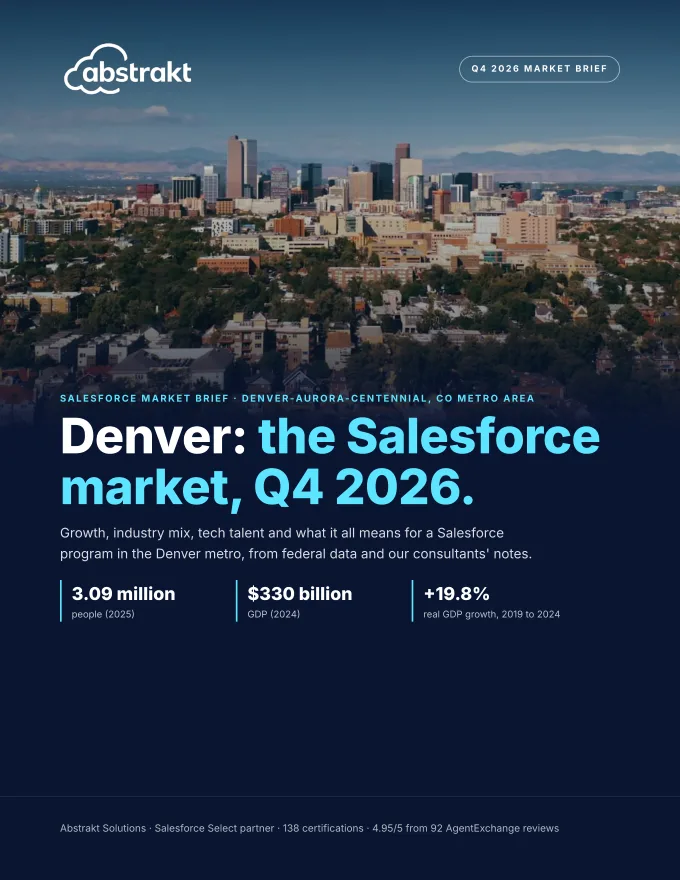
A free 22-page PDF with Denver's growth ranked against 100 metros, its industry mix, tech wages and nearby markets. It is offered on the public Denver page; send your customer there or get a copy for your own prep.
Get the Denver brief →Co-sell with Abstrakt in Denver
Working a Denver account? Bring in a named consultant for discovery, scoping or a health check. We reply within 4 business hours.