

How Salesforce work starts in Salt Lake City
Our Salesforce consulting in this market covers Salt Lake City, Murray, the wider Salt Lake Valley and Tooele County west of the Oquirrh Mountains, with a focus on finance, technology and shared-services organizations. Salt Lake City is one of our focus markets.
What buyers here usually run into
- 1
Startups that outgrew their first org
Fast-growing software companies often build Salesforce quickly, then find duplicate objects, brittle automation and unreliable renewal data blocking their next stage.
- 2
Regulated finance on modern stacks
Fintech and lending firms tend to run custom platforms, so connecting them to Salesforce securely, with the right consent and audit controls, takes deliberate integration design.
- 3
Shared-services centers serving a whole company
Headquarters and shared-services operations commonly support customers and staff nationwide, which calls for routing, knowledge and reporting built for volume across time zones.
Budget, team and partner questions
What drives cost
Salt Lake City scope is usually set by how much cleanup an existing org needs, how many custom platforms must connect, and how much consent, encryption and audit design lenders and fintechs require. Shared-services centers add routing and knowledge work for high case volume.
Admin or partner
Software and fintech companies here often have engineers who can build on Salesforce but no one who owns its design. A partner typically supplies architecture and governance while internal teams handle smaller changes, and smaller firms outsource administration entirely.
What buyers ask a partner
Ask how the partner restructures an org that grew without a plan, for Financial Services Cloud references with custom-platform integration, and how they document consent and audit controls. Ask what they would remove before adding anything.
The local economy and its biggest industries (4)
| Sector | Share of 2024 GDP | Where Salesforce fits |
|---|---|---|
| Finance and insurance Salesforce for mortgage & lending → | 14.5% | Finance and insurance is the metro’s largest private sector, and EDCUtah profiles both financial services and fintech statewide. Lenders, card issuers, payment companies and insurers need servicing consoles, compliant outreach and clear audit trails. |
| Professional, scientific, and technical services Salesforce for professional services → | 8.7% | Consulting, engineering and custom software firms fall in this sector, and many of them work alongside Utah’s Silicon Slopes tech community. Subscription businesses need product usage, renewals and expansion revenue in view alongside new-logo pipeline. |
| Manufacturing Salesforce for manufacturing → | 8.0% | Aerospace and advanced materials each have an EDCUtah industry profile, and the governor’s office lists aerospace and defense as a target. Producers selling engineered parts need configured quotes, program tracking and customer service linked to ERP data. |
| Retail trade Salesforce for retail & consumer goods → | 6.9% | Retail trade ranks fourth among the metro’s private sectors in BEA data, just behind manufacturing. Store chains, e-commerce sellers and consumer brands depend on customer data, service and marketing working from the same profile. |
Source: U.S. Bureau of Economic Analysis, GDP by county (CAGDP2), 2024, summed to the metro area; private sectors only, excluding real estate and government. “At least” marks sectors where BEA suppresses some county figures.
Regional target sectors named by local economic development groups: Tech (AI, Quantum, Blockchain), Life Sciences & Healthcare, Aerospace & Defense, Energy & Minerals, Financial Services / FinTech (EDCUtah industry profiles), Headquarters and Shared Services (EDCUtah industry profile).
Salesforce products that fit Salt Lake City (6)
In the order we lead with them here, from the industries above.
Salesforce Sales Cloud
The CRM where sales pipeline lives, when it is built right.
Salesforce Service Cloud
The operating system for modern customer service, case, knowledge, voice, and AI agent assist together.
Salesforce Financial Services Cloud
Industry CRM for wealth management, banking, insurance, and lending, built for compliance from the start.
Salesforce Data 360 (Data Cloud)
Unify customer data into a real-time profile that powers segmentation, analytics, and AI.
Salesforce Agentforce
AI agents that handle real work inside Sales Cloud, Service Cloud, and Marketing Cloud.
MuleSoft
Enterprise API platform, for connecting Salesforce, ERP, data warehouses, and the rest of your stack.
Agentforce jobs worth piloting in Salt Lake City
Salt Lake City has an unusually large financial sector for its size, 14.5% of metro GDP in 2024, and the region lists financial services and fintech among its target industries. Those teams live in documents and queues. Agentforce can read loan paperwork and flag missing items, summarize disputes before a specialist picks them up, and suggest replies that a reviewer edits. Professional and technical services (8.7%) tend to value lead triage that separates qualified inquiries from noise. Manufacturers (8.0%) can give technicians an assistant that surfaces equipment history and procedures on a work order. Each use relies on permission sets scoped tightly and knowledge content that compliance has approved.
- Flagging gaps in loan paperwork
- Dispute summaries for specialists
- Technician assistant on work orders
Services buyers here usually need (7)
Salesforce Optimization in Salt Lake City
Optimization in Salt Lake City often means untangling an org that was built at startup speed. Several admins, contractors and packages have added objects and automation over the years, and renewal or pipeline reports no longer match finance. We measure adoption and data quality, consolidate overlapping Flows and triggers, rationalize the revenue data model, rebuild the dashboards leaders use, and retrain each team on the simpler version, without taking the org offline or starting over.
By industry in Salt Lake City
- 1
Professional, scientific, and technical services
Firms selling professional, scientific and technical expertise generated about 8.7% of the Salt Lake City metro's 2024 GDP, second only to finance. Consulting and software firms in this sector often see adoption fall because staff must log time, pipeline and account notes in separate places. Optimization streamlines those entries, uses Flow to create renewal and follow-up tasks automatically, and rebuilds utilization and backlog reports so partners and practice leads can manage from Salesforce instead of exporting data into spreadsheets every week.
- 2
Tech (AI, Quantum, Blockchain)
Utah's economic development office targets AI, quantum and blockchain companies. Young tech firms in these fields tend to layer tools quickly: a product-led signup flow, a usage database, a support desk, then Salesforce. Optimization for them focuses on connecting product usage to accounts through Data 360 (formerly Data Cloud), cleaning duplicate leads created by self-serve signups, and reporting on conversion from free users to paid accounts that sales and product teams both accept as accurate.
- 3
Finance and insurance
Lenders and insurers often have Salesforce orgs where servicing agents juggle several consoles and tabs to answer one question. We streamline Lightning console layouts, surface core-platform data in one panel, and replace manual case updates with Flow automation, keeping compliance-sensitive steps intact and documented. Dashboards for call reasons, first-contact resolution and complaint trends are rebuilt so leaders can act on them rather than debating the numbers. Agents help test each change before it ships.
Raise before scoping
Audit installed packages
Fast-growing orgs collect AgentExchange packages for trials that ended long ago. Check which are still licensed, which still run automation or store data, and which can be removed. Unused packages slow page loads, complicate releases and occasionally hold permissions nobody reviewed.
Fix the revenue data first
For subscription businesses, dashboards break when contracts, renewals and expansion live in inconsistent structures. Standardize how renewals are created and how expansion is recorded before rebuilding reports, or the new dashboards will inherit the same arguments with finance. Involve finance in that decision.
Retrain after every change
Even well-designed simplifications fail if users keep old habits. Pair each release with a short, role-specific walkthrough and a one-page note, and watch field-completion and login data for a few weeks afterward to confirm the change took hold. Adjust anything people ignore.
Salesforce Implementation in Salt Lake City
Salt Lake City implementations frequently involve companies that grew quickly on a mix of custom platforms, spreadsheets and a starter CRM. Because finance and insurance leads the metro's economy, many builds also carry consent, audit and encryption requirements from the first workshop. We agree which system owns each record, design the objects and sharing model around those decisions, configure in a sandbox, migrate cleaned data and launch in phases.
By industry in Salt Lake City
- 1
Finance and insurance
Finance and insurance generated about 14.5% of 2024 metro GDP, the largest private share. Lenders, card issuers and insurers implementing Financial Services Cloud here must decide early how customers, financial accounts and applications relate, and which fields the core servicing platform keeps authoritative. We set those boundaries in design, add field-level encryption and audit history where compliance needs them, and keep balances flowing in from source systems instead of being edited in Salesforce.
- 2
Professional, scientific, and technical services
Consulting, engineering and software firms in this sector sell engagements or subscriptions rather than products off a shelf. Their implementation hinges on modeling contracts, renewals and expansion alongside new business, and on linking resourcing or usage data to accounts. We build opportunity types for each revenue motion, automate renewal creation from contract end dates, and design reports that separate new-logo pipeline from growth in the installed base. Resourcing and billing systems connect in a later phase.
- 3
Aerospace & Defense
The governor's office names aerospace and defense as a targeted industry. Suppliers in that field implement Salesforce to manage long programs, prime-contractor relationships and bids that span years. We model programs as parent records for opportunities and quotes, restrict access by program where contracts require it, and settle before building which technical data stays out of the CRM entirely. Service processes for fielded parts come in a later phase, once the sales side is stable.
Raise before scoping
Map every source system
Growing Utah companies often run a custom product database, billing tool and support desk alongside any CRM. List each one, what it owns and how it will reach Salesforce before design starts, so the data model reflects real integrations rather than assumptions made in a workshop.
Design for national service
Headquarters and shared-services teams in the valley often support customers across every U.S. time zone. Build queues, business hours and routing rules for that spread from the start; retrofitting multiple time zones into service levels and escalation rules after launch disrupts agents mid-shift.
Leave room for Agentforce
Many new orgs here are expected to support AI agents soon after launch. Keep the data model standard where possible, document what each field means and set permissions tightly now, so a later Agentforce rollout builds on the core org instead of forcing a redesign.
Salesforce Integration in Salt Lake City
In Salt Lake City, integration projects often connect Salesforce to systems a company built itself: loan platforms, payment engines, product usage databases and internal admin tools, alongside billing and ERP. We document which system owns each field, design APIs or events with consent and audit controls where regulated data is involved, build with MuleSoft or lighter tooling as volumes justify, and set up monitoring with named owners so failures surface before customers or examiners notice them.
By industry in Salt Lake City
- 1
Financial Services / FinTech
Fintech and lending firms run core platforms their own engineers maintain. Integrating those with Salesforce calls for versioned APIs, careful handling of identifiers such as account and tax numbers, and clear rules about which systems may write to which fields. We often place MuleSoft or a thin API layer between them, so product teams can change the platform without breaking CRM processes, and we log every call for audit review.
- 2
Manufacturing
At about 8.0% of 2024 metro output, manufacturing ranks third among the Salt Lake City area's private sectors. Producers of engineered parts, including aerospace and advanced materials suppliers, need ERP inventory, lead times and order status visible on Salesforce opportunities and cases. We design the sync around the ERP as the master for products and prices, push booked orders back automatically, and add alerts when an open quote references a part the ERP has since changed or retired.
- 3
Life Sciences & Healthcare
Life sciences and healthcare is a targeted industry for Utah's economic development office. Healthcare technology and device companies here usually connect Salesforce to product analytics, contract systems and support tools, while keeping protected health information out of the CRM. We design integrations that carry account-level usage and contract status, strip or never collect patient identifiers, and give customer success teams a single view of adoption across hospital and clinic customers.
Raise before scoping
Treat your platform as a product
When the other system is one your engineers build, integration contracts need version control and change notices just as external APIs do. Agree how breaking changes are announced, tested in a Salesforce sandbox and released, or the CRM will fail quietly after a routine deploy.
Size for real volumes
Consumer lenders, payment firms and retailers can generate far more events than a typical B2B org. Test integrations with production-scale data, check Salesforce API and storage limits, and decide which detail belongs in Data 360 (formerly Data Cloud) or a warehouse instead of standard objects.
Log for audit, not debugging
Regulated firms may need to show who changed a customer record and which system sent the update. Design integration logs to keep that lineage, with retention agreed with compliance, rather than relying on error logs that are cleared after a few days.
Salesforce Migration in Salt Lake City
Many Salt Lake City companies reach Salesforce after outgrowing tools they chose at launch: HubSpot for marketing and early sales, a homegrown admin panel for customers, spreadsheets for everything else. Migration brings those together. We profile each source, map records to a Salesforce model that supports the next stage of growth, deduplicate before loading, preserve the history that sales and compliance need, rehearse the load in a sandbox and cut over on a planned date.
By industry in Salt Lake City
- 1
Professional, scientific, and technical services
Software and consulting firms moving off HubSpot or a startup CRM need their subscription history to survive the move. We map deals, line items and contract dates into opportunities, products and renewal structures, carry marketing attribution across so campaign reporting stays continuous, and repoint web forms and sequences at Salesforce on cutover day. Duplicate contacts created by years of form submissions are merged before the load rather than after it.
- 2
Finance and insurance
Lenders and insurers moving onto Financial Services Cloud usually migrate from a mix of an older CRM, point-of-sale tools and servicing exports. Data has to be reshaped into households, financial accounts and applications, and sensitive identifiers handled under encryption from extract to load. We reconcile record counts and key balances against source systems, and keep a documented audit trail of the migration that compliance teams can review afterward. Temporary files are deleted once counts match.
- 3
Retail trade
Retailers migrating customer service to Salesforce often bring case history from a standalone help desk and customer profiles from an e-commerce platform. We match shoppers across both using email and order numbers, decide how many years of tickets agents need at hand, archive the rest, and load knowledge articles with their categories intact. Cutover is timed outside promotional peaks so agents learn the new console during a quieter stretch of the retail calendar.
Raise before scoping
Carry marketing consent across
Email opt-outs, SMS consent and preference settings must move with the contact record. Losing them during a HubSpot or marketing-tool migration can mean emailing people who unsubscribed. Map consent fields explicitly, test them in the sandbox load, and verify suppression lists before the first campaign runs.
Retire tools on a schedule
Decide when each old system becomes read-only and when its license ends. Running two CRMs for months invites double entry and conflicting data. A dated decommission plan, with an archive for anything not migrated, keeps every team focused on Salesforce.
Keep external IDs on records
Store each source system's record ID on the matching Salesforce record. Those keys let you trace migrated data back to its origin, rerun loads safely, and build later integrations with product or billing systems without another round of matching. Adding them costs little.
Salesforce Health Checks in Salt Lake City
Salt Lake City companies usually commission a health check at a turning point: an Agentforce pilot, a regulatory exam, a funding round or a new admin inheriting an unfamiliar org. We review permissions, sharing, connected apps and integration users; measure duplicates and incomplete records on key objects; inventory Flows, triggers, Apex and installed packages; and check reports and adoption. The result is a ranked list of risks with recommended fixes and a view of whether your data can support AI agents.
By industry in Salt Lake City
- 1
Finance and insurance
Lenders, card issuers and insurers face examiners who ask how customer data is protected. A health check documents the Salesforce side: who holds admin rights, which integration users have broad access, whether sensitive identifiers are encrypted and tracked, how consent is recorded and how long data is kept. Each gap is ranked by regulatory exposure, so compliance and technology leaders agree on what to close before the next review. Owners and due dates can be assigned directly from the report.
- 2
Tech (AI, Quantum, Blockchain)
Companies in the AI, quantum and blockchain fields that Utah targets are often among the first to try Agentforce. Our review tests readiness honestly: whether account and case data is complete enough to ground an agent, whether knowledge content is current, and whether permissions keep agents from reaching records a user should not see. Findings show which use cases can start now and which need cleanup first. Pilots then start where the data is strongest.
- 3
Headquarters and Shared Services
Shared-services centers built on Service Cloud often accumulate years of queues, entitlement processes and macros from successive reorganizations. A health check inventories which of those still receive work, which automation conflicts, and where case volume pushes against platform limits. It also reviews agent access to records from multiple business units, since shared teams frequently hold wider visibility than their tasks require, which becomes a larger risk once AI agents inherit it.
Raise before scoping
Include integration users
Connections to fintech platforms, billing and product systems often run as users with near-admin permissions. Review every integration and connected app, reduce each to the objects and fields it truly needs, and rotate any credentials held by former employees or vendors.
Test AI readiness with real questions
Instead of a generic readiness score, pick a few questions an Agentforce agent would actually answer for your customers or staff, then check whether the data, knowledge and permissions exist to answer them correctly. The gaps you find become the cleanup plan.
Prepare for due diligence
Growing companies raising capital or preparing for acquisition get asked about data ownership, security controls and customer records. A recent health check report, with fixes underway, answers those questions with evidence rather than reassurance from whoever built the org. Investors and acquirers notice the difference.
Salesforce Managed Services in Salt Lake City
Managed services for Salt Lake City companies tends to cover orgs that change constantly. Software firms add products and pricing each quarter, lenders adjust disclosures and workflows, and shared-services centers keep reworking routing as volumes shift. We run a single prioritized backlog, deliver enhancements in regular sprints, test each Salesforce release in a sandbox, monitor integrations with core and billing systems, and keep documentation current so a departing admin never takes the org's knowledge with them.
By industry in Salt Lake City
- 1
Financial Services / FinTech
EDCUtah publishes separate profiles for financial services and fintech. Firms in both run Salesforce next to fast-moving product platforms, and each platform release can change a field, status or API that the CRM relies on. Managed services keeps those connections in step: we review upcoming platform changes with your engineers, adjust integrations and Flows ahead of deployment, and record every change for compliance review, so servicing agents are not surprised by missing data.
- 2
Headquarters and Shared Services
Headquarters and shared services has its own EDCUtah profile. Centers serving a company's customers or employees nationwide depend on queues, entitlements, knowledge articles and routing that shift with every reorganization. Our managed services team handles those updates as routine tickets, keeps knowledge publishing permissions orderly, and watches case volumes after each change so a routing mistake is caught quickly rather than discovered in the monthly service report. Knowledge gaps spotted in case notes become new article requests.
- 3
Retail trade
Stores and online sellers made up roughly 6.9% of Salt Lake City's 2024 output in BEA's retail trade figures. Store chains and e-commerce sellers lean on Salesforce most around promotions and holiday peaks, exactly when a broken case rule or email journey hurts most. Managed services for them includes change freezes ahead of peak periods, pre-season testing of service routing and marketing integrations, and a backlog of improvements scheduled for quieter months when agents have time to learn new features.
Raise before scoping
Plan around product releases
Utah software and fintech companies ship product changes often. Share your release calendar with the managed services team so CRM updates, integration adjustments and user training land alongside each product launch instead of trailing it by a sprint or more.
Define request categories realistically
Decide which request types need a same-day response, which fit the next sprint and which wait for quarterly planning. Written categories keep a fast-growing company's many requesters from treating every ask as urgent and spending the monthly allotment on minor changes.
Document as you go
Fast-growing firms rarely record why fields and automation exist. Ask for documentation as part of every managed ticket, stored where admins and developers can find it, so onboarding new staff or another partner never depends on anyone's memory. Review it each quarter.
Salesforce Implementation Rescue in Salt Lake City
Troubled Salesforce projects in Salt Lake City often share a cause: the company grew faster than the design. Scope expanded as new products, markets or regulatory requirements arrived, and the build never caught up. Rescue starts with triage of the org, its integrations and what users actually need today. We stop the failures disrupting daily work, decide which components to keep, then finish in short phases that deliver working features to a team that has been waiting.
By industry in Salt Lake City
- 1
Finance and insurance
Rescues at lenders and insurers often trace back to an integration with the servicing platform that was never finished, leaving agents to copy balances and statuses by hand. We stabilize that connection first, with monitoring and error handling, then revisit the Financial Services Cloud data model and consent tracking that were rushed to meet a launch. Compliance reviews each fix before release, so trust rebuilds on both the business and control sides.
- 2
Life Sciences & Healthcare
Healthcare technology companies sometimes launch Salesforce with protected health information mixed into sales or support records because nobody set boundaries in design. Recovery starts by locating and removing that data, tightening access and documenting the fix for security reviewers. Then we rebuild the processes that stalled, such as long hospital buying cycles, implementation handoffs and renewal tracking, on a structure that keeps clinical data where it belongs. Security reviewers sign off before relaunch.
- 3
Aerospace & Defense
Aerospace and defense suppliers stall when a generic sales build ignores program structure and contract access rules. Reps then track bids in spreadsheets, and leadership loses the backlog view it was promised. Our recovery reorganizes opportunities under program records, applies access restrictions that match contract requirements, and brings the spreadsheet bids back into Salesforce once the structure is sound, so the first relaunch already shows real pipeline. Program managers review each release.
Raise before scoping
Freeze scope during triage
While the assessment runs, pause new feature requests. Every addition to an unstable org adds risk and muddies the diagnosis. Collect requests in a list, and decide which belong in the recovery plan once the team understands what is broken and why.
Check the integrations first
In fast-growing companies, a failing integration with a product, billing or servicing platform is often the real reason users abandon Salesforce. Diagnose those connections before redesigning screens, since clean data arriving reliably solves more adoption complaints than new layouts do.
Restore the sponsor's confidence
A failed project usually costs its executive sponsor credibility. Give that person a short recovery plan with visible checkpoints, and report progress against it plainly, including setbacks. Sponsors who can see the path forward keep funding and defending the work.
Industry plays in Salt Lake City (4)
Salesforce for Salt Lake City Lenders
When a Salt Lake City lender originates online or through partners, its borrowers can sit in many states at once, and the CRM has to keep up. Salesforce supports that model by tracking applicants from first click through funding, managing broker, dealer and embedded-finance partners, and keeping funded customers engaged for the next product. We integrate it with origination and servicing platforms, build consent and state licensing logic into outreach, and give leaders a funnel view that shows where applicants and partners drop off.
Finance and insurance is the dominant private industry around Salt Lake City, accounting for 14.5% of 2024 metro GDP in Bureau of Economic Analysis county figures, far ahead of professional services at 8.7%; lending is part of that total rather than reported alone. Financial services and fintech are statewide target sectors for EDCUtah, and the state's economic development office targets technology including blockchain. A statewide IT workforce of more than 84,000 gives lenders local engineering talent for digital products.
Use cases to open with
- 1
Digital application funnel
Online lenders win or lose borrowers in the minutes after an application starts. Salesforce can capture every started application with source, product and stage, trigger follow-up through Marketing Cloud when someone stalls, and route high-intent applicants to a licensed loan officer. Leaders see conversion by channel and step, and product teams know which screens or document requests cost the most applicants.
- 2
Broker and partner channels
Many Salt Lake lenders grow through mortgage brokers, auto or equipment dealers and embedded-finance partners. Financial Services Cloud tracks each partner's agreements, volume, pull-through and compliance documents, while Experience Cloud gives partners a portal to submit deals and check status. Channel managers spot declining partners early and focus onboarding on the ones producing quality loans. Partner scorecards built on funded volume and early payment performance make pricing and incentive decisions easier to defend.
- 3
Servicing and retention
A borrower who has already repaid on time is a known quantity. Data 360 (formerly Data Cloud) can combine servicing, payment and product data to identify customers eligible for refinance, a second loan or a deposit product, and Marketing Cloud delivers consent-aware offers. Servicing agents using Service Cloud see the same context, so a payment question can become a retention conversation at the right moment.
Raise before scoping
Build in multi-state licensing
Lenders serving borrowers nationwide must respect state licensing, disclosure and marketing rules. Store the borrower's state and the lender's license status on applications and campaigns, and have compliance approve routing and messaging logic before launch. Licenses lapse and renew, so the status must stay current rather than being set once and forgotten.
Guard consumer financial data
Applications contain income, credit and identity data covered by GLBA privacy and safeguards expectations. Limit fields in Salesforce to what sales and service need, encrypt sensitive values such as tax identifiers, and restrict partner portal access to each partner's own deals and borrowers.
Integrate origination in real time
Digital lenders need fast status updates. Decide which origination events, such as submitted, approved, conditioned and funded, sync to Salesforce in near real time, and design error handling so a failed sync does not leave borrowers receiving the wrong message.
Salesforce for Salt Lake City Professional Services
Salt Lake City's professional services firms often sell to technology companies, financial institutions and regional headquarters, and many deliver work through partnerships with software vendors or cloud platforms. Salesforce helps them manage pipeline by practice, track renewals of managed services and retainers, and co-sell with technology partners without losing sight of who sourced the deal. We design the system around your delivery model, connect it to project and billing tools, and give partners a clear view of backlog and capacity.
Consulting, engineering and technical firms produced 8.7% of the Salt Lake City metro's 2024 output, according to the Bureau of Economic Analysis, trailing only the region's large financial sector. The state's economic development office targets technology, including AI, quantum and blockchain, and EDCUtah profiles headquarters and shared services as a statewide sector. Utah has more than 10,500 IT-related establishments and a tech corridor stretching south of Salt Lake City, a customer base that keeps implementation partners, consultants and engineering firms busy.
Use cases to open with
- 1
Practice-level pipeline and forecasting
Firms with several practices, such as cloud engineering, data, security and advisory, need pipeline and forecasts by practice and by client. Sales Cloud can split opportunities across practices, track resource needs by role, and roll up forecasts that practice leaders and finance agree on. That helps leaders decide when to hire, which pursuits need senior staff and where utilization will dip.
- 2
Technology partner co-selling
Many local services firms resell or implement software from larger vendors. Salesforce can track which partner sourced each opportunity, registered deals, joint account plans and partner contacts, so co-selling motions are measurable. Partner managers see which vendor relationships generate revenue and can prepare stronger quarterly reviews with data on joint wins. Certifications held by your consultants can be tracked too, since vendors often tie partner tiers to them.
- 3
Managed services renewals
Retainers, support subscriptions and managed services create recurring revenue that needs careful renewal management. Revenue Cloud or CPQ can price service tiers, and Sales Cloud creates renewal opportunities ahead of term end, with usage and client satisfaction attached. Account leaders act on at-risk renewals before notice periods pass and find upsell openings in growing accounts. Finance gets a cleaner view of recurring revenue for planning and valuation.
Raise before scoping
Model partner attribution clearly
When deals involve vendors, resellers and referral partners, attribution disputes follow. Define partner roles, deal registration steps and credit rules before build, so reports on partner-sourced revenue are trusted by your team and your technology partners, and compensation plans can reference the same numbers.
Connect delivery and finance
Time tracking, project accounting and invoicing usually live outside Salesforce. Decide which system creates projects and how budgets, hours and revenue sync, so leaders compare pipeline and backlog with real utilization rather than estimates. Reconcile a month of data with finance before trusting the dashboards.
Plan for fast growth
Salt Lake firms can add practices and staff quickly. Keep the data model standard, use permission sets rather than one-off profiles, and document naming conventions, so new hires and acquired teams fit into the org without a redesign. A named internal owner for the platform keeps changes from piling up.
Salesforce for Salt Lake City Health and Life Sciences
In Salt Lake City, health and life sciences overlap heavily with the tech community: companies selling data, analytics and software to hospitals work alongside device makers and care providers. Salesforce helps each in a different way. Health data companies manage long enterprise sales, implementation and renewals with health systems. Device and diagnostics makers manage sales reps, distributors and service. Hospitals and clinics lean on it for scheduling centers and patient outreach. We keep protected health information out of vendor CRMs where possible and design strict controls where it is not.
You will not find hospitals and clinics on the metro's top-five private sector list in BEA's 2024 data; lenders, card issuers and insurers lead at 14.5%, followed by professional and technical firms at 8.7%. The industry shows up instead through Utah's statewide target lists: the Governor's Office of Economic Development names life sciences and healthcare, and EDCUtah publishes a life sciences industry profile. Healthcare data and analytics is part of the state's IT sector, and the Silicon Slopes community provides resources for both tech and life sciences companies.
Use cases to open with
- 1
Health system subscription renewals
Analytics and software vendors sell multi-year subscriptions to hospitals and health systems, where renewal depends on proven value. Salesforce can track each client's contract term, modules, usage, support tickets and executive sponsors, and open renewal opportunities early. Customer success teams document outcomes the client has achieved, so renewal conversations start from evidence rather than a price increase notice. Expansion into new modules is tracked the same way.
- 2
Device rep and distributor network
Medical device and diagnostics companies often sell through a mix of direct reps and independent distributors across several western states. Sales Cloud can assign territories, track accounts and procedures supported, and share leads with distributors through an Experience Cloud portal. Sales leaders compare direct and distributor performance, and commissions can draw on the same opportunity and order data. Distributor contracts and renewal dates sit on the account.
- 3
Implementation handoff to delivery
After a health system signs, implementation teams must gather data feeds, security approvals and clinical champions before value appears. Salesforce can carry scope, promised timelines and key contacts from the sales process into an implementation project, visible to sales, delivery and support. Early risks such as delayed data access become visible to leadership while there is still time to act.
Raise before scoping
Keep PHI out when possible
An analytics vendor's CRM exists to sell and support software, not to hold anyone's medical history. Design case forms, email handling and attachments to discourage PHI, train support staff accordingly, and put a business associate agreement and encryption in place only if patient information cannot be avoided.
Statewide data, local focus
Utah's sector profiles and target lists are statewide, and many life sciences and tech firms sit in Utah County rather than Salt Lake County. Build territories and account data around actual locations, not assumptions, so reporting reflects where customers and teams really are.
Work around the release calendar
Schedule workshops and go-live around your product release calendar and busiest renewal periods, so customer-facing teams are not learning a new system while they are also shipping or renewing.
Salesforce for Salt Lake City Retailers and Consumer Brands
Retail in Salt Lake City has a strong online and service-center character: e-commerce companies, marketplace operations and direct-to-consumer brands supporting customers across the country from Utah. Salesforce can run their contact centers, support marketplace sellers, and unify shopper data from commerce, service and marketing tools into one profile. Agentforce can resolve routine order questions at scale. We integrate with order management, payments and fulfillment systems so agents and automated replies work from current information.
Stores, online sellers and dealers generated 6.9% of the metro's 2024 output in BEA county data, a hair behind the 8% from manufacturing and good for fourth place. EDCUtah, whose profiles are statewide, lists headquarters and shared services as an industry focus. EDCUtah's IT profile also notes that online retail operations in the state span customer service, software development and corporate functions. That points to a retail sector where e-commerce operations, customer service centers and technology teams are as important as physical stores.
Use cases to open with
- 1
Contact center for online retail
Online retailers handle order status, returns, damaged items and account questions across phone, chat, email and messaging, often from a Utah service center that supports the whole country. Service Cloud can route each contact by reason and loyalty tier, put commerce and carrier data on the agent's screen, and surface the right return policy. Agentforce can resolve simple order questions directly, and supervisors track queues across shifts and time zones.
- 2
Marketplace seller support
Marketplaces support large numbers of sellers with onboarding, listing issues, payouts and policy questions, often from teams split across several locations. An Experience Cloud help center can give sellers self-service knowledge and case submission, while Service Cloud routes cases to specialized teams. Seller account managers see each seller's history, performance and open issues, helping them prioritize high-value sellers and spot problems early.
- 3
Unified direct-to-consumer profiles
Direct-to-consumer brands collect data from commerce platforms, subscriptions, reviews, service interactions and marketing tools. Data 360 (formerly Data Cloud) can stitch those sources into a single permissioned shopper record, which Marketing Cloud then uses for audiences such as lapsed subscribers or serial returners. Service agents see the same record, so a customer who complained yesterday does not receive a cheerful promotion today, and marketers can suppress offers while a case is open.
Raise before scoping
Order data before automation
Agentforce and service agents need accurate, current order, payment and shipment information. Integrate order management and fulfillment systems first, handle edge cases such as split shipments, partial refunds and gift orders, and test automated answers against real historical order scenarios before launch.
Plan for promotion-day spikes
A national sale or holiday weekend can bury a Utah service center under chats and emails within hours. Rehearse the spike: load-test routing and bots, pre-build profiles for seasonal hires, and give supervisors in Salt Lake City and any remote teams live dashboards to rebalance work.
Consumer privacy and consent
Customers across many states bring varied privacy laws and consent expectations. Capture consent by channel and purpose, honor deletion and opt-out requests across every connected system, and review data retention settings with legal staff before unifying profiles in Data 360 (formerly Data Cloud).
Case studies to send (3)
From the industries this market leans on. Client names are anonymized and these projects are not specific to Salt Lake City.
The Salt Lake City Salesforce market brief, Q4 2026
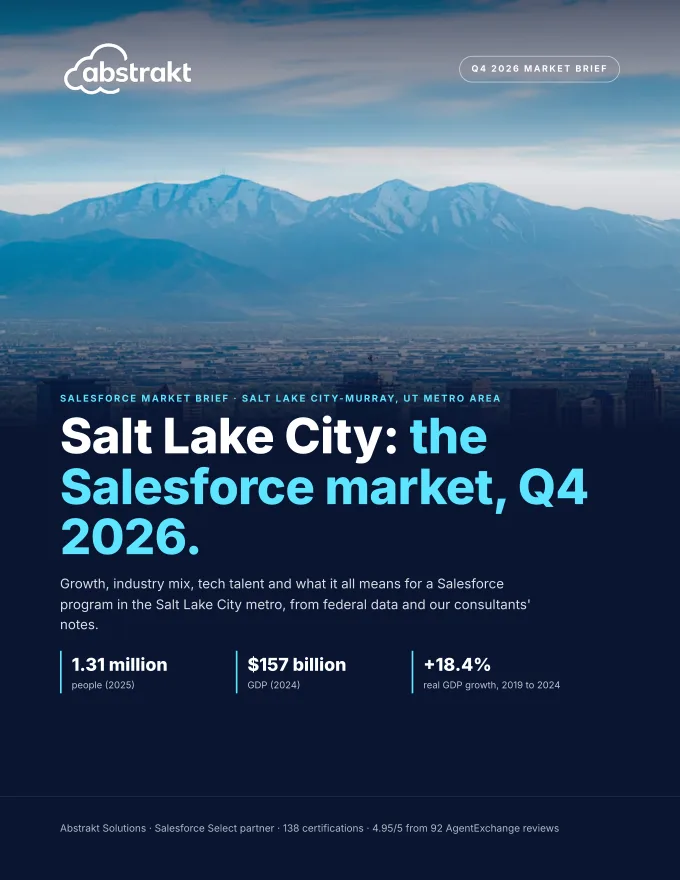
A free 24-page PDF with Salt Lake City's growth ranked against 100 metros, its industry mix, tech wages and nearby markets. It is offered on the public Salt Lake City page; send your customer there or get a copy for your own prep.
Get the Salt Lake City brief →Co-sell with Abstrakt in Salt Lake City
Working a Salt Lake City account? Bring in a named consultant for discovery, scoping or a health check. We reply within 4 business hours.