

How Salesforce work starts in El Paso
Abstrakt Solutions is a Salesforce Consulting Partner serving companies across El Paso and Hudspeth counties, including businesses whose customers and suppliers sit across the border in Ciudad Juárez. El Paso is one of our focus markets.
What buyers here usually run into
- 1
Customers on both sides of the border
When one customer has entities in the U.S. and Mexico, duplicate accounts, mixed currencies and inconsistent addresses build up fast. A clear account hierarchy and matching rules keep pipeline and revenue reports trustworthy.
- 2
High-volume service and processing teams
Large back-office and contact-center operations need routing, knowledge and queue reporting that hold up at scale, often inside an org governed by a parent company elsewhere.
- 3
Controlled defense and aerospace data
Suppliers chasing defense work face strict rules on who may see program information, so permission design, and sometimes a government-grade Salesforce environment, has to be settled early.
Budget, team and partner questions
What drives cost
El Paso scope rises with cross-border complexity: multiple legal entities, currencies and address formats, plus ERP and transportation integrations. Bilingual knowledge and self-service content add work, and defense suppliers need access design settled early.
Admin or partner
Many contact-center and back-office operations here run inside a parent company's Salesforce org, so the local need is a partner who coordinates with the central team. Independent manufacturers and distributors more often outsource administration entirely.
What buyers ask a partner
Ask for examples of multi-currency, multi-entity account design, bilingual service setups and integrations with transportation systems. Defense suppliers should ask how the partner restricts access by program.
The local economy and its biggest industries (4)
| Sector | Share of 2024 GDP | Where Salesforce fits |
|---|---|---|
| Manufacturing Salesforce for manufacturing → | at least 19.4% | Producers in a binational region that the Borderplex Alliance ties to automotive and food production need quoting, customer programs and service history connected to ERP. Aerospace and defense suppliers growing around UTEP's research centers also need disciplined tracking of long pursuits. |
| Health care and social assistance Salesforce for health & life sciences → | 6.3% | A multi-hospital network and a medical school’s health sciences campus anchor a health sector the city also courts through life sciences. Salesforce projects here tend to focus on patient outreach and referral handling, with privacy controls set before launch. |
| Wholesale trade Experience Cloud → | at least 5.2% | Distributors moving goods through El Paso need account terms, order status and customer service that draw on inventory and ERP data. A self-service portal lets buyers on either side of the border check orders without calling in. |
| Transportation and warehousing Sales Cloud → | at least 4.4% | Truckload carriers based in the region, along with the city's focus on logistics and border trade, make shipper relationships, lane quoting and service cases a practical fit for Salesforce. |
Source: U.S. Bureau of Economic Analysis, GDP by county (CAGDP2), 2024, summed to the metro area; private sectors only, excluding real estate and government. “At least” marks sectors where BEA suppresses some county figures.
Regional target sectors named by local economic development groups: Advanced Manufacturing, Aerospace & Defense, Business Services & Support, Life Sciences, Logistics & Border Trade, Automotive; Food Production; Health Science.
Salesforce products that fit El Paso (6)
In the order we lead with them here, from the industries above.
Salesforce Sales Cloud
The CRM where sales pipeline lives, when it is built right.
Salesforce Service Cloud
The operating system for modern customer service, case, knowledge, voice, and AI agent assist together.
Salesforce Revenue Cloud / CPQ
Configure-price-quote, billing, subscription management, and quote-to-cash on Salesforce.
Salesforce Experience Cloud
Customer, partner, and employee portals built on Salesforce.
MuleSoft
Enterprise API platform, for connecting Salesforce, ERP, data warehouses, and the rest of your stack.
Salesforce Field Service
Scheduling, dispatch, mobile work orders and parts for teams that work on site.
AI for El Paso manufacturing and border trade
Manufacturing is at least 19.4% of El Paso's metro GDP according to BEA's 2024 data, and logistics tied to border trade is a regional priority. Shipment and customs paperwork is where AI proves itself: an agent can read commercial invoices and bills of lading, pull key fields into the case, and flag missing items for a broker to verify. Manufacturers can summarize quality and delivery cases for plant managers. Retail trade, the second largest private sector, suits bilingual self-service for order questions if Spanish and English articles are equally maintained. Clean customer and shipment records, role-based access and a human check on anything regulatory are prerequisites.
- Reading invoices and bills of lading
- Quality and delivery case summaries
- Bilingual self-service for order questions
Services buyers here usually need (7)
Salesforce Implementation in El Paso
An El Paso implementation typically has to account for the U.S. and Mexico before the first object is created. Many local manufacturers and distributors bill a U.S. entity while shipping to or sourcing from a related operation in Ciudad Juárez, so the account structure, currency settings and address formats have to be right before any records load. We run discovery with sales, service and finance, settle the data model, build in a sandbox, and phase the launch so the core sales process is live before quoting and portals follow.
By industry in El Paso
- 1
Manufacturing
By BEA's 2024 figures, manufacturing contributes at least 19.4% of El Paso metro output, the largest private share. For producers here, the implementation choice that shapes everything else is how the org represents a plant, its parent company and its customers' ship-to locations on either side of the border. We map quoting, order visibility and warranty history to those structures in design, then decide which ERP data Salesforce should display and which stays in the ERP, before a single page layout is built.
- 2
Aerospace & Defense
The city's economic development office lists aerospace and defense among its key industries, and a university research center for aerospace and advanced manufacturing opened in April 2025 to support it. Suppliers pursuing that work need an implementation where pursuit records, teaming partners and contract vehicles are modeled deliberately, and where access to program information is restricted by role from day one. We decide early whether any controlled data belongs in Salesforce at all, so the org is not torn apart and rebuilt after the first compliance review.
- 3
Business Services & Support
Business services and support is another of the city's target sectors, which covers the brokerage, payroll and insurance processing operations that run large service teams here. A new Service Cloud org for a large processing or contact-center team starts with queues, routing rules, case types and knowledge categories. When the site answers to a parent company's Salesforce team, we agree on naming conventions and deployment paths with that team during design, so the local build fits their standards from the start.
Raise before scoping
Enable currencies before loading data
Multi-currency and address formats for Mexican customers are far easier to set before the first import. Decide which currency each account and opportunity carries, how exchange rates are maintained and how reports roll up to dollars, then build and test those settings in the sandbox.
Give design sessions their own calendar
Design sessions are booked for late morning and early afternoon, when plant, warehouse and office leads can step away together. Kickoff workshops, user acceptance testing and go-live each get dedicated days, because those decisions need the whole group.
Phase quoting after core sales
CPQ is tempting to include from the start, but quoting rules depend on clean products, price books and account structure. Launch accounts, opportunities and activity tracking first, confirm the data is trusted, then add Revenue Cloud quoting in a second phase with its own testing.
Salesforce Integration in El Paso
Integration work in El Paso is dominated by operations data. Manufacturers, distributors and carriers here tend to keep pricing and invoices in an ERP, shipments in a warehouse or transportation system, and customer conversations in Salesforce, often with records for Mexican entities mixed in. We decide which system owns each piece of data, design the flows through MuleSoft or direct APIs, handle currency and address differences in the mapping layer, and build monitoring so a failed sync is caught before a customer calls about a missing order.
By industry in El Paso
- 1
Wholesale trade
Wholesale trade accounts for at least 5.2% of metro GDP, and distributors in El Paso usually need three feeds into Salesforce before anything else: credit status, open orders and invoice history. We sync those from the ERP on a schedule suited to how often each changes, keep order entry in the ERP unless there is a strong reason to move it, and surface the results on the account so reps stop calling accounting before every customer conversation.
- 2
Transportation and warehousing
For carriers and third-party logistics providers, the valuable integration is between Salesforce and the transportation management system. Load counts, on-time performance and claims by shipper can flow into account records, giving sales a factual basis for rate discussions and renewals. We aggregate operational data before it lands, because pushing every individual load event into the CRM creates storage costs and clutter without improving a single pricing or renewal decision anyone makes.
- 3
Advanced Manufacturing
Advanced manufacturing is a city target sector, and the state's economic development corporation names robotics, automation and 3D printing as emerging fields here. Producers in those areas often run engineering or product lifecycle systems alongside ERP. Integration can carry part numbers, configurations and revision status into Salesforce quotes and service cases, so sales does not promise a superseded design and service knows exactly what shipped. We agree on one master for product data before building.
Raise before scoping
Normalize data for both countries
Mexican addresses, tax identifiers and currency codes rarely match U.S. formats in ERP exports. Handle those conversions in the integration layer with documented rules, rather than asking users to fix records by hand, and validate a sample from each entity before turning on live sync.
Choose sync frequency by use
Freshness should match the decision each field supports. A credit hold on a Juárez-bound order should reach the rep within minutes; last month's invoices can wait for a nightly batch. Matching frequency to real needs keeps API usage within limits and makes any failure easier to diagnose when it happens.
Monitor failures, not just success
An integration that fails quietly is worse than none. Set up alerts for rejected records, record counts that drift and authentication errors, route them to a named owner, and review an error log weekly until the flows have run cleanly through a full business cycle.
Salesforce Managed Services in El Paso
Managed services for an El Paso company typically replaces a single overstretched administrator, or covers the gap after one leaves. We take the queue of user requests, maintain permissions as staff change, test each Salesforce seasonal release in a sandbox, and work through a backlog ranked with your leadership. Because many local firms run plant, warehouse or contact-center shifts, we schedule deployments outside those hours and keep a written change log, so operations never discover a new field in the middle of a shift.
By industry in El Paso
- 1
Health care and social assistance
At about 6.3% of 2024 metro GDP, health care and social assistance ranks third among El Paso's private sectors, and the city lists life sciences among its key industries. Providers running Salesforce for referrals, outreach or patient service need an admin partner who treats every permission change as a privacy decision. Our monthly work includes reviewing who can see protected fields, removing access for departed staff promptly, and testing releases against the intake and outreach flows that care coordinators rely on each day.
- 2
Logistics & Border Trade
The city targets logistics and border trade, and brokers, carriers and warehouse operators here tend to change Salesforce constantly: new lanes, new shipper accounts, new fields on quotes for cross-border moves. A managed team keeps those small requests from piling up. We triage tickets weekly, bundle related changes into planned releases, and keep automation documented so a rate or process change on one lane does not quietly break reporting for another.
- 3
Business Services & Support
High-volume service and processing centers, which the city courts under business services and support, depend on routing and knowledge that stay tuned as volumes and products shift. Ongoing work here means adjusting capacity rules, updating knowledge articles, building supervisor dashboards on request and keeping macros current. When the center operates inside a parent company's org, we follow that org's release calendar and submit changes through its governance process rather than around it.
Raise before scoping
Protect shift schedules during releases
Plants, warehouses and contact centers in El Paso often work early or extended shifts. Deployments, data loads and user-facing changes should land in agreed windows, with a short note to supervisors beforehand, so a floor lead is never surprised by a changed screen during a busy run.
Keep one prioritized backlog
Requests arrive from sales, service, finance and operations, frequently by email or hallway conversation. Put every request into a single ranked backlog reviewed monthly with a business owner, so hours go to the changes with the most value rather than to whoever asked loudest.
Document cross-border configuration
Currency settings, address rules and account hierarchies for Mexican entities are easy to break with a well-meant change. Record why each setting exists and test it after every release, so a new admin or a future partner does not undo a design decision nobody wrote down.
Salesforce Optimization in El Paso
Optimization in El Paso usually begins with a complaint we hear often: the org has everything, yet nobody trusts it. Years of additions by different admins leave duplicate fields, overlapping Flows and dashboards built for managers who have since moved on. We interview users on the sales floor, in service and in finance, measure which fields and reports are used, then remove clutter, consolidate automation and rebuild the reports leaders need. Everything is proven in a sandbox first and reaches users in modest, announced batches rather than one large switch.
By industry in El Paso
- 1
Manufacturing
Manufacturers here often run an org that began as a simple pipeline and slowly absorbed quoting spreadsheets, service notes and ERP exports. Optimization means deciding which of those belong in Salesforce, replacing manual re-keying with a proper sync or a single source, and rebuilding forecast reports around the product lines and plants leadership actually tracks. Reps notice the difference first: fewer required fields, clearer stages, and quotes that reflect current pricing instead of last year's spreadsheet.
- 2
Transportation and warehousing
Carriers and warehouse operators in El Paso measure the business by lanes, loads and customer scorecards, while their CRM may still report only on opportunities. We restructure the data so shipper accounts show volume trends, service cases and renewal dates together, and we retire automation that sends duplicate alerts to dispatch. The goal is a dashboard a sales manager can open on Monday morning and trust without exporting anything to a spreadsheet first.
- 3
Life Sciences
Life sciences firms, which the city lists among its target sectors, often set up Salesforce quickly to track distributors, research partners or clinical sites. As they mature, that early setup shows its age: custom objects nobody maintains, approval steps that no longer match the quality process, and reports built on inconsistent definitions. We streamline the model, align approvals with current procedures and write down what each key field means, so new staff and auditors read the data the same way.
Raise before scoping
Measure usage before removing anything
Salesforce already records which fields get filled in, who logs in and which reports anyone runs. Start with that evidence, share it with department heads, and agree on what to retire, so cleanup decisions rest on data rather than on whoever complains most.
Consolidate automation by object
Workflow rules, Process Builder and several generations of Flow often fire on the same record. Moving each object's logic into a small number of well-named Flows makes behavior predictable, speeds up saves and prepares the org for Salesforce retiring its older tools.
Fix currency reporting for binational accounts
When opportunities for Mexican entities are entered in different currencies, pipeline totals can mislead. Confirm the corporate currency, dated exchange rates and which reports convert, so El Paso leadership sees one consistent number for customers operating on both sides of the border.
Salesforce Health Checks in El Paso
An El Paso health check typically follows a change: an admin leaves, a partner relationship ends, the company adds a Mexican entity, or leadership asks whether the org is ready for AI. We review profiles, permission sets and sharing, integration users, automation, code, data quality on key objects and unused customization, and we talk with the people who rely on the system every day. The result is a ranked list of risks and fixes with effort ranges that your team or ours can act on.
By industry in El Paso
- 1
Aerospace & Defense
Suppliers working toward defense contracts need to know who can see program data before an auditor or prime contractor asks. We examine sharing rules, file access, guest user settings and integration permissions, flag any controlled information stored where it should not be, and check whether logging captures the events a compliance officer would need. Findings come with a plain recommendation on what to restrict, move or delete, which helps when a prime's security questionnaire arrives.
- 2
Health care and social assistance
Providers using Salesforce for referrals, outreach or patient service carry privacy risk in places that are easy to miss: report exports, email templates, list views shared too widely and integration logs holding patient details. A health check traces where protected information lives, who can reach it and whether field-level security matches policy. We also review audit trail settings, so the organization can answer an access question with evidence rather than assumptions.
- 3
Business Services & Support
Service and processing centers accumulate queues, routing rules and macros as clients and products change, and old ones rarely get removed. The review measures which queues and case types still receive work, where routing sends cases to empty queues, and whether knowledge articles are current. For centers inside a larger corporate org, we also check that local customizations follow the parent's standards and will survive its next scheduled release without breaking.
Raise before scoping
Review before adding Agentforce
An Agentforce agent answering a border-trade customer sees exactly what its assigned permissions allow, stale records included. Before an El Paso team pilots Agentforce, confirm that sharing is tight, knowledge is current and key fields are complete, or the agent will surface the wrong records with apparent confidence.
Include integrations in scope
Many risks sit in integration users with broad permissions, stored credentials that never rotate and API calls nobody monitors. Ask for those connections to be reviewed alongside the org itself, especially links to ERP and warehouse systems that handle order and pricing data.
Plan who acts on findings
A health check is only useful if someone fixes what it finds. Decide beforehand whether your admin, a managed-services partner or a short project will take the top items, and set aside time for them in the quarter after the review.
Salesforce Migration in El Paso
Most El Paso migrations we scope start from a mix of sources: a legacy CRM, rep spreadsheets, an ERP customer list and sometimes a separate system used for Mexican operations. The same customer can appear under several spellings, legal names and currencies across them. We inventory every source, agree which records survive, deduplicate in a staging area, map fields to the new model and run trial loads in a sandbox. Users check their own accounts before the final cutover, so nothing surprises them on the first morning.
By industry in El Paso
- 1
Transportation and warehousing
Transportation and warehousing contributes at least 4.4% of metro GDP, and carriers here often track shipper relationships in dispatch software, email and spreadsheets rather than a CRM. Migrating them means pulling customer contacts, rate agreements and service history from systems that were never designed to export cleanly. We standardize company names, link contacts to the correct shipper account and bring only the history sales will use, leaving load-level detail in operations.
- 2
Manufacturing
Manufacturers moving to Salesforce frequently hold customer data in an older CRM plus quote files saved by individual engineers or reps. We extract accounts, contacts, open opportunities and recent quotes, match them to ERP customer numbers so future integration works, and archive older quote documents where they remain searchable. Getting the ERP key onto every migrated account is the single step that saves the most rework later, and it costs little during the migration itself.
- 3
Health care and social assistance
Clinics, home health agencies and social service providers in the region sometimes run outreach and referral tracking in spreadsheets or a basic contact tool. Moving that data into Salesforce requires deciding which fields contain protected health information, whether they belong in the CRM at all, and how consent and communication preferences transfer. We classify data before migration and load sensitive fields only once access rules are in place and tested.
Raise before scoping
Match records across both countries
A distributor or manufacturer may know one buyer under a U.S. trade name and a Mexican legal name. Agree on matching rules with sales and finance, then resolve those pairs in staging so the migrated org shows one relationship with properly linked entities.
Carry ERP identifiers forward
Every migrated account should hold its ERP customer number, even if integration is a later phase. That single field makes future syncs, invoice lookups and reconciliation much simpler, and it is far easier to capture during migration than to backfill afterward.
Rehearse the cutover in a sandbox
Run the full migration more than once in a sandbox, timing each step and checking record counts. Rehearsal reveals slow loads and missing lookups while there is still time to fix them, and gives an honest estimate of how long the legacy system must be frozen.
Salesforce Implementation Rescue in El Paso
Rescue work in El Paso often starts after a project was designed for a simpler business than the one it serves: a single country, a single currency, or one sales channel where there are several. Triage comes first: we read the statement of work, open the org, list unresolved defects and hear from the El Paso staff who stopped using it. Then we decide what to keep, what to repair and what to rebuild, agree on a recovery plan with fixed checkpoints, and deliver it in phases so users see progress within weeks.
By industry in El Paso
- 1
Manufacturing
A common rescue case among producers is an implementation that launched pipeline tracking but never finished quoting or the ERP connection, so reps still build quotes in spreadsheets and managers reconcile numbers by hand. Recovery starts with the product catalog and price books, since broken ones undermine every quote. We then complete the ERP link the original team deferred, retire the workaround spreadsheets and retrain reps on a quoting process that finally matches how orders are placed.
- 2
Logistics & Border Trade
Freight and border-trade firms sometimes inherit an org configured around generic sales stages that ignore lanes, equipment types and cross-border paperwork. Users respond by keeping the real information elsewhere. In a rescue, we sit with brokers and account managers, redesign the opportunity and account model around how freight is actually sold, migrate what was captured correctly and remove the fields and automation that never fit the way these teams work.
- 3
Health care and social assistance
Health and social service organizations can end up with an org that went live before privacy controls were finished, leaving leaders uneasy about using it. Rescue begins by closing access gaps: tightening sharing, restricting sensitive fields and reviewing what reports can export. Only then do we restart the workflow build, so care coordinators and outreach staff return to a system that compliance has already reviewed rather than one still waiting on a fix.
Raise before scoping
Stabilize before adding scope
Stakeholders often want the missing features at once. Fix blocking defects, access problems and bad data first, then add the deferred capabilities in order. A short period of visible stability rebuilds trust faster than a rushed release of everything that was promised.
Recover the original requirements
Scope documents, user stories and meeting notes from the first partner explain why things were built as they were. Gather them early, even if incomplete, and interview the El Paso staff who took part, since their memory fills gaps the paperwork left.
Set a clear decision owner
Stalled projects frequently lack someone with authority to settle disagreements between sales, operations and finance. Name one executive sponsor who can make scope calls within days, and hold a brief weekly review, so recovery does not repeat the drift that caused the stall.
Industry plays in El Paso (4)
Salesforce for El Paso Manufacturers
El Paso manufacturing rarely stops at the city line. Production often shares work with facilities across the border, parts move through customs several times, and customers expect precise delivery dates regardless. Salesforce should give sales and customer service an accurate picture of that chain: which plant quotes and builds, where an order sits in transit and what the customer was promised. We connect the CRM to ERP and logistics data so commitments are made on facts instead of phone calls.
Bureau of Economic Analysis county data show manufacturing producing at least 19.4% of El Paso's 2024 GDP, more than twice the share of any other private sector. The City of El Paso's economic and international development office lists advanced manufacturing, aerospace and defense, and logistics and border trade among its key industries. Automotive and food production stand out in the Borderplex Alliance's regional snapshot, which treats both sides of the border as one economy. A university's $80 million advanced manufacturing and aerospace center opened in April 2025.
Use cases to open with
- 1
Quoting across paired plants
When a part is machined in one facility and assembled or finished in another across the border, the quote has to reflect both cost bases, currencies and lead times. CPQ with pricing pulled from each plant's ERP, plus approval rules for margin and freight, keeps quotes consistent. Account managers then see which plant owns each commitment instead of chasing two operations teams for answers.
- 2
In-transit order visibility
Customers call when a shipment is late at the crossing, and the answer usually sits in a logistics or brokerage system sales cannot see. Integrating shipment milestones into Service Cloud lets agents answer status questions in one screen, open cases for exceptions and warn account managers before the customer calls. Experience Cloud can share the same status directly with key customers.
- 3
Aerospace and additive job shops
Precision and additive manufacturing shops serving aerospace and defense programs sell engineering capability job by job, often after a customer tests sample parts. Sales Cloud can track requests for quote, drawing revisions, first-article results and certification requirements on each opportunity, so estimators and sales both know what a customer has already approved. Repeat orders are then priced from real job history rather than from memory or an old spreadsheet.
Raise before scoping
Bilingual users and records
Teams on both sides of the border may work in English and Spanish. Salesforce supports translated labels, picklists and knowledge articles, but naming standards and which language the source records use must be decided early, or reports will split the same product or reason code into two values.
Customs and trade data ownership
Import, export and duty information usually lives with brokers and trade compliance tools. Salesforce should reference shipment status and documents, not recreate trade records, and access to controlled technical data for defense programs needs its own permission design settled before build.
Plant systems of uneven maturity
Paired facilities often run different ERP versions or even different vendors. Map every source for part numbers, customers and orders, agree on one master for each, and budget integration effort accordingly, because clean cross-plant reporting depends on it more than on any dashboard design.
Salesforce for El Paso Health and Life Sciences
For El Paso health organizations, Salesforce is most useful at the edges of the clinical record: getting patients scheduled, keeping referrals from falling through, running outreach in the language each patient prefers, and managing relationships with researchers, sponsors and partner clinics. The EHR remains the clinical system. We design Salesforce around the access and engagement work that surrounds care, with PHI boundaries defined up front and integrations that keep staff from typing the same information twice.
Health care and social assistance contributed 6.3% of the metro's 2024 GDP, based on Bureau of Economic Analysis county data, behind manufacturing and retail trade. The City of El Paso's economic development office names life sciences as a key industry, and the Borderplex Alliance lists health science among the sectors it highlights for the binational region. The local research base includes a health sciences center and a university offering engineering, data science and robotics programs, which gives providers and life sciences startups a pool of partners for studies and technology projects.
Use cases to open with
- 1
Outreach in the patient's language
Preventive care reminders, screening campaigns and post-discharge follow-up work better when they arrive in the language a patient actually reads. Marketing Cloud journeys can branch on a stored language preference and consent status, sending English or Spanish content by email or text message. Service Cloud agents see the same preference and outreach history when a patient calls back with questions, so the conversation continues in that language.
- 2
Referral loop closure
Referrals between primary care, specialists and outpatient services are easy to lose, especially when the receiving office is busy. Service Cloud can create a task when a referral arrives, track each scheduling attempt and flag referrals that never became appointments. Reports by referring practice help leaders see where patients drop out of the process and which partner clinics need a better handoff or a direct scheduling line.
- 3
Research participant and sponsor tracking
Clinical research and life sciences partnerships involve sponsors, investigators and participants who all run on different timelines. A Salesforce data model for studies, sites and contacts, with Experience Cloud for partner collaboration, keeps communication and milestones in one place instead of scattered inboxes. Participant data needs tight role-based access and a clear rule for which details stay only in the research system of record.
Raise before scoping
Consent across channels
Text, email and phone outreach each carry their own consent rules, and patients may agree to one channel but not another. Store consent per channel and purpose, check it in every journey, and make sure agents can see and update it during calls, not just the marketing team.
Keeping PHI in its lane
Before any EHR feed is switched on, agree on which clinical fields live in Salesforce and which appear only as a live view from the source. HIPAA applies to PHI regardless of platform, so a business associate agreement, encryption decisions and field-level security by role must be settled first.
Owning the translated content
Bilingual templates, knowledge articles and portal content double the material to maintain. Plan who owns translations, how clinical wording is reviewed, and how updates stay in sync, or the Spanish versions will fall behind the English ones within a single campaign cycle.
Salesforce for El Paso Professional Services Firms
Professional services in El Paso look different from a typical downtown consulting market. Many firms deliver outsourced processing, contact-center work or engineering support for manufacturers and defense programs, often on behalf of clients headquartered elsewhere. Salesforce helps these firms win and retain contracts, staff engagements and report service levels. Sales Cloud tracks proposals and renewals, Service Cloud runs high-volume client queues, and dashboards show clients the performance they are paying for.
Professional services do not appear among El Paso's five largest private sectors in Bureau of Economic Analysis 2024 county data, which are led by manufacturing at 19.4% or more of metro GDP. They show up instead through the City of El Paso Economic & International Development list of key industries, which includes business services and support alongside logistics and border trade, aerospace and defense, and advanced manufacturing. The Texas EDC names cybersecurity, robotics and automation, and 3D printing as emerging sectors, which creates demand for engineering, technical and advisory work tied to local industry.
Use cases to open with
- 1
Contract pipeline and renewals
Business services firms win multi-year contracts through proposals, site visits and pilots, and the renewal date matters as much as the original award. Sales Cloud tracks each pursuit with its scope, pricing assumptions and decision makers, then turns the win into a contract record with renewal alerts. Leadership sees which clients are expanding, which are due for renegotiation and how much revenue rests on a handful of accounts.
- 2
Client queues at scale
Firms running contact-center or processing work on behalf of clients need routing by client, language and skill, plus reporting that matches each contract's service levels. Service Cloud can separate work by client program while sharing agents where allowed, and dashboards show handle time, backlog and quality scores per client. Supervisors can shift staff between programs as volume moves during the day.
- 3
Engineering and trade advisory work
Engineering firms supporting local manufacturers and advisors helping companies with customs or cross-border setup both sell projects with defined milestones. Salesforce can hold the opportunity, statement of work and milestone schedule, then track utilization and change requests as the engagement runs. Partners see margin by client and practice rather than waiting for month-end reports from accounting, and resource managers can spot engineers who are overbooked on one program while another sits idle.
Raise before scoping
Clients' data, your org
When you process work for other companies, their customer data may flow through your Salesforce org. Contracts often dictate where it may be stored, who may see it and how long it is kept. Build separation by client into sharing rules and retention policies before the first program goes live.
Bilingual and binational records
Clients and contacts on both sides of the border bring Spanish and English names, Mexican and U.S. addresses and two currencies. Set address formats, duplicate rules and multi-currency settings early, so account hierarchies stay clean and revenue reports do not double-count a client operating two entities.
Governance with a distant parent
Many El Paso operations belong to firms headquartered elsewhere, and corporate IT may own the Salesforce org. Agree on who approves changes, how local requirements get into the release process and which admin tasks stay local, so the El Paso team is not waiting months for simple fixes.
Salesforce for El Paso Retailers and Consumer Brands
Here the core retail problem is recognizing one shopper whether she writes in Spanish on social media, buys online in English or pays at the register. Service Cloud handles order questions, returns and store inquiries in English or Spanish from one console. Marketing Cloud and Data 360 (formerly Data Cloud) tie purchase history, loyalty and preferences together for targeted campaigns. Brands that also sell wholesale use Sales Cloud to manage buyer accounts and distributor orders, with inventory and shipment data coming from ERP and warehouse systems.
Retail trade is El Paso's second-largest private sector, at 7.8% of 2024 metro GDP in Bureau of Economic Analysis county data, and wholesale trade adds at least 5.2%. Retail is not on the City of El Paso's key industries list, but logistics and border trade is, and the Borderplex Alliance names food production among the industries in its binational El Paso, Ciudad Juarez and Las Cruces snapshot. Consumer businesses here sell into a regional market that crosses a state line and an international border, which affects addresses, languages, currencies and how goods move.
Use cases to open with
- 1
Bilingual shopper service
Customers contact retailers by phone, chat, email and social messages, often switching between English and Spanish. Service Cloud routes each conversation to agents with the right language skills, shows order and loyalty history, and offers bilingual knowledge articles for returns, warranties and store policies. Agentforce can handle order status and store-hours questions in either language, passing complicated cases to a person with context attached.
- 2
Unified customer and loyalty data
A register system, a web store and a loyalty app rarely agree on who a shopper is. Data 360 (formerly Data Cloud) can match records into unified profiles, flag lapsed shoppers and build segments by store, product category, channel or language, including families who shop both in person and online. Marketing Cloud then sends promotions in the customer's preferred language, and store managers see which campaigns actually drove visits rather than relying on redemption counts alone.
- 3
Wholesale and distributor accounts
Consumer-products and food producers in the region often sell to retailers, distributors and foodservice buyers on both sides of the border. Sales Cloud manages those accounts with price lists, order history and promotions, while integration with ERP shows inventory and shipment status. Account managers can see which buyers are ordering less and plan visits or promotions accordingly, before the account quietly moves to a competitor.
Raise before scoping
Addresses, currencies and duplicates
Customers and buyers with addresses in Texas, New Mexico and Mexico create messy data fast. Standardize address formats, enable multi-currency where you sell in pesos and dollars, and write matching rules that catch the same shopper or buyer entered twice with different spellings.
Consent for marketing messages
Email and text marketing depend on documented consent, and rules differ by channel and country. Track opt-ins and language preferences on each profile, honor opt-outs across every brand and channel, and have counsel confirm requirements before launching campaigns to customers in Mexico.
POS and ERP integration
Store sales, e-commerce orders and wholesale shipments usually sit in different systems. Decide which data Salesforce needs in near real time and which can load nightly, and use MuleSoft or connectors to avoid brittle point-to-point scripts that break every time a vendor upgrades.
Case studies to send (3)
From the industries this market leans on. Client names are anonymized and these projects are not specific to El Paso.
The El Paso Salesforce market brief, Q4 2026
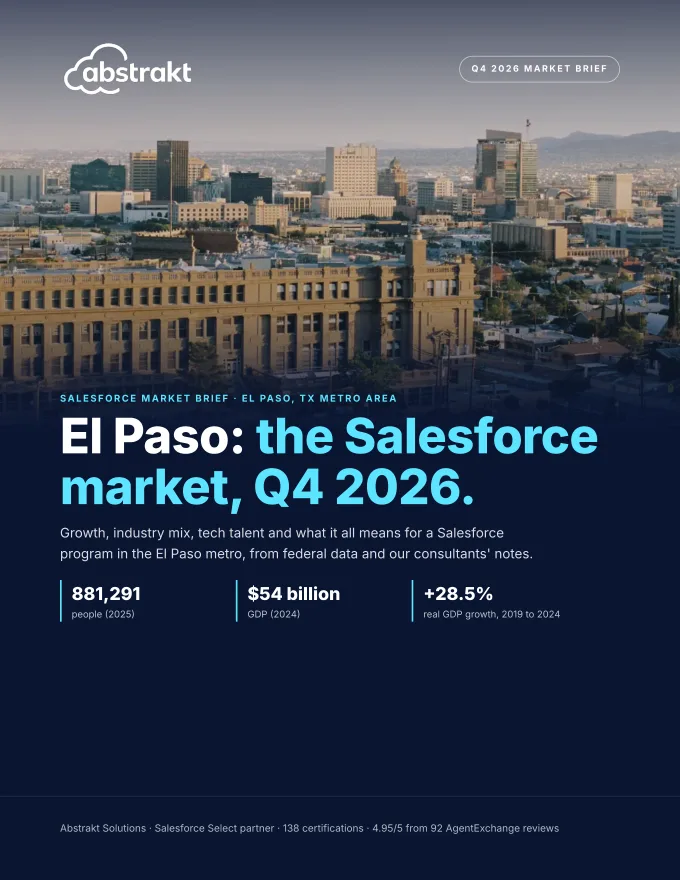
A free 24-page PDF with El Paso's growth ranked against 100 metros, its industry mix, tech wages and nearby markets. It is offered on the public El Paso page; send your customer there or get a copy for your own prep.
Get the El Paso brief →Co-sell with Abstrakt in El Paso
Working a El Paso account? Bring in a named consultant for discovery, scoping or a health check. We reply within 4 business hours.