

How Salesforce work starts in San Antonio
Abstrakt Solutions is a Salesforce Consulting Partner whose San Antonio-New Braunfels clients span finance, insurance, manufacturing and defense work. San Antonio is one of our focus markets.
What buyers here usually run into
- 1
Member service at scale
Financial institutions serving large member bases need routing, knowledge and self-service that keep service consistent across channels and teams.
- 2
Security and access requirements
Defense contractors and cybersecurity firms scrutinize permissions, integrations and data residency, so security review has to be part of the design from the start.
- 3
Marketing compliance
Banks and insurers need consent tracking, approvals and audit trails in marketing automation before campaigns go out.
Budget, team and partner questions
What drives cost
In San Antonio, member volume and security drive cost. Financial institutions need routing, knowledge, consent tracking and core system integration, and defense and cybersecurity firms need security review built into every design decision. Retail and consumer goods suppliers are driven by store-level data and promotion analysis.
Admin or partner
Large financial institutions here typically keep internal Salesforce teams and bring in partners for architecture, integration or a specific cloud. Mid-sized manufacturers and suppliers more often use managed services for daily administration.
What buyers ask a partner
Ask for Financial Services Cloud and Service Cloud references at member scale, how the partner handles marketing consent and approvals, and how they work through a security review for defense customers. Ask who owns the work after go-live.
The local economy and its biggest industries (4)
| Sector | Share of 2024 GDP | Where Salesforce fits |
|---|---|---|
| Finance and insurance Financial Services Cloud → | 10.2% | Insurers, banks and credit unions serving large member and customer bases need relationship views, compliant marketing and service at high volume. |
| Manufacturing Salesforce for manufacturing → | 9.2% | Aerospace, defense and industrial manufacturers need quoting, contract and service history tied to ERP, with access controls suited to defense work. |
| Retail trade Salesforce for retail & consumer goods → | 7.6% | Grocers, retailers and consumer brands need customer data, loyalty and marketing working together across stores and digital channels. |
| Health care and social assistance Salesforce for health & life sciences → | at least 6.7% | Health systems and life science organizations need patient and customer engagement, referral management and service designed around privacy. |
Source: U.S. Bureau of Economic Analysis, GDP by county (CAGDP2), 2024, summed to the metro area; private sectors only, excluding real estate and government. “At least” marks sectors where BEA suppresses some county figures.
Regional target sectors named by local economic development groups: Advanced Manufacturing & Logistics, Aerospace & Defense, Cybersecurity & IT, Finance & Professional Services, Headquarters, Life Science & Health.
Salesforce products that fit San Antonio (6)
In the order we lead with them here, from the industries above.
Salesforce Financial Services Cloud
Industry CRM for wealth management, banking, insurance, and lending, built for compliance from the start.
Salesforce Service Cloud
The operating system for modern customer service, case, knowledge, voice, and AI agent assist together.
Salesforce Sales Cloud
The CRM where sales pipeline lives, when it is built right.
Salesforce Marketing Cloud
Cross-channel marketing, email, mobile, journey, and Data 360-powered personalization at scale.
Salesforce Experience Cloud
Customer, partner, and employee portals built on Salesforce.
Salesforce Agentforce
AI agents that handle real work inside Sales Cloud, Service Cloud, and Marketing Cloud.
Where San Antonio insurers and makers can use Agentforce
Finance and insurance is San Antonio's largest private sector, at 10.2% of metro GDP in 2024. Insurers and banks there handle claims, policy and account-servicing inquiries in high volume, and AI can summarize a member's case history so a representative starts every call informed. Drafted replies are helpful, but regulated communications should go through human approval every time. Manufacturers, 9.2% of output, can use AI-assisted forecasting to check pipeline assumptions against order history. Retail, at 7.6%, suits self-service answers built on policy articles. Before any of this, confirm that member data is consolidated, sensitive fields are masked by role, and compliance has signed off on the knowledge the agent may cite.
- Member case summaries before calls
- Checking forecasts against order history
- Policy-based retail self-service answers
Services buyers here usually need (7)
Salesforce Implementation in San Antonio
San Antonio implementations often involve large customer or member bases and strict access requirements from the first workshop. A financial institution needs households, service cases and consent in one model; a defense supplier needs capture pipelines and permissions that keep sensitive program data contained. Discovery comes first; the data model and security are agreed before configuration; then we build and test in a sandbox, migrate clean data and train each role.
By industry in San Antonio
- 1
Finance and insurance
Finance and insurance is San Antonio's largest private sector, about 10.2% of 2024 metro GDP, spanning insurers, banks and credit unions with large member bases. The key implementation decisions are how Financial Services Cloud represents households and financial accounts, how service volume is routed, and how marketing consent is captured. We settle those in design and plan the core-system integration early, because every later phase depends on how accounts and relationships are modeled.
- 2
Aerospace & Defense
Aerospace and defense is a greater:SATX target sector, and the region hosts a 1,900-acre campus southwest of downtown whose tenants include defense primes, aircraft maintenance providers and Air Force cyber units. Contractors implementing Salesforce need pursuit and capture stages, teaming partner records and contract vehicles modeled from the outset. Just as important is deciding what data may live in a commercial cloud at all, which can point toward Government Cloud for controlled information.
- 3
Health care and social assistance
Health organizations serving the eight-county San Antonio-New Braunfels area tend to implement Salesforce for outreach, referral intake and a shared contact center. Priorities are routing that sends each inquiry to the right location, consent records that follow the patient across channels, and intake forms that feed scheduling without duplicate entry. We agree privacy rules and integration points in design, so compliance review happens before the build rather than in the middle of testing.
Raise before scoping
Design for member volume
Institutions serving large customer bases need queues, routing and knowledge articles sized for peak contact periods from day one. Model how cases arrive through phone, chat and email, and test with realistic volumes in a sandbox, since routing that works for a pilot team often buckles at full scale.
Classify data before building
Before configuration, classify which records are public, internal, confidential or controlled. That classification drives profiles, encryption choices and which integrations are permitted. Defense and financial clients will ask for it, and producing it after the build usually forces rework. Revisit it whenever a new integration is proposed.
Phase marketing after service
Marketing Cloud journeys depend on clean contact data and recorded consent. Launch core relationships and service first, confirm that preferences are captured correctly, and add journeys afterward. Starting campaigns on unverified data risks messaging people who have already opted out.
Salesforce Integration in San Antonio
San Antonio integration projects frequently involve operational systems with long histories: ERPs at industrial manufacturers, warehouse and transportation platforms at logistics companies, and core or policy systems at financial firms. Each engagement produces a written record of data ownership, a tool choice among MuleSoft, Workato or direct APIs weighed against volume and support needs, tests with realistic data, and monitoring. The aim is that reps and service agents see current orders, shipments and account status without asking another department.
By industry in San Antonio
- 1
Advanced Manufacturing & Logistics
greater:SATX lists advanced manufacturing and logistics among its target sectors, and logistics providers and distributors here need shipment status, proof of delivery and exceptions visible on the customer account in Salesforce. Integration connects transportation and warehouse systems so service agents can answer where-is-my-order questions immediately. Account managers, meanwhile, can review volume trends and service failures together before sitting down with a key customer, instead of assembling that picture from exports.
- 2
Manufacturing
Industrial and aerospace manufacturers in the region generally run production, pricing and invoicing in an ERP. Once Salesforce is connected, reps quote from live prices and part numbers, won orders reach the ERP without retyping, and account teams can see invoices and shipments. For manufacturers with defense work, we also check which part and program data may pass through each connection, and limit the integration to fields the CRM genuinely needs.
- 3
Health care and social assistance
Health organizations connect Salesforce to scheduling, EHR and billing systems so outreach and service staff work from current information. Integration design here is largely about restraint: pass only the data each team needs, record where every field came from, and log access. We plan standards-based clinical interfaces through middleware where appropriate, and confirm the design with privacy officers before any patient data moves between systems. Any data element added later passes through the same privacy review before it is switched on.
Raise before scoping
Choose sync versus lookup
Not every value belongs in Salesforce permanently. Copy the data users report on, such as order totals and status, and look up volatile data, like inventory or live balances, on demand. Getting that split right controls storage, keeps records current and reduces load on older back-end systems.
Respect legacy system limits
Older ERPs and core platforms may lack modern APIs, cap concurrent connections or run batch jobs overnight. Find those limits during design, not testing. Middleware can queue and retry requests, but the integration schedule still has to respect what the source system can safely handle.
Test at production scale
Integrations tested on a few hundred records often fail on hundreds of thousands. Load realistic volumes into a sandbox, run month-end and peak-day scenarios, and measure timing and API consumption before go-live, so the surprises happen in testing rather than in production.
Salesforce Managed Services in San Antonio
San Antonio organizations tend to come to managed services with a busy, regulated org and a business that keeps asking for more. Our team handles user and permission requests, builds enhancements from a shared backlog, reviews each Salesforce release in a sandbox and fixes integration issues as they surface. Regular reviews show what shipped, what is still waiting and what comes next.
By industry in San Antonio
- 1
Finance and insurance
Insurers, banks and credit unions here run orgs where small changes carry regulatory weight. A new field on a member record may need a privacy review; a routing change affects service levels. Our managed services work follows a documented change process: requests are logged, tested in a sandbox, approved by your designated owner and deployed with a record of what changed, which gives auditors and examiners a clear trail. Even a same-day hotfix leaves that record behind.
- 2
Cybersecurity & IT
Cybersecurity and IT is one of greater:SATX's target sectors, and firms in this field hold their own tools to high standards. They expect permission changes to be reviewed, integration credentials to be rotated and admin activity to be traceable. Managed services for them includes periodic access reviews, monitoring of connected apps and API users, and release testing, alongside the day-to-day pipeline and renewal reporting their sales teams depend on.
- 3
Retail trade
Retail trade adds about 7.6% of the metro's 2024 GDP, and retailers and the brands supplying them use Salesforce for loyalty, marketing and customer service. Their managed services needs are seasonal: journeys to adjust before holidays, service queues to scale for peaks and segment definitions to refresh. We plan that work into the backlog ahead of each season, so campaigns and routing changes are tested before the volume arrives. After each peak, we review what worked and adjust the backlog for the next one.
Raise before scoping
Document every production change
In regulated environments, an undocumented change is an audit finding waiting to happen. Keep a change log recording the request, the tester, the approver and the deployment date, and use sandboxes and a consistent deployment method. It makes audits faster and handovers painless.
Plan capacity around peaks
Open enrollment, tax season, holiday retail and fiscal year-end can all spike Salesforce requests. Map your organization's busy periods at the start, front-load enhancement work before them and reserve capacity for support during them, so urgent fixes are not competing with a half-finished project.
Watch connected systems
Core banking, marketing, telephony and e-signature connections each depend on credentials and API limits that change over time. Include integration health in every regular review: failed jobs, expiring certificates and API usage trends, so problems are caught before a customer or member notices them.
Salesforce Health Checks in San Antonio
A health check for a San Antonio organization often starts with security, because so many local teams answer to auditors, examiners or government customers. We review profiles, permission sets, sharing rules and integration users, then measure data quality, inventory automation and custom code, and check which dashboards reflect reliable data. You receive risks and fixes in priority order, each with an effort estimate. It is especially useful before an Agentforce pilot, a change of partner or a license renewal.
By industry in San Antonio
- 1
Cybersecurity & IT
Cybersecurity and IT firms in the region, many serving defense and government customers, sell on the strength of their controls, so their own CRM should hold up to scrutiny. The review checks multi-factor enforcement, admin access, connected apps with broad scopes and API users that outlived their purpose. We also look at whether customer environment details stored in Salesforce are restricted appropriately, and document findings in a format their compliance staff can use.
- 2
Finance and insurance
Financial institutions here tend to have mature orgs with years of layered automation and custom fields. The health check inventories overlapping flows and triggers on accounts and cases, identifies unused fields and packages that slow page loads, and reviews how marketing consent is stored and synchronized. For firms considering AI agents to handle member inquiries, we assess whether data and permissions are ready for an agent to act on them safely.
- 3
Health care and social assistance
Health care and social assistance contributes at least 6.7% of 2024 metro GDP, and organizations in the sector store sensitive information in Salesforce even when clinical records live elsewhere. A health check examines field-level security on patient-related fields, audit settings, sharing between departments and locations, and whether any integration copies more data than intended. Findings are ranked so privacy risks are addressed ahead of performance or usability improvements. Each high-risk item comes with a suggested fix.
Raise before scoping
Scope it to your obligations
A health check is more useful when it reflects the rules you actually operate under, whether banking regulation, health privacy or defense contract requirements. Share those obligations at kickoff so findings are ranked against them rather than against a generic checklist.
Prepare for Agentforce with evidence
An agent answering member or customer questions draws on your records, knowledge articles and permissions. Test those foundations first: duplicate rates, outdated articles and what an agent user could reach. A pilot on a verified subset of data produces results you can evaluate honestly.
Ask what renewal is buying
Before renewal, compare purchased licenses and add-ons with actual use. Inactive users, idle feature licenses and packages installed for past projects all surface in a health check, giving procurement concrete facts for the negotiation rather than estimates. Unused licenses can often be reassigned before new ones are bought.
Salesforce Optimization in San Antonio
Optimization in San Antonio usually follows a period of growth: new locations, acquisitions or product lines added to an org designed for a smaller company. Users compensate with spreadsheets, and leaders stop trusting dashboards. Our approach pairs usage data with interviews of daily users, followed by simpler layouts, old automation consolidated into Flow, deduplicated accounts and reports rebuilt around agreed definitions. Short role-based sessions show each team what changed and why it helps them.
By industry in San Antonio
- 1
Retail trade
Retailers and consumer brands in the region often have rich customer data spread across loyalty, e-commerce and service, while Salesforce reflects only part of it. Optimization focuses on customer records first: merging duplicates, standardizing store and channel attributes and repairing the segments marketing relies on. We then rebuild reporting so merchandising, service and marketing leaders compare the same customer counts and response rates instead of reconciling three versions. Loyalty, service and campaign data then tell one consistent story.
- 2
Finance & Professional Services
Finance and professional services is a greater:SATX target sector, and advisory, accounting and consulting firms here commonly track relationships in Salesforce but manage engagements elsewhere. Their orgs accumulate custom fields for every partner's preference. We trim those fields, align opportunity stages with how engagements are really won, and build dashboards connecting pipeline to delivered work, so firm leadership can plan staffing from the CRM rather than from separate spreadsheets.
- 3
Manufacturing
Manufacturing contributes about 9.2% of 2024 metro GDP, and the region's industrial firms often use Salesforce mainly for quoting and account management. Adoption drops when reps must enter the same order details in both Salesforce and the ERP, or when approval rules block routine quotes. Optimization removes that double entry through better integration or simpler forms, retires obsolete approval logic and gives sales managers forecast and margin views that match finance's numbers.
Raise before scoping
Start with the least trusted report
Ask leaders which dashboard they trust least and trace its numbers back to the records. That exercise usually exposes the duplicate accounts, missing stage dates and inconsistent picklist values that distort everything else, and it produces a visible win early in the project.
Protect regulated processes
Simplifying layouts and retiring automation in a financial or health org can remove a field or step that compliance depends on. Review every proposed removal with your compliance contact and record the reasoning. Cleanup should reduce clutter, not quietly weaken a control.
Retrain after every change
Even welcome changes confuse users who have built habits around the old screens. Plan short sessions by role, publish a one-page summary of what moved, and check adoption measures a few weeks later. Retraining is what turns a technical cleanup into different daily behavior.
Salesforce Migration in San Antonio
Migrations in San Antonio often follow consolidation: a headquarters operation that absorbed regional teams using different tools, or a financial institution replacing a CRM that came bundled with an older core platform. Every source gets inventoried, the business decides which records and history survive, the data is standardized and deduplicated in staging, and your team reviews a sandbox load before anything goes live. Cutover happens in one planned step, with a brief freeze on the old systems, so nobody works in two places at once.
By industry in San Antonio
- 1
Headquarters
Headquarters is one of greater:SATX's target sectors, and the region hosts more than 400 headquarters and major operations of global companies. Relocated or expanding headquarters teams often inherit a patchwork of CRMs from divisions and acquisitions. Migrating them means agreeing on one customer master, deciding which division's process becomes the standard and mapping each legacy system to it. We preserve the account history sales still uses and archive the rest in searchable form.
- 2
Life Science & Health
Life science and health is a greater:SATX target sector covering research organizations, device makers and clinical services. Their contact data tends to be scattered across event lists, grant records, distributor files and an older CRM. Migration separates customers, partners and research contacts, merges duplicate institutions and physicians, and keeps consent flags attached to each record. Regulated documents stay in their validated systems, with links rather than copies in Salesforce.
- 3
Finance and insurance
Banks, credit unions and insurers moving to Salesforce frequently leave behind a CRM tied to an older core, where households were stored inconsistently. Before loading anything into Financial Services Cloud, we rebuild household and relationship groupings, standardize addresses and member identifiers, and decide which service history compliance requires us to keep. Trial loads are reconciled against the core so the balances and product holdings shown in Salesforce match the system of record.
Raise before scoping
Establish one customer identifier
When several legacy systems each assign their own customer numbers, duplicates survive every migration. Choose a master identifier, usually from the ERP or core, cross-reference the others to it in staging and store the legacy IDs in Salesforce for troubleshooting and future integrations.
Retire old systems on schedule
Set a firm date for switching off the old CRM or making it read-only. Leaving it editable after cutover invites users to keep updating it, and the two systems diverge within weeks. Announce the date early and give managers Salesforce reports that replace what they used before.
Handle marketing data separately
Email lists, consent records and campaign history often live in a different tool from the CRM. Migrate opt-in and opt-out status with particular care, rebuild segments rather than copying them, and verify suppression lists before the first send from Marketing Cloud.
Salesforce Implementation Rescue in San Antonio
Troubled Salesforce projects in San Antonio tend to share causes: a design approved before security requirements were understood, a data migration rushed to meet a date, or a partner that rotated staff until nobody knew the build. The first step is a short assessment that sets the org against the original scope and what users report. We stabilize anything blocking daily operations, decide what to keep, fix or rebuild, and finish in phases, closing with a planned relaunch for every affected team.
By industry in San Antonio
- 1
Aerospace & Defense
Aerospace and defense projects stall most often when security questions surface late: an integration moving program data nobody cleared, or sharing rules that expose teaming partner information. Recovery pauses new features, corrects access and data flows, and documents the controls for the client's security officers. We then rebuild capture and contract processes in a simpler, reviewable form, so the org supports pursuits without creating new compliance exposure. Each restored feature is reviewed with security staff before release.
- 2
Retail trade
Failed retail and consumer brand projects usually involve marketing: journeys launched on unreliable customer data, consent that never synced, or a loyalty integration that matched members incorrectly. Triage fixes the identity and consent problems first and suspends risky sends. With a clean customer base in place, we rebuild segments and journeys, test them on small audiences and relaunch campaigns alongside the marketing team. Complaints and unsubscribe rates are watched closely through the first sends after relaunch.
- 3
Life Science & Health
Life science and health organizations sometimes launch patient-support or partner programs on Salesforce that meet the deadline but not the process. Case types do not match real inquiries, intake forms miss required details and staff return to spreadsheets. A rescue maps actual workflows with frontline staff, keeps what works, rebuilds intake and case handling, and documents the changes for quality or compliance review before the relaunch. Staff who helped map the workflows then act as champions for their colleagues.
Raise before scoping
Separate urgent from important
In the first days of a rescue, list every open issue and sort it into what stops work today and what merely frustrates. Fix the first group quickly to rebuild confidence, and schedule the second into the recovery plan instead of chasing everything at once.
Get a straight account of scope
Compare what was contracted, what was built and what users expected. The gaps between those three explain most failed projects. Documenting them early prevents arguments later and gives sponsors a fair basis for a revised plan and budget. Keep the comparison factual and free of blame.
Keep compliance in the loop
For regulated organizations, a rescue often changes access, data flows and marketing consent. Include your compliance or security contact in the assessment and at every recovery checkpoint, so fixes are approved as they happen rather than reviewed in one large batch before relaunch.
Industry plays in San Antonio (4)
Salesforce for San Antonio Insurers and Agencies
Insurance organizations in San Antonio frequently serve customers who hold several products at once, such as auto, home, life and banking accounts, and who contact them at major life moments. Salesforce can bring those relationships into one view, so a service representative handling a move, marriage or new vehicle sees every affected policy and account. We build that view on Financial Services Cloud, integrate it with policy and core systems, and design access controls to the standard security teams in this region expect.
Measured by 2024 output, banks, insurers and other financial firms form San Antonio-New Braunfels's biggest private industry group, with a 10.2% slice of metro GDP in Bureau of Economic Analysis data; manufacturing's 9.2% comes next. Cybersecurity and IT sit on the greater:SATX target list right beside finance. A 1,900-acre technology campus southwest of downtown houses aerospace, defense and cybersecurity tenants. Insurers here therefore recruit from, and are judged by, a security-minded technology community, which raises the bar for how customer records are protected and who can see them.
Use cases to open with
- 1
Life-event service across products
When a customer moves, marries, buys a car or has a child, several policies and accounts may need changes. Salesforce can recognize the life event from a service contact or data signal, show every related product, and guide the representative through each update in one flow. Customers avoid being transferred between product teams, and the organization captures relevant cross-sell opportunities without a sales script.
- 2
Digital self-service with handoff
Many policyholders prefer to handle simple tasks online. An Experience Cloud portal can let customers update information, request documents and start claims, while Agentforce answers routine coverage and billing questions. When a request needs a licensed representative, the conversation passes to Service Cloud with full context, so the customer never repeats information and the representative can resolve it faster. Deflection rates are tracked by topic.
- 3
Marketing to eligible members only
Organizations that serve defined membership groups must market only to eligible people and within strict consent rules. Marketing Cloud journeys driven by eligibility, product holdings and preferences can deliver relevant offers, such as coverage reviews after a life event, while suppressing ineligible or opted-out contacts. Compliance teams can review templates and audiences before campaigns send, keeping a clear record. Eligibility is rechecked at send time.
Raise before scoping
Design security from the start
Customers and regulators expect strong protection of financial data covered by GLBA and state rules. Use least-privilege access, multi-factor authentication, encryption, event monitoring and regular access reviews, and involve your security team in design rather than asking them to approve a finished build.
Connect multiple core systems
Multi-product organizations often run separate policy, claims and banking platforms. Decide which summary data each contributes to the Salesforce customer view, which system owns each field, and how updates flow back, so representatives act on current information across products. Stale data erodes representative trust quickly.
Govern marketing consent tightly
Cross-product marketing touches several consent regimes and internal policies. Centralize preferences, apply eligibility and opt-out rules automatically in every journey, and keep audit trails of what was sent to whom, reviewing requirements with compliance counsel before launch. Test suppressions before every major send.
Salesforce for San Antonio Lenders
San Antonio lenders compete for the same purchase and refinance borrowers, whether they are banks, credit unions or independent mortgage companies. Salesforce helps them win on responsiveness and relationships: capturing inquiries from every channel within minutes, giving loan officers a workspace that mirrors LOS milestones, and staying in touch with borrowers for years after funding. Your origination platform stays the home of the regulated loan file. We deploy Financial Services Cloud for lending, integrate it with the LOS and core, and build compliant marketing on top.
Lenders sit inside the metro's top-ranked private industry: Bureau of Economic Analysis data puts finance and insurance at 10.2% of San Antonio-New Braunfels output for 2024. The research record does not separate mortgage and consumer lending from banking and insurance, so lending's own share is not stated. Regional recruiters at greater:SATX court finance employers along with corporate headquarters and logistics operations. Lending in the region spans banks, credit unions and independent mortgage companies, often competing for the same borrowers and referral partners including member-owned credit unions.
Use cases to open with
- 1
Loan officer pipeline management
Loan officers juggle leads, applications in progress and past clients due for a check-in. Financial Services Cloud gives them one pipeline from inquiry to application, with loan milestones synchronized from the LOS, automated tasks for document follow-up and alerts when a file stalls. Managers can see conversion and cycle time by officer and source, which supports coaching and capacity planning.
- 2
Referral partner programs
Purchase business in a growing metro depends heavily on agents and home builders who recommend a lender. Salesforce can record each partner's referrals, funded loans, preferred communication and co-marketing history, send them automatic milestone updates on shared clients, and flag partners whose referrals have slowed. Marketing Cloud can deliver program and rate updates to partners, within the partner marketing rules your compliance team sets.
- 3
Borrower retention after closing
Winning the second loan is cheaper than finding a new borrower. Data 360 (formerly Data Cloud) can combine servicing, rate and life-event signals to identify borrowers who may benefit from refinancing, a home equity line or a new purchase, and route them to their original loan officer. Service teams handle escrow and payment questions in the same record, keeping the relationship intact after closing.
Raise before scoping
Integrate the LOS carefully
The loan origination system holds the regulated file. Map which milestones, dates and loan attributes Salesforce needs, how often they sync, and which system owns borrower contact data, so loan officers see accurate status without duplicate entry or conflicting records.
Build fair lending into marketing
Targeting and messaging must comply with fair lending, advertising and privacy rules, including GLBA for consumer financial data. Review segmentation criteria, templates and suppression lists with compliance, keep an audit trail of campaigns, and avoid criteria that could create disparate impact.
Support loan officer adoption
Loan officers are paid on production and resist anything that slows them down. Provide mobile access, automated task creation, and dashboards that show their own pipeline and referral sources, so Salesforce helps them close more loans instead of adding administrative work.
Salesforce for San Antonio Manufacturers
San Antonio manufacturing spans factories making industrial and consumer products, aerospace repair and overhaul operations, and suppliers to defense and cybersecurity programs. Salesforce serves them best when it matches how each earns revenue: quotes and orders for producers, work orders and turnaround tracking for repair shops, and pursuit management for government-facing suppliers. Security review belongs at the start, since defense customers scrutinize access and integrations. We connect Salesforce to the ERP and maintenance systems and keep controlled data in the platforms approved for it.
Only banks and insurers, at 10.2%, out-produce San Antonio-New Braunfels factories, which generated 9.2% of the metro's 2024 output according to Bureau of Economic Analysis county figures. The greater:SATX Regional Economic Partnership pairs advanced manufacturing with logistics as one target industry and lists aerospace and defense separately. The research record describes a 1,900-acre technology campus southwest of downtown whose tenants span aerospace, defense, cybersecurity and advanced manufacturing, alongside military cyber operations. That puts an unusual share of local production close to government customers, security requirements and long-lived equipment.
Use cases to open with
- 1
Repair and overhaul work orders
Aircraft components and industrial equipment arrive for repair with serial numbers, customer requirements and turnaround commitments. Service Cloud can open a case for each induction, track teardown findings, customer approvals and parts availability, and show promised return dates to account managers. Customers see status through a portal instead of emailing, and leaders can spot which work scopes routinely miss turnaround targets.
- 2
Defense and prime pursuits
Suppliers to defense programs pursue work as primes, subcontractors or vendors on contract vehicles. Salesforce opportunities can hold the program, government customer, prime contractor, contract vehicle, teaming partners and key dates, with capture tasks and bid decisions recorded. Executives can filter by service branch or funding year, and once a contract lands, the capture file, including competitor notes and customer feedback from debriefs, moves with it to the program office.
- 3
Quotes grounded in plant data
Producers selling to distributors and industrial customers need accurate pricing, lead times and availability. Pricing tiers, stock on hand and quoted lead times should come straight from the plant's ERP, with any below-floor price waiting on a manager's approval in Revenue Cloud or CPQ. Accepted quotes flow back to the ERP as orders, and customer service can answer order questions from Salesforce without logging into the plant's systems.
Raise before scoping
Start with security review
Defense customers and cybersecurity-minded buyers ask about permissions, integrations, data residency and user authentication. Involve your security team from the first workshop, document the data classification for each object, and consider government cloud options where contracts require them, rather than retrofitting controls after the build.
Keep technical data separate
Drawings, specifications and repair data may be export-controlled or proprietary to the customer. Store them in approved engineering or maintenance systems, reference them from Salesforce, and restrict visibility by program so users see only the customers and contracts they support.
Model assets and serial numbers
Repair and service businesses depend on the history of each serialized unit. Decide which system owns asset records, how repair history and parts traceability are linked, and how customers are matched, so account teams can see every unit and every visit without duplicate records.
Salesforce for San Antonio Health and Life Sciences
San Antonio health organizations serve patients spread from the urban core to rural counties, and many programs need to reach people in more than one language. Salesforce helps providers coordinate patient access, referrals and outreach programs with consistent language preferences and consent. Research and life sciences organizations use it to manage sponsors, partners and commercial customers. Across all of them, the electronic health record remains the clinical system of record, and only the data a given outreach or scheduling task requires crosses into Salesforce.
Care providers and social services generate no less than 6.7% of San Antonio-New Braunfels output in 2024, according to Bureau of Economic Analysis county data; withheld county detail means the true figure could be higher. Life science and health is one of six target industries for the greater:SATX Regional Economic Partnership. The research record notes a downtown university building housing a school of data science and a national security collaboration center, linking health data work to the region's technology base. The metropolitan area spans eight counties, from Bexar to more rural neighbors such as Atascosa, Bandera and Medina, so access and outreach need to reach well beyond the city.
Use cases to open with
- 1
Outreach in the patient's language
Preventive screenings, chronic care programs and appointment reminders work better in the patient's preferred language. Marketing Cloud can send English and Spanish versions based on recorded preference and consent, and track responses by program and clinic. Service agents see language preference on every request and can route calls to bilingual staff, which improves follow-through, reduces repeated contacts and shows managers where more bilingual capacity is needed.
- 2
Referral networks across counties
A cardiology or oncology program in Bexar County may draw patients from family physicians in Comal, Guadalupe and Wilson counties. Salesforce can track referral sources, volumes, liaison visits and turnaround times, and notify outreach teams when a practice's referrals decline. Leaders can compare referral patterns by county and service line, and plan outreach to areas where patients travel farthest for care or leave the region entirely.
- 3
Data-informed care programs
Care management and population health programs need to identify eligible patients, enroll them and follow up. Health Cloud or Service Cloud can manage enrollment, tasks and outreach, while Data 360 (formerly Data Cloud) combines permitted data from clinical, claims and engagement sources. Program managers see enrollment and completion by clinic and county, and staff work prioritized lists rather than spreadsheets, with each outreach attempt and its result recorded for program reporting.
Raise before scoping
Minimize patient data exposure
Outreach lists rarely need diagnoses or lab values, so leave them in the EHR and pass only contact details, program flags and consent into Salesforce. A business associate agreement, field-level restrictions and access monitoring complete the picture. HIPAA interpretation stays with your privacy officer and legal counsel, and we configure to their decisions.
Localize content, not just translate
Spanish-language outreach works best when written for local patients, reviewed by bilingual staff and tested for reading level. Store language preferences reliably, and make sure every automated message, portal page and knowledge article exists in both versions before launch, with an owner responsible for keeping them aligned.
Plan for rural connectivity
Patients and outreach staff in rural counties may have limited internet access. Offer text and phone options alongside portals, design mobile workflows that tolerate weak signal, and measure program participation by county to see where digital channels fall short and where community health workers should follow up in person.
Case studies to send (3)
From the industries this market leans on. Client names are anonymized and these projects are not specific to San Antonio.
The San Antonio Salesforce market brief, Q4 2026
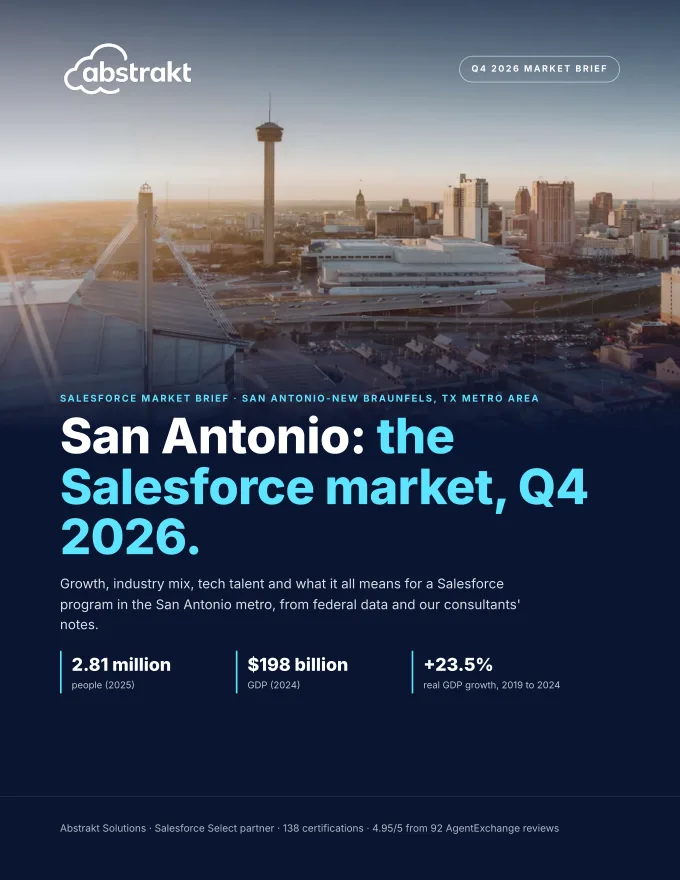
A free 24-page PDF with San Antonio's growth ranked against 100 metros, its industry mix, tech wages and nearby markets. It is offered on the public San Antonio page; send your customer there or get a copy for your own prep.
Get the San Antonio brief →Co-sell with Abstrakt in San Antonio
Working a San Antonio account? Bring in a named consultant for discovery, scoping or a health check. We reply within 4 business hours.