

How Salesforce work starts in Tucson
In Tucson and across Southern Arizona, Abstrakt Solutions serves aerospace, diagnostics and mining-technology companies as a Salesforce Consulting Partner. Tucson is one of our focus markets.
What buyers here usually run into
- 1
Security expectations in defense supply chains
Suppliers to aerospace and defense programs typically face strict customer requirements on data handling, so Salesforce permissions and integrations need review before expansion.
- 2
Equipment service across remote sites
Mining-technology and industrial companies send technicians to spread-out locations, and scheduling, parts and service history are hard to manage without a field service system.
- 3
Science-driven organizations with unusual pipelines
Diagnostics and research groups track collaborators, studies and grants, and they need Salesforce configured around those relationships instead of a generic sales model.
Budget, team and partner questions
What drives cost
Tucson scope is shaped by access design for export-controlled or restricted data, Field Service needs for spread-out sites, and ERP integration for programs and installed equipment. Diagnostics and research groups add custom models for collaborators, studies and grants.
Admin or partner
Aerospace and mining-technology firms here often have strong engineering teams but little Salesforce depth, so a partner covers design, integration and releases. University spinouts and smaller retailers usually outsource administration entirely.
What buyers ask a partner
Ask how the partner designs access for restricted data, for Field Service references in low-connectivity conditions, and for examples of installed-base models in diagnostics. Ask how they document permissions for customer audits.
The local economy and its biggest industries (4)
| Sector | Share of 2024 GDP | Where Salesforce fits |
|---|---|---|
| Manufacturing Salesforce for manufacturing → | 14.7% | Tucson's aerospace, defense and mining-equipment makers manage long programs, supplier networks and aftermarket service, which calls for careful account structures and ERP integration. |
| Health care and social assistance Salesforce for health & life sciences → | 9.2% | Alongside health providers, the region's diagnostics and research organizations need Salesforce for customer service, partner programs and scientific outreach with strict access controls. |
| Retail trade Salesforce for retail & consumer goods → | 6.6% | Retailers across Pima County can use Salesforce to connect store, online and service interactions so marketing and support work from the same customer record. |
| Professional, scientific, and technical services Salesforce for professional services → | 4.9% | Engineering, research and technology firms around the UA Tech Park and university incubators often need a CRM for partnerships, grants and client projects rather than a standard sales funnel. |
Source: U.S. Bureau of Economic Analysis, GDP by county (CAGDP2), 2024, summed to the metro area; private sectors only, excluding real estate and government. “At least” marks sectors where BEA suppresses some county figures.
Regional target sectors named by local economic development groups: Aerospace & Defense, Bioscience & Healthcare, Transportation & Logistics, Renewable & Mining Technologies.
Salesforce products that fit Tucson (6)
In the order we lead with them here, from the industries above.
Salesforce Sales Cloud
The CRM where sales pipeline lives, when it is built right.
Salesforce Service Cloud
The operating system for modern customer service, case, knowledge, voice, and AI agent assist together.
Salesforce Field Service
Scheduling, dispatch, mobile work orders and parts for teams that work on site.
MuleSoft
Enterprise API platform, for connecting Salesforce, ERP, data warehouses, and the rest of your stack.
Salesforce Agentforce
AI agents that handle real work inside Sales Cloud, Service Cloud, and Marketing Cloud.
Salesforce Experience Cloud
Customer, partner, and employee portals built on Salesforce.
Tucson aerospace, bioscience and retail meet practical AI
In Tucson, manufacturing accounted for 14.7 percent of metro GDP in 2024 and health care for 9.2 percent, per BEA. Aerospace and defense suppliers work under strict documentation requirements, so AI should assist rather than decide: summarizing a program's service history, reading a customer specification and highlighting open items, or preparing a draft reply that an engineer finishes. Bioscience and health care organizations can use Agentforce for knowledge-grounded answers to common patient or customer questions. Retailers can automate first drafts of order-status replies. Restricted and export-controlled data needs its own access model before any agent is connected, and a human reviewer should own every outbound response.
- Customer specification review and highlights
- Program service history summaries
- Knowledge-grounded patient question answers
Services buyers here usually need (7)
Salesforce Implementation in Tucson
Many Tucson implementations begin with a question most CRMs skip: what exactly is the customer? For a mining-equipment supplier it is a mine site with its own fleet; for a diagnostics maker it is a lab holding instruments; for a defense supplier it is a program with a prime contractor above it. We settle that structure in discovery, then build security, automation and integrations on top of it in a sandbox, migrate cleaned data, and train each role before a phased launch.
By industry in Tucson
- 1
Health care and social assistance
Health care and social assistance produced about 9.2% of Tucson's 2024 GDP, second only to manufacturing among private industries. Clinics, home-health agencies and community providers implementing Salesforce here usually want referral intake, outreach and patient communication in one place. The choices that matter are how much of a healthcare-specific data model to adopt versus a lighter Service Cloud build, which staff roles may open clinical details, and how consent is captured. We make those decisions with your privacy lead before configuration starts.
- 2
Renewable & Mining Technologies
Firms in this Chamber of Southern Arizona target sector range from solar and storage developers to suppliers serving copper operations. For project-based renewable companies, implementation centers on the path from site prospecting through permitting, interconnection and commissioning, where each stage is gated by documents rather than by a sales conversation. We model those milestones as stages with required evidence, so leadership sees how many projects are truly ready to build, then hand finished installations to a service process for ongoing maintenance.
- 3
Aerospace & Defense
Aerospace and defense is one of the Chamber's target sectors, and Tucson suppliers in it often sell to prime contractors, government buyers and aftermarket customers at once. Implementation choices here come down to separation and traceability: which pursuits belong to which business line, who may see pricing on government work, and how opportunities link to contract numbers held in the ERP. Getting the security model right in the first release avoids redesigning sharing later, when the pipeline is full of sensitive records.
Raise before scoping
Plan cutover around operations
Mine sites, hangars and labs rarely pause, so cutover has to fit the gaps in their schedules. Agree cutover windows and post-launch coverage with operations leads early, and write them into the project calendar before configuration begins.
Keep controlled data outside
Defense-related suppliers should decide before build which information may enter Salesforce at all. Drawings, specifications and export-controlled details generally stay in systems approved for them, with Salesforce holding pursuits, contacts and status. Writing that boundary into the design prevents cleanup after an audit.
Design for no signal
Technicians serving remote mine sites and desert installations can lose coverage for long stretches. If Field Service is in scope, decide which records are cached to devices and test offline behavior during the build, rather than letting a crew discover the gaps on its first day.
Salesforce Health Checks in Tucson
For Tucson organizations, a health check is an outside look at the org before something forces one: an audit, a customer security questionnaire, a renewal or an AI project. Without editing anything, we trace who holds which rights, how connected systems log in, how much automation and Apex has built up, and which licenses sit idle, then rank every finding by exposure and effort. Defense suppliers and diagnostics makers here tend to prioritize access and data-handling findings, while growing service firms usually care most about automation debt.
By industry in Tucson
- 1
Aerospace & Defense
Suppliers in this Chamber target sector increasingly receive security questionnaires from prime contractors and government customers. A health check gives a factual answer for the Salesforce portion: how authentication is enforced, who holds administrative rights, which connected apps can reach data, and whether any file or field holds information that contract terms restrict. Where gaps exist, the report names the specific settings to change, so your security lead can close them and document the result for the next questionnaire.
- 2
Health care and social assistance
Providers and health-related organizations in Tucson carry obligations that make access reviews unavoidable. We check which roles can view or export sensitive records, whether encryption and field-level security match policy, how portal and guest users are restricted, and whether field history and audit settings would support an investigation. Findings touching patient data come first in the ranking, with plain explanations that let compliance leadership approve fixes quickly without a Salesforce specialist in the room.
- 3
Transportation & Logistics
Logistics operators in this Chamber target sector usually run Salesforce with several always-on integrations. A health check looks at those connections closely: error rates, API limit consumption, integration users with excessive rights, and automations that fire on every inbound update. It also measures how much storage duplicate or orphaned records consume. The output helps operations teams see which technical issues threaten service levels now and which can be scheduled for later cleanup.
Raise before scoping
Review before the questionnaire arrives
Tucson suppliers to defense and regulated customers often discover Salesforce gaps while completing a security questionnaire under deadline. Scheduling a health check ahead of that cycle means the answers describe controls you already have, not promises to add them later.
Test readiness for Agentforce
Before any AI pilot, confirm that the knowledge an agent would draw on is current, that case and account data are reliable, and that the running user's access is narrow. A health check tests each of those conditions, which shortens pilot setup and lowers its risk.
Include sandboxes in scope
A full-copy test environment can hold the same customer and patient records as production while being guarded far less carefully. Include them in the review, check whether data masking is used, and confirm who can log in, since a leak from a sandbox is as serious as one from production.
Salesforce Integration in Tucson
Integration projects in Tucson usually connect Salesforce to a manufacturing ERP, and often to a quality or maintenance system as well. We begin by listing each record that crosses between platforms, who owns it, how fresh it must be and what happens when a sync fails. From there we choose the pattern: MuleSoft for several systems or reusable APIs, native connectors or direct APIs for simpler cases. Security gets as much design time as mapping, since many local suppliers answer to defense or regulated customers.
By industry in Tucson
- 1
Manufacturing
Manufacturing contributes about 14.7% of Tucson's 2024 GDP, the largest private share in the metro, and aerospace and mining-equipment producers here rely on ERP data for almost every customer conversation. Integration puts order status, shipment dates, serial numbers and invoice history on the account and asset records, and sends won quotes back as orders. We connect service too: when a technician logs a repair in Field Service, parts consumption flows to the ERP so inventory and billing stay correct.
- 2
Aerospace & Defense
The Chamber of Southern Arizona reports more than 100 tenants in the Tucson International Airport Employment Zone, spanning maintenance, aviation services and air cargo. MRO and aviation-services businesses need Salesforce to reflect work performed in their maintenance systems, such as component status, completed tasks and upcoming inspections, without copying regulated records. We integrate summaries and status fields, keep the certified maintenance system as the record of truth, and log every exchange so an audit can trace what moved.
- 3
Bioscience & Healthcare
For diagnostics and life-science companies in this Chamber target sector, integration often links Salesforce to quality management, ERP and instrument-connectivity platforms. The goal is one view of the installed base: which instruments sit at which lab, their service history, consumable orders and any open complaints. Complaints that begin in Service Cloud must pass to the quality system with a traceable handoff, and we design that exchange so regulated records stay authoritative wherever your procedures require.
Raise before scoping
Treat integration users as privileged
Every connection runs as a user with its own permissions. For Tucson suppliers answering to defense or regulated customers, those accounts should carry the narrowest access possible, rotated credentials and monitored activity, which prevents an integration from quietly holding administrator rights for years.
Choose sync timing per object
Latency needs differ by record. Order status for service agents may justify near-real-time events, while invoice history or product updates can move on a schedule. Deciding timing object by object keeps API usage, cost and complexity in proportion to what users actually need.
Plan for API limits and growth
Integrations sized for today's volume can hit Salesforce API limits as orders, shipments or instrument readings grow. We estimate volumes with your operations team, batch where sensible, and monitor limit consumption, so growth prompts a planned change rather than an outage.
Salesforce Optimization in Tucson
Tucson optimization projects usually begin by comparing the process drawn in the original design documents with the workarounds staff rely on today. We measure logins, record completion and report usage, shadow a few users in service, sales and the field, and trace the automation that fires on key objects. Then we remove fields and steps nobody needs, consolidate overlapping Flows, rebuild the handful of dashboards leaders rely on, and fix mobile screens for technicians. The project has a defined scope and a clear end.
By industry in Tucson
- 1
Retail trade
Retail trade accounts for about 6.6% of Tucson's 2024 GDP, and retailers here often run Salesforce for service or marketing without giving store and support teams a shared customer view. Optimization means merging duplicate shopper records created by separate channels, showing recent purchases and open cases on one page, and cutting the steps an agent takes to process a return or exchange. We then rebuild reporting so marketing, stores and service all measure repeat customers with the same rule.
- 2
Manufacturing
Tucson manufacturers, from aerospace component makers to mining-equipment suppliers, frequently carry automation built by several generations of administrators. Quotes trigger approval rules nobody remembers requesting, and service cases update fields no report reads. We map every automation on the quote, order, asset and case objects, retire what no longer serves a purpose, and move the rest into documented Flows. The result is faster saves, fewer surprise emails and a smaller surface for errors after each release.
- 3
Bioscience & Healthcare
In this Chamber target sector, diagnostics and life-science companies often have Service Cloud handling instrument support, yet agents still search email for the history of an installed system. Optimization links cases to the instrument and site, brings service history and consumable usage onto one screen, and simplifies the handoff when a complaint needs quality review. We also tidy knowledge articles, since outdated troubleshooting content slows agents today and would mislead any AI assistant added later.
Raise before scoping
Measure mobile adoption separately
Desktop users and technicians experience Salesforce very differently. For Tucson companies with crews at mines, solar sites or customer facilities, pull mobile usage on its own and ride along with a technician if possible, because the fixes for the field rarely match the fixes for the office.
Cut fields before adding features
The quickest adoption gains usually come from subtraction: hiding fields that are never filled in, removing required fields that force junk entries, and trimming page layouts to what each role needs. Only after that should new automation or AI features be layered on top.
Tie each dashboard to a decision
Ask each Tucson leader which decisions they make weekly and which numbers inform them. Dashboards rebuilt around those questions get used; dashboards rebuilt around whatever fields exist do not. Retire the rest openly, so people stop citing figures from reports no one maintains.
Salesforce Managed Services in Tucson
In Tucson, managed services usually fills a gap rather than replacing a team: an admin left, or the role was always split with another job. We take over the queue, rank it monthly with your owner, and deliver in small tested releases. Seasonal Salesforce upgrades are checked in a sandbox first, integration jobs are watched, and every change is documented. Each month's work is summarized for your owner in plain language, with open items carried into the next ranking.
By industry in Tucson
- 1
Professional, scientific, and technical services
Professional, scientific and technical services make up about 4.9% of the metro's 2024 GDP, and engineering, research and consulting firms here often have small operations teams. Their Salesforce needs arrive in bursts: a new grant program, a new client project type, a proposal tracker for a new agency. A managed team absorbs those spikes, reuses existing objects where it can, and keeps project and pipeline reports consistent across practice groups, without the firm hiring an administrator it would only need part of the year.
- 2
Bioscience & Healthcare
The Chamber of Southern Arizona lists bioscience and healthcare as a target sector, and diagnostics and research organizations in it adjust Salesforce around product launches, studies and regulatory updates. Managed support handles those changes with the discipline the sector expects: requests tied to an approver, testing documented before deployment, and service processes updated in step with quality procedures. We also recheck complaint-handling automation after every Salesforce release, since a silent routing failure has consequences well beyond customer service.
- 3
Transportation & Logistics
Transportation and logistics is another Chamber target, and fulfillment, air-cargo and trucking operations in Pima County lean on integrations that run all day. The managed work is largely operational: monitoring the jobs that bring shipment and account data into Salesforce, adjusting case routing when a customer's service terms change, and keeping dashboards accurate for dispatch and account managers. As volumes grow, we tune automation so record updates do not slow down during the busiest hours.
Raise before scoping
Put support terms in writing
Support arrangements cause friction when each side remembers the agreement differently. Spell out support windows, response expectations and escalation contacts in the agreement, and revisit them whenever your own operating hours change.
Keep a documented change trail
Organizations close to regulated products, such as diagnostics makers, benefit from a recorded path for every change: request, approval, sandbox test evidence, deployment. Ask for that trail from the first month of a managed arrangement, because reconstructing it later for an auditor is slow and rarely complete.
Budget for release season
Salesforce's seasonal upgrades bring both risk and new features. Reserve part of each release month for regression testing and for deciding whether new capabilities, such as Agentforce updates, are worth switching on, instead of letting the upgrade simply happen to your users.
Salesforce Implementation Rescue in Tucson
When a Tucson Salesforce project goes wrong, the causes are usually a mix: a data model that did not fit how customers are structured, integrations postponed until the end, requirements that kept moving, or a partner that left. We start with a diagnostic of the org, documents and data, plus interviews with sponsors and frustrated users. The output is a stabilization list for immediate fixes, a verdict on every major component, and a sequenced plan to reach a system your teams choose to use.
By industry in Tucson
- 1
Manufacturing
Rescues at Tucson manufacturers often trace back to a data model built for simple product sales when the business actually sells long programs with aftermarket service. Opportunities cannot represent multi-year deliveries, assets are missing, and service cases float without equipment context. We restructure around programs and installed units, move existing records into the corrected model, and restore the ERP link so users can finally see orders and shipments beside the customer relationship.
- 2
Bioscience & Healthcare
In this Chamber target sector, failed projects are commonly service implementations where complaint handling was not designed with quality procedures in mind. Cases close without required information, handoffs are manual, and auditors ask questions nobody can answer from Salesforce. Rescue starts with that process: we map complaint intake to your procedures, add required fields and approval steps, and rebuild the handoff so the record trail holds up under inspection before we turn to anything else.
- 3
Renewable & Mining Technologies
Equipment and service firms in this Chamber target sector sometimes launch Field Service before sites, assets and work types are clean, and dispatchers quickly return to whiteboards. Recovery begins by rebuilding the reference data: which units sit at which site, which skills each job requires, and which crews can reach which locations. Once that is corrected and offline mobile access is tested for remote areas, scheduling becomes trustworthy enough for dispatch to move back into the system.
Raise before scoping
Collect documents, not just logins
A rescue needs more than org access. Gather the statement of work, design documents, test results, change requests and meeting notes from the original project. Gaps between what was contracted, what was designed and what was built explain most failures and settle scope disputes faster.
Stabilize before redesigning
Some problems cannot wait for a new plan: failing integrations, broken approvals, users locked out. Fix those first in small tested releases, so the business can operate while the larger decisions about structure and scope are made carefully and without pressure.
Reset sponsorship and ownership
Troubled projects often lack a single decision-maker on the client side. Before rework begins, name an executive sponsor and a day-to-day product owner on your Tucson team who can settle priorities quickly, so the recovery does not repeat the drift that caused the problem.
Salesforce Migration in Tucson
A migration in Tucson is rarely just about the CRM. Research-driven organizations bring grant and collaborator records from databases built years ago, manufacturers bring customer data spread across an old CRM and ERP exports, and service businesses bring equipment lists in spreadsheets. We catalog every source, decide with you what earns a place in Salesforce, standardize and deduplicate it, and rehearse the load in a sandbox until counts and spot checks match. The final switch happens in a quiet window with a clear rollback plan.
By industry in Tucson
- 1
Professional, scientific, and technical services
Engineering, research and technical firms in Tucson often manage clients, proposals and partnerships in a patchwork of an old CRM, a proposal spreadsheet and individual inboxes. Migrating them means agreeing on what a client, a pursuit and a partnership actually are, then mapping each source to that model. We preserve proposal history and key correspondence where it informs future pursuits, and archive rather than import the long tail of contacts nobody can identify anymore.
- 2
Bioscience & Healthcare
Diagnostics makers, research institutes and health providers in this Chamber target sector bring data with privacy and regulatory weight. The migration plan classifies each field before it moves: what counts as protected health information, which records must remain in a validated system, and what consent history has to travel with a contact. Transfers run through secured channels with a logged chain of custody, and trial loads are checked by your own compliance staff as well as by us.
- 3
Renewable & Mining Technologies
Suppliers and service firms in this Chamber target sector commonly track customer sites and installed equipment in spreadsheets or an aging service database. Migrating those records means rebuilding relationships along the way: each machine linked to its site, each site to its customer, each service contract to the right units. We match equipment by serial number, flag gaps for field teams to confirm, and bring over enough service history to make the first dispatches in Salesforce well informed.
Raise before scoping
Find the homegrown databases
Tucson's research and technical organizations often run on a database someone built years ago with little documentation. Locate these early, identify who understands them, and extract a sample before scoping, since their structure often determines how much transformation work the project really needs.
Agree on duplicate rules
Decide how duplicates are identified and which record wins before any load: by email, by customer number or by site address. Write the rules down with sales and service leads so merges are predictable, and keep a log of merged records so anyone can trace an old ID to its new home.
Rehearse until counts reconcile
Run full trial loads into a sandbox until record counts, relationships and spot checks all agree. Each rehearsal also times the load, so the final cutover window is based on evidence. Users who check their own records during rehearsal tend to become allies at go-live.
Industry plays in Tucson (4)
Salesforce for Tucson Manufacturers
Manufacturing is Tucson's largest private sector, with aerospace and defense, aviation maintenance and mining technology prominent. Salesforce work here often involves maintenance, repair and overhaul quoting, relationships with defense primes and program offices, and service for equipment operating at mines and remote facilities. We build Sales Cloud and Field Service around those motions, integrate ERP and quality systems, and design permissions carefully, because defense customers impose strict data handling requirements on their suppliers.
Aerospace, defense and mining equipment makers help put manufacturing at the head of Pima County's economy, with a 14.7% share of 2024 GDP in Bureau of Economic Analysis figures against 9.2% for health care. The Chamber of Southern Arizona, which absorbed the former regional economic development organization, targets aerospace and defense and renewable and mining technologies, plus transportation and logistics. It reports that the airport employment zone holds more than 100 tenants in MRO, aviation services, aerospace and air cargo, and a university tech park spanning 1,267 acres houses more than 85 companies. Aviation, defense and mining customers all shape what local manufacturers need from a CRM.
Use cases to open with
- 1
MRO work scope quoting
Aircraft and component maintenance quotes depend on inspection findings, parts availability and labor estimates that change once work begins. Salesforce opportunities linked to work scopes, parts quotes and customer approvals track each additional finding, so customers approve extra work quickly and sales can see which operators and aircraft types drive the most repeat business and the best margins. Turnaround commitments are tracked against actual completion dates.
- 2
Mining equipment service
Mining and processing sites depend on equipment that runs continuously in harsh conditions. Field Service with asset hierarchies, preventive maintenance plans, parts on trucks and offline mobile work orders keeps technicians productive far from town, and service histories help sales propose upgrades or rebuilds based on actual wear rather than the calendar or a hunch. Parts consumption by site also improves inventory planning at regional depots.
- 3
Defense capture pipeline
Suppliers pursuing defense programs follow long capture cycles with requirements, proposals and teaming agreements. Salesforce capture stages, contact roles for program offices and primes, and document tracking for proposals and agreements give leadership a clear pipeline, while access controls limit sensitive opportunities to authorized staff and keep teaming partners from seeing each other's pursuits. Win themes and lessons learned stay with the account for the next competition.
Raise before scoping
CMMC and controlled information
Defense suppliers handling controlled unclassified information face cybersecurity requirements under DFARS and the CMMC program. Decide whether that information belongs in Salesforce at all, evaluate government cloud options if it does, and have your compliance team confirm the applicable level and controls.
Repair station documentation
Aviation repair work carries regulatory documentation, parts traceability and signed release records. Keep those records in the maintenance system of record, and link work order numbers and statuses into Salesforce so commercial teams can answer customers without touching controlled documents.
Heat, dust and connectivity
Technicians at mines and desert sites work in conditions that punish devices and networks. Choose rugged devices, test offline sync where connectivity drops, and keep forms short so data gets captured before the shift ends rather than reconstructed from memory days later.
Salesforce for Tucson Health and Life Sciences
Tucson's health and life sciences sector blends care delivery with diagnostics and bioscience. Diagnostics firms place instruments in laboratories and earn recurring revenue from reagents and service; startups move technology from university labs toward customers; providers manage patient access and referrals. Salesforce should model instrument placements and consumable contracts, support laboratory customers with responsive service, and handle patient-facing work under careful privacy controls. We tailor each org to the regulatory context of its users.
Hospitals, clinics, labs and social service agencies together account for 9.2% of Pima County's 2024 output in Bureau of Economic Analysis estimates, a share topped only by manufacturing. The Chamber of Southern Arizona targets bioscience and healthcare, a sector it also labels bioscience and diagnostics, which points to diagnostics as a notable part of the local industry. A university-run incubator network supports science and technology startups at locations including the tech park, Oro Valley, Sahuarita and Vail, adding young companies to a market that also includes hospitals and clinics.
Use cases to open with
- 1
Instrument placement and reagent contracts
Diagnostics companies often place analyzers under reagent rental or volume commitment agreements. Salesforce contract and asset records tie each installed instrument to its agreement, expected test volumes and actual reagent orders from the ERP, so account managers see underperforming placements early and can address training, workflow or pricing issues well before the agreement comes up for renewal. Placement proposals can reuse profitability data from similar labs.
- 2
Laboratory customer support
Laboratories need quick help when instruments fail or results look wrong. Service Cloud cases linked to instrument serial numbers, with remote diagnostics data, knowledge articles and Field Service dispatch, restore uptime faster, and complaint flags route potential product issues to quality for investigation and any required reporting. Lab managers can track their open cases and download service reports through a portal.
- 3
Translational startup pipelines
Bioscience startups coming out of university labs manage investors, pilot customers, clinical collaborators and grant sponsors with very few staff. A lean Salesforce org with separate record types for each relationship, simple milestones and investor-ready dashboards supports fundraising today and scales into commercial operations later, without the rebuild that spreadsheets eventually force. Grant deliverables and reporting dates sit alongside investor milestones.
Raise before scoping
Diagnostics complaint obligations
Customer reports about diagnostic products may be complaints requiring evaluation and, in some cases, regulatory reporting. Capture them consistently in Salesforce, hand them to the quality system with complete data and preserved timestamps, and let your regulatory team define the criteria reps apply.
Lab data stays with the lab
Test results tied to patients are protected health information. Keep patient-level results out of Salesforce unless absolutely required, use aggregated volumes for commercial analysis, and confirm HIPAA and business associate obligations with your privacy officer before integrating any instrument data.
Service territory coverage
Field engineers may cover Tucson, the rest of Southern Arizona and territories well beyond. Model territories, travel time and skills in Field Service, stock critical parts regionally, and monitor response times by territory so service commitments in contracts stay realistic.
Salesforce for Tucson Professional Services Firms
Tucson's consultancies mostly follow the money in mines, aircraft, solar fields and labs. Engineering and environmental firms support mining and renewable energy projects, technical services firms work alongside aerospace and defense programs, and consultancies serve bioscience and diagnostics companies. Much of that work arrives through long-term contracts, subcontracts to prime contractors or task orders tied to project phases. Salesforce helps these firms track pursuits, prime and subcontract relationships, and staffing in one place, and connects that pipeline to the project accounting systems that hold budgets and billing.
At 4.9% of 2024 output, the BEA's professional and technical line is Tucson's fourth-ranked private industry, roughly a third the size of manufacturing (14.7%). Three of the four industries the Chamber of Southern Arizona courts, namely aerospace and defense, renewable and mining technologies, and bioscience, buy large amounts of engineering, testing and consulting work. A university research park on Rita Road covers 1,267 acres with more than 85 companies, and the airport employment zone hosts more than 100 aviation and aerospace tenants, many of them clients for technical services firms.
Use cases to open with
- 1
Prime and subcontract tracking
Firms supporting aerospace and defense programs often work as subcontractors to large primes, sometimes teaming with competitors on other bids. Salesforce can track each pursuit with its prime, teaming partners, contract vehicle and role, and record past performance on each program. Business development leaders see where they are positioned, with whom, and which relationships need attention before the next solicitation.
- 2
Mining and renewable project work
Engineering and environmental firms serving mines and renewable energy developers work through permitting, studies, design and construction support phases. Opportunities can follow each phase with its own scope and budget, linked to the parent project and client site. Account leaders see which projects are advancing to the next phase and which have stalled, and can plan staffing for the field and office accordingly.
- 3
Research park and startup clients
Firms serving bioscience and technology companies in the research park and university incubators often start with small engagements that grow over time. Sales Cloud can track these early relationships, grant-funded work and follow-on opportunities, while Marketing Cloud keeps founders and technical leads informed about relevant services, events and regulatory changes. When a startup lands funding or a first manufacturing partner, the account team already knows its history.
Raise before scoping
Export control and security limits
Subcontracts under aerospace primes may carry flow-down clauses about technical data and foreign persons. Keep drawings and test data in approved systems, store only business information in Salesforce, and restrict access by program so staff without authorization cannot see sensitive details even in reports.
Phase-based opportunity design
Mining and renewable projects move through distinct phases, each with its own budget, client approval and sometimes a different buyer. Model phases as related opportunities or a project structure so forecasting reflects realistic timing rather than one large, uncertain number that distorts the pipeline and staffing plans.
Right-size for a smaller firm
Many Tucson services firms are small or mid-sized, with a handful of principals doing most of the selling. Start with pursuits, accounts, contacts and a simple forecast, add CPQ and marketing automation later, and keep administration manageable for a team without a dedicated Salesforce administrator on staff.
Salesforce for Tucson Retailers and Consumer Brands
Retail in Tucson is a mix of regional chains, specialty and outdoor stores, home and auto service retailers, and consumer brands that sell locally and online. Their customers move between stores, websites and phone calls, and expect each interaction to reflect the last. Salesforce helps by giving every location and channel the same customer record. We configure Service Cloud for store and online service, Marketing Cloud for consent-based campaigns, Data 360 (formerly Data Cloud) to unify point-of-sale and web data, and Field Service for retailers that install or repair what they sell.
Stores and online sellers make up Tucson's third-largest private industry: 6.6% of 2024 output in BEA county data, trailing only plants (14.7%) and health providers (9.2%). The regional chamber's recruiting focus lies elsewhere, on aerospace, bioscience, logistics and mining technology, so retail is not a sector the region sets out to recruit. The metro is a single county, Pima, so retailers here reach a spread-out region of city neighborhoods and growing communities such as Oro Valley, Sahuarita and Vail, which also host university incubator locations.
Use cases to open with
- 1
Service across stores and online
A customer who bought online may walk into a store with a return or call about a missing part. Service Cloud with order and point-of-sale integration lets associates and agents see every purchase and prior case, process returns within policy, and log the reason. Managers see issue trends by store, product and channel and can fix recurring problems at the source.
- 2
Installation and repair scheduling
Retailers that sell appliances, cooling equipment, furniture or vehicles often install or service what they sell. Field Service schedules technicians by skill and location across Pima County's long drive times, sends appointment reminders, and records completed work, photos and serial numbers against the customer's purchase. Customers get accurate arrival windows, and follow-up offers for maintenance plans are based on real service history.
- 3
Local marketing by community
Shoppers in Oro Valley, Sahuarita, Vail and central Tucson may respond to different products, store events and timing. Marketing Cloud journeys driven by Data 360 (formerly Data Cloud) profiles can segment by nearest store, purchase history and consent, and measure store visits and online orders that follow each campaign, so marketing budget goes where it produces sales and store managers see which events are worth repeating.
Raise before scoping
Clock rules for campaigns
Arizona stays on Mountain Standard Time all year, so its offset from other states shifts twice a year while its own clocks never move. Set email send times and service hours in local time, and double-check any automation, reminder or scheduled report that silently assumes daylight saving changes.
Consent and data quality
Store receipts, loyalty programs and web accounts often hold different versions of the same customer, with old addresses and duplicate emails. Clean and deduplicate before unifying in Data 360 (formerly Data Cloud), record where each consent came from, and honor preferences consistently across email, text and advertising audiences.
Seasonal staffing and training
Store staff and service agents turn over and change with the seasons. Keep associate screens simple, use knowledge articles for common questions about returns and warranties, and train store leads as internal champions so new hires learn the system quickly without pulling managers off the floor.
Case studies to send (3)
From the industries this market leans on. Client names are anonymized and these projects are not specific to Tucson.
The Tucson Salesforce market brief, Q4 2026
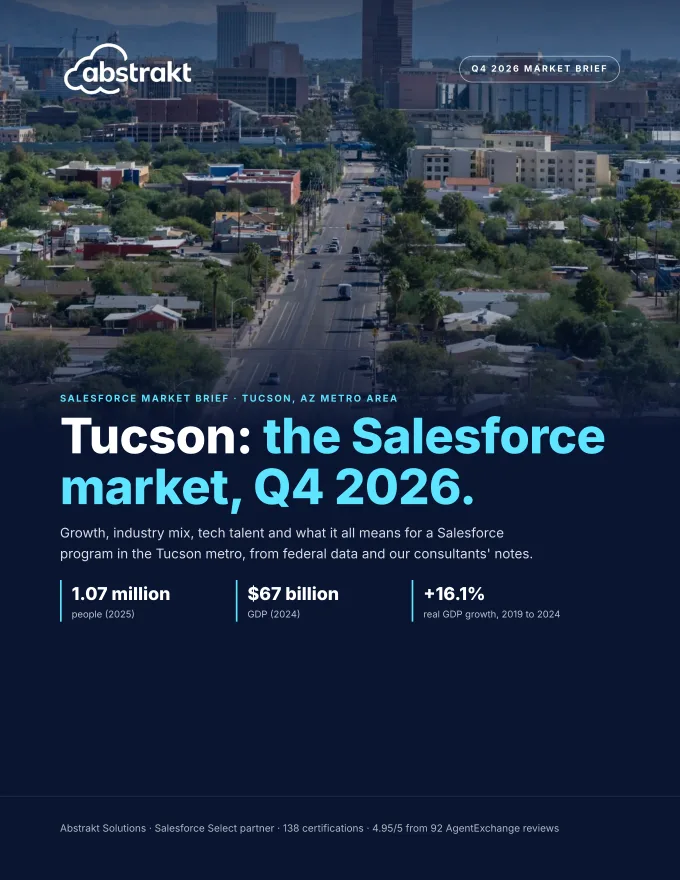
A free 22-page PDF with Tucson's growth ranked against 100 metros, its industry mix, tech wages and nearby markets. It is offered on the public Tucson page; send your customer there or get a copy for your own prep.
Get the Tucson brief →Co-sell with Abstrakt in Tucson
Working a Tucson account? Bring in a named consultant for discovery, scoping or a health check. We reply within 4 business hours.