

How Salesforce work starts in Lakeland
Abstrakt Solutions, a Salesforce Consulting Partner, works with companies in Lakeland, Winter Haven and elsewhere in Polk County. Lakeland is one of our focus markets.
What buyers here usually run into
- 1
Order visibility for customers
Distribution-heavy businesses field constant status questions. Portals and integrated order data let customers help themselves and free up service teams.
- 2
Crews and technicians in the field
Manufacturers and service contractors spread across a large county need scheduling, mobile work orders and cost tracking that do not depend on paper or spreadsheets.
- 3
Insurance service volume
Insurance and financial operations handle large volumes of policyholder requests, where routing, privacy and audit trails all matter.
Budget, team and partner questions
What drives cost
Lakeland cost drivers are mainly integration: how many WMS, ERP and plant systems Salesforce must connect to and how reliable that data is. Customer portals, Field Service for technicians across the county and insurance service design for volume surges each add scope.
Admin or partner
Distribution and manufacturing firms here often have uneven Salesforce workloads, with heavy periods during integration or portal launches and quieter months after. Managed services fits that pattern; companies with steady daily requests usually add an internal admin.
What buyers ask a partner
Ask for experience with warehouse and ERP integration, B2B portals and Field Service, plus insurance service design if relevant. Ask how the partner monitors integrations and what happens when one fails during your busiest week.
The local economy and its biggest industries (4)
| Sector | Share of 2024 GDP | Where Salesforce fits |
|---|---|---|
| Wholesale trade Integration → | 11.3% | Distribution is the backbone of Polk County’s economy. Wholesalers and logistics providers here need account management, order status and B2B self-service tied to warehouse and ERP systems. |
| Manufacturing Salesforce for manufacturing → | 8.8% | From phosphate fertilizer production to the tech-enabled producers the CFDC is recruiting, manufacturers need quoting, service and field work connected to plant data. |
| Health care and social assistance Salesforce for health & life sciences → | 7.9% | Health care and social assistance ranks third among Polk’s private sectors at 7.9% of 2024 GDP, and the CFDC targets life sciences and healthcare advancements. Health care organizations here use Salesforce for patient access, referrals and outreach across hospitals and clinics. |
| Retail trade Salesforce for retail & consumer goods → | 7.8% | With retail trade at 7.8% of 2024 metro GDP and e-commerce on the CFDC’s target list, the suppliers, brands and service businesses that sell into retail need clear account plans, trade promotion tracking and marketing. |
Source: U.S. Bureau of Economic Analysis, GDP by county (CAGDP2), 2024, summed to the metro area; private sectors only, excluding real estate and government. “At least” marks sectors where BEA suppresses some county figures.
Regional target sectors named by local economic development groups: Advanced + Tech-Enabled Manufacturing, Logistics, Supply Chain & E-Commerce, Aviation, Aerospace & Defense, Life Sciences & Healthcare Advancements, Corporate & Professional Services, Research, Innovation & Technology.
Salesforce products that fit Lakeland (6)
In the order we lead with them here, from the industries above.
Salesforce Sales Cloud
The CRM where sales pipeline lives, when it is built right.
Salesforce Service Cloud
The operating system for modern customer service, case, knowledge, voice, and AI agent assist together.
Salesforce Field Service
Scheduling, dispatch, mobile work orders and parts for teams that work on site.
Salesforce Experience Cloud
Customer, partner, and employee portals built on Salesforce.
MuleSoft
Enterprise API platform, for connecting Salesforce, ERP, data warehouses, and the rest of your stack.
Salesforce Marketing Cloud
Cross-channel marketing, email, mobile, journey, and Data 360-powered personalization at scale.
Distribution-driven AI opportunities in Lakeland
Wholesale trade is Lakeland's largest private sector, at 11.3% of metro GDP in 2024 per BEA, with manufacturing at 8.8%. Distribution centers and e-commerce fulfillment operations generate many near-identical questions about orders, backorders and deliveries. Grounded self-service can absorb a share of those once order data flows into Salesforce reliably. Sales teams at distributors can use AI to prioritize accounts whose buying has dropped, giving reps a reason to call. Manufacturers can apply case summaries to supplier and quality issues. Health providers, the third large sector, should start with drafted replies only. Integration with warehouse and ERP systems is usually the real project here, and it has to be solid first.
- Order and backorder self-service
- Flagging accounts with declining purchases
- Supplier issue case summaries
Services buyers here usually need (7)
Salesforce Implementation in Lakeland
Implementing Salesforce in Lakeland usually means fitting a CRM onto operations that were built around warehouses, plants and trucks rather than a sales floor. Polk County businesses tend to sell to other businesses, serve customers across a wide county and depend on an ERP or warehouse system for the facts. We map those realities into the data model first, decide what each team sees on launch day, and phase the rollout so the first group is productive before the next one starts.
By industry in Lakeland
- 1
Manufacturing
Manufacturing is the metro's second-largest private sector, about 8.8% of 2024 GDP, and the CFDC recruits advanced and tech-enabled producers. For a Polk County plant adopting Salesforce, the design questions are practical: how distributors, end customers and job sites relate as accounts, whether quotes start in Salesforce or the ERP, and which service visits need Field Service rather than a simple case. Answering those before configuration keeps the build from being redone once the plant floor starts using it.
- 2
Logistics, Supply Chain & E-Commerce
Logistics, supply chain and e-commerce is a CFDC target, and wholesale trade is Polk's largest private sector at 11.3% of 2024 GDP. Carriers and 3PLs implementing Salesforce need a model built around shippers, lanes, facilities and contracts rather than a generic funnel. We set up onboarding as a tracked project for each new client, cases for exceptions and claims, and account plans that show volume and renewal dates, so sales and operations work from one customer record instead of competing lists.
- 3
Life Sciences & Healthcare Advancements
Life sciences and healthcare advancements is another CFDC target, in a county where health care produces 7.9% of 2024 GDP. Implementations for providers, device suppliers and research-driven firms here start by drawing a clear line around protected information. We decide with your compliance staff which objects hold patient or trial details, restrict them with permission sets from the first sprint, and build outreach and referral processes on top, rather than bolting privacy controls on after users are already inside.
Raise before scoping
Design for mobile crews early
Technicians, drivers and reps in a county this spread out often spend the day away from a desk. Build mobile layouts and offline access into the first release instead of a later phase, because field users judge the system by what it does on their phone.
Decide where quotes begin
Many local producers and distributors already price in an ERP. Choose whether quotes originate in Salesforce and flow back, or start in the ERP and display in Salesforce, before building anything, since reversing that decision later rewrites the integration and retrains every rep.
Tie the first phase to revenue
Pick a launch scope leadership can measure, such as new-account onboarding or quote turnaround. A first phase with a visible business result earns support for the service, portal and marketing phases that follow, and gives users a reason to keep their records current.
Salesforce Integration in Lakeland
In Lakeland, integration is often the reason a Salesforce project exists. Distributors and logistics companies hold orders, inventory, shipments and invoices in operational systems, and sales and service teams need that information without logging into three screens. We map the flows each team relies on, decide which system owns what, and connect them with MuleSoft, native connectors or scheduled jobs depending on volume. Monitoring and alerting are designed in, so failures are caught before customers notice.
By industry in Lakeland
- 1
Wholesale trade
At roughly 11.3% of 2024 output, wholesalers outweigh every other private industry in Polk County. For wholesalers, the most valuable integration usually brings open orders, backorders, credit holds and invoice status from the ERP into the account page, and sends new customers and approved quotes back. We design the account key and product mapping carefully, since mismatched customer numbers are the most common reason distribution integrations lose trust in their first months.
- 2
Logistics, Supply Chain & E-Commerce
Fulfillment centers and 3PLs in the county move enormous volumes, so the integration question is what to summarize. Salesforce should not store every scan; it should show account managers daily volume, exceptions, claims and billing disputes. We pull aggregated metrics from WMS and TMS platforms, create cases automatically for exceptions that need a customer response, and give shippers a portal view of their own open issues where that reduces calls.
- 3
Manufacturing
Manufacturers in Polk County, from food and consumer goods producers to industrial firms, often need Salesforce connected to both an ERP and a production or quality system. Sales wants order status and lead times; service wants installed equipment, warranties and lot history. We sequence those integrations by business value, starting with order visibility, and use MuleSoft when several systems need the same product or customer data rather than building separate point-to-point links for each.
Raise before scoping
Match customer numbers first
Before any data flows, reconcile how customers are identified across Salesforce, the ERP and the warehouse system. One shared key, cleaned in advance, prevents duplicate accounts and orphaned orders that otherwise surface during the first busy week after launch and erode trust in the new connection.
Summarize high-volume data
Warehouses generate far more transactions than a CRM should hold. Decide which totals, exceptions and trends account teams truly need, and store those in Salesforce, leaving line-level transaction history in the operational systems where it is already reported and audited.
Assign an integration owner
Someone must receive alerts when a sync fails, understand the error and decide whether to retry. Name that person, internal or through managed services, and give them runbooks, so a failed order sync on a Friday afternoon is handled rather than discovered on Monday.
Salesforce Optimization in Lakeland
Optimization in Lakeland tends to target orgs that grew quickly alongside the business. A distributor adds a region, an insurer adds a product line, a supplier picks up a big retail account, and each change leaves new fields, queues and automation behind. We study usage data and watch people work, then remove clutter, merge duplicates, rebuild overlapping automation as a smaller set of Flows and redesign the reports managers use to run the week.
By industry in Lakeland
- 1
Retail trade
Retail trade accounts for about 7.8% of 2024 GDP in the Lakeland-Winter Haven metro. Suppliers and service firms that sell into large retailers often track promotions, store visits and deductions in Salesforce objects built piecemeal. Optimization consolidates those into one account plan per retail customer, fixes visit and task automation that creates noise, and rebuilds reports so a key-account manager can see sell-through issues without exporting data.
- 2
Corporate & Professional Services
Service centers and professional firms in Polk County live in Service Cloud consoles, where every unnecessary click is multiplied across a full shift. We time common tasks, remove fields agents skip, rebuild macros and quick actions around the requests that actually arrive, and simplify case closure. Reports shift from volume counts to first-contact resolution and backlog age, which tell supervisors far more about whether the operation is healthy and where coaching would help most.
- 3
Advanced + Tech-Enabled Manufacturing
The CFDC's focus on tech-enabled manufacturing fits producers that already run modern plants but an aging CRM configuration. Common problems include opportunity stages that no longer match the sales process, quote approvals routed by email outside Salesforce, and forecast reports built on fields reps ignore. We rebuild stages around real buying steps, move approvals into Salesforce with clear thresholds, and retire fields that nobody has touched in a long time.
Raise before scoping
Start from real usage data
Which fields get filled, who logs in and which reports get run tell you where the org earns its keep. Start there, then shadow a few users in Lakeland and Winter Haven, so recommendations rest on evidence rather than the loudest complaint in the room.
Merge duplicates, then prevent them
Retail and distribution orgs collect duplicate accounts through imports, web forms and reps creating their own records. Merge the existing duplicates carefully, keeping history attached, then add matching and duplicate rules so the problem does not quietly return a few months later.
Consolidate automation per object
Multiple triggers, flows and legacy rules firing on the same object make behavior unpredictable. Map what runs on each key object, combine logic into one well-documented Flow per event where possible, and test every path in a sandbox before deactivating the old pieces for good.
Salesforce Managed Services in Lakeland
Managed services for a Lakeland company typically covers the gap between a finished implementation and a mature internal team. Distributors, service operations and insurers here often have one administrator juggling users, reports and integrations, while construction, at about 6.5% of metro GDP, adds contractors with field crews whose needs change every season. We handle the request queue, keep Flow automation and connected systems healthy, prepare each Salesforce release, and maintain a ranked backlog you review with us monthly.
By industry in Lakeland
- 1
Corporate & Professional Services
Corporate and professional services is a CFDC target, a category that takes in regional offices and back-office operations. Back-office and service centers like these run Salesforce at high volume, where a small change to routing or a queue can affect an entire floor of agents by lunchtime. We manage those changes through a sandbox, test them against real case scenarios, deploy in a planned window and keep a record of what moved, so supervisors are never surprised by a Monday morning configuration change.
- 2
Wholesale trade
Wholesalers across Polk County keep asking Salesforce for small things: a new price book, another report for a key account, an extra field on the order screen. Individually they are easy; together they bury a solo admin. Managed services absorbs that steady flow, groups related requests into releases and watches integration logs with the ERP, so account teams keep getting what they need while the underlying org stays tidy and documented.
- 3
Health care and social assistance
Hospitals, clinics and other providers across the county run outreach, referral and patient-access work in Salesforce. Their managed services priorities are access control and release safety: quarterly user reviews as staff move between facilities, testing of intake forms before each platform update, and careful handling of any change that touches protected fields. We keep a change log compliance staff can read without translating admin jargon.
Raise before scoping
Define what counts as urgent
Agree on response targets by request type before the engagement starts. A broken integration that stops orders from reaching the warehouse deserves same-day attention; a new report can wait for the next release. Clear categories keep the queue calm and your expectations realistic.
Keep one internal decision-maker
Outside consultants can do the work but should not set priorities alone. Name someone in your company who approves backlog order, signs off on releases and speaks for the business, so enhancements reflect Lakeland priorities rather than whoever emailed last.
Budget for seasonal peaks
Distribution, agriculture and tourism businesses here see busy seasons that change what users need from Salesforce. Plan larger enhancements for quieter months and keep peak periods for support and small fixes, so no one is retraining staff during your heaviest weeks.
Salesforce Health Checks in Lakeland
A health check for a Lakeland organization gives leadership a clear list of what is risky, what is wasteful and what is fine. Nothing is edited while we look through who can reach which records, what visitors see, how connected systems log in, what the automation and Apex are doing, and how clean the data is. Every issue gets a severity rating and a rough size, so the order of repairs is obvious. Health care, insurance and defense-related organizations usually focus on access; distributors on integrations and data.
By industry in Lakeland
- 1
Health care and social assistance
Health care and social assistance contributes about 7.9% of metro GDP, and hospitals and clinics here increasingly run outreach and referral work in Salesforce. The review checks whether protected fields are limited to the roles that need them, whether reports and exports could expose patient details, how public forms and guest users are configured, and whether audit trails would support an investigation. Plain wording lets your compliance lead decide on each item without an admin translating.
- 2
Aviation, Aerospace & Defense
Defense-related suppliers in the county need confidence that sensitive program information is not visible to the wrong people or stored where it should not be. The health check reviews record-level sharing on pursuits and contracts, file and attachment access, login policies and multi-factor settings, and any integrations that move data out of Salesforce. It also flags fields or notes that may contain information your policies say belongs in another system.
- 3
Corporate & Professional Services
Insurance operations and shared-service centers here often run large Service Cloud orgs built by several teams over the years. Common findings include profiles cloned many times with slightly different access, automation that fires on every case update and slows the console, and custom code nobody on staff can maintain. We quantify that technical debt, estimate which items carry real risk, and identify what must be tidied before an Agentforce pilot sees production data.
Raise before scoping
Check integration users closely
Accounts used by ERP, marketing or telephony tools often receive broad permissions during setup and are never revisited. They can read and change far more than their purpose requires, so they deserve the same scrutiny as any human administrator, including a check of when each one last logged in.
Audit guest and portal access
Public forms, community sites and customer portals are where many Salesforce exposures happen. Review what unauthenticated and external users can query, especially after Salesforce security updates, and remove sharing that was opened temporarily for a campaign or event and then forgotten.
Confirm AI data readiness
Before switching on AI features, confirm that knowledge articles are current, duplicate records are under control and sensitive fields are restricted. The health check reports on each of those conditions, so any Agentforce pilot starts from records and content your team would stand behind.
Salesforce Implementation Rescue in Lakeland
A Salesforce rescue in Lakeland starts with finding out what actually went wrong. Projects here commonly stall at integration, where warehouse or ERP data never arrived, or at adoption, where reps and dispatchers kept their spreadsheets. We review the org, contracts, backlog and data, interview the sponsor and a range of users, and separate structural problems from unfinished work. You get a triage report, early fixes that restore confidence and a practical plan for completing the project.
By industry in Lakeland
- 1
Logistics, Supply Chain & E-Commerce
Logistics projects in Polk County often fail when Salesforce was designed without operations in the room. Cases arrive with no link to shipments, onboarding tasks are tracked in email, and account managers cannot see volume. In a rescue we bring dispatch and warehouse leads into short working sessions, redesign case types and onboarding around their workflow, and prioritize a basic operational data feed so users see why the system is worth updating.
- 2
Manufacturing
Manufacturing rescues frequently involve a quote tool that nobody trusts. Pricing rules were built from an outdated price list, discounts need approvals that never route, and reps quietly return to spreadsheets. We test recent real quotes against the configuration to find where it fails, decide whether to repair the rules or simplify the catalog, and restore a dependable quote process before tackling service, portals or other deferred scope, so reps have a reason to log back in.
- 3
Retail trade
Retail-facing projects here often go live with too much at once: new service console, marketing journeys and loyalty data all in one launch. When problems appear, users cannot tell which piece failed. Our rescue approach narrows the live scope to what works, pauses features that are generating errors, and reintroduces them one at a time with testing. That approach lets service and marketing teams regain confidence without abandoning the investment already made.
Raise before scoping
Get an independent read
Internal teams and the original partner are too close to the history. An outside review, conducted with access to everyone involved, produces a diagnosis sponsors can trust and a recommendation that is not shaped by who made which decision or who signed which contract.
Stabilize before adding features
Resist the pressure to deliver the missing scope immediately. Fix broken automation, data errors and access problems first, so the system in production is reliable, then resume feature work on a foundation that will not undermine it or force the same fixes again later.
Reset the plan with users
Share the new plan with the people who stopped using Salesforce, not only with executives. When dispatchers, reps and agents see their specific complaints on the fix list, they are far more willing to try the system again and report the next problem instead of working around it.
Salesforce Migration in Lakeland
Companies around Lakeland usually migrate to Salesforce because growth broke whatever they started with. A distributor has outgrown a desktop CRM, a young tech firm has outgrown a free tool, a contractor is running jobs from spreadsheets. We list every data source, design the target objects, clean and deduplicate in a staging area, and rehearse the load in a sandbox with the people who know the data. Cutover is scheduled around your busy season, not in the middle of it.
By industry in Lakeland
- 1
Research, Innovation & Technology
Research, innovation and technology is a CFDC target, and the county's STEM-focused public university and the Central Florida Innovation District feed a growing group of young firms. Startups here often begin on a free or low-cost CRM and move to Salesforce when investors, partners or larger customers expect more rigor. Their migrations are small in volume but need thoughtful design, because the object model chosen now must still work after several more rounds of growth.
- 2
Wholesale trade
Distributors carry the messiest migration data in the county: accounts split by ship-to address, contacts copied into several records and pricing agreements held in attachments or email. We collapse those into a clear parent and child account structure, carry forward the sales history reps actually use, and move contract terms into fields instead of files. Anything too old or too detailed stays in an archive that remains searchable when someone needs it.
- 3
Aviation, Aerospace & Defense
Aviation, aerospace and defense is a CFDC target industry, and firms in it often migrate from tools built for smaller programs. Their data includes contract vehicles, prime and subcontractor relationships, and pursuit history with sensitive details. Migration planning here includes classifying which records may enter a commercial Salesforce org at all, mapping pursuits to opportunities with the right record types, and restricting visibility from the first load rather than tightening it afterward.
Raise before scoping
Inventory every hidden source
The official CRM is rarely the only source. Ask each team for the spreadsheets, shared inboxes and personal contact lists they rely on, because the most valuable customer notes often live outside the system everyone assumes is authoritative, and losing them would cost relationships.
Assign data owners by object
Someone who knows the customers must approve how accounts are merged, which contacts are inactive and which history matters. Give each major object a business owner, not only an IT contact, so cleanup decisions are made quickly and confidently instead of stalling in a shared inbox.
Avoid peak-season cutovers
Distribution, agriculture and tourism businesses in Polk County all have predictable busy periods. Schedule the final load for a quieter stretch, so users learn the new system while order volume is manageable, questions get answered quickly and support staff are not stretched thin.
Industry plays in Lakeland (4)
Salesforce for Lakeland Manufacturers
Manufacturers in the Lakeland-Winter Haven area often sit in the middle of long supply chains: they buy from growers or component suppliers, build or process products, and ship to distributors, retailers and e-commerce customers. Salesforce helps by giving sales and service a shared view of each customer's contracts, open orders and quality issues. We connect it to ERP and warehouse systems, add partner portals where distributors need self-service, and keep the design simple enough for plant-based staff to use.
Manufacturing contributed 8.8% of 2024 GDP in the Lakeland-Winter Haven metro, which matches Polk County exactly, according to Bureau of Economic Analysis figures; wholesale trade is larger at 11.3%. The Central Florida Development Council lists advanced and tech-enabled manufacturing as a target industry, alongside logistics, supply chain and e-commerce, and AgTech. In Lakeland, a public university created in 2012 describes itself as Florida's only one dedicated exclusively to STEM, and the council promotes a 3,000-acre innovation district connecting universities with startups and accelerators, giving manufacturers local engineering talent and research partners.
Use cases to open with
- 1
Distributor and private-label accounts
Many Polk County producers sell branded products through distributors while also making private-label goods for retail customers. Sales Cloud can separate those programs on the same account, with specifications, pricing agreements and forecast volumes for each. Account managers see which programs are growing, which contracts renew next and which customers are ordering below forecast, so they can act before a quarter is lost rather than explaining it afterward.
- 2
Self-service parts and order portal
Distributors and dealers call constantly to check stock, order status and pricing. An Experience Cloud portal connected to ERP inventory and order data lets them place orders, track shipments and download documents on their own. Service staff handle exceptions instead of routine lookups, and the portal captures demand signals that sales can use to plan promotions or production runs with better information.
- 3
Quality claims and returns
When a shipment arrives damaged, off-spec or short, the customer expects a quick credit or replacement and an explanation. Service Cloud cases linked to orders, lots and shipments speed that process and track root causes across customers. Quality teams see patterns by product line or plant, and account managers know about open claims before they walk into a customer review meeting.
Raise before scoping
Lot and batch traceability
Food, chemical and processed-product makers often need lot-level tracking for recalls and customer audits. Salesforce should link cases and orders to lot numbers held in ERP or quality systems, rather than storing full traceability data itself, so the source of truth stays clear.
Warehouse and ERP integration
With wholesale and logistics so prominent in the county, many manufacturers share data with third-party warehouses and carriers. Map every source of order and shipment status before integrating, and agree which system customers and service agents should trust when they disagree.
Plant-based user adoption
Customer service and inside sales staff at manufacturing sites often juggle several screens already. Build compact layouts, automate data entry from ERP where possible and train with real scenarios, or users will fall back on the systems and spreadsheets they know.
Salesforce for Lakeland Retail and Consumer Brands
Retail and consumer brands around Lakeland operate in a county where wholesale and distribution outweigh every other private sector, and their customers judge them by delivery speed and service. Salesforce helps connect storefronts, online orders, warehouses and customer service into one experience. We integrate commerce and fulfillment data so agents can answer order questions immediately, use marketing tools to reach shoppers based on real purchase behavior, and give store and regional managers a clearer view of customer feedback by location.
Retail trade represented 7.8% of 2024 GDP in Polk County, which is the entire Lakeland-Winter Haven metro, based on Bureau of Economic Analysis data, while wholesale trade was the largest private sector at 11.3%. The Central Florida Development Council targets logistics, supply chain and e-commerce, reflecting the county's role in moving goods to stores and homes. Retailers and consumer brands here therefore live alongside distribution centers and e-commerce fulfillment operations, which shapes customer expectations about delivery and the data that service teams need.
Use cases to open with
- 1
Order-status service at scale
When most customer contacts are about where an order is, agents need shipment data on screen instantly. Service Cloud connected to commerce, warehouse and carrier systems shows order, fulfillment and tracking details in one view. Agentforce can answer routine status questions through chat or messaging, handing off to an agent when an order is delayed, damaged or needs a refund decision.
- 2
Multi-location store feedback
Retailers with several locations need to know which stores generate complaints, compliments or repeat issues, and whether those patterns change after new staff or policies arrive. Service Cloud cases tagged by store and category, with dashboards for district and regional managers, turn scattered feedback into visible trends. Managers can follow up with customers directly and track whether training, staffing or layout changes actually improved results at each location.
- 3
Loyalty and purchase-based marketing
Marketing Cloud and Data 360 (formerly Data Cloud) can combine online orders, store transactions and loyalty data into one shopper profile, even when each lives in a different system today. Journeys can then recognize first purchases, lapsed customers and frequent buyers, and adjust offers by channel and store location. Consent and preferences follow each profile, and reporting shows which campaigns drove repeat visits and revenue rather than just email opens and clicks.
Raise before scoping
Carrier and warehouse data quality
An agent or chatbot can only report what carrier and warehouse feeds have already recorded. Confirm how often warehouse and carrier systems update, how delivery exceptions are flagged and which system is authoritative before promising customers real-time information through agents, chat or automated messages.
Store-level data structure
Decide early how stores, districts and regions are represented, and whether store staff will use Salesforce directly or only receive reports from it. A clean location hierarchy makes reporting simple from the first day; retrofitting one after launch means rebuilding dashboards, queues and sharing rules.
Consumer privacy and consent
Shopper data from loyalty programs, online accounts and service interactions must be handled according to applicable privacy laws and your own published policies. Capture consent per channel, honor opt-outs across every connected system, and document where customer data flows so questions from shoppers or auditors have ready answers.
Salesforce for Lakeland Health Systems
Health care in the Lakeland-Winter Haven area is shaped by geography: patients live across a wide county, clinics sit in many small cities, and a lot of care happens in homes. Salesforce helps organizations coordinate that spread. Service Cloud centralizes patient access and referral intake, Field Service schedules home visits and mobile staff by territory and skill, and Experience Cloud gives referring offices and patients a self-service channel. Charts, orders and results never leave the EHR in this design.
Because one county forms the entire metro, Polk's care providers can be measured cleanly: they produced 7.9% of 2024 GDP by the BEA's reckoning, trailing only distributors and factories. The Central Florida Development Council, the county's economic development organization, lists life sciences and healthcare advancements among its target industries, along with research, innovation and technology. It also promotes a 3,000-acre innovation district meant to connect universities and established institutions with startups and accelerators, and the county hosts a public university dedicated exclusively to STEM that welcomed its first students in 2014.
Use cases to open with
- 1
Countywide referral intake
Referrals arrive from primary care offices, urgent care centers and hospitals scattered across Polk County, by fax, phone and portal. Service Cloud turns each one into a tracked request with insurance verification, scheduling status and follow-up tasks. Coordinators see which referrals are stuck, and liaisons can compare referral volume by office and city to decide where outreach will make the biggest difference.
- 2
Home health and mobile visits
Home health, therapy and mobile care teams spend hours on the road between patients in different towns. Field Service schedules visits by territory, clinician skill and patient availability, optimizes routes and captures visit notes or supply usage on a mobile device. Schedulers can rebalance the day when a clinician calls out, and managers see productivity without chasing paper logs at the end of the week.
- 3
Life-sciences partnerships and pilots
Life-sciences startups and research groups connected to the county's innovation district work with clinical partners, sponsors and early customers at once. Sales Cloud can track pilot agreements, data-sharing terms, grant milestones and commercial opportunities in one place. Founders then report progress to investors and partners from live data instead of assembling slides from email threads before each meeting, and new hires inherit a documented history of every clinical relationship rather than a departed colleague's inbox.
Raise before scoping
HIPAA and minimum necessary
When patient information is stored in Salesforce, a business associate agreement, encryption decisions and role-based access come first. Store only what outreach and coordination require, link back to the EHR for clinical detail, and let your privacy officer approve the data model before anyone builds automation.
Mobile coverage in rural areas
Clinicians visiting homes in the county's rural stretches may lose signal. Configure the Field Service mobile app for offline use, keep forms short, and test in the areas where coverage is weakest, so notes and time entries sync reliably once the clinician is back in range.
Storm-season continuity plans
Central Florida providers must reach vulnerable patients before and after hurricanes. Build patient lists by risk, equipment dependency and location in advance, prepare outreach templates, and test how the team would work if offices close, so Salesforce supports the emergency plan rather than improvising during an event.
Salesforce for Lakeland Insurers and Agencies
Insurance work around Lakeland tends to be service-heavy. Agencies handle a steady stream of policy changes, billing questions and certificate requests, and carrier or back-office teams face sudden surges when a storm moves through Central Florida. Salesforce helps both. Service Cloud routes requests by line and skill, Experience Cloud lets policyholders and agents help themselves, and Financial Services Cloud organizes households and businesses with their policies. Agentforce can take routine questions during peaks, handing coverage matters to licensed staff.
Insurance is not one of the Lakeland-Winter Haven metro's five largest private sectors in 2024 BEA county data, which wholesale trade, manufacturing, health care, retail and construction lead, and no finance-sector share appears in the record. The industry shows up through the Central Florida Development Council's target of corporate and professional services, which covers the service centers and operations offices that insurers and financial firms place in lower-cost markets. The county's large logistics and construction base also drives commercial demand for property, fleet, cargo and builders' risk coverage.
Use cases to open with
- 1
Policyholder service at scale
Service centers take calls, emails and chats about payments, policy changes, documents and claims status. Service Cloud routes each request by line of business, language and skill, shows the policy summary from the core system, and suggests knowledge articles. Supervisors track queue age and staffing in real time, and quality teams can review interactions without pulling recordings from a separate system.
- 2
Catastrophe surge handling
After a hurricane or major storm, first-notice and status inquiries can overwhelm normal staffing. Salesforce can switch on surge routing, overflow queues and prepared messaging, while Agentforce answers routine status and document questions around the clock through digital channels. Claims teams see the backlog by severity and location, and communications go out proactively instead of waiting for policyholders to call.
- 3
Commercial lines for logistics and builders
Distribution centers, carriers and contractors carry property, auto, cargo, workers' compensation and builders' risk policies that change as fleets and projects change. Salesforce groups those policies under each business, tracks exposure changes and certificate requests, and schedules pre-renewal reviews. Producers see which commercial clients are adding locations or trucks and can quote the change before a competitor does, while account managers keep certificate turnaround visible to shippers and general contractors who need proof of coverage the same day.
Raise before scoping
Planning for peak volume
Design queues, routing and automation to scale when a storm multiplies contacts overnight. Load-test with realistic volumes, prepare surge templates, overflow rules and temporary-staff profiles in advance, and confirm that reports and dashboards still perform when case counts jump sharply in a single weekend.
Florida regulatory expectations
Claims handling and policyholder communications in Florida are closely regulated, with timing expectations after catastrophes. Build auditable timestamps and communication logs into Salesforce, and have your compliance team confirm what must be captured. Interpreting those statutes is your counsel's job; ours is making the evidence easy to pull.
Core system integration
Claim files, invoices and policy forms stay where they are today. Decide which summaries Salesforce displays, how quickly they refresh and how service actions write back. During a surge, stale claim status erodes trust fast, so integration latency deserves attention early in design.
Case studies to send (3)
From the industries this market leans on. Client names are anonymized and these projects are not specific to Lakeland.
The Lakeland Salesforce market brief, Q4 2026
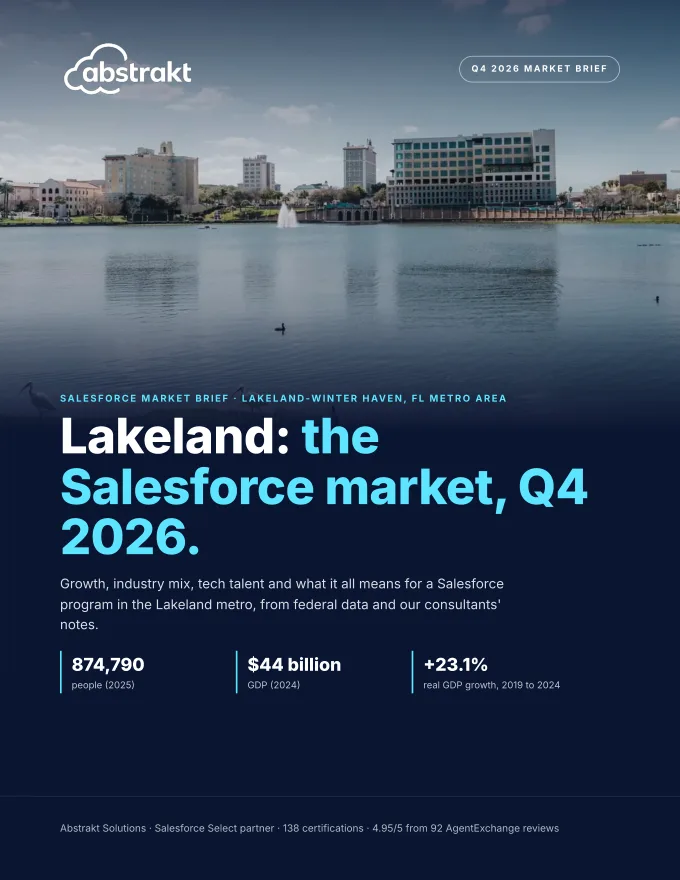
A free 22-page PDF with Lakeland's growth ranked against 100 metros, its industry mix, tech wages and nearby markets. It is offered on the public Lakeland page; send your customer there or get a copy for your own prep.
Get the Lakeland brief →Co-sell with Abstrakt in Lakeland
Working a Lakeland account? Bring in a named consultant for discovery, scoping or a health check. We reply within 4 business hours.