

How Salesforce work starts in Orlando
In the Orlando region, from Seminole County to Osceola County, Abstrakt Solutions provides Salesforce consulting to hospitality groups, health organizations, professional services firms and defense-related companies. Orlando is one of our focus markets.
What buyers here usually run into
- 1
Guest data spread across systems
Hospitality companies often hold reservations, loyalty, events and support in separate tools. A single guest view usually starts with integration and data cleanup.
- 2
Seasonal service volume
Travel and leisure businesses see demand swing through the year, so routing, self-service and AI assistance need to absorb spikes without adding headcount.
- 3
Government and defense requirements
Firms that work on defense programs need careful access controls and clear records of pursuits and contracts, which shape how Salesforce is configured.
Budget, team and partner questions
What drives cost
In Orlando the main cost drivers are guest data integration and seasonal service design. Unifying records from property, booking and loyalty systems takes data cleanup before any journey can run, and service built to absorb peak-season spikes needs routing and self-service work. Defense-related firms add access control design.
Admin or partner
Hospitality groups often have marketing and IT teams but few Salesforce specialists, so a partner covers data integration and Service Cloud while internal staff own campaigns. Engineering and simulation firms with smaller sales teams commonly outsource administration.
What buyers ask a partner
Ask for hospitality or retail references with guest data unification, how the partner handles consent across channels, and how they plan for peak volume. Defense-related firms should ask how the partner keeps controlled data out of the CRM.
The local economy and its biggest industries (4)
| Sector | Share of 2024 GDP | Where Salesforce fits |
|---|---|---|
| Accommodation and food services Marketing Cloud → | 7.4% | Resorts, vacation ownership companies and restaurant groups need guest profiles, sales pipelines for groups and owners, and service that spans many properties and brands. |
| Professional, scientific, and technical services Salesforce for professional services → | 8.6% | Engineering, simulation and technology services firms, many supporting defense programs, need pursuit tracking, contract history and delivery reporting in one system. |
| Health care and social assistance Salesforce for health & life sciences → | 7.3% | Large health systems and life sciences companies in the region need patient and customer engagement, referral tracking and service designed around privacy requirements. |
| Retail trade Salesforce for retail & consumer goods → | 7.3% | Retailers serving residents and visitors alike need customer data, loyalty and marketing tied together across stores and online channels. |
Source: U.S. Bureau of Economic Analysis, GDP by county (CAGDP2), 2024, summed to the metro area; private sectors only, excluding real estate and government. “At least” marks sectors where BEA suppresses some county figures.
Regional target sectors named by local economic development groups: Advanced Manufacturing, Aviation, Aerospace & Defense, Digital Technology, Headquarters and Regional Offices, Life Sciences and Healthcare, Logistics & Distribution.
Salesforce products that fit Orlando (6)
In the order we lead with them here, from the industries above.
Salesforce Service Cloud
The operating system for modern customer service, case, knowledge, voice, and AI agent assist together.
Salesforce Marketing Cloud
Cross-channel marketing, email, mobile, journey, and Data 360-powered personalization at scale.
Salesforce Sales Cloud
The CRM where sales pipeline lives, when it is built right.
Salesforce Data 360 (Data Cloud)
Unify customer data into a real-time profile that powers segmentation, analytics, and AI.
Salesforce Experience Cloud
Customer, partner, and employee portals built on Salesforce.
Salesforce Agentforce
AI agents that handle real work inside Sales Cloud, Service Cloud, and Marketing Cloud.
Orlando guest service, retail and AI agents
Orlando's mix is unusual: professional services lead the BEA 2024 ranking at 8.6% of metro GDP, followed closely by accommodation and food services at 7.4% and retail at 7.3%. Hospitality groups field endless questions about bookings, changes and policies, which makes knowledge-grounded self-service a sensible starting point as long as the articles match current policy. Retailers can use Marketing Cloud segments built from Data 360 (formerly Data Cloud) to target offers, with an agent drafting message variants for a marketer to approve. Simulation, defense and technology contractors in the region are more likely to want lead triage for government and commercial inquiries. Guest data consent and clear escalation paths come before any automation.
- Answering booking and policy questions
- Drafting offer variants for approval
- Triaging government and commercial inquiries
Services buyers here usually need (7)
Salesforce Implementation in Orlando
Many Orlando implementations have to serve two very different kinds of customer at once: individuals such as guests, owners or patients, and organizations such as group buyers, referral sources or government program offices. Getting that split right in the data model, with person accounts where they fit and business accounts where they do not, is the first design decision we make. From there we build in a sandbox, load cleaned data and go live in phases, usually service or sales first, with marketing journeys added once the records are dependable.
By industry in Orlando
- 1
Accommodation and food services
Resorts, vacation ownership companies and restaurant groups need a guest model that recognizes one person across stays, dining, ownership and loyalty. During implementation we decide which system is the source for each of those, how households and travel companions are linked, and which properties or brands share records. Group and event sales usually get a pipeline of their own with separate stages, because a convention booking behaves nothing like an individual reservation.
- 2
Professional, scientific, and technical services
At about 8.6% of 2024 GDP, professional, scientific and technical services outranks every other private sector in metro Orlando, and it includes firms doing simulation and defense work. Implementing Salesforce for them centers on pursuits: opportunities that track solicitation, proposal, award and contract, teaming partners on each bid, and the customer organization behind each program. We also define early what users must never enter, since some program information does not belong in a commercial CRM.
- 3
Life Sciences and Healthcare
The Orlando Economic Partnership counts life sciences and healthcare among its six target industries. Health organizations and life sciences companies implementing Salesforce need a design that leaves protected information in clinical systems while giving outreach, referral and service teams the context they need. We settle the patient or provider model, consent tracking and permission structure during design, and keep the first phase to a single department or program before widening access.
Raise before scoping
Separate brands and properties cleanly
Hospitality groups here often operate several brands or properties from one headquarters. Decide early whether they share one org, one set of guest records and one service queue, or run as separate business units, because that choice drives sharing, reporting and every later integration.
Plan launches around peak seasons
Central Florida's travel calendar has stretches when front-line teams cannot spare time for testing or training. Schedule go-lives and classroom sessions in quieter weeks, and keep structural changes out of peak periods, so staff learn the system when they actually have room to.
Train on the screens staff will use
Front-line agents and sellers learn fastest on realistic scenarios, so training uses their own screens, queues and sample guests rather than generic demos. Discovery and go-live sessions follow the same principle, with staff walking through real reservations, cases and group bookings.
Salesforce Integration in Orlando
Integration in Orlando is usually about bringing operational systems into view rather than replacing them. Resorts keep their property management and booking platforms, health organizations keep clinical records, and distributors keep ERP. We map what each system owns, decide what Salesforce needs to see and how quickly, and connect it through Data 360 (formerly Data Cloud), an integration layer or direct APIs. Every integration ships with monitoring and a runbook, so a failed reservation or order sync is caught by your team before an agent gives a customer the wrong answer.
By industry in Orlando
- 1
Accommodation and food services
Hotels and resorts rarely replace their property management or reservation platforms, so Salesforce has to sit beside them. We connect stays, folios, loyalty and event bookings into a guest profile, usually through Data 360 (formerly Data Cloud) when several brands or properties are involved, and send back only what operations needs. The aim is that an agent sees a guest's upcoming stay and recent history without opening another application or asking a colleague.
- 2
Logistics & Distribution
Logistics and distribution is one of the six industries the Orlando Economic Partnership targets. Distributors and logistics providers need Salesforce to show orders, shipments, inventory positions and invoices held in ERP and warehouse systems. We design those flows around what sales and service actually ask about, typically order status and account balances, and keep high-volume transaction detail in the operational systems built to handle it. Sales reps can then answer a customer's order question during the call instead of promising a callback.
- 3
Professional, scientific, and technical services
Engineering and technology services firms around the region, including many that support defense programs, run project accounting and timekeeping outside Salesforce. Integration connects awarded opportunities to those systems so a contract becomes a project without re-keying, and brings billed and backlog figures back to the account for business development. We keep program data that must stay in controlled systems out of the sync entirely, and document the exclusions for your security team.
Raise before scoping
Choose the linking identifier
Reservation, loyalty and point-of-sale systems each assign their own IDs to the same guest. Decide which identifier links them, and how records without one get matched, before building any connection, or the integration will quietly create new duplicates every night.
Test at peak-season volumes
Integration traffic in tourism businesses climbs sharply in the busiest weeks. Test syncs with realistic high-season volumes, not quiet-month samples, and confirm API limits on both sides, so connections do not start failing on exactly the days they matter most.
Filter controlled data at the source
Defense-services and health organizations here often hold data that must not reach a commercial CRM. Filter it at the integration layer, record which fields are excluded and why, and include those rules in regression tests so a later change cannot reintroduce them.
Salesforce Optimization in Orlando
Optimization in Orlando usually focuses on the people who use Salesforce most intensively: service agents, reservation teams and group sales staff. We watch how they work, measure which fields and screens they skip, and simplify layouts so common tasks take fewer clicks. Duplicate guest and customer records are merged under agreed rules, overlapping automation moves into maintainable Flows, and service and sales reports are rebuilt so managers can trust handle times, conversion and pipeline without exporting everything into a spreadsheet first.
By industry in Orlando
- 1
Accommodation and food services
Hospitality agents handle large volumes of short interactions, so every extra field on a case layout costs real time. Optimization for resorts and restaurant groups trims case and contact screens to what agents need, adds quick actions for common requests such as date changes and refunds, and fixes routing so the right team sees each case first. Managers then get queue and resolution reports that reflect how work actually moves.
- 2
Retail trade
Retailers often hold marketing lists, loyalty data and service history that never quite match. We deduplicate customers, standardize how stores and channels are recorded, and rebuild segments so journeys stop reaching the wrong people or the same person twice. Reporting is reworked around repeat purchases and service contacts per customer, giving merchandising and marketing teams a shared picture of who their most valuable customers are, and which stores serve them best.
- 3
Digital Technology
Digital technology is one of the Orlando Economic Partnership's target industries, and the region is also known for simulation and gaming work. Growing firms in this group often built Salesforce quickly and now carry unused fields, abandoned stages and dashboards nobody opens. We cut the org back to the process the team runs today, consolidate automation and rebuild pipeline reporting so founders and sales leaders finally look at the same numbers.
Raise before scoping
Watch agents before redesigning
Usage data shows which fields go blank, but sitting with reservation and service agents shows why. A morning of observation often reveals extra tabs, copy-and-paste steps and workarounds that no report captures, and those drive the most useful layout changes.
Merge people, not just records
Merging duplicate guests or shoppers affects loyalty balances, marketing consent and service history. Decide which record wins, how consent is combined and who reviews borderline matches before any merge runs, because an overly aggressive merge is harder to undo than a duplicate.
Leave training new hires can use
Front-line teams in hospitality and retail change often. Pair each round of optimization with short, role-based guides and recorded walkthroughs that new staff can use later, so the simplified process survives the next hiring wave instead of drifting back to old habits.
Salesforce Managed Services in Orlando
In Orlando, managed services often supports organizations whose workload swings with the travel calendar and whose Salesforce spans guest service, marketing and sales. We handle user requests and configuration, keep a ranked backlog with your operations lead, review each Salesforce release in a sandbox before users see it, and bring in developers or integration specialists when a task needs them. Changes are timed around your peak periods, so the busiest weeks of the year are never the weeks something new goes live.
By industry in Orlando
- 1
Accommodation and food services
Accommodation and food services contributes about 7.4% of the metro's 2024 GDP. Resorts, timeshare operators and restaurant groups add properties, menus, packages and promotions constantly, and each change touches Salesforce through new case categories, campaign audiences or package records. A managed team absorbs that stream of requests, keeps guest data rules consistent across brands, and schedules larger changes for shoulder seasons when service teams have time to adjust. Every change is logged, so property managers can see what moved and why.
- 2
Headquarters and Regional Offices
The Orlando Economic Partnership targets headquarters and regional offices, and companies that open a regional hub here often inherit a Salesforce org administered somewhere else. Managed services gives the local team a responsive path for requests, while we coordinate with the corporate admin group on releases, shared automation and security. Regional needs get met without breaking processes that other offices rely on, and every change is documented for both teams.
- 3
Retail trade
Retailers serving both residents and visitors run frequent promotions, loyalty changes and store openings. Managed services keeps the Salesforce side current: segments and journeys refreshed, service macros updated for new policies, store records maintained and reports adjusted as the calendar shifts. Because retail teams rarely employ a dedicated Salesforce admin, we fill that role and also cover the occasional development task or integration fix that falls outside it. Store managers get one place to send requests instead of several.
Raise before scoping
Set change freezes for peak weeks
Agree on freeze windows around your busiest travel and holiday periods. Routine requests continue, but new automation, releases and structural changes wait, so reservation and service agents never have to learn a new screen while contact volume is at its highest.
Manage marketing and service together
Marketing Cloud journeys and Service Cloud cases often touch the same guest or shopper in the same week. We run both backlogs side by side, so a campaign never launches before agents know about the offer customers will be calling to ask about.
Deploy late in your office day
Planned deployments run toward the end of your office day, once most administrative users have finished their main work, which leaves time to confirm results before the next morning's shift.
Salesforce Health Checks in Orlando
An Orlando health check often starts with a question about exposure: who can see guest contact details, patient information or defense program contacts, and should they? We review profiles, permission sets, sharing, integration users and connected apps against least privilege, then inventory automation and custom code for overlap and failure risk. Data quality is measured on the objects that matter most, especially ahead of Agentforce or other AI. You receive findings ranked by risk and effort, with a plan you can run internally or with us.
By industry in Orlando
- 1
Health care and social assistance
Health care and social assistance accounts for about 7.3% of 2024 metro GDP, and the region's health systems and life sciences firms carry strict privacy duties. A health check for them traces every path to protected fields: profiles, permission sets, sharing rules, reports, integrations and exports. It also confirms that audit settings and field history are configured the way compliance teams expect, and flags any place patient data appears where it should not.
- 2
Aviation, Aerospace & Defense
Aviation, aerospace and defense is a target industry for the Orlando Economic Partnership, and firms supporting these programs need confidence that their CRM holds only what it should. A health check scans free-text fields, attachments and notes for program information that belongs in controlled systems, reviews who can export data, and confirms that access for subcontractors and former staff has actually been removed. Findings are written so your security officer can act on them directly.
- 3
Accommodation and food services
Hospitality orgs accumulate automation quickly: routing rules for each property, triggers for loyalty updates, Flows for every promotion. A health check inventories that automation, finds rules that fire on the same records or conflict, and measures duplicate guest and contact rates. Those findings matter before AI agents answer guests directly, because an agent acts on the same messy records and competing rules your staff work around today, only faster and with customers watching.
Raise before scoping
Review guest-facing portals
Experience Cloud sites for owners, guests or patients expose Salesforce data outside your walls. Check guest-user access, sharing sets and page visibility as part of any health check, since portal settings are easy to loosen during a launch and rarely revisited afterward.
Check integration users' reach
Integrations with booking, clinical or ERP systems often run under users granted broad permissions during setup. Confirm each one has only the access its job requires, and that credentials belong to the organization rather than to a departed employee or a former partner.
Scope AI readiness by use case
Rather than scoring the whole org for AI, review the specific objects, knowledge articles and permissions a planned agent would use, such as guest service cases or appointment requests. That keeps the health check focused on what must be fixed before a pilot starts.
Salesforce Migration in Orlando
Orlando migrations often combine a CRM move with a marketing move. A restaurant group or retailer may keep customers in an older CRM, subscribers in an email tool and loyalty members in a separate database. We inventory each source, map everything to one set of accounts, contacts and consent records, merge duplicates before loading and preserve the history service and marketing teams still use. Trial loads in a sandbox are reconciled against source counts, and the final cutover is scheduled outside your peak season.
By industry in Orlando
- 1
Retail trade
Retail trade adds about 7.3% of 2024 metro GDP, and retailers here serve residents and visitors whose records look very different. Migration is a chance to separate one-time visitors from repeat local customers, standardize store and channel codes, and carry marketing consent across accurately. We bring the purchase and service history that supports segmentation and archive the rest, so the new org starts with customers marketing can actually reach and service can recognize.
- 2
Health care and social assistance
Health organizations moving outreach or referral tracking into Salesforce often start from spreadsheets and aging databases. The migration needs a clear line between what enters the CRM and what stays in clinical systems, careful handling of consent, and access controls in place before the first record loads. We test with de-identified samples where possible and reconcile every load before real records move, so compliance staff can sign off with evidence.
- 3
Headquarters and Regional Offices
Companies relocating a headquarters or opening a regional office in the Orlando area sometimes bring a separate CRM from an acquired unit or a previous location. Folding it into the company's main Salesforce org means mapping its fields to a common design, deduplicating shared customers and agreeing account ownership before cutover, so the move does not leave two sales teams calling the same client with different offers. Open deals from the old system move last, after owners confirm them.
Raise before scoping
Move consent with each contact
Email and text consent collected in older marketing tools must arrive in Salesforce attached to the right person and channel. Map opt-ins and opt-outs explicitly and test them on sample records, because a lost opt-out creates compliance risk from the very first campaign.
Schedule cutover in quieter weeks
Cut over when front-line teams have room to learn. For Central Florida tourism and retail businesses, that means placing the final load and training away from holiday and peak travel periods, with a short freeze on the old system just beforehand.
Leave old transactions behind
Not every past reservation, receipt or email needs a Salesforce record. Keep what supports current relationships and reporting, move the rest to a searchable store, and tell users where to find it, which keeps the new org quick and storage costs predictable.
Salesforce Implementation Rescue in Orlando
A stalled Orlando project can look like a guest platform that launched without its key integrations, leaving agents to switch between Salesforce and the systems it was meant to unify. It can also be a health or defense-related build that stopped when security requirements surfaced late. Recovery begins with an assessment of the build, data, integrations and promised scope. Daily blockers are cleared first, and every component then gets a keep, repair or rebuild verdict. Remaining scope is delivered, documented and relaunched with role-based training.
By industry in Orlando
- 1
Accommodation and food services
When a hospitality platform goes live without working reservation or loyalty feeds, agents quickly return to the property systems they know. Rescue starts by restoring those connections or providing interim views, so Salesforce shows at least the upcoming stay and recent history. We then fix routing and case design, and relaunch property by property rather than across every brand at once, which lets each site confirm the fixes work before the next one follows.
- 2
Life Sciences and Healthcare
Health and life sciences projects sometimes stall when privacy or security reviews arrive after much of the build is done. In a rescue, we map the design against those requirements, restructure permissions and data storage where they fall short, and document the controls reviewers asked for. Work that already meets the standard is kept, which avoids restarting a project that was mostly sound and only needed the gaps closed and the evidence written down.
- 3
Retail trade
Retail projects can stall when marketing, loyalty and service were scoped together and none of them was finished. We separate the three, get the most valuable piece working first, often customer service or a clean subscriber base, and bring the rest back into a staged plan. Store and marketing teams see progress sooner, and the project regains the confidence it lost while everything was half-built. Loyalty changes, usually the most complex, come last.
Raise before scoping
Restore integrations before features
If the original promise was one view of the guest or customer, missing integrations are usually the biggest gap. Prioritize the feeds front-line staff rely on before adding new features, so users see the system deliver its core purpose and give it a second look.
Bring security reviewers in early
For health and defense-related organizations, involve compliance and security staff at the start of the recovery assessment. Their requirements decide which parts of the build can stay, and learning those requirements late is often how the first attempt stalled in the first place.
Win back front-line supervisors
Supervisors in hospitality, retail and health settings decide whether their teams give Salesforce a second chance. Involve them in testing the fixes, let them preview the relaunch and give them simple adoption reports, so they champion the system rather than quietly allowing workarounds.
Industry plays in Orlando (3)
Salesforce for Orlando Professional Services Firms
Orlando's professional services firms range from simulation and training contractors to creative agencies working for entertainment brands and advisory firms supporting new regional offices. What they share is selling expertise in projects and contracts. Salesforce helps them manage pursuits and proposals, keep client relationships visible across practices, and connect pipeline to staffing and delivery. We configure it for your mix of government, commercial and agency work, and integrate it with the project and accounting tools you already use.
Professional, scientific and technical services is the Orlando-Kissimmee-Sanford metro's leading private sector by output, with 8.6% of 2024 GDP by Bureau of Economic Analysis estimates, ahead of accommodation and food services at 7.4%. The Orlando Economic Partnership targets aviation, aerospace and defense, digital technology, and headquarters and regional offices, among others, and highlights simulation, optics and photonics, and gaming. A research park beside a public university's main campus hosts a simulation institute that represents the university in a military modeling and simulation partnership spanning all four services, which draws engineering and training firms to the area.
Use cases to open with
- 1
Simulation and training pursuits
Firms building simulation, training and engineering solutions for defense customers pursue work through solicitations, subcontracts and task orders. Salesforce can track each pursuit with the customer program, prime or subcontract role, contract vehicle and key dates, and forecast by expected award and period of performance. Capture teams see which bids need attention, and leadership sees a backlog grounded in real milestones.
- 2
Agency client and project pipeline
Digital and creative agencies serving entertainment, hospitality and technology clients juggle retainers, campaign projects and pitches. Sales Cloud can track each by type, with estimates built from role-based rate cards through CPQ. When a pitch wins, a project is created in the delivery tool automatically, and account leads can compare scope sold with hours spent to protect margins on the next proposal.
- 3
Serving relocating companies
Advisory, staffing, accounting and commercial real estate services firms often win work from companies opening regional offices or moving headquarters. Salesforce can track those organizations as they move from inquiry to lease signing and hiring, coordinate introductions across service lines and trigger Marketing Cloud content for each stage, so the firm stays relevant throughout a long relocation process. Referral sources get credit too.
Raise before scoping
Separate government and commercial
Firms serving both defense and commercial clients face different rules, pricing and data sensitivity. Use record types, sharing rules and approval processes that keep controlled program details out of general views, and review access and hosting needs with security staff early.
Connect estimates to actuals
Scoping mistakes repeat when nobody compares estimates with results. Integrate Salesforce with time-tracking and project accounting so completed projects report estimated versus actual hours by role, and feed those lessons into rate cards and future proposals. Estimators improve fastest when they see their own variances.
Keep it simple for small teams
Smaller consultancies and agencies here often lack anyone whose full-time job is running Salesforce. Favor standard features over heavy customization, document every automation, and plan ongoing support so the org does not decay when the person who built it moves on. Review the org twice a year.
Salesforce for Orlando Health and Life Sciences
Orlando's health organizations serve residents and, in a metro built partly on tourism, a flow of visitors whose needs arrive unannounced, which can make intake and scheduling uneven. Salesforce helps providers route requests from phone, web and text, coordinate referrals, and keep outreach consistent without exposing more patient data than necessary. Life sciences and health technology companies, including makers of simulation and training systems, use it to manage long sales to hospitals and support customers afterward. We integrate with the electronic health record or ERP as needed.
Health care and social assistance produced 7.3% of Orlando-Kissimmee-Sanford GDP in 2024, according to the Bureau of Economic Analysis's county figures, tied with retail trade and behind professional services and accommodation and food services. Life sciences and healthcare make the Orlando Economic Partnership's short list of sector priorities, and the same organization showcases simulation, optics and photonics as regional strengths. The metro's large public research university and the neighboring Central Florida Research Park, home to a university institute for simulation and training, give the region an unusual link between health care and modeling technology. The partnership revalidates its targets annually, so priorities may shift.
Use cases to open with
- 1
Seasonal intake and scheduling
Busy travel periods can swell demand for urgent care and walk-in visits. Service Cloud routes calls, web forms and texts to the right queue, and omni-channel capacity rules shift work between teams as volumes rise. An Agentforce agent can answer location, hours and preparation questions, handing clinical matters to staff, so scheduling agents focus on requests only people can resolve.
- 2
Physician liaison programs
Across Orange, Seminole, Osceola and Lake counties, orthopedic, cardiac and cancer programs court the same independent primary care offices. Salesforce can plan liaison visits, record practice concerns, track referral volumes from integrated data and flag declining sources. Service line leaders see which practices send patients elsewhere and the reasons they give, such as access delays or communication gaps, and liaisons arrive at each visit knowing the practice's recent history with the organization.
- 3
Selling simulation and training systems
Companies selling medical simulators, training software or devices to hospitals and schools manage evaluations with educators, clinicians and procurement. Sales Cloud tracks those stakeholders and grant or budget timing, Revenue Cloud or CPQ configures systems and service plans, and Service Cloud supports installed units. Renewal dates for software licenses and service contracts appear alongside expansion opportunities, such as additional scenarios, trainers or sites.
Raise before scoping
Keep PHI where it belongs
Scheduling and outreach need some patient data, but clinical detail should stay in the electronic health record. Define the minimum fields for each workflow, sign a business associate agreement, apply field-level security and audit logging, and let your privacy officer and counsel decide HIPAA obligations.
Plan for demand peaks
Routing, staffing and automation should be tested against peak-season volumes, not average months. Build dashboards that show queue lengths and response times in real time, and design self-service and AI deflection that can scale without new configuration each season. Staffing plans should draw on the same data.
Serve visitors and residents differently
A visitor needing one urgent appointment and a resident managing a chronic condition need different journeys. Segment communications and consent accordingly, record preferred language and contact channel, route follow-up results to the patient's home physician when authorized, and avoid enrolling one-time patients in long nurture programs.
Salesforce for Orlando Manufacturers
Many Orlando manufacturers build specialized products for demanding customers: training simulators for defense programs, optical components, aerospace parts and chips. Salesforce helps when it tracks long pursuits with program offices and prime contractors, produces accurate quotes for configured systems, and supports equipment through years of upgrades and service. Access controls matter for defense work. We design the data model around programs and installed systems, integrate with the ERP, and keep engineering involved without burying them in data entry.
Manufacturing does not rank among the Orlando-Kissimmee-Sanford metro's five largest private sectors in the Bureau of Economic Analysis's 2024 figures, which put professional services first at 8.6%, so we give it no share. It enters the picture through targets and assets instead. The Orlando Economic Partnership names advanced manufacturing and aviation, aerospace and defense among its six target industries and also promotes simulation, optics and photonics. In Osceola County, the NeoCity district is described as a 500-acre center for semiconductor manufacturing, backed by $50.8 million in federal investment. A military modeling and simulation partnership next to the university research park anchors much of the defense-related work.
Use cases to open with
- 1
Program pursuits with primes
Simulation and aerospace manufacturers often bid as subcontractors to prime contractors on government programs. Salesforce can track each program, the prime and government customers, contract vehicles, teaming agreements and key milestones, with capture activities, color reviews and bid decisions assigned to named owners. Leadership sees pipeline by program and funding status, and the history transfers to program management when the award arrives.
- 2
Configured systems and upgrades
Training systems and optical assemblies come in many configurations, with software, hardware and support options. Rules in Revenue Cloud or CPQ stop a rep from pairing a visual system with an incompatible host computer, and margin exceptions go to finance. Installed configurations are recorded, so when a customer asks for an upgrade or technology refresh, sales can quote only what is compatible with what they already own.
- 3
Long-term sustainment support
Simulators and specialized equipment often need years of software updates, spare parts and on-site maintenance. Field Service schedules technicians by clearance and skill, tracks parts, and records work performed on each asset, while Service Cloud manages support cases and entitlements. Sustainment revenue and contract renewals become visible to account teams rather than hidden in a separate spreadsheet kept by the service manager.
Raise before scoping
Plan for controlled information
Defense programs may involve export-controlled or otherwise restricted technical data that should not sit in standard Salesforce records. Keep such data in approved systems, reference it by ID, restrict program visibility and consider government cloud options with your security team.
Track installed configurations accurately
Upgrades, service and spare parts all depend on knowing what each customer owns. Define asset structures, serial numbers and software versions early, and decide whether the ERP or Salesforce maintains them, so the installed-base record stays accurate over many years.
Match sales process to volumes
A semiconductor fab, a photonics startup and a simulation integrator sell very differently. Some need high-volume quoting and distributor channels; others close a few large contracts. Choose stages, forecast methods and approvals that reflect your actual volume instead of a generic template.
Case studies to send (3)
From the industries this market leans on. Client names are anonymized and these projects are not specific to Orlando.
The Orlando Salesforce market brief, Q4 2026
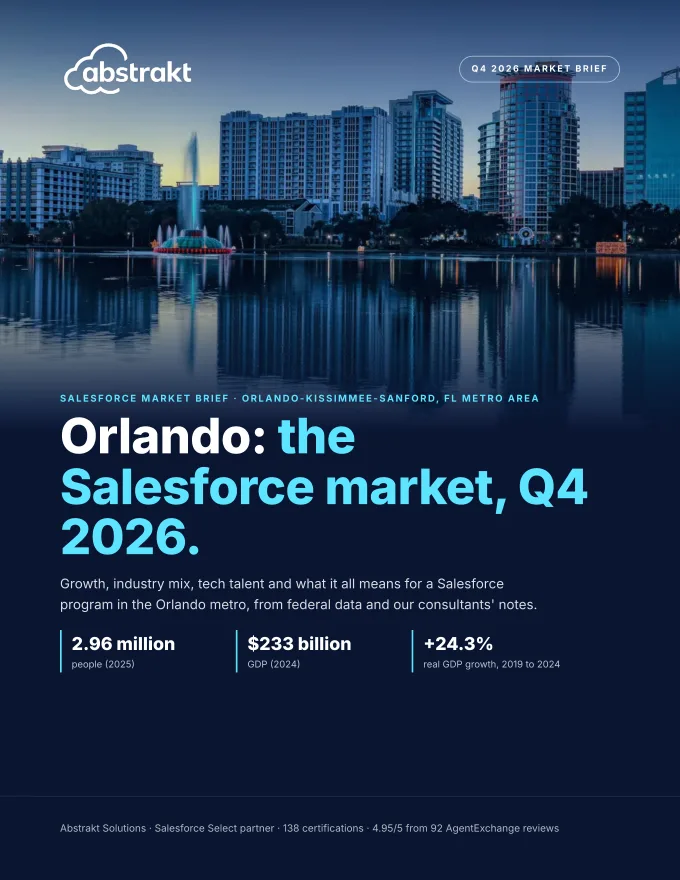
A free 24-page PDF with Orlando's growth ranked against 100 metros, its industry mix, tech wages and nearby markets. It is offered on the public Orlando page; send your customer there or get a copy for your own prep.
Get the Orlando brief →Co-sell with Abstrakt in Orlando
Working a Orlando account? Bring in a named consultant for discovery, scoping or a health check. We reply within 4 business hours.