

How Salesforce work starts in Memphis
Abstrakt Solutions is a Salesforce Consulting Partner serving companies in Memphis and Shelby County, including the Northridge area of North Memphis, along with businesses in the Mississippi and Arkansas parts of the metro. Memphis is one of our focus markets.
What buyers here usually run into
- 1
Shipment exceptions that arrive by email
Logistics providers commonly field delays, damage claims and rate disputes through shared inboxes and phone calls, which leaves no dependable record of what each shipper was promised.
- 2
Independent reps and distributors
Medical device makers often sell through independent reps and distributors, so consigned inventory, case coverage and commissions drift into spreadsheets outside the CRM.
- 3
Customers in three states
Companies serving Tennessee, Mississippi and Arkansas accounts have to manage territory assignment, tax and licensing differences and state-specific contact rules within a single org.
Budget, team and partner questions
What drives cost
Memphis project scope is set mostly by integration: how many TMS, WMS, ERP and EDI connections Salesforce needs, and how clean the shipper and ship-to records are. Device makers add cost through rep and distributor portals and inventory reconciliation, while three-state territory and tax rules add design work for almost everyone.
Admin or partner
Logistics and distribution companies here often have capable operations IT but no dedicated Salesforce staff, so a partner usually handles integration upkeep and release testing. Device makers with a small commercial team tend to outsource administration until the rep network and portal settle down.
What buyers ask a partner
Ask for examples of TMS or EDI data surfaced on cases, how the partner monitors integrations after go-live, and how they would model territories that cross state lines. Device companies should ask how consigned inventory and transparency reporting are handled.
The local economy and its biggest industries (4)
| Sector | Share of 2024 GDP | Where Salesforce fits |
|---|---|---|
| Transportation and warehousing Service Cloud → | at least 10.4% | Carriers, freight brokers, 3PLs and warehouse operators working around the express carrier's airport hub juggle shipper accounts, rate requests and service exceptions that move quickly and involve many contacts on both sides. |
| Wholesale trade Experience Cloud → | at least 10.3% | Distributors of auto parts, food, paper products and medical supplies based along the Memphis corridor need reorder visibility, territory coverage and a B2B portal where buyers can check orders without phoning a rep. |
| Manufacturing Salesforce for manufacturing → | 9.8% | Orthopedic, spine and surgical device makers work next to food, paper and automotive producers, and each group needs its own blend of contract pricing, surgeon or distributor relationships and ERP data. |
| Health care and social assistance Salesforce for health & life sciences → | at least 8.5% | A nationally known pediatric research hospital and the University of Tennessee Health Science Center anchor a health economy in which clinics, research programs and charitable care providers must keep patient, participant and donor records apart under clear access rules. |
Source: U.S. Bureau of Economic Analysis, GDP by county (CAGDP2), 2024, summed to the metro area; private sectors only, excluding real estate and government. “At least” marks sectors where BEA suppresses some county figures.
Regional target sectors named by local economic development groups: Supply Chain & Logistics, Corporate, Headquarters & Tech, Advanced Manufacturing, Life Sciences / Medical Devices, Food & Beverage, Advanced industries (automotive, aerospace, advanced electronics, battery technology, semiconductors, robotics, AI, advanced machinery).
Salesforce products that fit Memphis (6)
In the order we lead with them here, from the industries above.
Salesforce Service Cloud
The operating system for modern customer service, case, knowledge, voice, and AI agent assist together.
Salesforce Sales Cloud
The CRM where sales pipeline lives, when it is built right.
Salesforce Experience Cloud
Customer, partner, and employee portals built on Salesforce.
MuleSoft
Enterprise API platform, for connecting Salesforce, ERP, data warehouses, and the rest of your stack.
Salesforce Field Service
Scheduling, dispatch, mobile work orders and parts for teams that work on site.
Salesforce Revenue Cloud / CPQ
Configure-price-quote, billing, subscription management, and quote-to-cash on Salesforce.
Using AI on Memphis freight, distribution and plant data
Transportation and warehousing produced at least 10.4% of Memphis metro GDP in 2024, and wholesale trade at least 10.3%. For logistics and distribution firms, the heaviest service load is shipment status and exception handling, and an agent that reads tracking records and account terms can answer routine questions while routing damaged or delayed freight to a coordinator. Wholesalers can use AI to summarize long customer threads about backorders. Manufacturers, 9.8% of output, may pair Field Service with an assistant that pulls asset history for technicians. Integration is the prerequisite here: carrier, warehouse and ERP data must land in Salesforce reliably before any agent can be trusted with it.
- Routine shipment status answers
- Routing freight exceptions to coordinators
- Backorder thread summaries for wholesalers
Services buyers here usually need (7)
Salesforce Integration in Memphis
In Memphis, Salesforce integration work usually starts with operational systems rather than marketing tools. Transportation management, warehouse management and ERP platforms hold the shipment, inventory and order data that sales and service teams need on every account. We decide which system owns each field, choose between MuleSoft, a lighter integration tool or direct APIs based on volume and change frequency, and build error handling and monitoring in from the start, so a failed sync is caught long before a customer calls about it.
By industry in Memphis
- 1
Manufacturing
Manufacturing accounts for 9.8% of 2024 metro GDP, and EDGE's advanced manufacturing focus includes food, paper, medical and automotive producers. Their integrations typically move product catalogs, price lists and order status from ERP into Salesforce and send won quotes back as orders. We define the system of record for each field, handle unit-of-measure and pricing conversions in the integration layer and design retries for large nightly loads, so a catalog update does not leave reps quoting yesterday's prices.
- 2
Transportation and warehousing
Carriers and 3PLs need shipment milestones, exceptions and proof of delivery visible on Salesforce cases, but copying every tracking event would bloat the org. A better pattern pulls summarized status on demand or stores only the milestones service agents act on. We also connect EDI onboarding steps to account records, so sales knows when a new shipper is technically ready to tender freight and operations is not chasing the account team for missing details.
- 3
Advanced industries
The Greater Memphis Chamber's Prosper Memphis 2030 plan aims to add advanced industry companies in fields such as automotive, battery technology, robotics and advanced machinery. Newer plants in these fields often arrive with modern ERP and manufacturing execution systems but no CRM connection. Integrating early lets account teams see production commitments, quality holds and shipment dates by customer, and it gives engineering a clean path to receive change requests logged by sales.
Raise before scoping
Name a system of record
Every shared field, from credit status to ship-to address, needs one owning system. Write that down per field before building, or two systems will overwrite each other and nobody will know which value is right. The same list becomes the reference for troubleshooting later.
Plan for EDI partners
Many shippers and retail buyers in the region still exchange orders and advance ship notices through EDI. Salesforce rarely needs raw EDI documents, but it does need the resulting order and shipment status, so decide which translated events flow into CRM and how often.
Budget for monitoring
Expired credentials and renamed upstream fields break data flows without anyone being told. Include logging, alerting and a runbook in the project scope, and assign someone to read the alerts, so problems are caught by the support team rather than by an unhappy customer.
Salesforce Implementation in Memphis
For most Memphis companies, implementing Salesforce means modeling relationships that span many parties: a shipper with dozens of locations, a distributor serving buyers in Tennessee, Mississippi and Arkansas, or a device maker selling through independent reps. We spend discovery on those structures first, because accounts, territories and sharing rules decide whether the org scales. Then we build in a sandbox, load cleansed records, train each role and bring the rollout live in phases, starting with the team that feels the most pain today.
By industry in Memphis
- 1
Transportation and warehousing
Transportation and warehousing is the metro's biggest private sector by output, at no less than 10.4% of 2024 GDP. Carriers, brokers and warehouse operators implementing Salesforce have to decide early how a shipper account relates to its facilities, lanes and billing entities, and whether consignees get their own records. We model those hierarchies with operations leaders in the room, set up case types for service exceptions and leave rate and tender data in the transportation system, linked rather than copied.
- 2
Life Sciences / Medical Devices
EDGE lists life sciences and medical devices among its key industries for Memphis and Shelby County and counts more than 50 life sciences companies there. Device makers need a design that separates surgeons, facilities and value analysis committees, captures case coverage by rep and keeps patient details out of the CRM entirely. We build those objects and permission sets in the first phase, since compliance reviewers will ask how interactions are logged before any rep is allowed to use the system.
- 3
Wholesale trade
Wholesalers along the Memphis corridor often start with customer data scattered across an ERP, a pricing spreadsheet and each salesperson's phone. The implementation work that pays off is agreeing on a single account hierarchy for buyers with many ship-to addresses, then assigning territories that cross state lines without doubling up coverage. Order history and open invoices display from the ERP, so reps stop calling the warehouse to answer routine questions and can spend their time on new placements.
Raise before scoping
Map ship-to and bill-to early
Customers here frequently buy from one entity, receive at several facilities and pay from another. Decide in design whether each of those is an account, a location record or a related contact, because reports, sharing and integrations all depend on the answer and it is hard to reverse later.
Design territories for three states
A Memphis metro sales team can cover Tennessee, Mississippi and Arkansas accounts in the same afternoon. Build territory and assignment rules that reflect how coverage is really split, and store state-specific tax or licensing attributes on the account, rather than creating a separate business unit for each state.
Start where exceptions pile up
For logistics and distribution firms, the first phase with the quickest return is often case management for delays, damage and billing disputes rather than pipeline tracking. Putting service live first gives the operations team relief within weeks and produces clean customer data that the sales phase can build on.
Salesforce Optimization in Memphis
Optimization for Memphis companies typically begins with a question operations and sales leaders both ask: why does nobody trust the numbers? The usual answers are duplicate customer accounts created by several teams, required fields that slow down busy reps and automation layered on by successive admins. We measure usage, interview people on the floor and in the field, then simplify layouts, merge duplicates, move old rules into Flow and rebuild the dashboards leadership actually reviews, all without starting the org over.
By industry in Memphis
- 1
Wholesale trade
Wholesale trade contributes no less than 10.3% of 2024 metro GDP, nearly matching transportation. Distributors that installed Salesforce years ago often find reps logging calls in email instead, because the layout asks for fields nobody uses. Optimization trims those screens, adds reorder alerts built from ERP history and replaces a dozen overlapping reports with one account view per territory, so managers can see which buyers are slipping before the quarter ends.
- 2
Food & Beverage
Food and beverage manufacturing and distribution is one of EDGE's key industries. Producers selling to grocery, foodservice and institutional buyers tend to accumulate promotion tracking, broker activity and pricing exceptions in separate tools. We consolidate those into Salesforce records reps will actually update, clean account data by chain and distributor, and build dashboards comparing plan to shipped volume. The goal is a sales team that stops maintaining parallel spreadsheets for each retail customer.
- 3
Manufacturing
Manufacturers in the metro, from paper and packaging to automotive components, frequently run orgs where quote approvals, service requests and forecasts were each automated by a different admin. The result is Flows and legacy workflow rules that fire in conflicting order. Our optimization work inventories every automation, merges what overlaps into maintainable Flows and tests each change against real orders, so reps regain confidence that a saved quote will route correctly.
Raise before scoping
Measure usage before redesigning
Before redesigning anything, pull evidence of avoidance: which users rarely log in, which fields stay empty and which reports nobody opens. Then interview a handful of reps, dispatchers and service agents, so changes target the actual friction instead of the loudest complaint from a single department.
Clean accounts before rebuilding dashboards
Dashboards rebuilt on top of duplicate customers and inconsistent stages will lose trust again within weeks. Merge duplicates, standardize account names and ship-to data, and agree on stage definitions with sales leadership before a single new chart is published to managers.
Retire what nobody opens
Many orgs carry fields, reports and email templates that no one has touched in a year or more. Archiving them shortens page layouts, speeds up searches and makes the remaining automation easier to understand for whoever maintains the org next.
Salesforce Migration in Memphis
Memphis companies that migrate to Salesforce are often leaving more than one source behind: an aging CRM, an Access or SQL database built by a former employee, and spreadsheets kept by reps in each state. Then we catalog each source, settle with every team which years of history matter, map fields, merge duplicate customers and repeat sandbox loads until the numbers match. The cutover happens during a quiet period, with users trained beforehand.
By industry in Memphis
- 1
Wholesale trade
Distributors moving off an older CRM frequently discover that the same buyer exists under several spellings, one per rep or branch. We treat that as the core migration problem: matching rules keyed on tax ID, address and phone, a review queue for uncertain matches, and ship-to locations attached to the surviving parent. Pricing and order history remain in ERP, so the migration carries relationships and activity rather than transaction records Salesforce does not need.
- 2
Health care and social assistance
Clinics, community health programs and charitable care organizations in the metro often run intake, referrals and donor outreach in separate tools. Migrating them into Salesforce means separating patient or participant data from fundraising records, carrying consent flags accurately and deciding which old case notes are needed for continuity. We validate the load with privacy staff before cutover, and anything that fails a consent check is held back rather than imported.
- 3
Corporate, Headquarters & Tech
Companies relocating or consolidating headquarters operations in Memphis and Shelby County, a sector EDGE actively recruits, often inherit several CRMs from acquired or merged units. Migration for them is also a design decision: which unit's fields, stages and picklists survive. We run mapping workshops with each unit, convert values to one standard and preserve the original source ID on every record so auditors and legacy reports can still trace history.
Raise before scoping
Decide what history to keep
Years of closed deals and stale notes make a load slower and harder to check. Agree with each team how many years of activity really matter for selling and service, migrate only those, and archive the remainder in a searchable file anyone can consult later.
Collect the spreadsheets early
Reps in Tennessee, Mississippi and Arkansas may each keep their own customer lists. Gather every file at the start of the project, not the week before cutover, so duplicates across states are resolved in testing and nobody's key accounts are left out.
Rehearse the cutover
Before the real cutover, load everything into a sandbox once end to end, then have the people closest to your largest accounts check them record by record. A rehearsal exposes mapping errors and slow loads while there is still time to fix them without delaying go-live.
Salesforce Managed Services in Memphis
Managed services for Memphis organizations usually centers on keeping Salesforce in step with operations that never slow down. Distribution calendars, peak shipping seasons and new customer onboarding generate a steady stream of requests for queues, fields, reports and integration fixes. We work that list from a shared tracker, test each Salesforce release in a sandbox, watch the connections to warehouse and ERP systems, and meet monthly with your owner to reorder priorities. Your team keeps the same consultants month to month, so context is never lost.
By industry in Memphis
- 1
Retail trade
Retail trade represents at least 9.2% of the metro's 2024 GDP, and retailers here often run customer service, loyalty or B2B programs on Salesforce that change with every season. Managed services gives them a predictable way to add promotions, adjust case routing before holiday volume and retire campaigns that ended, with each change tested first. Store and digital teams submit requests into one queue, and a monthly review decides which of them move ahead.
- 2
Supply Chain & Logistics
Supply chain and logistics tops EDGE's list of key industries for Memphis and Shelby County. Providers in this field add lanes, customers and service commitments constantly, and each addition touches entitlements, case routing and integrations with transportation or warehouse systems. Our managed services team handles those updates on a regular cadence, monitors sync errors before dispatchers notice them and keeps documentation of every service-level rule current, so a new customer never goes live with the wrong commitments attached.
- 3
Corporate, Headquarters & Tech
EDGE also targets corporate, headquarters and tech operations, and shared-service centers in the county often run one Salesforce org for several divisions. The practical need is governance: a single intake process, agreed rules for who approves changes to shared objects and a release calendar each division can see. We provide that structure along with the admin and development capacity to deliver the approved work, so no division has to hire its own specialist.
Raise before scoping
Schedule around peak seasons
Shipping and retail peaks are the wrong time to change page layouts or case routing. Agree on freeze windows with your managed services partner, front-load enhancements into quieter months and plan Salesforce release testing so nothing new reaches frontline users during the busiest weeks.
Monitor integrations as well
Many Memphis orgs depend on nightly or hourly feeds from TMS, WMS and ERP platforms. Include monitoring of those jobs in the managed services scope, with alerts routed to the support team, so failed syncs are caught and rerun before customers see stale order or shipment data.
Set a clear request path
When sales, operations and finance all message the admin directly, urgent fixes and wish-list items blur together. Route every request through one form with a category and business impact, and let a named owner set the order each month so capacity goes to what matters most.
Salesforce Health Checks in Memphis
Memphis organizations usually commission a health check when they are about to commit to new Salesforce work and want facts first. We examine profiles, permission sets and sharing, data completeness and duplicates, custom code coverage, overlapping automation, integration users and actual usage by team. For device makers and health organizations the access review carries the most weight, and for logistics firms it is often integration reliability. Every finding is ranked by risk and effort, giving leadership a plan they can fund rather than a vague sense that something is wrong.
By industry in Memphis
- 1
Health care and social assistance
Hospitals, clinics and care agencies, grouped by BEA as health care and social assistance, generated a floor of 8.5% of Memphis GDP in 2024. Providers and care organizations storing patient or participant information in Salesforce need proof that access is limited to the right roles. Our review checks sharing defaults, permission sets that grant view-all or export rights, field history on sensitive fields and integration accounts with broad access, then ranks each gap by privacy exposure for your compliance team to confirm.
- 2
Life Sciences / Medical Devices
Device companies, including the spinoffs and startups EDGE says the regional medical device sector often produces, frequently build Salesforce quickly to support early commercial launches. By the time they add distributors and more products, the org carries rushed permissions and untested code. A health check identifies interactions logged without the fields transparency reporting needs, distributor users who can see beyond their territory and technical debt that will slow the next product launch.
- 3
Supply Chain & Logistics
Logistics orgs tend to accumulate integration users, scheduled jobs and API connections added one customer at a time. We review which of those still run, how much access each integration account holds and whether error logs are being read. The data review measures duplicate shippers and stale contacts, both of which matter before introducing Agentforce or any AI tool that would answer customer questions from those records. Findings arrive sorted by what could interrupt service first.
Raise before scoping
Check integration accounts first
In orgs connected to transportation, warehouse and ERP systems, integration users often hold administrator-level rights granted during a rushed launch. Reducing each one to the minimum it needs is usually the quickest, highest-value security fix a health check produces, and it rarely affects users.
Audit before any AI rollout
Agentforce and other AI features work through the permissions and records they are given. If duplicates are common or sharing is too broad, an agent will repeat those problems at scale. Treat the health check as the gate that an AI pilot must pass first.
Turn findings into a funded plan
A list of problems has little value without owners and priorities. Group findings into quick fixes, planned projects and items to monitor, attach effort estimates and assign each to your admin, an optimization project or ongoing managed services so the work actually gets done.
Salesforce Implementation Rescue in Memphis
Salesforce projects in Memphis usually get into trouble at the seams between systems and teams: an integration with the TMS or ERP that never became reliable, a service process designed without dispatchers in the room, or distributor access that was promised but never built. Rescue begins with triage. We review the org, the original scope and open defects, talk to users and sort each component into keep, fix or rebuild. Then we stabilize daily operations first and finish the remaining work in phases.
By industry in Memphis
- 1
Transportation and warehousing
When a carrier or 3PL rollout fails, service agents usually go back to shared inboxes within weeks of launch, because cases were slower to log than emails were to forward. Recovery starts by making case creation automatic from email and web forms, fixing routing so exceptions reach the right desk and linking shipment status. Only after agents trust the queue do we return to the reporting and sales features that were originally planned.
- 2
Food & Beverage
Food and beverage companies, an EDGE key industry, sometimes stall on Salesforce projects that tried to model trade promotions, broker commissions and retailer programs all at once. The rescue approach narrows scope to accounts, contacts and a working pipeline by customer, then reintroduces promotion tracking in a later release with a simpler design. Data loaded during the first attempt is audited, because failed projects often leave duplicate retailers and distributors behind.
- 3
Wholesale trade
A distributor's failed implementation often traces back to a quoting or pricing build that tried to replicate every ERP rule inside Salesforce. Reps stop using it once quotes come out wrong. Our triage checks whether pricing should be read from the ERP instead, stabilizes the integration and removes custom logic that duplicates it. Reps then get a quoting process they can rely on, even if it does less than the original design promised.
Raise before scoping
Stabilize before adding scope
Pressure to deliver the missing features is understandable, but adding work on top of a broken foundation repeats the original failure. Fix what is blocking daily operations first, whether that is case routing, a failing sync or wrong prices, then agree on a smaller finish line.
Reclaim access from the old vendor
Sometimes the outgoing vendor is the sole holder of admin logins, integration passwords and design notes. Collect all three before anyone changes the org, rotate every credential an outside firm knew and confirm your own staff can reach each connected system, so recovery work never stops for a missing password.
Rebuild trust with users
Frontline teams who lived through a failed launch are skeptical of a second one. Involve a few of them in testing each fix, announce changes in plain language and relaunch by team rather than all at once, so early successes are visible before the wider rollout.
Industry plays in Memphis (4)
Salesforce for Memphis Manufacturers
Memphis-area manufacturers tend to sell through distributors, brokers and retail or foodservice buyers who care as much about fill rates and delivery windows as about price. Salesforce earns its place when account teams can see orders, shipments and deductions next to the relationship, and when quality complaints are traced to a lot. We set up Sales Cloud and Service Cloud for that, connect ERP and transportation data with MuleSoft, and keep forecasting tied to what customers actually order.
Bureau of Economic Analysis county data for 2024 puts manufacturing at 9.8% of Memphis metro GDP, just behind transportation and warehousing (at least 10.4%) and wholesale trade (at least 10.3%). EDGE, the economic development agency for Memphis and Shelby County, lists advanced manufacturing and food and beverage among its target industries, and the Greater Memphis Chamber's Prosper Memphis 2030 plan adds advanced industries ranging from automotive and aerospace to battery technology, robotics and semiconductors. Because logistics and wholesale carry so much of the economy, manufacturers here often share customers, carriers and data with distribution partners.
Use cases to open with
- 1
Distributor and broker management
Food and beverage producers often reach grocery and foodservice buyers through brokers and distributors. Sales Cloud with account relationships for distributor, broker and end customer shows who influences each placement, tracks promotions and new-item presentations, and rolls up volume by channel, so sales leaders can tell which partners are building a brand and which are simply taking orders. Broker commissions can be calculated from the same volume data.
- 2
Order status without phone tag
Customers call when a truck is late or an order ships short. Pulling order, shipment and tracking data from the ERP and carrier systems into Salesforce lets inside sales and customer service answer from the account record, log the issue as a case, and spot patterns such as a lane or warehouse that keeps missing appointments before the customer escalates.
- 3
Quality complaints traced to lots
When a buyer reports a damaged pallet, foreign material or an off-spec batch, Service Cloud captures the complaint with lot number, plant and product, routes it to quality, and tracks the credit or replacement. Over time, complaint trends by line and product give plant managers evidence for corrective action, and account managers can show customers exactly how each issue was resolved.
Raise before scoping
Account structure across channels
The same product may reach a store through a broker, a distributor and a retailer's own warehouse. Decide how those parties relate in the account model and which one receives revenue credit before building reports, or pipeline and volume totals will double count.
Integrate transportation data selectively
Carrier and warehouse systems produce huge volumes of status events. Bring in only what sales and service act on, such as exceptions, delivery confirmations and proof of delivery, and leave the full event stream in the logistics platform to keep Salesforce fast and storage costs predictable.
Separate new program pursuits
Companies courting automotive, battery and electronics customers from the Prosper Memphis 2030 list face qualification steps and ramp schedules unlike repeat food or packaging orders. Give those pursuits their own opportunity type so forecasts never blend long-cycle programs with weekly reorder business.
Salesforce for Memphis Health and Life Sciences
Life sciences in Memphis leans toward medical devices, so Salesforce often supports a commercial team selling to surgeons and hospital value committees, covering procedures and managing loaner or consigned sets. Providers and health technology firms use it for referrals, patient access and outreach. In each case the design has to keep protected health information to the minimum needed, integrate with clinical or ERP systems, and give field teams a mobile view they will actually use between cases.
Hospitals, clinics and device makers form a sizable slice of the Memphis economy, and the Bureau of Economic Analysis's 2024 county figures, which withhold some data, still credit health care and social assistance with no less than 8.5% of metro output. EDGE, which leads economic development for Memphis and Shelby County, targets life sciences and medical devices, and says the sector frequently produces spinoffs and startups with help from a regional medical device council and an accelerator it ranks among the nation's leading programs. The Greater Memphis Chamber's Digital Delta initiative also targets medical device and healthcare technology across a nine-county, three-state innovation district.
Use cases to open with
- 1
Surgeon and account coverage
Device reps juggle surgeons, schedulers, sterile processing and value analysis committees at each hospital. Sales Cloud with contact roles for each group, procedure-based opportunities and a mobile case calendar shows who must approve a product, which cases are covered this week, and where a competing product is entrenched, so managers can plan coverage instead of reacting to missed cases. Territory changes then carry the full surgeon history to the new rep.
- 2
Loaner set and consignment tracking
Instrument sets and implants move between warehouses, reps and hospitals constantly. Custom objects or Field Service inventory records track where each set is, when it must return and what was used, and usage entered after a case triggers a replenishment order and a billing record, which cuts the manual reconciliation that usually piles up at month end and shows which sets sit idle.
- 3
Startup commercial launch
Spinoffs moving from clearance to first sales need a CRM small enough to run with a handful of people yet structured for growth. We set up Sales Cloud with clean account and contact data, early value analysis tracking and simple dashboards for investors, leaving room to add distributors, service and complaint handling as the company scales and investors ask for sharper reporting.
Raise before scoping
Keep PHI out where possible
Device sales and case coverage rarely need patient identities. Design case records around procedure type, date and facility rather than patient names, and restrict any protected health information to objects covered by appropriate controls and agreements. HIPAA questions belong with your privacy officer before build.
Route potential device complaints
Feedback a surgeon mentions in passing may count as a complaint that quality must evaluate. Give reps a one-tap way to flag it in Salesforce, then send it to the quality system of record with timestamps intact, so nothing lingers unreviewed inside a sales note.
Mobile use between cases
Reps work from parking lots, hallways and sterile core offices, not desks. Prioritize a lean mobile layout with offline access to schedules and set locations, limit required fields to what a manager truly uses, and test the app with working reps before launch.
Salesforce for Memphis Retailers and Consumer Brands
Retail and consumer goods companies in Memphis tend to live close to their supply chain. Stores, online sellers and brands share warehouses, carriers and buyers across Tennessee, Mississippi and Arkansas, so many customer questions are really questions about an order in motion. Salesforce works when service agents can see order, shipment and return status on the customer record, and when marketing uses the same profile. We pair Service Cloud and Marketing Cloud, add Data 360 (formerly Data Cloud) to unify store and online identities, and integrate order systems with MuleSoft.
Retail trade accounts for at least 9.2% of Memphis metro GDP in the Bureau of Economic Analysis's 2024 county figures, placing it fourth behind transportation and warehousing, wholesale trade and manufacturing, each near a tenth of output. EDGE, which covers Memphis and Shelby County, names food and beverage manufacturing and distribution as a target industry, and the Greater Memphis Chamber's Digital Delta innovation district includes agri-business and food. For consumer companies here, logistics is not a back-office function; carriers, warehouses and wholesalers are neighbors, and customers expect delivery answers to match.
Use cases to open with
- 1
Order status service
A large share of retail service contacts ask about delivery status, damaged goods or a missing item. With order and carrier tracking data pulled into Service Cloud, an agent or an Agentforce assistant can answer from the customer record, issue a replacement or refund within policy, and log the reason. Supervisors can then see which warehouse, carrier or product causes the most contacts and take it up with operations.
- 2
Returns and exchanges tracked
Returns flow back through the same distribution network that shipped the order. Service Cloud cases can capture the reason, condition and refund method for each return, trigger a label, and follow the item until it is received and restocked or written off. Merchandising teams get return reasons by product and supplier, which feeds vendor conversations and product descriptions that set better expectations.
- 3
Shopper marketing by region
A shopper in suburban Mississippi and one in midtown Memphis may buy the same brand through different channels. Marketing Cloud, working from a unified Data 360 (formerly Data Cloud) profile, can segment by channel, store and purchase history, respect each shopper's consent, and measure whether a campaign moved store visits or online orders. Brands selling through retailers can use the same approach for their direct-to-consumer lists.
Raise before scoping
Three states, different rules
The metro spans Tennessee, Mississippi and Arkansas, and sales tax, delivery options and promotions can differ by state. Store the shopper's state and ship-to region on the profile, and make sure campaign logic, refund rules and service scripts all read from that one field.
Pick one order source
Online store, point of sale and warehouse systems each hold part of an order's story. Decide which system is authoritative for status, and bring summarized updates into Salesforce rather than every scan, to keep service screens fast and records accurate.
Consent and identity first
Merging store receipts, loyalty sign-ups and web accounts into one profile only helps if consent follows the person. Map where each email address and phone number came from, and exactly what permission was given, before Data 360 (formerly Data Cloud) starts unifying records across channels.
Salesforce for Memphis Nonprofits
Memphis nonprofits range from health and research charities with national donor bases to neighborhood agencies delivering food, housing and youth programs. Most juggle three jobs in separate tools: fundraising, program delivery and reporting to funders. Salesforce Nonprofit Cloud can bring those together so a donor, a volunteer and a program participant can be the same person with one history. We configure fundraising and program management, build Tableau dashboards for boards and funders, and keep sensitive client data behind tight permissions.
The Bureau of Economic Analysis does not report nonprofits as their own sector, so their footprint in Memphis is folded into other lines of its 2024 county figures, most visibly health care and social assistance, which accounts for at least 8.5% of metro GDP. EDGE's target list covers only Memphis and Shelby County, while the metro reaches into Mississippi and Arkansas, and many charities serve clients on both sides of those lines. Because giving and services cross state lines, organizations here often report to funders in more than one state.
Use cases to open with
- 1
Donor and grant pipeline
Individual gifts, corporate sponsorships and foundation grants follow different paths and calendars, and each needs its own stewardship. Nonprofit Cloud can track major-gift cultivation, recurring donors and grant applications side by side, with deadlines, reporting requirements and restrictions on each award. Development staff see the whole relationship before an ask, and finance can reconcile restricted funds against what programs actually spent.
- 2
Program intake and outcomes
Agencies running food, housing, health or youth programs need to enroll participants, record services and measure results. Program management in Nonprofit Cloud captures each enrollment and service delivered, and Tableau turns those records into outcome reports by program, ZIP code and state. Case workers see only the clients assigned to them, program managers see caseloads across their sites, and funders receive consistent numbers every reporting period.
- 3
Volunteers and events
Large events and weekly volunteer shifts both depend on getting the right people in the right place. An Experience Cloud portal can let volunteers sign up, complete waivers and log hours, while Marketing Cloud handles reminders and thank-you messages. Staff can see which volunteers are also donors, a common path to larger gifts, and invite them to events or giving conversations accordingly.
Raise before scoping
Protect client information
Programs touching health, housing or family services collect sensitive details. Limit access by role and program, record consent, and keep case notes away from development staff. Charities operating clinics or health programs should treat PHI in the org under HIPAA rules, with an agreement from Salesforce in place first.
Clean up before migrating
Many Memphis nonprofits run on older donor databases, spreadsheets and program trackers. Deduplicate constituents, standardize addresses across the three states and decide which gift history to bring over, because a migration is the best moment to fix years of inconsistent entry.
Plan for small admin teams
Most Memphis agencies will run the org with part of one staff member's week. Keep automation understandable, document every flow, and train two staff members as internal owners so routine changes do not wait on outside help or stall when one person leaves.
Case studies to send (2)
From the industries this market leans on. Client names are anonymized and these projects are not specific to Memphis.
The Memphis Salesforce market brief, Q4 2026
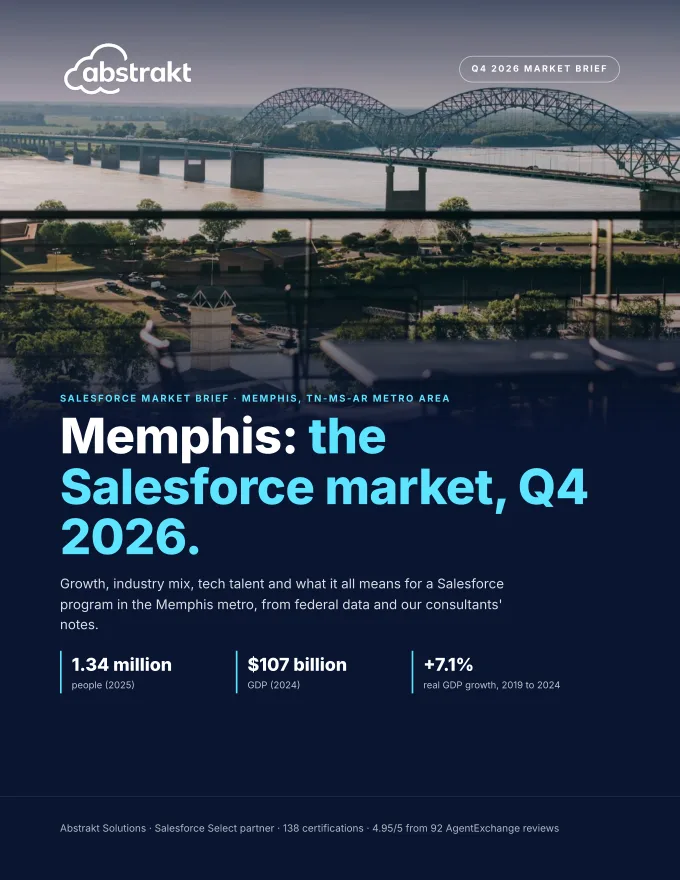
A free 24-page PDF with Memphis's growth ranked against 100 metros, its industry mix, tech wages and nearby markets. It is offered on the public Memphis page; send your customer there or get a copy for your own prep.
Get the Memphis brief →Co-sell with Abstrakt in Memphis
Working a Memphis account? Bring in a named consultant for discovery, scoping or a health check. We reply within 4 business hours.