

How Salesforce work starts in Nashville
Abstrakt Solutions is a Salesforce Consulting Partner that implements, integrates and supports Salesforce for health care vendors, growing firms and relocated headquarters teams in Nashville and Middle Tennessee. Nashville is one of our focus markets.
What buyers here usually run into
- 1
Selling to health systems
Companies selling into hospitals face long cycles and many stakeholders per account. Account hierarchies and relationship mapping make the difference.
- 2
Service at volume
Consumer-facing insurers and service companies handle large case volumes, where routing, knowledge and AI-drafted responses reduce handling time.
- 3
Protected health information
Anything touching patient data needs access controls, audit and careful integration design before it goes live.
Budget, team and partner questions
What drives cost
In Nashville the biggest swings come from privacy scope and account structure. Anything touching patient data adds access design, audit and testing, and modeling health systems with divisions and facilities takes more design than a flat account list. Insurance and device-protection service centers add cost through case routing, knowledge and contact center integration.
Admin or partner
Health-tech vendors here often grow faster than their Salesforce team, so a partner fills architecture and integration gaps while one internal admin handles requests. Companies relocating corporate operations to the area frequently use managed services while they recruit permanent staff.
What buyers ask a partner
Ask for references selling into hospitals and health systems, how the partner designs access around protected health information, and how they model account hierarchies. If you run a contact center, ask how they test routing and knowledge before launch.
The local economy and its biggest industries (4)
| Sector | Share of 2024 GDP | Where Salesforce fits |
|---|---|---|
| Health care and social assistance Salesforce for health & life sciences → | at least 10.6% | Hospital operators, health-tech companies and the many firms that serve them use Salesforce for patient and member engagement, referral and provider relationships, and service, with privacy and access designed in from the start. |
| Professional, scientific, and technical services Salesforce for professional services → | at least 8.7% | Healthcare consultancies, revenue-cycle vendors and technology services firms need pipeline and account management for large, complex health-system clients. |
| Manufacturing Salesforce for manufacturing → | 7.6% | Automotive and industrial manufacturers in Middle Tennessee need dealer and supplier relationships, quoting and service connected to ERP. |
| Finance and insurance Service Cloud → | at least 6.5% | Insurers, device-protection and financial services firms run high-volume customer service, where case routing, knowledge and AI assistance matter as much as sales. |
Source: U.S. Bureau of Economic Analysis, GDP by county (CAGDP2), 2024, summed to the metro area; private sectors only, excluding real estate and government. “At least” marks sectors where BEA suppresses some county figures.
Regional target sectors named by local economic development groups: Health Care, Music & Entertainment, Advanced Manufacturing, Corporate Operations, Distribution & Logistics, Technology & Innovation.
Salesforce products that fit Nashville (6)
In the order we lead with them here, from the industries above.
Salesforce Service Cloud
The operating system for modern customer service, case, knowledge, voice, and AI agent assist together.
Salesforce Sales Cloud
The CRM where sales pipeline lives, when it is built right.
Salesforce Experience Cloud
Customer, partner, and employee portals built on Salesforce.
Salesforce Agentforce
AI agents that handle real work inside Sales Cloud, Service Cloud, and Marketing Cloud.
Salesforce Marketing Cloud
Cross-channel marketing, email, mobile, journey, and Data 360-powered personalization at scale.
Salesforce Data 360 (Data Cloud)
Unify customer data into a real-time profile that powers segmentation, analytics, and AI.
Nashville health care is the obvious AI starting point
Nashville's AI conversation should begin with medicine, since health care and social assistance made up at least 10.6% of the metro's 2024 GDP. Provider groups, revenue-cycle firms, and health IT vendors here share a problem AI handles well: high volumes of similar questions about claims, eligibility, and appointments. Agentforce can answer many from an approved knowledge base and pass the rest to staff with a summary attached. The catch is governance. Protected health information needs strict permission sets, and answers must cite vetted content rather than guess. Professional services firms and manufacturers in the region have simpler wins, such as drafting follow-up emails and triaging inbound leads, which make good second projects once the first one is stable.
- Claims and eligibility question handling
- Summarized handoffs to staff
- Follow-up email drafting
Services buyers here usually need (7)
Salesforce Implementation in Nashville
A Salesforce implementation for a Nashville company tends to hinge on relationships that are more complex than a simple account and contact list. Health care vendors sell to parent systems with many facilities, entertainment businesses deal with people who wear several hats, and relocated headquarters teams inherit processes from elsewhere. We model those relationships in discovery, build in a sandbox, migrate cleaned data and phase the launch so the core sales or service process goes live first, with training timed to each team's start date.
By industry in Nashville
- 1
Health care and social assistance
Health care and social assistance is at least 10.6% of the metro's 2024 GDP by BEA's figures, making it the region's largest private sector. Implementations for hospital operators, physician groups and health-tech vendors need an account hierarchy that runs from parent company to facility, a careful choice between Health Cloud and Service Cloud, and a security model reviewed by privacy staff before build begins. We lock those decisions early, because redesigning them after patient data arrives is slow and risky.
- 2
Music & Entertainment
Music and entertainment is one of the Nashville Area Chamber of Commerce's target industries. Labels, publishers, management firms, venues and promoters rarely fit Salesforce's standard objects without adjustment, because their relationships overlap across deals, tours and sponsorships. Implementation starts with a model for people, companies, engagements and events that reflects those overlapping roles, then adds sponsorship pipeline and ticket-buyer marketing once the relationship data is clean enough to segment and report on with confidence.
- 3
Corporate Operations
Corporate operations is another Chamber target sector, and companies moving headquarters or shared-service functions to the region often implement Salesforce as part of the move. That creates an opportunity to design the org around the new operating model instead of recreating every legacy workflow. We document which processes the new team owns, set up roles and territories for managers who may not have arrived yet, and plan training in waves as hiring progresses through the first year.
Raise before scoping
Choose Health Cloud deliberately
Health Cloud adds care plans, care teams and clinical data structures, but a vendor selling to hospitals rarely needs them. Decide whether you coordinate patient care or manage business relationships with providers, because that answer determines the licenses, data model and privacy controls for the whole project.
Train in waves as teams grow
Fast-growing Nashville companies hire through the project and after it. Build a repeatable onboarding path, with short role-based modules and a sandbox for practice, so the people who join after go-live learn the same process as those who were trained at launch.
Put milestones on the calendar
Growing companies fill calendars quickly, so fix the dates for discovery, user acceptance testing and go-live at kickoff. Holding those dates steady, with weekly build reviews in between, keeps scope changes visible instead of letting them quietly push the launch.
Salesforce Managed Services in Nashville
Managed services in Nashville often supports companies growing faster than their Salesforce team. Health care vendors add customers, tech firms add reps, and relocated operations add whole departments, each bringing new requests. We take ownership of that backlog, prioritize it with a named business owner each month, test the three annual Salesforce releases in a sandbox and keep integrations healthy. Work runs through a shared queue, and a quarterly planning session with your leadership sets the next round of priorities.
By industry in Nashville
- 1
Professional, scientific, and technical services
Consultancies, law firms, engineers and other technical specialists together account for no less than 8.7% of the metro's 2024 output. Revenue-cycle vendors and technology services firms here frequently adjust their offerings, pricing and account teams as health-system clients change. Managed services keeps Salesforce in step: new opportunity types, revised approval rules, updated dashboards for account leaders and clean handoffs between sales and delivery. Our team handles those changes on a predictable monthly rhythm, so partners and principals are not waiting on one overloaded admin.
- 2
Health care and social assistance
Providers, health plans and health-tech companies change referral sources, service lines and access rules often, and each change touches sensitive data. Under managed services we review every request for privacy impact, build and test it in a sandbox, and record it in a change log that compliance staff can audit. Release testing includes a specific check of any feature that affects patient or member records, so updates do not catch privacy officers off guard.
- 3
Technology & Innovation
Technology and innovation is a Chamber target industry, and the region ranked tenth nationally for tech job growth between 2019 and 2024, at 29.6%. Software and tech-enabled service companies growing at that pace add reps, territories and products quickly, and their Salesforce configuration has to keep up. We maintain lead routing, territory assignments, product catalogs and integrations with billing or product-usage systems month by month, and flag when a request belongs in a larger project.
Raise before scoping
Name one business owner
Growing companies generate requests from every direction. Assign one person to rank the backlog each month, so our consultants spend their hours on the changes that matter most and the sales, service and operations leaders understand why some requests wait.
Standardize user onboarding
When hiring is steady, user setup becomes a recurring task. Define permission-set groups for each role, a checklist for new users and a short training path, and let the managed services team apply them consistently instead of copying settings from whichever existing user looks similar.
Review integrations every month
Nashville companies commonly link Salesforce to billing, marketing, support and data tools. Include a monthly review of sync errors, API usage and expiring credentials in the managed services scope, so a quiet failure is caught early rather than discovered through a customer complaint.
Salesforce Integration in Nashville
Integration for Nashville organizations usually connects Salesforce to the systems that run operations: ERP for manufacturers, warehouse and transportation systems for distributors, and clinical, billing or claims platforms for health care. We start by mapping which system owns each record and how fresh the data needs to be, then build with MuleSoft, native connectors or custom APIs as the volume and risk require. Each integration includes logging and alerting, and we document it so your team or ours can maintain it after launch.
By industry in Nashville
- 1
Manufacturing
Manufacturing accounts for about 7.6% of 2024 metro GDP, with automotive and industrial producers among the region's larger employers. Their Salesforce integrations usually link dealer or distributor accounts to ERP pricing, orders and shipments, and connect warranty or service records to the plant's quality system. We design those flows so sales and dealer teams see order status in Salesforce while ERP remains the system of record for pricing, inventory and invoices.
- 2
Distribution & Logistics
Distribution and logistics is a Chamber target industry, and warehouse and freight operators need customer-facing teams to see shipments, exceptions and service levels. We connect Salesforce to warehouse management, transportation and billing systems so account managers can answer a customer's question without calling operations, and so service cases open automatically when a shipment is late. Event-driven integration suits those alerts, while slower-moving data such as invoices can sync on a schedule.
- 3
Health care and social assistance
Hospital operators, physician groups and health-tech firms in the region connect Salesforce to electronic health records, scheduling, billing and credentialing systems. The integration design has to limit what data moves, restrict who sees it and log every transfer, which is why we involve privacy and security teams from the first workshop. For vendors selling to health systems, the more common need is connecting Salesforce to contract, implementation and support tools so account teams see each facility's status.
Raise before scoping
Decide how current data must be
Real-time sync is not always necessary. A service agent may need live order status, yet invoice history can refresh overnight without anyone noticing. Assigning a freshness target to each data type lowers running costs and makes failures much easier to diagnose when they happen.
Protect health data in transit
When clinical or claims data touches Salesforce, confirm which fields are necessary, whether Shield encryption or event monitoring is warranted, and how the integration user's access is restricted. Review those choices with your compliance team before development starts, not during testing.
Keep a map of every connection
Growing companies add connectors one at a time until nobody remembers them all. Maintain a living inventory of each integration, its owner, credentials, schedule and error handling, so an outage can be traced quickly and upstream changes do not break Salesforce unexpectedly.
Salesforce Optimization in Nashville
Optimization for Nashville companies usually starts in the service queue or the sales forecast, the two places where a tired org shows first. We review how people actually use Salesforce, then remove clutter from page layouts, consolidate automation into well-documented Flows, fix case routing and rebuild dashboards so leaders stop exporting to spreadsheets. Where volume is high, we look at knowledge articles and Agentforce for drafting responses. Improvements ship in small, tested releases, with short training sessions for the teams each one affects.
By industry in Nashville
- 1
Finance and insurance
Finance and insurance contributes at least 6.5% of the region's 2024 GDP, and insurers and device-protection firms here run large customer service operations. Optimization for them focuses on routing, handle time and consistency: omni-channel routing tuned to agent skills, knowledge articles suggested on the case, macros for common requests and dashboards that show backlog by queue. Where claims or policy data lives elsewhere, a small integration that surfaces it on the case often saves more time than any new feature.
- 2
Retail trade
Retail trade adds about 6.2% of metro GDP, and the region is home to large discount and rural lifestyle retailers along with many smaller chains and dealers. Retailers using Salesforce for customer care, store operations or vendor relationships often accumulate duplicate contacts and email preferences scattered across tools. We merge duplicates, align consent and preference data with Marketing Cloud, and simplify service consoles so store and support teams resolve questions without switching screens.
- 3
Health Care
Health care leads the Chamber's list of target industries, and health-tech and services firms here often run Salesforce orgs that grew alongside the business. Optimization targets the account views sales teams use for hospital customers, contact-center consoles for patient or member calls, and the reports executives rely on for renewals. We also retire automation that sends duplicate notifications, a frequent complaint in orgs where several teams added their own rules over time.
Raise before scoping
Start with the busiest queue
In service-heavy organizations, a few minutes saved per case compounds quickly. Analyze case volume by type, channel and queue, and optimize the highest-volume paths first, before touching lower-traffic processes that feel important but affect far fewer customer interactions each week.
Rebuild reports around decisions
Report sprawl is common in orgs used by several departments. List the decisions each leader makes weekly, build dashboards that answer those questions, and retire reports nobody has opened recently, so the numbers discussed in meetings come from one agreed source.
Consolidate automation into Flow
Orgs built over several years often contain workflow rules, Process Builder processes, Flows and Apex triggers acting on the same object. Consolidating them into fewer, documented Flows makes behavior predictable and simplifies future changes, though each consolidation needs careful regression tests.
Salesforce Health Checks in Nashville
A Salesforce health check for a Nashville organization answers a simple question: is this org safe and sound enough for what we want to do next? Access rights, record quality, piled-up Apex and Flows, integration behavior and real adoption are all in scope, alongside a comparison with Salesforce's security guidance. Health care companies and high-volume service businesses here often commission one before deploying Agentforce or opening a portal, since both extend access to new people and processes. You receive a ranked report and a walkthrough.
By industry in Nashville
- 1
Health care and social assistance
Hospital operators, physician practices, health plans and health-tech companies in the region handle protected health information that often reaches Salesforce through intake, referrals or support cases. The review focuses on who can view, report on and export that information, whether audit trails and field history cover sensitive fields, and whether integration users hold more access than needed. Each finding is tied to a named setting, so privacy officers and administrators can confirm the fix together.
- 2
Finance and insurance
Insurers, device-protection companies and financial firms here often operate service orgs with many agents, queues and outside partners. A health check for them looks at partner and portal sharing, contact-center user access, data retention and consent handling, and at the automation that routes and closes cases. Technical debt is measured too, because high-volume orgs slow noticeably when old triggers and duplicate flows fire on every record save. The report separates urgent risks from slower cleanup.
- 3
Technology & Innovation
Tech companies, one of the Chamber's target industries, often build Salesforce quickly and pile on connected apps, managed packages and API integrations as they scale. A health check inventories every one of those connections, checks the permissions each holds, flags tokens and users tied to former employees, and measures test coverage on custom code. The findings help a growing company decide whether to clean up now or before the next funding round, audit or security questionnaire.
Raise before scoping
Review sharing with partners
Portals for brokers, dealers or health-system customers can expose more than intended when sharing sets and guest user settings are misconfigured. Include every Experience Cloud site in the review and test access by logging in as sample external users from each partner type.
Prepare data for AI agents
Agentforce reasons over records, knowledge and automation you already have. Duplicate accounts, outdated articles and loosely defined case types lead to poor answers. The health check scores those inputs so you know what to clean before an agent reaches customers or staff.
Keep the report actionable
Findings should arrive with an owner, an effort estimate and a priority. We present them in business terms as well as technical ones, so executives, compliance staff and administrators leave the walkthrough agreeing on the first fixes and when they will be done.
Salesforce Migration in Nashville
Migrations for Nashville companies often combine several sources at once: a legacy CRM, spreadsheets that individual teams kept, and records from acquired or relocated business units. We profile each source, agree on rules for duplicates and inactive records, map everything into one data model and run trial loads in a sandbox before the real cutover. Users review their own accounts after each trial. Reports, automation and email templates are rebuilt deliberately in Salesforce rather than copied, which removes years of workarounds along the way.
By industry in Nashville
- 1
Music & Entertainment
Entertainment businesses in the region often keep relationships in spreadsheets, email and industry-specific booking or royalty tools. Migrating them means separating people from the companies they work with, capturing roles on each engagement and deduplicating contacts who appear under stage names, personal emails and agency addresses. We bring over deal and event history so sponsorship and booking teams keep their context, and leave royalty or accounting data in the systems designed for it.
- 2
Professional, scientific, and technical services
Consulting and technology services firms usually migrate from a lighter CRM they outgrew or a combination of spreadsheets and a project tool. The cleanup concentrates on client hierarchies, especially health-system parents and their facilities, and on linking historical opportunities to the engagements that followed. With that history in place, partners can see lifetime value by client and spot cross-selling opportunities that were invisible across separate files from their first week in Salesforce.
- 3
Corporate Operations
Companies relocating corporate operations to Middle Tennessee often use the move to consolidate CRMs from several business units. The migration plan has to reconcile different account definitions, ownership rules and picklist values, and decide which unit's process becomes the standard. We document each mapping decision with the business owners, so the new team in Nashville inherits one org with clear rules rather than a merge of competing habits carried over from the old offices.
Raise before scoping
Profile data before mapping
Run a data profile on every source before designing field mappings. Counts of blanks, duplicates, invalid emails and inconsistent picklist values show where cleanup effort will go and prevent surprises during the trial load, when timelines are hardest to adjust.
Agree on duplicate rules
Two records for the same customer can differ in name, address and owner. Decide which source wins for each field, who reviews uncertain matches and how merged records are flagged, then apply the same rules to every trial load so results stay consistent.
Rebuild automation rather than copy
Old systems carry rules written for processes that no longer exist. Instead of translating every trigger and template, list what the business still needs, rebuild those pieces in Flow and email templates, and retire the rest with the stakeholders' agreement.
Salesforce Implementation Rescue in Nashville
When a Nashville Salesforce project stalls, the cause is rarely one bad decision. More often scope kept growing, testing was squeezed, and the people who understood the design left before launch. Rescue starts with triage: we review the org and its open defects, read the original requirements and talk to users about what blocks them. We stabilize the most painful problems first, then agree which components to keep, fix or rebuild and deliver the rest in short, tested releases, reviewing progress with sponsors at each checkpoint.
By industry in Nashville
- 1
Advanced Manufacturing
The Chamber lists advanced manufacturing as a target industry, and in that field Salesforce projects most often stall where CRM meets ERP. Quotes do not match ERP pricing, orders are keyed twice and dealer data arrives late, so sales teams give up on the system. Recovery traces each symptom back to either a faulty sync or a flawed process, repairs the data feeds reps depend on, and simplifies quoting until reps trust it enough to stop keeping spreadsheets alongside Salesforce.
- 2
Health care and social assistance
Health care projects in the region stall for reasons that are hard to see from outside: access rules that block clinical staff, intake flows built without front-line input, or an integration with scheduling that never passed privacy review. We involve compliance and front-line staff in triage, correct access before adding anything new, and relaunch in stages by department so each group gets focused training and support. Feedback from each group shapes the next stage.
- 3
Distribution & Logistics
Distribution and logistics firms, another Chamber target, sometimes launch Salesforce with shipment and order data that is missing or stale because the warehouse or transportation integration was deferred. Account managers then call operations for every answer and stop trusting the CRM. Rescue brings that integration forward, cleans customer and location records, and rebuilds service case routing around real exceptions such as late or damaged shipments, so customer-facing staff can answer questions in one place.
Raise before scoping
Secure admin rights first
If the previous partner or an internal champion has left, confirm who holds system administrator access, integration credentials and sandbox logins. Rotate anything shared with former team members before recovery work begins, and store credentials in your organization's password vault.
Triage by business impact
List every open defect and complaint, then rank it by the damage it causes today: lost revenue, customer delays, compliance risk or wasted staff hours. Fix the top of that list first, even if lower items are simpler, so users feel the difference quickly.
Relaunch with visible support
A second launch must look different from the first. Plan hands-on support for the relaunch day, short role-based training, and a daily check-in for the first weeks, so users see problems being fixed in front of them and trust returns.
Industry plays in Nashville (4)
Salesforce for Nashville Health Care Companies
Many Nashville health care companies are businesses whose customers are other health care organizations: management services firms, revenue cycle and staffing providers, health IT vendors and multi-site operators. Salesforce serves them as a B2B platform: managing long sales cycles with provider executives, onboarding new facilities as structured projects, and running account service at scale with contract and performance data in view. We build that model, integrate it with billing, implementation and support systems, and keep protected health information out of places it does not belong.
Health care leads Nashville's private industries: the Bureau of Economic Analysis puts it at a floor of 10.6% of 2024 metro GDP, a lower bound because some county values are withheld. The Nashville Area Chamber of Commerce lists health care first among its target industries, together with corporate operations and technology and innovation. The Chamber reports that tech jobs grew 29.6% from 2019 to 2024, the #10 rate nationally, and cites a major research university as an anchor. Nashville's health sector therefore includes a large corporate and technology layer serving providers nationwide, not only local care delivery.
Use cases to open with
- 1
Selling services to providers
Health care services and IT companies sell to CFOs, CIOs, CNOs and practice leaders, usually with a committee decision and a long evaluation. Sales Cloud can map buying committees, track evaluations, reference calls, security reviews and contract negotiations, and forecast by facility count or contract value. Leaders see which stage deals stall in and which messages resonate with each executive role.
- 2
Facility onboarding as projects
After a contract is signed, onboarding a hospital or practice involves data feeds, training, go-live dates and staffing. Salesforce can create onboarding projects automatically from closed opportunities, assign tasks to implementation teams, track milestones and risks, and give clients visibility through an Experience Cloud portal. Sales and executives see whether new clients go live on time, which protects renewals. Onboarding templates improve with every facility.
- 3
Account service with performance data
Clients of revenue cycle, staffing and technology companies expect responsive service and proof of results. Service Cloud can manage cases by client and facility, route them by product and severity, and show performance metrics from operational systems on the account. Agentforce can summarize case history for account managers before quarterly business reviews, highlighting open issues and trends. Escalations reach executives before clients complain.
Raise before scoping
Keep PHI out when possible
B2B health companies often do not need patient-level data in the CRM. Design cases and integrations to use identifiers or aggregates, restrict any necessary PHI to specific objects and users, and ensure a business associate agreement and HIPAA controls are in place where PHI is unavoidable.
Model provider organizations accurately
Health systems include parent organizations, hospitals, clinics, physician groups and buying groups. Build account hierarchies that reflect ownership and contracting, and plan for mergers and divestitures, which are common and can reshape territories and renewals quickly. Keep facility identifiers consistent with billing.
Connect contracts to operations
Service and renewal decisions depend on contract terms and delivered performance. Integrate Salesforce with contract, billing and operational reporting systems, and decide which metrics appear on accounts, so account managers can discuss value using the same numbers clients see. Refresh them on a set schedule.
Salesforce for Nashville Professional Services Firms
Nashville professional services firms often build their practices around the city's signature industries: health care consulting and advisory, business management for music and entertainment clients, and accounting and legal support for companies moving operations to the region. Salesforce helps them organize those different client types, capture referrals that drive most new business, and keep relationships consistent as partners change. We design Salesforce around your practices and engagement types, integrate it with practice management and billing, and keep the experience simple for busy client-facing professionals.
Professional, scientific and technical services account for at least 8.7% of 2024 Nashville metro GDP in Bureau of Economic Analysis figures, second only to health care among private sectors; both figures are lower bounds. The Nashville Area Chamber of Commerce targets health care, music and entertainment, corporate operations and technology and innovation, each a large client base for consulting, accounting, legal and advisory work. The Chamber notes tech job growth of 29.6% from 2019 to 2024 and that the city hosts one of six locations of a national startup accelerator program. Local firms therefore serve established health care organizations, creative businesses and fast-growing companies at once.
Use cases to open with
- 1
Practice-based client pipelines
Firms with health care, entertainment and corporate practices sell differently to each. Salesforce can give each practice its own opportunity process, stages and fields while sharing a single client database, so leadership sees the whole firm and partners see what matters to them. Cross-practice opportunities become visible when a health care client, for example, also needs tax or technology help.
- 2
Referral source management
Much professional services work arrives through referrals from attorneys, bankers, managers, agents and other advisors. Salesforce can record each referral source, track introductions and resulting engagements, and remind partners to reciprocate or thank sources. Reports show which relationships produce the most valuable work, guiding where partners invest their networking time. Partners can also see which introductions went nowhere and why, and quietly retire relationships that no longer produce.
- 3
Onboarding relocating companies
Companies moving corporate operations to Nashville need accounting, legal, HR, real estate and technology support within tight timelines. Firms can use Salesforce to coordinate those engagements, with onboarding checklists, shared notes across practices and milestone tracking tied to the client's move. Marketing Cloud can send relevant guidance to new arrivals, keeping the firm engaged beyond the first project. Each practice sees its tasks.
Raise before scoping
Handle confidential client matters
Entertainment, health care and corporate clients often expect strict confidentiality. Use sharing rules, restricted record types and field-level security so only engaged teams see sensitive matters, and set clear rules for what information belongs in Salesforce versus document management systems.
Integrate practice management systems
Time, billing and engagement letters usually live in practice management or accounting software. Decide how engagements are created from won opportunities, which data flows back to Salesforce, and how often, so partners see billed revenue and realization alongside pipeline. Realization gaps then surface early.
Make adoption worthwhile for partners
Rainmakers judge any new system by whether it wins them time back. Automate activity capture, keep required fields minimal and provide useful outputs such as referral reports and client briefs, so Salesforce saves them time and supports business development instead of adding overhead.
Salesforce for Nashville Manufacturers
Nashville-area manufacturers often sit at the junction of two strong regional sectors: distribution and health care. Some produce industrial and consumer goods moved through distributors and dealers; others make products sold to hospitals and clinics. Salesforce helps when channel partners have a portal for orders and deal registration, when quotes draw on ERP pricing, and when sales to health systems account for committees and contracts. We integrate with the ERP and logistics systems so sales, service and operations work from the same order data.
Manufacturing produces 7.6% of Nashville-Davidson--Murfreesboro--Franklin GDP in the Bureau of Economic Analysis's 2024 figures, third among private sectors behind health care and professional services, both reported as lower bounds. The Nashville Area Chamber of Commerce targets advanced manufacturing along with distribution and logistics, health care, corporate operations, technology and innovation, and music and entertainment. The research record notes tech job growth of 29.6% from 2019 to 2024, tenth nationally. For manufacturers, that combination means strong distribution channels, a large health care customer base close by, and a growing pool of technology talent for automation and data work.
Use cases to open with
- 1
Dealer and distributor portal
Dealers and distributors want pricing, availability, order status and marketing materials without calling inside sales. An Experience Cloud portal can provide those, along with deal registration, warranty claims and training resources. Channel managers see partner activity, sell-through and registered deals in Salesforce, and can identify which partners need support or which territories lack coverage before the quarter closes, then plan co-marketing where it will pay off.
- 2
Selling products into hospitals
Manufacturers of medical supplies, equipment or facility products sell into hospital committees, group purchasing agreements and department budgets. Sales Cloud can map each health system's hierarchy, stakeholders and contract status, track product evaluations and value analysis reviews, and alert reps when agreements near renewal. Leaders see pipeline by health system, product line and contract type across the region, and can tell which evaluations are stuck in committee.
- 3
ERP-backed quoting and orders
Accurate quotes need current prices, lead times and inventory. Contract pricing for a large dealer or a hospital network differs from list, so the quote engine has to know which agreement applies to each account, with anything outside it held for a manager's sign-off. Accepted quotes become orders in the ERP through integration, and service agents see order and shipment status in Salesforce, cutting the calls and emails between sales, customer service and the warehouse.
Raise before scoping
Match health care buying rules
Hospitals buy through contracts, group purchasing organizations and value analysis committees, and may require vendor credentialing for on-site visits. Model contracts, pricing tiers and credential status in Salesforce, and confirm with your contracts team which agreements govern pricing for each account.
Set channel conflict rules
Direct sales, distributors and dealers can pursue the same customer. Define deal registration, territory and pricing rules before launch, configure sharing so partners see only their own deals, and give channel managers reports that surface conflicts early rather than after a customer receives two quotes.
Integrate logistics data
Order status questions depend on ERP, warehouse and carrier data. Decide which shipment details appear in Salesforce and portals, how often they update, and who resolves discrepancies, so customers and partners trust what they see and stop calling to double-check.
Salesforce for Nashville Insurers and Agencies
Nashville insurance organizations range from agencies serving local businesses to carriers and health coverage companies whose customers may live well beyond Middle Tennessee. The common need is service at volume: routing calls and messages, giving agents the policy or member context they need, and using automation and AI to shorten handling time. Salesforce also supports agent and broker distribution and marketing with consent controls. We integrate with policy, billing and claims systems and design privacy protections before anything goes live.
Nashville's financial sector, insurance included, generated a minimum of 6.5% of 2024 metro output in Bureau of Economic Analysis data; withheld county detail makes that a floor, not an exact figure. Health care, the metro's largest private sector at a minimum of 10.6%, shapes much of the insurance market, from health coverage to benefits and professional liability. The Nashville Area Chamber of Commerce names health care and corporate operations among its target industries, and the market's challenges point to consumer-facing insurers handling large case volumes. That makes service operations, rather than field sales alone, a central focus for Salesforce here.
Use cases to open with
- 1
High-volume policyholder service
Carriers and health coverage companies handle many calls, chats and messages about billing, coverage, claims and documents. Service Cloud can route each contact by topic, customer segment and agent skill, show policy or member context on one screen and suggest knowledge articles. Supervisors watch queues in real time, and reporting shows which contact reasons drive volume so processes can be fixed upstream.
- 2
AI-assisted handling time
Agentforce can summarize long case histories, draft replies for agents to approve and answer routine questions directly, such as ID card requests or payment status. Grounding responses in approved knowledge and policy data keeps answers consistent. Handoffs to licensed or specially trained staff include context, so customers do not repeat themselves and complex issues reach the right team faster, while quality reviewers sample AI-drafted replies each week.
- 3
Agent and broker distribution
Carriers and managing general agents working with independent agents and brokers need to track appointments, licenses, production and support requests. Financial Services Cloud and an Experience Cloud portal can give agents quoting resources, forms, commission statements and case status, while territory managers see production by agency, spot agencies whose submissions are declining, and plan visits where growth potential is highest.
Raise before scoping
Protect member and policyholder data
Health coverage and benefits data may include protected health information, and all insurance data carries privacy obligations. Limit access by role, avoid unnecessary health details in notes, sign business associate agreements where required, and have counsel confirm HIPAA, GLBA and state requirements.
Design AI with guardrails
Decide which topics AI may answer directly, which require human review and which are off limits, such as coverage determinations. Ground responses in approved content, log outputs for quality review, and involve compliance and service leaders in testing before any customer-facing launch.
Integrate policy and claims systems
Nothing about coverage, premium or claim status should be re-mastered in Salesforce. Choose which data agents need in Salesforce, how often it refreshes and how customers are matched, and test integration performance at peak volumes so service agents are not waiting on screens during busy periods.
Case studies to send (3)
From the industries this market leans on. Client names are anonymized and these projects are not specific to Nashville.
The Nashville Salesforce market brief, Q4 2026
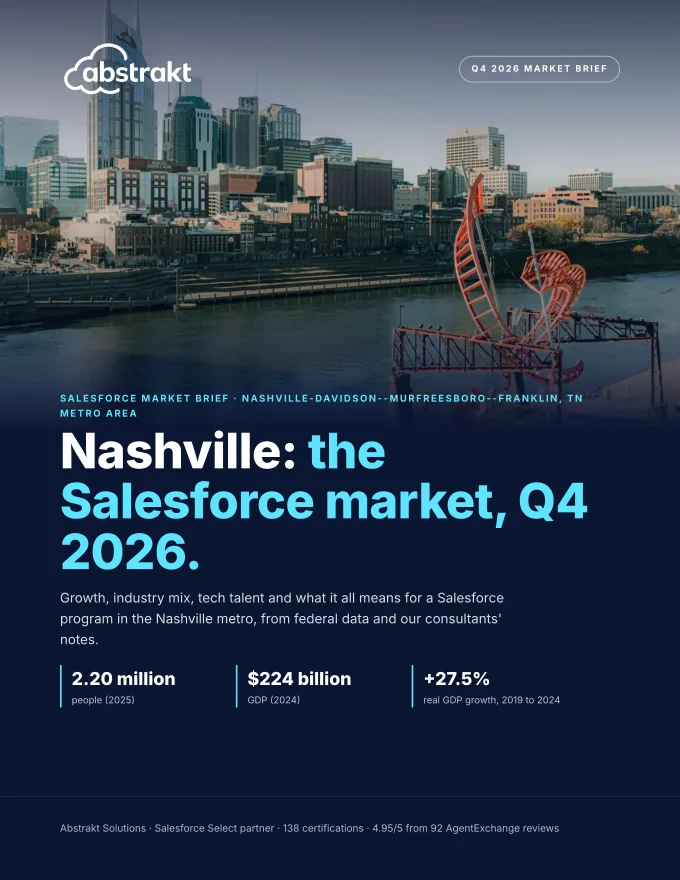
A free 25-page PDF with Nashville's growth ranked against 100 metros, its industry mix, tech wages and nearby markets. It is offered on the public Nashville page; send your customer there or get a copy for your own prep.
Get the Nashville brief →Co-sell with Abstrakt in Nashville
Working a Nashville account? Bring in a named consultant for discovery, scoping or a health check. We reply within 4 business hours.