

How Salesforce work starts in Little Rock
Abstrakt Solutions is a Salesforce Consulting Partner working with banks, health systems, distributors and manufacturers from Little Rock and North Little Rock in Pulaski County out to Conway in Faulkner County. Little Rock is one of our focus markets.
What buyers here usually run into
- 1
Bank-grade compliance for fintech and lenders
Smaller banks and the fintech firms that serve them need consent tracking, record access and audit trails that satisfy examiners without slowing down the people who manage relationships.
- 2
A small admin team for a growing org
Mid-sized Arkansas companies often run Salesforce with a single admin or a part-time owner, so managed support, documentation and a clear release process matter more than adding features.
- 3
Orders, shipments and notes in different places
Distributors commonly keep orders in ERP, shipments in a warehouse system and customer notes in email. Connecting those sources usually comes before any automation pays off.
Budget, team and partner questions
What drives cost
In Little Rock the cost depends on regulated data and integration: privacy design and EHR connections for health care, loan system integration and audit trails for banks and lenders, and ERP and warehouse links for distributors. Documentation and a release process add some scope but save money for companies with a single admin.
Admin or partner
Many mid-sized Arkansas companies run Salesforce with one admin or a part-time owner, which works when a partner covers integrations, releases and specialist work. Larger health and financial organizations more often keep a small internal team and use a partner for projects.
What buyers ask a partner
Ask for experience with EHR, loan origination or warehouse integration relevant to you, and how the partner documents the org so a small internal team can own it. Ask what the release process looks like and how changes are tested before they reach users.
The local economy and its biggest industries (4)
| Sector | Share of 2024 GDP | Where Salesforce fits |
|---|---|---|
| Health care and social assistance Salesforce for health & life sciences → | at least 9.6% | The metro's largest private sector centers on Arkansas's academic medical center, which both the Alliance and the city list among their institutions, along with clinics and care providers across Pulaski and Faulkner counties. Projects tend to start with referral intake and patient outreach, with privacy settings agreed before any data moves. |
| Finance and insurance Financial Services Cloud → | 8.5% | With financial services and technologies among the Alliance’s target sectors and two fintech accelerators at the Venture Center, Little Rock banks, lenders and the technology firms that sell to them need relationship views, onboarding workflows and marketing that compliance can sign off on. |
| Wholesale trade Integration → | 8.3% | The Alliance's push on logistics and distribution, and fulfillment sites such as a department store chain's e-commerce center in Maumelle, point to distributors that need order status, account terms and customer service tied to warehouse and ERP systems. |
| Manufacturing Salesforce for manufacturing → | 6.3% | Business-jet assembly and cosmetics production in North Little Rock show how far the range stretches. Suppliers and food and beverage producers in the region need distributor management, quoting and service history connected to ERP. |
Source: U.S. Bureau of Economic Analysis, GDP by county (CAGDP2), 2024, summed to the metro area; private sectors only, excluding real estate and government. “At least” marks sectors where BEA suppresses some county figures.
Regional target sectors named by local economic development groups: Advanced Manufacturing, Food and Beverage Manufacturing, Logistics and Distribution, Financial Services and Technologies, Healthcare, Aerospace.
Salesforce products that fit Little Rock (6)
In the order we lead with them here, from the industries above.
Salesforce Financial Services Cloud
Industry CRM for wealth management, banking, insurance, and lending, built for compliance from the start.
Salesforce Service Cloud
The operating system for modern customer service, case, knowledge, voice, and AI agent assist together.
Salesforce Sales Cloud
The CRM where sales pipeline lives, when it is built right.
Salesforce Marketing Cloud
Cross-channel marketing, email, mobile, journey, and Data 360-powered personalization at scale.
Salesforce Experience Cloud
Customer, partner, and employee portals built on Salesforce.
Salesforce Field Service
Scheduling, dispatch, mobile work orders and parts for teams that work on site.
Little Rock health care and banking get practical AI
BEA's 2024 figures rank health care first among Little Rock's private sectors (at least 9.6 percent of metro GDP), followed by retail trade at 8.6 percent and finance and insurance at 8.5 percent. For hospitals and clinics, AI can take on intake paperwork: reading referral forms and suggesting case fields that staff confirm. Banks, credit unions and fintech firms can offer members a self-service assistant grounded in approved account articles, with a clear path to a person. Retailers and distributors can use reply drafting for order questions. Each depends on member and patient data being deduplicated, on permissions tight enough for regulated information, and on someone checking the agent's work until it has earned trust.
- Referral form intake assistance
- Member self-service for account questions
- Order question reply drafting
Services buyers here usually need (7)
Salesforce Implementation in Little Rock
A Little Rock implementation has to fit the team that will run it afterward. Many Central Arkansas organizations have one admin or a part-time owner, so we favor standard features and Flow over custom code, keep the data model tight and document every decision. Discovery covers sales, service and compliance needs; the build happens in a sandbox; data is cleaned before loading; and each role gets training built around its own daily work.
By industry in Little Rock
- 1
Finance and insurance
Finance and insurance contributes about 8.5% of metro GDP, and the Metro Little Rock Alliance targets financial services and technologies. Community banks and Arkansas insurers weighing a new org should first test their branch referral and household reporting needs against what Financial Services Cloud provides out of the box. We settle that alongside the role hierarchy and field-level security, because examiners will ask who sees what, and those answers are built into the design.
- 2
Food and Beverage Manufacturing
The Alliance also names food and beverage manufacturing as a target. Producers selling to grocery chains, distributors and food-service buyers need an implementation that models retail banners, broker relationships and promotional programs, not just a flat list of accounts. We design account hierarchies around how buyers are organized, track trade promotions as opportunities or campaigns, and plan an ERP link for orders so sales can see fill rates without phoning the plant.
- 3
Healthcare
Healthcare is on the City of Little Rock's list of priority sectors, and health care and social assistance is the metro's largest private sector. Implementations for providers usually begin with Service Cloud for referral intake and patient inquiries, sometimes with Health Cloud for care coordination. Before configuring anything, we confirm the business associate agreement, decide which clinical details stay in the EHR, and set access so front-desk, nursing and outreach staff each see only what their jobs require.
Raise before scoping
Design for the admin you have
If one person will maintain the org, every custom object, Apex class and complex Flow becomes their responsibility. Choose declarative tools, name things consistently and write short runbooks, so a Little Rock team can handle routine changes without calling a partner for each one.
Seat compliance in discovery
Banks, lenders and health providers need their compliance lead in the first design workshops, not at user acceptance testing. Record retention, consent capture and audit needs change the data model, and discovering them late forces rework on sharing rules and automation alike.
Train by role on real records
Training with invented sample data rarely sticks. Load a cleaned subset of your own accounts into a sandbox and walk relationship managers, service agents or dispatchers through their actual daily tasks before go-live, then staff a launch-week help desk for their questions.
Salesforce Managed Services in Little Rock
Managed services suits a familiar Little Rock situation: one administrator, or a manager who took on Salesforce alongside another job, supporting a growing user base. We pick up the request queue, keep users and permissions current, repair broken automation, test Salesforce's seasonal releases in a sandbox and deliver enhancements from a backlog you rank with us. Your admin stays the owner and gains a bench of Flow, integration and reporting skills, and a monthly summary shows where every hour went.
By industry in Little Rock
- 1
Health care and social assistance
No Central Arkansas sector outproduces health care and social assistance, which BEA puts at no less than 9.6% of metro GDP. Providers running Service Cloud or Health Cloud need steady upkeep: onboarding and offboarding clinical and front-office staff, updating referral routing as clinics open or change hours, and keeping patient communication templates current. We handle those changes under documented procedures, review access to protected fields on a set schedule and test each release against intake flows before it reaches production.
- 2
Financial Services and Technologies
Banks and the technology companies that sell to them, a focus of the Metro Little Rock Alliance, depend on Salesforce behaving the same way every day. Our managed work for them emphasizes controlled change: requests logged and approved, changes built in a sandbox, peer review before deployment and a change record an examiner or auditor can follow. Fintech firms graduating from local accelerators also lean on us for pipeline and onboarding reports as their customer base widens.
- 3
Logistics and Distribution
Distributors and logistics firms, another Alliance target, generate a steady stream of small Salesforce requests: new territories, revised account assignments, price list updates and fresh service case categories. Left alone, those pile up until users build workarounds in spreadsheets. We batch them into planned releases, keep the connection to ERP and warehouse systems monitored and document each change, so the next person to touch the org understands how and why it works.
Raise before scoping
Keep your admin as owner
Managed services works best when an internal person still owns priorities and knows the business. We carry the technical load and mentor where useful, while your Little Rock admin decides what matters most and remains the first point of contact for colleagues.
Write down what counts as urgent
Define which problems are emergencies, such as a locked-out branch manager or a stopped ERP sync, and which are routine. Put response expectations for each level in writing, so users know what to expect and a report tweak never gets escalated as a crisis.
Brief users before each release
Salesforce ships major releases several times a year, and each can alter automation, security or screens. Review release notes against your org, test in a preview sandbox and send Central Arkansas users a short note on visible changes before the release lands.
Salesforce Integration in Little Rock
In Little Rock, integration requests tend to come from three directions: distributors connecting ERP and warehouse data, banks and fintech firms feeding core and loan system details into relationship views, and providers linking scheduling or EHR data to outreach. Each needs a clear owner for every data element, a sync design matched to how fresh the data must be, and error handling someone actually watches. We build with MuleSoft where several systems share data and with lighter connectors where one link will do.
By industry in Little Rock
- 1
Wholesale trade
Wholesale trade represents about 8.3% of metro GDP, and Central Arkansas distributors often split the customer story across ERP orders, warehouse shipments and email threads. An integration plan starts by listing the questions customers ask most, typically about order status, tracking and open balances, then brings only the fields that answer them into Salesforce. Service agents respond from one screen, and sales spots changes in buying patterns without requesting exports from operations each week.
- 2
Financial Services and Technologies
Banks and credit providers usually keep balances and loan details in a core or loan origination system. Integrating those with Financial Services Cloud gives relationship managers a current view without granting CRM users access to the core itself. We design nightly or event-driven loads depending on the use, mask or omit sensitive numbers where they are not needed, and log every transfer so audit questions can be answered from records rather than recollection.
- 3
Healthcare
For providers in the city's healthcare sector, integration usually connects scheduling or EHR systems to Salesforce outreach and referral workflows. We move the minimum: appointment status, referral outcomes and communication preferences, not clinical notes. Standards-based interfaces are used where the EHR supports them. Every integration user gets narrowly scoped access, credentials are stored outside code, and logs are reviewed so no protected information lands in places like error messages or debug files.
Raise before scoping
List the owner of each field
Before any build work, agree in writing which system owns prices, balances, contacts and shipment status for Central Arkansas customers. Integrations fail most often when two systems both believe they own a value, and the resulting overwrite battles are hard to trace after the fact.
Plan capacity for API limits
Every org has a rolling allowance of API requests set by its edition and licenses. High-volume syncs from order or transaction systems should be batched or event-based. Estimate volumes during design so an Arkansas distributor's integration does not stall halfway through a heavy month-end close or a seasonal rush.
Give monitoring a named owner
In lean Little Rock IT teams, integration alerts often land in a shared inbox nobody watches. Assign a person, define what counts as an incident and write a short runbook for common failures, so a stalled sync is fixed the same day it breaks.
Salesforce Optimization in Little Rock
Optimization for Little Rock organizations usually targets three symptoms together: users who avoid Salesforce because screens are crowded, automation nobody fully understands, and dashboards that disagree with the finance team's numbers. We measure field and report usage, interview people in each department, and then simplify page layouts, consolidate Flows and rebuild core reports on agreed definitions. The work arrives in small releases, so staff see steady improvement instead of one disruptive change, and your admin inherits a cleaner org to maintain.
By industry in Little Rock
- 1
Manufacturing
Manufacturing adds about 6.3% of metro GDP, and producers range from business-jet and cosmetics operations to food and beverage plants. Their orgs often carry opportunity stages copied from a generic template that ignore sampling, trials or distributor approvals. We redesign stages around how deals actually progress, add simple product and quantity tracking that finance trusts, and prune quote approval rules that have grown so tangled that sales routes around them.
- 2
Finance and insurance
Banks and insurers frequently accumulate referral and campaign fields from years of initiatives, leaving relationship managers with long pages and little guidance. Optimization streamlines those layouts by role, reworks the referral process so branch staff can submit a lead in a few clicks, and rebuilds pipeline and referral reports that match the definitions used in board materials. Consent and compliance fields are reviewed with the compliance officer, not removed, so nothing required for audit disappears.
- 3
Healthcare
Provider organizations that started with a quick Service Cloud setup often find routing rules and case types no longer reflect how referrals arrive. We streamline categories, fix queues that send work to the wrong team and add dashboards showing referral volume, time to first contact and conversion to appointments. For clinics spread from Little Rock to Conway, reporting by location helps leaders see which sites need staffing or process help first.
Raise before scoping
Tie changes to one metric
Pick a measure leadership already watches, such as time to first contact or forecast accuracy, and track it before and after each optimization release so improvement is visible. Visible results keep sponsors engaged and help a small admin team justify the hours spent.
Retire old automation carefully
Legacy workflow rules and Process Builder still run in many older orgs. Rebuild their logic in Flow, test the replacements against real records in a sandbox and switch off the old versions only after behavior matches, since Salesforce is phasing those tools out.
Hide fields before deleting them
Removing fields frees users from clutter, but deleted data is hard to recover. Take candidates off layouts first, wait through a full reporting cycle to see whether anyone asks, then export and delete, which keeps Little Rock teams comfortable with the cleanup.
Salesforce Health Checks in Little Rock
For many Little Rock organizations, one or two people built the org over years, and nobody outside that pair has examined it closely. Our review covers login and session policies, who holds which permission sets, record sharing, Flow and Apex, each connected system and the quality of core records, plus conversations with users in each department. Findings are ranked by risk and effort, with fixes sized so a small internal team can act on them. Banks and health providers also get a focused look at access to sensitive records.
By industry in Little Rock
- 1
Financial Services and Technologies
Banks, lenders and fintech firms need confidence that customer financial data is visible only to the right people. The review lists who can view, export and modify sensitive fields, checks for profiles with modify-all rights, examines login policies and multi-factor settings, and evaluates integration users. Findings are mapped to the kinds of questions examiners and bank-customer security reviews raise, so the report doubles as evidence of diligence when those reviews arrive.
- 2
Healthcare
Healthcare organizations face privacy exposure in reports, list views, email templates and attachments as well as in obvious fields. We trace protected information through the org, confirm that field-level security matches policy and check whether event monitoring or field history captures what compliance expects. Where Agentforce or other AI features are under consideration for patient questions, we also assess whether the data they would draw on is accurate and properly restricted.
- 3
Logistics and Distribution
Distributors often accumulate technical debt around integrations: old sync jobs, fields populated by retired systems and automation that still fires on data nobody updates. A health check identifies which integrations are active, which fields are stale and which Flows could fail under month-end volume. The output gives your admin a practical cleanup list, ordered by risk, that improves reliability before new capabilities such as customer portals or AI are layered on.
Raise before scoping
Confirm multi-factor authentication coverage
Salesforce requires multi-factor authentication for direct logins, but exemptions, single sign-on gaps and integration accounts can leave holes. Verify coverage across every user type during the review, including contractors and service accounts, and close those gaps before anything else on the list.
Estimate effort on every finding
A long findings list can overwhelm a small Little Rock team. Ask for an effort estimate on each item and group quick fixes separately from larger projects, so leaders can budget realistically and see progress soon after the review ends.
Score readiness per AI use case
Before switching on AI features, confirm that the records they would read are complete, current and properly shared. Scoring readiness against specific use cases, such as drafting service replies, keeps pilots from launching on data that would embarrass the organization in front of customers.
Salesforce Migration in Little Rock
Little Rock migrations often involve an organization moving off a CRM it outgrew, or combining systems after a merger. Retailers, with retail trade at about 8.6% of metro GDP, also bring loyalty and customer-service data that needs careful consent handling. We inventory sources, map every field to the target model, deduplicate in staging, test loads in a sandbox and have users confirm their own records. Cutover is timed around your busiest periods, with the old system frozen for as short a stretch as possible.
By industry in Little Rock
- 1
Finance and insurance
When banks combine after an acquisition, relationship data often lives in two CRMs with different definitions of a household, a referral and an owner. Migration means agreeing on one set of definitions, mapping both sources to Financial Services Cloud and resolving overlapping customers. Regulated consent and communication preferences must move intact, so we reconcile suppression lists between systems before and after the load and keep an audit file of every step.
- 2
Health care and social assistance
Clinics and service agencies moving into Salesforce often start with referral logs, spreadsheets and a basic contact database. We classify each field, separating demographic and contact details from anything clinical, and migrate protected information only after access controls are live and tested. Historical referrals, including source and disposition, are loaded with their outcomes so leaders can compare volumes before and after the switch, while clinical documentation stays in the EHR where it belongs.
- 3
Food and Beverage Manufacturing
Food and beverage producers typically hold buyer contacts, broker agreements and promotion history across spreadsheets, email and an ERP customer list. Migrating them into Salesforce involves matching each grocery or retail banner to its parent company, standardizing product references and bringing over recent promotion results. We stamp the ERP customer number on every account as it loads, which makes a later order and invoice integration far simpler to build and to reconcile.
Raise before scoping
Clean in staging, not production
A buyer listed three ways or a region spelled four ways costs minutes to fix in a staging file and hours once reps are working the records. Agree on matching rules with sales and service, resolve duplicates in bulk and standardize values ahead of the initial sandbox trial, then repeat the check before cutover.
Keep consent intact
Every unsubscribe a Little Rock bank or retailer has honored must still be honored the morning after cutover. Map each one explicitly, count suppressed contacts in the old and new systems until the numbers agree, and run a trial send to internal addresses before any customer campaign leaves the new org.
Have owners validate their records
Ask relationship managers, reps and service leads to review their own accounts in the sandbox. They spot wrong owners, missing contacts and odd values faster than any script, and their sign-off builds confidence across Central Arkansas teams before go-live, which matters more than any training session.
Salesforce Implementation Rescue in Little Rock
Rescue projects in Little Rock often trace back to a mismatch between scope and support: an ambitious build handed to a small internal team with no one left to finish it, or a partner that disappeared midway. We start with triage, reviewing the org, contracts, open issues and user feedback, then separate what works from what must be repaired. The recovery plan puts the processes people need daily first, and we document everything so your team can own the result.
By industry in Little Rock
- 1
Finance and insurance
Financial institutions sometimes reach go-live with relationship data loaded but referral processes, consent tracking or reporting unfinished. Staff then drift back to spreadsheets, shared drives and email, and the new org sits unused. Recovery prioritizes the pieces that carry compliance weight, such as consent and access controls, followed by referral and pipeline workflows. We also reconcile any data loaded incorrectly, since relationship managers lose faith quickly when household or account balances look wrong.
- 2
Wholesale trade
Distributors with stalled projects often have a Salesforce org that never received the ERP connection it was designed around, leaving service agents without order status. We assess the integration design left behind, decide whether to finish it or replace it with a simpler approach, and deliver order visibility first. Once agents can answer the most common customer question from Salesforce, adoption across sales and service tends to recover, and the remaining scope can follow.
- 3
Aerospace
Aerospace is on the City of Little Rock's list of target sectors, and suppliers in that field run long programs with detailed customer requirements. A failed implementation there often shows up as opportunity records that cannot represent programs, options and multi-year service agreements. Recovery redesigns that structure, migrates what can be salvaged and links service history to specific aircraft or components, so program managers get a view they can rely on.
Raise before scoping
Secure org access first
After a partner exit, confirm your organization holds admin credentials, sandbox access, integration keys and code repositories. Rescues slow badly when those assets sit in someone else's accounts or a former employee's inbox, so recovering them is the opening task for any Little Rock recovery.
Separate defects from wishes
Stalled projects collect every request anyone ever made. Sort the list into defects blocking work, promised scope still missing and new ideas, and handle them in that order so the recovery stays finite, funded and understandable to the executives paying for it.
Rebuild trust with quick wins
A branch manager who stopped logging in will come back only when something visibly improves. Fix a few visible frustrations early, such as a broken report or a confusing page, and tell Little Rock staff what changed and why before tackling larger repairs.
Industry plays in Little Rock (4)
Salesforce for Little Rock Health Care and Life Sciences
Health organizations in the capital region frequently accept referrals and transfers from smaller hospitals and clinics well outside the metro. Salesforce works best here as the coordination layer around the EHR: capturing incoming referrals, tracking scheduling and follow-up, supporting physician outreach to referring communities and running patient communications. We design with PHI boundaries and role-based access first, then add the service, outreach and analytics pieces that match what your teams actually do each day.
Some county figures are withheld, so the Bureau of Economic Analysis share for health care and social assistance, at least 9.6% of 2024 metro GDP, is a floor; even so, it tops every other private sector in central Arkansas. The City of Little Rock names health care among its economic development focus industries. The Metro Little Rock Alliance counts twenty higher-education institutions in its region, including a medical sciences university, and the city lists research and technology assets such as a technology park and an emerging analytics center. That mix of care delivery, medical education and research infrastructure is what a CRM design here has to serve.
Use cases to open with
- 1
Statewide referral intake
Specialty and tertiary services receive referrals by fax, phone and portal from providers across Arkansas. Service Cloud can turn each one into a tracked case, attach the documents, route it to the right scheduling team and alert staff when it stalls. Referring offices get status updates without calling back, and leaders can see turnaround times by specialty and referral source.
- 2
Outreach to referring communities
Physician liaisons who cover rural and regional practices need to know which relationships are growing and which are quietly fading. Sales Cloud visit logging, combined with referral counts pulled from the scheduling system, lets liaisons plan routes around the practices that matter most and prepare for each visit with recent history. Tableau dashboards show leadership where referrals originate by county and service line, and how that pattern shifts over time.
- 3
Research engagement and recruitment
Clinical research programs juggle sponsors, investigators and potential participants, each needing different communication at different stages. A study and site data model in Salesforce, with Marketing Cloud for consented recruitment outreach, keeps that communication organized and measurable. Participant details stay limited to what recruitment actually requires, while the research system of record holds everything else under its own controls, audit trail and institutional review requirements.
Raise before scoping
HIPAA and minimum necessary
Referral and outreach work touches PHI constantly. Store only what each process needs, sign a business associate agreement, use encryption and field-level security for sensitive fields, and document who can see what. We design with your privacy officer so decisions are recorded, not assumed.
Fax and phone still matter
Many referring offices across Arkansas will keep sending faxes and making calls for years. Plan for digital fax intake, document capture and phone integration rather than assuming every partner adopts a portal, or the new system will only capture part of the referral volume.
Small teams, steady support
Regional health organizations often run Salesforce with a lean IT group. Build with standard features where possible, document every automation and integration, and plan ongoing managed support so the org keeps pace with Salesforce releases, security reviews and changing clinical workflows.
Salesforce for Little Rock Lenders
Lenders in the Little Rock area compete on relationships as much as on rates. Salesforce helps when it connects the loan origination system with everything around it: referral partners, borrower communication, cross-sell to deposit and wealth products, and retention after closing. We build around Financial Services Cloud or Sales Cloud depending on your mix of products, integrate the LOS and core systems, and design consent and access controls that stand up to regulatory examination.
Finance and insurance accounts for 8.5% of the metro's 2024 GDP in Bureau of Economic Analysis county data, close behind retail trade and ahead of wholesale trade. The Metro Little Rock Alliance lists financial services and technologies as a key industry, and the City of Little Rock names banking and finance among its focus areas. The Alliance also points to an innovation center that hosts fintech accelerator programs, including one aimed at community banking. Lenders here therefore work beside technology firms building the tools they use, while borrowers compare their experience with digital-first competitors.
Use cases to open with
- 1
Loan pipeline beyond the LOS
The loan origination system tracks files, but it rarely shows sales activity before application or after closing. Salesforce captures leads, pre-qualification conversations and follow-ups, then syncs milestones from the LOS so loan officers and managers see one pipeline from first inquiry to funding. Automated tasks prompt outreach when a file stalls in processing, and reports show conversion by lead source, product and loan officer.
- 2
Referral partner management
Purchase business for a mortgage lender usually arrives through people: agents, home builders and the advisors who counsel buyers. Sales Cloud or Financial Services Cloud can track each partner's referrals, closings and co-marketing activity, while Marketing Cloud keeps partners informed about programs and rate changes. Loan officers see which relationships are productive and which need a visit before the spring buying season starts.
- 3
Retention after closing
Once a loan closes, the borrower becomes a prospect for deposits, refinancing and home equity. Data 360 (formerly Data Cloud) or a scheduled integration can bring servicing and core banking data into Salesforce so relationship bankers see life events, payoff signals and product gaps. Marketing Cloud journeys then reach borrowers with relevant offers, filtered by consent and eligibility, instead of the blanket rate emails that customers learn to ignore.
Raise before scoping
Consumer data protections
Borrower information falls under GLBA privacy and safeguards requirements, and marketing must respect fair lending and telemarketing consent rules. Design sharing, encryption, consent capture and audit trails with your compliance officer, and keep evidence ready for examiners rather than rebuilding it at each review.
One borrower, many systems
The same person may appear in the LOS, core banking, servicing and marketing lists with different spellings and addresses. Agree on matching rules and a household model before integration, or relationship views will show duplicates that undermine trust in the new system.
Loan officer adoption
Loan officers will not update two systems. Automate milestone updates from the LOS, give mobile access for partner meetings, and keep required fields minimal. Measure adoption through pipeline accuracy rather than login counts, and involve top producers in design from the start.
Salesforce for Little Rock Manufacturers
Most manufacturers around Little Rock are mid-sized, lean on IT and sell through buyers, brokers or distributors rather than huge direct sales teams. Salesforce should respect that. Sales Cloud organizes buyer accounts, promotions and new-item launches; Service Cloud handles order issues, quality complaints and claims; Experience Cloud gives distributors a self-service view of orders and documents. We integrate the ERP for pricing, inventory and shipments so account managers stop asking the plant for status updates by phone.
Manufacturing is 6.3% of the Little Rock-North Little Rock-Conway metro's 2024 GDP, the fifth-ranked private sector in Bureau of Economic Analysis county data, behind health care, retail, finance and wholesale trade. The Metro Little Rock Alliance, a 13-county regional coalition, still puts advanced manufacturing and food and beverage manufacturing on its key-industries list, together with logistics and distribution. The City of Little Rock separately lists aerospace. That mix points to producers selling packaged goods to grocery and foodservice buyers, and technical suppliers with longer qualification cycles, many shipping through the region's distribution network.
Use cases to open with
- 1
Retail and foodservice buyer programs
Food and beverage producers juggle retailer buyers, foodservice distributors and brokers, each with promotions, slotting and new-item timelines. Sales Cloud can hold account plans, promotional calendars and item authorizations per buyer, with shipments and deductions coming from the ERP. Sales managers can compare planned against actual volume by account and catch a promotion that underperformed before the next buying meeting.
- 2
Quality complaints and claims
A customer complaint about a damaged pallet or off-spec product needs quick acknowledgment and a documented resolution. Service Cloud logs each complaint with lot numbers and photos, routes it to quality staff, tracks corrective actions and credits, and shows sales the open issues before a call. Trends by product, plant or carrier become visible instead of buried in an inbox.
- 3
Distributor order visibility
Distributors and dealers call repeatedly to ask where an order is or to request a spec sheet. An Experience Cloud portal, fed by ERP and warehouse data, lets them check order and shipment status, download certificates of analysis or product documents, and open a request. Inside sales spends less time on status calls and more on growing accounts that have room to buy more.
Raise before scoping
Small admin, clear ownership
Many central Arkansas manufacturers run Salesforce with one admin or a part-time owner. Favor declarative configuration over custom code, document every automation, and set a simple release process. Managed support can cover the gaps so the system does not stall when that one person is on vacation.
ERP and warehouse data first
Orders, pricing and shipments usually live in ERP, with a warehouse system tracking what actually left the dock. Connect those before adding automation, decide which fields sync and how often, and avoid building workflows that depend on data sales reps must re-enter by hand.
Food safety records stay put
Food producers keep lot traceability, audits and food safety documentation in dedicated quality systems. Salesforce should reference lot numbers and link to those records rather than duplicate them, so recalls and audits still draw from one authoritative source that inspectors and customers trust.
Salesforce for Little Rock Retailers and Consumer Brands
Retail and consumer-goods businesses around Little Rock span department and specialty stores, regional chains and distributors that supply retailers across the South. Salesforce helps each connect customer data that currently sits in separate tools. Service Cloud handles shopper questions, returns and order issues; Marketing Cloud runs loyalty and promotional campaigns; Sales Cloud manages wholesale buyers. With a small admin team, the design should stay simple, documented and tightly integrated with POS, e-commerce and ERP systems.
Retail trade makes up 8.6% of the Little Rock metro's 2024 GDP by Bureau of Economic Analysis county figures, second only to health care, and wholesale trade adds another 8.3%. Retail is not a named target of the Metro Little Rock Alliance, but its logistics and distribution focus, and its food and beverage manufacturing target, both feed consumer supply chains. The combination suggests a market where stores, distributors and consumer-products makers often sit close together, sharing warehouses, carriers and sometimes the same customers across central Arkansas.
Use cases to open with
- 1
Shopper service across channels
Shoppers reach out about online orders, store pickup, returns and gift cards through phone, email and chat. Service Cloud collects those requests in one console with order history from e-commerce and POS, so agents answer without switching systems. Knowledge articles cover return policies and product care, and managers can see which questions spike after a promotion or a shipping delay.
- 2
Loyalty and seasonal campaigns
Regional retailers rely on repeat customers and seasonal events such as back-to-school, holidays and football weekends. Marketing Cloud uses purchase history and loyalty data to send targeted offers by store, category and customer value, suppresses messages to shoppers who just bought, and paces outreach so loyal customers are not flooded during peak weeks. Results feed back into Salesforce so merchandising and marketing see what actually moved product.
- 3
Wholesale accounts and reorders
Distributors and consumer brands sell to independent retailers, grocers and chains who reorder on regular cycles. Sales Cloud tracks each buyer's order patterns, price agreements, open credits and service issues, and flags accounts whose reorders are running late compared with their usual rhythm. Integration with the ERP shows inventory and shipment status, so reps can promise realistic delivery dates and suggest substitutes when an item is short.
Raise before scoping
Keep the org maintainable
Mid-sized Arkansas retailers often have one Salesforce admin juggling store systems too. Favor standard features and declarative automation, write down every flow and integration in plain language, and plan a predictable release rhythm around peak selling seasons. Managed support is worth considering before custom development piles up.
Customer identity across systems
The same shopper may appear in POS, e-commerce, loyalty and email tools under different emails or phone numbers. Agree on matching rules and a master identifier early, and decide whether Data 360 (formerly Data Cloud) is needed to unify profiles or whether simpler integration is enough.
Payment data stays out
Card data belongs in your payment processor and POS, not in Salesforce. Design integrations to pass order and customer details without card numbers, keep PCI scope narrow, and confirm with your processor and security lead which data may be stored or displayed to agents.
Case studies to send (3)
From the industries this market leans on. Client names are anonymized and these projects are not specific to Little Rock.
The Little Rock Salesforce market brief, Q4 2026
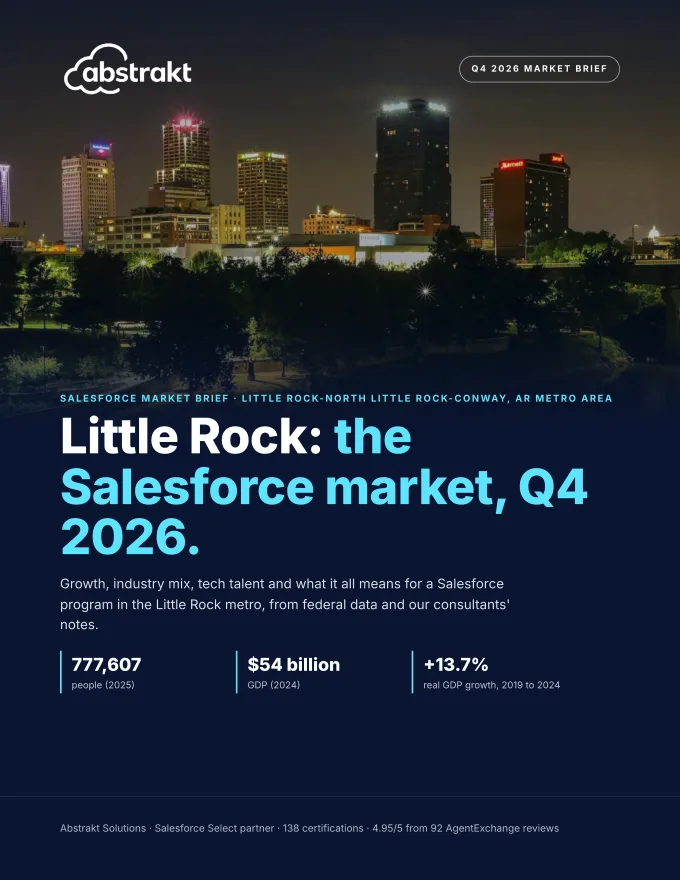
A free 23-page PDF with Little Rock's growth ranked against 100 metros, its industry mix, tech wages and nearby markets. It is offered on the public Little Rock page; send your customer there or get a copy for your own prep.
Get the Little Rock brief →Co-sell with Abstrakt in Little Rock
Working a Little Rock account? Bring in a named consultant for discovery, scoping or a health check. We reply within 4 business hours.