

How Salesforce work starts in New Orleans
Abstrakt Solutions, a Salesforce Consulting Partner, works with plants, energy contractors, terminal operators and health providers in New Orleans and Metairie and throughout the 10 parishes Greater New Orleans, Inc. covers, up the Mississippi River corridor lined with deepwater cargo terminals. New Orleans is one of our focus markets.
What buyers here usually run into
- 1
Plant contracts and crew billing
Industrial service contractors commonly work under master service agreements with plants and terminals, and keeping rates, work orders and safety certifications in separate systems slows billing.
- 2
Cargo status outside the CRM
Freight, port and logistics businesses often field customer questions about cargo that live in terminal or transport systems Salesforce cannot see without integration.
- 3
Milestone-driven studio revenue
Game development and QA studios typically sell by project or milestone, and a CRM configured for product sales misses the resourcing and milestone billing those deals depend on.
Budget, team and partner questions
What drives cost
New Orleans projects are sized by Field Service scope, offline mobile needs, and how many ERP, payroll or terminal systems must connect. Professional services firms are driven by the project and billing handoff, and health care organizations by privacy design.
Admin or partner
Industrial contractors here often have field operations expertise but little Salesforce depth, so a partner usually covers Field Service design, integration and releases. Smaller engineering firms, agencies and studios commonly outsource administration altogether.
What buyers ask a partner
Ask for Field Service references with certifications and contract entitlements, how the partner tests mobile where connectivity is weak, and how they connect project systems for milestone billing. Ask who supports the org after go-live.
The local economy and its biggest industries (4)
| Sector | Share of 2024 GDP | Where Salesforce fits |
|---|---|---|
| Manufacturing Salesforce for manufacturing → | 20.1% | The refineries and chemical plants GNO points to share this sector with food makers and space-launch hardware assembly in eastern New Orleans. Industrial suppliers serving them need contracts, service visits and ERP data joined in one system. |
| Health care and social assistance Salesforce for health & life sciences → | at least 7.4% | As the metro's second-largest private sector, health care here spans hospitals, clinics and home health agencies that need patient outreach and referral tracking, with Service Cloud and Marketing Cloud set up around privacy requirements. |
| Professional, scientific, and technical services Salesforce for professional services → | at least 6.1% | Large IT outsourcing operations, the game development and QA studios GNO highlights, and engineering firms supporting energy and port projects all sell project work that Sales Cloud and Tableau can forecast. |
| Finance and insurance Salesforce for insurance → | 5.3% | Banks, lenders and insurance agencies in the metro write loans and coverage for homeowners, maritime businesses and energy contractors. Financial Services Cloud keeps policy, loan and household details connected for their service teams. |
Source: U.S. Bureau of Economic Analysis, GDP by county (CAGDP2), 2024, summed to the metro area; private sectors only, excluding real estate and government. “At least” marks sectors where BEA suppresses some county figures.
Regional target sectors named by local economic development groups: Technology & Innovation, Energy, Value Added Manufacturing, Trade & Logistics.
Salesforce products that fit New Orleans (6)
In the order we lead with them here, from the industries above.
Salesforce Sales Cloud
The CRM where sales pipeline lives, when it is built right.
Salesforce Field Service
Scheduling, dispatch, mobile work orders and parts for teams that work on site.
Salesforce Service Cloud
The operating system for modern customer service, case, knowledge, voice, and AI agent assist together.
MuleSoft
Enterprise API platform, for connecting Salesforce, ERP, data warehouses, and the rest of your stack.
Salesforce Experience Cloud
Customer, partner, and employee portals built on Salesforce.
Tableau
Executive analytics, embedded dashboards, and CRM Analytics built on Tableau.
What AI can realistically do for New Orleans industry
Manufacturing generated 20.1 percent of New Orleans metro GDP in 2024, a far larger share than health care or professional services. Plants and their suppliers run on maintenance work orders, safety documentation and customer technical questions, and AI is most useful when it reads those documents and summarizes them for a planner or engineer. Field Service technicians can query an assistant for procedures and past repairs on specific equipment. Trade and logistics firms can triage shipment inquiries and draft status replies. Hospital billing offices can let a knowledge-based agent handle routine statement and appointment questions. All of this assumes asset and account data is reliable and that someone reviews AI output before it reaches a customer.
- Work order and safety document summaries
- Past repair lookup for technicians
- Shipment inquiry triage and replies
Services buyers here usually need (7)
Salesforce Implementation in New Orleans
For most New Orleans companies, implementing Salesforce means modeling work that happens outside an office: plant maintenance under master agreements, shipments moving through river terminals and projects billed by milestone. We start by designing the objects and relationships that represent those contracts, sites and assets, then phase the rollout so the sales process and clean account data go live first. Field teams, portals and integrations follow in later phases, each opened with discovery workshops and closed out with go-live support and training.
By industry in New Orleans
- 1
Manufacturing
Manufacturing accounts for about 20.1% of 2024 metro GDP, far ahead of any other private sector, and it spans refining, chemicals, food production and aerospace assembly. For an implementation, the first design question is usually how to represent a plant: as an account, a site under a parent account or an asset with its own service history. Getting that hierarchy right determines whether quoting, service contracts and reporting by facility work cleanly once the org grows beyond its first users.
- 2
Energy
GNO, Inc. lists energy among the region's target sectors, and the work around it includes refining, chemicals and the service contractors that keep plants running. Contractors implementing Salesforce here need a data model that ties each work order to a master service agreement, a rate schedule and the crew certifications a site requires. We design those relationships before building screens, so billing and safety records trace back to the same contract without spreadsheets in between.
- 3
Trade & Logistics
Trade and logistics is another GNO, Inc. target sector, fed by the terminals lining the Mississippi. Freight forwarders, terminal operators and trucking firms implementing Salesforce usually want customer accounts, rate agreements and service cases in one place, while shipment events stay in their operational systems. We scope the first phase around sales and customer service, and design the shipment object early so a later integration can populate it without reworking the data model.
Raise before scoping
Model sites before screens
Industrial customers along the river corridor often own several plants, each with its own contacts, contracts and safety rules. Decide early whether sites are child accounts, locations or assets, because that choice drives sharing, reporting and Field Service scheduling later, and reversing it after go-live means migrating records again.
Test offline work early
Crews working inside refineries, chemical plants and terminals may lose signal for long stretches. If Field Service is part of the roadmap, test the mobile app's offline behavior against real work orders during the build rather than discovering gaps on the first day technicians use it.
Plan go-lives around operations
Plant turnarounds and storm-season disruptions can pull away the same people you need for testing and training. Agree on go-live windows with operations leaders early, and keep each phase small enough that a delayed launch moves one piece of scope rather than the whole program.
Salesforce Integration in New Orleans
In New Orleans, integration work usually centers on systems Salesforce cannot replace: ERP for pricing and invoicing, terminal and transportation platforms for cargo events, and timekeeping for plant crews. Every build starts with a written map of who owns which record; the choice between MuleSoft, a lighter platform or direct APIs follows from volume and from who will support it, and error handling is designed in rather than bolted on. The payoff is that a rep or dispatcher can say where an order or crew stands without phoning another department.
By industry in New Orleans
- 1
Trade & Logistics
Port, freight and warehousing businesses in the region track cargo in terminal operating and transportation systems that must remain the operational record. The integration pattern that works is event-based: milestone updates such as arrival, release or delay flow into Salesforce against the customer's shipment, where service agents and portal users can see them. We design for late or duplicate events and for vessel delays that reorder everything, because cargo data rarely arrives in perfect sequence.
- 2
Manufacturing
Refiners, chemical producers, food makers and aerospace suppliers in the metro generally run ERP as the source for products, pricing, orders and invoices. Integration brings order status and invoice history into account pages, pushes approved quotes back as sales orders and keeps the product catalog in step. We agree on the system of record field by field and build reconciliation reports, so finance can confirm the two systems match at month end.
- 3
Energy
Energy is one of GNO, Inc.'s target sectors, and its service contractors often reconcile crew hours, materials and contract rates across three or four systems. Connecting Field Service work orders to timekeeping, payroll and ERP billing lets invoices reflect the agreed master service agreement without manual re-entry. We add validation that flags hours charged against expired certifications or out-of-scope work before an invoice is created and reaches the plant owner.
Raise before scoping
Decide ownership field by field
When ERP, dispatch and Salesforce all hold customer addresses, contacts or rates, conflicts are inevitable. Agree in writing which system wins for each field, how often changes flow and who fixes a record that fails to sync, before any integration is built.
Involve plant IT early
Refineries and terminals often restrict how external systems reach on-premises software. Bring plant IT and security teams into integration design at the start, since firewall approvals, service accounts and VPN arrangements can take longer to secure than the build itself.
Monitor from launch day
A sync that silently stops can go unnoticed until an invoice or customer update is wrong. Set up alerts, error queues and a short runbook before go-live, and name the person on your side who receives them and decides what happens next.
Salesforce Optimization in New Orleans
Optimization in New Orleans usually starts where people have quietly stopped using Salesforce: supervisors tracking crews in spreadsheets, account managers keeping notes in email, dashboards nobody quotes in meetings. We look at login and field-completion data, interview each team, and then simplify layouts, retire duplicate automation, clean account and contact records and rebuild the reports leaders use. It is a defined project on your existing org, and training focuses on what changed rather than repeating the original rollout.
By industry in New Orleans
- 1
Professional, scientific, and technical services
At least 6.1% of metro GDP comes from engineering, IT services, consulting and other professional, scientific and technical firms, many of which support energy and port projects. Their orgs tend to accumulate fields for each practice area and pipeline stages nobody agrees on. Optimization settles shared stage definitions, removes redundant fields and rebuilds forecast reports around signed and probable work, so partners and project leads can plan staffing from Salesforce rather than a separate tracker.
- 2
Health care and social assistance
Providers and community health organizations here often run referral intake, outreach and follow-up in Service Cloud, but staff under time pressure skip fields that seem pointless. We measure which fields are completed, cut required fields to the ones reporting actually uses and consolidate overlapping case automation. The result is faster intake screens and outreach lists built from records staff trust, while privacy settings are reviewed as part of the same pass.
- 3
Value Added Manufacturing
Value-added manufacturing is a GNO, Inc. target sector, and producers in it often inherited Salesforce orgs configured for a different product mix. Common problems are quote templates that no longer match pricing, opportunity stages that skip sampling or qualification, and duplicate distributor accounts. We clean the account list, align stages with how orders are actually won and rebuild pipeline and margin reports so sales and operations leaders are looking at the same numbers.
Raise before scoping
Measure before you simplify
Before touching a single layout, export login history, field fill data and a record of which reports get opened. Those numbers expose the screens people dodge and the dashboards nobody visits, and they become the baseline for proving to leadership that adoption actually moved.
Consolidate automation carefully
Older orgs here often carry workflow rules, Process Builder and Flows written by different admins, sometimes updating the same field. Map every automation touching a key object before migrating it to Flow, so the consolidated version keeps the behavior teams rely on and drops the conflicts.
Retrain by role, briefly
Crews, dispatchers, account managers and executives each need to learn only the parts that changed for them. Short, role-specific sessions get better attendance than a single long retraining and avoid reintroducing features nobody uses.
Salesforce Managed Services in New Orleans
Managed services for a New Orleans company usually means taking over an org that one person built and nobody else fully understands. Our first weeks go into writing down how the org actually works; after that we run the request queue, build configuration and Flow changes, regression-test every Salesforce release in a sandbox and keep links to plant, clinic or policy systems healthy. Priorities are agreed monthly with a business owner you name.
By industry in New Orleans
- 1
Health care and social assistance
Health care and social assistance contributes at least 7.4% of metro GDP, and providers here range from hospital systems to home health and community agencies. Their Salesforce orgs change constantly as referral sources, service lines and outreach programs shift. A managed services team handles those changes through a documented queue, checks each release against privacy settings and access rules, and keeps a change log that compliance staff can review without asking the admin to reconstruct history.
- 2
Finance and insurance
Banks, lenders and insurance agencies in the metro can see service volumes jump after a major storm, when customers call about claims, payments and coverage at once. Managed services gives them administrators who can adjust case queues, routing rules and communication templates quickly during those periods, then return to planned enhancements. Every change is still tested in a sandbox and logged, so auditors can see that urgency did not bypass change control.
- 3
Technology & Innovation
GNO, Inc. names technology and innovation as a target sector, pointing to IT services, satellite communications, travel technology and game studios. Companies in that mix often change pricing, partner programs and support tiers as they grow. Managed services keeps Salesforce aligned with each change: new opportunity types, revised approval rules, updated entitlements and dashboards that reflect how revenue now arrives, handled by admins and developers who already know the org.
Raise before scoping
Name one business owner
Requests from sales, service and field operations compete for the same hours. A single business owner who ranks the backlog each month keeps the loudest department from setting priorities, and gives our team one person to confirm scope with before larger changes begin.
Reserve hours for releases
With each seasonal release the platform itself moves under you, and Flow behavior or page layouts can shift without anyone in New Orleans touching them. Set aside part of each release month for sandbox regression testing of your Flows, integrations and mobile layouts, so field crews and case agents are not the first to discover what changed.
Document integrations early
Many New Orleans orgs connect to ERP, terminal, clinical or policy systems through integrations built by someone who has since moved on. Early in the engagement we record every connection, who owns its credentials and where its failure alerts go, so an outage becomes a routine fix rather than an investigation.
Salesforce Health Checks in New Orleans
A health check gives New Orleans leaders an evidence-based picture of the Salesforce org they already pay for. The work covers permission design, record quality on the objects that matter, the automation and Apex built up over the years, how each integration signs in and whether paid licenses match real logins. The report orders every issue by how dangerous it is and how hard it is to fix. Organizations here often commission one before adding Agentforce, switching partners or preparing for an audit, since those moments reward knowing exactly where the weak points are.
By industry in New Orleans
- 1
Health care and social assistance
Hospitals, clinics, home health agencies and social service providers in the metro store sensitive information in Salesforce, sometimes in fields nobody expected. The review traces which profiles can view or export health details, whether field history and encryption cover the right fields, and whether marketing users can reach data they should not. Findings map to each setting, so your privacy officer can see what to change and why before outreach programs expand.
- 2
Finance and insurance
Examiners reviewing a bank or insurer increasingly ask how CRM access is granted and removed. For finance and insurance firms here, we test whether departed staff still have active users, which integration accounts carry administrator rights, how exports of customer lists are controlled and whether production changes follow a documented approval. Each gap comes with the specific setting to change, so the compliance team can track remediation item by item rather than interpreting a generic checklist.
- 3
Energy
Energy companies and the contractors in GNO, Inc.'s energy sector often connect Salesforce to ERP, dispatch and safety systems through service accounts created years ago. A health check lists every integration user, its permissions and when its credentials were last rotated, and flags automation that fails silently. It also measures data quality on sites, assets and contracts, which matters before any AI agent is asked to summarize work history or answer customer questions.
Raise before scoping
Decide who receives the findings
Decide before the review whether results go to IT, operations, compliance or all three. Sensitive findings, such as over-broad export rights, may need a smaller audience first, and a named owner for each area speeds the step from report to remediation.
Check AI readiness honestly
An Agentforce agent inherits the org as it stands the day it launches, duplicates and loose sharing included. Measure duplicate rates, stale contacts and sharing breadth on the objects an agent would use, and treat the result as a go or no-go input rather than a formality.
Include integrations and portals
Reviews that stop at the core org miss real exposure. Include integration users, connected apps and any Experience Cloud portal used by customers, subcontractors or brokers, since external access is where a single misconfigured sharing rule causes the most harm.
Salesforce Migration in New Orleans
Migrating to Salesforce in New Orleans often means consolidating records that grew up separately: a policy or loan system, an agency CRM, a contact list maintained by one partner, spreadsheets tracking project bids. Each of those files and systems is profiled, its fields are translated into Salesforce terms with sign-off from the staff who rely on them, and practice loads run in a sandbox until the totals tie out. The final cutover is scheduled around your busy periods, with a short freeze so nobody keeps working in the old system.
By industry in New Orleans
- 1
Finance and insurance
Finance and insurance makes up about 5.3% of metro GDP, and many of the banks, lenders and agencies in it still hold customer relationships across a core system, an agency management tool and personal spreadsheets. Migration here is largely a household and relationship clean-up: matching the same client across sources, deciding which policy or loan details belong in Salesforce and which stay in the core system, and preserving contact history that regulators may ask about.
- 2
Technology & Innovation
Technology companies in GNO, Inc.'s target sector often start on a lightweight CRM and outgrow it when partner channels or support contracts arrive. Their migrations move deals, accounts and activity history, but also marketing lists and subscription data held in other tools. We map each object to Salesforce's standard model where it fits, decide which old custom fields to retire and test that reports built on migrated data match the figures leadership already knows.
- 3
Professional, scientific, and technical services
Engineering, consulting and IT services firms in the metro frequently track proposals and clients in spreadsheets owned by individual principals. Migration consolidates those into shared accounts and opportunities, which surfaces conflicts such as the same client under three spellings or overlapping bids. We clean and deduplicate before loading, keep the proposal history that informs future pricing and archive the rest where it can still be found if someone needs it.
Raise before scoping
Inventory every hidden spreadsheet
Ask each department which spreadsheets, shared inboxes and personal contact lists they actually rely on. In smaller New Orleans firms the most current data is often outside any system, and leaving it out of the migration means users keep the spreadsheet open after go-live.
Keep the history that matters
Not every note and email needs to move. Agree which activity, policy or project history supports sales, service or compliance, and archive the remainder in a searchable form, which keeps the new org lean and makes the cutover loads noticeably faster.
Time cutover around busy periods
Avoid switching systems during renewal peaks, month-end billing or the city's major event seasons, when staff attention is elsewhere. Choose the switchover weekend together with operations leaders, lock the old system for edits for a day or two and keep consultants on call through the first week of live use.
Salesforce Implementation Rescue in New Orleans
Rescue work in New Orleans tends to follow a familiar pattern: an ambitious scope covering sales, field crews and customer portals, a partner who delivered part of it, and teams that went back to spreadsheets. Our first step is a brief review of what was built, what data landed and what the contract actually promised; next we unblock daily work, and only then rule on each component: keep it, repair it or replace it. Whatever scope is left gets delivered in phases, with documentation your admin can follow and a relaunch that retrains each role.
By industry in New Orleans
- 1
Value Added Manufacturing
Producers in GNO, Inc.'s value-added manufacturing sector sometimes end up with a half-built quoting process: product rules partly configured, approvals that loop and quote documents nobody sends. We test the configuration against real recent orders to see what fails, stabilize the pieces reps need to quote this week, then rebuild the rules that were designed around assumptions rather than the actual catalog. Pricing stays anchored to the ERP throughout, so the rescue does not create a second source of truth.
- 2
Trade & Logistics
Logistics and terminal operators occasionally inherit a portal or integration that went live before it was reliable, leaving customers with shipment data that is late or wrong. Rescue starts by checking which events arrive, which fail and why, then pausing the features that erode trust. We fix the integration pattern and error handling, reconcile shipment records and relaunch the portal to customers only once the data behind it holds up.
- 3
Professional, scientific, and technical services
Engineering and consulting firms sometimes buy Salesforce for project delivery as well as sales and find the build too complex for principals to use. Our assessment identifies which custom objects and automations actually support resourcing and billing, and which duplicate what another tool already does. Often the fix is removing scope rather than adding it, returning to a simpler pipeline and project record that busy principals will actually keep updated.
Raise before scoping
Secure access and documentation first
A departing partner can take credentials, sandbox access and design notes out the door. Confirm your organization owns every admin login, integration account and code repository before any rescue work starts, and gather whatever documentation, contracts and test results remain.
Stabilize before redesigning
Teams that depend on Salesforce for dispatch or customer updates cannot wait for a full recovery plan. Fix the defects that block daily work first, communicate what changed, and only then begin the keep, fix or rebuild decisions for the rest.
Reset expectations with users
Staff who were promised a working system and did not get one will be skeptical. Involve a few respected users in testing the recovered build, share exactly what was fixed and relaunch in stages so confidence grows alongside the scope.
Industry plays in New Orleans (3)
Salesforce for New Orleans Manufacturers
Manufacturing around New Orleans mixes project-based fabrication and marine construction with value-added producers shipping through the region's trade and logistics network. Salesforce should support long, engineered bids with milestones and change orders, as well as repeat industrial orders with export documentation. We configure opportunities for both patterns, use CPQ where products are configurable, connect ERP and project accounting data, and give leadership a backlog view that shows committed work alongside open pipeline.
By a wide margin, manufacturing is the New Orleans metro's largest private sector, producing 20.1% of 2024 GDP in Bureau of Economic Analysis county figures, compared with at least 7.4% for health care. GNO, Inc. names value-added manufacturing and trade and logistics among its target industries, and its homepage references marine engineering and construction and EV battery components as areas of activity. That mix suggests two distinct commercial models: engineered projects with long timelines, and production businesses whose customers care about specifications, delivery and export paperwork.
Use cases to open with
- 1
Engineered project bids
Fabricators and marine builders bid on projects with drawings, specifications, milestone payments and heavy change activity. Salesforce opportunities with bid documents, estimator assignments, milestone schedules and change order records keep the commercial history in one place, and a backlog dashboard shows how awarded work will fill the yard or shop over the coming months. Estimators can see which of their bids are still waiting on the customer.
- 2
Export order visibility
Producers shipping internationally deal with letters of credit, certificates of origin and freight bookings. Integrating order and shipment milestones from ERP and freight systems into Salesforce lets sales answer customer questions about vessel dates and documents, and case records capture issues such as documentation discrepancies before they delay payment or strand cargo at the dock. Customer-specific document requirements are stored once and reused on every order.
- 3
New supply-chain customer onboarding
Suppliers entering battery or other emerging supply chains face customer audits, qualification samples and supplier portals. Tracking qualification steps, documents and audit findings as structured records helps teams meet requirements on time and shows leadership where each prospective customer stands before capacity investments are committed or new equipment is ordered. Sample shipments and test results are logged against each prospect so nothing is resent by mistake.
Raise before scoping
Backlog versus pipeline reporting
Project manufacturers need to see awarded but unbuilt work separately from open bids. Define how awarded opportunities become backlog, how revenue recognition milestones map from the ERP, and who updates percent complete, so executives never mistake pipeline for secured work.
Document-heavy customer requirements
Marine, export and industrial buyers require certifications, inspection reports and material traceability. Decide which documents Salesforce stores, which it links from a document management system, and how customers receive them, since duplicated files quickly become outdated and confuse everyone, including the customer's own inspectors.
Import estimates, not estimating logic
Many fabricators estimate in specialized software or detailed spreadsheets. Bring estimate totals and key assumptions into Salesforce rather than rebuilding estimating logic, and store revisions so the team can see how pricing moved between the first bid and the final award.
Salesforce for New Orleans Professional Services
Professional services in greater New Orleans span engineering and environmental firms serving plants, pipelines and port facilities, IT services operations, and interactive studios that build or test games for publishers. Their common problem is revenue that arrives by milestone or project phase, not by closed deal. Salesforce helps when pipeline, contracted milestones and staffing sit together. We configure Sales Cloud for pursuits and change orders, Revenue Cloud or CPQ for rate-based proposals, and Tableau for backlog and utilization, integrated with project accounting.
Refineries and chemical plants help push manufacturing to 20.1% of New Orleans output, and the consultancies, engineers and IT shops that serve them sit third on the BEA's 2024 private-sector ranking with a lower-bound share of 6.1%. Greater New Orleans, Inc., which covers ten parishes reaching beyond the metro, lists technology and innovation among its target sectors next to energy, value added manufacturing, and trade and logistics. It highlights IT services, satellite communications, travel technology and game development and QA firms, and cites Louisiana's digital interactive incentive: a 25% payroll rebate and an 18% rebate on development expenditures.
Use cases to open with
- 1
Milestone-based studio contracts
Game development and QA studios often work for publishers under contracts paid by milestone, with acceptance criteria for each build. Salesforce can store each contract with its milestones, amounts and due dates, track acceptance status, and forecast cash from expected approvals rather than from signature alone. Producers and finance see which milestones are at risk and which clients are slow to sign off.
- 2
Energy and port client pursuits
Engineering and environmental firms pursue work from refineries, chemical plants, terminals and public port authorities, often through master service agreements and task orders. Sales Cloud can track each master agreement, the task orders issued under it and upcoming capital projects by site. Principals see where a client's spending is growing, which facilities are planning turnarounds or expansions, and which task orders are nearing their ceiling.
- 3
Incentive-aware project tracking
Studios and technology firms using Louisiana's digital interactive incentive need to track qualifying payroll and expenditures by project. While the calculation and filing belong with your accountants, Salesforce can tag projects and contracts that are expected to qualify, capture key dates and documentation requirements, and give leadership a view of how incentive-eligible work fits into the pipeline and hiring plans.
Raise before scoping
Task orders under master agreements
Many industrial clients buy through master agreements with many small task orders. Model the master agreement as a parent record and each task order as a child, so remaining capacity, spend and renewal dates roll up accurately for account leaders.
Utilization drives the forecast
In project businesses, capacity is the real constraint. Bring current assignments and utilization from your project or time system into Salesforce, and add expected roles to opportunities, so leaders see whether they can staff what they are about to win.
Keep incentive records clean
State incentive programs carry documentation, certification and audit requirements that outlast any single project. Store supporting records in controlled finance systems, link them to the matching Salesforce projects, and make sure your tax advisors, not the CRM or the sales team, own eligibility decisions and filings.
Salesforce for New Orleans Health Care Organizations
Health care organizations around New Orleans serve patients spread across parishes on both sides of Lake Pontchartrain and the river, which makes access, referrals and follow-up harder than in a compact metro. Salesforce helps when intake, referral tracking, outreach and home-based services are coordinated in one place while clinical records stay in the EHR. We configure Service Cloud for access centers and care coordination, Field Service for home health scheduling, and Marketing Cloud for consent-based outreach, all integrated through MuleSoft and designed around HIPAA-appropriate controls.
After the plants and refineries, the metro's next-largest private engine is care: hospitals, clinics, home health and social services produced a floor of 7.4% of 2024 output in BEA figures. It is not among Greater New Orleans, Inc.'s target sectors, which focus on technology and innovation, energy, value added manufacturing, and trade and logistics. GNO's ten-parish footprint, reaching from Jefferson and Orleans out to Tangipahoa and Washington, is a reminder that providers here draw patients from a broad and partly rural region, not just the urban core.
Use cases to open with
- 1
Access center service
A caller from Slidell and a caller from Uptown may want the same thing, a rescheduled visit or an explanation of a bill. Service Cloud integrated with scheduling and billing lets agents resolve most questions from one screen, with each call logged by reason. Supervisors see volume and resolution times by clinic and parish, and self-service through a portal or Agentforce handles routine requests, such as reminders and form completion, after hours.
- 2
Home health coordination
Home health and hospice agencies schedule nurses and aides across wide territories with variable traffic and weather. Field Service assigns visits by skill, location and patient preference, optimizes routes, and captures visit completion from mobile devices. Coordinators see missed or late visits as they happen and can reassign staff before a patient goes without care, while managers review travel time and visit counts by territory.
- 3
Referral and discharge follow-up
Patients discharged from a hospital often need follow-up with specialists, home health or community services. Salesforce can track each referral, the receiving organization and the scheduled appointment, alert coordinators when follow-up has not happened, and report completion rates by service line. Nurses keep charting in the EHR; the coordinators working the follow-up queue live in Salesforce, and integration keeps the appointment status in sync between them. Leaders can then compare follow-up completion across hospitals and receiving agencies.
Raise before scoping
Plan for severe weather disruption
Storms and flooding can close clinics and interrupt home visits across the region. Build patient contact preferences, alternate phone numbers and priority flags into the data model, and prepare outreach templates in advance so staff can reach vulnerable patients quickly when schedules change.
Report by parish, not facility
Metro providers draw patients from Orleans and Jefferson as well as more distant parishes across the lake and upriver. Store parish and service area on every patient and referral so access gaps, outreach results and home health coverage can be reported by community rather than only by facility.
Integrate with the EHR selectively
Only the scheduling, referral and contact details that coordinators act on should cross from the EHR, and clinical content should stay behind. Name an owning system for every shared field, sign Salesforce's business associate addendum before any PHI arrives, and let your privacy officer approve the access model.
Case studies to send (3)
From the industries this market leans on. Client names are anonymized and these projects are not specific to New Orleans.
The New Orleans Salesforce market brief, Q4 2026
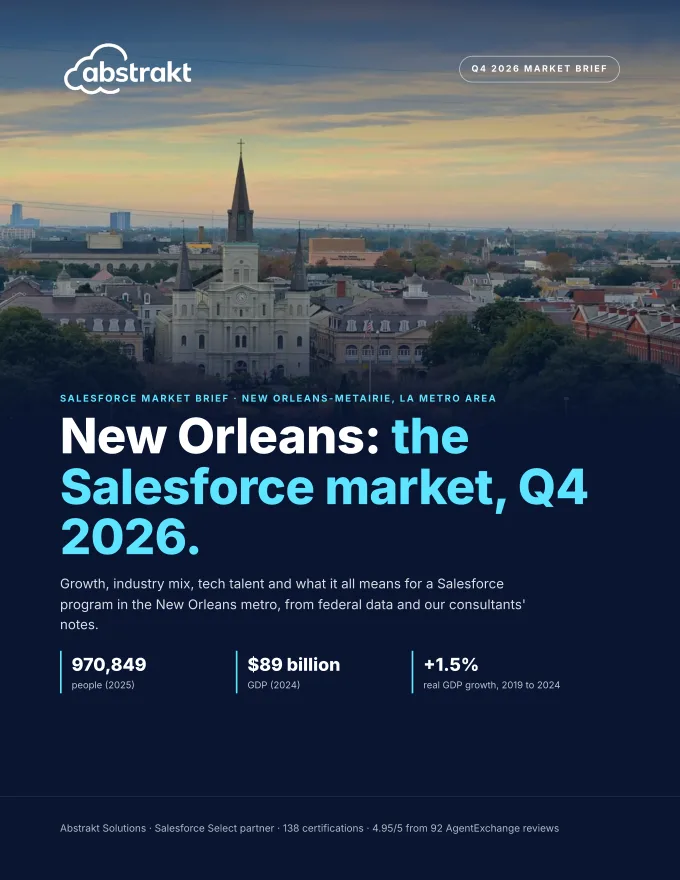
A free 21-page PDF with New Orleans's growth ranked against 100 metros, its industry mix, tech wages and nearby markets. It is offered on the public New Orleans page; send your customer there or get a copy for your own prep.
Get the New Orleans brief →Co-sell with Abstrakt in New Orleans
Working a New Orleans account? Bring in a named consultant for discovery, scoping or a health check. We reply within 4 business hours.