

How Salesforce work starts in Baton Rouge
As a Salesforce Consulting Partner, Abstrakt Solutions takes on CRM, field service and integration projects for process manufacturers, industrial contractors and health care organizations in Louisiana's Capital Region. Baton Rouge is one of our focus markets.
What buyers here usually run into
- 1
Industrial service crews
Contractors serving process plants often schedule large numbers of laborers by phone and spreadsheet. Field Service can be scoped so crews are tracked without licensing every worker.
- 2
Bids and job costs out of sync
Construction and industrial services firms commonly see cost overruns only after a job closes. Linking estimates to field work shows the gap while it can still be managed.
- 3
Safety and compliance records
Companies working in regulated plant environments need certifications, inspections and service records attached to the right accounts and assets.
Budget, team and partner questions
What drives cost
Baton Rouge scope is driven by plant-site complexity: owner and site account hierarchies, MSA and approved-vendor tracking, Field Service for large crews, and links to estimating and ERP. Safety and certification records attached to accounts and assets add design effort.
Admin or partner
Process manufacturers often have strong IT and engineering groups and use a partner for Salesforce architecture and integration. Industrial contractors usually have no Salesforce specialist and lean on managed services, especially through busy turnaround seasons.
What buyers ask a partner
Ask for Field Service references with industrial crews, contract volume tracking for manufacturers, and how the partner links estimates to job costs. Health care buyers should ask about referral management and privacy controls.
The local economy and its biggest industries (4)
| Sector | Share of 2024 GDP | Where Salesforce fits |
|---|---|---|
| Manufacturing Salesforce for manufacturing → | at least 23.7% | Refining, polymer and chemical plants along the river dominate the region's largest sector. Manufacturers and their suppliers need account management, quoting and maintenance or service work tied to ERP. |
| Construction Salesforce for construction → | at least 9.9% | Construction is the metro's second-largest sector. Industrial and commercial contractors need estimating, crew scheduling and job costing in one system. |
| Health care and social assistance Salesforce for health & life sciences → | at least 6.5% | Health care and life sciences is a target sector, with Pennington Biomedical research and hospital partnerships in the region. Organizations need patient engagement and service built around privacy rules. |
| Professional, scientific, and technical services Salesforce for professional services → | at least 5.4% | Baton Rouge engineering and technology services firms need pipeline, project delivery and client reporting connected. |
Source: U.S. Bureau of Economic Analysis, GDP by county (CAGDP2), 2024, summed to the metro area; private sectors only, excluding real estate and government. “At least” marks sectors where BEA suppresses some county figures.
Regional target sectors named by local economic development groups: Process Industries, Energy, Healthcare & Life Sciences, Logistics & Transportation, Technology.
Salesforce products that fit Baton Rouge (6)
In the order we lead with them here, from the industries above.
Salesforce Field Service
Scheduling, dispatch, mobile work orders and parts for teams that work on site.
Salesforce Sales Cloud
The CRM where sales pipeline lives, when it is built right.
Salesforce Revenue Cloud / CPQ
Configure-price-quote, billing, subscription management, and quote-to-cash on Salesforce.
Salesforce Service Cloud
The operating system for modern customer service, case, knowledge, voice, and AI agent assist together.
Salesforce Experience Cloud
Customer, partner, and employee portals built on Salesforce.
MuleSoft
Enterprise API platform, for connecting Salesforce, ERP, data warehouses, and the rest of your stack.
Agentforce for Baton Rouge plants, builders and clinics
BEA's 2024 county data puts manufacturing at no less than 23.7 percent of Baton Rouge metro GDP, with construction at 9.9 percent or more. Process plants and the contractors who maintain them generate turnaround schedules, inspection reports and change orders; AI can read those files, pull out dates and scope, and attach a summary to the right account or work order. Field Service technicians gain from an assistant that retrieves job-specific procedures. Health care organizations can apply reply drafting to referral and scheduling inquiries. The limiting factor is rarely the AI itself. It is whether contracts, sites and assets are recorded consistently, whether sensitive safety records are restricted, and whether a supervisor signs off on what the agent produces.
- Inspection report and change order reading
- Job-specific procedure retrieval
- Referral and scheduling reply drafts
Services buyers here usually need (7)
Salesforce Implementation in Baton Rouge
In Baton Rouge, an implementation usually has to reflect the plant economy along the river. Chemical and refining operators buy through master service agreements and site-level approvals; the contractors who serve them win work turnaround by turnaround and staff it with large, shifting crews. We design the account and facility hierarchy first, decide how MSAs, rate sheets and safety credentials are stored, then build sales, estimating and field execution in phases. Crew supervisors and estimators help shape each phase, so the finished tools reflect how plant work is actually bid and staffed.
By industry in Baton Rouge
- 1
Manufacturing
Manufacturing accounted for at least 23.7% of the metro's 2024 GDP, an unusually high share driven by refining, polymer and chemical production. Plant owners and the vendors who sell them pumps, valves and instrumentation must first settle where the CRM stops and the maintenance system begins. We typically keep maintenance execution in the plant's asset system and use Salesforce for customer, supplier and commercial relationships, with Field Service reserved for companies that send their own technicians to other people's sites.
- 2
Process Industries
Process industries lead the Greater Baton Rouge Economic Partnership's target-sector list, and the contractors and service firms around them need a very particular data model. Every facility sits beneath its owning company, carrying its own approved-vendor status, badge and training rules, and rate sheet. We build those facility records during the first phase, because turnaround bids, crew assignments and invoices all depend on them. Adding that layer after go-live would mean touching every opportunity and work order already in the system.
- 3
Construction
Commercial and industrial builders in the Capital Region implement Salesforce mainly to see the pipeline of bids and the backlog of awarded work in one place. We model bid packages, general contractor relationships and awarded projects separately, connect estimating so bid amounts are not re-keyed, and add Revenue Cloud only where proposals involve configurable scopes or unit pricing. Superintendents get a simple mobile view in a later phase, once project records have proved reliable.
Raise before scoping
Build the facility layer first
Plant owners grant approvals, badges and rates facility by facility. If Salesforce stores them only at the corporate account, estimators and dispatchers will work from the wrong terms. Create site records in phase one and link contacts, credentials and agreements there.
Separate craft labor from dispatch
Industrial contractors may place large numbers of craft workers on a job, but only foremen and supervisors need to update work orders. Decide which roles need Field Service mobile licenses and which can be tracked as resources, before the resource model is built.
Plan around turnaround season
Go-lives that land in the middle of a major plant turnaround compete with the busiest weeks of the year. Schedule launches and training for quieter periods, and keep critical estimating functions stable while crews are mobilized and supervisors are hard to reach.
Salesforce Implementation Rescue in Baton Rouge
Capital Region recoveries frequently center on a stalled dispatch and crew scheduling build. A contractor licensed technicians and crews, but the scheduling model never matched how plant work is staffed, so dispatch went back to spreadsheets and radios. Triage sorts working processes from broken ones, flags suspect records and lines the contract up against what dispatchers really require. Then we stabilize essentials such as scheduling and billing, decide which components to keep, repair or rebuild, and finish in phases that dispatchers test before each release.
By industry in Baton Rouge
- 1
Energy
Energy service firms, a Partnership target sector, sometimes stall halfway through Salesforce projects when the partner underestimated the complexity of site requirements, rates and job tickets. Recovery begins by confirming that tickets, invoicing and crew assignments are working, even with temporary workarounds. We then rebuild the site and asset model properly, reconnect the ERP for billing, and bring mobile work orders back to the field in stages, starting with the crews most willing to test.
- 2
Construction
Contractors whose Salesforce rollout stalled often have a pipeline no one updates and a project module nobody finished. We triage the bid process first, because estimators feel the pain daily, then decide whether project and job cost tracking should be completed in Salesforce or kept in accounting with a summary link. The recovery plan is phased around the company's busiest bidding periods, so staff are not asked to learn new tools at the worst possible time.
- 3
Healthcare & Life Sciences
Health care and life sciences organizations in the region sometimes find their Salesforce project halted by a compliance review that came late. Recovery starts with a privacy assessment: where protected data sits, who can see it and whether agreements are in place. We correct the access model and data handling first, then resume the paused features in order of clinical and operational value, with compliance staff reviewing each phase before it goes live.
Raise before scoping
Stabilize billing and scheduling
Cash and crews come first: are invoices leaving the building, and is tomorrow's crew list correct? If Salesforce is blocking either, restore a working process, even temporarily, so cash flow and commitments to plant owners are protected while the deeper recovery work proceeds in parallel.
Get an honest inventory
Inherited orgs often contain half-built features, test data and abandoned automation. Catalog every component, mark what is live and used, and switch off what is not. A clear inventory makes the recovery plan credible and shows sponsors exactly what they are paying to fix.
Relaunch with one crew
Pick one crew, office or department whose leaders want the system to work. Relaunch there first, fix issues quickly and share the results. A successful pilot inside the company is far more persuasive to skeptical users than any training session or memo.
Salesforce Integration in Baton Rouge
Integration for Baton Rouge companies is often about getting several operational systems to agree. An industrial contractor might run estimating in one tool, payroll and job cost in an ERP, safety credentials in another platform, and deal with procurement portals from plant owners on top. We map which system owns each piece of data, decide what Salesforce needs to show, and build the connections with MuleSoft or simpler tools. Every flow gets error handling, alerts and a runbook your team can follow.
By industry in Baton Rouge
- 1
Process Industries
Chemical and refining operations, the Partnership's lead target sector, run on plant maintenance and procurement systems that suppliers must work with. For vendors, integration often means receiving purchase orders, work requests or invoices through supplier portals or electronic data exchange and turning them into Salesforce records automatically. We build those inbound flows with validation so a malformed order does not create bad data, and we send status back wherever the owner's system accepts it.
- 2
Finance and insurance
Banks, credit unions and insurers in the Capital Region connect Salesforce to core banking, loan origination or policy administration systems. The integration design has to respect which system is authoritative for balances, applications and policies; Salesforce usually displays them rather than editing them. We use MuleSoft or vendor connectors for the core, limit which fields flow into the CRM, and log every access to customer financial data so compliance reviews go smoothly.
- 3
Technology
Technology is one of the Partnership's target sectors, and software and IT services firms in the region integrate Salesforce with billing, subscription, support and product platforms. The goal is one account view for sales and customer success. We bring in invoices and subscription status from billing, open tickets from support tools and summarized product metrics, then build renewal and expansion reports on top, without copying raw event streams into Salesforce storage.
Raise before scoping
Integrate credentials by status
Safety training and site access often live in a credentialing platform. Rather than copying certificates into Salesforce, bring in status and expiration dates so dispatchers and Field Service scheduling can act on them, and link to the source system for the documents themselves.
Handle owner portals realistically
Some plant owners only offer web portals without APIs for suppliers. In those cases we design a simple, controlled manual step or a file-based exchange instead of fragile screen scraping, and record the result in Salesforce so reporting stays complete.
Choose middleware for the long run
If several systems will connect to Salesforce over the next few years, a middleware layer such as MuleSoft keeps integrations reusable and easier to monitor. For a single connection, a native or lighter tool may be enough. Deciding early avoids rebuilding later.
Salesforce Optimization in Baton Rouge
Optimization in Baton Rouge usually starts where Salesforce and field reality diverge. Estimators keep their own bid logs, dispatchers schedule crews on whiteboards, and managers rebuild the same report in a spreadsheet every Monday. We measure which parts of the org people use, sit with estimators and dispatchers, and then remove clutter, merge automation that fires twice, and rebuild bid, backlog and utilization dashboards on data people already enter. Each change is small enough to test with the crew or office that relies on it.
By industry in Baton Rouge
- 1
Construction
Construction produced at least 9.9% of the metro's 2024 GDP, second only to manufacturing. Contractors here often have Salesforce pipelines that stop at contract award, so backlog and job cost live elsewhere. Optimization extends the record through delivery with simple project and change order objects, fixes win-rate reporting by standardizing loss reasons, and gives project managers a view of estimated versus actual cost fed from accounting. The aim is fewer side spreadsheets, not a larger org.
- 2
Logistics & Transportation
Logistics and transportation is on the Partnership's target list. Carriers and distribution firms that adopted Salesforce for sales often let it drift: lanes and rates tracked in notes, quote requests handled in email, and duplicate shipper accounts created by every rep. Optimization introduces a lane or rate structure reps can actually maintain, routes quote requests into a queue, merges duplicates, and rebuilds pipeline reports around lanes and customers rather than individual deals.
- 3
Health care and social assistance
BEA's 2024 county figures put the Baton Rouge metro's care sector at a floor of 6.5%. Providers that use Salesforce for referral intake or patient outreach frequently find staff re-entering data from fax and phone into multiple screens. We streamline intake into a single guided flow, clean up referral status values so reports reflect reality, and tune Service Cloud routing so requests reach the right clinic team. Privacy settings are reviewed alongside every change, not afterward.
Raise before scoping
Close the loop past award
A pipeline that ends at Closed Won hides whether jobs made money. Adding a light project stage and a job cost summary from accounting lets leaders compare bid assumptions with actual results, which improves the next estimate more than any sales dashboard.
Standardize loss reasons
Win-rate analysis only works when losses are recorded consistently. Replace free-text loss notes with a short picklist agreed with estimators, keep a comment field for detail, and review the categories every few months so they keep matching how bids are really lost.
Give dispatch one screen
Dispatchers juggling crew availability, certifications and site requirements should not click through several tabs. A consolidated Field Service dispatcher console, filtered for their territory and job types, often does more for adoption than any new feature the org could add.
Salesforce Managed Services in Baton Rouge
Managed services for Baton Rouge clients often follows the rhythm of plant work. When turnaround season approaches, contractors need new site records, updated rate sheets, crew credentials and Field Service schedules adjusted fast; afterward, the backlog turns to reporting and cleanup. We handle both on one ranked queue agreed with your leadership, test each Salesforce release in a sandbox, and assign a named lead who knows your sites and contracts. Larger requests are scoped separately so small fixes keep moving.
By industry in Baton Rouge
- 1
Energy
Energy is on the Partnership's target list, and energy service firms here run Salesforce orgs that grow with every new customer site and contract type. Ongoing work centers on keeping MSAs, rate schedules and approved-vendor statuses current, adjusting Field Service territories as crews move between facilities, and maintaining the reports operations leaders use to track utilization. We document each change so the org stays understandable even as the business shifts between upstream, midstream and downstream customers.
- 2
Finance and insurance
Finance and insurance contributed at least 5.4% of 2024 metro GDP. Community banks, credit unions and insurance agencies in the region tend to run lean Salesforce teams, often one administrator supporting lenders, branches and marketing. Managed services adds the depth they lack: permission reviews when staff change roles, release testing against loan and service processes, and change records that examiners can follow. We also handle the steady trickle of report and campaign requests without letting them crowd out compliance work.
- 3
Healthcare & Life Sciences
Healthcare and life sciences is a Partnership target sector, and hospital systems and research-linked organizations in the region need Salesforce administration that treats privacy as routine. Each request is reviewed for protected data exposure, sandbox refreshes are masked, and releases are tested against referral, outreach and patient service processes before they reach staff. When a new program or clinic opens, we extend the org using existing patterns instead of building a parallel setup that later needs merging.
Raise before scoping
Staff up before turnaround season
Plant turnarounds concentrate Salesforce changes into a few busy weeks. Agree in advance that support capacity rises during those periods, and queue non-urgent enhancements for afterward, so crew scheduling and new-site onboarding never sit waiting behind a dashboard or report redesign.
Keep a trail examiners accept
Banks, insurers and health organizations may need to show who changed permissions or automation and why. Each change we make is logged with the request, the approver and the components touched, giving auditors a clear trail without extra work from your staff.
Watch licenses as crews change
Contractor headcounts rise and fall with project work. Review active users and Field Service licenses regularly, deactivate departed workers promptly for security, and reassign existing licenses rather than buying new ones every time a large industrial job ramps up again.
Salesforce Health Checks in Baton Rouge
Baton Rouge organizations usually ask for a health check when their Salesforce org has grown faster than its governance. Contractors add portals for subcontractors, lenders add new product lines, and health systems add programs, each with its own users and automation. We review access, sharing, external users, integration accounts, automation, code and data quality, then speak with users in each group. The findings are ranked by risk and effort, so you know what to fix before adding Agentforce or more users.
By industry in Baton Rouge
- 1
Finance and insurance
Banks, credit unions and insurers in the region hold sensitive customer financial data in Salesforce, so a health check focuses first on access. We review who can see account balances or policy details, whether field-level security matches job roles, how long departed employees kept access, and whether event monitoring and field history cover what examiners ask about. We also identify customization built for past products that now adds risk without adding value and complicates upgrades.
- 2
Process Industries
Suppliers and contractors serving the region's process plants often expose Salesforce data through portals for customers or subcontractors. The review checks guest and external user access, sharing sets and file visibility, so one company cannot see another's sites, rates or safety records. We also examine the automation behind scheduling and credential tracking, since failures there can put an unqualified worker on a site. Findings come with clear remediation steps and effort estimates.
- 3
Professional, scientific, and technical services
Engineering and environmental consultancies serving refineries and chemical plants belong to a services sector BEA sizes at no less than 5.4% of local 2024 GDP. Their orgs often carry years of technical debt: custom objects for past project types, unused fields and overlapping flows. We quantify that debt, identify what can be retired safely, and check whether data quality on accounts and projects is good enough to support Agentforce or new reporting.
Raise before scoping
Audit external access first
Portals for customers and subcontractors are the most exposed part of many orgs. Check guest user settings, external sharing and file links before anything else, because a mistake there reaches people outside the company, often for months without anyone on staff noticing.
Look for departed users
Contractor workforces change quickly. Confirm that users are deactivated promptly when people leave, that shared logins are not in use, and that integration users do not rely on a former employee's account, which breaks integrations as soon as the account is frozen.
Estimate cleanup before AI
Agentforce depends on accurate, well-structured data and tight permissions. The review estimates the effort to clean the data and access model for a specific first use case, so leadership can budget realistically and pick a sensible scope before committing money to an AI pilot.
Salesforce Migration in Baton Rouge
Baton Rouge migrations tend to involve industrial data that general CRM tools never handled well: plant sites, MSAs, rate sheets, crew credentials and job histories spread across spreadsheets and a legacy system. We start by defining the target model, especially the site hierarchy, then clean, deduplicate and map each source to it. Rehearsal loads run in a sandbox so estimators and dispatchers can check records they know. Cutover is timed away from major turnaround work, with reconciliation reports to confirm nothing went missing.
By industry in Baton Rouge
- 1
Healthcare & Life Sciences
Health care providers and life sciences organizations in the region, a Partnership target sector, often migrate from older referral, CRM or outreach tools. Moving that data safely means a business associate agreement in place before any load, masked data in sandboxes, and careful matching of patients or providers who appear in several systems. We map referral histories and program enrollments with their relationships intact, since staff rely on that context during follow-up, and archive what does not need to move.
- 2
Construction
Builders and specialty contractors across the nine parishes frequently move bid logs, customer lists and job histories out of spreadsheets and estimating software. The hard part is separating general contractors, owners and architects who were all typed into one customer column, then linking each bid to the right parties. We clean and classify those relationships before loading, bring in open bids and recent jobs in detail, and summarize older history so it stays searchable without clutter.
- 3
Energy
Energy service companies, another Partnership target sector, may migrate from industry-specific systems that store customers, facilities and service tickets together. We split those into accounts, sites or assets and service records in Salesforce, preserving the links that let a technician see previous work at a location. Asset identifiers are validated first and reviewed with operations staff before the final load, because a wrong mapping there cascades into service history, contracts and billing.
Raise before scoping
Settle hierarchy before mapping
Most industrial migrations fail on account structure, not field mapping. Agree on how owners, plants, units and contacts relate before any data moves, then map every source record into that hierarchy. Retrofitting structure after the load means cleaning the same data twice.
Time cutover around turnarounds
A migration weekend that collides with a major plant turnaround leaves estimators and dispatchers without their tools at the worst moment. Check your customers' outage calendars and schedule cutover for a quieter window, with the legacy system available read-only as a fallback.
Carry credentials with care
Worker certifications and site orientations have expiration dates that matter for safety and access. Migrate them with dates intact, flag records with missing or conflicting information for review, and confirm with your safety lead before scheduling depends on the new data.
Industry plays in Baton Rouge (3)
Salesforce for Baton Rouge Manufacturers
Process manufacturers in the Capital Region sell by contract, specification and delivery schedule rather than by catalog, and their customers expect technical answers backed by lot-level data. Salesforce fits when it models supply agreements, index-linked pricing and customer technical service, with the ERP and laboratory systems feeding it. For the many firms supplying and servicing those plants, the same platform tracks bids, turnaround work and field crews. We design for whichever side of that relationship you sit on, and often both.
Manufacturing accounts for at least 23.7% of the Baton Rouge metro's 2024 GDP in Bureau of Economic Analysis figures, a lower bound because some county data are withheld, and more than double the next sector, construction. The Greater Baton Rouge Economic Partnership, the nine-parish region's economic development organization, puts process industries first on its target list, followed by energy, health care and life sciences, logistics and transportation, and technology. The Partnership also runs a program that supports prototyping and advanced manufacturing for hard-tech startups, and a 200-acre university research park adds commercialization activity nearby.
Use cases to open with
- 1
Supply agreements with formula pricing
Chemical and plastics producers often price against published indexes, feedstock costs or volume tiers written into multi-year agreements. Revenue Cloud can model those agreements, calculate current prices from the formula and track volumes lifted against commitments. Account managers see which customers are running behind contract before quarter end, and pricing changes flow through approvals instead of spreadsheets passed between sales and finance.
- 2
Technical service and product complaints
When a customer reports an off-spec shipment, technical service needs the batch, certificate of analysis and delivery details at once. A Service Cloud case opened on the shipment can display the lab results and carrier details automatically, then carry the investigation, any credit memo and the customer response through to resolution. Trend reports by product and plant give quality and operations teams early warning of recurring problems.
- 3
Turnaround pipelines for plant suppliers
Firms that sell equipment, parts and maintenance services into refineries and chemical plants plan around scheduled turnarounds. Sales Cloud can track each plant's outage calendar, the scopes out for bid and the crews or inventory each award requires. Field Service then schedules the work, and managers see capacity conflicts across several simultaneous turnarounds before crews, rental equipment and inventory are committed to one customer.
Raise before scoping
Integrate lab and ERP data
Technical answers depend on laboratory results and batch records held outside the CRM. Plan MuleSoft or middleware interfaces for orders, lots and certificates early, decide what Salesforce displays versus stores, and test with real batches so service agents can trust what they see.
Plan for safety and site records
Suppliers working inside plants must keep training, safety certifications and site access records current for every worker. Tie those records to accounts and technicians so scheduling respects them, and let your safety team confirm which documents belong in Salesforce versus the systems they already audit.
Design for contract-driven selling
Standard opportunity stages rarely describe renewals of long supply agreements or index-based repricing. Model agreements, renewal dates and pricing formulas explicitly, and give commercial teams reports on contract coverage, expiring volume and repricing exposure rather than a conventional sales funnel built for one-time deals.
Salesforce for Baton Rouge Construction Firms
Many Baton Rouge contractors sell less to developers than to plant owners, under master service agreements that produce a steady stream of work orders, maintenance projects and periodic turnarounds. Salesforce can manage those owner relationships as programs rather than single bids: agreement terms and rate sheets, open requests by unit, planned turnaround dates and the credentials each crew member needs to get through the gate. We connect it to estimating and job cost systems so leaders see backlog and margin by owner.
Construction accounts for at least 9.9% of the Baton Rouge metro's 2024 GDP in Bureau of Economic Analysis figures, second only to manufacturing, and the share is a floor because some parish data are withheld. The Greater Baton Rouge Economic Partnership does not target construction itself, but the first two sectors on its list, process industries and energy, drive a large share of local building and maintenance work. Contractors in this market often divide their year between plant maintenance under long-term agreements, capital projects inside operating facilities, and commercial and public building across the nine-parish Capital Region.
Use cases to open with
- 1
Master agreements as accounts
An owner with several units might issue dozens of small work requests under one service agreement each quarter. Salesforce can store the agreement, its approved rates and expiration, and every request and quote issued against it. Business development sees which plants are growing their spend and which agreements are up for rebid, and estimators work from the approved rate sheet instead of an old email attachment.
- 2
Turnaround pursuit calendars
Plant turnarounds are planned well in advance and staffed in a rush. Salesforce can log each owner's expected outage windows, scope discussions and bid deadlines, then roll them into a calendar that shows when crews, equipment and supervisors will be committed. Leadership spots overlapping turnarounds early enough to decide which to pursue, subcontract or decline, before a bid commits people the company cannot supply.
- 3
Craft credentials and site access
Crews entering plants need current safety training, site orientations and craft qualifications. Salesforce can track each worker's credentials with expiration dates, flag who is cleared for which owner's facilities, and alert supervisors before a certification lapses. Field Service scheduling then assigns only qualified people to a job, and owners receive credential records on request without a scramble through binders or a call to the safety office.
Raise before scoping
Choose your job cost source
Estimating, payroll and job cost usually live in construction accounting software. Decide which figures Salesforce shows, such as committed cost, billed to date and projected margin, and how often they refresh, so project managers do not reconcile two sets of numbers every week.
License only who needs it
Large crews do not all need Salesforce logins. Supervisors and schedulers may need full access, while craft workers only need to receive assignments or complete a checklist. Scoping licenses by role keeps cost reasonable without losing the credential and time data that owners ask for.
Owner reporting requirements
Plant owners often expect safety metrics, credential proof and progress reporting in their own formats. Build those reports into the design from the beginning, including where source data lives and who approves it, rather than assembling them by hand when an owner audit or rebid arrives.
Salesforce for Baton Rouge Health and Life Sciences
For Baton Rouge health organizations, Salesforce is most valuable where patients, volunteers and partners fall between systems. The electronic health record handles clinical care; Salesforce can manage everything around it: access center calls, referral follow-up, research volunteer pipelines and relationships with the large employers that buy care for their workforces. We design around privacy first, connect to scheduling and clinical systems where needed, and keep the first phase focused on one measurable problem.
Hospitals, clinics and social services rank third in the Baton Rouge private economy, after manufacturing and construction, with a floor of 6.5% of 2024 GDP in Bureau of Economic Analysis data; parish-level suppression means the real figure sits somewhat higher. Healthcare and life sciences also made the Greater Baton Rouge Economic Partnership's short list of five, beside process industries, energy, logistics and technology. Research is part of that picture: the state university in Baton Rouge runs a 200-acre research and technology park focused on commercialization, and a biomedical research center it describes as a key research asset. Providers here also serve an industrial workforce employed by process plants.
Use cases to open with
- 1
Patient access center
Calls about appointments, referrals, billing and directions often reach the same small team. Service Cloud gives agents a single view of the caller with scheduling status from integrated systems, routes requests by service line and tracks response times. An Agentforce agent can answer location, preparation and hours questions online, leaving staff to handle scheduling problems and anything that needs clinical judgment.
- 2
Research volunteer pipeline
Biomedical studies need volunteers who meet specific criteria, and recruitment often runs through ads, events and physician referrals. Salesforce can track each volunteer's interest, prescreening outcome and consent to contact, match them to open studies and schedule follow-ups. Coordinators see which outreach produces enrolled participants, while study data remains in dedicated research systems that investigators already use and auditors already know.
- 3
Employer health partnerships
Large industrial employers contract for occupational health, screenings and direct access programs. Sales Cloud can manage each employer relationship, its contracts, covered services and renewal dates, while Service Cloud handles requests from employer HR teams. Account managers review utilization and service issues before renewal, and leadership sees which partnerships are growing, and which employers are underusing services, without pulling reports from several departments.
Raise before scoping
Keep PHI where it belongs
Decide which clinical details Salesforce truly needs. A business associate agreement, field-level security and encrypted fields handle protected health information, but the simplest safeguard is not copying data the workflow does not require. Before configuration starts, the privacy officer reviews and approves every field that crosses over.
Separate research consent
Research volunteers agree to different uses of their information than patients do. Model research consent separately, restrict study-related records to research staff, and make sure marketing tools cannot reach volunteers who only agreed to be contacted about studies, even when the same person is also a patient.
Integrate scheduling carefully
Access center value depends on live appointment data. Plan which scheduling and EHR interfaces are available, what they return, and how failures are handled, and test with real scenarios. A beautiful console with stale appointment information erodes trust quickly among agents and patients.
Case studies to send (3)
From the industries this market leans on. Client names are anonymized and these projects are not specific to Baton Rouge.
The Baton Rouge Salesforce market brief, Q4 2026
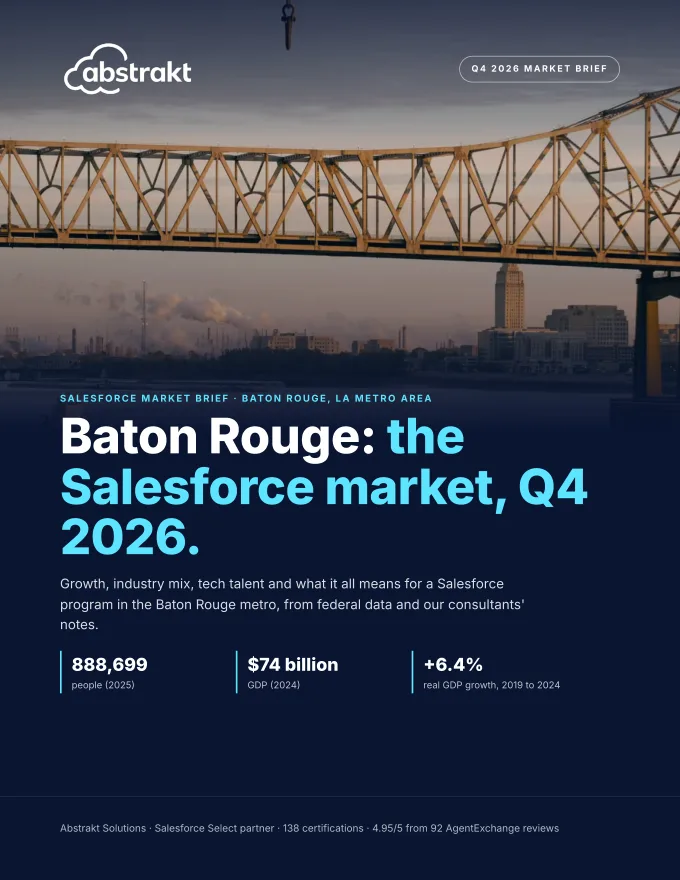
A free 21-page PDF with Baton Rouge's growth ranked against 100 metros, its industry mix, tech wages and nearby markets. It is offered on the public Baton Rouge page; send your customer there or get a copy for your own prep.
Get the Baton Rouge brief →Co-sell with Abstrakt in Baton Rouge
Working a Baton Rouge account? Bring in a named consultant for discovery, scoping or a health check. We reply within 4 business hours.