

How Salesforce work starts in Houston
Abstrakt Solutions brings Salesforce Consulting Partner experience to Houston refiners, petrochemical suppliers, wholesale distributors and life sciences teams. We implement, integrate, optimize and manage Salesforce for organizations across greater Houston. Houston is one of our focus markets.
What buyers here usually run into
- 1
Service on customer sites
Energy and industrial firms send technicians to customer facilities. Scheduling, parts and work history are often in separate tools, which Field Service can pull together.
- 2
ERP-heavy sales processes
In manufacturing and distribution, pricing and availability live in ERP. Without integration, quotes are slow and reps work around the CRM.
- 3
Healthcare privacy
Health systems and life-sciences firms need Salesforce designs where access, consent and audit are settled before launch.
Budget, team and partner questions
What drives cost
Houston costs are driven by Field Service scope, the number of operational systems to integrate (ERP, dispatch, asset and logistics platforms), and data cleanup such as duplicate part numbers. Mobile and offline requirements for technicians add testing.
Admin or partner
Industrial companies here often have strong IT teams but few Salesforce specialists. A partner typically covers Field Service design, integration and release testing, while internal IT owns infrastructure and identity.
What buyers ask a partner
Ask for Field Service and installed-base references, how the partner monitors integrations in production, and how they test mobile in low-connectivity conditions. Ask who completes the work if the original builder leaves.
The local economy and its biggest industries (4)
| Sector | Share of 2024 GDP | Where Salesforce fits |
|---|---|---|
| Manufacturing Field Service → | 16.7% | Industrial and energy-equipment manufacturers need account plans, service contracts and installed-base history tied to ERP. Field Service is often part of the picture for companies that maintain equipment on customer sites. |
| Wholesale trade Integration → | at least 11.9% | Distributors of industrial supplies, chemicals and food service products depend on order, pricing and inventory data. Salesforce earns its keep here when reps see that data without leaving the CRM. |
| Professional, scientific, and technical services Salesforce for professional services → | at least 8.1% | Engineering, construction-management and technical services firms run long pursuits for large capital projects, which calls for pursuit pipelines and client relationship history across offices. |
| Transportation and warehousing Service Cloud → | 5.4% | Logistics, shipping and pipeline operators need service, scheduling and customer communication at volume, often with case management and portals for customers. |
Source: U.S. Bureau of Economic Analysis, GDP by county (CAGDP2), 2024, summed to the metro area; private sectors only, excluding real estate and government. “At least” marks sectors where BEA suppresses some county figures.
Regional target sectors named by local economic development groups: Energy & Energy Transition, Life Sciences & Biotechnology, Aerospace, Aviation, Advanced Manufacturing, Digital Technology.
Salesforce products that fit Houston (6)
In the order we lead with them here, from the industries above.
Salesforce Sales Cloud
The CRM where sales pipeline lives, when it is built right.
Salesforce Field Service
Scheduling, dispatch, mobile work orders and parts for teams that work on site.
Salesforce Service Cloud
The operating system for modern customer service, case, knowledge, voice, and AI agent assist together.
MuleSoft
Enterprise API platform, for connecting Salesforce, ERP, data warehouses, and the rest of your stack.
Salesforce Experience Cloud
Customer, partner, and employee portals built on Salesforce.
Salesforce Agentforce
AI agents that handle real work inside Sales Cloud, Service Cloud, and Marketing Cloud.
Where AI pulls its weight in Houston's industrial economy
Manufacturing produced 16.7% of Houston's metro GDP in 2024, and wholesale trade at least 11.9%, so the first AI wins here tend to sit in order desks and plant-facing service teams. An agent can read an inbound purchase order or spec sheet, match it to the account, and draft the reply a rep would otherwise have typed. Case summaries let engineers pick up a warranty dispute without rereading the whole thread. None of that works if part numbers live in three systems and nobody has decided which fields the agent may see. We start by mapping permissions and cleaning the product catalog, then keep a person approving every outbound message until the drafts earn trust.
- Purchase order and spec reading
- Warranty case summaries
- Drafted replies for order desks
Services buyers here usually need (7)
Salesforce Implementation in Houston
A Houston Salesforce build has to reflect an industrial customer base. Customers are often large operators with many sites and buying units, products are serviced in the field, and pricing belongs to the ERP. We settle the account hierarchy, the asset model and system-of-record decisions in discovery, then build in a sandbox and roll out in phases: core sales first, then service and field operations, then portals. Our consultants join you in Houston for workshops, go-live and training.
By industry in Houston
- 1
Manufacturing
Manufacturing is the metro's largest private sector, at about 16.7% of 2024 GDP, spanning refining, petrochemicals and energy equipment. Implementations for these companies turn on the installed base: which equipment sits at which customer site, under what service contract, with what history. We design assets, contracts and entitlements before opportunity stages, because the service data model drives renewals, parts sales and field work. Sales Cloud and Field Service then share one view of every customer site.
- 2
Energy & Energy Transition
Energy and the energy transition head the Greater Houston Partnership's target-sector list. Suppliers serving producers and newer clean-energy developers need to track bids by basin or project and relationships that span procurement, engineering and field teams. Implementation design for them centers on how customers are grouped and how agreements are recorded, with pipeline reporting that rolls up by customer and by region. Where transition projects bring new kinds of buyers, we add record types rather than bolting on a separate process.
- 3
Professional, scientific, and technical services
Engineering, construction-management and technical consulting firms here pursue capital projects over long cycles, often with teaming partners. Implementing Salesforce for them means pursuit stages that reflect go/no-go gates, proposal and bid tracking linked to opportunities, and relationship maps across client offices. We also connect wins to resource planning early, so leadership can see whether the backlog being sold can actually be staffed by the engineers and project managers the firm has on hand.
Raise before scoping
Model hierarchies before pipelines
Houston customers are frequently large operators with regional units, joint ventures and separate procurement groups. Agree how parent and child accounts, sites and contacts are structured before designing opportunity stages, since every report, territory and sharing rule depends on that hierarchy being right.
Settle ERP ownership early
Pricing, part numbers and credit terms usually belong to the ERP in Houston's industrial firms. Decide during design which ERP fields Salesforce will read, which it will copy and which it must never change, so quoting and ordering rest on the right foundation from the first phase.
Plan for field connectivity
Technicians and sales engineers work at plants, terminals and remote facilities where connectivity varies. Test mobile layouts and offline behavior with real users during the build, and keep field screens short, so the system works where the work actually happens rather than only in the office.
Salesforce Integration in Houston
Most Houston integration projects connect Salesforce to an ERP that owns pricing, orders and invoices, and often to operational systems for dispatch, logistics or asset maintenance as well. We begin by mapping each system and naming an owner for every shared data set, then choose MuleSoft where many systems and reusable APIs are involved, or lighter direct integration for simpler cases. Connections are tested at production-sized volumes, and every flow has alerts and a runbook so failures are caught and fixed quickly.
By industry in Houston
- 1
Manufacturing
Industrial and energy-equipment makers across the region need Salesforce and the ERP to agree on customers, products, prices and installed equipment. A typical integration syncs the product and price book on a schedule, sends accepted quotes to the ERP as sales orders, returns order and invoice status, and links serial-numbered assets to service records. Field Service work orders then pull parts availability from inventory, so technicians arrive at the site with what the job needs.
- 2
Transportation and warehousing
Shipping, trucking, storage and pipeline companies run operational platforms that Salesforce should never replace. Integration here is selective: customer-facing events such as bookings, delays, damage claims and invoices flow into Salesforce, where service agents and account managers need them, while high-frequency tracking data stays in the source system and is fetched on demand. That balance keeps storage and API usage manageable and gives customers faster answers through Service Cloud or a portal.
- 3
Aerospace
Aerospace is a Greater Houston Partnership target sector, anchored by the region's human spaceflight cluster. Suppliers and service firms in it manage programs with long contract lives, strict configuration control and government-driven documentation. Integrating Salesforce with their ERP, contract management and quality systems means keeping part revisions, contract modifications and program milestones aligned everywhere. We design these integrations with audit trails in mind, so every value that arrives in Salesforce can be traced to its source.
Raise before scoping
Filter operational data upstream
Pipeline, terminal and freight platforms in Houston emit a constant stream of status changes, most of it irrelevant to sales. Decide which events matter to sales and service, filter the rest in middleware, and fetch detail on demand, so Salesforce stays fast and within its storage and API limits.
Match customers across systems
The same operator or distributor can appear under several names and numbers across ERP, billing and field systems. Build a cross-reference of external IDs before the first sync, or integrations will create duplicates faster than anyone can merge them by hand.
Fund monitoring from day one
Integrations fail quietly when a source system renames a field or a certificate expires. Include alerting, error queues and a named owner in the project scope, rather than treating monitoring as a later phase that may never get funded or staffed.
Salesforce Managed Services in Houston
Houston organizations that run Salesforce across sales, service and field operations generate a steady flow of change: new sites, contract types, technician skills, pricing updates from the ERP and reports for every operations meeting. Managed services absorbs that flow. We keep one ranked backlog, handle administration and Flow changes, involve developers for integration fixes, and test every Salesforce release against your field and service processes in a sandbox. Because Field Service and MuleSoft often sit in the same org, our team covers both.
By industry in Houston
- 1
Transportation and warehousing
Transportation and warehousing accounts for about 5.4% of metro GDP, from shipping and trucking to pipeline and storage operators. Their Salesforce orgs carry high case volumes and customer notifications that must keep working through every release. Ongoing support for them focuses on routing rules, service milestones, email-to-case and portal behavior, with changes tested against peak volumes. We also watch integration logs so a stalled feed from an operational system is fixed before agents start fielding complaints about missing updates.
- 2
Life Sciences & Biotechnology
Life sciences and biotechnology is one of the Greater Houston Partnership's target sectors, and companies in it often grow from a small research-stage org into a commercial one. Managed services for them includes careful permission changes, consent and audit settings maintained through each release, and new objects for clinical sites or research partners as programs expand. Every change to access or data capture is documented, which keeps quality and compliance reviews straightforward rather than a scramble for evidence.
- 3
Advanced Manufacturing
Advanced manufacturing is another sector the Greater Houston Partnership is courting. Manufacturers in it keep asking for new product lines, quoting rules, dealer changes and service contract types in Salesforce, and managed services lets them add those without launching a new project each time. We maintain product and price synchronization with the ERP, adjust Field Service work types and skills as equipment changes, and keep dashboards for plant and sales leadership consistent as the business model shifts.
Raise before scoping
Protect field operations during releases
Dispatchers and technicians cannot pause work while a Salesforce release is investigated. Test scheduling, mobile flows and work order automation in a preview sandbox before each release, and keep a rollback plan for any configuration change that touches the field app.
Separate run from change
Houston teams often mix urgent operational tickets with larger enhancements in one list. Keep a fast lane for issues that stop work and a planned roadmap for improvements, so outages are handled immediately without derailing longer projects the business is waiting for.
Keep integration knowledge shared
MuleSoft flows and ERP mappings are often understood by one person. Require runbooks, alert recipients and mapping documents as part of the managed service, so knowledge survives staff changes on either side and your IT team can follow what is happening.
Salesforce Optimization in Houston
In Houston, optimization projects usually target a gap between Salesforce and the ERP. When pricing, availability and order status are missing, reps keep quoting from other tools, and pipeline in Salesforce drifts from reality. We measure usage, interview sales, service and field users, and fix the causes: surface the ERP data people need, remove fields nobody fills in, consolidate old workflow rules into Flows and rebuild dashboards on agreed definitions. The project has a fixed scope and ends with short, role-based training.
By industry in Houston
- 1
Wholesale trade
Wholesale trade contributes at least 11.9% of the metro's GDP, reflecting the region's industrial, chemical and food distributors. For them, optimization means making the account page the place reps check before calling a customer: recent orders, open quotes, credit holds and reorder patterns in one view. We also clean duplicate accounts created by branch-level entry and rebuild territory dashboards, so regional managers stop keeping their own spreadsheets and start running reviews from Salesforce.
- 2
Energy & Energy Transition
Energy suppliers and service companies frequently have orgs shaped by commodity cycles, with fields and processes added in busy years and abandoned in slow ones. Optimization removes that sediment: unused record types, stale bid stages and approval steps nobody follows anymore. We then align opportunity stages with how bids are really won across producers and basins, so forecasts reflect current activity rather than optimistic entries left open since the last upturn.
- 3
Digital Technology
Digital technology is among the Greater Houston Partnership's target sectors, and software and IT services companies here often run lean sales teams that live in Salesforce all day. Small inefficiencies add up: redundant clicks, slow pages overloaded with components, and activity logging that duplicates what email integration already captures. We trim page layouts, speed up record pages, automate follow-up tasks and rebuild renewal and expansion reports so customer success and sales work from the same numbers.
Raise before scoping
Bring ERP data to reps
Many adoption problems in Houston's industrial firms disappear once reps can see order history, pricing and stock in Salesforce. Prioritize that visibility early in an optimization project, even as a simple read-only view, before spending effort on training people to enter more data.
Simplify mobile screens
Field sales engineers and technicians rarely tolerate long mobile forms. Review what the mobile app asks of them, cut fields that can be derived or defaulted, and add quick actions for the few updates that matter, so records get updated between site visits.
Merge overlapping automation
Orgs built across several administrators often trigger multiple automations on the same save. Map every rule on key objects such as accounts, opportunities and work orders, fold them into well-documented Flows and remove the duplicates that slow records down and cause unexpected field changes.
Salesforce Health Checks in Houston
A Houston health check typically looks hardest at three things: who can see sensitive data, how reliable the integrations are, and how much automation has piled up on accounts, assets and work orders. We review access, sharing, integration users, automation, custom code, unused customization and data quality, and interview sales, service and field users. The result is a ranked list of risks and fixes, with effort estimates, that tells you what must be addressed before adding clouds, agents or users.
By industry in Houston
- 1
Life Sciences & Biotechnology
Life sciences companies and the health organizations they work with face scrutiny over protected health information in any system they run. A health check for them verifies which objects and fields might contain such data, whether encryption and field history tracking are enabled where needed, whether consent is captured consistently and whether reports or exports expose more than intended. Findings are ranked by exposure, so privacy and compliance teams know which gaps to close before the next audit or expansion.
- 2
Wholesale trade
Distributors often run orgs where integration users sync pricing, credit and orders with broad permissions, and where years of territory changes have left sharing rules inconsistent. A health check reviews those integration accounts, tests whether reps can see accounts outside their territory, measures duplicate and incomplete customer records, and inventories automation on quotes and orders. For distributors planning AI features, we also assess whether product and pricing data is consistent enough for an agent to use.
- 3
Aviation
Aviation is a Greater Houston Partnership target sector, and suppliers and service providers in it operate under strict documentation and quality expectations. Here the review is mostly about traceability: field history on critical records, audit trails for configuration changes, and whether support cases and quality issues connect reliably to the right parts, customers and aircraft types. We also review custom code and packages installed for past programs, since unused components add risk without adding value.
Raise before scoping
Check integration user privileges
Houston orgs often connect to several ERPs, maintenance and logistics systems, each through its own integration user. Confirm that each account has only the access its job requires, that credentials are current, and that users tied to retired systems have been deactivated.
Assess agent readiness honestly
Agentforce reads and acts on the records it can reach. Before switching it on, measure duplicate rates, missing values and conflicting automation on the objects the agent will touch, and confirm that permissions restrict it to the data and actions intended.
Review mobile and offline setup
Field users working at plants and remote sites depend on mobile configuration that is often overlooked in audits. Include the Field Service mobile setup, offline data priming and page performance in the review, since problems there surface later as missing work data.
Salesforce Migration in Houston
Houston migrations often carry more than contacts and opportunities. Industrial and energy companies need installed equipment, service contracts and work history moved as well, and those records rely on relationships that break easily during a load. We inventory each source system, agree on mappings and which history to keep, deduplicate customers and sites in staging, then run trial loads in the right sequence with reconciliation after each. The final cutover is dated in advance and kept short, so field and sales teams switch over cleanly.
By industry in Houston
- 1
Professional, scientific, and technical services
Professional, scientific and technical services make up at least 8.1% of metro GDP, and many engineering and consulting firms still track pursuits in an aging CRM or a proposal database. Migration for them means combining client relationships held across offices, keeping win and loss history for past bids, and linking proposals to the opportunities they supported. We load active pursuits and recent projects first so business development can work immediately, then bring older history in behind them.
- 2
Energy & Energy Transition
Suppliers to producers and clean-energy developers often hold customer data across a legacy CRM, field ticketing tools and spreadsheets kept by region. The migration challenge is structure: rebuilding customer hierarchies, attaching sites, wells or project locations to the right accounts, and carrying contract terms across. We map each source to one target model, clean overlaps between regions, and verify with sales leaders that account ownership after the move reflects how territories actually work.
- 3
Life Sciences & Biotechnology
Research-stage life sciences companies moving onto Salesforce frequently start from spreadsheets and email lists covering investors, collaborators, clinical sites and vendors. The migration separates those into distinct record types, removes duplicates and captures consent where relationships involve people outside the company. If any record could contain patient information, we identify it before loading and keep it out of Salesforce until the privacy design, agreements and encryption are all in place and reviewed.
Raise before scoping
Load in dependency order
Accounts before sites, sites before assets, assets before contracts and work orders. Houston migrations with equipment history fail most often when records load out of sequence and lose their parents. Script the order, test it repeatedly in a sandbox and reconcile counts at each step.
Preserve legacy identifiers
Store every legacy identifier on the migrated record as an external ID. ERP numbers, old CRM IDs and field ticket references let you reconcile the load, support integrations afterward and answer the inevitable question of where a particular record went after cutover.
Retire the old system deliberately
Set a date to make the legacy tool read-only, a date to archive it and a clear owner for each step. Houston crews used to a familiar field tool will keep using it unless access changes, which splits data between systems all over again.
Salesforce Implementation Rescue in Houston
Rescues in Houston often involve field operations. A Field Service rollout that schedules the wrong crews, a mobile app that fails at remote sites or an ERP integration that never finished can halt daily work quickly. We triage first: fix what blocks dispatch, billing and service, and restore reliable data where it matters. Then we assess the build against the original scope, decide what to keep, fix or rebuild, and finish the remaining work with documentation and training your team can sustain.
By industry in Houston
- 1
Advanced Manufacturing
Manufacturers that launched Salesforce quoting or service without a finished ERP connection usually end up with reps keying orders twice and service teams unsure which contract covers which machine. Rescue starts by stabilizing the most-used processes, sometimes with an interim data feed, then completes the integration properly. We also untangle product catalogs that were loaded inconsistently, since quotes cannot be trusted until products, price books and ERP part numbers agree with each other.
- 2
Energy & Energy Transition
Energy service companies sometimes buy Salesforce for field ticketing, crew dispatch and customer billing, then find the build cannot handle multi-day jobs, rate sheets or customer approval steps. Recovery separates configuration defects from design gaps. We fix the defects that stop tickets from being completed and invoiced, then redesign the pieces that never matched how crews and customers work, testing each one with the field supervisors who will depend on it.
- 3
Transportation and warehousing
Logistics and storage companies whose Service Cloud projects stalled often have case routing that sends work to the wrong team, portals customers ignore and integrations that post incomplete shipment data. We restore basic routing first so customers get answers, then rebuild the data feed with proper error handling and monitoring. The customer portal relaunch comes last, once the information customers see is accurate enough to reduce calls instead of generating them.
Raise before scoping
Protect billing first
In field-heavy Houston businesses, an unfinished Salesforce build often delays invoicing because tickets or work orders never close cleanly. Identify every step between completed work and an issued invoice, and fix those before cosmetic improvements, since cash flow is usually the first thing leadership asks about.
Test with real crews
Field Service defects frequently appear only under real conditions: multi-day jobs, crew swaps, poor connectivity. Recreate those scenarios with supervisors and technicians in a sandbox before declaring anything fixed, rather than relying on test scripts written by the original build team.
Reset expectations with users
Teams burned by a failed launch need to hear what will change and when. Share a short recovery plan, name the people fixing issues, and report visible progress regularly, so field and office staff are willing to give the system a second chance.
Industry plays in Houston (3)
Salesforce for Houston Manufacturers
Houston manufacturers that serve industrial and energy customers often build to specification, whether that means pressure equipment, valves, pumps, process skids or fabricated structures. Their sales cycle runs through bids, engineering reviews and revisions before an order is placed, and the most dependable revenue often comes later from parts and service. Salesforce supports that with bid and opportunity tracking tied to engineering, quoting from ERP costs through Revenue Cloud or CPQ, and an aftermarket view of every installed unit.
At 16.7% of the Houston metro's 2024 GDP, manufacturing outranks every other private sector in Bureau of Economic Analysis county data, and wholesale trade follows at no less than 11.9%. The Greater Houston Partnership names advanced manufacturing among its target industries, along with energy and energy transition and aerospace. With energy and manufacturing both on that list, many producers here sell engineered products into industrial buyers, directly or through distributors, which puts quoting, installed-base tracking and channel sales at the center of a CRM project rather than high-volume transactional selling.
Use cases to open with
- 1
Bids for engineered equipment
Engineered-to-order equipment is sold through bid packages, technical clarifications and revisions. We model each bid as an opportunity with its specifications, drawings and revision history linked, route technical questions to engineering as tracked tasks, and report hit rates by product line, customer and competitor type, so estimators know where to spend their limited time. Lost bids carry a reason code, which over time shows whether price, lead time or specification fit is costing orders.
- 2
Quoting from ERP cost data
Material costs for steel, alloys and components change often. Revenue Cloud or CPQ, fed with ERP item, cost and lead-time data through MuleSoft, lets sales engineers build configured quotes with current pricing and margin checks, send approvals when margins fall below policy, and convert accepted quotes into ERP orders without retyping. Quote templates can include lead times and terms, so customers see the same commitments the plant expects to meet.
- 3
Aftermarket parts and service
Installed equipment needs spare parts, rebuilds and inspections for years. Recording each unit as an asset with its serial number, configuration and service history lets inside sales quote the correct parts quickly, and Field Service can schedule technicians for inspections and repairs, while account managers see service revenue alongside new equipment sales. Service history also shows which designs fail most often, which is useful feedback for engineering.
Raise before scoping
Engineering and document control
Drawings, specifications and certifications belong in engineering and document control systems. Link them to Salesforce opportunities and assets instead of storing copies, so sales and service always see the current revision and nobody quotes against superseded documents. Access to controlled documents should follow the same rules everywhere.
Milestone billing and change orders
Large equipment orders are delivered in milestones with progress billing and change orders. Decide whether Salesforce tracks those milestones or reads them from the ERP or project system, and make sure change orders update the opportunity and forecast so revenue reporting stays accurate.
Distributor and direct overlap
Houston manufacturers often sell some products direct and others through distributors in the same accounts. Define rules for deal registration, territory and commissions before build, so reps and partners are not competing for the same order and reporting reflects each channel accurately.
Salesforce for Houston Professional Services Firms
Houston's engineering and technical services firms rarely sell one project at a time. They win master service agreements with operators, then compete for work orders, studies and projects under them, often against the same rivals. Salesforce should track agreements, rate schedules and expiry dates, run a disciplined bid or no-bid decision on each pursuit, and show whether the firm has the engineers to deliver. We connect it to project accounting and resource planning so pursuit teams see margin and availability before they commit.
By the Bureau of Economic Analysis's 2024 figures, professional, scientific and technical services contributed a minimum of 8.1% of Houston metro GDP, a smaller share than manufacturing at 16.7% or wholesale trade at a minimum of 11.9%, but closely tied to both. Of the six industries the regional partnership recruits for, energy and its transition comes first, with advanced manufacturing and digital technology also on the list. Engineering, environmental, inspection and consulting firms here largely serve those operators and plants, so their pipeline follows capital programs, turnarounds and regulatory cycles at client sites rather than a marketing funnel.
Use cases to open with
- 1
Master agreements and work orders
An operator's master service agreement can generate dozens of work orders over its term. Salesforce can hold each agreement with its rate schedule, approved scopes, insurance requirements and expiry date, then link every work order and proposal to it. Account managers see total value under each agreement, spot clients whose call-offs are slowing, and start renewal discussions well before an agreement lapses or goes back out to tender.
- 2
Bid or no-bid discipline
Proposals for large studies and projects are expensive, and firms often bid everything. A structured pursuit record captures client relationship strength, competitors, technical fit, available staff and expected margin, and requires a documented decision at a set gate. Over time, win rates by client, service line and proposal size show where effort pays off, and leaders can decline the bids the firm is unlikely to win.
- 3
Engineer availability for pursuits
Winning work the firm cannot staff damages client relationships. We connect Salesforce to the resource planning or PSA system so pursuit teams see which disciplines and named leads are available in the proposed window. Weighted pipeline rolls up into demand by discipline, and resource managers get early warning when a cluster of pending awards would overload process, electrical or environmental teams at the same time.
Raise before scoping
Client prequalification records
Operators often require contractor prequalification, safety statistics and insurance certificates before awarding work. Track those requirements and expiration dates on the account, assign owners for renewals, and make sure pursuit teams can see whether the firm is eligible before they invest in a proposal.
Project accounting stays authoritative
Time, costs, billing and project margins belong to project accounting. Salesforce should receive summary figures, such as backlog, billed to date and margin by work order, on an agreed schedule. That keeps one version of project financials while giving account managers the context they need for client conversations.
Volatile demand planning
Client spending moves with commodity prices and capital budgets. Design pipeline reports that separate committed agreement work from speculative pursuits, and review forecast assumptions frequently. Leadership can then adjust hiring or subcontracting plans quickly when a major client pauses or accelerates a program.
Salesforce for Houston Health and Life Sciences
Houston's life sciences organizations frequently start inside research institutions and incubators, then need systems that did not exist on day one: trial site relationships, investigator and sponsor contacts, early commercial teams and patient programs. Salesforce can grow with them, beginning with partnership and site management and adding commercial and patient-facing capabilities as products advance. Providers use it for referral growth and patient access. In every case we design for HIPAA, keep clinical data in the systems that own it, and plan consent before launch.
Manufacturing, at 16.7%, heads Houston's 2024 sector breakdown from the Bureau of Economic Analysis; health care falls outside the top five private sectors listed, so this page gives it no share of its own. It shows up instead through the Greater Houston Partnership, which names life sciences and biotechnology as a target industry, and through the region's medical center complex, described as the largest in the world, where innovation programs for startups are housed. That pairing of major clinical institutions and young companies spun out around them is the setting for most Salesforce work in this sector locally.
Use cases to open with
- 1
Clinical trial site relationships
Emerging biotech and medtech companies depend on investigators and trial sites. Salesforce can track each site's capabilities, contacts, feasibility responses, contracting status and enrollment against targets, with tasks for monitors and clinical operations staff. Leaders see which sites are enrolling, which are stalled, and which relationships to invest in for the next study, instead of piecing it together from spreadsheets and email.
- 2
Research and licensing partnerships
Companies born in academic settings manage sponsored research agreements, licenses and collaborations alongside investors. A partnership record can hold agreements, milestones, obligations and key contacts at each institution, with reminders before reporting deadlines or option dates. Business development teams gain a single view of every collaboration, and management can report partnership status to the board without assembling it manually each quarter.
- 3
Referral intake for specialty care
Referrals to specialty programs still arrive through a mix of faxed orders, phone calls and web forms. Service Cloud with Health Cloud can capture every referral, check completeness, route it to scheduling and track it through to the first appointment. Referring physicians receive status updates, and program leaders see referral volume, conversion and time to appointment by source, which guides physician outreach priorities.
Raise before scoping
HIPAA and research data
Patient information is subject to HIPAA, and research participant data may be governed by consent terms and institutional review board requirements as well. Model consent explicitly, limit access to the minimum needed, and ask your privacy and research compliance teams to confirm the rules for each data set.
Design for growth stages
A startup's first Salesforce org should not need rebuilding when the company commercializes. Choose a data model that can accommodate trial sites, providers, patients and payers later, even if early users only need partnership tracking, and document design decisions for the team that inherits them.
Institutional system boundaries
Organizations that grew from larger institutions may still rely on shared services, identity systems and data agreements. Clarify which systems the company controls, how user access is managed, and which data can move into Salesforce before integration work begins, and record the answers in writing.
Case studies to send (3)
From the industries this market leans on. Client names are anonymized and these projects are not specific to Houston.
The Houston Salesforce market brief, Q4 2026
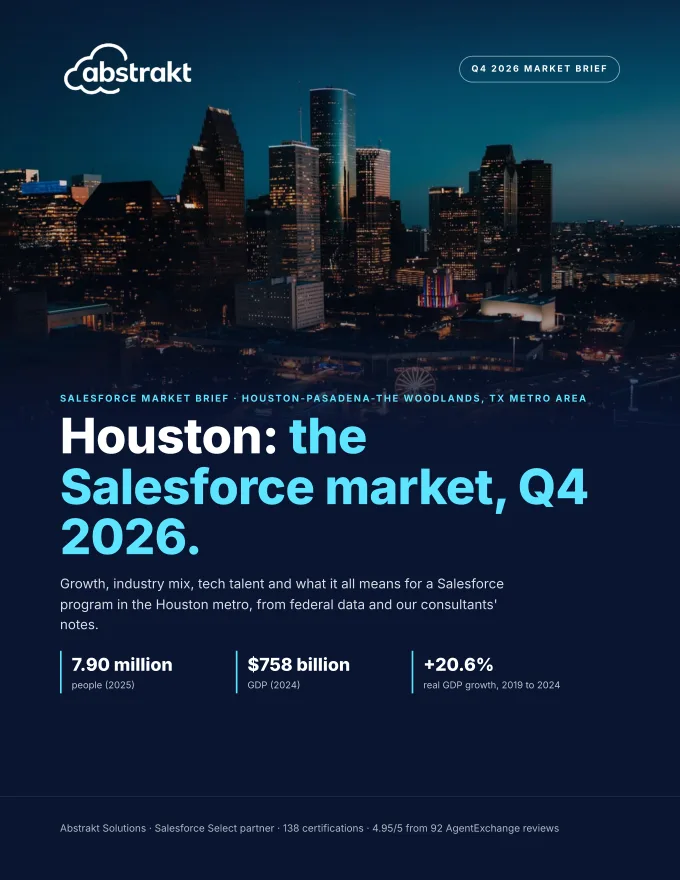
A free 22-page PDF with Houston's growth ranked against 100 metros, its industry mix, tech wages and nearby markets. It is offered on the public Houston page; send your customer there or get a copy for your own prep.
Get the Houston brief →Co-sell with Abstrakt in Houston
Working a Houston account? Bring in a named consultant for discovery, scoping or a health check. We reply within 4 business hours.