

How Salesforce work starts in San Diego
San Diego County's life sciences, defense, software and manufacturing companies bring in Abstrakt Solutions to design, fix and manage Salesforce. San Diego is one of our focus markets.
What buyers here usually run into
- 1
Commercializing science
Biotech and device companies moving from research to revenue need commercial processes built before launch, not bolted on after.
- 2
Regulated service
Medical-device companies must capture complaints and service events in ways that support their quality systems and audits.
- 3
Government and defense customers
Contractors selling to government manage pursuits, teaming partners and contract vehicles that a standard pipeline does not model well.
Budget, team and partner questions
What drives cost
In San Diego the main cost drivers are regulatory boundaries and data classification. Device and diagnostics companies need complaint handoffs, audit trails and field-level security, and defense-related firms need access design and sometimes Government Cloud evaluation. Startups commercializing research cost the least when the first build stays small.
Admin or partner
Life sciences companies moving toward launch often have no Salesforce staff and start with a partner. Larger device and technology firms usually keep internal admins and bring in a partner for architecture, integration and regulated service design.
What buyers ask a partner
Ask for medical device or diagnostics references, how the partner documents complaint handoffs for audits, and how they have handled controlled data for defense customers. Ask what they would deliberately leave out of the first phase.
The local economy and its biggest industries (4)
| Sector | Share of 2024 GDP | Where Salesforce fits |
|---|---|---|
| Professional, scientific, and technical services Salesforce for professional services → | 12.3% | Research organizations, defense contractors and engineering firms run long, technical pursuits and need account planning, capture management and client history in one place. |
| Manufacturing Salesforce for health & life sciences → | 9.0% | Medical-device and diagnostics manufacturers need commercial teams, distributor relationships, complaint handling and field service that support regulated quality processes. |
| Health care and social assistance Experience Cloud → | 6.9% | Health systems and patient-facing device companies use Salesforce for patient engagement, onboarding and support, with privacy designed in. |
| Information Revenue Cloud / CPQ → | 4.8% | Wireless, satellite and software companies manage enterprise and government accounts, partners and renewals across long contract cycles. |
Source: U.S. Bureau of Economic Analysis, GDP by county (CAGDP2), 2024, summed to the metro area; private sectors only, excluding real estate and government. “At least” marks sectors where BEA suppresses some county figures.
Regional target sectors named by local economic development groups: Life Sciences, Defense, Tech / Software, Cybersecurity, Aerospace & Manufacturing, Cleantech / Tourism.
Salesforce products that fit San Diego (6)
In the order we lead with them here, from the industries above.
Salesforce Service Cloud
The operating system for modern customer service, case, knowledge, voice, and AI agent assist together.
Salesforce Sales Cloud
The CRM where sales pipeline lives, when it is built right.
Salesforce Experience Cloud
Customer, partner, and employee portals built on Salesforce.
Salesforce Field Service
Scheduling, dispatch, mobile work orders and parts for teams that work on site.
Salesforce Agentforce
AI agents that handle real work inside Sales Cloud, Service Cloud, and Marketing Cloud.
MuleSoft
Enterprise API platform, for connecting Salesforce, ERP, data warehouses, and the rest of your stack.
AI that fits San Diego research and manufacturing work
Professional, scientific and technical services made up 12.3% of San Diego metro GDP in 2024, the region's biggest private sector. Research and engineering firms generate dense documents, so an agent that reads proposals, protocols or contract terms and pulls out key dates and obligations cuts a lot of manual reading. Manufacturing, at 9.0%, fits a different pattern: forecasting support in Sales Cloud, where AI flags deals that look stalled while reps keep ownership of the call. Health care providers, at 6.9%, face the strictest constraints, and patient-facing uses need privacy review, narrow data access and clinician sign-off. Pilots succeed when the underlying records are complete and a named person reviews outputs.
- Extracting obligations from research contracts
- Flagging stalled manufacturing pipeline deals
- Staff-reviewed patient inquiry drafts
Services buyers here usually need (7)
Salesforce Implementation in San Diego
Salesforce implementations in San Diego tend to be shaped by research-heavy selling and sensitive data. Life sciences, device, defense and engineering companies sell to specialists over long cycles, and many handle information that must stay out of a CRM entirely. We start with discovery workshops that define what Salesforce will hold and what it will only reference, design accounts, contacts and opportunities around real buying committees, build in a sandbox, and phase go-lives so each team gets a working release.
By industry in San Diego
- 1
Professional, scientific, and technical services
Professional, scientific and technical services is the metro's largest private sector, about 12.3% of 2024 GDP, covering research contractors, engineering firms, testing labs and consultancies. Their implementations hinge on modeling pursuits and engagements: proposals with several contributors, work that spans many projects for one client, and staffing questions. We decide early whether a project or engagement object is needed alongside opportunities, since that choice shapes every report principals will later ask for.
- 2
Life Sciences
The San Diego Regional EDC names life sciences as a leading sector, citing strengths in genomics, medical devices and RNA therapeutics. Companies moving from research toward commercial sales need a data model for institutions, labs and individual scientists, with distinct records for evaluations, instrument placements and service contracts. We assess whether Health Cloud fits or whether Sales Cloud and Service Cloud are enough, and design field-level security for any data that touches patients.
- 3
Defense
Defense is one of the EDC's target sectors, and many contractors and subcontractors here sell to government buyers while teaming with larger primes. The design work covers how pursuits move from early market research to award, how teaming relationships are recorded, and which program information must never enter Salesforce. Getting access boundaries into the first release matters, because retrofitting need-to-know visibility after users have loaded many records is slow and risky.
Raise before scoping
Classify data before design
San Diego firms often hold regulated, export-controlled or clinical information alongside ordinary commercial data. Classify what may and may not live in Salesforce during discovery, and design objects, fields and integrations around that list, instead of discovering restrictions during user acceptance testing.
Model buying committees properly
Selling to research institutions, hospitals and government programs involves scientists, procurement, finance and end users. Use contact roles and account relationships from the start, so reps can see who influences each decision and forecasts are not built on one friendly contact.
Keep one team from kickoff to stabilization
Discovery workshops, build reviews, go-live and training are led by the same consultants from kickoff through stabilization, so the people carrying out each decision understand why it was made.
Salesforce Integration in San Diego
Integration projects in San Diego often have two goals that pull against each other: give commercial and service teams complete customer context, and keep regulated, clinical or controlled data in the systems built for it. We map which system owns each record, decide what Salesforce should store, display or merely link to, choose MuleSoft or lighter tools to fit, and build connections with logging, alerts and retry handling so failures are caught before they affect customers or audits.
By industry in San Diego
- 1
Manufacturing
Device, electronics and aerospace manufacturers here typically connect Salesforce to an ERP for orders, pricing and inventory, and to a quality management system for complaints. The integration design decides when a service case becomes a quality record, which fields pass across, and how the two systems stay linked for traceability. We document each handoff so quality teams can explain the process confidently during inspections and supplier audits, without reconstructing it from emails.
- 2
Health care and social assistance
At about 6.9% of 2024 metro GDP, health care and social assistance includes providers and device companies with patient programs that often need Salesforce to exchange data with electronic health records, scheduling or eligibility systems. We favor patterns that pass only the minimum necessary information, use standard interfaces where the source system supports them, and log every access, so outreach and support work without expanding the footprint of protected health information.
- 3
Aerospace & Manufacturing
The EDC groups aerospace with manufacturing among its target sectors. Aerospace suppliers usually keep engineering, configuration and production data in PLM and ERP systems that should not be copied into a CRM. Integration for them brings in the commercial slice, such as order status, ship dates and part availability, while linking to engineering records rather than duplicating them. Account managers get answers without anyone widening access to technical data or creating a second copy to maintain.
Raise before scoping
Decide store, show or link
For each data type, decide whether Salesforce stores it, displays it from another system, or only links to it. San Diego companies with controlled or clinical data benefit most from this discipline, because it limits what must be secured and validated inside the CRM.
Include quality and IT early
Integrations that touch complaints, service events or patient data affect quality and security processes. Bring those owners into design reviews, agree the evidence they need, and avoid rework when they examine the integration shortly before go-live and ask for changes that ripple through the design.
Respect API and storage limits
Instrument usage, device readings or lab results can exceed Salesforce API allowances and storage quickly. Keep raw readings in a warehouse or data platform, and pass Salesforce only the exceptions and summaries that trigger work for a person on your team.
Salesforce Health Checks in San Diego
San Diego companies usually request a health check at a turning point: before a commercial launch, ahead of a security questionnaire from a large customer, after an acquisition, or before trying Agentforce. We review access and permissions, data protection settings, data quality, automation and custom code, integrations, reports and adoption. The output is a ranked list of risks and fixes with effort estimates, written so executives, quality teams and admins can each act on the parts that concern them.
By industry in San Diego
- 1
Cybersecurity
Security companies in the region, part of a sector the EDC targets, face scrutiny of their own tools from customers who ask for evidence. A health check for them concentrates on identity and access: single sign-on and multi-factor settings, permission set sprawl, API-only users, connected apps, session settings and data export controls. We compare findings with Salesforce's security baseline and show which fixes close the largest gaps first and which can wait for routine maintenance.
- 2
Defense
For defense contractors, the key question is whether Salesforce holds anything it should not. We search attachments, notes and free-text fields for program or technical detail, review who can open pursuit records, and confirm that integrations honor the same limits. The result helps security officers decide whether cleanup, tighter sharing or a move to a government-grade Salesforce environment is warranted, and gives them documentation to support that decision with leadership and customers.
- 3
Tech / Software
Software companies in San Diego often reach a point where their Salesforce org holds more automation than anyone can explain. The review maps flows, triggers and managed packages on key objects, identifies logic that runs twice or conflicts, and flags custom code without test coverage that could block deployments. That gives engineering and revenue operations a shared list of technical debt to retire before adding new products or pricing models.
Raise before scoping
Scope it around a decision
A health check is most useful when tied to a coming decision, such as an AI pilot, a new cloud, a partner change or an audit. Say what that decision is, so the review weighs findings by their effect on it rather than listing every imperfection in the org.
Look inside text fields
Researchers and engineers paste details into notes and descriptions. Include a scan of free-text fields and attachments for clinical, export-controlled or personal data, because permissions only protect data that sits where you expect it to be, not in a pasted paragraph.
Assess Agentforce readiness
Before an AI agent answers customers or staff, confirm knowledge articles are current, case data is consistent and the agent's user has only the access it needs. The health check should state which of these conditions your org already meets and which it does not.
Salesforce Managed Services in San Diego
For San Diego companies, managed services usually means keeping a growing org orderly as products, regulations and teams change. We handle user administration, a prioritized enhancement backlog, Flow and development work, integration monitoring and review of each Salesforce release in a sandbox. Access reviews and change documentation get extra attention, because many firms here answer to quality, export-control or customer security requirements. You work with a named lead and draw on admins, developers and architects as tasks require.
By industry in San Diego
- 1
Tech / Software
Tech and software is one of the San Diego Regional EDC's target sectors, and the EDC describes the region as the second most patent-intense in the country. Software and hardware companies change pricing, packaging and territories often, and each change lands as a Salesforce request. Managed services keeps those changes flowing through a ranked backlog, with release testing so a product launch or territory shift does not break quoting or lead routing.
- 2
Manufacturing
Manufacturing contributes about 9.0% of the metro's 2024 GDP, and the EDC pairs aerospace with manufacturing among its target sectors. Manufacturers' Salesforce orgs need a steady flow of small changes: new products, distributor onboarding, updated service entitlements. A managed services team handles these as routine requests, keeps a change log that quality and IT teams can review, and retests connected processes, such as complaint intake or service case routing, whenever something changes.
- 3
Health care and social assistance
Health care providers, clinics and device companies running patient programs cannot let Salesforce changes drift out of control. Managed services for them includes scheduled reviews of who can see patient data, prompt deactivation of departed staff, testing of encryption and sharing after each release, and careful handling of any request that adds a field holding health information, with a documented approval from privacy or compliance before anyone builds it in production.
Raise before scoping
Keep a reviewable change log
Quality, security and compliance teams at San Diego firms may need to see what changed and why. Agree a change log format with your managed services provider, including approver and date, so evidence is ready when an auditor or a large customer asks for it.
Separate urgent from important
Research-driven companies generate a steady stream of good ideas. Put a business owner in charge of ranking them, reserve capacity for production issues, and review the list at a fixed cadence so strategic work does not disappear behind small daily requests.
Budget for release testing
Each seasonal Salesforce release can change how flows, screens and APIs behave. Make release review part of the agreement, with sandbox testing of your key processes, rather than an extra you request only after users report something broken or a customer notices a wrong total.
Salesforce Optimization in San Diego
San Diego orgs often grow in bursts: a quick build after a funding round, new fields for a product launch, a service process added when the first customers arrive. Optimization untangles that history. We review usage and data quality, simplify layouts by role, consolidate overlapping flows, fix duplicate accounts and contacts, and rebuild the dashboards leadership and boards rely on. Changes are released in small tested batches, with short training so scientists turned sellers and service engineers adopt them.
By industry in San Diego
- 1
Information
The information sector, about 4.8% of 2024 metro GDP, includes wireless, satellite, software and media companies with enterprise and government customers. Their orgs often carry several generations of renewal and subscription logic. Optimization consolidates renewal automation, cleans up product and asset records so installed-base reports are accurate, and rebuilds pipeline and churn dashboards so sales and finance quote the same numbers in forecast reviews and board updates, without separate spreadsheets.
- 2
Life Sciences
Life sciences companies, part of a cluster the EDC describes as one of the top three in the country, frequently add Salesforce functions one team at a time: sales, then field applications, then service, then medical affairs. The result is duplicate contact records for the same scientist and inconsistent account structures for institutions. We merge those, standardize how labs and departments relate to their parent institutions, and simplify layouts so each role sees only what it needs.
- 3
Cybersecurity
Cybersecurity is on the EDC's target list, and security vendors in the region often sell through resellers, managed service providers and direct teams at once. Their Salesforce orgs accumulate deal registration rules, overlapping partner fields and channel reports nobody reconciles. Optimization simplifies deal registration, clarifies partner attribution, removes automation that assigns the same lead twice, and gives channel managers dashboards they can defend in quarterly partner reviews, backed by attribution rules everyone understands.
Raise before scoping
Start from user observation
Watch reps, field application scientists and service engineers work in the org before changing it. Their workarounds, such as side spreadsheets or notes pasted into description fields, point to the changes that will make the biggest difference to adoption across sales and service.
Retire automation deliberately
Older workflow rules, process builders and flows often overlap in San Diego orgs built by several admins. Map what each one does, move the necessary logic into consolidated flows, and remove the rest with testing, rather than switching items off and waiting for complaints.
Tie dashboards to decisions
Board and investor reporting drives much of the dashboard demand at venture-funded firms here. Ask each dashboard owner what decision it supports, rebuild the few that matter on clean definitions, and archive the rest so leadership stops choosing between conflicting numbers.
Salesforce Migration in San Diego
Migrations in San Diego are frequently triggered by growth or deals: a startup outgrows its first CRM, a device company approaches commercial launch, or an acquisition brings a second org into the business. We inventory sources, map objects and fields to the target design, clean and deduplicate in a staging area, decide how much history to keep, load in dependency order, and reconcile counts with your team. The cutover plan keeps sales and service working throughout.
By industry in San Diego
- 1
Professional, scientific, and technical services
Engineering firms, contract research organizations and consultancies often start with a practice management tool and spreadsheets of pursuits. Moving them to Salesforce involves separating clients from individual projects, preserving the history of past proposals that informs future bids, and linking contacts across many engagements. We also map old win and loss reasons into consistent values, so the migrated data supports bid and no-bid decisions from the first week, not after a year of new entries.
- 2
Life Sciences
Young life sciences companies moving toward commercial launch often have contacts scattered across conference lists, early access programs and a starter CRM. Migration consolidates those into accounts for institutions and labs, dedupes scientists who appear under different email addresses, and carries consent and communication preferences across correctly. Launching commercial operations on a clean contact base avoids early complaints, wasted outreach and reports that overstate the market you can reach, which matters when investors ask.
- 3
Defense
Defense suppliers that merge or are acquired frequently need to combine pursuit histories, teaming records and contact lists from different systems. The migration has to respect access boundaries: some records may be restricted to specific programs, and some fields should not move at all. We classify data before extraction, carry sharing restrictions into the new org, and verify visibility with program leads immediately after each load, before general users are given access.
Raise before scoping
Fix the design before loading
Migration is the cheapest time to correct an awkward data model. If your old CRM forced labs, departments and parent institutions into flat accounts, restructure them now rather than loading the same problem into Salesforce and paying to fix it later.
Carry consent with each contact
Outreach records gathered at conferences, trials and trade shows come with different consent terms. Migrate opt-in status and original source alongside every contact, so marketing in the new org respects what people agreed to and your team can prove it.
Reconcile with the people who know
Record counts are not enough. Ask account owners and service leads to check samples of their own customers after each trial load, since they will spot mismatched parent accounts or missing history faster than any script, and their sign-off builds confidence before launch.
Salesforce Implementation Rescue in San Diego
Failed Salesforce projects in San Diego often share a pattern: a design copied from a generic template that ignores long research or government sales cycles, security requirements discovered late, or an implementation partner that left mid-build. We begin with triage, reviewing the org, backlog and original scope, and interviewing users and sponsors. Then we recommend what to keep, fix or rebuild, and deliver a phased plan that returns the business to a usable system people trust.
By industry in San Diego
- 1
Life Sciences
Life sciences projects often stall when regulatory concerns surface late. A build that mixed complaint information into ordinary service cases, or stored patient details without proper controls, may be halted by quality or legal teams just before launch. Rescue separates what is safe to keep from what needs redesign, adds the handoffs and controls reviewers expect, and relaunches with those teams involved in every design decision from then on, so the org can pass the internal reviews that stopped it.
- 2
Information
Technology and communications companies sometimes launch Salesforce with subscription logic built quickly in custom code, then find that renewals, upgrades and co-terming produce wrong amounts. We trace the calculation paths, identify which can move to standard configuration or Revenue Cloud, and stabilize the rest with tests. The priority is restoring accurate renewal and pipeline data, because finance stops trusting the CRM fast once the numbers go wrong, and rebuilding that trust takes longer than fixing the code.
- 3
Professional, scientific, and technical services
Engineering and research services firms often abandon a first Salesforce build because it tracked sales but not the projects that follow. Staff kept using spreadsheets for staffing and delivery, and the CRM went stale. Rescue adds a lean project or engagement structure linked to won opportunities, simplifies pursuit stages, and retrains the principals who handle most client contact, so the system becomes useful beyond the sales team and worth the time principals spend in it.
Raise before scoping
Stabilize before extending
Fix the defects blocking daily use, such as failed saves, broken integrations or unusable screens, before adding anything from the original backlog. Early visible fixes rebuild confidence among the users who gave up on the system, and they make later phases easier to staff.
Recheck the security design
Projects at regulated or government-facing San Diego firms sometimes stall because security was never designed properly. Revisit sharing, permission sets and data classification during triage, since fixing them after relaunch is harder and may force another pause just as users begin to return.
Document what already works
Rescue does not mean discarding everything. Previous teams often built sound objects, reports or integrations. Identify and document those early in triage, which lowers recovery cost and shortens the path to an org people will use, while respecting the budget already spent.
Industry plays in San Diego (4)
Salesforce for San Diego Health and Life Sciences
San Diego's life sciences companies mostly sell science to institutions: instruments and assays to labs, devices to hospitals, therapies through physicians and payers. Salesforce here has to track accounts with many stakeholders, long evaluation cycles, installed equipment and service contracts, and interactions that regulators may later ask about. We configure Sales Cloud and Service Cloud around those realities, connect them to ERP and quality systems, and keep clinical and promotional data separated so commercial teams move quickly without creating compliance exposure.
The San Diego Regional EDC lists life sciences first among its target sectors, and cites a 2025 commercial real estate industry ranking that places the region among the top 3 U.S. clusters for the field; the EDC counts about 59,980 life sciences jobs here, concentrated in genomics, device development and RNA-based therapies. Health care and social assistance adds 6.9% of metro GDP for 2024 in Bureau of Economic Analysis figures, while professional, scientific and technical services, the category that includes much contract research, leads the private economy at 12.3%. Two research universities anchor the region, so academic collaboration shapes how many companies start.
Use cases to open with
- 1
Selling instruments and assays
Genomics and diagnostics companies sell to lab directors, core facilities and procurement at the same institution, often with a grant cycle behind the purchase. Sales Cloud with account hierarchies and buying-group roles tracks every stakeholder, and CPQ handles instrument, consumable and service bundles. Reps can see which labs run which platforms, making reagent reorders and upgrade conversations far easier to plan.
- 2
Device service and complaints
Medical device makers need to know where every unit sits, who services it and what customers report. Service Cloud with asset records and Field Service scheduling keeps maintenance history in one place, while case processes capture potential complaints in a structured way and hand them to the quality system, so nothing reported to a service agent is lost. Recurring issues by product or site also become visible to engineering sooner.
- 3
Clinician and partner portals
Therapeutics and device companies exchange documents, training and requests with clinical sites, distributors and research collaborators. An Experience Cloud portal gives each partner a secure login to see their materials, submit questions and track status. Agentforce can answer routine product and order questions inside the portal, passing anything medical or regulatory to the right internal team with context attached. Partners stop emailing attachments back and forth.
Raise before scoping
Separate medical and commercial
Medical affairs, clinical and sales teams often share accounts but must not share every interaction. Plan record types, sharing rules and field-level security so each function sees what it should, and document the design so it holds up when compliance or auditors review it.
Validate where regulations require
If Salesforce feeds complaint handling or other regulated quality processes, parts of the org may need computer system validation. Identify those processes during discovery, keep them narrow, and plan documented testing so the rest of the CRM can change without triggering full revalidation.
Plan for rapid growth
Many companies here move from research to commercial launch quickly. Build a data model that can add products, territories and distributors without restructuring, and avoid hard-coded logic tied to one product, because the second and third launches arrive sooner than planned.
Salesforce for San Diego Professional Services Firms
San Diego professional services firms often sell expertise to technical buyers: engineering support to defense and aerospace programs, contract research to biotech, security and software services to technology companies. Salesforce helps them manage pursuits that run through proposals and contract vehicles, forecast billable work against staff capacity, and keep client relationships visible beyond the partner or principal who owns them. We configure it around how your firm wins and delivers work, then connect it to project accounting so pipeline and delivery tell the same story.
Engineers, scientists, lawyers and consultants carry a big share of San Diego's economy; their sector produced 12.3% of 2024 metro GDP in Bureau of Economic Analysis county estimates, above manufacturing's 9.0%. The San Diego Regional EDC's target list, covering life sciences, defense, tech and software, cybersecurity, and aerospace and manufacturing, describes the clients many of those firms serve. The EDC also calls San Diego the second most patent-intense region in the U.S., which points to a large base of engineering, legal, scientific and advisory work built around research and product development rather than consumer services.
Use cases to open with
- 1
Pursuit and proposal tracking
Firms supporting defense and aerospace programs pursue work through solicitations, teaming agreements and task orders. Sales Cloud can track each pursuit from capture through proposal submission and award, record teaming partners and contract vehicles, and forecast by probability and period of performance, so leadership sees a realistic backlog instead of a list of hopeful bids. Capture managers can also log lessons learned on losses.
- 2
Forecasting against staff capacity
Selling work the firm cannot staff creates delivery problems. Connecting opportunities to role-based resource estimates and a project or professional services automation tool lets managers compare expected demand with available engineers, scientists or consultants by month, and plan hiring or subcontracting before a large award lands rather than after it starts. It also shows which skills, such as cleared engineers or regulatory specialists, limit growth most.
- 3
Client development by practice
Firms with several practices, such as engineering, regulatory and security services, often serve the same client without knowing it. A shared account view, with Marketing Cloud nurturing tied to practice interests, lets partners spot cross-selling opportunities and send relevant technical content, such as briefings on new regulations or research, to the right client contacts. Account reviews then include every practice's work.
Raise before scoping
Protect controlled information
Work for defense and aerospace customers can involve CUI and ITAR-governed technical data. Keep that material in approved systems, restrict what enters Salesforce to business-level details, and review access and hosting requirements with your security team before migrating any government program records.
Connect to project accounting
Pipeline is only half of the forecast. Decide how won opportunities create projects in the accounting or PSA system, which fields carry over, and how actual hours and revenue return to Salesforce, so utilization, margin and backlog reports reconcile with finance every month.
Win over senior practitioners
The principal investigators and senior engineers who win the work rarely volunteer to type notes into a CRM. Keep required fields few, capture meetings from email and calendar automatically, and give them useful views, such as account briefs before client meetings, so the system pays them back.
Salesforce for San Diego Manufacturers
San Diego manufacturers often serve two demanding worlds: regulated health care buyers and government or defense programs. Salesforce has to handle both without mixing them. For device makers that means complaint intake and service records that feed the quality system. For defense and aerospace suppliers it means pursuits, teaming partners and contract vehicles modeled properly, with access limited to the people cleared to see them. We design those boundaries first, then build pipeline, quoting and service around them.
Manufacturing is the metro's second-largest private sector, producing 9.0% of San Diego-Chula Vista-Carlsbad GDP in 2024 according to the Bureau of Economic Analysis, behind professional, scientific and technical services at 12.3%. The San Diego Regional EDC lists aerospace and manufacturing, defense and life sciences among its target sectors, and describes the region as a top life sciences cluster with strengths in genomics and medical devices. The EDC also calls San Diego the second most patent-intense region in the country. Put together, local manufacturing leans toward engineered, regulated and often low-volume products rather than commodity output.
Use cases to open with
- 1
Government pursuits and teaming
Defense and aerospace suppliers bid as primes or subcontractors, often on the same program with different partners. Salesforce can model opportunities with contract vehicle, customer agency, role, teaming partners and key dates, then track capture activities, gate reviews and bid or no-bid decisions. Leadership sees a pipeline weighted by probability and funding stage, and program managers inherit the full pursuit history when a contract is awarded.
- 2
Complaint intake for devices
When a clinician or distributor reports a device problem, the first record matters. Service Cloud can capture product, lot or serial number, event details and patient involvement in structured fields, then pass potentially reportable events to the quality management system, where trained staff investigate and decide next steps. Agents follow guided scripts, and every case keeps an audit trail that supports inspections rather than complicating them.
- 3
Configured quotes for engineered products
Build-to-print and configured assemblies carry options, tooling, qualification costs and long lead times. Revenue Cloud or CPQ can enforce valid configurations, pull cost data from the ERP and route non-standard pricing to engineering and finance for approval. Quote versions stay attached to the opportunity, so the team can see exactly what was offered when a customer comes back months later.
Raise before scoping
Separate controlled technical data
Export-controlled drawings and specifications generally should not live in Salesforce at all. Keep technical data in systems approved for it, store only references in the CRM, and design sharing so that users see only the programs they work on. Your compliance team decides the rules; we implement and test them.
Respect the quality system
For device makers, the quality management system remains the record for investigations and corrective actions. Define exactly which complaint fields Salesforce captures, how records transfer, who confirms receipt and how status flows back, so neither system becomes a partial copy of the other.
Low volume, high value
Many local manufacturers ship a small number of expensive units each year, sometimes against a single contract. Forecasting by program, milestone or unit is more useful than rolling up hundreds of small opportunities, so choose pipeline stages and forecast categories that fit how revenue actually lands.
Salesforce for San Diego Insurers and Agencies
In San Diego, insurance work is shaped by who the clients are. Agencies and carriers writing commercial business here serve research labs, device makers, defense contractors, software firms and hospitality operators, each with distinct coverage questions. Salesforce helps when it organizes accounts by industry, tracks submissions and quotes across carriers, and schedules renewal work early enough to remarket. Service teams then handle certificates, endorsements and claims questions from the same record, while personal lines and benefits can run in the same org.
Finance and insurance is not among the five largest private sectors in the Bureau of Economic Analysis's 2024 figures for the San Diego-Chula Vista-Carlsbad metro, and the San Diego Regional EDC does not name it as a target, so insurance shows up here mainly as a service to the rest of the economy. Those clients are distinctive: professional, scientific and technical services lead at 12.3% of GDP, manufacturing follows at 9.0%, and the EDC targets life sciences, defense, cybersecurity, and tech and software. For agencies and carriers, that means specialized commercial risks, including clinical research, product liability and cyber exposure.
Use cases to open with
- 1
Industry practice groups
Agencies that specialize by client industry need their CRM to reflect it. Salesforce can tag accounts by practice, such as life sciences, technology or hospitality, and give each group its own pipeline, renewal calendar and prospect lists. Producers see which markets they are winning in, and leadership can compare growth, retention and cross-sell across practices without exporting data from the agency management system.
- 2
Submission and market tracking
A commercial renewal may go to several carriers with different appetites. Financial Services Cloud can track each submission, quote, declination and binding decision by market, attach supporting documents such as loss runs and applications, and remind account managers of expiring quotes. Over time the agency learns which carriers respond fastest for which classes, which shortens the next remarketing effort and improves conversations with clients.
- 3
Certificate and endorsement requests
Contractors, event operators and tenants need certificates of insurance quickly and often. An Experience Cloud portal lets commercial clients request certificates and endorsements, track status and download documents, while cases route to the right service team. An Agentforce agent can answer routine coverage questions from policy data, and licensed staff keep control of anything that changes coverage or requires underwriting judgment.
Raise before scoping
Agency system remains primary
Your AMS keeps its role as the book of record for coverage, premium and producer pay. Decide which policy data Salesforce displays, how often it refreshes and how accounts match across systems, because duplicate clients between the two platforms are the most common source of distrust in reports.
Protect sensitive client information
Commercial files can include financial statements, payroll and claims histories, and benefits work involves personal health data. Restrict access by role and line of business, encrypt sensitive fields where appropriate, and confirm your obligations under state privacy law with counsel before migrating anything.
Keep producer adoption simple
Producers resist tools that feel like reporting for management. Capture email and calendar activity automatically, show renewals and open quotes on one home screen, and limit required fields so producers see value in their own book before being asked to maintain it.
Case studies to send (3)
From the industries this market leans on. Client names are anonymized and these projects are not specific to San Diego.
The San Diego Salesforce market brief, Q4 2026
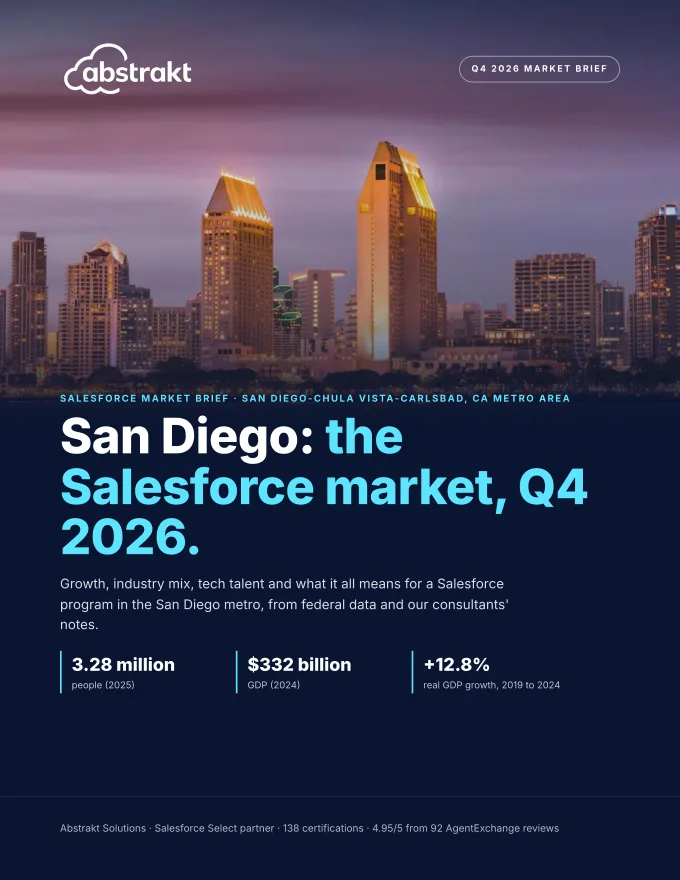
A free 23-page PDF with San Diego's growth ranked against 100 metros, its industry mix, tech wages and nearby markets. It is offered on the public San Diego page; send your customer there or get a copy for your own prep.
Get the San Diego brief →Co-sell with Abstrakt in San Diego
Working a San Diego account? Bring in a named consultant for discovery, scoping or a health check. We reply within 4 business hours.