

How Salesforce work starts in Los Angeles
Entertainment, health care, aerospace, professional services and trade companies across greater Los Angeles and Orange County make up the core of our Salesforce consulting work in the region. Los Angeles is one of our focus markets.
What buyers here usually run into
- 1
Deal and relationship tracking
Entertainment and media companies run deals that do not fit a standard sales pipeline: talent, rights, partners and advertisers all need their own structure.
- 2
Audience and customer data
Consumer-facing brands and media companies hold customer data across many platforms. Unifying it is the precondition for personalization and AI.
- 3
Event and project work
Production and events businesses coordinate bookings, contractors and travel, often across half a dozen tools.
Budget, team and partner questions
What drives cost
In Los Angeles the largest swings come from unifying customer data across ticketing, commerce and streaming platforms, custom objects for deals that do not fit a standard pipeline, and export-control or privacy review for aerospace and health organizations. Consent handling under California privacy law adds design and testing.
Admin or partner
Media and consumer companies here often have marketing technologists but few Salesforce architects, while aerospace suppliers rely on IT staff stretched across ERP and quality systems. A partner typically covers data model design and integration, with one internal owner setting priorities.
What buyers ask a partner
Ask for examples of custom deal or rights models, Data 360 work that carries consent, and how the partner handles controlled technical data for defense suppliers. Ask who maintains the integrations after go-live.
The local economy and its biggest industries (4)
| Sector | Share of 2024 GDP | Where Salesforce fits |
|---|---|---|
| Information Data 360 → | 10.6% | Studios, streaming services, music and media companies manage talent, partner and advertiser relationships, licensing and subscription audiences. Salesforce helps when those relationships and deals are tracked in one place. |
| Professional, scientific, and technical services Salesforce for professional services → | 9.0% | Agencies, consultancies, law firms and engineering firms need pipeline, client history and delivery tracking across offices. |
| Manufacturing Salesforce for manufacturing → | 8.8% | Aerospace, apparel and consumer-products manufacturers need key-account management, distributor channels and service tied to ERP. |
| Health care and social assistance Salesforce for health & life sciences → | 7.2% | Health systems and medical groups use Salesforce for patient engagement, referrals and contact-center service, with privacy designed in. |
Source: U.S. Bureau of Economic Analysis, GDP by county (CAGDP2), 2024, summed to the metro area; private sectors only, excluding real estate and government. “At least” marks sectors where BEA suppresses some county figures.
Regional target sectors named by local economic development groups: Aerospace, Defense & Space Commercialization, Biosciences, Entertainment, Healthcare, Sports, Trade and Logistics.
Salesforce products that fit Los Angeles (6)
In the order we lead with them here, from the industries above.
Salesforce Sales Cloud
The CRM where sales pipeline lives, when it is built right.
Salesforce Data 360 (Data Cloud)
Unify customer data into a real-time profile that powers segmentation, analytics, and AI.
Salesforce Marketing Cloud
Cross-channel marketing, email, mobile, journey, and Data 360-powered personalization at scale.
Salesforce Service Cloud
The operating system for modern customer service, case, knowledge, voice, and AI agent assist together.
Salesforce Experience Cloud
Customer, partner, and employee portals built on Salesforce.
Salesforce Agentforce
AI agents that handle real work inside Sales Cloud, Service Cloud, and Marketing Cloud.
Where AI pulls its weight for Los Angeles firms
Information businesses produced 10.6% of Los Angeles metro GDP in 2024, professional services 9.0% and manufacturing 8.8%, according to BEA county data. Each of those sectors has a different AI entry point. Media and content companies field heavy volumes of licensing, subscriber and partner inquiries, so Agentforce drafting replies from approved knowledge is a sensible first step. Agencies and consultancies tend to gain most from summaries that condense long client threads before a status call. Manufacturers can point an agent at spec sheets and warranty terms so reps answer distributor questions faster. None of this works on messy records. Tight sharing rules, current articles and a person approving outbound messages come before any launch.
- Drafting media licensing inquiry replies
- Condensing long client email threads
- Answering distributor spec and warranty questions
Services buyers here usually need (7)
Salesforce Implementation in Los Angeles
Many Los Angeles implementations start with a modeling question: what is actually being sold? For a studio it may be a license or a partnership tied to a release; for a space or defense supplier, a program pursuit that runs for years; for a team or venue, a season package. We design objects around that unit, set up consent and privacy fields for consumer data, build in a sandbox and launch in phases, with discovery workshops for each team whose deals the model has to fit.
By industry in Los Angeles
- 1
Information
Information is the metro's largest private sector, at about 10.6% of 2024 GDP, and here it means studios, streaming, music, publishing and digital media. Implementations for these companies need opportunities linked to the property or catalog being licensed, contacts who play different roles on different deals, and a separate model for audiences or subscribers. We decide early which records are business relationships and which are consumer profiles, since mixing them causes lasting reporting problems.
- 2
Aerospace, Defense & Space Commercialization
LAEDC names aerospace, defense and space commercialization as a target sector. Newer space companies in the region often implement Salesforce while they are still defining their commercial model, selling components, services or data to a mix of government and commercial buyers. We keep the first release flexible: a product catalog that can grow, account records that distinguish agencies from commercial customers, and pipeline stages that reflect long qualification periods before any order is placed.
- 3
Sports
Sports is one of LAEDC's target sectors, and teams, leagues, venues and sports-technology companies here sell sponsorships, premium seating and group packages alongside fan engagement. An implementation for this work separates corporate partner deals, which run through Sales Cloud with deliverables and renewal dates, from fan records, which belong in Data 360 (formerly Data Cloud) or Marketing Cloud. Designing both at the start keeps sponsors and ticket buyers from colliding in one account structure.
Raise before scoping
Map consent before loading contacts
California privacy law gives consumers rights over how their data is used, so consent and preference fields need a place in the data model before any fan, patient or subscriber data arrives. Retrofitting consent after contacts are loaded means auditing every record and every journey that touched it.
Plan launches around premieres and seasons
Studios, venues and consumer brands have fixed dates, such as premieres, product drops and season openers, when sales and service teams have no room to learn a new system. Schedule go-live and training in the quieter weeks between those dates, and keep configuration changes out of the busiest periods.
Give each division its own launch
Entertainment and media groups often contain units with very different sales models, such as advertising, licensing and live events. Launch them one at a time on a shared foundation, which lets each division shape its own layouts and stages without delaying the others.
Salesforce Integration in Los Angeles
In Los Angeles, the integrations that matter most usually track goods moving and patients being scheduled. Manufacturers need ERP orders, pricing and inventory visible to sales; logistics firms need shipment milestones next to the customer; health organizations need scheduling and referral status without copying clinical data. We map each flow, decide which system owns every shared field, choose middleware or direct APIs based on volume and maintenance, and set up alerts so a failed sync reaches a named person quickly.
By industry in Los Angeles
- 1
Manufacturing
Manufacturing contributes about 8.8% of 2024 metro GDP, spanning aerospace components, apparel and consumer products. Manufacturers here usually need Salesforce connected to the ERP for account, order and invoice history, and to product and pricing data so reps quote from current numbers. We make the ERP the owner of pricing and inventory, sync summaries into Salesforce on an agreed schedule and push new accounts back only after credit or finance approval.
- 2
Trade and Logistics
Forwarders, customs brokers and distributors in LAEDC's trade and logistics sector run operations in specialized platforms, and their customers mostly want to know where freight is. The integration posts milestone changes, such as departures, holds and deliveries, to the related case or account, sends exceptions to a service queue and keeps quotes aligned with operations. Volumes are tested against peak-season loads so the connection holds up when the ports are busiest.
- 3
Healthcare
Healthcare is also on LAEDC's target list. Medical groups here often want outreach and contact-center staff to see upcoming appointments and referral status, which means linking Salesforce with practice-management and records platforms, matching patient identities reliably and logging every exchange. We push only the fields staff need for a given call and leave clinical notes in the source system, reachable through a secure link when a clinician needs them. Identity matching is tested against real duplicate cases before launch.
Raise before scoping
Test with peak volumes
Port activity, product launches and open-enrollment periods can multiply integration traffic. Load-test with realistic peak volumes, not a quiet week's sample, so API limits, batch windows and error handling are proven well before the first busy season after launch arrives.
Plan for partner data formats
Carriers, distributors and contract manufacturers often send data as flat files or through their own portals. Allow time to normalize those formats, with mapping tables and validation, because inconsistent partner data breaks more integrations than the Salesforce side ever does.
Assign a reconciliation owner
Someone on your side should own the daily question of whether Salesforce and the source system agree. Give that person a reconciliation report and alert access, so discrepancies are corrected by the business rather than discovered by a customer or an auditor weeks later.
Salesforce Migration in Los Angeles
Los Angeles migrations often involve data that was never designed for a CRM: talent and contact databases, event and production spreadsheets, distributor lists and marketing platforms that each hold part of a customer's story. We inventory every source, decide what history matters, map fields to the new model and de-duplicate people and companies before loading. Every trial load lands in a sandbox first, with record counts checked against each source, and cutover is timed around your production or sales calendar.
By industry in Los Angeles
- 1
Entertainment
Entertainment companies, a target sector for LAEDC, often hold relationships in industry-specific databases, production spreadsheets and personal contact lists. People appear under several names, representatives change, and a single project may involve a long list of contacts in different roles. Migrating that data means careful matching rules, preserving the history of who worked on what, and agreeing which fields carry over and which stay in an archive for reference. Representation history is kept as dated relationships rather than overwritten.
- 2
Professional, scientific, and technical services
Law, consulting, engineering and agency firms in the region commonly move to Salesforce from a lighter CRM once they need multi-office reporting or shared client ownership. The migration work lies in reconciling office-specific conventions, such as different industry codes or stage names, and preserving the relationship history attached to each contact so partners keep their context. We review mapping decisions with each office's lead before the first trial load and again after it.
- 3
Manufacturing
Aerospace, apparel and consumer-products manufacturers frequently run distributor and rep data in spreadsheets or an older CRM tied to a retired ERP. Migration brings those accounts into one hierarchy, matches ship-to and bill-to addresses, and links historical orders where they are needed for forecasting. We confirm the target model with sales operations and finance first, because both teams will report from the migrated data from the day of go-live onward.
Raise before scoping
Trace consent through the move
Marketing lists moving from another platform carry opt-outs and preferences that California privacy law expects you to honor. Map those fields explicitly, test that they arrive intact, and suppress any records whose consent status cannot be confirmed rather than guessing during the load.
Define what counts as a duplicate
A contact who is at once a client, a vendor contact and an event guest may appear in each system separately. Agree matching rules with the business, such as email plus company or phone plus name, before running deduplication, because the right answer differs by department.
Keep any dual-running window short
If a hard cutover is impossible during a busy season, run both systems briefly with a clear rule about where new records are created. End that window with a final delta load, so teams are not maintaining two versions of the truth for longer than a few days.
Salesforce Managed Services in Los Angeles
For Los Angeles companies, managed services often means supporting service teams as much as sales. Contact centers in health care, ticketing and logistics depend on case routing, email-to-case and knowledge articles that need steady tuning. We run the request backlog, handle user and permission changes, adjust queues and automation as volumes shift, test each Salesforce release in a sandbox and review priorities with your owner regularly.
By industry in Los Angeles
- 1
Health care and social assistance
Medical groups and health systems, in a health care and social assistance sector that makes up about 7.2% of metro GDP, run Service Cloud for scheduling questions, referrals and patient outreach, and those contact centers change constantly: new clinics, new queues, updated scripts. Managed services keeps routing, macros and knowledge current, manages access for rotating staff and checks each release against privacy settings before it reaches agents. We also document every change for compliance review.
- 2
Entertainment
Entertainment is one of LAEDC's target sectors, and its Salesforce users work in bursts: a release window, a tour announcement or an awards season can multiply requests overnight. A managed services team absorbs those peaks, adding campaign fields, partner records and reports on short notice, then works through technical cleanup in quieter periods. A shared backlog lets marketing and partnership leads see what is in progress without chasing an individual admin.
- 3
Trade and Logistics
LAEDC lists trade and logistics among its target sectors, reflecting the region's ports. Forwarders, customs brokers and warehouse operators here use Salesforce for quoting and customer service, and their rate structures and service offerings change often. We maintain price and product records, tune case assignment as shipping volumes rise and fall, and keep the connection to operational systems monitored so customer-facing teams never quote stale shipment details to an importer or exporter.
Raise before scoping
Plan capacity for seasonal peaks
Studios, sports organizations and logistics firms have busy periods that are predictable far ahead. Share that calendar with us so extra capacity, change freezes and release testing are planned around it, and so no major configuration change lands during the week your service team is busiest.
Keep a living org document
When admins rotate, knowledge disappears. Ask your managed services partner to maintain a current description of objects, automation, integrations and key reports, updated as changes ship, so onboarding a new internal admin or auditor does not require reverse-engineering the org.
Agree on request priorities
Agree with your business owner which request types are urgent, which wait for the regular review and who can approve each. Written priorities keep routine work flowing, while urgent issues still follow an escalation path you have approved.
Salesforce Optimization in Los Angeles
Optimization in Los Angeles often follows years of new business lines: an agency adds a service, a media company launches a platform, and each gets its own fields, record types and automation. We start by measuring how each team uses the org, then remove what nobody needs, merge duplicate records, consolidate automation into Flow and rebuild the dashboards leaders review. We deliver in modest increments, each paired with a brief walkthrough, rather than saving everything for one large relaunch.
By industry in Los Angeles
- 1
Professional, scientific, and technical services
Agencies, consultancies, law and engineering firms across Los Angeles and Orange County, in a professional services sector worth about 9.0% of metro GDP, often track pursuits in Salesforce but manage delivery elsewhere, so pipeline reports never reflect capacity. Optimization links the two with simple utilization or project fields, trims the opportunity layout to what account leads actually fill in, and builds a dashboard showing pipeline against available staff for each office.
- 2
Biosciences
Among LAEDC's target sectors is biosciences, and companies in it that set up Salesforce during a research phase often find it poorly matched to later commercial or partnering work: generic stages, free-text notes holding important details and reports built for a handful of users. We restructure those records, replace notes with defined fields where decisions depend on them, and create views that business development and medical teams can each use without seeing each other's restricted data.
- 3
Information
Studios, streaming and digital media businesses frequently run several overlapping automations for campaigns, renewals and partner onboarding, built by different teams. Optimization inventories every flow, workflow rule and trigger on those objects, removes duplicates and conflicts, and rebuilds renewal and partner reports so marketing and finance see the same numbers. The result is an org that new staff can learn quickly, and we document the resulting automation map for the next admin.
Raise before scoping
Talk to the people who stopped
Usage data shows who avoids Salesforce, but not why. Short interviews with those users, whether account executives, producers or coordinators, usually reveal one or two blockers, such as a mandatory field or a slow page, that explain most of the lost adoption.
Separate quick wins from redesign
Some fixes are small, like hiding unused fields or correcting a report filter. Others, such as reworking record types across divisions, need design and testing. Ship the quick wins first so users see progress, and schedule the larger items once their impact has been measured.
Protect consumer consent during cleanup
Deduplication and mass updates touch contact records that may carry California privacy preferences. Make sure merges keep the most restrictive consent value, and log bulk changes, so an optimization project does not accidentally re-subscribe people who had opted out of communications.
Salesforce Health Checks in Los Angeles
A Los Angeles health check often weighs privacy and access heavily, because consumer, patient and fan data all fall under California privacy law. We review permissions and sharing, check where personal data is stored and whether consent is tracked, inventory automation, code and installed packages, and measure data quality on core objects. Findings are ranked by risk and effort, including a clear view of whether the org is ready for Agentforce or Data 360 (formerly Data Cloud) work.
By industry in Los Angeles
- 1
Aerospace, Defense & Space Commercialization
For companies in LAEDC's aerospace, defense and space commercialization sector, a health check confirms that Salesforce holds only what it should. We search for technical attachments or notes that may contain controlled information, review who can export reports and data, check how contractors and teaming partners are granted access, and verify login and session policies. Findings go to your compliance and security leads in a format they can act on and track to closure.
- 2
Health care and social assistance
Health systems and medical groups across the region use a health check to see whether Service Cloud and Marketing Cloud settings match their privacy commitments. We look at which fields hold protected information, how encryption and field-level security are applied, whether marketing lists could pull in patients who have not consented, and how contact-center users' access is scoped to their role. Privacy officers leave with changes they can hand straight to IT.
- 3
Biosciences
Biosciences companies, another LAEDC target sector, often find their Salesforce org has grown faster than its governance. A health check identifies unused custom objects left from early experiments, duplicate records for the same institution or clinician, automation built by departed staff and packages still billing for features nobody uses. That gives a lean team a short, ranked list rather than a vague sense that the org needs work, and a clear view of what to fix first.
Raise before scoping
Scope every connected org and app
Growth and acquisitions can leave a company with more than one org and a long list of connected apps. List them all at kickoff, including marketing and portal tools, so the health check covers every place customer data can be reached rather than just the main production org.
Review Experience Cloud guest access
Portals built for partners, fans or patients can expose records through guest-user settings or overly broad sharing. Include every Experience Cloud site in the review and test what an unauthenticated visitor can actually retrieve, since misconfigured guest access is among the more serious exposures a review can find.
Turn findings into a funded plan
Findings without owners tend to sit untouched. Before the review ends, agree who owns each high-risk finding, whether it will be handled by your team, a project with us or managed services, and when leadership will next see progress on the list.
Salesforce Implementation Rescue in Los Angeles
In Los Angeles, rescued projects often share an origin: a generic sales pipeline was forced onto work that runs on deals, properties, seasons or programs, and users rejected it. Triage comes first: a close look at what was configured, what data was loaded and what was promised, plus conversations with the teams who stopped using it. Urgent fixes come first so operations can continue, then each component gets a keep, fix or rebuild decision, and the remaining scope is finished and relaunched with role-based training.
By industry in Los Angeles
- 1
Information
Media and entertainment rollouts sometimes stall because audience data and business relationships were loaded into the same account structure, leaving reports that satisfy neither marketing nor sales. Recovery separates the two: partner and advertiser deals stay in Sales Cloud, while subscriber and fan profiles move to Data 360 (formerly Data Cloud) or Marketing Cloud. We keep usable configuration, re-map the data and relaunch each team on the part of the system built for it.
- 2
Sports
Teams and venues in the sports sector, which LAEDC targets, can find themselves with a half-built system just as a season or major event approaches. Rescue then becomes a sequencing problem: stabilize sponsorship tracking and ticketing service first, defer anything that can wait until the off-season, and document every decision so the remaining work resumes smoothly once the calendar allows. Peak weeks stay off-limits for launches of any kind, however small.
- 3
Manufacturing
Manufacturers in the region sometimes buy Salesforce for distributors and service, then stall when the ERP connection or partner portal proves harder than planned. We test the existing integration against real orders, fix or replace it, and simplify the Experience Cloud portal to the functions partners actually requested. With orders and accounts reliable again, sales and service teams have a reason to return, and your IT team receives documentation of the integration.
Raise before scoping
Plan around fixed event dates
Launch dates in entertainment, sports and consumer-products manufacturing are often tied to outside events. Build the recovery plan around those fixed dates, deciding what must work before them and what can follow, instead of trying to deliver the full original scope under deadline pressure.
Find out what the licenses cover
Stalled projects often leave companies paying for clouds or add-ons that were never configured. Review the contract alongside the build, so the recovery plan either puts those licenses to work or flags them before renewal, rather than carrying unused spend forward.
Relaunch for partners too
If distributors, sponsors or agencies were invited into a portal that did not work, they need a relaunch as well. Plan a short partner communication and a small pilot group before reopening access broadly, so their second experience is noticeably better than the first.
Industry plays in Los Angeles (4)
Salesforce for Los Angeles Retailers and Brands
Consumer brands in Los Angeles often grow through launches, collaborations and social channels before they build the systems behind them. Salesforce helps by joining storefront, loyalty and support data into one shopper profile with Data 360 (formerly Data Cloud), sending launch and replenishment messages from Marketing Cloud, and handling order and return questions in Service Cloud. For brands that also sell wholesale, we keep retail partner accounts and sell-in on the same platform so both channels read the same demand signals.
The Bureau of Economic Analysis's 2024 county data puts wholesale trade at 6.7% of Los Angeles metro GDP, behind information at 10.6%, professional services at 9% and manufacturing at 8.8%. Retail is not among the metro's five largest private sectors by that measure, so brands here tend to sit where manufacturing, distribution and media meet. The Los Angeles County Economic Development Corporation names trade and logistics, entertainment and sports among its target sectors, which is a fair description of the mix: goods moving through the region, marketed through audiences the region builds.
Use cases to open with
- 1
One profile per shopper
The same customer may buy on the website, at a pop-up, through a marketplace and after a creator's post. Data 360 (formerly Data Cloud) can resolve those identities into a single profile with order history, loyalty status and consent, so marketing stops sending welcome offers to repeat buyers and service agents can see what a caller bought before they ask. Consent flags travel with the profile, so opt-outs collected at a pop-up are honored in every channel afterward.
- 2
Launch and drop campaigns
Limited releases and collaborations produce sharp spikes in traffic and email volume. Marketing Cloud journeys can build waitlists, send early access to high-value segments, follow up on abandoned carts and suppress people who already bought, while reporting shows which audiences and partners drove sell-through for each release rather than for the whole season. Those results feed the next drop, so the brand learns which segments to invite early and which creators to work with again.
- 3
Support that holds up at peak
Where is my order, size exchanges and damaged-item claims make up most of a brand's contact volume after a launch. Service Cloud with order data, macros and knowledge articles, plus an Agentforce agent for the routine questions, lets a small team handle the surge without hiring for it, and routes complicated cases to people with context attached. Managers can watch queue volume by launch and add macros for new questions as soon as they appear.
Raise before scoping
Commerce and fulfillment connections
Most brands already run a commerce platform, a warehouse or third-party logistics provider and a returns tool. Decide which system owns orders, inventory and returns, and which events flow to Salesforce in near real time, before designing journeys that depend on that data.
Privacy rules for California shoppers
California's consumer privacy laws give shoppers rights over the personal data brands hold. Build consent capture, preference centers and deletion handling into the data model from the start, and have counsel confirm the requirements; we treat them as design inputs rather than legal guidance.
Wholesale and direct side by side
Brands selling to retail partners and to consumers need two very different account models in one org. Keep retailer accounts, orders and sell-through separate from individual shoppers, and agree on how shared product and pricing data will stay consistent across both.
Salesforce for Los Angeles Professional Services
Professional services in Los Angeles covers accounting and law firms, but also creative agencies, production services, engineering consultancies and specialists serving aerospace and health care. What they share is project-based revenue. Salesforce tracks pitches and proposals, turns a won deal into a scoped engagement, and connects to the tools that manage staffing, time and billing. We design the pipeline around how your firm prices work, whether by retainer, fixed fee or hours, so forecasts reflect real capacity.
Professional, scientific and technical services represented 9% of Los Angeles metro GDP in 2024 by the Bureau of Economic Analysis's county data, second only to information at 10.6%. The Los Angeles County Economic Development Corporation targets entertainment, aerospace, defense and space commercialization, biosciences and health care, and each of those industries buys specialized outside services, from post-production and creative work to engineering and regulatory consulting. Service firms here therefore often sell into one dominant client industry, and their CRM has to reflect that industry's buying calendar and approval chain.
Use cases to open with
- 1
Pitch and proposal tracking
Agencies and consultancies compete in formal pitches and requests for proposal with fixed deadlines and several decision makers. We model each pitch as an opportunity with its team, deliverables and due dates, keep proposal versions attached, and report win rates by client industry and service line, so leadership can see where new business effort actually pays off. Lost pitches get a recorded reason, which over time shows whether price, chemistry or scope is costing the firm work.
- 2
From signed scope to staffed project
The handoff from sales to delivery is where estimates get lost. When a deal closes, Salesforce can create the engagement, carry over the scope, budget and roles, and pass them to your project or PSA tool, so producers and project managers start with what was sold instead of rebuilding it from email and a spreadsheet. Change orders logged against the engagement later show how far delivery drifted from the original estimate.
- 3
Freelancer and vendor rosters
Many Los Angeles firms staff projects with contractors and specialty vendors. A roster in Salesforce with skills, rates, availability and past projects lets producers find the right people quickly, and connecting it to opportunity data shows whether the pipeline will need more outside capacity next quarter than the roster can supply. Rates and past performance notes also help producers price the next bid with fewer surprises.
Raise before scoping
Pricing models drive design
Retainers, fixed-fee projects, hourly work and usage-based fees each forecast differently. Settle which models you sell before configuring products, price books and quoting, because revenue schedules and utilization reports inherit those choices and are painful to rework after launch. Start with the models that drive most of your revenue.
Client confidentiality by account
Firms serving competing studios, manufacturers or health organizations often need to wall off client teams from one another. Plan role hierarchies, account teams and sharing rules early so conflicts are handled by the system rather than by memory. Audit who can see pitch materials and rate cards, since those are often more sensitive than contact data.
Integrations with time and billing
Salesforce should not become a second timesheet. Decide which system owns time entry, invoicing and project accounting, then integrate the summary data leadership needs, such as hours against budget and invoiced revenue, back into accounts and opportunities. Keep the sync simple and scheduled rather than real time where possible.
Salesforce for Los Angeles Health and Life Sciences
In Los Angeles, health and life sciences Salesforce work splits into two kinds of project. Providers want patient access centers that handle scheduling, referrals and follow-up across many sites, usually on Health Cloud and Service Cloud. Bioscience companies want commercial foundations as a product nears market: provider engagement, medical inquiries and patient support. Both need HIPAA-aware permissions and consent tracking designed before build, and both depend on clean integration with the electronic health record or the safety and quality systems that stay authoritative.
Health care is a mid-sized sector by output here: 7.2% of Los Angeles metro GDP in 2024, per the Bureau of Economic Analysis, with three larger private sectors ahead of it. The Los Angeles County Economic Development Corporation lists both healthcare and biosciences among its target sectors, next to aerospace, entertainment, sports, and trade and logistics. The record also notes a federally funded research and development center managed by a Pasadena university. For CRM purposes, that means large care networks sharing the region with research-driven companies that are still building commercial operations.
Use cases to open with
- 1
Patient access center operations
Scheduling, prior authorization questions, referrals and billing calls often land in different queues with different tools. Service Cloud with Health Cloud gives agents one view of the patient, the referral and open requests, routes calls and messages by specialty and location, and measures time to appointment by clinic. Agentforce can handle routine rescheduling and directions, handing off anything clinical to trained staff with the conversation history attached, so patients never repeat themselves.
- 2
Referral network development
Specialty programs grow through community physicians. Physician liaisons can log visits, track referral volume and leakage by practice, and follow up when a referring office's volume drops. Referral data from the scheduling or EHR system flows into Salesforce, so program leaders can see which relationships are growing and which need attention without waiting for a monthly report. Outreach plans for new clinics or service lines can target the practices most likely to refer.
- 3
Bioscience commercial readiness
A bioscience company approaching launch needs field teams, account targeting, medical information requests and patient support set up correctly. Salesforce can hold provider and institution accounts, keep medical and commercial activity separate, and run a patient support program with enrollment, benefits verification steps and case management. Building that foundation before launch avoids rebuilding it under pressure afterward, when field teams are already calling on providers and support requests are arriving daily.
Raise before scoping
California privacy on top of HIPAA
Beyond HIPAA, California has its own medical information and consumer privacy laws. Consent, data retention and marketing preferences should be modeled explicitly, and your privacy counsel should confirm which rules apply to each data set. We treat these as design inputs, not legal conclusions, and document the decisions.
EHR stays the clinical record
Clinical data belongs in the electronic health record. Decide which demographics, appointments and referral details Salesforce receives, how often, and through what integration. Keeping the clinical record authoritative avoids conflicting information and keeps PHI in Salesforce to what service and outreach teams actually use.
Separate medical and commercial
Life sciences companies must keep medical affairs, safety reporting and commercial promotion properly separated. Record types, permissions and routing should reflect that separation, and adverse event mentions captured in service cases need a clear path to the pharmacovigilance team within their required process.
Salesforce for Los Angeles Manufacturers
For many Los Angeles manufacturers, sales starts with a request for quote against a customer drawing, not a catalog. Salesforce should capture each RFQ, its revision level, quantities and due date, move it through estimating and approval, and link the resulting purchase orders back to the account. We connect it to the ERP for costs and routings, keep export-controlled drawings in the systems that already protect them, and give sales and program managers one view of open quotes and awarded work.
Output figures from the Bureau of Economic Analysis rank manufacturing third among private sectors in the Los Angeles metro, at 8.8% of 2024 GDP; only information and professional services are larger, and wholesale trade contributes another 6.7%. Aerospace, defense and space commercialization is one of the county economic development corporation's six target sectors, and trade and logistics is another. The mix points to engineered, build-to-print and export-sensitive work, where quoting accuracy and data handling weigh more heavily than high-volume lead management.
Use cases to open with
- 1
RFQ intake and estimating
Aerospace and industrial buyers send packages of drawings with tight response windows. Salesforce can log each RFQ with part numbers, revisions and quantity breaks, assign estimators, and track bid, no-bid and submission deadlines. Win and loss reasons captured on every quote show which part families and customers are worth pursuing, and which requests the shop should decline early. Estimators also see past quotes for the same part number before starting.
- 2
ERP-priced quotes and approvals
Quotes built outside the ERP drift from real costs. Revenue Cloud or CPQ, fed with material, routing and outside-processing costs through an integration, produces consistent quotes with quantity breaks and lead times, and routes margins below threshold to leadership. Accepted quotes convert into orders without re-keying, and account managers can see quote history by part before they respond. Expiring quotes trigger follow-up tasks automatically.
- 3
Customer quality and corrective actions
When a customer reports a nonconformance, the account team needs to know. Service Cloud can log each complaint against the part, lot and purchase order, route it to quality, and track root-cause and corrective actions with due dates. Account managers see open issues before renewal conversations, and quality leaders can report escapes by customer and product line. Customer-required corrective action forms can be generated from the record.
Raise before scoping
Export-controlled technical data
Defense work can involve technical data covered by ITAR or other export rules. Decide which information may live in Salesforce, restrict access by citizenship or role where your compliance team requires it, and keep controlled drawings in approved repositories linked by reference rather than uploaded as attachments.
Mixed commercial and defense work
Many suppliers serve commercial aerospace, defense and industrial customers from the same plants. Separate record types, approval paths and visibility for each segment keep sensitive programs contained while leadership still sees combined pipeline and backlog across the business, and auditors can confirm who had access to each program.
Parts master and ERP ownership
Part numbers, revisions, costs and routings belong to the ERP. Agree what Salesforce receives, how often it refreshes, and how new part numbers created during quoting reach the ERP. Clear ownership prevents duplicate parts and quotes built on outdated revisions.
Case studies to send (3)
From the industries this market leans on. Client names are anonymized and these projects are not specific to Los Angeles.
The Los Angeles Salesforce market brief, Q4 2026
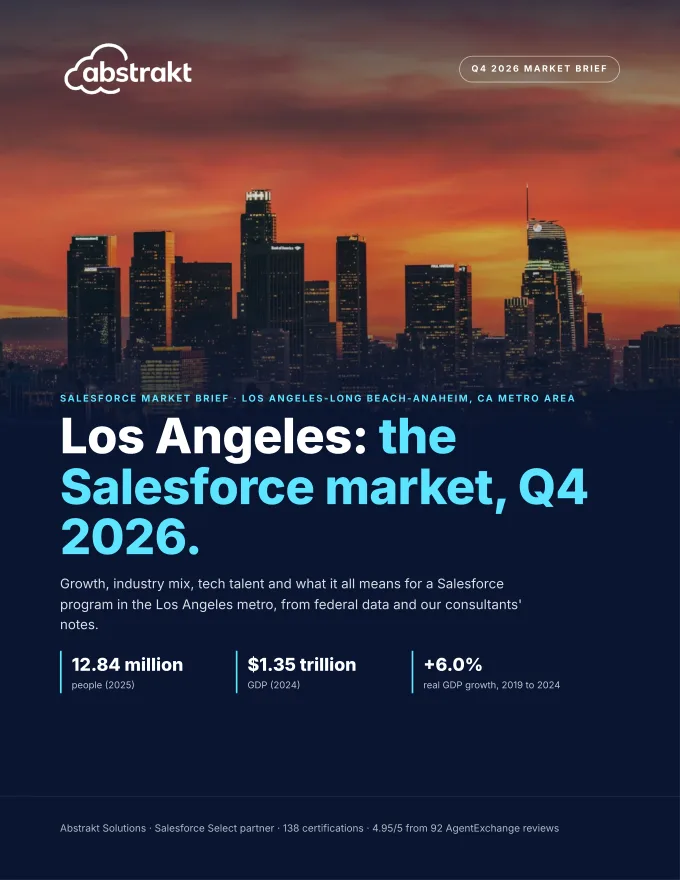
A free 24-page PDF with Los Angeles's growth ranked against 100 metros, its industry mix, tech wages and nearby markets. It is offered on the public Los Angeles page; send your customer there or get a copy for your own prep.
Get the Los Angeles brief →Co-sell with Abstrakt in Los Angeles
Working a Los Angeles account? Bring in a named consultant for discovery, scoping or a health check. We reply within 4 business hours.