

How Salesforce work starts in Riverside
Across the Inland Empire, in Riverside and San Bernardino counties alike, Abstrakt Solutions provides Salesforce consulting as a Salesforce Consulting Partner. Riverside is one of our focus markets.
What buyers here usually run into
- 1
Operations data outside the CRM
Logistics and distribution companies often keep shipment, inventory and order status in warehouse and ERP systems, leaving sales and service teams without the full picture unless those systems are integrated.
- 2
High-volume service
Businesses handling large numbers of orders, members or patients need case routing, self-service and automation that keep response times steady as volume grows.
- 3
Field and mobile work
Drivers, technicians and crews working across a large geography need mobile tools that fit the job, not desktop screens adapted after the fact.
Budget, team and partner questions
What drives cost
In the Inland Empire, integration with warehouse, transportation and ERP systems is usually the largest cost driver. High-volume service adds routing and self-service work, and field teams spread across two large counties add mobile and territory design. Health plans and systems add privacy design.
Admin or partner
Logistics and distribution companies often have operations IT teams but few Salesforce specialists, so a partner covers integration and Service Cloud while internal staff handle users. Smaller distributors and contractors usually outsource administration.
What buyers ask a partner
Ask for references integrating Salesforce with warehouse or transportation systems, how the partner filters operational data so Salesforce stays fast, and how they design mobile tools for crews and drivers. Health organizations should ask about member data access design.
The local economy and its biggest industries (4)
| Sector | Share of 2024 GDP | Where Salesforce fits |
|---|---|---|
| Transportation and warehousing Service Cloud → | 7.7% | Fulfillment, warehousing and trucking operations across the region's logistics corridors need customer service, carrier and shipper relationships, and case handling tied to warehouse and transportation systems. |
| Wholesale trade Revenue Cloud / CPQ → | 7.5% | Distributors running regional warehouses in the Inland Empire sell to repeat B2B buyers, so quoting, reorders and account visibility have to match what the ERP says. |
| Health care and social assistance Salesforce for health & life sciences → | 8.6% | With several large hospital systems and a regional health plan, Salesforce work here tends to center on member and patient service, outreach and referral tracking, built around privacy rules. |
| Retail trade Salesforce for retail & consumer goods → | 9.1% | Retailers and consumer brands serving the region's large population need customer service, loyalty and marketing data in one place rather than spread across store and ecommerce tools. |
Source: U.S. Bureau of Economic Analysis, GDP by county (CAGDP2), 2024, summed to the metro area; private sectors only, excluding real estate and government. “At least” marks sectors where BEA suppresses some county figures.
Regional target sectors named by local economic development groups: Transportation & Logistics, Advanced Manufacturing, Cybersecurity, Clean Technology / Clean Energy, AgTech, Biotech.
Salesforce products that fit Riverside (6)
In the order we lead with them here, from the industries above.
Salesforce Service Cloud
The operating system for modern customer service, case, knowledge, voice, and AI agent assist together.
Salesforce Sales Cloud
The CRM where sales pipeline lives, when it is built right.
Salesforce Field Service
Scheduling, dispatch, mobile work orders and parts for teams that work on site.
Salesforce Experience Cloud
Customer, partner, and employee portals built on Salesforce.
MuleSoft
Enterprise API platform, for connecting Salesforce, ERP, data warehouses, and the rest of your stack.
Salesforce Agentforce
AI agents that handle real work inside Sales Cloud, Service Cloud, and Marketing Cloud.
Inland Empire logistics and retail meet AI
Retail trade, health care, and transportation and warehousing lead the Riverside metro's private economy, at 9.1%, 8.6%, and 7.7% of 2024 GDP. For distribution operators, the obvious fit is shipment and delivery inquiries: an agent looks up order and carrier data, answers routine status questions, and routes exceptions with a summary so a coordinator does not start from zero. Chains selling to Inland Empire households apply that routing logic to returns. Clinics and home health providers tend to need scheduling support and reply drafting. Before any of that, order data must flow into Salesforce reliably, and the agent should only see the records its role allows. Humans still decide claims, credits, and anything clinical.
- Shipment status and exception routing
- Returns handling for retailers
- Clinic scheduling reply drafts
Services buyers here usually need (7)
Salesforce Integration in Riverside
Integration is often the first Salesforce project an Inland Empire company needs. Warehousing, trucking, distribution and health care organizations run specialized systems for inventory, shipments, orders or clinical records, and customer-facing teams end up phoning colleagues for status. We decide which system owns each record, choose an integration pattern and tool, whether MuleSoft, middleware or direct APIs, then build, test and monitor the connections so exceptions surface quickly instead of weeks later in a customer complaint.
By industry in Riverside
- 1
Wholesale trade
With wholesale trade near 7.5% of 2024 metro GDP, distributors are a large part of the regional economy, and for them the valuable integration usually runs from ERP to Salesforce: customer accounts, credit status, open orders, invoices and price agreements, with quotes and new accounts flowing back the other way. We define which fields each system masters, so a rep never edits a price in Salesforce that the ERP then overwrites overnight, and we alert a named person when a sync fails.
- 2
Transportation and warehousing
Carriers, 3PLs and fulfillment centers generate status events in large volumes inside their warehouse and transportation management systems, and very few of them belong in Salesforce. Integration for these companies passes only what service and account teams act on: exceptions, delays, damage claims and the performance summaries customers review. Event-driven patterns keep volumes manageable and API usage within limits, and error handling routes failed messages to someone who can fix them.
- 3
Clean Technology / Clean Energy
Both IEGO and Riverside County name clean energy among their target sectors. Solar, storage and energy efficiency companies typically sell in Salesforce but design, permit and install in separate project and field tools. Integrating those systems lets sales see where each installation stands, gives service teams the equipment and warranty details they need, and lets finance match signed contracts to completed work without manual reconciliation at month-end or chasing installers by phone.
Raise before scoping
Name a system of record
Before building a connection, agree which system owns each piece of data: customers, prices, orders, shipment status and inventory. Many Inland Empire firms have two or three candidates for the same record, and integrations without a clear owner create conflicting updates that erode trust in both systems.
Plan for high event volumes
Logistics and fulfillment platforms produce far more updates than a CRM should store. Filter at the source, summarize where possible, and design around Salesforce API and storage limits early, so peak-season traffic does not throttle the integration when customers most need accurate status.
Own the monitoring
Every integration fails occasionally. Decide who receives error alerts, how failed records are retried and what counts as urgent before go-live. Without that, a silent failure can leave reps quoting against stale inventory for days before anyone on the team notices.
Salesforce Implementation in Riverside
For most Inland Empire companies, a Salesforce implementation is shaped by operations more than by sales. Logistics, distribution and health care organizations here already run warehouse, ERP or clinical systems that will stay, so the first design question is what Salesforce should own and what it should only display. We settle that boundary in discovery workshops, build the data model around accounts, sites and service requests, configure in a sandbox, then go live in phases with hands-on training for each role.
By industry in Riverside
- 1
Transportation and warehousing
Transportation and warehousing produced about 7.7% of the metro's 2024 GDP, and Riverside County's economic development strategy lists transportation and logistics as an established strength. When a carrier, fulfillment operator or 3PL implements Salesforce, the data model usually needs a facility or lane object beneath the account, because one shipper may use several buildings and routes. We define those objects, the service request types and the account team roles before configuration starts, so reporting by customer and by site works from the first release.
- 2
Health care and social assistance
Health care is the region's second-largest private sector, at roughly 8.6% of 2024 metro GDP, spread across hospital systems, clinics, community providers and a regional health plan. Implementations here begin with a choice between Health Cloud and a leaner Service Cloud build, and with a classification exercise that marks which fields will hold protected health information. Putting sharing rules, encryption choices and audit logging into the initial design avoids a costly redesign when compliance reviews the org shortly before launch.
- 3
Advanced Manufacturing
Riverside County and the two-county IEGO collaborative both name advanced manufacturing as a growth sector, and the region's producers range from aerospace components to industrial equipment. Their first Salesforce release typically needs a product catalog that mirrors the ERP, quote records that carry the right price book, and installed-asset history that service teams can see. We phase the rollout so sales gets accounts, opportunities and quoting first, with service and asset tracking following once the catalog and ERP pattern are proven.
Raise before scoping
Map sites, not just accounts
Inland Empire customers often operate several warehouses, clinics or stores across two counties. Model locations as records related to the account from the start, so ownership, service requests and reporting can roll up by site and by region instead of being crammed into address fields later.
Design for users away from desks
Much of the data in logistics and home health is created on a phone in a yard, a truck cab or a patient's home. Include mobile layouts, quick actions and offline requirements in phase one, and test them with actual field users before any training sessions are scheduled.
Schedule around shift patterns
Discovery workshops, go-live and hands-on training are booked at times that suit warehouse and clinic shifts, and weekly reviews stay short enough for supervisors to attend.
Salesforce Optimization in Riverside
Optimization in the Inland Empire often starts on the service floor. Many regional companies adopted Salesforce during a growth spurt, added fields and automation for each new customer or site, and ended up with screens that slow agents down and reports that disagree with the warehouse system. We interview users, measure which fields and flows are actually used, consolidate automation, rebuild the dashboards leadership relies on, and retrain teams on the simplified process, one tested release at a time.
By industry in Riverside
- 1
Transportation & Logistics
Transportation and logistics is the strength Riverside County's economic development strategy leads with, and it is where cluttered case pages cost the most time. Optimization for carriers and fulfillment operators focuses on case layouts that show shipment context at a glance, assignment rules that route by customer and facility, and fewer manual status updates. We also align service metrics with the definitions operations already uses, so on-time and exception reports finally agree.
- 2
Health care and social assistance
Health organizations in the region often built outreach, referral and member service processes in Salesforce one program at a time. Over the years that produces overlapping record types, duplicate contacts and flows that fire twice on the same record. Optimization consolidates those into one patient or member view, removes fields nobody completes, and rebuilds program dashboards, while checking that each change keeps access to protected health information as narrow as it was before.
- 3
Retail trade
Retailers and consumer brands selling to Inland Empire residents usually hold more customer data than they can use. When service cases, loyalty records and marketing lists sit in separate objects with inconsistent matching, agents cannot see a shopper's history and campaigns reach the wrong people. We tighten duplicate rules, standardize how store and online customers are identified, and rebuild case and customer reports so managers act on a single set of numbers.
Raise before scoping
Measure usage before removing anything
Field history, login data and report usage show which parts of the org people rely on. Review them with supervisors from each site before deleting fields or flows, because a field that looks unused at head office may drive a report a warehouse manager checks each morning.
Retrain by shift and role
Screen changes land hardest on dispatchers, agents and clerks working set shifts. Plan short training sessions for each role at times that fit early and late crews, and give supervisors a one-page summary so the new process survives staff turnover.
Agree on metric definitions
Operations teams in the region often measure on-time performance, resolution time or order accuracy differently from sales and finance. Settle one definition per metric before rebuilding dashboards; otherwise the new reports simply move the old argument from spreadsheets into Salesforce.
Salesforce Managed Services in Riverside
In the Inland Empire, managed services usually means supporting an org that sits beside busy operational systems. We take ownership of the request backlog, user administration, Flow changes, integration monitoring and each seasonal Salesforce release, drawing on admins, developers or architects as a task requires. Requests are ranked with your business owner at a regular review, and changes pass through a sandbox before reaching users. It suits distributors, carriers and health organizations whose single admin cannot keep pace with demand.
By industry in Riverside
- 1
Retail trade
Retail is the largest private sector in the metro, about 9.1% of 2024 GDP. Retailers and consumer brands serving the region's population see demand swing around promotions and holidays, and Salesforce requests pile up at exactly those moments: new case reasons, loyalty fields, campaign lists and dashboard changes. A managed services team can absorb those peaks, hold risky changes until busy periods pass, and clear the backlog once volume drops, without you hiring for a seasonal spike.
- 2
Wholesale trade
Distributors in the region depend on Salesforce showing order status, pricing and account history that originate in the ERP. When an ERP upgrade, a new price list or a renamed field breaks that sync, reps notice first. Ongoing support includes watching integration errors, keeping price books and product records aligned, adjusting account ownership as territories change, and testing each Salesforce release against the connected fields that the sales team relies on every day.
- 3
Cybersecurity
IEGO names cybersecurity as a target sector for the two-county region, and security-minded buyers expect their vendors' own systems to be run carefully. For security firms and the organizations that hire them, managed services covers periodic permission set reviews, login and session policy checks, prompt deactivation of departed users, and a release review that examines the security changes in every Salesforce update before they reach production users, with findings shared in plain language.
Raise before scoping
Name one business owner
Managed services works when someone on your side ranks the backlog. In multi-site Inland Empire companies, requests arrive from warehouses, branches and head office at once, so agree who breaks ties between operations and sales before work starts, and keep that person in every review.
Protect peak seasons from change
Retail and fulfillment volume here climbs sharply around holidays. Set a change-freeze calendar with your managed services team, schedule larger releases for quieter periods, and keep only urgent fixes in flight while service and warehouse teams are running at full capacity.
Keep documentation with the org
Turnover among admins and power users is common in fast-growing operations. Require that every change carries a short note in the org or a shared log, so a new hire or a future partner can see why a field, flow or permission exists without guessing at its purpose.
Salesforce Health Checks in Riverside
A health check gives Inland Empire companies a prioritized view of their Salesforce org before they spend more on it. The review covers who can see what, how clean the data is, automation and custom code, the connections to warehouse, ERP or clinical systems, and how reports and adoption hold up. Findings are ranked by risk and effort, so leadership can see what must be fixed now, what can wait and what an AI or Agentforce project would need first. Many clients commission one before renewing licenses or changing partners.
By industry in Riverside
- 1
Cybersecurity
Cybersecurity is a two-county priority for IEGO, which runs a regional cyber competition and leads the sector for a statewide jobs initiative. Organizations in and around that sector are judged on their own controls, so a health check here gives extra weight to access: profiles with excess permissions, users who never log in, shared integration accounts, missing multi-factor enforcement and connected apps with broad scopes. We document each finding against the setting that fixes it.
- 2
Health care and social assistance
For hospitals, clinics and health plans in the region, the core question is whether protected health information is exposed more widely than it needs to be. The review checks field-level security on clinical and member data, sharing rules, report folders, data export rights and event logging, along with how each integration authenticates. Findings are written so a compliance officer can follow them, not only an administrator, with each fix tied to the rule it supports.
- 3
Wholesale trade
Distributors that have run Salesforce for years accumulate technical debt quickly: old workflow rules alongside newer flows, price fields copied from the ERP by several integrations, and validation rules nobody remembers adding. A health check traces which automation touches each key object, flags conflicts that cause wrong totals or failed saves, and estimates the effort to retire the legacy pieces before they block an upgrade or a new product line.
Raise before scoping
Check readiness before adding AI
AI features, Agentforce included, work from whatever your org already contains. If case reasons are inconsistent or access is too broad, an agent can give wrong answers or surface data it should not. A health check tells you which of those gaps to close first.
Include the integrations
In Inland Empire operations, many Salesforce issues start in a connected system. Review integration users, error logs and the fields each connection writes, because an integration with administrator rights and no monitoring is both a security risk and a common source of silent data errors.
Turn findings into a plan
A report nobody acts on changes nothing. Ask for findings ranked by risk and effort, with owners and a suggested sequence, so your team or a partner can schedule the fixes into normal work rather than waiting for a large project budget to appear.
Salesforce Migration in Riverside
Inland Empire companies that migrate to Salesforce often carry data from several sources at once: a legacy CRM, spreadsheets kept by each branch or warehouse, service history in a shared inbox, and records from businesses they acquired. We inventory those sources, decide what history is worth keeping, clean and deduplicate before import, load in the right order so relationships survive, and reconcile record counts with your team. Cutover is planned so nobody has to work in two systems.
By industry in Riverside
- 1
Retail trade
Retailers and consumer brands serving the region's large population tend to hold customer records in point-of-sale, ecommerce and loyalty tools, each keyed differently. Migrating service and customer data into Salesforce means choosing a matching rule, often email plus phone or loyalty number, merging duplicates before load, and keeping purchase summaries rather than every transaction. Getting that right is what lets agents recognize a returning shopper on the first call and resolve the issue quickly.
- 2
AgTech
Riverside County's economic development strategy lists agtech as a growth opportunity, and agricultural suppliers and startups often track growers, trials and dealers in spreadsheets. Migration for them focuses on building a proper account structure for farms, ranches and cooperatives, with trial results and field locations kept as related records. We clean grower names and addresses before loading, because duplicates in a small, relationship-driven market are especially damaging to credibility with long-standing customers.
- 3
Health care and social assistance
Community health providers, clinics and home-care agencies moving to Salesforce frequently start from a mix of older case management tools and spreadsheets. Migration here must respect protected health information at every step: secure transfer, limited access to staging data, and deliberate decisions about which historical notes are needed operationally. We document each field's source and treatment, which helps with compliance review and with any later audit of the new system.
Raise before scoping
Inventory every branch's spreadsheets
Multi-site companies across the two counties often discover that each location kept its own customer list. Collect them early, identify an owner for each, and agree on matching rules, or the migration will load the same customer several times under slightly different names.
Keep history selectively
Moving every old note and email is rarely worth the cost. Decide per object how many years of history operations and sales actually use, archive the rest in a searchable form, and keep Salesforce lean enough that searches and reports stay fast.
Rehearse the cutover
Run a full trial load in a sandbox with real data, then check counts and spot-check records with the people who know them. Choose a cutover window away from month-end and peak shipping weeks, so the switch does not collide with your busiest days of the year.
Salesforce Implementation Rescue in Riverside
When a Salesforce project in the Inland Empire fails, the cause is often a mismatch between the design and how operations really work: an org built for a sales team that ignores warehouses, dispatch or clinics, or integrations that were promised but never finished. We start with triage, reviewing the org, the original scope and the open issues, then interview the users who stopped using it. You get a plain recommendation on what to keep, fix or rebuild, and a phased plan to a usable go-live.
By industry in Riverside
- 1
Transportation and warehousing
Logistics projects stall most often at the integration layer. A partner builds accounts and cases, but shipment and exception data never arrives from the transportation or warehouse systems, so agents keep using the old tools and Salesforce drifts out of date. Rescue starts by deciding which operational data service teams truly need, finishing or replacing the integration for that slice, and relaunching only once that data flows reliably into the case view.
- 2
Advanced Manufacturing
Manufacturers in the region sometimes inherit an org heavy with custom code written to mirror ERP logic for pricing and configuration. When the developer who wrote it leaves, nobody can change quoting safely, and sales falls back to spreadsheets. We identify which custom components are essential, replace what configuration can now handle, add tests and documentation for the rest, and give sales and service teams back an org they can change without fear.
- 3
Biotech
Riverside County lists biotech as a growth opportunity, and startups coming out of the region's university incubators often implement Salesforce in a hurry after funding. Rushed builds leave copied templates, stages that do not match the company's real buying process, and investor reports nobody trusts. Rescue for a young life sciences company is usually a focused reset: a clean opportunity process, reliable account data, and a forecast leadership is willing to present.
Raise before scoping
Stop adding scope first
A struggling project usually keeps accumulating requests. Freeze new features while triage runs, so the team can see the real state of the org, and so fixes are not undone by fresh changes made to meet an old deadline that no longer applies.
Find out why users left
Talk to the dispatchers, agents and reps who stopped logging in. Their reasons, such as too many required fields, missing status data or slow pages, show what the relaunch has to fix before any amount of training will change behavior.
Clarify who decides
Many stalled Inland Empire projects lacked a single sponsor with authority. Appoint one person who can settle process questions and approve scope, and give them a direct line to the consultants doing the recovery so decisions happen in days rather than weeks.
Industry plays in Riverside (4)
Salesforce for Riverside Retailers and Consumer Brands
For retailers and consumer brands in the Inland Empire, Salesforce earns its keep when it joins the shopper side of the business to the fulfillment side. Service agents need order and delivery status without switching screens, marketers need purchase history rather than email lists alone, and store teams need the same customer record the website uses. We build that shared profile, connect it to order management and warehouse systems, and keep the data model simple enough for seasonal staff to use.
Stores and shopping outrank every other private industry in the Riverside-San Bernardino-Ontario economy: retail trade produced 9.1% of metro GDP in 2024, by the Bureau of Economic Analysis's county data. Transportation and warehousing, at 7.7%, and wholesale trade, at 7.5%, sit close behind, so selling and moving goods account for a large part of the regional economy. The Riverside County Office of Economic Development's 2026 strategy names transportation and logistics as an established strength. For consumer brands, that means stores, distribution buildings and ecommerce operations often sit in the same two counties, and customer data has to follow the product across all three.
Use cases to open with
- 1
Order-aware customer service
Where is my order is the most common question a retail contact center gets. Service Cloud, with order and shipment status pulled from the order management system, lets agents answer it in one screen, issue returns or replacements from the case, and see prior contacts, so a customer who called about a late delivery last week is not asked to explain it again.
- 2
One shopper profile across channels
Store purchases, online orders and loyalty activity usually live in separate tools. Data 360 (formerly Data Cloud) can match those records into one profile per shopper, which gives marketing accurate segments, gives service agents purchase history and lets merchandising see how customers in different parts of the region actually buy, without a separate data warehouse project to get started. Profiles also make it possible to recognize a returning customer at the register, in the app and on the phone.
- 3
Campaigns tied to inventory
Promoting a product the distribution center has run out of wastes budget and frustrates customers. Marketing Cloud journeys that check inventory and fulfillment data before sending can suppress sold-out items, trigger back-in-stock messages and time offers around delivery windows, which matters for brands whose customers expect quick shipping from nearby warehouses. Journey results then flow back to the shopper profile, so the next campaign starts from what customers actually bought.
Raise before scoping
Integrate order systems first
Service and marketing both depend on accurate order, return and delivery data. Settle how order management, point-of-sale and warehouse systems feed Salesforce, and how often, before designing journeys or agent screens, because every later feature assumes that data is current.
Plan for seasonal volume
Holiday and promotional peaks can multiply case volume and bring in temporary agents. Build routing, macros and knowledge articles that new staff can use on their first day, and size licenses and queues for the peak rather than an average week.
Respect California privacy rules
Shopper profiles assembled from many sources raise California consumer privacy obligations around access requests, deletion and opt-outs of data sharing. Design consent capture, preference management and data retention into the profile from the start, keep an audit trail of changes, and confirm specific requirements with your own counsel.
Salesforce for Riverside Health and Life Sciences
In the Inland Empire, health organizations use Salesforce mostly for access and service: helping patients and members reach the right clinic, program or benefit across two large counties. That means contact center routing, referral tracking and outreach built on a record that respects privacy rules. For the region's younger biotech and medtech companies, the need is different, covering research partners, investors and early customers. We design for whichever side you are on, and connect Salesforce to the clinical or research systems that stay the source of truth.
Only retail trade outranks health care and social assistance among the metro's private industries; care providers and related services produced 8.6% of regional GDP in 2024, per the Bureau of Economic Analysis. The Riverside County Office of Economic Development's 2026 strategy lists biotech among its growth opportunities. The research record adds two startup supports: a university-run wet lab incubator for life sciences, agriculture, biotech and medtech companies, described as the first of its kind in the region, and a downtown Riverside incubator whose portfolio includes biomedical devices. The result is a sector dominated by large care and coverage organizations, with a small but growing life sciences startup base beside it.
Use cases to open with
- 1
Patient access and scheduling
Patients across a large, spread-out region often call several numbers before reaching the right clinic. A Service Cloud contact center with routing by specialty, location and language, plus knowledge articles for common questions, shortens that path. Integration with the scheduling system lets agents book or confirm appointments on the call, and every contact is logged against one patient record instead of separate department spreadsheets.
- 2
Member outreach for health plans
Health plans serving both counties run outreach for enrollment, renewals and preventive care. Salesforce can segment members by program and language, track outreach attempts across phone, text and mail, and route members who need help to care managers. Agentforce can answer routine benefit questions outside office hours in a self-service portal, handing complex cases to staff with the conversation attached.
- 3
Startup partner and investor tracking
Early-stage biotech and medtech companies manage research collaborators, grant sources, investors and first customers with a handful of people. Sales Cloud gives them one place for those relationships, with pipeline stages that fit partnering and fundraising rather than retail sales, so founders can report progress to boards without rebuilding the same spreadsheet each quarter. When the company signs its first commercial customers, the same org can take on service.
Raise before scoping
Keep PHI access minimal
Protected health information in Salesforce brings HIPAA obligations, a business associate agreement and careful access design. Decide which clinical fields truly need to be in the CRM, surface the rest from source systems, and apply encryption, field-level security and audit logging from the first build.
Serve patients in their language
The region's patient and member base is linguistically diverse. Plan language preference as a core field, route contacts to agents who speak it, and build templates and portal content in the languages you actually serve rather than translating after launch.
Size the build to the organization
A large health system and a biotech startup need very different Salesforce footprints. Startups should begin with a lean Sales Cloud setup and avoid heavy customization, while health systems need governance, release management and integration planning before any build starts.
Salesforce for Riverside Manufacturers
Manufacturers in the Inland Empire rarely sell in isolation from logistics. Customers ask where an order is, distributors want stock and pricing, and reps quote with freight in mind. Salesforce earns its place when it pulls order, shipment and inventory status from the ERP and warehouse systems into the account record, gives distributors a self-service portal, and keeps quotes aligned with plant costs. We design that model first and add automation only where it removes real manual work.
Manufacturing is not one of the five largest private sectors in the Bureau of Economic Analysis's 2024 figures for the Riverside-San Bernardino-Ontario metro, so we do not put a share on it. It shows up instead as a stated priority: Riverside County's 2026 economic development strategy and the two-county IEGO collaborative both name advanced manufacturing as a target. The surrounding economy is built on movement of goods, with transportation and warehousing at 7.7% of GDP and wholesale trade at 7.5%. A downtown Riverside incubator's portfolio also includes logistics automation, renewable energy and aerospace navigation startups.
Use cases to open with
- 1
Order status without phone calls
When a customer calls about a late shipment, the answer usually sits in the ERP or a warehouse system. Integrating order lines, ship dates and tracking into Service Cloud lets agents answer from the case screen, and proactive alerts can warn account owners before a delay turns into a complaint. Case reasons then show which plants, carriers or product lines generate the most status inquiries.
- 2
Distributor ordering and stock visibility
An Experience Cloud portal gives distributors their contract pricing, open orders, invoices and available inventory without emailing inside sales. Distributors can register deals, request samples and download spec sheets, while your team sees portal activity alongside sell-through data. Channel managers learn which partners are growing and which have gone quiet, and inside sales spends its time on quotes that need judgment rather than status lookups.
- 3
Quotes that include landed cost
For bulky or heavy products, freight can decide whether a deal makes money. Revenue Cloud or CPQ can pull standard costs from the ERP, apply freight rules by ship-to zone and flag quotes that fall below target margin. Approvals route to the right manager automatically, and the accepted quote converts to an order the plant recognizes, so nobody re-enters line items by hand.
Raise before scoping
Map every operational system
Order, inventory and shipment data may span an ERP, a warehouse management system and carrier feeds. Inventory each source, decide what Salesforce displays versus stores, and agree on refresh frequency, because stale status data erodes trust with both agents and distributors faster than missing data.
Keep partner access tight
Distributors often compete with one another in the same territory. Sharing rules, pricing visibility and account relationships in the portal must keep each partner inside its own data, and testing should include logging in as several different partners before any launch.
Plan for young product lines
Companies spun out of local incubators may still be changing products, pricing and channels. Build a lean product catalog and simple approval rules that are easy to revise, rather than hard-coding assumptions that will need expensive rework once the business settles.
Salesforce for Riverside Construction Firms
Riverside-area contractors get the most from Salesforce when a single record carries each job from the first bid invite to final closeout. Sales tracks which general contractors and owners invite you and how often you win, estimators hand off scope and assumptions, and project managers compare committed costs with the estimate as work proceeds. Crews use mobile work orders instead of paper, and warranty calls land on the original job record. Integration with accounting keeps billing numbers consistent.
Construction accounts for 6.4% of 2024 GDP in the Riverside-San Bernardino-Ontario metro according to the Bureau of Economic Analysis, fifth among private sectors behind retail trade, health care, transportation and warehousing, and wholesale trade. That mix matters for builders: much of the regional economy runs on distribution space and the facilities that support it. Riverside County's 2026 strategy and the IEGO collaborative both list clean energy as a target sector, which points to demand for contractors that install and maintain energy systems. The metro also covers a very large territory across two counties, so travel time shapes scheduling.
Use cases to open with
- 1
Bid invitations and win rates
Specialty contractors can receive far more invitations than they can price. Salesforce records each invitation with the owner, general contractor, bid date and scope, so estimating leads can decline early and focus effort. Over time, win rates by customer, project type and estimator show where bidding pays off, and follow-up tasks keep relationships warm with the contractors who award the most work.
- 2
Estimate to budget handoff
When a bid is awarded, the estimate should become the working budget without retyping. Revenue Cloud or CPQ can hold line items, allowances and exclusions, then pass them to the job record and accounting system. Project managers log change orders against the original scope, and leadership can see which jobs are drifting from estimated margin while there is still time to act.
- 3
Crew scheduling across distance
Driving between jobs in a large metro burns hours. Field Service schedules crews by skill, certification and location, groups nearby work to cut windshield time, and gives foremen mobile checklists, photos and signatures, including sign-off from the customer on site. Service and warranty visits after completion use the same tool, so the history of every installed system stays attached to the customer and the job.
Raise before scoping
Decide what accounting owns
Your accounting package should remain the home of payroll and cost codes. Agree which figures Salesforce shows, how often they sync and who fixes mismatches. Without that agreement, project managers end up comparing two margin numbers and trusting neither, which undermines adoption within a few weeks.
Design for foremen first
Field leads work on phones, in sun and dust, often with poor signal. Limit each mobile screen to what a foreman needs, let photos and signatures save without a connection, and have real crews try it first. If the field app slows them down, data stops flowing and office reports become guesses.
Model recurring service work
Contractors that install energy or building systems may add maintenance agreements after completion. Plan service contracts, entitlements and preventive schedules in the data model now, even if you launch with project work only, so recurring revenue does not require a second rebuild later.
Case studies to send (3)
From the industries this market leans on. Client names are anonymized and these projects are not specific to Riverside.
The Riverside Salesforce market brief, Q4 2026
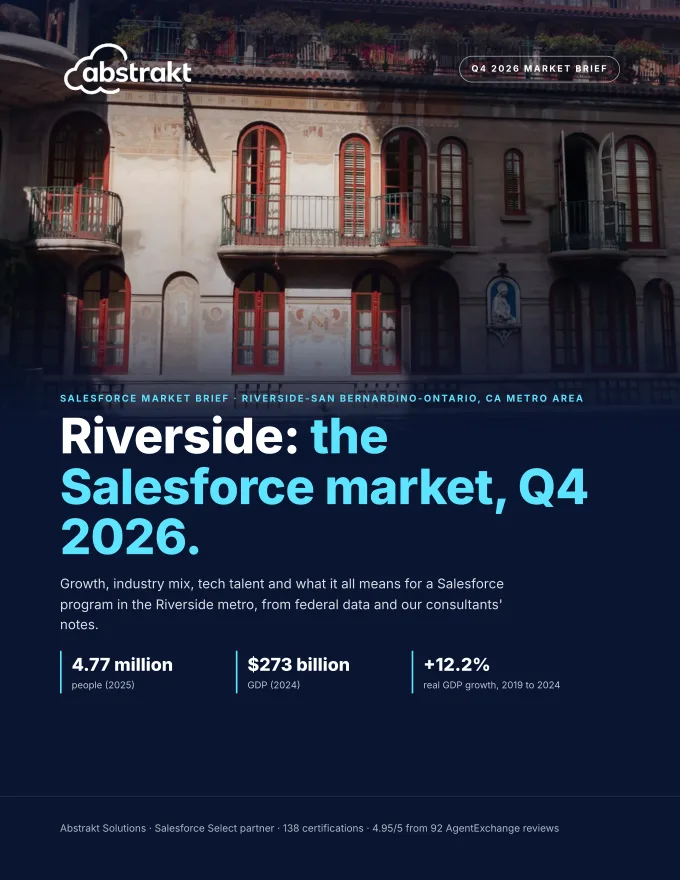
A free 22-page PDF with Riverside's growth ranked against 100 metros, its industry mix, tech wages and nearby markets. It is offered on the public Riverside page; send your customer there or get a copy for your own prep.
Get the Riverside brief →Co-sell with Abstrakt in Riverside
Working a Riverside account? Bring in a named consultant for discovery, scoping or a health check. We reply within 4 business hours.