

How Salesforce work starts in San Francisco Bay Area
Abstrakt Solutions is a Salesforce Consulting Partner whose Bay Area work spans software, life sciences and professional services firms in San Francisco, Oakland and the East Bay. San Francisco Bay Area is one of our focus markets.
What buyers here usually run into
- 1
Orgs built fast
High-growth companies often build Salesforce quickly and pay for it later in technical debt, conflicting automation and reports nobody trusts.
- 2
Product and usage data
Software companies need product usage and billing data in Salesforce to spot expansion and churn, which means integration and data work, not just CRM configuration.
- 3
Early AI adoption
Bay Area teams often want Agentforce or other AI early. Data readiness and governance decide whether those projects succeed.
Budget, team and partner questions
What drives cost
Bay Area costs depend on how much technical debt an early org carries, how much usage and billing data must reach Salesforce, and the governance work needed before AI goes live. Refactoring legacy automation is often a larger line item than new features.
Admin or partner
Software companies here often have RevOps engineers and a Salesforce admin but limited architecture time. A partner typically handles data model decisions, refactoring and Agentforce evaluation, while the internal team owns the backlog.
What buyers ask a partner
Ask for usage-based billing and Revenue Cloud references, how the partner tests agents before customers see them, and how they refactor automation without breaking reports. Ask for the names of the architects assigned.
The local economy and its biggest industries (4)
| Sector | Share of 2024 GDP | Where Salesforce fits |
|---|---|---|
| Information Revenue Cloud / CPQ → | 19.8% | Software and internet companies run product-led and enterprise sales motions at the same time, with subscriptions, usage data and renewals that need to reach Salesforce. |
| Professional, scientific, and technical services Salesforce for professional services → | 14.6% | Research organizations, consultancies and agencies need pipeline and delivery tracking, and many are scaling past starter tools. |
| Manufacturing Salesforce for health & life sciences → | 9.0% | Biotech, medical-device and hardware manufacturers need commercial, field and service processes that fit technical products and regulated quality systems. |
| Finance and insurance Financial Services Cloud → | 6.4% | Banks, payments and fintech companies need onboarding, relationship views and service at scale, with the controls regulated firms require. |
Source: U.S. Bureau of Economic Analysis, GDP by county (CAGDP2), 2024, summed to the metro area; private sectors only, excluding real estate and government. “At least” marks sectors where BEA suppresses some county figures.
Regional target sectors named by local economic development groups: Technology, Life Sciences and Healthcare, Financial Services, Clean Technology and Green Business, Tourism and Hospitality, Creative Industries.
Salesforce products that fit San Francisco Bay Area (6)
In the order we lead with them here, from the industries above.
Salesforce Agentforce
AI agents that handle real work inside Sales Cloud, Service Cloud, and Marketing Cloud.
Salesforce Data 360 (Data Cloud)
Unify customer data into a real-time profile that powers segmentation, analytics, and AI.
Salesforce Sales Cloud
The CRM where sales pipeline lives, when it is built right.
Salesforce Revenue Cloud / CPQ
Configure-price-quote, billing, subscription management, and quote-to-cash on Salesforce.
Salesforce Service Cloud
The operating system for modern customer service, case, knowledge, voice, and AI agent assist together.
Claudeforce
Salesforce data and governed actions, inside Claude.
Practical Agentforce work for San Francisco software firms
Information accounted for 19.8% of the San Francisco metro's 2024 GDP and professional, scientific, and technical services for 14.6%, which means many buyers here already ship software and are skeptical of demos. The useful question is narrower: which queues are repetitive enough to hand an agent a first pass? Support teams at subscription businesses usually point to tier-one tickets that a knowledge-grounded answer can close, plus lead routing when inbound volume outruns the SDR team. Consulting practices lean toward account research summaries before renewals. Each depends on current help articles, deduplicated contact records, and clear rules about which data leaves the org. A reviewer should still read what the agent sends until error rates are measured.
- Tier-one ticket deflection
- Inbound lead routing
- Pre-renewal account research summaries
Services buyers here usually need (7)
Salesforce Health Checks in the San Francisco Bay Area
For Bay Area companies, a health check most often comes before an AI project. Leadership wants Agentforce or another assistant working on customer data, and someone needs to confirm the org is ready for it. The review covers who can see what, the quality of data on key objects, automation that overlaps, customization nobody uses, integrations and adoption, and every finding is ranked by risk and effort. The report separates what must be fixed before an agent touches the data from what can wait for routine cleanup.
By industry in San Francisco Bay Area
- 1
Finance and insurance
Banks, fintech lenders, payments firms and insurers face audits that ask who can see which customer records and why. A health check for them concentrates on profiles, permission sets and sharing, admin access, field history and encryption settings, and it flags customer identifiers stored where they should not be. The result is a list examiners and internal auditors can follow, with the highest-risk access issues placed at the top. Most of those fixes are configuration changes rather than new projects.
- 2
Technology
Technology companies, first on the city's target-sector list, tend to have orgs shaped by rapid iteration: packages installed for a trial and never removed, Apex written by short-term contractors, and integration users with broad permissions. We inventory that technical debt, test coverage and connected apps, and estimate what each item costs to keep. Engineering leaders generally want findings in the same terms they use for their own code, so the report reads that way.
- 3
Life Sciences and Healthcare
For life sciences and healthcare organizations, a health check focuses on whether data that needs protection is actually protected. We check field-level security on sensitive fields, sharing between medical and commercial teams, audit trail settings and which integrations can read what. Findings are ranked so privacy and compliance risks are resolved before anything else, including any plan to point an AI agent at case or contact data. Anything that cannot be fixed right away gets a documented owner and a target date.
Raise before scoping
Check data before AI
An agent is only as good as the records, articles and access rules it inherits. A health check measures duplicate rates, stale articles and inconsistent case reasons on the objects an agent would use, so you know whether a pilot will test the AI itself or simply expose existing data problems.
Review every integration user
Orgs connected to many tools often grant each integration user more access than it needs. We list every connected app and API user, compare its permissions with what it actually does, and flag the ones that could read or change far more than intended.
Time it before renewal
A health check some months ahead of your Salesforce renewal shows which licenses, add-ons and packages are actually used. That gives you facts for the renewal conversation and a cleanup list to act on, instead of renewing everything the org has accumulated over the years.
Salesforce Optimization in the San Francisco Bay Area
Bay Area optimization projects are almost always a side effect of growth. An org configured for a small founding sales team has since absorbed new products, several reorganizations and automation from admins who have moved on. Reps work around it, and forecast calls open with arguments about which report is right. We measure usage and field completion, interview each team, then simplify layouts, consolidate legacy automation into Flow, clean duplicates and rebuild the reports leaders use in board and pipeline meetings.
By industry in San Francisco Bay Area
- 1
Information
Software and media companies often carry the heaviest accumulation of fields and automation, because they adopted Salesforce early and changed pricing models more than once since. Optimization for them means retiring fields tied to discontinued plans, rewriting overlapping Process Builder logic in Flow, and agreeing on one definition of annual recurring revenue that every dashboard uses. Reps notice the difference in faster pages and fewer required fields; leadership notices it in forecast accuracy.
- 2
Creative Industries
Agencies, studios, design shops and media production firms fall under creative industries, which the city includes among its priority sectors. Their Salesforce orgs often track projects, pitches and freelance talent in custom objects built by whoever had time that month. Optimization consolidates those objects, adds simple intake forms and builds utilization and win-rate reports that account leads actually open, rather than asking producers to update records they never look at or use.
- 3
Finance and insurance
Although finance and insurance is a smaller slice of this economy, about 6.4% of 2024 metro GDP, the banks, fintechs and insurers in it tend to have orgs where compliance requirements added validation rules and approval steps one at a time. We review which controls are still required, remove the ones that only slow users down, and replace manual attestations with automation that records who did what. Advisors and account teams spend less time fighting the system, and the audit trail stays intact.
Raise before scoping
Measure before you simplify
Login history and field completion show where people avoid the system, but interviews explain why. We combine both before changing anything, because removing a field someone quietly relies on for commission or compliance reporting creates a new problem while fixing the old one.
Agree on metric definitions
Fast-growing companies often have several versions of pipeline or churn in circulation. Getting finance, sales and operations to sign off on one definition is a business decision, not a configuration task, and it has to happen before dashboards are rebuilt or they will be disputed again.
Retire automation in order
Legacy workflow rules and Process Builder often interact in ways nobody documented. We move them to Flow one object at a time, testing in a sandbox against real records, so a cleanup effort does not break lead routing or renewal reminders in the middle of a quarter.
Salesforce Integration in the San Francisco Bay Area
In the Bay Area, integration work typically starts with product and billing data rather than ERP. Subscription companies need usage, plan and invoice status in front of account teams, while manufacturers and life-sciences firms need orders and shipments from their ERP. We map each system, decide which one owns every shared field, then pick a pattern: MuleSoft or other middleware where many systems meet, direct APIs where only a few do, and Data 360 (formerly Data Cloud) where volume makes copying impractical. Every connection ships with monitoring.
By industry in San Francisco Bay Area
- 1
Manufacturing
Manufacturing contributed about 9.0% of 2024 metro GDP, much of it in biotech production, medical devices and hardware. These companies need Salesforce and ERP to agree on products, pricing and order status, and many also carry lot, serial or device data that quality systems own. We keep regulated records in their source systems and surface what sales and service need, such as shipment status or installed units, so the CRM never becomes an uncontrolled copy.
- 2
Information
For software and internet companies, the integration that matters most brings product usage and billing into Salesforce. Sending every event is rarely the answer; account teams need trends such as active seats, feature adoption and overdue invoices. We aggregate in the warehouse or Data 360 (formerly Data Cloud), push summarized signals to accounts and trigger tasks when usage drops or a renewal approaches, so expansion and churn signals reach reps while they can still act on them.
- 3
Financial Services
Fintech and payments companies, part of the financial services sector the city targets, need onboarding and risk status from their core platforms inside Salesforce. The integration question is how little sensitive data to move. We usually sync status fields, risk flags and reference IDs, keep full identity and transaction records in the source system, and log every sync so compliance teams can trace what the CRM displayed and when it changed.
Raise before scoping
Settle data ownership in writing
When billing, product and sales tools all store customer names and plans, conflicts are inevitable. We document which system wins for each shared field and what happens when records disagree, then build the integration to that document instead of discovering the rules during testing.
Size for event volume
Consumer apps and usage-based products can generate far more events than Salesforce should store. Decide early what gets summarized before it arrives, what stays in the warehouse and what should trigger action in the CRM, which keeps storage, API limits and page performance under control.
Watch for quiet failures
Integrations rarely fail loudly; they drop records without anyone noticing. Every connection we build includes alerts, error logs and a short runbook, so your team, or ours under managed services, sees a failed record the same day instead of discovering the gap at quarter end.
Salesforce Implementation in the San Francisco Bay Area
Many Bay Area implementations are not first CRMs in the usual sense. The company has already sold for years out of a starter tool, a billing platform and a product database, and now needs one system that ties accounts to subscriptions and usage. We design that data model first, agree which system owns each shared field, then build in phases: core sales process, then service, then quoting and AI. Discovery workshops and go-live anchor the plan, with each phase built and tested in a sandbox before release.
By industry in San Francisco Bay Area
- 1
Information
Information produced about 19.8% of the metro's 2024 GDP, more than any other private sector. For software and internet companies, the implementation decision that shapes everything else is how accounts relate to workspaces, subscriptions and usage. We model those objects before configuring stages, decide whether usage arrives as summarized fields or through Data 360 (formerly Data Cloud), and keep product-led signups apart from sales-assisted deals so pipeline reporting stays honest from the first day.
- 2
Life Sciences and Healthcare
Life sciences and healthcare sit on the target-sector list published by San Francisco's Office of Economic and Workforce Development. Biotech and diagnostics companies implementing Salesforce for a first commercial team need account structures for hospitals, labs and research institutions, contact roles for principal investigators and procurement staff, and a clear line between scientific engagement and selling. We set up those record types and sharing rules in the initial design, since reworking them after reps have loaded accounts means reassigning ownership and rebuilding reports.
- 3
Financial Services
Financial services is another of the city's named target sectors, and the fintech and payments firms in it rarely look like a traditional bank. Many serve businesses rather than households, so Sales Cloud with a well-designed onboarding object often fits better than a full financial-services data model. Implementation work centers on onboarding stages, risk review handoffs and which identifiers stay in the core ledger instead of the CRM, all decided before the first sandbox build.
Raise before scoping
Name the system of record early
Bay Area companies often run billing, product analytics and a data warehouse before Salesforce arrives. Decide in discovery which system owns accounts, contracts and usage, and design Salesforce to receive that data rather than duplicate it. Skipping this step produces a second, conflicting customer list within months.
Leave room for Agentforce
If leadership already expects AI agents on top of the new org, the data model and permissions have to support them. Consistent picklists, clean case reasons and least-privilege access cost little during implementation and are expensive to retrofit once agents depend on them.
Review working software, not status
Configuration is prepared ahead of every review, so design reviews and acceptance testing open with something new to try rather than a status update.
Salesforce Managed Services in the San Francisco Bay Area
For Bay Area companies, managed services usually fills a gap rather than replacing a person. Admins change roles, operations teams reorganize, and the Salesforce backlog grows while nobody clearly owns it. We take over user requests, configuration changes, Flow work and release testing, and keep a prioritized backlog you can see at any time. When a request needs a developer or an architect rather than an admin, the right specialist picks it up, and a standing review with your operations lead decides what ships next and what waits.
By industry in San Francisco Bay Area
- 1
Professional, scientific, and technical services
With about 14.6% of 2024 metro GDP coming from professional, scientific and technical services, consultancies, agencies and research firms make up a large share of Bay Area Salesforce users. They change service lines often, and each change touches opportunity types, project records and utilization reports. Under managed services we handle those changes as backlog items, test them in a sandbox and release them on a set cadence, so the partners who rely on the pipeline report are not surprised by a renamed stage on Monday morning.
- 2
Tourism and Hospitality
Tourism and hospitality is one of six sectors the city's development office prioritizes. Hotel groups, event venues and hospitality operators here see demand swing with conventions and seasons, and their Salesforce needs swing with it: group sales pipelines before the busy period, service queues during it, and cleanup afterward. Managed services lets them add capacity for those peaks without a new hire, then shift attention to reporting and data quality when the calendar quiets down.
- 3
Technology
Technology tops the city's target-sector list, and technology companies are exacting Salesforce customers. Their operations teams change pricing, territories and product lines every quarter, and each change needs matching updates to fields, validation rules and dashboards. We work from a shared backlog, review each Salesforce seasonal release against the org before it reaches users, and keep a change log engineers will recognize: what changed, why, and how it was tested.
Raise before scoping
Keep one prioritized backlog
In fast-moving teams, Salesforce requests show up in chat threads, inboxes and side comments after meetings. We gather them into one queue with an owner and a priority agreed with your operations lead, so urgent sales fixes are not buried under nice-to-have dashboard requests.
Test every seasonal release
We preview each Salesforce release in a sandbox, check it against your automation, integrations and custom components, and tell your team what will change for users before it happens, rather than learning about it from a support ticket after the upgrade.
Document what you inherit
Many Bay Area orgs were assembled quickly by a series of admins and contractors. In the opening weeks we document automation, integrations and permission sets as we touch them, so knowledge lives in the org and its runbook instead of in one person's memory.
Salesforce Migration in the San Francisco Bay Area
Bay Area migrations tend to come in two forms. Younger companies outgrow the CRM they picked at seed stage and need deals, contacts and email history in Salesforce before the sales team grows again. More established firms, often after an acquisition, need to fold one Salesforce org into another. Either way, the work that matters happens before loading: inventorying the source data, deciding what history to keep, deduplicating, and testing loads in a sandbox until the counts reconcile.
By industry in San Francisco Bay Area
- 1
Professional, scientific, and technical services
Consultancies, agencies and research firms, a large part of the region's professional services economy, often run pipeline in one tool and projects in another. Migrating them means moving clients, contacts and opportunities while preserving links to past engagements, so a partner can see the full history before pitching again. We map project codes and engagement types carefully, since those become the backbone of utilization and profitability reporting once the firm is on Salesforce.
- 2
Clean Technology and Green Business
Clean technology and green business appear on San Francisco's target-sector list. Energy, climate software and sustainability firms often start with spreadsheets of sites, installations and incentive applications alongside a lightweight CRM. Migration for them involves turning those sheets into properly related records, such as sites under accounts and projects under sites, so pipeline, installed capacity and program deadlines can be reported together instead of being reconciled by hand each month.
- 3
Life Sciences and Healthcare
Life sciences and healthcare companies migrating to Salesforce often bring records that carry more risk than a typical sales database, such as physician contacts, study sites or patient-support inquiries. We classify fields before moving anything, exclude data that should not live in a CRM and configure sharing rules in the target org before the first test load. That order keeps regulated information from being exposed, even briefly, while the migration is underway.
Raise before scoping
Decide what history is worth moving
Years of logged emails and stale leads can double the size of a migration without adding value. Agree with sales and marketing on a cutoff, move what supports current selling, and archive the rest in a format people can still search when an old thread matters.
Merge orgs after acquisitions
Acquisitive Bay Area companies often inherit a second Salesforce org with its own fields, automation and user habits. Merging requires choosing one data model, mapping the other to it and planning which processes change for the acquired team, not just copying records across.
Keep the cutover short
Running two systems at once causes more confusion than the migration itself. We schedule a freeze, final load and verification over a brief window, then remove write access to the old tool so everyone works in Salesforce from the first day after cutover.
Salesforce Implementation Rescue in the Bay Area
Bay Area rescues often trace back to speed. A project scoped during rapid growth changed direction with each reorganization, or a partner built heavily in custom code that nobody left behind can maintain. We start with triage: what is live, what is broken, what data can be trusted and what the original scope promised. Stabilizing fixes go in first so the business can function, after which every component is marked keep, fix or rebuild and we deliver what is left, fully documented.
By industry in San Francisco Bay Area
- 1
Manufacturing
Hardware, device and biotech manufacturers here often stall on the connection between Salesforce and operations: quotes that do not match ERP pricing, service cases without the right serial numbers, or field technicians scheduled in a tool that never synced back. Rescue for them starts by confirming which product and asset records are correct, then repairs the integration and service processes on that foundation before any new features are considered. Quality and operations leads review each repair before it is released.
- 2
Professional, scientific, and technical services
Consultancies and agencies frequently attempt a combined CRM and project-delivery build, and those are the projects most likely to stall. Pipeline works, but resource planning and time tracking were bolted on and nobody trusts the utilization numbers. We separate the parts that function, decide whether delivery belongs in Salesforce or in a dedicated tool, and complete whichever path serves the firm's partners and project leads best. Either way, we rebuild the utilization reports only after the underlying data is trustworthy.
- 3
Tourism and Hospitality
Hospitality and tourism operators, a sector the city targets, sometimes launch Salesforce for group sales or guest service and find it buckles at peak volume or disconnects from property and booking systems. Recovery addresses the processes that affect revenue first: inquiries routed to the right sales manager, quotes that reflect current availability and service cases linked to a guest record, followed by the reporting that was promised originally. Seasonal peaks set the order of the work.
Raise before scoping
Stabilize before replanning
Teams working in a broken org need relief quickly. We fix the issues that stop daily work, such as failed automation or blocked record access, while the full assessment runs, so the recovery plan is not drafted under pressure from users who have stopped logging in.
Recover the missing design history
When the original partner or internal lead has moved on, the reasoning behind the build often left with them. We reconstruct it from metadata, deployment history and interviews, and write down what we find, because every later fix depends on understanding why the org was built this way.
Re-launch in stages
Users who gave up on a failed launch need a reason to come back. We re-launch with the team most likely to see quick gains, share visible fixes and training, and only then ask everyone else to leave their spreadsheets for a second time.
Industry plays in San Francisco Bay Area (4)
Salesforce for Bay Area Professional Services Firms
Professional services firms in the Bay Area frequently sell to software and internet companies, and their clients buy differently: quick pilots, usage-based or outcome-based fees, and expansion once results show. Salesforce helps these firms move from first call to signed pilot fast, price unconventional deals with Revenue Cloud, and track expansion across a client's teams. Delivery and usage data flowing back into Salesforce lets partners see which engagements are ready to grow. Agentforce can take on proposal drafting and account research.
Information is the Bay Area's largest private sector at 19.8% of 2024 metro GDP in Bureau of Economic Analysis county data, and professional, scientific and technical services follows at 14.6%, so a big consulting and services economy sits directly beside the region's software and internet companies. San Francisco's Office of Economic and Workforce Development lists technology, financial services, life sciences and healthcare, and creative industries among its target sectors. For a services firm here, that usually means clients who are technical, data-literate and quick to question a proposal that cannot show measurable outcomes.
Use cases to open with
- 1
Pilots that turn into programs
Many engagements with technology clients start as a paid pilot or proof of concept. Modeling pilots as their own opportunity type, with success criteria, stakeholders and an expansion opportunity created when the pilot closes, shows partners how many pilots convert, how long conversion takes and which offerings expand most. That is more useful than a single pipeline where small pilots and large programs are mixed together in every report.
- 2
Unconventional pricing and quoting
Technology buyers often ask for fixed-fee sprints, retainers with usage tiers or fees tied to outcomes. Revenue Cloud can model those structures with products, price rules and approval chains, generate proposals and order forms consistently, and pass contracted terms to billing, so partners can respond quickly without improvising a spreadsheet every time a client asks for a new structure. Discount guardrails keep creative structures profitable.
- 3
AI help with proposals and research
Consultants spend significant time preparing account research and first drafts of proposals. Agentforce, grounded in your Salesforce data and approved content, can summarize an account's history, draft a proposal outline from a discovery call and suggest relevant case materials. Partners still review every draft, but they start from something closer to finished and spend their time on judgment instead of formatting.
Raise before scoping
Data readiness before AI
Agentforce and other AI features are only as good as the records behind them. Before any AI project, clean account and contact data, standardize engagement types and outcomes, and decide what content the model may draw on. Firms that skip this step usually end up with confident but unreliable drafts.
Avoid rebuilding a fast org
Firms that set up Salesforce quickly during growth often carry conflicting automation and reports nobody trusts. Start with a review of what exists, retire unused fields and flows, and document ownership, so new capabilities are added to a stable base rather than to accumulated technical debt.
Client confidentiality with tech buyers
Clients in competing technology segments expect their product plans and data to stay private. Structure account teams, sharing and document storage so consultants see only what their engagements require, and log access, since clients increasingly ask about these controls in security reviews.
Salesforce for Bay Area Health and Life Sciences
In the Bay Area, a health company is often built like a software company. A digital health startup may sell to employers and health plans, onboard members, support clinicians and bill on usage, all at once. A biotech approaching launch needs field teams, medical inquiries and patient services set up before approval. Salesforce can cover both paths: enterprise sales and account management for complex buyers, Service Cloud or Health Cloud for patient and member support, and Data 360 (formerly Data Cloud) to join product usage with account data.
San Francisco's Office of Economic and Workforce Development names life sciences and healthcare as a target sector next to technology, and the city's research strength includes a university teaching, research and clinical campus at Mission Bay with more than 1 million square feet of research space. In the Bureau of Economic Analysis's 2024 county data, health care and social assistance is 5.4% of Bay Area GDP, a smaller share than in many metros because information alone is 19.8%. Health organizations here therefore share the region with a very large software economy, and many CRM projects sit where the two meet: digital health products, research-driven biotech and providers adopting new technology.
Use cases to open with
- 1
Selling to health systems and payers
Enterprise deals with health systems, health plans and large employers involve clinical, IT, security, procurement and finance stakeholders over long cycles. Sales Cloud opportunity teams, relationship maps and mutual action plans keep every stakeholder and security review visible, while forecasting separates signed contracts from launched and billing members, which is the number investors actually track and boards ask about first.
- 2
Member and patient onboarding
After a contract is signed, members or patients must be enrolled, verified and engaged. Marketing Cloud journeys can drive activation, Service Cloud or Health Cloud can handle support and escalations, and Agentforce can answer common questions about the program. Consent and communication preferences are stored per person, and activation data flows back to the account team as a renewal signal.
- 3
Launch readiness for biotech
A biotech moving toward its first approval must stand up key account management, medical information requests, sample or access programs and patient support in a short window. Salesforce provides a single platform for those teams, with separate data access for commercial and medical roles, so launch planning covers systems as well as people and processes, and nothing is improvised during the first months on the market.
Raise before scoping
HIPAA scope and product data
Digital health companies often hold protected health information in their product. Decide what, if any, clinical data belongs in Salesforce, sign a business associate agreement where needed, and use Data 360 (formerly Data Cloud) or integration to bring in usage signals without copying unnecessary health details into the CRM.
Commercial and medical separation
Regulators expect a clear line between what sales and marketing teams say about a therapy and what medical affairs communicates. Design record types, permissions and processes so medical inquiries are handled by medical affairs, and commercial users cannot see or influence those responses. Compliance and legal teams should confirm the model before launch.
Scaling from startup tools
Health startups often begin with a lighter CRM and spreadsheets. When enterprise deals and member programs arrive, migrate early, define the account and contract model carefully, and avoid rebuilding the same shortcuts in Salesforce that caused problems in the starter system.
Salesforce for Bay Area Lenders
Bay Area lenders, from mortgage originators to consumer and small-business lending platforms, often run origination through their own apps and portals. Salesforce is most useful as the layer that turns application events into action: following up on abandoned applications, assisting borrowers who need help, managing partners who refer volume, and giving service teams a full history. We connect product event data through Data 360 (formerly Data Cloud), add Agentforce for routine status questions, and build the controls lenders need around consent, adverse action and fair treatment.
In the Bureau of Economic Analysis's 2024 county figures, information leads the Bay Area at 19.8% of metro GDP and professional services follows at 14.6%, while finance and insurance contributes 6.4%. San Francisco's Office of Economic and Workforce Development lists financial services among the city's target sectors, next to technology. The combination produces lenders that behave like software companies: fast-built Salesforce orgs, heavy use of product and usage data, and early interest in AI. Those strengths also create technical debt and governance questions that lending regulators and auditors will eventually ask about.
Use cases to open with
- 1
Recovering abandoned applications
Many applicants start online and stop at income verification or document upload. Data 360 (formerly Data Cloud) can bring application events from the product into Salesforce in near real time, so Marketing Cloud sends a reminder that matches where the borrower stopped, and loan officers or advisors receive tasks for high-value applications. Conversion can be measured by step, channel and campaign, guiding changes to both outreach and the application itself.
- 2
AI-assisted borrower service
Status questions dominate borrower contacts during processing. Agentforce, grounded in live loan milestones and approved knowledge, can answer where an application stands, what documents are outstanding and what happens next, and hand anything involving credit decisions, disputes or hardship to trained staff. Service leaders review conversations, refine instructions and extend the agent's scope only when quality holds. Human agents inherit the full transcript, so borrowers never start over after a handoff.
- 3
Referral and embedded partners
Lending platforms often grow through partners: marketplaces, software providers, builders or financial advisors who refer borrowers. Salesforce can track each partner's agreement, integration status, referral volume, funded loans and revenue share, and alert partner managers when volume drops. Partner-facing portals built on Experience Cloud can show referral status without exposing borrower data the partner is not entitled to see. Revenue share statements can be generated from the same funded-loan data.
Raise before scoping
Fair lending and adverse action
Outreach, prioritization and AI assistance must not treat applicants differently on prohibited bases, and ECOA and Regulation B govern adverse action notices. Keep credit decisions in the origination system, document how Salesforce segments and routes applicants, and have compliance review models and rules before launch.
Technical debt from speed
A lending org assembled during hypergrowth tends to accumulate overlapping flows, parallel objects for the same loan data and dashboards that disagree. Before adding AI or new channels, run a health check, retire unused automation and clarify data ownership, so new features rest on a stable foundation that auditors can follow.
Product data governance
Application and app events can be voluminous and sensitive. Decide which events Salesforce needs, how long they are retained, and who can access them. GLBA and California privacy requirements apply to consumer financial data, so involve privacy counsel in the data model decisions.
Salesforce for Bay Area Wealth Managers
Bay Area wealth managers frequently serve clients whose net worth depends on equity awards: options, restricted stock and shares in private companies. Salesforce, on Financial Services Cloud, can track those holdings and their key dates, prompt advisors before vesting, lockup expiry or tender windows, and support digital onboarding for clients who prefer self-service. We integrate custodians and planning software, record each client's goals and concentration risks, and design communications that are timely without overwhelming busy professionals.
Information is the largest sector in the Bay Area by far, 19.8% of metro GDP in 2024 in Bureau of Economic Analysis figures, with professional services second at 14.6%; finance and insurance adds 6.4%. San Francisco's Office of Economic and Workforce Development counts financial services and technology among its target sectors, and the region's startup accelerators support hundreds of companies each year. For wealth managers, that economy produces a client base with concentrated stock positions, liquidity events tied to company milestones, and high expectations for digital experience.
Use cases to open with
- 1
Equity compensation event tracking
Clients may hold options, restricted stock units and private shares with different vesting schedules and tax treatment. Salesforce can record grants, vesting dates, lockup expirations and company events, and create advisor tasks ahead of each one. Advisors prepare exercise, diversification or tax conversations in advance, and the firm can see which clients face concentration risk or upcoming liquidity across the book.
- 2
Digital-first client onboarding
Many prospective clients expect to open accounts and share information online. An Experience Cloud portal can collect profile data, financial details, equity documents and signatures, show progress through onboarding, and let clients book meetings. Advisors receive completed information before the first planning session, and operations teams track account opening with the custodian without chasing emails or paper forms. Incomplete sections trigger gentle reminders, and advisors can see exactly where a prospect paused.
- 3
Planning-led client segmentation
Rather than segmenting only by assets, firms can group clients by planning needs: pre-liquidity founders, employees with concentrated holdings, retirees or families with education goals. Data 360 (formerly Data Cloud) and Marketing Cloud can combine those attributes with engagement data to send relevant content and event invitations, while advisors see recommended next conversations on each household record. Segments update automatically as a client's situation changes, for example after a liquidity event or retirement.
Raise before scoping
Private company data limits
Information about unannounced company events can be sensitive. Store only what clients share and what advisors need, restrict access to it, and ask compliance how material nonpublic information should be handled. We design permissions and audit trails around those rules; your compliance team sets them.
Integration with planning tools
Equity and tax planning often happen in specialist software. Decide which results return to Salesforce, such as plan status, key dates and recommended actions, so advisors and service teams work from the same information without duplicating detailed calculations in the CRM.
Supervision and communications
Digital communications, portals and text messages all fall under SEC or FINRA recordkeeping and supervision expectations for registered firms. Capture required communications, route marketing through review and confirm retention with compliance before enabling new channels, including any AI-generated drafts and portal messages from clients.
Case studies to send (3)
From the industries this market leans on. Client names are anonymized and these projects are not specific to San Francisco Bay Area.
The San Francisco Bay Area Salesforce market brief, Q4 2026
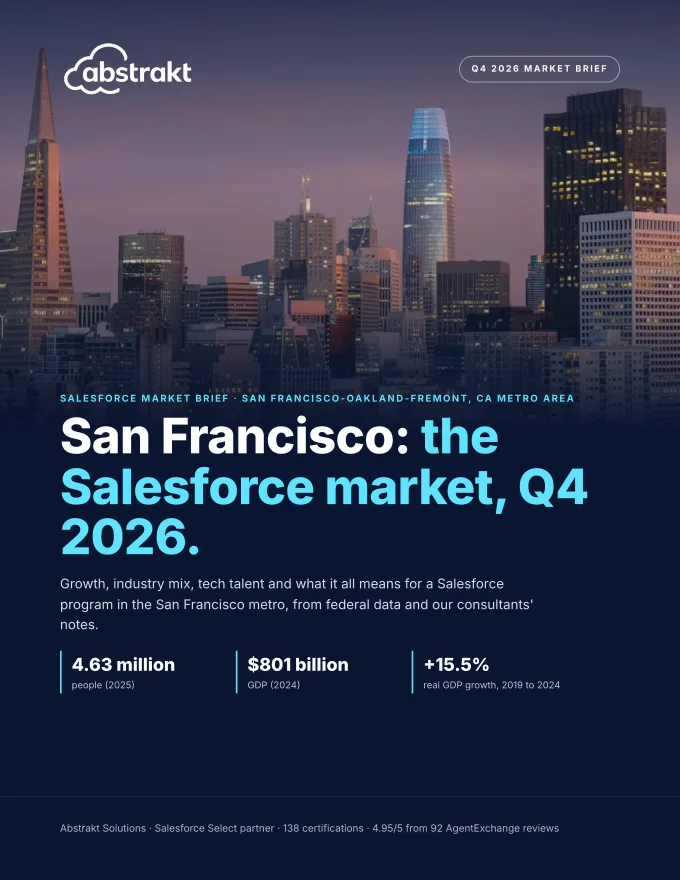
A free 25-page PDF with San Francisco Bay Area's growth ranked against 100 metros, its industry mix, tech wages and nearby markets. It is offered on the public San Francisco Bay Area page; send your customer there or get a copy for your own prep.
Get the San Francisco Bay Area brief →Co-sell with Abstrakt in San Francisco Bay Area
Working a San Francisco Bay Area account? Bring in a named consultant for discovery, scoping or a health check. We reply within 4 business hours.