

How Salesforce work starts in Sacramento
Abstrakt Solutions is a Salesforce Consulting Partner for health care, construction and consulting organizations throughout the Sacramento region, including Placer, Yolo and El Dorado counties. Sacramento is one of our focus markets.
What buyers here usually run into
- 1
Privacy-sensitive member and patient data
Health systems and health benefits companies need Salesforce designs where access, consent and clinical or claims integrations are right before launch.
- 2
Estimates versus actual costs
Contractors often can't see job costs against estimates until a project closes. Connecting estimating and field work in one system shows it while there is still time to act.
- 3
Public-sector clients and contracts
Firms that sell to government agencies manage long procurement cycles and contract records that generic pipeline stages don't capture well.
Budget, team and partner questions
What drives cost
In Sacramento, privacy design and procurement modeling drive cost. Health systems and benefits companies need access, consent and clinical or claims integration, and firms selling to public agencies need procurement stages and contract records. Contractors add field mobility and job-cost integration.
Admin or partner
Large health organizations often keep Salesforce ownership internal and use a partner for architecture and integration. Consulting firms and contractors more often outsource administration and keep one internal owner.
What buyers ask a partner
Ask for health care or health plan references, experience modeling public procurement, and how the partner connects estimating to job costs for contractors. Ask how they document access controls for privacy reviews.
The local economy and its biggest industries (4)
| Sector | Share of 2024 GDP | Where Salesforce fits |
|---|---|---|
| Health care and social assistance Salesforce for health & life sciences → | 9.8% | With several large health systems sharing the market, Salesforce work here often covers patient engagement, referral networks and contact centers, designed around privacy requirements. |
| Professional, scientific, and technical services Salesforce for professional services → | 7.0% | Consulting, engineering and technology firms, many serving public agencies, need pursuit tracking, contract history and delivery reporting in one system. |
| Construction Salesforce for construction → | 6.9% | Builders and specialty contractors across Sacramento, Placer, Yolo and El Dorado counties need estimating, job tracking and crew scheduling that office and field staff both use. |
| Finance and insurance Salesforce for insurance → | 4.5% | Health and vision benefits companies, insurers and credit unions need member service, broker and agent relationships, and compliant communications. |
Source: U.S. Bureau of Economic Analysis, GDP by county (CAGDP2), 2024, summed to the metro area; private sectors only, excluding real estate and government. “At least” marks sectors where BEA suppresses some county figures.
Regional target sectors named by local economic development groups: Semiconductors, Tech, Life science, Agri-food tech, Cleantech, Precision manufacturing.
Salesforce products that fit Sacramento (6)
In the order we lead with them here, from the industries above.
Salesforce Service Cloud
The operating system for modern customer service, case, knowledge, voice, and AI agent assist together.
Salesforce Sales Cloud
The CRM where sales pipeline lives, when it is built right.
Salesforce Field Service
Scheduling, dispatch, mobile work orders and parts for teams that work on site.
Salesforce Revenue Cloud / CPQ
Configure-price-quote, billing, subscription management, and quote-to-cash on Salesforce.
Salesforce Experience Cloud
Customer, partner, and employee portals built on Salesforce.
Salesforce Agentforce
AI agents that handle real work inside Sales Cloud, Service Cloud, and Marketing Cloud.
Sensible AI starting points for Sacramento organizations
Sacramento's private economy is anchored by health care, which accounted for 9.8 percent of metro GDP in 2024, followed by professional services at 7.0 percent and construction at 6.9 percent. All three handle heavy document flow. Care providers receive referrals, authorizations and forms that an AI agent can read and turn into structured case fields for staff to verify. Engineering and consulting firms can have proposal and scope questions drafted from prior project records. Contractors and specialty trades can give crews a mobile assistant in Field Service that surfaces job notes and safety procedures. What matters most is the groundwork: consistent record types, sharing rules that match job roles, and a knowledge library someone actually maintains.
- Referral and authorization form reading
- Proposal drafting from project history
- Crew assistant for job notes
Services buyers here usually need (7)
Salesforce Implementation in Sacramento
For many Sacramento-region companies, a first Salesforce implementation replaces a mix of spreadsheets, shared inboxes and an aging contact database. The design work centers on who the customer really is: a patient, an employer group, a public agency or a general contractor. We model those relationships first, then phase the build so the team feeling the most pain goes live first. Kickoff and launch workshops anchor the plan, and your team reviews each build and test cycle in between.
By industry in Sacramento
- 1
Health care and social assistance
At about 9.8% of 2024 GDP, hospitals, clinics and social-service providers form the biggest private slice of the Sacramento economy, and a handful of large systems deliver most hospital care there. Implementations for providers, clinics and the organizations that refer into them start with the patient and referral model, consent capture and role-based access, because those choices dictate every later screen and report. We typically launch contact-center intake first and add referral partner access in a later phase, once privacy reviewers have signed off on the sharing design.
- 2
Construction
Builders and specialty contractors across the four counties usually implement Salesforce to connect bidding with the work that follows. The data model has to hold projects, bids, general contractors and owners as distinct records, since one firm can play several roles over a year. We phase the build so estimators and project managers get pipeline and bid tracking first, then add Field Service scheduling or quoting only after the core records are trusted by the office and the field.
- 3
Professional, scientific, and technical services
Engineering, consulting and technical firms here frequently serve state and local agencies as well as private clients. Their implementation needs opportunity stages that mirror solicitations and awards, contract records with renewal dates, and a way to tie proposals to the staff who will deliver them. We design those objects in discovery with the people who write proposals, so the first release reflects public procurement instead of a generic business-to-business funnel borrowed from a template.
Raise before scoping
Define the customer before configuring
Sacramento organizations often serve several kinds of customer at once: patients and payers, agencies and private clients, growers and buyers. Agree on which of them are accounts, which are contacts and which are custom records before anyone configures a page layout, or reports will never reconcile.
Book workshops around your operation
Discovery and design sessions are booked when estimators, care coordinators or account leads can actually step away from daily work. Kickoff and go-live workshops bring the decision-makers together, so choices made there carry straight into the build.
Leave room for later clouds
A first release rarely includes everything. Name the phase-two candidates, such as Field Service for contractors or Experience Cloud for referral partners, during design, so the data model and sharing settings in phase one will accept them later without rework or a second round of migration.
Salesforce Health Checks in Sacramento
Years of changes by different admins and partners leave many Sacramento orgs hard to read, and a health check maps what is there. Our consultants examine permissions and sharing, data quality, custom code, automation, integrations and actual usage, then hold the configuration up against Salesforce's security baseline. The findings come back ranked by risk and effort, so leaders can decide what to fix now, what to schedule and what to leave. Organizations here that handle patient or member records often ask for one before expanding access to partners or turning on Agentforce.
By industry in Sacramento
- 1
Health care and social assistance
Health systems, clinics and care organizations in the region store sensitive information in Salesforce whenever intake, referrals or patient outreach run there. Our review for them traces who can view and export that information, checks field-level security on sensitive fields, tests sharing rules for unintended exposure and examines integration users, which often hold far broader access than any person would. Findings map to the specific setting involved, so privacy officers and admins can agree on fixes quickly.
- 2
Finance and insurance
Benefits companies, insurers and credit unions need to show examiners and auditors that customer data is protected. A health check for them covers login policies, multi-factor authentication, session settings, connected apps, field history and data retention, plus a review of how broker or agent portals share records. The report doubles as evidence for internal audit, showing what was reviewed, what was found and which fixes are already scheduled for the admin team.
- 3
Cleantech
Cleantech appears on GSEC's list of target sectors, and companies in it often grow through pilots and new product lines, adding Salesforce customizations at each stage. A health check measures that technical debt: unused fields, untested Apex, overlapping Flows and abandoned packages. It also checks whether incentive, permitting or project data is tracked consistently, which matters before the company adds forecasting, partner portals or AI that depends on that data being reliable.
Raise before scoping
Include integration and API users
The accounts that run integrations frequently carry wide permissions yet rarely get the scrutiny human users receive. Include every API user, connected app and managed package in scope, and confirm that each one still needs the access it holds and still has a named owner.
Check readiness before Agentforce
An AI agent works with whatever permissions, data and automation already exist. Before enabling one, confirm that duplicate records are under control, sensitive fields are protected and Flows do not conflict, so the agent's answers and actions reflect current, accurate information.
Assign owners to findings
A report without owners gathers dust. Before the review closes, agree which findings your admin will handle, which need a partner and which you accept as known risks, and set a date to revisit progress with the same scorecard used this time.
Salesforce Optimization in Sacramento
Optimization is for Sacramento companies that already run Salesforce and want more from it without starting over. The first step is watching people work: where they leave Salesforce for a spreadsheet, which fields nobody fills in and which reports get rebuilt by hand every month. From there we simplify page layouts, consolidate old workflow rules and Process Builder into Flow, and rebuild dashboards around the decisions managers make. Changes ship in small releases so each team adapts gradually rather than facing a new system overnight.
By industry in Sacramento
- 1
Retail trade
Retail trade accounts for about 6.4% of 2024 metro GDP, and retailers and dealers in the region often run Salesforce for customer service, loyalty or business accounts next to point-of-sale and e-commerce systems. Optimization for them usually targets case handling: better routing rules, macros for repeat questions, knowledge articles surfaced on the case and reports that show where customers wait longest. When those pieces work, agents stop keeping side notes and managers can staff to actual demand.
- 2
Professional, scientific, and technical services
Engineering, consulting and other technical firms produced about 7.0% of Sacramento-area output in 2024, by BEA's count. Firms in this group commonly find that utilization, pipeline and proposal data live in three places and never agree. We tidy the opportunity process, add required fields only where they feed a real report, automate proposal and renewal reminders and build a leadership dashboard that combines pipeline with backlog. Adoption tends to follow when consultants spend fewer minutes updating records after client meetings.
- 3
Agri-food tech
Agri-food tech is a GSEC target sector, and companies in it sell to growers, processors and buyers whose buying seasons rarely line up with the fiscal quarter. Optimization here often means reshaping forecasts around the growing season, cleaning up duplicate grower accounts created by field reps, and automating follow-up after trials or demonstrations so promising leads are not forgotten between harvests. Small fixes to mobile layouts also matter, since reps update records from fields and packing sheds.
Raise before scoping
Measure before you change
Pull login history, field fill rates and report usage before changing anything. The numbers show which features people ignore and which they depend on, and they give you a baseline to compare against after each optimization release, so improvement is measured rather than assumed.
Fix mobile before desktop
Contractors, agri-food field reps and home-health staff often reach Salesforce from a phone. Review the mobile layouts, quick actions and offline needs of those users early, because a desktop-only optimization leaves the people with the least patience for clumsy screens exactly where they started.
Train on what changed
Short, role-specific sessions covering what changed and why beat a full retraining. For teams spread across four counties, recorded walkthroughs plus a live question-and-answer session usually reach field staff and office staff alike, and the recordings help new hires catch up later.
Salesforce Integration in Sacramento
Most integration requests from Sacramento companies come down to one complaint: people re-key the same information into two or three systems. We map which system owns each piece of data, such as orders in ERP, job costs in accounting and patient details in the clinical record, then connect Salesforce through APIs, middleware such as MuleSoft or scheduled syncs, whichever fits the volume and risk. Every integration gets error handling and alerts, so an admin notices a failed sync before a sales rep or customer does.
By industry in Sacramento
- 1
Semiconductors
Chipmaking is a GSEC target sector, and the region's specialties include memory research and silicon carbide production. Chip companies and their equipment and materials suppliers typically integrate Salesforce with ERP for quotes, orders and shipments, and with engineering or quality systems for design-win and sample tracking. The integration design has to respect export controls and customer confidentiality, which usually means passing summaries into Salesforce rather than copying technical data wholesale.
- 2
Precision manufacturing
Precision manufacturing is another GSEC target sector, and machine shops and component makers here often run an ERP that holds routings, pricing and order status their reps cannot see. We connect those records to Salesforce so reps can check order progress and quote history without calling the plant, and so production planners see expected demand from the pipeline. Where volumes are modest, a scheduled sync is often enough; real-time connections are reserved for data that changes by the hour.
- 3
Construction
Builders, remodelers and specialty trades generated about 6.9% of Sacramento-area GDP in 2024, according to BEA county figures. Contractors usually need Salesforce connected to estimating software, project management tools and job-cost accounting, so an awarded bid moves into delivery without a second round of data entry. We define the hand-off point, often the moment a bid is marked won, and decide which fields flow back to Salesforce, such as percent complete or change-order value, so account managers can talk to repeat clients with current information.
Raise before scoping
Name a system of record
For every shared field, from customer address to contract value, decide which system owns it and which only reads it. Integrations without that rule end up overwriting good data with stale data, and nobody can say with confidence which version is correct.
Involve infrastructure teams early
Some regional manufacturers and health organizations still run ERP or clinical systems on premises. Connecting them to Salesforce may require a secure agent, VPN or middleware layer, so bring your infrastructure team into design early rather than discovering network restrictions during testing.
Budget for monitoring after launch
Expired passwords, retired API versions and renamed upstream fields all break integrations without any obvious warning. Assign someone to watch error logs and alerts after go-live, whether an internal admin or a managed services team, and review sync health every month.
Salesforce Managed Services in Sacramento
Managed services for Sacramento-area companies usually means taking a request queue off an overstretched admin or covering the gap left when that person moved on. We work through the backlog in priority order, test each of the three annual Salesforce releases in a sandbox, watch integrations for failures and ship small improvements every month. Your business owner sets priorities in a monthly review.
By industry in Sacramento
- 1
Finance and insurance
Health and vision benefits companies, insurers and credit unions in the region change products, broker contracts and renewal rules every plan year. Managed services gives them a steady team to update record types, renewal automation and broker portal permissions ahead of each enrollment season, with changes tested in a sandbox and documented for compliance staff. Member data access is reviewed whenever roles change, so a reorganization does not quietly widen who can see sensitive records.
- 2
Health care and social assistance
Clinics, care organizations and the service teams inside large health systems tend to generate a steady stream of small Salesforce requests: a new referral source, a revised intake question, a report for a quality committee. We handle those through a single tracked queue, check each one against privacy rules before it ships and keep a change log that compliance reviewers can read without a Salesforce login. Larger requests are scoped and scheduled in the monthly roadmap.
- 3
Tech
Tech is one of the Greater Sacramento Economic Council's target sectors, and younger software and hardware firms here often reach a point where a founder or sales-operations generalist has been running Salesforce on the side. Managed services lets them keep growing without hiring a full-time admin too early. We maintain lead routing, product and pricing updates and integrations with billing or product tools, and flag when the workload has grown enough to justify an internal hire.
Raise before scoping
Set a clear request process
Agree on when requests are handled and who can submit them. A shared queue with clear priority levels works better than direct messages, and it gives both sides a record of every change that was asked for.
Watch releases against busy seasons
Salesforce's three yearly releases can land close to open enrollment, contractor peak season or fiscal year-end for the agencies you sell to. We check release dates against your calendar and finish sandbox testing early whenever an update would otherwise arrive during your busiest weeks.
Leave the org better documented
Each managed month should leave the org easier to understand, not harder. We record the purpose of new fields, flows and integrations as we build them, so an internal hire, an auditor or another partner can pick up the work later without reverse-engineering it.
Salesforce Migration in Sacramento
A migration to Salesforce for a Sacramento company is mostly a data project. Records arrive from an older CRM, a desktop database, shared spreadsheets or several of these at once, and each source has its own duplicates, abandoned fields and naming habits. We profile the data first, agree on what to keep, merge and archive, then map it into the new model and run trial loads in a sandbox. Users check familiar accounts before cutover, so the first day in Salesforce starts with records they trust.
By industry in Sacramento
- 1
Finance and insurance
Finance and insurance represents about 4.5% of 2024 metro GDP, with benefits administrators, insurers and credit unions among the firms in it. Their migrations typically involve policy or member data in core systems, broker records in spreadsheets and years of email-based service history. We move the relationship data, link rather than copy the core policy records where possible, and carry over service history in a form that meets retention rules without cluttering the new org.
- 2
Life science
GSEC lists life science among the six sectors it is working to grow in the Sacramento region. Early-stage life science companies often begin with a spreadsheet of investigators, research partners and prospects that eventually outgrows its format. Migrating them means standardizing institution names, separating people from organizations and capturing research interests as structured fields, so a growing business development team can segment contacts instead of scrolling through a shared file that only its original author understands.
- 3
Construction
Contractors in the region commonly migrate from a construction-specific CRM, a bid-board tool or an estimator's own spreadsheet. The hard part is untangling companies that appear several times under slightly different names, and people who moved between firms but still sit under their old employer in the source data. We deduplicate before loading, rebuild the relationships between owners, general contractors and subcontractors, and bring over bid history so estimators can see past win rates on day one.
Raise before scoping
Decide what not to migrate
Plenty of legacy records have no business in the new org. Agree on cutoff rules, such as long-inactive accounts or leads that never responded, and archive the rest in a searchable export. Smaller, cleaner data loads are faster to test and easier for users to trust.
Map old fields to new purposes
Legacy systems accumulate fields whose meaning drifted over time. Walk through each source field with the people who use it, confirm what it now represents and decide whether it maps to a standard Salesforce field, a new custom field or nothing at all.
Plan a clean cutover weekend
Freeze edits in the old system, run the final load and have key users spot-check their own accounts before Monday. Keep the legacy system read-only for an agreed period, so anyone can confirm a detail without reopening it for edits or creating a second source of truth.
Salesforce Implementation Rescue in Sacramento
Stalled Salesforce projects tend to follow a familiar pattern: a build scoped for one department grew to cover several, the budget ran out before testing, and users went back to spreadsheets. For Sacramento organizations in that position, the first step is triage: reading the build, the original requirements and the defect list, and sitting down with the people who were supposed to use it. Then we fix whatever blocks daily work, decide component by component what to keep, and finish the build in smaller releases with users testing each one.
By industry in Sacramento
- 1
Health care and social assistance
Health organizations needing a rescue have often launched a patient service or referral project that front-line staff stopped using. Common causes include intake screens that do not match how calls actually flow, missing integrations with scheduling or records systems, and access rules so tight that nurses cannot see what they need. We fix access and intake first, then rebuild integrations in order of clinical impact, testing each change with the staff who handle patients.
- 2
Professional, scientific, and technical services
Consulting and engineering firms that sell to public agencies sometimes buy a project management add-on alongside Salesforce and find it never fit their procurement-driven pipeline. Rescue for them usually strips the data model back to accounts, pursuits and contracts, removes customizations that duplicate the add-on, and restores reporting on win rates and backlog. Once leadership trusts those numbers again, resource planning features can return in a later, carefully scoped release.
- 3
Tech
Tech companies in the region, one of GSEC's target sectors, sometimes let an early Salesforce build grow through quick fixes by whoever had time. By the time they ask for help, lead routing contradicts itself, forecast categories mean different things to different managers and a billing integration fails silently. Triage identifies which of those issues cost revenue today, stabilizes them first and then replaces the tangle of automation with a smaller, documented set of Flows.
Raise before scoping
Stabilize before adding scope
The temptation in a rescue is to deliver the missing features at the same time as the fixes. Resist it. Get the core process working, data flowing and users back in the system, then reintroduce deferred requirements through a prioritized backlog with clear owners.
Reset expectations with sponsors
Executives who approved the original project may have lost patience or confidence. Share the triage findings plainly, explain what will change about how the recovery is run, and agree on visible milestones measured in weeks so progress is obvious to people outside the project.
Win back users with small releases
Staff who abandoned the system need a reason to return. Choose early fixes that remove their biggest daily frustrations, involve a few respected users in testing, and announce each release in person or by short video so the change is noticed and credited.
Industry plays in Sacramento (4)
Salesforce for Sacramento Health and Life Sciences
Sacramento's health organizations work unusually close to government. Health systems and plans run outreach tied to public coverage programs, report to state agencies and compete for public and private employer contracts, while a young life science sector grows around university research. Salesforce can coordinate that work: tracking program outreach and grant commitments, managing employer and broker relationships, and organizing research partnerships. We design around privacy rules from the first workshop and integrate Salesforce with EHR, eligibility and enrollment systems that remain the systems of record.
Care providers and social assistance organizations produce 9.8% of Sacramento-Roseville-Folsom GDP, the largest private share in the Bureau of Economic Analysis's 2024 county figures, clearly ahead of professional services at 7.0%. The Greater Sacramento Economic Council includes life science among its six target sectors and describes the region as an emerging life science market anchored by a $1 billion university research park. The record also notes two major public universities in the region. As the state capital, Sacramento hosts large state government operations, so many health organizations here deal with public agencies as regulators, funders and customers at the same time.
Use cases to open with
- 1
Public program outreach tracking
Health systems, plans and community clinics often run outreach funded or required by public programs, such as enrollment assistance, preventive screenings and renewal reminders. Salesforce can manage target populations, outreach attempts by channel and language, and outcomes, then produce the reports that funders and state agencies request. Staff see which members still need contact, and leaders can show results without assembling spreadsheets.
- 2
Employer and broker relationships
Health plans and provider networks sell to public and private employers, often through benefits brokers. Sales Cloud can track each employer group's renewal date, plan mix, broker and service issues, and coordinate proposals across underwriting and account management. Service teams handle employer questions in the same record, so renewal conversations begin with a full picture of the group's experience during the year.
- 3
Research partnership management
Early life science and agri-food companies near the region's research institutions manage sponsored research agreements, licensing discussions, grants and investors. Salesforce can track each partnership's stage, obligations and deadlines, along with contacts at universities, funders and corporate partners. Founders gain one place to prepare board updates and follow up on commitments, instead of relying on inboxes and memory. Milestone reminders keep licensing and grant obligations from slipping.
Raise before scoping
Map public reporting requirements
Programs funded by state or county agencies often come with specific reporting formats and data definitions. Identify those requirements during discovery and design fields, outcomes and reports to match, so compliance reporting comes directly from Salesforce rather than manual reconciliation.
Protect PHI and member data
Health systems and plans handling PHI need HIPAA controls and a business associate agreement, plus California's own medical privacy and consumer privacy rules. Store only necessary data, apply role-based access, encryption and audit logging, and review design choices with privacy counsel.
Integrate eligibility and enrollment data
Outreach depends on accurate eligibility and enrollment information from core systems or state files. Plan secure, regular data loads, handle changes and terminations carefully, and define which system owns member status, so outreach lists do not target people who have left or were never eligible.
Salesforce for Sacramento Construction Firms
Sacramento contractors often balance public works for state and local agencies with private commercial, residential and energy projects. Each brings different bidding rules, documentation and customers. Salesforce helps them track bids and certifications, manage installation sales where a salesperson and crew both touch the job, and handle warranty and service after completion. Schedules, RFIs and job costing remain in the tools your project managers already run. We connect the systems so leaders see pipeline, backlog and margins together, and crews get mobile tools built for the field.
Construction makes up 6.9% of Sacramento-Roseville-Folsom GDP in the Bureau of Economic Analysis's 2024 county data, almost matching professional services at 7.0% and ranking third among private sectors after health care. The Greater Sacramento Economic Council targets semiconductors, cleantech, precision manufacturing, agri-food tech and life science, and says the region is home to nine of the world's largest semiconductor companies. State government operations in the capital add a steady stream of public-sector projects. Contractors here therefore serve public agencies, advanced industry facilities, health organizations and a clean energy market in the same region.
Use cases to open with
- 1
Public works bid tracking
Public projects come with prequalification, bonding, small business participation goals and strict submission deadlines. Salesforce can track each opportunity from advertisement through prebid meetings, subcontractor outreach, bid submission and award, and store certifications and required documents. Estimators see upcoming deadlines, and leadership sees win rates by agency and project type, which guides where to focus bidding effort. Bond capacity can be checked before committing to a bid.
- 2
Clean energy sales to installation
Solar, battery, EV charging and electrification contractors sell to homeowners and businesses, then schedule installation crews. Salesforce can manage leads, site assessments and proposals with CPQ, then hand off to Field Service for permitting tasks, installation scheduling and inspections. Customers receive status updates, and sales can see whether commitments made during the sale were delivered on schedule. Rebate and incentive paperwork can be tracked on the same job.
- 3
Warranty and service after completion
Completed buildings and installations generate warranty claims, maintenance requests and service contracts. Service Cloud can log requests from owners and tenants through a portal, verify warranty coverage, dispatch crews and track resolution. Service history for each project and system informs future bids, helps identify recurring installation or product issues and creates follow-on revenue opportunities. Owners can see open requests in a portal without calling the office.
Raise before scoping
Track public compliance requirements
Public projects in California carry prevailing wage, certified payroll, small business participation and documentation requirements. Decide which of these Salesforce tracks and which remain in payroll and project systems, and keep required documents linked to each bid and contract for audits.
Connect to job cost systems
Bid and sales data mean little without actual costs. Integrate Salesforce with accounting and construction management platforms to bring contract value, change orders and final costs back to each opportunity, so estimators and leaders can compare bid assumptions with real results.
Keep mobile work simple
Crews and installers work in attics, rooftops and job sites with limited time. Give them short mobile flows for photos, checklists, signatures and time, with offline support where coverage is poor, and test with real crews before rollout. Photos should attach to the job automatically.
Salesforce for Sacramento Professional Services Firms
In California's capital region, public agencies are often an important client group for professional services firms, alongside health systems, builders and technology companies. Salesforce fits when it follows the public procurement rhythm: watching for solicitations, recording bid decisions and teaming partners, and tracking master agreements with their ceilings, amendments and individual task orders. Staffing forecasts draw on that pipeline. We connect Salesforce to time and project accounting so leaders can compare contract burn against remaining value before an agency asks why.
Professional, scientific and technical services generate 7.0% of Sacramento-Roseville-Folsom output in the Bureau of Economic Analysis's 2024 county figures, second among private sectors after health care at 9.8% and just ahead of construction at 6.9%. Each sector on the Greater Sacramento Economic Council's priority list, from chips and cleantech to agri-food tech and precision manufacturing, buys engineering, testing and advisory help from outside firms. The research record mentions two major public universities in the region and an emerging life science market around a university research park. Beyond those targets, the region's role as the seat of state government makes public-sector clients a recurring theme for local firms.
Use cases to open with
- 1
Solicitation tracking and bid decisions
Firms selling to public agencies monitor procurement portals for requests for proposals, qualifications and bids. Salesforce can log each solicitation with the agency, due dates, evaluation method, required certifications and teaming partners, then run a structured go or no-go review. Proposal managers work from one calendar, and leadership compares win rates by agency, contract type and proposal lead each year.
- 2
Master agreements and task orders
Public contracts often set a ceiling and period of performance, with work released through separate task orders. Salesforce can model the master agreement with its amendments and ceiling, and link each task order with its own budget and dates. Account leaders see remaining capacity on every vehicle, and alerts warn when a contract nears its ceiling or expiration so renewals start early.
- 3
Private clients in target industries
Firms diversifying beyond government pursue clients in semiconductors, life science, cleantech and agri-food tech. Sales Cloud and Marketing Cloud can segment prospects by industry, track engagement with case studies and events, and hand interested contacts to the right practice lead. Leaders compare private-sector pipeline growth against public work to guide hiring and marketing investment across both segments, and to reduce exposure to any single agency's budget cycle.
Raise before scoping
Model public contract structures
Ceilings, amendments, task orders, retention and prevailing-wage or small-business requirements rarely fit standard opportunity fields. Design contract and task order objects deliberately, decide what finance maintains versus what Salesforce holds, and test reports against a few complex agreements before migrating everything.
Respect public records and ethics
Communications with agency staff may be subject to public records requests, lobbying rules and procurement blackout periods. Configure activity logging and reminders with those rules in mind, and have counsel confirm how long records must be kept and what your staff may discuss during active solicitations.
Tie pipeline to staff capacity
Public awards can arrive in clusters when budget cycles close. Forecast staffing needs by role from weighted pipeline and signed task orders, so delivery leaders see crunch periods ahead and can plan subcontracting or hiring instead of scrambling after several awards land in the same month.
Salesforce for Sacramento Insurers and Agencies
Insurance in the Sacramento region leans toward health coverage and employee benefits alongside property and casualty agencies serving local employers. Salesforce helps benefits brokers manage employer groups through renewal and open enrollment, helps coverage organizations handle member questions with privacy controls, and helps agencies track commercial renewals and producer activity. We design access around health and personal data from the start and integrate with agency management, enrollment and claims systems so service teams answer questions without switching screens.
Finance and insurance is the smallest of the five private sectors the Bureau of Economic Analysis lists for the Sacramento-Roseville-Folsom metro, at 4.5% of 2024 GDP, and the Greater Sacramento Economic Council does not include it among its targets. The industry shows up most clearly through health care, which leads the private economy at 9.8%. The research record draws on a regional health-market report covering the same four counties, and the market's challenges highlight health benefits companies that need careful handling of member and claims data. For agencies and brokers, the metro's leading private sectors, health care, professional services and construction at 6.9%, are natural sources of employer clients.
Use cases to open with
- 1
Employer group renewals and enrollment
Benefits brokers manage renewals for employer groups months before plan years begin, with census updates, carrier quotes, plan comparisons and open enrollment support. Financial Services Cloud can open a renewal workflow for each group, track carrier submissions and employer decisions, and schedule enrollment meetings. Account managers see which groups are behind schedule, and leadership reviews retention and revenue by segment.
- 2
Member service with privacy controls
Health coverage organizations field questions about eligibility, benefits, claims and providers. Service Cloud can route inquiries by topic and member segment, show agents only the data they need and guide them with knowledge articles. An Agentforce agent can answer routine questions, such as ID card requests or network lookups, and hand sensitive issues to trained staff with the conversation summarized.
- 3
Commercial account renewals
Property and casualty agencies serving construction firms, professional practices and health care employers need organized renewals and cross-selling. Salesforce can track exposures, carrier submissions and quotes, stewardship meetings and coverage gaps, while producers see their book, upcoming renewals and cross-sell opportunities in one place. Service teams handle certificates and endorsements from the same account record, so producers know about every change before the renewal meeting.
Raise before scoping
Protect health and personal data
Benefits and member data can include protected health information and sensitive personal details. Sign a business associate agreement where applicable, limit access by role and line of business, avoid free-text health details, and have counsel confirm HIPAA and California privacy obligations before migration.
Integrate enrollment and policy systems
Eligibility, enrollment, claims and policy data live in carrier, administration and agency management systems. Decide what Salesforce displays, how often it refreshes and how members, employees and employer groups are matched, and test with realistic records, including dependents and mid-year changes, before launch.
Plan for open enrollment peaks
Benefits service volume spikes around open enrollment and plan-year changes. Build routing, self-service and knowledge content that handle peak demand, test with expected volumes, and give supervisors real-time dashboards so they can move staff between queues quickly when a carrier change or plan redesign triggers a wave of questions.
Case studies to send (3)
From the industries this market leans on. Client names are anonymized and these projects are not specific to Sacramento.
The Sacramento Salesforce market brief, Q4 2026
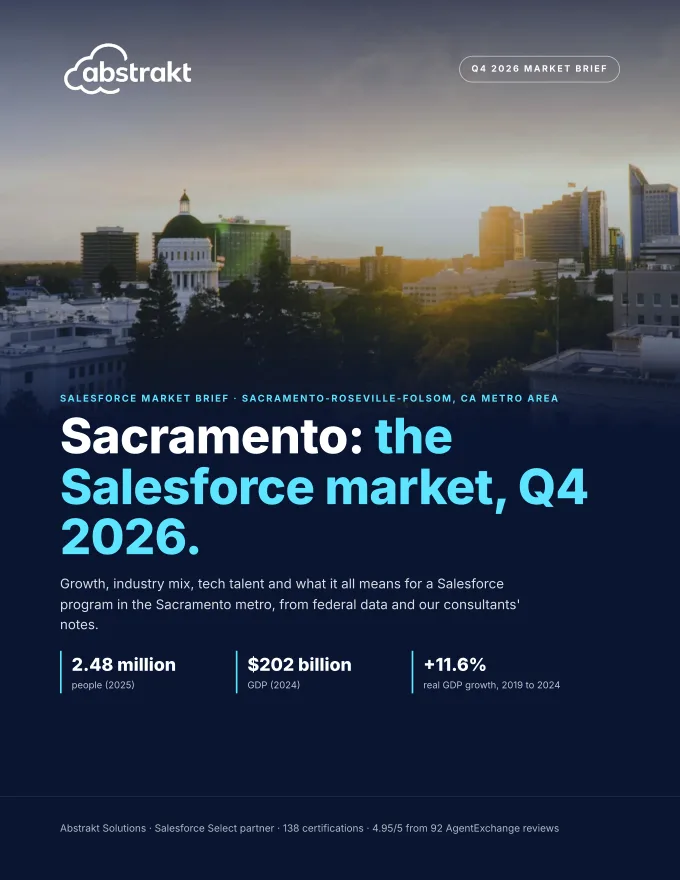
A free 23-page PDF with Sacramento's growth ranked against 100 metros, its industry mix, tech wages and nearby markets. It is offered on the public Sacramento page; send your customer there or get a copy for your own prep.
Get the Sacramento brief →Co-sell with Abstrakt in Sacramento
Working a Sacramento account? Bring in a named consultant for discovery, scoping or a health check. We reply within 4 business hours.