

How Salesforce work starts in Stockton
Our Salesforce consulting in San Joaquin County covers logistics operators, food and agriculture businesses, health providers and contractors from Stockton to Lodi and Tracy. Stockton is one of our focus markets.
What buyers here usually run into
- 1
Operations data outside the CRM
Logistics and distribution companies often keep shipment, inventory and billing data in operational systems, so sales and service teams work without the full picture.
- 2
Seasonal and contract-driven sales
Agriculture and food businesses sell through seasonal contracts and long buyer relationships that generic sales stages rarely fit.
- 3
Construction estimates versus actuals
Industrial construction and field-service firms need estimates, crews and job costs in one place to see whether a project is on budget.
Budget, team and partner questions
What drives cost
Stockton cost drivers are mostly integration: how many WMS, TMS and ERP connections are needed and how much event filtering they require. Food processors add grower contract modeling and lot traceability, and wholesalers add portal work. Health providers spend more on privacy design than on configuration.
Admin or partner
Larger logistics operators and health organizations here may keep an internal admin and use a partner for integration and new sites. Processors, wholesalers and contractors more often rely on managed services until the workload supports a dedicated hire.
What buyers ask a partner
Ask for experience with warehouse and transportation system integration, seasonal grower contracts, or B2B portals, depending on your business. Ask how the partner monitors integrations after go-live and who is alerted when one fails.
The local economy and its biggest industries (4)
| Sector | Share of 2024 GDP | Where Salesforce fits |
|---|---|---|
| Transportation and warehousing Integration → | 11.3% | E-commerce fulfillment and grocery distribution centers anchor the county’s largest private sector. Carriers and 3PLs here need shipper account management, quoting and case handling tied to transportation and warehouse systems. |
| Manufacturing Salesforce for manufacturing → | 8.4% | Food processors and producers tied to the county’s agriculture manage buyer contracts, grower relationships and quality issues across seasons. |
| Health care and social assistance Salesforce for health & life sciences → | 8.1% | The Stockton hospitals and the county hospital in French Camp, along with a health plan employing people in Lodi, need patient or member service, referrals and outreach designed around privacy rules. |
| Wholesale trade Experience Cloud → | 7.1% | Wholesalers such as the medical-supply distributor listed in Tracy need account plans, order visibility and B2B self-service for their customers. |
Source: U.S. Bureau of Economic Analysis, GDP by county (CAGDP2), 2024, summed to the metro area; private sectors only, excluding real estate and government. “At least” marks sectors where BEA suppresses some county figures.
Regional target sectors named by local economic development groups: Transportation and Logistics, Health Care, Agriculture, Technology, Industrial Construction.
Salesforce products that fit Stockton (6)
In the order we lead with them here, from the industries above.
Salesforce Sales Cloud
The CRM where sales pipeline lives, when it is built right.
Salesforce Service Cloud
The operating system for modern customer service, case, knowledge, voice, and AI agent assist together.
MuleSoft
Enterprise API platform, for connecting Salesforce, ERP, data warehouses, and the rest of your stack.
Salesforce Field Service
Scheduling, dispatch, mobile work orders and parts for teams that work on site.
Salesforce Experience Cloud
Customer, partner, and employee portals built on Salesforce.
Salesforce Revenue Cloud / CPQ
Configure-price-quote, billing, subscription management, and quote-to-cash on Salesforce.
Stockton logistics and AI: a grounded starting point
Transportation and warehousing is Stockton's largest private sector, at 11.3 percent of metro GDP in 2024, with manufacturing at 8.4 percent and health care at 8.1 percent. Warehouse and freight operators field constant questions about shipments, appointments and damages; Agentforce can read those requests, check the related records and draft a status reply for a coordinator. Agricultural processors and manufacturers can use AI to classify incoming orders and flag unusual ones. Dispatchers can equip technicians with a mobile assistant that pulls up machine procedures. Health care providers can apply case summaries to patient service requests. Shipment, customer and asset records must be connected and current, or the agent will answer from incomplete information.
- Shipment and damage status replies
- Unusual order flagging for processors
- Equipment procedure help for technicians
Services buyers here usually need (7)
Salesforce Implementation in Stockton
A Stockton implementation often has to represent relationships that a standard sales pipeline ignores: a processor buying from growers while selling to grocers, a builder bidding on a warehouse that will take many months to finish. We start by modeling those parties and cycles, agree which records live in Salesforce and which stay in the ERP or project system, and release in stages. Discovery workshops with each team open the project, and go-live comes with training by role.
By industry in Stockton
- 1
Manufacturing
Manufacturing supplies about 8.4% of the county's 2024 GDP, much of it food processing tied to the surrounding farmland. A processor implementing Salesforce needs two sides of the model working together: grower contracts and acreage on the supply side, retail and food-service buyers on the demand side. We design custom objects for contracts and lots, link quality complaints to lot numbers, and bring buyer opportunities into Sales Cloud so leadership sees both halves of the business at once.
- 2
Agriculture
Agriculture is one of the industries San Joaquin County's economic development office highlights, and agribusinesses here run on seasons rather than quarters. Implementation means modeling farms, ranches and fields as related accounts, timing campaigns and visits to planting and harvest, and giving field representatives a mobile layout that works where signal fades between orchards. We keep the first release to the records reps will actually update, so the system reflects the season rather than trailing behind it.
- 3
Industrial Construction
Industrial construction is on the county's list too, reflecting the warehouses and distribution buildings that keep going up across the valley. For contractors, Salesforce implementation centers on bids, estimates, subcontractor relationships and the handoff from sales to project delivery. We connect opportunities to project records, track estimate versions, and, when crews need scheduling, add Field Service in a later phase so the core bidding process is stable before job-site work moves into the system.
Raise before scoping
Model the season explicitly
Agricultural and food businesses in the county plan around harvest windows, not calendar quarters. Build season or crop-year fields into opportunities, contracts and campaigns from the start, so reports compare like with like and forecasts do not mislead leadership every spring.
Separate supply and demand
Processors buy from growers and sell to retailers, and the two relationships need different stages, owners and permissions. Plan distinct record types or objects for each side early, rather than forcing growers into the customer pipeline and untangling the reports after launch.
Test with the people who do the work
Field reps, dispatchers and project managers use Salesforce in very different conditions. Include a few of each in user acceptance testing, on their own devices and in their own settings, so problems with mobile layouts or slow screens surface before launch rather than after.
Salesforce Integration in Stockton
Integration is central to Salesforce work in Stockton because the county's businesses run on operational systems. Carriers and warehouse operators track shipments in a TMS and WMS, processors run production and lots in an ERP, and builders manage jobs in project software. We decide what customer-facing teams need from each, which system owns every shared record, and how often data must move. Then we build with MuleSoft or native APIs, adding error alerts and a monitoring dashboard.
By industry in Stockton
- 1
Transportation and warehousing
Transportation and warehousing is the county's largest private sector, about 11.3% of 2024 GDP, anchored by e-commerce fulfillment and grocery distribution. For 3PLs and carriers, integrations should give account managers daily volume, on-time performance, claims and billing exceptions without importing every scan event. We aggregate operational data on a schedule, open cases automatically for exceptions that need a customer response, and surface shipper-specific metrics that make quarterly reviews and renewal negotiations far more concrete.
- 2
Manufacturing
Food processors and other manufacturers here need Salesforce and the ERP to agree on customers, products, pricing and lots. Sales wants order status and shipping dates on the account page; quality teams want complaints linked to production lots. We build the product and customer sync first, then order visibility, then lot lookups for service cases, using MuleSoft when several systems need the same data rather than wiring each pair together separately.
- 3
Industrial Construction
Industrial builders often keep estimates in one tool, project schedules in another and accounting in a third. Integration brings the winning bid from Salesforce into project setup automatically, then returns budget and progress summaries so sales and leadership can see how awarded work is performing. We limit the data returned to what supports customer conversations and future bids, leaving detailed cost tracking in the construction and accounting systems where it already belongs.
Raise before scoping
Aggregate before importing
Logistics systems produce enormous transaction volumes. Decide which totals, exceptions and trends account managers need, calculate them outside Salesforce or in the middleware layer, and import the summaries, keeping storage costs reasonable and pages fast while leaving detail in the WMS or TMS.
Align product and lot keys
Processors often find that product codes, pack sizes and lot numbers differ between systems. Agree on shared identifiers and cleanse them before building, because an integration cannot reliably connect records that each system describes in its own way, and fixing mismatches later means reprocessing history.
Monitor from day one
Build alerts, retry logic and a simple health dashboard into the first release, not a later phase. When a warehouse feed stops at night, someone should know by morning, and users should see when data was last refreshed so they can judge its accuracy.
Salesforce Optimization in Stockton
Optimization in Stockton usually begins with a complaint that Salesforce takes more effort than it returns. Distributors, retailers and agribusinesses here, with retail trade alone at about 7.4% of metro GDP, often built their orgs quickly and then layered on fields, automation and reports as needs changed. We measure what is used, simplify screens and list views, replace tangled automation with fewer well-documented Flows, fix duplicate records, and rebuild the reports managers use for weekly decisions.
By industry in Stockton
- 1
Wholesale trade
Wholesalers in the county, including distributors of medical supplies and food, often run Salesforce with pricing, order and account data partly synced from an ERP and partly entered by hand. Optimization clarifies which fields are system-fed and locks them, removes manual duplicates, and redesigns account pages so inside sales sees open orders, credit status and recent cases in one glance. Automation that sends redundant notifications gets consolidated, which quiets inboxes and restores attention to real alerts.
- 2
Agriculture
Agricultural businesses frequently adopted Salesforce with generic sales stages that never matched seasonal buying. Reps skip stages, forecasts drift, and managers stop trusting the pipeline. We redesign stages and fields around the crop year, add season-aware reports, and simplify mobile layouts for representatives visiting ranches and packing houses. Where growers and buyers were mixed in one list, we separate them with record types so each team sees only what it works on.
- 3
Health care and social assistance
Hospitals and clinics in and around Stockton often use Salesforce for outreach and referrals, and after a few years their orgs carry duplicate provider records, outdated campaign lists and reports built on inconsistent fields. Optimization merges duplicates with care for history, standardizes referral sources, and rebuilds dashboards that show which relationships generate appointments. We also review page layouts for liaisons so the fields they fill in during visits are limited to what the reports actually use.
Raise before scoping
Lock system-fed fields
When ERP or warehouse data flows into Salesforce, users editing those fields by hand creates silent conflicts. Mark integration-owned fields read-only, label them clearly and explain the change, so everyone knows which numbers come from operations and which are theirs to maintain.
Fit reports to the season
Comparing this month with last month misleads businesses whose volume follows harvests and holidays. Build reports that compare the same period across seasons, so managers in agriculture, food and distribution judge performance against the right baseline and stop chasing false alarms.
Trim before you add
Before building new features, remove unused fields, retired automation and stale reports. A smaller org is faster to use, cheaper to maintain and easier to extend, and the cleanup often reveals which requested features were really workarounds for existing clutter.
Salesforce Managed Services in Stockton
Managed services for Stockton companies is mostly about keeping a live Salesforce org useful as operations change. A 3PL signs a new shipper, a clinic adds a program, a young tech firm changes its pricing, and each change lands on whoever administers Salesforce. We take that queue, maintain Flow automation and the integrations to warehouse or billing systems, test each Salesforce release in a sandbox, and review a ranked backlog with your internal owner every month.
By industry in Stockton
- 1
Transportation and Logistics
Transportation and logistics tops the county's list of highlighted industries, and carriers and warehouse operators here rely on Salesforce for shipper accounts, onboarding and claims. Their managed services needs center on integrations: watching the connection to the WMS or TMS, fixing mappings when a new facility or service is added, and adjusting case routing as volumes shift. We keep a runbook for each connection so small failures are resolved quickly rather than escalating into billing disputes.
- 2
Health Care
Health care is another highlighted county industry, and providers and health plans in the area manage member service, referrals and outreach in Salesforce. Managed services for them means disciplined change control: every new field or report reviewed against privacy rules, user access reconciled as staff change roles, and intake processes regression-tested before each Salesforce release. We document changes in terms your compliance staff can read and keep an audit trail of who approved what.
- 3
Technology
Technology is on the county's highlighted list, and a Stockton innovation hub supports emerging ventures in health care, agri-business and sustainable construction technology. Startups in those areas rarely have a Salesforce specialist, yet their pricing, packaging and sales processes change often. Managed services lets them adjust stages, products and dashboards as the business evolves, with an experienced consultant guarding the data model so quick changes today do not become expensive cleanup next year.
Raise before scoping
Protect integration health
In a logistics-heavy county, the connections between Salesforce and operational systems are where support time goes. Agree on monitoring, alert recipients and response expectations for each integration, and review error trends monthly, so recurring failures are fixed at the root instead of patched every week.
Schedule releases around peak volume
Warehousing, agriculture and health operations each have stretches when a disrupted screen is expensive. Keep a shared calendar of peak shipping, harvest and enrollment weeks, and hold nonurgent deployments until those windows pass, while still fixing anything that stops work.
Document as you go
Every change we make is logged with the request, the reason and the approver. That record protects you if staff change, helps auditors in regulated areas like health care, and means any future admin or partner can understand the org without reverse-engineering it.
Salesforce Health Checks in Stockton
A Salesforce health check for a Stockton organization gives an honest picture of risk and waste before the next investment. The review touches nothing in production; it inspects record visibility, portal exposure, the logins connected systems use, the state of Flow and Apex, record quality and paid-for licenses nobody opens. You receive them sorted so the dangerous and the cheap-to-fix rise to the top. Care providers usually care most about access to protected information, while logistics firms tend to find their exposure in integrations built quickly and never revisited.
By industry in Stockton
- 1
Health care and social assistance
Health care and social assistance is about 8.1% of metro GDP, and the county's hospitals, clinics and a health plan with local staff handle protected information daily. The health check examines who can view, report on or export health-related records, whether field-level security matches your privacy policies, how portals and public forms are secured, and whether audit tools would let you trace access after an incident. Findings are written for compliance staff, not only administrators.
- 2
Technology
Technology firms in the county often build fast and customize heavily. The health check measures that technical debt: Apex without meaningful tests, unused managed packages, duplicated automation and connected apps with generous OAuth scopes. It also reviews how sandboxes handle production data, which is a common blind spot. Each finding comes with a rough effort estimate so founders and engineering leads can weigh cleanup against new features on the product roadmap.
- 3
Transportation and Logistics
A typical valley carrier or warehouse operator has wired its CRM into dispatch, yard and invoicing software, each connection signing in under a separate service login. The review checks those accounts for excessive permissions, looks for credentials tied to departed staff or former vendors, and tests whether shipper portals could expose one customer's data to another. We also examine case automation for loops and conflicts that slow agents during peak volume, which often appear only when the org is under load.
Raise before scoping
Test external sharing carefully
Portals for shippers, patients or partners are powerful but easy to misconfigure. A health check should test what an external user can actually query, not just what the page layouts show, because exposure often hides in sharing sets, reports and guest profiles.
Measure debt, not just risk
Security gaps get attention, but technical debt quietly raises the cost of every future change. Counting unused fields, overlapping automation and untested code gives leadership a realistic view of what maintaining the org really costs over time and where simplification would pay back fastest.
Assess AI readiness honestly
Whatever an AI assistant says is only as good as the articles and customer records beneath it. If those are messy, results will be too. A health check reports on data quality and access specifically for AI use, so a pilot is scoped around what your data can support.
Salesforce Migration in Stockton
Migrations in the Stockton area usually involve data that grew up alongside the business rather than inside a formal CRM. Distributors keep customer and pricing details in accounting add-ons, agribusinesses track growers and buyers in spreadsheets, and startups outgrow free tools. We gather every source, map it to a Salesforce design built for your process, clean and deduplicate in staging, rehearse the load in a sandbox, and schedule the cutover away from harvest and peak shipping periods.
By industry in Stockton
- 1
Wholesale trade
Wholesale trade makes up about 7.1% of the county's 2024 GDP, and distributors here often run customer records inside accounting or ERP add-ons that were never meant to be a CRM. Migration means separating true customers from ship-to locations, consolidating contacts, and bringing enough order history into Salesforce for reps to see buying patterns. Pricing agreements that live in PDFs or email become structured fields, so they can be reported on and enforced consistently.
- 2
Agriculture
Agricultural businesses migrating to Salesforce typically carry spreadsheets organized by season, crop or field representative rather than by customer. We restructure that data into farms, ranches and contacts, attach historical contracts to the right seasons, and standardize names that vary from sheet to sheet. The goal is a record for each grower or buyer that shows the whole relationship, rather than a new system that simply mirrors the old spreadsheet tabs.
- 3
Technology
Young technology firms in the county, including ventures working in health care, agri-business and construction technology, often start with free CRM tools and move to Salesforce when investors or enterprise customers expect more. Their data volume is small, so the real work is design: choosing objects and fields that will scale, bringing over deal and contact history cleanly, and avoiding replicating every improvised field the starter tool accumulated over its short but busy life.
Raise before scoping
Separate customers from locations
Distributors and processors often store each delivery point as its own customer. Decide how parent accounts, ship-to sites and billing entities relate before loading, so reports show real customers and reps stop tripping over near-duplicate accounts created by a location structure.
Choose a quiet cutover window
Harvest, holiday shipping and year-end all strain teams in San Joaquin County. Plan the final migration for a slower period, with time afterward for training and questions, so users adopt Salesforce without juggling it against their heaviest workload of the year.
Keep a searchable archive
Years of stale detail can slow a fresh org. Agree on a cutoff for detailed history, archive the rest in a searchable format, and tell users where to find it. That keeps the new org fast while protecting information you may need for audits.
Salesforce Implementation Rescue in Stockton
Rescuing a Salesforce project in Stockton usually starts with separating what is broken from what was simply never finished. Builds here often stall on integrations with warehouse, ERP or project systems, or launch with a sales process that does not fit seasonal or project-based work. We review the org, contracts, backlog and data, interview sponsors and users, and deliver a triage report with stabilizing fixes, keep-or-replace decisions and a plan to complete the work.
By industry in Stockton
- 1
Industrial Construction
Construction-related projects often stall when Salesforce was configured like a standard sales pipeline for businesses that win work through bids, change orders and long project timelines. Estimators stop updating opportunities, and leadership loses sight of the backlog. In a rescue we redesign stages around bid milestones, add a simple project handoff, and reconnect estimate data so the pipeline reflects real awarded and pending work before any further scope is added.
- 2
Manufacturing
Food processing and manufacturing projects in the county sometimes fail because the ERP integration promised in the original plan never arrived. Reps are asked to enter orders twice or work without order visibility, and adoption collapses within the first season. Our rescue prioritizes a minimal, reliable data feed for order status and product data, then revisits quoting or lot tracking once users trust that the numbers in Salesforce match the ERP.
- 3
Transportation and warehousing
Logistics projects stall when service processes were designed around a generic help desk rather than shipments, claims and facilities. Cases pile up without context, and agents return to email. We rebuild case types and routing around how exceptions actually arrive, attach cases to shippers and facilities, and add the operational data agents need. Recovering case history already in the org usually helps convince skeptical users that the effort is worth it.
Raise before scoping
Separate unfinished from broken
Many troubled projects mix genuinely flawed design with work that was simply never completed. Distinguishing the two avoids rebuilding sound pieces, focuses budget on real problems, and gives sponsors a more accurate picture of how far the project actually is from done.
Revisit the original scope
Scope written before discovery often promised too much. Compare the contract with what the business needs now, drop items that no longer matter, and agree on a smaller finish line that delivers value sooner and restores momentum for later phases.
Show progress every week
After a failed start, sponsors and users need proof that recovery is working. Weekly demonstrations of fixed issues, even small ones, rebuild credibility faster than status reports and keep the project visible to leadership throughout the rescue, which protects its budget.
Industry plays in Stockton (3)
Salesforce for Stockton Manufacturers
Manufacturers around Stockton and Lodi typically sell to large customers who care as much about delivery as about product. Salesforce works when it combines contract volumes, pricing, production status and freight into a single account view. We model supply agreements and forecasts, build quoting that accounts for delivered cost, and connect order and shipment data so customer service answers questions without chasing the plant or the carrier. The design stays practical for teams that also run production.
San Joaquin County and the Stockton-Lodi metro are the same territory, and there the Bureau of Economic Analysis credits factories and processing plants with 8.4% of 2024 output. Transportation and warehousing is the largest private sector at 11.3%, and San Joaquin County Economic Development highlights transportation and logistics, agriculture, industrial construction and technology among its industries. In that mix, manufacturers share the county with growers and large logistics operations, so commercial conversations regularly involve delivered pricing, seasonal volumes and logistics partners as much as the product itself.
Use cases to open with
- 1
Supply agreements and forecasts
Processors and manufacturers often sell under annual or seasonal supply agreements with committed volumes and price adjustment terms. Sales Cloud can store each agreement with its schedule, pricing tiers and actual shipments pulled from ERP. Account teams see where customers are running ahead of or behind commitment, and planning gets an early warning when forecasted demand shifts before the next production run.
- 2
Quotes that include delivered cost
When freight is a large share of total cost, quotes that ignore delivery terms lose money or lose deals. CPQ can combine product pricing with freight lanes, packaging options and minimum order rules, then route exceptions for approval. Sales reps quote accurately without calling logistics for every request, and margin reports reflect what the company really earns once product reaches the customer's dock.
- 3
Shipment-aware customer service
Most customer questions concern when an order will arrive or why it came up short. With ERP, warehouse and carrier feeds connected, a Service Cloud agent can trace an order from the production line to the receiving dock without leaving the case. Agents resolve most inquiries in the first contact, log claims with photos and proof-of-delivery documents, and flag recurring carrier problems to logistics before they turn into account-level problems.
Raise before scoping
Seasonal peaks and staffing
Harvest and holiday peaks bring spikes in orders, questions and temporary staff. Plan simple layouts, clear queues and quick training materials so short-term employees can work in Salesforce without long onboarding, and load-test integrations for peak volumes before the season starts.
Food safety and traceability
Food and beverage processors must trace lots from supplier to customer. Salesforce should reference lot and shipment data held in ERP or quality systems so service teams can respond to customer questions and recalls, while regulated records stay in systems built for them.
Logistics partner data
Third-party warehouses and carriers each report status in their own way and on their own schedule. Standardize the handful of milestones you care about, agree on update frequency and decide which system customers should trust, or service agents will end up relaying conflicting information to the same buyer.
Salesforce for Stockton Health Systems
Health organizations in the Stockton-Lodi area serve a growing, diverse county where many patients juggle work schedules, transportation and language needs. Salesforce helps them coordinate access and follow-up beyond the clinical visit. Service Cloud centralizes scheduling help and referral intake, Marketing Cloud runs consented reminders in patients' preferred languages, and Experience Cloud offers self-service for patients and referring offices. Community programs can track enrollments and outcomes, while the EHR remains the record for clinical care.
Care delivery ranks third in the Stockton-Lodi economy: the BEA's 2024 county series puts health care and social assistance at 8.1%, behind freight-and-warehouse activity and factory output. Since the metro and San Joaquin County share the same boundary, that number describes the whole service area most local providers cover. County economic development staff single out health care as one of five featured industries. A Stockton-based innovation hub focuses on health care, agri-business and sustainable construction technology, and a private university founded in 1851 runs its 175-acre main campus in Stockton with 9 schools and colleges.
Use cases to open with
- 1
Access center coordination
A patient in Tracy or Manteca may dial three different clinic numbers before reaching someone who can move an appointment. Service Cloud gives a central access team one console with the patient's open requests, preferred language and contact preferences, pulled from the EHR where appropriate. Requests route to the right clinic or department, and managers see wait times and abandonment by location and hour.
- 2
Multilingual reminders and outreach
Missed appointments and overdue screenings cost health systems revenue and patients their health. Marketing Cloud can send appointment, preventive care and vaccination reminders in the patient's preferred language by text or email, based on consent. Responses flow back to Salesforce, so outreach staff can call patients who did not confirm, and program managers measure which messages, channels and send times actually change behavior for shift workers, long-distance commuters and older patients.
- 3
Community program enrollment
Health organizations often run programs for chronic disease management, maternal health or social needs screening with community partners. Salesforce can track enrollments, referrals to partner agencies, follow-ups and outcomes, and Experience Cloud lets partners update referral status. Grant and program reporting then comes from live records instead of spreadsheets rebuilt every quarter by overworked coordinators, and leaders can see which partner referrals closed the loop and which families dropped out after the first contact.
Raise before scoping
Privacy for sensitive data
Loading any patient data means signing a BAA and restricting fields by role. Social needs and behavioral health information may carry extra restrictions under state law. Agree with your privacy officer which data enters Salesforce, who sees it and how partner access is limited.
Language and consent tracking
A diverse patient population means tracking preferred language, communication channel and consent for each type of message. Build these fields into the data model early, translate templates with clinical review, and make sure opt-outs sync across every tool sending messages.
EHR integration boundaries
Scheduling, demographics and referral status usually originate in the EHR. Decide what Salesforce reads, what it writes back and how often, and use MuleSoft or vendor interfaces rather than manual exports, so staff do not work from outdated appointment data.
Salesforce for Stockton Construction Firms
Construction around Stockton leans industrial: warehouses, distribution centers, cold storage and facilities for logistics, food processing and agriculture. Contractors win that work through fast, competitive bids and deliver it on tight schedules. Salesforce ties the process together. Sales Cloud tracks developers, tenants and general contractors; Revenue Cloud or CPQ builds consistent estimates; Field Service schedules crews and captures field costs. With accounting and project management integrated, owners see estimate against actual while jobs are underway.
Construction is not among the Stockton-Lodi metro's five largest private sectors in the BEA's 2024 county data. The top spot belongs to transportation and warehousing at 11.3%, and that is the industry driving much local building. San Joaquin County's economic development office lists industrial construction as one of its highlighted industries next to transportation and logistics, and a Stockton innovation hub focuses on sustainable construction technology. The county's market page notes that industrial and field-service firms struggle to keep estimates, crews and job costs in one place.
Use cases to open with
- 1
Industrial bid pipeline
Warehouse and distribution projects often come through developers, brokers and national tenants with short bid windows. Sales Cloud tracks each opportunity with square footage, project type, decision makers and bid deadline, and records outcomes. Leaders see hit rates by developer and project type, and estimators can prioritize bids the firm is most likely to win rather than chasing every invitation.
- 2
Crew and equipment scheduling
Tilt-up, concrete, steel and electrical crews move between sites across the county and into neighboring valleys. Field Service schedules crews, lifts and loaders by skill, certification and location, and foremen log hours, materials, weather delays and photos from the mobile app before leaving the site. Office staff see daily progress without phone calls, and time entries flow to payroll and job costing without retyping.
- 3
Estimate versus actual tracking
Industrial margins are thin, so a few bad weeks on one job can erase profit. Pairing the CPQ estimate with daily field entries lets a project manager see that slab work is running over by cost code in week two, not at closeout. That same history of square feet poured per crew-day becomes the baseline for the next distribution-center bid.
Raise before scoping
Accounting and job cost
Construction accounting software owns budgets, commitments and costs. Decide what Salesforce displays and what it sends back, match cost codes between systems, and agree on sync timing before month-end close. Without that alignment, project managers will not trust either system's numbers, and they will return to their own spreadsheets.
Field adoption and offline use
Foremen judge software by how quickly they can finish daily reports. A daily report that takes a foreman more than a few minutes will be skipped, so trim fields ruthlessly and let entries save without signal. Their feedback should shape layouts more than office preferences.
California labor and safety records
Certified payroll on public work, safety training and California-specific labor requirements generate records crews must keep current. Track certifications and training expirations in Salesforce so dispatchers never assign an unqualified worker, and keep formal payroll and safety documentation in systems your compliance team already approves and audits.
Case studies to send (3)
From the industries this market leans on. Client names are anonymized and these projects are not specific to Stockton.
The Stockton Salesforce market brief, Q4 2026
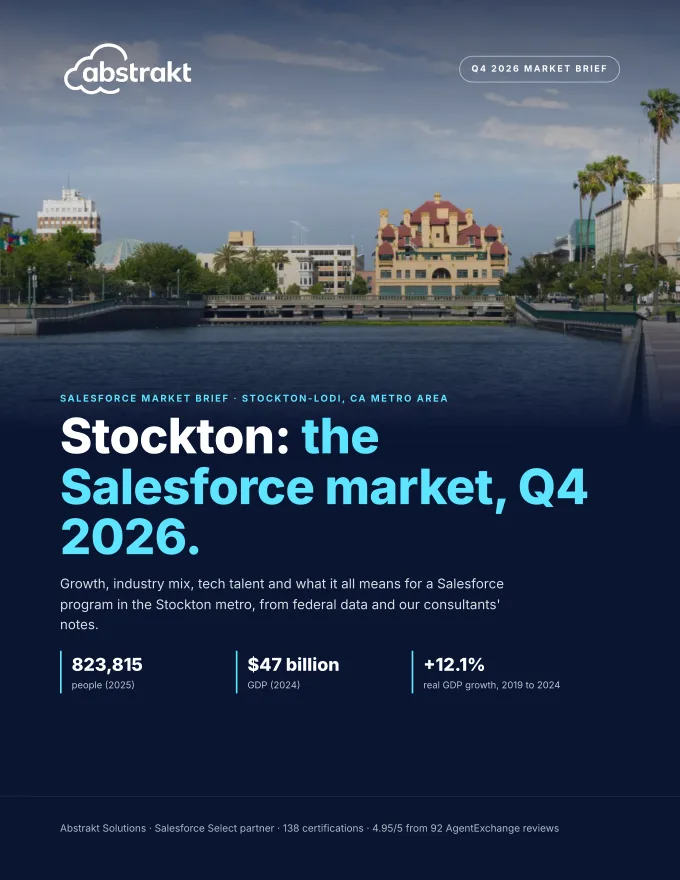
A free 20-page PDF with Stockton's growth ranked against 100 metros, its industry mix, tech wages and nearby markets. It is offered on the public Stockton page; send your customer there or get a copy for your own prep.
Get the Stockton brief →Co-sell with Abstrakt in Stockton
Working a Stockton account? Bring in a named consultant for discovery, scoping or a health check. We reply within 4 business hours.