

How Salesforce work starts in Phoenix
Abstrakt Solutions is a Salesforce Consulting Partner whose Greater Phoenix work covers lenders and insurers, health care organizations, manufacturers and builders. We implement, integrate, optimize and manage Salesforce across the Valley. Phoenix is one of our focus markets.
What buyers here usually run into
- 1
Customer operations at scale
Back-office and contact-center operations need routing, knowledge and automation to keep service levels steady as volume grows.
- 2
Estimating and field work
Construction and home-services companies often quote in one tool and schedule crews in another. Connecting them shows real margins by job.
- 3
Supplier and account complexity
Manufacturers supplying the semiconductor build-out manage few, very large accounts with many contacts and long qualification timelines.
Budget, team and partner questions
What drives cost
In Phoenix, cost depends mostly on service volume and routing complexity for financial and health operations, Field Service scope for builders and equipment suppliers, and the number of ERP, estimating or loan systems to connect. Growth also pushes up data volume, which affects integration design.
Admin or partner
Large customer operations centers in the Valley often have Salesforce staff, while builders and suppliers usually rely on a general IT team. A partner typically supplies architecture, integration and Field Service expertise, and internal staff keep daily administration.
What buyers ask a partner
Ask for high-volume Service Cloud references, Field Service experience with construction or equipment, and how the partner handles protected health information in contact-center builds. Ask who supports the org once volumes grow.
The local economy and its biggest industries (4)
| Sector | Share of 2024 GDP | Where Salesforce fits |
|---|---|---|
| Finance and insurance Service Cloud → | 8.5% | Banks, insurers and lenders run large customer operations in the Valley, where service volume, onboarding and compliant communication are the core Salesforce needs. |
| Health care and social assistance Salesforce for health & life sciences → | 8.4% | Health systems and healthcare services companies use Salesforce for patient engagement, referral and scheduling workflows, and contact-center service with privacy built in. |
| Manufacturing Salesforce for manufacturing → | 7.4% | Semiconductor and aerospace manufacturers and their suppliers manage long qualification cycles, key accounts and service for installed equipment. |
| Construction Salesforce for construction → | 7.1% | With a fast-growing population, construction and home-services firms need estimating, project tracking and field work connected, from quote to crew. |
Source: U.S. Bureau of Economic Analysis, GDP by county (CAGDP2), 2024, summed to the metro area; private sectors only, excluding real estate and government. “At least” marks sectors where BEA suppresses some county figures.
Regional target sectors named by local economic development groups: Semiconductors, Advanced Business Services, Aerospace & Defense, Autonomous & Electric Vehicles, Finance & Insurance, Healthcare Innovation.
Salesforce products that fit Phoenix (6)
In the order we lead with them here, from the industries above.
Salesforce Service Cloud
The operating system for modern customer service, case, knowledge, voice, and AI agent assist together.
Salesforce Sales Cloud
The CRM where sales pipeline lives, when it is built right.
Salesforce Field Service
Scheduling, dispatch, mobile work orders and parts for teams that work on site.
Salesforce Revenue Cloud / CPQ
Configure-price-quote, billing, subscription management, and quote-to-cash on Salesforce.
Salesforce Experience Cloud
Customer, partner, and employee portals built on Salesforce.
Salesforce Agentforce
AI agents that handle real work inside Sales Cloud, Service Cloud, and Marketing Cloud.
AI use cases that suit Phoenix finance and healthcare
In 2024, BEA data put finance and insurance at 8.5% of Phoenix metro GDP, with health care close behind at 8.4% and manufacturing at 7.4%. Each of those sectors reads a lot of documents. Insurance and lending operations can have an agent pull key fields from submitted forms and attach them to the right record, leaving underwriting decisions with staff. Healthcare organizations can use reply drafting for scheduling and billing messages, provided protected health information stays behind strict access rules and a compliance review. Semiconductor and aerospace suppliers get more from case summaries on supplier quality issues. The common prerequisite is a Data 360 (formerly Data Cloud) customer profile accurate enough for an agent to rely on.
- Extracting fields from submitted forms
- Drafted scheduling and billing replies
- Supplier quality case summaries
Services buyers here usually need (7)
Salesforce Implementation in Phoenix
Phoenix has no single dominant industry, so implementations here vary more than in most large metros. A lender's servicing floor, a supplier to the chip build-out and a homebuilder each need a different data model. We open with discovery workshops, design objects, record types and sharing around the processes that actually generate revenue, build in a sandbox and launch in phases, so the first teams are working in Salesforce while later ones are still being configured.
By industry in Phoenix
- 1
Finance and insurance
Finance and insurance is the metro's largest private sector, at about 8.5% of 2024 GDP, and much of it runs as large servicing and back-office operations rather than front-office sales. Implementing Salesforce for those teams means designing around cases and queues first: how requests arrive, which records an agent needs on one screen, and how permissions separate servicing staff from advisors. We model customers, accounts and households once, so service and sales work from the same records instead of parallel copies.
- 2
Semiconductors
The Greater Phoenix Economic Council lists semiconductors as a target sector, and the suppliers around the region's fabs sell to a small number of very large customers. For those suppliers, implementation decisions center on account hierarchy and opportunity design: how a global customer, its local sites and its purchasing groups relate, and which stages represent qualification rather than a real buying decision. Getting that right in design keeps forecasts from counting parts that are still years away from approval.
- 3
Construction
Construction and home-services companies have grown with the Valley's population, and many still run estimating, scheduling and customer follow-up in separate tools. Implementation for them starts with the job as the central record: a quote becomes an opportunity, and the won opportunity becomes a job with crews, dates and change orders attached. Field Service handles dispatch for companies with their own crews, while Revenue Cloud covers structured quoting when pricing depends on options, materials and square footage.
Raise before scoping
Lock milestone dates early
Discovery, go-live and training dates are fixed at kickoff so department heads can protect those days well in advance.
Model service before sales
In Valley operations where servicing staff outnumber salespeople, the case model, queues and entitlements deserve as much design time as the opportunity pipeline. Starting with sales and bolting service on afterward tends to produce duplicate customer records and a second, more expensive round of permission work.
Phase by business line
Companies spanning several of the region's sectors, such as a builder with a financing arm, get more from separate phases per business line than from one large launch. Each phase shares the core account model but brings its own objects, automation and training, so a problem in one area does not hold up the others.
Salesforce Managed Services in Phoenix
For most Greater Phoenix companies, managed services means keeping a busy service or sales org healthy while the business keeps changing around it. Our team takes the request queue, reviews each spring, summer and winter Salesforce release in a sandbox, maintains data quality and works through an agreed backlog of enhancements. Admins, developers and architects join as each task requires, and a regular review with your Salesforce owner decides what ships next.
By industry in Phoenix
- 1
Health care and social assistance
Health care and social assistance accounts for about 8.4% of metro GDP, nearly tied with finance and insurance. Healthcare organizations here tend to run Salesforce for patient access, referrals and contact-center work, where a broken assignment rule or an expired permission shows up as a missed callback. Managed services for them is controlled change: access reviews when staff move roles, sandbox testing before any automation update, and documented changes that privacy and compliance teams can inspect.
- 2
Finance & Insurance
The Greater Phoenix Economic Council names finance and insurance among its target sectors, and the region hosts large servicing operations for financial firms. Those orgs change constantly: new products, new queues, new disclosures. A managed services team absorbs that flow of small changes, keeps Omni-Channel routing and case automation current as teams reorganize, and flags release features that affect service consoles before agents meet them mid-shift. Requests are logged, sized and ranked with your operations lead, so urgent fixes do not stall planned work.
- 3
Advanced Business Services
Advanced business services is another council target sector, covering headquarters, shared-service and technology companies that often grew faster than their Salesforce team. A familiar pattern is one overextended admin, a backlog kept in email and customizations nobody wrote down. We start by moving requests into a single tracked queue, then split the work: your admin keeps daily user support, and specialists on our side take development, integration fixes and release preparation.
Raise before scoping
Keep one prioritized backlog
Requests arrive from service, sales and leadership at once in fast-growing Valley companies. A single backlog with a named owner, rough sizing and a monthly priority review keeps the loudest request from always winning and gives every team a view of what is queued and why.
Plan releases around peak volume
Operations with seasonal peaks, such as healthcare enrollment periods or year-end servicing, should not absorb Salesforce release changes during their busiest weeks. We map your operating calendar against the release schedule and hold noncritical changes until volume drops, while still testing everything in a preview sandbox.
Document for continuity
Knowledge that lives in one person's head leaves when they do. Every change we make is logged with its purpose, the components touched and how it was tested, so the org's history stays readable whether the next change comes from our team, your admin or a future hire.
Salesforce Integration in Phoenix
Integration work in Phoenix tends to follow the region's mix of industries. Manufacturers and suppliers need quotes and orders to match ERP pricing, servicing operations need account and policy data from core systems inside the agent console, and builders need estimates, jobs and field schedules to agree. We map which system owns each record, choose MuleSoft, Workato or a direct API for each connection, and set up monitoring so failed syncs surface immediately.
By industry in Phoenix
- 1
Manufacturing
Manufacturing contributes about 7.4% of metro GDP and is closely tied to the semiconductor build-out. For suppliers, the most valuable integration is usually ERP to Salesforce: item master, customer-specific pricing, open orders and shipments visible on the account. We define the ERP as the owner of price and inventory and Salesforce as the owner of pipeline and contacts, then build reconciliation for records that do not match, which is where most manufacturing integrations quietly fail.
- 2
Aerospace & Defense
Aerospace and defense is a Greater Phoenix Economic Council target sector, and companies in it often keep program, contract and engineering data in systems with strict access rules. Integration for them is as much about what stays out of Salesforce as what flows in. We sync customer, opportunity and contract status while controlled technical data remains in its source system, with the field-level mapping reviewed by your security team before anything goes live.
- 3
Finance and insurance
Financial firms run their Valley servicing operations on core systems for accounts, policies or loans, and agents lose time switching between those screens and Salesforce. We bring the needed data into the service console, either by syncing key fields or by displaying it on demand without storing a copy, and write case outcomes back where the core system needs them. Choosing between copying and viewing depends on volume, latency and what compliance requires you to retain.
Raise before scoping
Decide ownership field by field
When two systems both edit customer addresses or credit terms, integrations overwrite each other. Agree in writing which system owns each field, how conflicts resolve and who on your team handles exceptions, before choosing a tool. That document becomes the reference for every later change.
Size for operational volume
Servicing and contact-center operations in the Valley can generate large numbers of case and interaction records. Integration design has to respect Salesforce API limits and record locking, using bulk patterns and queued processing where real-time calls would create contention at peak hours.
Monitor from the first day
A sync that fails silently is worse than no sync, because people keep trusting the data. Every connection we build writes errors to a log with alerts to a named owner, and a short runbook explains how to reprocess failed records without a developer.
Salesforce Optimization in Phoenix
Optimizing Salesforce in Greater Phoenix usually means catching an org up with a company that grew faster than its configuration. Teams were added, queues multiplied, fields piled up and reports stopped matching what managers see on the floor. We measure where users avoid the system, cut layouts back to what each role needs, move scattered workflow rules and Process Builders into maintained Flows, and rebuild dashboards on definitions leaders agree to use.
By industry in Phoenix
- 1
Retail trade
At about 7.3% of 2024 metro GDP, retail trade includes many retailers and consumer brands whose Salesforce service teams handle order, return and warranty questions alongside marketing and loyalty data. Optimization for them targets agent screens overloaded with fields, case categories too vague to report on and automation that emails a customer twice. Tightening case reasons and consolidating those Flows improves both the agent's day and the reports leaders rely on.
- 2
Construction
Builders and trade contractors in the Valley often adopted Salesforce during a growth spurt and configured it job by job. The result is duplicate accounts for the same general contractor, opportunity stages that mean something different to each estimator and backlog dashboards nobody trusts. We standardize stages and account matching, simplify the estimator's screen and rebuild pipeline and backlog reports so owners see won work, pending bids and margin in one place.
- 3
Healthcare Innovation
The Greater Phoenix Economic Council targets healthcare innovation, which spans digital health, services and device companies selling to providers. Their Salesforce orgs often carry features added for pilots or investor reporting that no longer matter. Optimization removes those leftovers, reshapes account and contact models around how provider organizations actually buy, and gives commercial teams a pipeline view that matches the finance forecast instead of competing with it. Adoption tends to follow once reps stop entering the same data twice.
Raise before scoping
Measure before cutting fields
Field usage, login patterns and report views show where people actually work in Salesforce. We collect that evidence before removing anything, because a field that looks unused may still feed an integration or a compliance report that runs only at quarter end.
Retire legacy automation carefully
Salesforce has retired workflow rules and Process Builder in favor of Flow, yet many Phoenix orgs still depend on them. Migrating that logic is the moment to remove duplicates and conflicts, but each change needs sandbox testing against real record scenarios before it reaches users.
Train on what changed
Users who learned an older, busier version of the org need a short walkthrough of what moved and why. Brief role-based sessions, sized to each team, turn a cleanup project into visible improvement rather than confusion about missing fields.
Salesforce Health Checks in Phoenix
Think of a Phoenix health check as a bounded audit: it describes your org exactly as configured today, without changing anything. With read-only access, we examine profiles, permission sets and sharing, measure duplicates and incomplete records, inventory automation and code, and interview a few users. The deliverable is a findings list ordered by risk and by the effort each fix needs. For servicing operations and healthcare organizations here, access and data-exposure findings usually rise to the top, followed by the automation debt that slows every change.
By industry in Phoenix
- 1
Finance & Insurance
Finance and insurance is one of the council's target sectors, and financial firms with large Valley operations often have big user populations whose access grew one exception at a time. A health check compares actual permissions against the roles people hold today, finds admin rights granted for a project and never removed, and checks field-level security on sensitive data. The output gives risk and compliance teams a specific remediation list rather than a general warning.
- 2
Health care and social assistance
Healthcare organizations need a health check that treats patient data as the first concern. We review which profiles can see or export records containing health information, whether Shield or encryption settings match your policies, how guest and portal users are restricted, and what integrations write into the org. Findings are ranked so privacy exposures are addressed before cosmetic issues, and the report is written for both the Salesforce owner and compliance leadership.
- 3
Semiconductors
Semiconductor suppliers often handle confidential customer information and technical files, and their orgs gather quotes, drawings and contacts from very large customers. A health check looks at where those files live, who can reach them, and whether sharing rules still reflect which teams serve which customer. It also inventories the custom objects added for qualification tracking, which frequently duplicate each other after years of incremental changes by different admins over time.
Raise before scoping
Review access before adding AI
Agentforce acts with the permissions it is given and reads whatever records it can reach. Loose sharing, stale knowledge articles and conflicting automation become visible to customers once an agent uses them, so we check each of these before any AI pilot is scoped.
Count what you are licensed for
Renewal conversations go better with facts. The review compares purchased licenses and add-ons against actual logins and feature use, so you can see which users have gone quiet, which features were bought but never configured, and where license types could be adjusted.
Interview users, not just metadata
Org metadata shows what exists; it does not show where people work around the system. Short interviews with service agents, sales reps and managers reveal the shadow spreadsheets and manual steps that metadata scanning misses, which often explains poor data quality.
Salesforce Migration in Phoenix
Many Greater Phoenix companies grew quickly enough that their first system, often spreadsheets or a lightweight CRM, still holds customer history nobody wants to lose. A migration moves that history into Salesforce without carrying its duplicates along. We inventory every source, agree with each team what is worth keeping, clean and match records outside Salesforce, run trial loads into a sandbox and plan a cutover weekend so nobody works in two systems at once.
By industry in Phoenix
- 1
Construction
Construction accounts for about 7.1% of metro GDP, a sign of how quickly the region has been building. Contractors and home-services firms moving to Salesforce typically hold customer and job history across estimating software, accounting files and spreadsheets kept by each estimator. The migration work is matching the same builder, homeowner or property across those sources, deciding how much closed-job history to load, and linking past jobs to accounts so repeat and warranty work can be traced.
- 2
Health care and social assistance
Healthcare organizations migrating referral or outreach data into Salesforce face a stricter version of the usual problem: records may contain protected health information, and not all of it belongs in a CRM. We classify fields before mapping, leave clinical detail in the systems of record, and load only what outreach, access or service teams need. Test loads run in a sandbox with masked data wherever a sample would expose patient details, so the privacy review can happen alongside the build.
- 3
Autonomous & Electric Vehicles
Autonomous and electric vehicles is a target sector for the Greater Phoenix Economic Council, and companies in this space often start commercial operations on a startup CRM or spreadsheets. As fleet customers, pilot programs and service sites multiply, those tools cannot link a customer to the vehicles, locations and agreements behind it. Migration to Salesforce is the point to introduce those relationships, mapping flat records into accounts, sites and assets rather than recreating the old structure.
Raise before scoping
Choose what history to bring
Not every closed deal or old note deserves a place in the new org. We agree cutoff rules with each team, such as keeping activity for current customers and archiving the rest in a searchable export, which keeps storage costs and load complexity down.
Match records outside Salesforce
Deduplication is cheaper before the load than after it. We match companies and people across sources using names, addresses, domains and phone numbers, review uncertain matches with your team and load only the surviving records, keeping source IDs for tracing.
Freeze the old system briefly
A clean cutover needs a short window where the old system is read-only while the final load and checks run. We plan that window around your busiest periods, with record counts reconciled and spot checks signed off by each team before users log in.
Salesforce Implementation Rescue in Phoenix
When a Phoenix Salesforce project goes wrong, the first job is to stop further damage and learn what was actually built. We review the configuration, code, data and original scope, interview the people who were supposed to use it and triage each component into keep, fix or rebuild. Meanwhile, targeted repairs keep sales and service running. Then we finish the remaining scope, document it and relaunch with training, so users give the system another chance.
By industry in Phoenix
- 1
Construction
Construction firms are especially exposed when a project stalls, because estimating and field teams cannot wait for a system to catch up with the season's work. Rescues here often involve Field Service configurations that assign the wrong crews or double-book multi-day jobs, and quoting tools that no longer match real pricing. We stabilize scheduling first so crews can work, then correct the quote-to-job flow that the original design got wrong.
- 2
Finance and insurance
A stalled project in a financial servicing operation has a visible cost: agents keep working in old screens while licenses sit unused. Rescue work in these orgs typically uncovers service consoles designed without input from agents, case routing that does not match the queue structure and permissions too broad to pass compliance review. We rebuild routing and access around how teams actually work, then bring agents into testing so the relaunch reflects their day.
- 3
Advanced Business Services
Technology and business services companies in the council's advanced business services sector often attempt implementation internally, relying on a developer who knew Salesforce moderately well. When that person leaves, heavy custom code remains that nobody understands. Our assessment reads the code, tests what still works and replaces custom logic with standard configuration where Flow can do the job, which reduces what your team will need to maintain after the rescue ends.
Raise before scoping
Stabilize before redesigning
Rescues that open with a redesign leave users stuck on a broken system for longer. We fix the defects that stop daily work first, such as failing automation or blocked record access, then agree the full recovery plan while the business keeps operating.
Recover the original requirements
Failed projects frequently lack a written scope anyone agrees with. We rebuild it from contracts, meeting notes and user interviews, then confirm with your leadership which requirements still matter, which changed and which were never needed, before committing to finish anything.
Name a decision owner
Many stalled projects had no one on the client side able to settle process disputes. Before relaunch work begins, we agree on one owner with authority to decide, plus a short standing meeting where open questions are closed rather than carried forward.
Industry plays in Phoenix (4)
Salesforce for Phoenix Construction Firms
For Phoenix construction firms, Salesforce is most useful before and after the build: tracking bids and relationships with owners, developers and general contractors, forecasting backlog, and running service and maintenance work once projects are handed over. Estimating and project management usually stay in dedicated construction tools, and we integrate them rather than replace them. Revenue Cloud or CPQ can standardize service quotes, Field Service can schedule crews, and an Experience Cloud portal can collect subcontractor qualification documents.
Construction is one of the Phoenix metro's five largest private sectors, at 7.1% of 2024 GDP in the Bureau of Economic Analysis's county data, alongside finance and insurance at 8.5% and manufacturing at 7.4%. The Greater Phoenix Economic Council's target list includes semiconductors, aerospace and defense, and autonomous and electric vehicles, industries whose facilities need specialized builders and trades. Specialized industrial work of that kind raises the stakes on bid selection, subcontractor qualification and crew planning, which is where a connected CRM earns its keep.
Use cases to open with
- 1
Bid pipeline and win rates
Contractors bid on many projects and win a fraction. Tracking each bid in Salesforce with owner, general contractor, market sector, estimated value, bid date and estimator shows win rates by sector and client, reveals which relationships produce awarded work, and helps leadership decide which bids to pursue when estimating capacity is tight, especially when large industrial projects compete for the same team.
- 2
Backlog and capacity forecasting
Awarded work turns into backlog that must be staffed. Combining won opportunities with project schedules from the construction management system shows backlog by month, sector and division, so leaders can see when crews will be stretched, when to hire or subcontract, and how a delayed start on a major project affects the rest of the year's revenue. Division leaders can compare backlog against crew headcount directly.
- 3
Service and maintenance divisions
Many mechanical, electrical and specialty contractors run service divisions for maintenance contracts and repairs after construction. Field Service can schedule technicians, track assets and service agreements, and capture work on mobile devices. Service revenue then appears next to construction pipeline, giving account managers a full picture of each customer relationship and more predictable revenue. Expiring service agreements create renewal opportunities automatically.
Raise before scoping
Estimating and project system integration
Estimating, project management and accounting tools remain the system of record for costs, schedules and billing. Decide which data Salesforce needs, such as bid values, awarded contract amounts and project milestones, and integrate it so project managers are not asked to update two systems.
Qualifying subcontractors and suppliers
Owners and general contractors expect subcontractors to be prequalified, with insurance, safety records and licenses current. A portal that collects documents and tracks expiration dates keeps qualification current, and alerts prevent awarding work to a subcontractor whose insurance or license has lapsed.
Field adoption in the heat
Superintendents and technicians work outdoors, often in extreme summer heat, and have little patience for complicated screens. Keep mobile forms short, use photos and checklists instead of typing, and test the app on job sites with real crews before rollout.
Salesforce for Phoenix Lenders
A Phoenix mortgage company may run two very different businesses under one roof: originating purchase loans, including new-construction loans tied to homebuilders, and running large operations for processing, servicing and borrower support. Salesforce can manage builder relationships and the long timelines of new-construction loans, route and resolve borrower requests in Service Cloud, and keep marketing and retention running through Marketing Cloud. Underneath, one Financial Services Cloud model links each borrower to their loans, their builder and their service history.
Measured by 2024 output in Bureau of Economic Analysis county data, the Phoenix metro's leading private industry is finance and insurance at 8.5%, and construction adds 7.1%. The Greater Phoenix Economic Council names both finance and insurance and advanced business services, which covers shared-service and back-office centers, among the industries it recruits. Mortgage companies here therefore sit at the crossroads of active home building, a broad financial sector and large operations teams, and their Salesforce design has to serve builders, borrowers and service agents at once.
Use cases to open with
- 1
Builder relationships and new construction
New-construction loans can take many months from contract to closing, with rate lock extensions and construction delays along the way. Salesforce can track builder partners, communities and the loans in each, alert loan officers to expiring locks and schedule changes, and give builder sales teams status updates, so buyers are not lost between contract and closing. Reports show pull-through by community and builder.
- 2
Operations center case management
Processing and servicing teams handle document requests, payment questions, escrow issues and payoff requests at volume. Service Cloud can turn each contact into a case with the right priority and queue, give agents borrower and loan context, and track resolution times. Leaders can see workload by team and adjust staffing as volume shifts. Deadlines for required responses are tracked on every case, with alerts before they pass.
- 3
Borrower self-service and AI
Many borrower questions are routine: where a document is, when a payment posted, what is still needed. An Experience Cloud portal lets borrowers upload documents and check status, and an Agentforce agent can answer common questions from loan and servicing data. Complex or sensitive requests go to trained staff with the conversation already logged. Portal and agent usage shows which questions still reach the phones.
Raise before scoping
Servicing data and compliance
Servicing brings obligations for error resolution, information requests and loss mitigation communications. Design case types, timelines and templates with your compliance team so required responses are tracked and documented, and treat these requirements as design inputs rather than legal advice.
Separating origination and servicing
Origination and servicing teams often need different views, permissions and processes for the same borrower. Plan record types, sharing and page layouts so each team sees what it needs, while leadership can still view the full borrower relationship. Borrower consent and preferences should be shared across both.
Arizona time and scheduling
Arizona does not observe daylight saving time, which shifts its offset from partners and borrowers in other states during the year. Configure business hours, service levels and campaign send times carefully, especially for multi-state lenders and operations centers serving borrowers nationwide.
Salesforce for Phoenix Health and Life Sciences
For Phoenix-area providers, Salesforce work usually centers on scale: contact centers handling scheduling, billing and nurse line calls, referral networks spread across many clinics, and outreach that brings patients back for preventive care. We build on Service Cloud and Health Cloud with routing, knowledge and AI assistance, connect scheduling and the electronic health record, and keep PHI access tight. Health innovation companies in the region use the same foundation to sell to providers and run patient programs.
Only a tenth of a percentage point separates Phoenix's two biggest private sectors in 2024 BEA county data: finance and insurance at 8.5% of metro GDP and health care and social assistance at 8.4%. The Greater Phoenix Economic Council lists healthcare innovation as a target sector and also works on biosciences recruitment. Advanced business services, the category that covers back-office and contact-center work, is another council target, and health organizations share the challenge those operations know well: keeping service levels steady as call and message volume grows, without adding staff for every increase.
Use cases to open with
- 1
Contact center at scale
Scheduling, billing, prescription refills and nurse advice calls often flow into separate queues with separate tools. Service Cloud unifies them with omnichannel routing by skill, language and urgency, shows agents appointments and open requests from integrated systems, and records every interaction. Agentforce can handle routine rescheduling, directions and billing questions, handing off clinical questions to nurses with context already captured.
- 2
Referral network across clinics
Health systems and specialty groups with many locations depend on referrals from independent and affiliated physicians. Salesforce can track referral volume by source and specialty, identify leakage to competitors, and plan liaison visits to practices whose referrals have changed. Referral intake can be standardized so every request is acknowledged, completed and scheduled, with status visible to the referring office. Liaisons can log visits and follow-ups from their phones between appointments.
- 3
Preventive care outreach
Screenings, annual visits and chronic care check-ins improve outcomes and fill schedules. Marketing Cloud, using care gap lists from clinical systems, can send reminders by text, email or phone in the patient's preferred language, with links to self-scheduling. Consent and suppression rules apply automatically, and results show which campaigns lead to completed appointments by clinic and population. Patients who opt out on one channel stay reachable on the channels they still allow.
Raise before scoping
Minimum necessary PHI
A scheduler resolving a billing question has no reason to see a patient's diagnosis history. Define which data each role sees, use field-level security and encryption where appropriate, sign the business associate agreement, and audit access regularly with your privacy officer. Revisit role definitions whenever new services join the contact center.
Scheduling system integration
Agents and AI tools can only help patients book if they see real availability. Decide whether Salesforce reads schedules in real time, books directly through the scheduling system, or hands off to it, and test performance at peak call volumes before launch.
Arizona time and reminders
Arizona does not observe daylight saving time, while patients, vendors and systems elsewhere may. Check that reminder schedules, service hours and integration timestamps use the correct time zone year-round, so messages are not sent an hour early or late for part of the year.
Salesforce for Phoenix Manufacturers
Many Phoenix manufacturers sell to a small number of very large customers: semiconductor fabs under construction or in operation, aerospace and defense contractors, and vehicle makers. Salesforce should manage long supplier qualifications, detailed account plans with many contacts, and service on equipment installed in demanding environments such as cleanrooms. We integrate the ERP for orders and parts, model complex customer sites and buying groups, and give sales, engineering and service teams a shared view of each strategic account.
At 7.4% of 2024 metro GDP in federal BEA figures, Phoenix manufacturing trails only finance and health care among private sectors, and not by much. The Greater Phoenix Economic Council lists semiconductors, aerospace and defense, and autonomous and electric vehicles among its target sectors, and semiconductor makers form one of the region's largest industry clusters. An Arizona public university has also been chosen to host a national research facility for advanced chip packaging and prototypes. For a supplier, winning one of those customers can take years of audits, samples and trial orders, and losing one can reshape the business.
Use cases to open with
- 1
Supplier qualification tracking
Becoming an approved supplier to a fab or aerospace prime involves audits, samples, documentation and trial orders over a long period. Salesforce can track each qualification as a project with stages, required documents, customer contacts and open actions, linked to the eventual revenue opportunity. Leaders see which qualifications are progressing, which are blocked, and what revenue depends on completing them.
- 2
Strategic account planning
A single fab or program can involve procurement, engineering, facilities, quality and executives across multiple sites. Salesforce account plans can map those contacts, their priorities and relationships, record commitments and risks, and track multi-year opportunities by site and product. Quarterly business reviews use data already in the system, and new team members can understand the account quickly. Relationship gaps, such as no contact in facilities or quality, become visible before they cost a renewal.
- 3
Cleanroom and site service
Equipment and systems installed at fabs and plants require preventive maintenance, emergency response and strict site access procedures. Field Service can schedule technicians with the right certifications and site badges, track installed equipment and service history, and record completed work with customer sign-off. Service performance by site feeds account reviews and contract renewals. Emergency calls are tracked against response commitments so the account team knows before the customer complains.
Raise before scoping
Customer confidentiality demands
Fab operators and defense primes may forbid suppliers from sharing tool layouts, ramp dates or program names even internally. Restrict access to sensitive accounts and documents, keep controlled technical data in approved systems, and document your security model for customer audits. Some customers will ask to review it before awarding business.
Long-horizon revenue forecasting
Revenue from new fabs and programs depends on construction and production ramps outside your control. Model opportunities with phased volumes by year, update them as customer schedules change, and keep speculative capacity separate from committed business in forecasts shared with finance.
Technician certifications and access
Cleanroom and defense sites require specific training, badges and sometimes citizenship verification. Record certifications and expiration dates on technician profiles, use them in scheduling rules, and alert managers before credentials lapse so field work is never blocked at the gate.
Case studies to send (3)
From the industries this market leans on. Client names are anonymized and these projects are not specific to Phoenix.
The Phoenix Salesforce market brief, Q4 2026
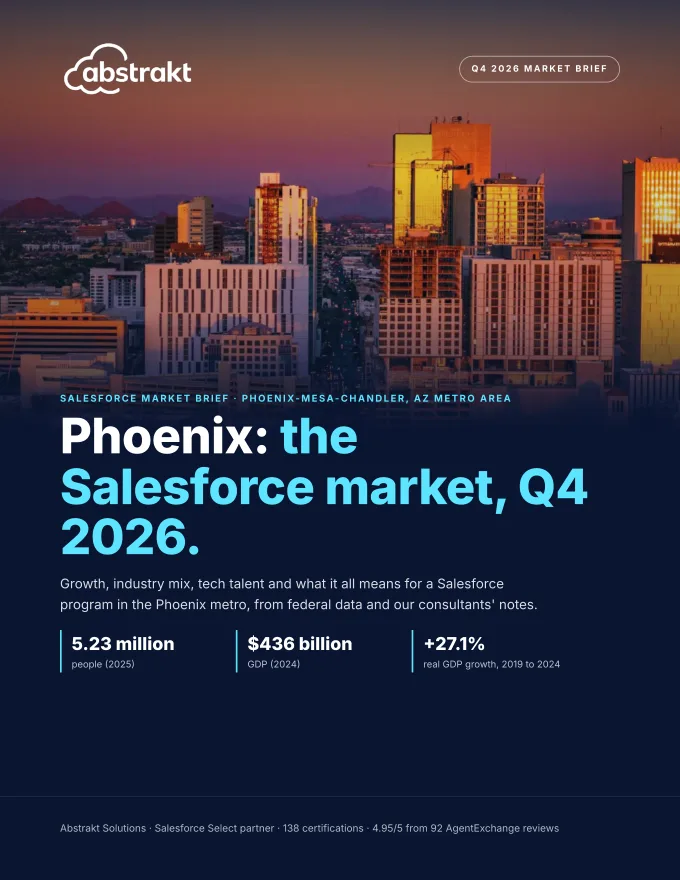
A free 23-page PDF with Phoenix's growth ranked against 100 metros, its industry mix, tech wages and nearby markets. It is offered on the public Phoenix page; send your customer there or get a copy for your own prep.
Get the Phoenix brief →Co-sell with Abstrakt in Phoenix
Working a Phoenix account? Bring in a named consultant for discovery, scoping or a health check. We reply within 4 business hours.