

How Salesforce work starts in Chicago
As a Salesforce Consulting Partner, Abstrakt Solutions works with manufacturers, insurers, distributors and professional services firms throughout the Chicago area. We implement, integrate, optimize and manage Salesforce for organizations across Chicagoland. Chicago is one of our focus markets.
What buyers here usually run into
- 1
Several systems, one customer
Diversified companies often run separate CRMs or instances by business unit. Consolidating them, or connecting them cleanly, is a frequent reason Chicago-area firms bring in a partner.
- 2
Supervision and audit in financial services
Firms in regulated finance need record access, communications and marketing workflows that stand up to compliance review.
- 3
Channel sales visibility
Manufacturers and distributors selling through partners often lack a shared view of pipeline and service. Partner portals and clean account hierarchies address that.
Budget, team and partner questions
What drives cost
Chicago cost drivers usually come from the operations side: how many ERP, TMS or agency-management systems Salesforce must talk to, whether pricing needs Revenue Cloud, and how many dealers or brokers need portal access. Professional services firms spend more on the PSA and finance handoff than on the CRM itself.
Admin or partner
Large Chicago companies often have internal Salesforce teams and need a partner for architecture, integration or a specific rollout. Mid-sized firms more often outsource administration entirely until volume justifies a hire.
What buyers ask a partner
Ask for references with ERP and dealer-channel integration, insurance or financial services data models if relevant, and evidence of quoting design. Ask how the partner hands documentation and ownership to your team.
The local economy and its biggest industries (4)
| Sector | Share of 2024 GDP | Where Salesforce fits |
|---|---|---|
| Manufacturing Salesforce for manufacturing → | 10.9% | Chicagoland manufacturers, including food manufacturers, usually run complex dealer and distributor channels. Salesforce projects here tend to center on account planning, quoting from ERP data and service after the sale. |
| Professional, scientific, and technical services Salesforce for professional services → | at least 10.0% | Consultancies, agencies and engineering firms need pipeline, resourcing and client reporting in one place, and often move to Salesforce from a lighter CRM as they grow. |
| Finance and insurance Financial Services Cloud → | 8.6% | Exchanges, asset managers, insurers and brokers bring strict data and supervision requirements. Financial Services Cloud, compliance-aware marketing and well-designed sharing models are common starting points. |
| Wholesale trade Integration → | at least 7.9% | As a national distribution hub, Chicago has many wholesalers whose sales teams depend on ERP order and inventory data. Integration is usually the difference between a CRM reps use and one they ignore. |
Source: U.S. Bureau of Economic Analysis, GDP by county (CAGDP2), 2024, summed to the metro area; private sectors only, excluding real estate and government. “At least” marks sectors where BEA suppresses some county figures.
Regional target sectors named by local economic development groups: Finance and Insurance, Transportation, Distribution, and Logistics, Innovation and Technology, Life Sciences, Manufacturing (incl. Food Manufacturing), Professional Services.
Salesforce products that fit Chicago (6)
In the order we lead with them here, from the industries above.
Salesforce Sales Cloud
The CRM where sales pipeline lives, when it is built right.
Salesforce Financial Services Cloud
Industry CRM for wealth management, banking, insurance, and lending, built for compliance from the start.
Salesforce Revenue Cloud / CPQ
Configure-price-quote, billing, subscription management, and quote-to-cash on Salesforce.
Salesforce Experience Cloud
Customer, partner, and employee portals built on Salesforce.
MuleSoft
Enterprise API platform, for connecting Salesforce, ERP, data warehouses, and the rest of your stack.
Salesforce Agentforce
AI agents that handle real work inside Sales Cloud, Service Cloud, and Marketing Cloud.
Practical AI for Chicago plants, firms and insurers
BEA figures show manufacturing at about 10.9% of Chicago's metro GDP in 2024 and finance and insurance at 8.6%. Those two sectors, plus a deep bench of professional services firms, generate large volumes of repetitive written work. On the factory side, an agent can summarize warranty and quality cases so engineers spot the pattern before reading every note. Insurers and lenders can let it draft replies to policy or account questions, with a licensed person approving each one. Consulting and legal practices tend to value lead triage that scores inbound inquiries against past engagements. None of this works on messy account records or loose sharing rules, so we fix data quality and permission sets before switching any agent on.
- Warranty and quality case summaries
- Reviewed replies to policy questions
- Scoring inbound professional-services inquiries
Services buyers here usually need (7)
Salesforce Implementation in Chicago
Chicago implementations often have to serve more than one selling model at once: direct accounts, distributors and independent reps for a manufacturer; brokers, carriers and clients for an insurer. We define the account hierarchy and partner model first, then product and pricing structure, then the security design, because each shapes the next. Configuration happens in a sandbox, clean data is loaded, and every role, from inside sales to channel managers, gets hands-on training before go-live.
By industry in Chicago
- 1
Manufacturing
Manufacturing is the metro's largest private sector, about 10.9% of 2024 GDP, and World Business Chicago folds food manufacturing into its target sectors. Implementations for these companies revolve around account hierarchies that mirror parent companies, plants and distributors, product catalogs large enough to need careful design, and quoting that respects ERP pricing. We usually phase the build: key-account pipeline first, then quoting through Revenue Cloud, then a partner portal for the dealer network.
- 2
Finance and insurance
Insurers, brokers, asset managers and trading firms in Chicago bring layered relationships: a client with several policies or accounts, contacts at carriers and intermediaries, and service teams with different permissions. Implementation for them starts with Financial Services Cloud, or a Sales Cloud design that models those parties explicitly, plus a sharing model that compliance has reviewed before any client data reaches production. Every design decision is written up so supervisors and auditors can follow the reasoning.
- 3
Life Sciences
Life sciences sits on World Business Chicago's list of target sectors, and companies in the field range from research spinouts to established device and diagnostics makers. For a growing company, a first implementation covers accounts such as hospitals and labs, clinician contacts, partnering deals and a clear line between commercial and medical activity. We build that separation into record types and permissions from the start, so later regulatory reviews do not force a redesign.
Raise before scoping
Design for distributor data early
If distributors or independent reps sell your products, decide in phase one how their sales, leads and resale reports will reach Salesforce. That choice affects the account model, sharing and licensing, and it is far cheaper to plan now than to force into a finished org.
Keep the first catalog lean
Large manufacturers often want every SKU in Salesforce on day one. Start with the product families reps actually quote, agree how configurable items will be represented, and add the long tail later, which keeps pricing rules testable and stops the quoting tool from slowing sales down.
Design with each department before combining
Chicago companies that sell through several channels often benefit from separate design sessions for sales, service and finance before the shared pieces are settled. Bring those groups together afterward for the decisions that cut across all three, such as pricing approvals and account ownership.
Salesforce Integration in Chicago
Chicago integration projects usually start from the ERP and fan outward, because order, inventory and pricing data drive what sales and service need to see, followed by warehouse, transportation and agency systems. We map every system and the data each owns, choose between MuleSoft, lighter middleware or direct APIs, and design how errors are caught and who resolves them. Connections are tested with production-like volumes, and a runbook and monitoring are ready before go-live.
By industry in Chicago
- 1
Wholesale trade
In a metro where wholesalers generated at least 7.9% of 2024 output, a common request is simple: show reps what the warehouse knows. Wholesalers need inventory availability, order status, pricing and credit holds visible in Salesforce, often from an ERP that was never designed to share data in real time. We use scheduled syncs for large product and price data sets, event-driven updates for order and credit changes, and a firm rule that the ERP owns pricing.
- 2
Manufacturing (incl. Food Manufacturing)
Food manufacturers, which World Business Chicago highlights within its manufacturing target sector, need Salesforce linked to ERP, lot and traceability data, and often to retailer or broker reporting. We connect customer, order and product records so account teams see shipments and promotions, while quality and traceability detail stays in operational systems, reachable when a customer asks. Other manufacturers follow a similar pattern with serial numbers and installed equipment instead of lots.
- 3
Finance and insurance
Insurance brokers and carriers here typically keep policies in an agency or policy administration system, while sales and account management work in Salesforce. Integration brings policy summaries, renewal dates and claims status onto the client record, and returns new business submissions to the source system. We add reconciliation reports and log each transfer, giving compliance a record of what moved, when and under which user. Carrier downloads can be included where available.
Raise before scoping
Map EDI and flat-file feeds
Many distribution and manufacturing partners still exchange orders and inventory through EDI or scheduled files. Include those feeds in the integration map and decide whether Salesforce needs their data directly or only the resulting ERP records, which is usually simpler to maintain.
Settle pricing ownership
Decide whether list prices, customer-specific pricing and discounts live in the ERP, in Revenue Cloud or in both. Split ownership is possible but needs explicit sync rules, and unclear pricing ownership is one of the fastest ways to put incorrect quotes in front of customers.
Budget for API consumption
Large product catalogs and frequent order updates can consume API limits quickly, both in Salesforce and in the connected systems. Estimate volumes during design, use bulk APIs for large loads, and set monitoring thresholds so capacity problems are visible well before a sync starts failing.
Salesforce Migration in Chicago
Chicago migrations are frequently consolidations: several divisions or acquired companies, each with its own CRM or spreadsheets, moving into one org. The difficult decisions come before any data moves, such as which account hierarchy wins, how customers shared by divisions are matched and which history is kept. We inventory each source, map it to the target model, de-duplicate and standardize, run reconciled trial loads in a sandbox, and plan a cutover that avoids month-end and seasonal peaks.
By industry in Chicago
- 1
Professional Services
Chicago consulting, accounting and legal firms often migrate from a CRM chosen when the firm was smaller, or from a practice-management system that doubled as one. We separate true client relationships from billing contacts, map engagements and pursuits into opportunities with consistent stages, and preserve referral sources, which many firms consider their most valuable data. Practice leaders review the mapping before trial loads so the migrated records reflect how they manage clients.
- 2
Wholesale trade
Distributors frequently hold customer data in the ERP, in an older CRM and in reps' own spreadsheets, each with different account numbers. Migration for them is largely an identity exercise: agree which ERP account number anchors each customer, match ship-to locations to parent accounts, and attach open quotes and recent orders. Clean hierarchies at this stage make later integration and territory reporting far simpler, and inactive accounts are retired rather than migrated.
- 3
Innovation and Technology
Startups coming out of the region's commercialization hubs, part of World Business Chicago's innovation and technology target sector, often begin on a lightweight CRM and switch to Salesforce as enterprise deals and partner channels arrive. The migration is a chance to fix what was improvised: we rebuild lead and account ownership rules, replace free-text fields with picklists, and load historical deals only where they help forecasting. Product and billing integrations are re-pointed at Salesforce during cutover.
Raise before scoping
Agree the surviving account numbers
When divisions or acquired companies each numbered customers differently, decide which identifier becomes the master and keep the others as reference fields. That mapping table is the backbone of the migration and of every later integration, so it deserves sign-off from sales operations and finance.
Standardize names and addresses first
Inconsistent company names, abbreviations and address formats hide duplicates from matching rules. Standardize them in the staging data before matching, so deduplication catches the same customer when it has been entered as different variations across several source systems and regions.
Retrain around the new model
A consolidated org means some teams will see stages, fields and account views they have never used. Train each group on what changed for them specifically, with examples from their own migrated records, rather than giving everyone a generic tour of Salesforce.
Salesforce Managed Services in Chicago
Managed services for a Chicago company is a working rhythm more than a contract: a prioritized backlog, a named team and regular reviews with the business owners who set priorities. We handle user and permission changes, new fields and reports, Flow automation, integration fixes and data-quality jobs, and test each Salesforce release in a sandbox before your users see it. Larger work, such as a new portal or quoting change, runs through the same team so context is never lost.
By industry in Chicago
- 1
Finance and insurance
Insurers, brokers and asset managers here work in a sector World Business Chicago targets and that accounts for about 8.6% of the metro's 2024 GDP. For them, managed services is largely about controlled change: every permission update logged, access removed promptly when staff leave, and release features reviewed against compliance requirements before activation. We also maintain renewal and service automation as products, carrier appointments and underwriting appetites shift through the year.
- 2
Professional Services
Accounting, consulting, legal and engineering firms in Chicago have busy seasons that leave no room for internal Salesforce projects. A managed services team keeps the org moving anyway: building reports for practice leaders, adding intake fields for new services, maintaining email and calendar sync and handling user changes as staff rotate between engagements. Requests are prioritized with a single firm contact so partners are not negotiating individually for admin time.
- 3
Transportation, Distribution, and Logistics
Carriers, freight brokers and third-party logistics providers in this World Business Chicago target sector use Salesforce for quoting, onboarding shippers and handling service cases. Their rate structures, lanes and service offerings change often, so managed services covers price and product updates, case routing adjustments and monitoring of the links to transportation management systems, with every change tested before busy shipping periods begin. Carrier onboarding checklists are kept current as requirements from shippers change.
Raise before scoping
Set priorities with one owner
Backlogs stall when every department lobbies separately. Name one product owner who ranks requests across sales, service and finance, meets with our team on a regular cadence and signs off on what moves to production. That person does not need to be technical, only empowered to make trade-offs.
Reserve capacity for technical debt
An engagement that only handles new requests leaves old problems growing. Set aside part of each month for retiring unused fields, migrating legacy workflow rules to Flow and cleaning duplicate records, so the org gets simpler over time instead of accumulating more to maintain.
Measure delivery, not hours
Track what the engagement delivers: requests closed, time to close by priority, releases tested and debt items retired. Reviewing those measures each quarter shows whether the arrangement is keeping pace with the business or needs to change in scope, staffing or focus.
Salesforce Optimization in Chicago
Chicago orgs that need optimization are often several years old and have outlived their original design: divisions were added, an acquisition was folded in, and each change brought its own fields and automation. We measure usage by team, interview the people who avoid the system, then simplify layouts, merge duplicate accounts, move old workflow rules and Process Builder into Flow, and rebuild dashboards on agreed definitions. Each team gets a brief session on what changed for its own role.
By industry in Chicago
- 1
Professional Services
World Business Chicago names professional services as a target sector, and the broader professional, scientific and technical category contributes at least 10% of 2024 metro GDP. Consulting, accounting and legal firms here often have Salesforce but track utilization and pursuits elsewhere. Optimization aligns opportunity stages with how engagements are actually won, cuts fields partners ignore, and builds practice-level dashboards showing pipeline, win rates and client coverage without an analyst in the loop.
- 2
Manufacturing (incl. Food Manufacturing)
At manufacturing companies in the metro, adoption problems usually trace to a sales team that cannot see what it needs in Salesforce, such as order history, open quotes or distributor activity. We bring the most useful ERP data into view, simplify opportunity and quote layouts for outside reps using mobile, and consolidate automation that fires on accounts and orders. Forecast reports are then rebuilt on the cleaned data so plant and sales leaders review the same numbers.
- 3
Innovation and Technology
Innovation and technology is one of World Business Chicago's target sectors, and the region's startup and commercialization hubs produce many software and hardware companies scaling their first sales teams. Their orgs often carry lead routing, scoring and handoff rules layered on by successive revenue leaders. Optimization maps that logic, removes conflicts, clarifies lifecycle stages from lead to renewal and rebuilds funnel reporting so marketing and sales stop disputing the numbers.
Raise before scoping
Merge divisional conventions first
Business units folded together over time often use different stage names, industry codes and account types for the same thing. Agree a single set of definitions with each division's sales leader before cleaning data, since normalization without agreement tends to be quietly undone within a quarter.
Review mobile, not just desktop
Outside sales and service staff covering the Midwest often update Salesforce from a phone between visits. Review the mobile layouts and quick actions they rely on, not only the desktop screens, because a clumsy mobile experience is a common reason field teams stop logging activity.
Fix duplicates at the source
Duplicate accounts often come from an integration or web form rather than from users. Before a deduplication pass, find where duplicates originate and fix the entry point with matching rules or integration logic; otherwise the cleanup has to be repeated a few months later.
Salesforce Health Checks in Chicago
A health check for a Chicago organization usually comes at a decision point: before an acquisition is folded in, a new cloud is added, an Agentforce pilot starts or a partner contract is renewed. We review security and sharing against least-privilege, inventory automation, code and packages for overlap and risk, measure data quality on key objects, check integrations and study how each team uses the org. Findings arrive ranked with effort estimates, so leadership can decide what comes first.
By industry in Chicago
- 1
Finance and Insurance
Financial exchanges, asset managers, insurers and brokers in Chicago face regular regulatory and client scrutiny of how data is protected. A health check tests whether Salesforce matches written policy: who can export client data, whether field history covers sensitive values, how integration users are scoped and whether leavers were removed promptly. We give compliance and IT a shared list of gaps, with recommended configuration changes and the evidence behind each finding.
- 2
Life Sciences
For device, diagnostics and biotech companies in World Business Chicago's life sciences sector, a health check often precedes a commercial launch or partnership. We confirm that sales and medical teams see only their own records, that validation rules keep required regulatory fields complete, and that installed packages and integrations have been reviewed by quality or IT. Findings are written so a small operations team can work through them without outside help.
- 3
Manufacturing
Manufacturers with long-running orgs tend to accumulate technical debt: triggers written for a retired ERP, custom quoting objects replaced by Revenue Cloud but never removed, and large numbers of unused fields. A health check inventories all of it, identifies what still runs and flags what can be retired safely. For companies considering Agentforce in service or sales, we also rate the quality of account, product and case data an agent would rely on.
Raise before scoping
Include acquired orgs
If your company has acquired businesses with their own Salesforce orgs, include them in the review even if consolidation is years away. Their security settings and integrations are part of your risk profile, and knowing their state early informs whether to merge, connect or retire them.
Ask for effort estimates
A list of problems without effort estimates is hard to act on. Make sure each finding includes the likely size of the fix and whether it needs a developer, an admin or a business decision, so it can be planned into budgets and managed services capacity.
Interview the heavy users
Configuration analysis finds technical issues, but the people who use Salesforce daily know where it slows them down. Include a handful of power users from sales, service and finance in the interviews, so the findings reflect business pain as well as technical risk.
Salesforce Implementation Rescue in Chicago
Rescued projects in Chicago often stalled at the hardest integration or quoting step: ERP pricing that never synced, a CPQ build too complex to maintain or a partner portal that distributors would not use. We start with triage of the build, data and scope, stabilize whatever the business needs to operate, then decide for each component whether it is kept, fixed or rebuilt. The remaining work is finished, documented and relaunched, with our consultants working alongside your teams through the restart.
By industry in Chicago
- 1
Manufacturing
Manufacturing rollouts in the region often stall in quoting, because product rules, bundles and pricing tiers are modeled in full detail before anyone tests a simple quote. Rescue simplifies the catalog to what reps sell most, fixes the pricing link to the ERP and gets a basic quote working end to end. Complex configuration rules are then reintroduced gradually, each tested against real orders with sales operations reviewing the results.
- 2
Transportation, Distribution, and Logistics
Logistics providers in World Business Chicago's transportation, distribution and logistics sector sometimes launch Salesforce without reliable connections to their operational systems, leaving service agents copying shipment data by hand. We stabilize the most-used data feeds first, restore case routing and email handling so customers get answers, and then complete the remaining integration and reporting scope once daily service is working reliably. Shippers tend to notice the difference quickly, and so do the agents.
- 3
Finance and insurance
Insurance and financial firms sometimes stall when a Financial Services Cloud design proves too complex for the team maintaining it. Recovery keeps the pieces that work, such as household or client groupings, and simplifies or removes custom structures that duplicate standard features. We rebuild the sharing model with compliance involved, then relaunch service and account teams with training focused on the renewal, onboarding and annual review processes they run every week.
Raise before scoping
Separate stabilization from completion
Keep urgent fixes and finishing work on separate tracks. Stabilization targets whatever is blocking orders, quotes or service today and ships as soon as it is tested; completion follows a plan agreed once the assessment is done, so emergency work does not get tangled with longer-term scope.
Revisit the original business case
Requirements written for a failed project may no longer reflect the business, especially after reorganizations or acquisitions. Check the original goals with current leaders before committing to finish the scope, since some features may no longer be needed and others may now matter more.
Make the relaunch visible
A relaunch has to look and feel different from the launch people abandoned. Announce the relaunch, show what changed, train each team on the parts that affect its work, and have managers run meetings from Salesforce so the new version is clearly the one that counts.
Industry plays in Chicago (4)
Salesforce for Chicago Manufacturers
Chicago-area manufacturers often reach customers through distributors, dealers and brokers rather than selling to every end buyer themselves. Salesforce works best here when it models that channel: partner accounts with their own pipelines, a portal where distributors register deals and check order status, and quoting that pulls prices and availability from the ERP. We connect those pieces so sales, channel managers and customer service see the same account history and the same numbers.
By the Bureau of Economic Analysis's 2024 county data, no private industry in the Chicago metro outweighs manufacturing, which produced 10.9% of regional GDP, while wholesale trade contributed at least 7.9%. World Business Chicago lists manufacturing, including food manufacturing, among its target industries next to transportation, distribution and logistics. That pairing matters for CRM design: a large share of the region's producers sell through wholesalers and depend on freight and distribution partners, so channel visibility, rebates and order status carry as much weight as direct pipeline.
Use cases to open with
- 1
Distributor and dealer portal
Channel partners want to register deals, request quotes, download spec sheets and check order status without calling an inside sales rep. Experience Cloud gives each distributor a secure view of its own accounts and orders, and the same data shows your channel managers which partners are growing, which are stalling and where registered deals overlap. Partner scorecards built from that data make quarterly business reviews shorter and far more specific.
- 2
Quotes from live ERP data
Pricing for industrial and food products often depends on volume tiers, customer contracts, freight and current availability. Revenue Cloud or CPQ, connected to the ERP through MuleSoft, builds quotes from the same cost and inventory data the plant uses, routes discounts beyond policy for approval, and turns an accepted quote into an order without re-keying. Reps also see lead times before promising a ship date, which cuts down on expedite requests later.
- 3
Rebates and promotions tracking
Food and consumer-packaged manufacturers frequently pay distributor rebates and fund retailer promotions. Tracking agreements, claims and actual volumes against each account in Salesforce shows whether a program produced incremental sales, and gives finance a record to reconcile against instead of spreadsheets passed between sales and accounting. Claim deadlines and accrual balances can trigger alerts, and account managers see funded programs alongside pipeline when planning the next season with a distributor or grocery buyer.
Raise before scoping
Account hierarchy for channels
Distributors, their branches, the end customers they serve and buying groups all need a place in the model. Decide how far down the channel you want visibility and what partners are allowed to see about each other before build, since sharing rules follow directly from that choice.
ERP as the master record
Chicago manufacturers often run more than one ERP after acquisitions. Name the system of record for items, prices, customers and orders, plan how Salesforce reconciles several sources, and schedule syncs to match how quickly reps actually need changes to appear.
Food safety and traceability data
Food producers handle lot, allergen and recall information that customers will ask service reps about. Decide whether Salesforce stores that data or links to the quality system, so answers come from the controlled source and are not copied into case notes.
Salesforce for Chicago Professional Services Firms
Many Chicago professional services firms are organized by industry practice, serving the region's manufacturers, financial institutions and logistics companies with teams that specialize in each. Salesforce helps those firms see relationships across practices, route new opportunities to the right partner, and connect pipeline to delivery capacity. We configure accounts, opportunities and quoting around your practice structure and link them to time, billing and resourcing systems so leadership can compare what is sold with what can be staffed.
Measured by the Bureau of Economic Analysis's 2024 county data, professional, scientific and technical services generated at least 10% of Chicago metro output, a close second to manufacturing and ahead of finance and insurance at 8.6%. World Business Chicago names professional services as one of its target industries alongside finance and insurance, manufacturing and logistics. That mix gives service firms here a large local client base in industries that buy audit, advisory, engineering and legal work, and it rewards firms that can show expertise sector by sector.
Use cases to open with
- 1
Cross-practice relationship view
A client may use the tax practice, the risk advisory team and an engineering group without anyone seeing the full relationship. Salesforce account teams, relationship maps and activity capture show every partner and project tied to a client, so account leaders can plan introductions and avoid three practices pitching the same executive in the same week. Relationship maps also reveal where a departing partner leaves an account exposed.
- 2
Practice-level pipeline and capacity
Forecasts by practice and service line, joined with bench and utilization data from the resourcing system, show whether a surge of wins will outrun available staff. Practice leaders can then decide on hiring, subcontracting or timing before the work lands, rather than learning about the gap when projects start late. The same view helps recruiters time campus and lateral hiring against expected demand by practice and office.
- 3
Proposals and statements of work
Revenue Cloud or CPQ can assemble proposals from approved service packages, rate cards and standard terms, route discounts and non-standard clauses for review, and generate a statement of work for signature. That keeps pricing consistent across partners and gives finance a clean record of what each engagement was sold for. Signed scopes then pass to the delivery team with budgets and roles attached, ready to staff.
Raise before scoping
Independence and conflict checks
Accounting and legal firms must check independence and conflicts before accepting work. Decide whether Salesforce triggers that check, stores the result or simply links to the system that owns it, and make sure opportunity stages cannot advance until clearance is recorded.
Relationships owned by partners
Senior partners often treat client relationships as personal. Agree on account ownership, team roles and what must be logged before rollout, and give partners reports that help them, such as relationship coverage and cross-sell gaps, so the system earns its place in their week.
PSA and finance integration
Most firms keep timesheets, invoicing and project ledgers in dedicated finance tools. Map which figures come back, such as hours against budget, realization and invoiced amounts, and how often, so account reviews show profitability and not just bookings. Start with a nightly sync and tighten it only if account teams need fresher numbers.
Salesforce for Chicago Insurers and Agencies
Chicago insurance work leans commercial: brokers renewing business accounts, wholesalers and MGAs placing specialty risks, and carriers managing the producers who bring them submissions. Salesforce fits best as the system for relationships, submissions and renewals, with policy, rating and billing left in core platforms. We usually build on Financial Services Cloud, add Experience Cloud where producers or insureds need self-service, and connect the agency or policy administration system so account teams see premium, lines and renewal dates without rekeying.
Insurers share a Bureau of Economic Analysis category with banks and investment firms, and together they contributed 8.6% of Chicago metro GDP in 2024, a smaller slice than manufacturing's 10.9%. World Business Chicago lists finance and insurance among its target sectors and also highlights fintech. The metro reaches into Indiana, and wholesale trade adds at least 7.9% of GDP alongside a transportation and logistics focus. For insurers, that mix means a deep base of commercial buyers, including manufacturers, distributors and carriers of freight, whose coverage renews every year.
Use cases to open with
- 1
Commercial renewal pipeline
Renewals are the bulk of a commercial book, yet they often live in spreadsheets. Salesforce can open a renewal opportunity well ahead of each expiration, attach loss runs, exposures and marketing plans, and track quotes from each market. Account executives see which renewals are at risk, and leaders can compare retention and rate change by producer, line and industry segment. Marketing activity to each carrier is recorded, so the team knows which markets declined and why.
- 2
Submission intake for MGAs
Wholesalers and MGAs receive submissions from many retail brokers in inconsistent formats. An Experience Cloud portal or structured email intake can capture risk details and documents, check appetite rules, and route each submission to the right underwriter. Brokers see status without calling, and managers can measure turnaround, quote ratios and bind ratios by broker and class of business. Declined risks are recorded with reasons, which helps refine appetite guides over time.
- 3
Producer oversight and performance
Carriers and large agencies manage many producers and sub-agencies. Salesforce can hold appointments, licenses by state, contracts and production figures from the policy system, flag expiring licenses, and show written premium and loss ratios by producer. Distribution leaders then direct attention to producers whose production or mix is shifting rather than reviewing everyone the same way. Onboarding for new producers follows a checklist with owners and due dates.
Raise before scoping
Licensing across two states
The metro spans Illinois and Indiana, and many books extend further. Track producer licenses and appointments by state with expiration dates, restrict quoting and assignment to properly licensed staff, and ask compliance to confirm the rules. We flag these as design questions rather than giving legal guidance.
Core systems stay authoritative
Policy, rating, billing and claims stay in core platforms or the agency management system. Decide which fields Salesforce receives, in which direction data moves, and how often. A clear integration contract prevents disputes over premium and renewal dates and keeps underwriting decisions in systems built for them.
Customer financial data handling
Insureds share financial statements, loss history and personal information on owners. Consumer data can fall under GLBA and state privacy rules, so plan field-level security, retention and audit logging with your compliance team, and limit document access to people working the account.
Salesforce for Chicago Private Equity Firms
For Chicago sponsors, the biggest Salesforce payoff often sits in the portfolio rather than at the fund. Operating partners want each company's pipeline, forecast and customer data defined the same way, add-on acquisitions folded in quickly, and board reporting that does not depend on spreadsheets. We standardize a revenue operations model across portfolio companies, consolidate acquired CRMs, and connect results to fund-level dashboards. The sponsor's own deal and investor relationships can run in a separate, tightly permissioned Financial Services Cloud org.
The Bureau of Economic Analysis puts manufacturing at 10.9% of Chicago metro GDP in 2024, with professional services at a minimum of 10%, finance and insurance at 8.6% and wholesale trade at a minimum of 7.9%. World Business Chicago names finance and insurance, manufacturing including food manufacturing, professional services, and transportation and logistics among its target sectors. Private equity has no separate BEA line; it sits within finance and insurance. What the local mix does show is the kind of company sponsors here often own: manufacturers, distributors and business services firms with established customers and uneven sales systems.
Use cases to open with
- 1
Common pipeline definitions
When every portfolio company defines stages, bookings and churn differently, portfolio reviews become debates about definitions. We set a standard set of stages, required fields and forecast categories that each company adopts in Salesforce, with room for industry-specific detail. Operating partners compare coverage, conversion and forecast accuracy across companies on the same basis every month. Sales leaders at each company also gain a cleaner forecast of their own.
- 2
Add-on CRM consolidation
Buy-and-build strategies bring a new CRM, or none at all, with every add-on. We run a repeatable playbook: map the acquired company's accounts and open pipeline, resolve duplicates against the platform company's customers, migrate what is useful, and retire the old system. Cross-selling between the combined sales teams starts sooner, and the consolidated customer list is ready for diligence. Each playbook run gets faster as the template matures.
- 3
Portfolio and board reporting
Operating partners need the same revenue metrics from every company without asking for exports. Data 360 (formerly Data Cloud) or a reporting integration can pull standardized pipeline, bookings and retention from each portfolio company's org into fund-level dashboards in Tableau. Board packs draw on live data, and the story told at exit rests on history that buyers can verify. Definitions are documented so each figure means the same thing everywhere.
Raise before scoping
One org or many
Decide whether portfolio companies share an org, run separate orgs on a common template, or keep their existing systems with standard reporting. Separate orgs simplify exits and carve-outs; a shared org lowers cost. The hold period and exit plan should drive the choice.
Management team adoption
Portfolio company leaders may see a sponsor-mandated CRM as reporting overhead. Tie the rollout to their own goals, such as forecast confidence or territory planning, involve the sales leader in design, and keep sponsor-only metrics out of daily screens so reps work in a system that helps them sell.
Separate fund and portfolio data
Deal pipelines, limited partner information and portfolio company data carry different confidentiality obligations. Keep the sponsor's own CRM apart from portfolio orgs, restrict who sees what, and confirm recordkeeping expectations for a registered adviser with your compliance team before design is finalized.
Case studies to send (3)
From the industries this market leans on. Client names are anonymized and these projects are not specific to Chicago.
The Chicago Salesforce market brief, Q4 2026
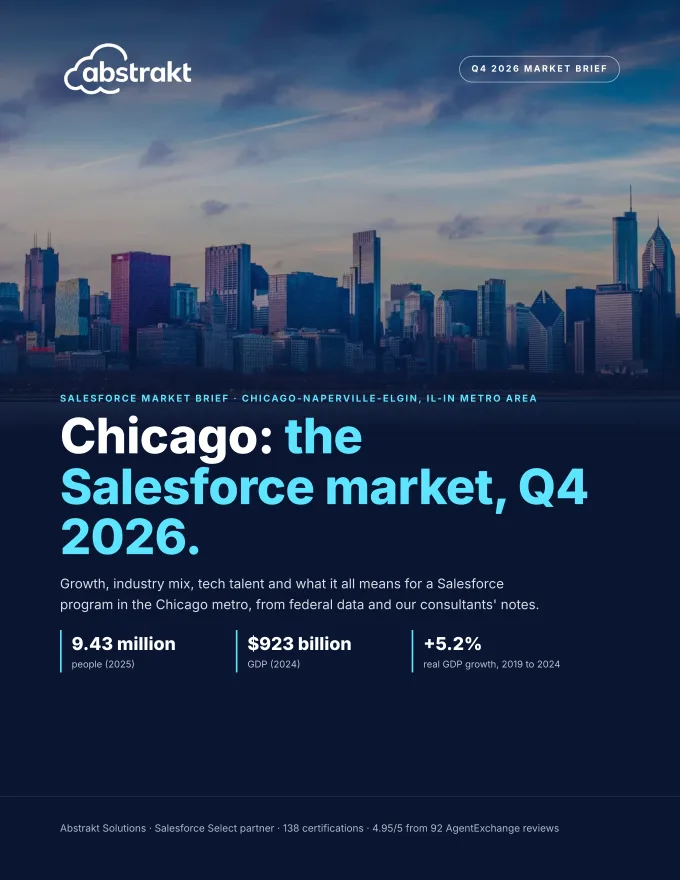
A free 23-page PDF with Chicago's growth ranked against 100 metros, its industry mix, tech wages and nearby markets. It is offered on the public Chicago page; send your customer there or get a copy for your own prep.
Get the Chicago brief →Co-sell with Abstrakt in Chicago
Working a Chicago account? Bring in a named consultant for discovery, scoping or a health check. We reply within 4 business hours.