
Salesforce consulting for Fayetteville companies
Abstrakt Solutions, a Salesforce Consulting Partner, works with retail suppliers, carriers and manufacturers in Fayetteville, Springdale, Rogers, Bentonville and the rest of Northwest Arkansas. Fayetteville is one of our focus markets.
The Fayetteville business landscape
Wholesale trade is the largest private sector in the Fayetteville–Springdale–Rogers metro, with manufacturing second and retail third. The Northwest Arkansas Council calls a retailer, a food company and a transportation company the region’s global anchor companies, and all three are based here: their SEC filings give business addresses in Bentonville, Springdale and Lowell. The Council also points to the state’s flagship university in Fayetteville, which holds R1 research status and supplies graduates to the regional workforce, and it says the university’s undergraduate supply chain management program was ranked No. 1 in the nation by an industry research firm.
The Council’s economic development work targets advanced manufacturing, aerospace, defense, life sciences and logistics, and it supports new companies through StartupNWA. It also reports that the Alice L. Walton School of Medicine opened in Northwest Arkansas in 2025, adding medical education to the region’s health care base. With a retailer, a food company and a transportation company as the anchors, and supply chain as a university specialty, Salesforce work here tends to center on order visibility, account planning for large customers, and collaboration with suppliers, carriers and other partners.
Figures cover the Fayetteville-Springdale-Rogers, AR Metro Area (AR).
- Wholesale trade11.2%Share of 2024 metro GDP Salesforce for retail & consumer goods →
- Manufacturing7.9%Share of 2024 metro GDP Salesforce for manufacturing →
- Retail trade6.7%Share of 2024 metro GDP Marketing Cloud →
- Health care and social assistanceat least 6.3%Share of 2024 metro GDP Salesforce for health & life sciences →
- Construction5.9%Share of 2024 metro GDP
Regional target sectorsAdvanced manufacturing, Aerospace, Defense, Life sciences, LogisticsNorthwest Arkansas Council, Economic Development
Where Salesforce fits in Fayetteville’s economy (4)
The largest private sectors by share of 2024 metro GDP, and what Salesforce work usually looks like in each.
| Sector | Share of 2024 GDP | Where Salesforce fits |
|---|---|---|
| Wholesale tradeSalesforce for retail & consumer goods → | 11.2% | Wholesale is the metro’s largest private sector. Distributors and consumer-goods sellers need account plans by retail customer, order status and deduction tracking connected to ERP. |
| ManufacturingSalesforce for manufacturing → | 7.9% | Food production, led by the global protein company based in Springdale, sits beside the Council’s advanced manufacturing, aerospace and defense targets. Producers here need quoting, customer specifications and quality claims tied to plant systems. |
| Retail tradeMarketing Cloud → | 6.7% | Retailers and brands selling direct to shoppers need one customer record across stores, online orders and service, with marketing driven by purchase history rather than broad lists. |
| Health care and social assistanceSalesforce for health & life sciences → | at least 6.3% | The Alice L. Walton School of Medicine and the Council’s life sciences target add clinical education and research to the region’s providers. Salesforce here usually supports referrals, patient outreach and service under strict privacy controls. |
Source: U.S. Bureau of Economic Analysis, GDP by county (CAGDP2), 2024, summed to the metro area; private sectors only, excluding real estate and government. “At least” marks sectors where BEA suppresses some county figures.
Fayetteville by the numbers: the trend, not just the size (3)
Northwest Arkansas has grown more than twice as fast as the nation since 2019, with construction and retail expanding quickly.
Business applications rose 64.1%, about level with the national 62.2%. New firms add to demand from retail suppliers and consumer goods companies.
Census Business Formation Statistics, county data summed to the metro, 2019–2025Real GDP grew 29.7%, well over twice the national 12.8%. Fast growth means many orgs were built for a smaller business and need restructuring.
BEA real GDP by county (CAGDP9), summed to the metro, 2019–2024Private employment rose 14.6%, about three times the U.S. rate. Scaling users and processes is continuous work.
BLS Quarterly Census of Employment and Wages, 2019 and 2024Leading private sectors in Fayetteville, 2024: concentration, growth and pay
| Sector | Concentration vs U.S. | Job growth 2019–2024 | U.S. job growth | Average annual pay |
|---|---|---|---|---|
| Wholesale trade | 1.07 | Not published | +3.8% | $114,530 |
| Manufacturing | 1.26 | +2.9% | -0.3% | $56,884 |
| Retail trade | 1.07 | +14.1% | -0.8% | $39,474 |
| Construction | 1.17 | +45.9% | +9.2% | $67,851 |
Construction grew 45.9% (1.17 times the national share), retail grew 14.1%, and manufacturing (1.26) and wholesale (1.07) are above average. Retail, consumer goods and supplier companies shape much of the Salesforce work.
BLS Quarterly Census of Employment and Wages for Fayetteville, 2019 and 2024 · How these measures work
Across the Fayetteville metro (7)
We work with companies throughout the metro area as the Census Bureau defines it.
Principal cities (4)
- Bentonville
- Fayetteville
- Rogers
- Springdale
Counties (3)
- Benton County
- Madison County
- Washington County
Salesforce in Fayetteville, service by service (7)
Each service has its own page for Fayetteville: what the work involves here, the industries it applies to and the questions local teams ask.
Implementation
Salesforce builds for Northwest Arkansas suppliers, carriers and life-sciences startups, with retail account hierarchies and lanes modeled first.
See Fayetteville implementation →Integration
Connect Salesforce to ERP, TMS, quality and retail-data systems for Northwest Arkansas food producers, carriers and consumer-goods suppliers.
See Fayetteville integration →Optimization
Better adoption and cleaner automation in Salesforce for Northwest Arkansas builders, wholesalers and health providers already on the platform.
See Fayetteville optimization →Managed Services
A standing Salesforce team for Northwest Arkansas retailers, food and consumer-goods makers and defense suppliers: admin, releases and backlog.
See Fayetteville managed services →Health Check
Access, technical-debt and AI-readiness review of Salesforce for Northwest Arkansas defense suppliers, life-sciences firms and retailers.
See Fayetteville health check →Migration
Referral databases, bid spreadsheets and legacy program records at Northwest Arkansas clinics, builders and aerospace firms, moved into Salesforce.
See Fayetteville migration →Implementation Rescue
Recover stalled Salesforce projects at Northwest Arkansas manufacturers, carriers and suppliers: assess the build, stabilize it and finish.
See Fayetteville implementation rescue →Salesforce products we implement for Fayetteville teams
Northwest Arkansas supplier teams and Agentforce
Wholesale trade produced 11.2% of Fayetteville metro GDP in 2024, the largest private share, with manufacturing at 7.9% and retail at 6.7%. Consumer-goods suppliers and distributors in Northwest Arkansas manage retailer accounts with detailed requirements around orders, deductions and replenishment. AI can read those requirement documents, summarize open issues by account, and support forecasting by highlighting orders that drift from history. Manufacturers can let an agent draft responses to broker and customer questions. Retail-facing teams gain from self-service on order status. Keep expectations grounded: item and account data must be clean, and planners should review every forecast adjustment.
- Reading retailer requirement documents
- Open-issue summaries by account
- Highlighting orders that drift from history
Salesforce for Fayetteville’s leading industries (3)
Retail & Consumer Goods
Salesforce for Northwest Arkansas consumer-goods suppliers and retailers: point-of-sale insight, joint business plans and shopper service data.
See Salesforce for retail & consumer goods in Fayetteville →Manufacturing
Salesforce for Northwest Arkansas food processors, private-label producers and aerospace suppliers: bid pricing, new-item launches and plant capacity.
See Salesforce for manufacturing in Fayetteville →Health & Life Sciences
Salesforce for Northwest Arkansas health organizations: clinical training sites, centralized new-patient scheduling and referral portals.
See Salesforce for health & life sciences in Fayetteville →Common Salesforce challenges in these industries (3)
- 01
A few very large customers
Suppliers whose revenue depends on a handful of big retail accounts often keep account plans, promotions and order data in separate spreadsheets and portals. Bringing them into one account view changes how business reviews run.
- 02
Shipment questions all day
Carriers, brokers and 3PLs answer constant status and billing inquiries. Service Cloud linked to transportation data lets reps reply without switching between systems.
- 03
Specifications that keep changing
Food and consumer-goods producers manage customer specs, quality claims and program terms that shift by season and plant. Versioned records and approvals prevent costly mix-ups.
What Salesforce should look like for Fayetteville companies (2)
Starting points for the industries that lead this market, not templates. Every org differs; these show the systems and the order they usually connect in.
A Bentonville consumer-goods supplier team managing a large retail account
- Retailer point-of-sale and replenishment data
- Snowflake or Data 360 for sell-through history
- ERP: orders, shipments, deductions
- Sales Cloud: retailer hierarchy, categories, joint business plans
- Service Cloud for deduction disputes and order issues
- Agentforce open-issue summaries by account
Wholesale trade is the metro's largest private sector at 11.2% of GDP. Supplier teams here usually depend on a handful of very large accounts, so summarized sell-through, open deductions and promotion results belong on one account view before the weekly business review.
A Northwest Arkansas food processor or private-label producer
- ERP and plant scheduling: capacity, lots, shipments
- MuleSoft for orders and lot data
- Sales Cloud for bids and new-item launches
- Revenue Cloud for bid pricing and program terms
- Versioned customer specifications with approvals
- Service Cloud for quality claims by lot and plant
Manufacturing is 7.9% of metro GDP, led by food production. Bids and new items depend on plant capacity, so the opportunity should show which line and plant would run the item before pricing is approved.
How Fayetteville revenue teams connect Salesforce to the rest of the stack (4)
Northwest Arkansas revolves around a retailer, a food company and a transportation company, so most stacks here are built to serve large customers and partners. The main RevOps work is bringing retailer data, plant data and shipment data into account views that sales, supply chain and finance all trust.
- 1
Retailer data portals → Account managers
Point-of-sale and replenishment data landed in Snowflake or Data 360 and summarized onto the Salesforce account by category and item.
- 2
ERP → Finance and sales
Orders, shipments and deductions synced through MuleSoft so disputes are worked as Service Cloud cases with the original shipment attached.
- 3
Sales → Plants
Approved bids and new-item launches in Revenue Cloud passed to plant scheduling with volumes and start dates.
- 4
All teams → Leadership
Tableau dashboards for joint business plan progress, sell-through and claims, used in weekly reviews.
Our work in these industries (2)
Client names are anonymized and these projects are not specific to Fayetteville.
Salesforce guides from our team (3)
Written by the consultants delivering the work.

Salesforce mobile app for field sales: setup that reps will use
How to set up the Salesforce mobile app so outside reps log visits and deals: phone pages, compact layouts, quick actions, sync, offline, maps, security, piloting and adoption.
Salesforce web-to-lead and lead capture: getting clean leads in
How to get clean website leads into Salesforce: Web-to-Lead, Account Engagement and API capture, spam and duplicate controls, UTM and source fields, consent, testing and monitoring.
Sales CloudSalesforce Sales Engagement: building cadences SDRs will follow
How to design Salesforce Sales Engagement cadences SDRs finish: builder, branching, enrollment via Flow, Work Queue, email, dialers, reporting, separate platforms, compliance and phase one.
Industry guides for Fayetteville companies (3)
- Retail & Consumer Goods Salesforce for retail and consumer goods: shoppers, orders, trade
- Manufacturing Salesforce Manufacturing Cloud: when it fits and how to implement it
- Health & Life Sciences Health Cloud implementation: patient data, care teams and compliance
Cost, staffing and partner choice in Fayetteville (3)
What drives the cost
In Northwest Arkansas, data volume and partner data drive scope. Point-of-sale and replenishment feeds, deduction tracking, ERP integration and the number of retail customers modeled add the most work; food producers add versioned specifications and quality claims.
How Salesforce consulting is priced →Hire, outsource or both
Supplier teams in Bentonville and Rogers are often lean, with analysts who know the retailer's data well but not Salesforce administration. Managed services fits until the org supports several customers and functions, then an internal admin makes sense.
Managed services vs. an in-house admin →Choosing a partner
Ask the partner how they would summarize point-of-sale data into Salesforce without loading every row, and how they track deductions back to shipments. For food producers, ask how they version customer specifications and require approvals.
Compare partners with the free scorecard →What Salesforce-related talent costs in Fayetteville (5)
These are the related occupations measured by BLS in the Fayetteville–Springdale–Rogers metro, next to national averages.
Annual wages for related occupations, Fayetteville and United States, May 2025
| Occupation (SOC code) | Fayetteville mean | Fayetteville median | U.S. mean | Fayetteville jobs |
|---|---|---|---|---|
| Computer systems analysts(15-1211) | $97,420 | $94,860 | $114,610 | 1,350 |
| Network and computer systems administrators(15-1244) | $94,470 | $86,530 | $103,680 | 570 |
| Database administrators(15-1242) | $87,210 | $81,300 | $110,090 | 70 |
| Software developers(15-1252) | $109,750 | $105,130 | $148,100 | 2,490 |
| Computer and information systems managers(11-3021) | $157,230 | $141,940 | $192,160 | 1,050 |
BLS Occupational Employment and Wage Statistics, May 2025: Fayetteville metro and U.S. estimates · About these figures
Northwest Arkansas pays below the national mean in every row, from about 9% for network administrators to about 26% for developers. In-house Salesforce staff cost considerably less than national guides.
Planner: in-house admin or outside support?
Compare the yearly cost of employing Salesforce staff in Fayetteville with a quote you have for outside support · How the planner works
In-house cost per year:$134,998
Enter an outside quote to compare.
Managed services vs an in-house admin → · Managed services in Fayetteville →
The Fayetteville Salesforce market brief, Q4 2026.
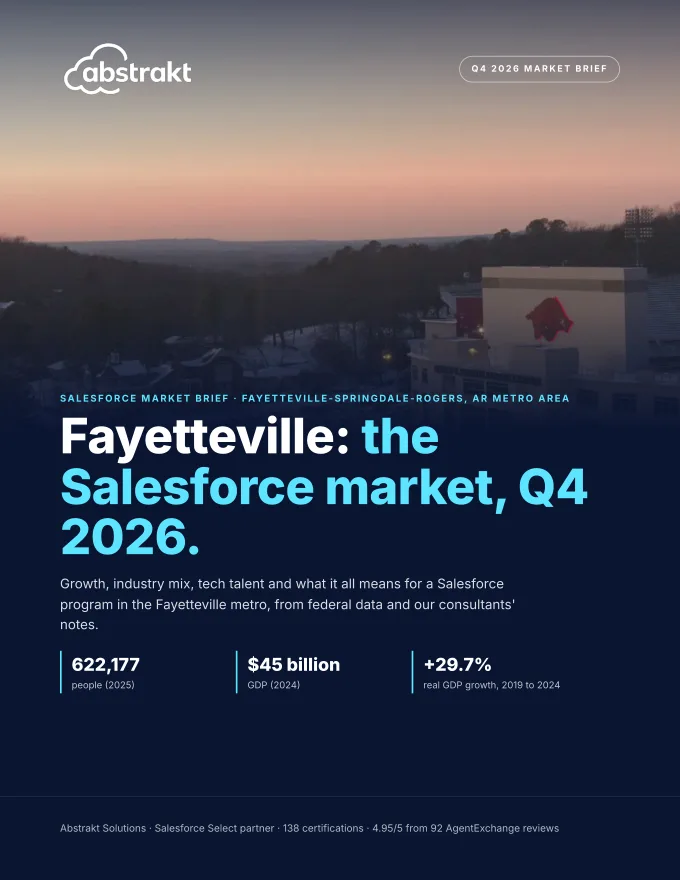
Everything on this page and more in one 22-page download for your planning: Fayetteville's growth since 2019 ranked against 100 metros, its industry mix, what related tech roles pay here compared with the U.S., the Fayetteville industry and service guides, and how Fayetteville compares with nearby metros.
A new edition of the Fayetteville brief is posted here each quarter, after the federal data refresh.
Salesforce consulting in Fayetteville: questions (10)
We sell to a large national retailer. How should our Northwest Arkansas team structure Salesforce?
Organize around the retail account and its categories. Build an account hierarchy for the retailer, its divisions and the categories you sell into, and keep joint business plans, promotions and category reviews on those records. Point-of-sale data belongs in Data 360 (formerly Data Cloud) or a warehouse, summarized into Salesforce so account managers see sell-through without exporting reports. Connect ERP for orders, deductions and shipments. Keep dashboards simple enough to open during a weekly business review.
Logistics is one of the NWA Council’s target sectors. How should a regional carrier or freight broker use Salesforce?
Treat lanes and shipper programs as core data. Sales Cloud can track bids by lane, equipment type and award status, while Service Cloud handles shipment inquiries and claims. Integrate your TMS through MuleSoft or a lighter connector so reps see load history, on-time performance and open issues on each shipper account. Carrier onboarding can run through an Experience Cloud portal that collects documents and insurance certificates. Begin with bid tracking, since it usually shows where revenue data is missing.
Our food plant in Springdale or Rogers handles customer specifications and quality claims by email. Can Salesforce fix that?
Yes. Service Cloud cases give each quality claim a lot number, product, plant and root cause, with photos and lab results attached, so trends by line or ingredient become visible. Customer specifications can live on the account as versioned records that need approval before a change takes effect. Sales teams then see open claims before renewal conversations. Pull lot and shipment data from ERP or your quality system rather than duplicating it, and give plant staff a stripped-down layout.
What drives the scope of Salesforce work for a Northwest Arkansas supplier team?
The amount of retailer data you need to see, how deductions are tracked, and how deep the ERP integration goes. Supplying one large retailer is simpler than modeling several with different requirements. Food and private-label producers add specification and quality claim workflows.
Should a Bentonville supplier team staff a Salesforce admin or use managed services?
Small supplier teams rarely have enough Salesforce work for a full-time role, and their analysts are better used on retailer data. Managed services covers configuration, integrations and releases. Hire once Salesforce supports several retail customers or adds service and marketing teams.
Do you need to be in our Bentonville or Rogers office to run the project?
No. The project runs inside your Salesforce org, and your team works with ours in scheduled sessions for design, review and testing, so having consultants in your office day to day isn't necessary. Account managers and analysts join when their part of the process is on the agenda.
How do we bring retailer deductions into Salesforce so we can resolve them faster?
Sync deductions from the ERP or retailer remittance data and open a Service Cloud case for each, linked to the original order and shipment. Categorize by reason code so recurring causes show up. Finance and account managers then work disputes from the same record instead of separate spreadsheets.
Can Agentforce read retailer requirement documents and tell us what affects our account?
It can summarize requirement and policy documents and highlight changes relevant to your categories, with an account manager reviewing the summary. It can also flag orders that drift from history for a planner to check. Clean item and account data and human review of every forecast adjustment are prerequisites.
How should a Northwest Arkansas private-label producer manage bids and new-item launches?
Track each bid as an opportunity with item, volume, plant and target start date, and price it in Revenue Cloud with program terms attached. When a bid is won, a launch checklist covers specifications, packaging and first production run. Linking plant capacity to the bid avoids promising volume a line cannot run.
How should an agribusiness in the region manage grower relationships and seasonal sales?
Model growers as accounts with their operations, contracts and delivery history, and track seasonal feed or equipment sales as opportunities timed to the production calendar. Retail customer specifications can sit on the buyer account. Field staff need a simple mobile layout to log visits.
Planning a Salesforce project? Read how Salesforce consulting is priced, the questions to ask a Salesforce consulting partner, or compare partners with our free scorecard.
Working across the South? (3)
The same team works with companies in these nearby metros. All 100 markets →
Little Rock
777,607 people · Health care and social assistance, at least 9.6% of GDP
Salesforce consulting in Little Rock →Tulsa
1.07M people · Manufacturing, 12.7% of GDP
Salesforce consulting in Tulsa →Kansas City
2.27M people · Professional, scientific, and technical services, at least 10.0% of GDP
Salesforce consulting in Kansas City →Sources and review (12)
Sources for the figures on this page
- U.S. Census Bureau, Population Estimates Program, Vintage 2025 (cbsa-est2025-alldata), July 1, 2025 estimate (accessed 2026-09-25)
- U.S. Bureau of Economic Analysis, CAGDP2 GDP by county (line 1, All industry total, current dollars), 2024; summed over the CBSA's component counties per Census Vintage 2025 delineation (accessed 2026-09-25; metro total summed from county figures)
- U.S. Census Bureau, County Business Patterns 2023, MSA file (NAICS total '------', ESTAB) (accessed 2026-09-25)
- Northwest Arkansas Council, Economic Development
- Northwest Arkansas Council, Region by the Numbers
- Northwest Arkansas Council
- U.S. Census Bureau, Core Based Statistical Areas delineation files (July 2023), lists 1 and 2
- U.S. Census Bureau, Business Formation Statistics, county-level annual business applications (2019-2025; retrieved 2026-10-20; Sum of component-county applications; growth computed as latest/base - 1. Published only when every component county matches.)
- U.S. Bureau of Economic Analysis, CAGDP9 Real GDP by county, chained 2017 dollars, all industry total (2019-2024; retrieved 2026-10-15; Sum of component-county real GDP; growth computed as latest/base - 1. Published only when every county matches (independent cities and combined areas need manual mapping).)
- U.S. Bureau of Labor Statistics, Quarterly Census of Employment and Wages, annual averages, private ownership (2019 and 2024 annual averages; retrieved 2026-10-15; Employment growth computed as latest/base - 1. Location quotients and pay as published by BLS. Suppressed values stored as null.)
- U.S. Bureau of Labor Statistics, Occupational Employment and Wage Statistics, May 2025 (May 2025; retrieved 2026-10-20; Related occupations only. BLS publishes no Salesforce Administrator occupation; these figures are not Salesforce salaries.)
- U.S. Bureau of Labor Statistics, Employer Costs for Employee Compensation, private industry workers (2026 2nd Quarter; retrieved 2026-10-15; benefitsOnWages = benefits cost per hour / wages and salaries cost per hour (national average, all private industry).)
Last reviewed October 5, 2026. See how Fayetteville compares with the other 99 markets in the U.S. Salesforce market report.