

How Salesforce work starts in Fayetteville
Abstrakt Solutions, a Salesforce Consulting Partner, works with retail suppliers, carriers and manufacturers in Fayetteville, Springdale, Rogers, Bentonville and the rest of Northwest Arkansas. Fayetteville is one of our focus markets.
What buyers here usually run into
- 1
A few very large customers
Suppliers whose revenue depends on a handful of big retail accounts often keep account plans, promotions and order data in separate spreadsheets and portals. Bringing them into one account view changes how business reviews run.
- 2
Shipment questions all day
Carriers, brokers and 3PLs answer constant status and billing inquiries. Service Cloud linked to transportation data lets reps reply without switching between systems.
- 3
Specifications that keep changing
Food and consumer-goods producers manage customer specs, quality claims and program terms that shift by season and plant. Versioned records and approvals prevent costly mix-ups.
Budget, team and partner questions
What drives cost
In Northwest Arkansas, data volume and partner data drive scope. Point-of-sale and replenishment feeds, deduction tracking, ERP integration and the number of retail customers modeled add the most work; food producers add versioned specifications and quality claims.
Admin or partner
Supplier teams in Bentonville and Rogers are often lean, with analysts who know the retailer's data well but not Salesforce administration. Managed services fits until the org supports several customers and functions, then an internal admin makes sense.
What buyers ask a partner
Ask the partner how they would summarize point-of-sale data into Salesforce without loading every row, and how they track deductions back to shipments. For food producers, ask how they version customer specifications and require approvals.
The local economy and its biggest industries (4)
| Sector | Share of 2024 GDP | Where Salesforce fits |
|---|---|---|
| Wholesale trade Salesforce for retail & consumer goods → | 11.2% | Wholesale is the metro’s largest private sector. Distributors and consumer-goods sellers need account plans by retail customer, order status and deduction tracking connected to ERP. |
| Manufacturing Salesforce for manufacturing → | 7.9% | Food production, led by the global protein company based in Springdale, sits beside the Council’s advanced manufacturing, aerospace and defense targets. Producers here need quoting, customer specifications and quality claims tied to plant systems. |
| Retail trade Marketing Cloud → | 6.7% | Retailers and brands selling direct to shoppers need one customer record across stores, online orders and service, with marketing driven by purchase history rather than broad lists. |
| Health care and social assistance Salesforce for health & life sciences → | at least 6.3% | The Alice L. Walton School of Medicine and the Council’s life sciences target add clinical education and research to the region’s providers. Salesforce here usually supports referrals, patient outreach and service under strict privacy controls. |
Source: U.S. Bureau of Economic Analysis, GDP by county (CAGDP2), 2024, summed to the metro area; private sectors only, excluding real estate and government. “At least” marks sectors where BEA suppresses some county figures.
Regional target sectors named by local economic development groups: Advanced manufacturing, Aerospace, Defense, Life sciences, Logistics.
Salesforce products that fit Fayetteville (6)
In the order we lead with them here, from the industries above.
Salesforce Sales Cloud
The CRM where sales pipeline lives, when it is built right.
Salesforce Service Cloud
The operating system for modern customer service, case, knowledge, voice, and AI agent assist together.
MuleSoft
Enterprise API platform, for connecting Salesforce, ERP, data warehouses, and the rest of your stack.
Salesforce Data 360 (Data Cloud)
Unify customer data into a real-time profile that powers segmentation, analytics, and AI.
Salesforce Experience Cloud
Customer, partner, and employee portals built on Salesforce.
Salesforce Revenue Cloud / CPQ
Configure-price-quote, billing, subscription management, and quote-to-cash on Salesforce.
Northwest Arkansas supplier teams and Agentforce
Wholesale trade produced 11.2% of Fayetteville metro GDP in 2024, the largest private share, with manufacturing at 7.9% and retail at 6.7%. Consumer-goods suppliers and distributors in Northwest Arkansas manage retailer accounts with detailed requirements around orders, deductions and replenishment. AI can read those requirement documents, summarize open issues by account, and support forecasting by highlighting orders that drift from history. Manufacturers can let an agent draft responses to broker and customer questions. Retail-facing teams gain from self-service on order status. Keep expectations grounded: item and account data must be clean, and planners should review every forecast adjustment.
- Reading retailer requirement documents
- Open-issue summaries by account
- Highlighting orders that drift from history
Services buyers here usually need (7)
Salesforce Implementation in Fayetteville
Implementation in Northwest Arkansas is shaped by who the customer is. Consumer-goods suppliers often sell mostly to one or two giant retailers, so the account hierarchy has to reflect divisions, categories and buyers rather than a flat list. Carriers and brokers sell lanes and capacity, not products. We settle that core structure in discovery, then configure in a sandbox, connect ERP or transportation data where needed, load cleaned records and train by role, launching in phases so each team is productive quickly.
By industry in Fayetteville
- 1
Wholesale trade
Wholesalers and consumer-goods suppliers make up the metro's largest private sector, about 11.2% of 2024 GDP, and many exist to serve the global retailer based in Bentonville. Their implementation starts with an account hierarchy that mirrors the retailer's divisions and categories, joint business plans stored against those records, and a clear place for deductions and promotions. We build that structure first, since every forecast, dashboard and account review depends on it being right.
- 2
Logistics
Logistics is one of the NWA Council's economic development targets, and a transportation company based in Lowell is among the region's global anchors. For carriers, brokers and 3PLs, implementation means modeling lanes, bids and shipper programs as first-class records, not squeezing them into generic opportunities. We configure bid tracking by lane and equipment type, link awarded freight to the shipper account, and set up Service Cloud for shipment inquiries so the same account view serves sales and support.
- 3
Life sciences
Life sciences sits on the NWA Council's target list, and a new medical school that opened in the region in 2025 adds clinical education to the local ecosystem. Young life-sciences companies implementing Salesforce need to track investors, research collaborators, clinical partners and early customers separately. We give each its own record type and stages, keep regulated data out of the first build, and leave room for approval steps as products move toward market.
Raise before scoping
Model the big retailer properly
A supplier whose largest customer has many divisions, categories and buyers needs more than one account record. Build a hierarchy that mirrors how that customer is organized, with plans and promotions at the right level, so account reviews draw directly from Salesforce instead of slides assembled by hand.
Decide where sell-through data lives
Point-of-sale and retailer portal data can be enormous. Keep the detail in Data 360 (formerly Data Cloud) or a warehouse and bring summaries into Salesforce, so account managers see trends on the account without slowing the org or inflating storage costs beyond what the value justifies.
Phase by team, not by feature
Launching sales, service and marketing features for everyone at once overloads small teams. Put one team fully live on clean data, learn from it, then bring the next team on with its own training, so adoption builds instead of stalling under a single oversized launch.
Salesforce Integration in Fayetteville
Integration projects in Northwest Arkansas usually connect Salesforce to systems that run the supply chain: ERP for orders, pricing and deductions, transportation management for loads and lanes, quality systems for specifications and claims, and retail data feeds for sell-through. We define which system owns each piece of data, choose MuleSoft or a lighter tool depending on how many connections are needed, and build monitoring so failures are caught quickly. Retailer data is summarized before it reaches Salesforce, keeping the org fast.
By industry in Fayetteville
- 1
Manufacturing
Manufacturing accounts for roughly 7.9% of 2024 metro GDP, led by food production and supported by the Council's advanced manufacturing, aerospace and defense targets. Producers need Salesforce linked to ERP for orders and pricing and to quality systems for lot numbers, specifications and claims. We integrate those so sales sees open claims and order history on each account, while plant systems remain the authority on production, inventory and lot traceability.
- 2
Logistics
Carriers, brokers and 3PLs, part of the logistics sector the NWA Council targets, keep load, lane and billing data in a transportation management system. Integration brings load history, on-time performance, open exceptions and billing disputes onto the shipper account in Salesforce. Service reps answer inquiries from one screen, and sales can see which lanes perform before rebidding. Carrier onboarding documents can also flow through an Experience Cloud portal into the right records.
- 3
Wholesale trade
Suppliers to large retailers rely on retailer portal, point-of-sale and deduction data that arrives from outside Salesforce every day. Integration lands that data in Data 360 (formerly Data Cloud) or a warehouse, summarizes it by account, category and item, and surfaces trends on the account record. Deductions from ERP appear alongside promotions, so account managers can reconcile disputes with context instead of chasing figures across several systems before every conversation with the buyer.
Raise before scoping
Summarize retailer data before loading
Daily item-by-store sales data can reach volumes Salesforce is not built to hold. Aggregate it by week, category or item in Data 360 (formerly Data Cloud) or a warehouse, and bring only the summaries account managers need into CRM records, keeping pages fast and storage predictable.
Align item and customer masters
Integrations fail when item numbers, customer IDs or units of measure differ between ERP, the quality system and Salesforce. Agree a master for each and map the exceptions before building, then test with real orders that include unusual or discontinued items.
Plan for API limits and peaks
Order and load volumes can spike around promotions and seasonal peaks. Design integrations with batching, queues and retries, check Salesforce API limits against peak volume, and alert a named owner when a sync falls behind, well before users notice missing data.
Salesforce Optimization in Fayetteville
Many Northwest Arkansas companies added Salesforce during rapid growth and kept bolting on fields, automation and reports as teams expanded. The result is an org that works, but slowly and inconsistently. Optimization begins with evidence: usage data, automation inventory and conversations with the people who use Salesforce daily. We simplify layouts, merge overlapping Flows and legacy rules, clean duplicate accounts, and rebuild the dashboards leaders review. Nobody faces a big-bang relaunch; each fix arrives on its own with a quick demo for the people it affects.
By industry in Fayetteville
- 1
Construction
Construction adds about 5.9% of 2024 metro GDP, reflecting building activity across the region's fast-growing cities. Builders and trade contractors often run Salesforce for bids and customers but manage jobs elsewhere, so estimators duplicate data and managers cannot see win rates by project type. Optimization streamlines the bid pipeline, removes unused fields, connects job status from the project system and gives owners a pipeline view they trust enough to plan crews and purchasing around.
- 2
Wholesale trade
Distributors and consumer-goods suppliers here often have Salesforce orgs full of fields added for one retailer program and then forgotten when the program ended. Account managers stop updating records, and leaders fall back to spreadsheets for business reviews. We clear out obsolete fields and automation, restructure account plans around current categories, and rebuild reports so sell-through, promotions and deductions appear in one place that account managers actually open before a customer meeting.
- 3
Health care and social assistance
Providers and care organizations in Northwest Arkansas use Salesforce for referrals, patient outreach and service requests, often built in a hurry as practices added locations. Optimization standardizes referral statuses across locations, merges duplicate patient and physician records, and tightens automation so reminders and follow-ups fire once, not twice. Leaders gain consistent referral and follow-up reporting, and front-desk and outreach staff spend less time working around the system and more time with patients.
Raise before scoping
Start with the reports leaders open
Check which dashboards executives actually view and which they ignore. Rebuilding the few that matter, with agreed definitions and clean data underneath, changes behavior faster than redesigning every screen, because teams keep records current once leaders visibly rely on them.
Retire fields from old programs
Fields and automation built for a retailer program, promotion or pilot that ended years ago still clutter layouts and slow saves. Inventory them, confirm with owners that they are unused, archive the data if needed and remove them to simplify every user's day.
Prepare the data AI will read
If Agentforce or other AI features are on the roadmap, optimization is the time to clean the records they will use. Merged duplicates, current knowledge articles and consistent picklist values make later AI pilots far more accurate and far less risky.
Salesforce Managed Services in Fayetteville
Technical talent is contested in Northwest Arkansas, where corporate headquarters and their suppliers all hire from the same pool, which makes keeping a seasoned Salesforce admin difficult. Managed services gives them a whole team instead: admins for daily requests, developers for Apex and integration work, and an architect for design decisions. Incoming tickets get sorted by business impact, each platform upgrade is tried on a sandbox copy before your users meet it, and leftover fields and dead automation are retired a little at a time. Priorities are agreed with you in regular reviews, and everything we change is documented.
By industry in Fayetteville
- 1
Retail trade
Stores and consumer brands along the Fayetteville-to-Bentonville corridor account for roughly 6.7% of 2024 metro GDP. Retailers and direct-to-consumer brands in the region lean on Salesforce for customer service, loyalty and campaigns, which produces a steady stream of small but time-sensitive requests. A managed team adds promotion audiences, updates case categories, keeps consent fields syncing correctly with marketing tools and tests changes ahead of peak shopping periods, so store and online teams are never caught out by an untested release.
- 2
Manufacturing
Food and consumer-goods manufacturers here, including the protein company based in Springdale, run Salesforce across sales, customer specifications and quality claims. Those processes shift every time customers, plants or product lines change. Managed services keeps specification records, approval flows and claim routing current, maintains the ERP and quality-system integrations that feed them, and handles report requests from plant, quality and commercial leaders without letting planned enhancements pile up behind urgent fixes.
- 3
Defense
The NWA Council courts defense suppliers alongside aerospace firms. Suppliers serving defense programs often need tight control of who can see program, pricing and customer information, and every change to that control must be documented. A managed team applies changes through a defined approval process, tests sharing and permission effects in a sandbox, and keeps a change log that your security and contracts staff can review whenever a customer or auditor asks.
Raise before scoping
Protect the business-review calendar
Suppliers presenting to large retail customers rely on Salesforce dashboards in regular business reviews. Schedule releases and enhancements so nothing changes in the days before those meetings, and verify key reports after every Salesforce release so the numbers presented are the numbers expected.
Separate urgent fixes from enhancements
Broken integrations or blocked users need attention the same day, while new features can wait for the next planning cycle. Two distinct lanes, each with clear response expectations, stop small emergencies from derailing the roadmap and stop the roadmap from starving support.
Document for your next internal hire
Many companies eventually bring an admin in-house alongside a managed team. Keeping configuration notes, integration diagrams and change history current means that person can be productive within weeks, rather than spending their first months reverse-engineering decisions nobody ever wrote down.
Salesforce Health Checks in Fayetteville
For Northwest Arkansas companies, a health check is often prompted by a customer: a large retailer, a defense prime or a research partner asks how customer and program data is protected. Our reviewers log in as sample users from each role, trace what portal and integration accounts can touch, and then read through the automation and code that act on those records. Findings are ranked by risk and effort, mapped to the questions customers and auditors typically raise, and turned into a sequenced list of fixes that your team or ours can begin immediately.
By industry in Fayetteville
- 1
Defense
Defense suppliers, a target sector for the NWA Council, often store program names, pricing and customer contacts in Salesforce under contractual limits on who may see them. We test whether a sales rep on one program can open records from another, search the org for technical data that should never have been entered, and check what the ERP connector is allowed to read. The report gives your security staff documented answers for customer reviews.
- 2
Life sciences
Life-sciences companies, another NWA Council target, frequently start with a lightweight Salesforce setup and add regulated processes as products advance. The review checks field history tracking on records that support quality or regulatory decisions, confirms who can see complaint and partner information, and flags automations that modify regulated records without an audit trail. It also identifies what must change before validation or quality processes are layered onto the existing org.
- 3
Retail trade
Retailers and consumer brands hold large volumes of shopper data in Salesforce, often synced with marketing platforms and e-commerce systems. We check who can export customer lists, whether consent and opt-out data sync correctly across every connected system, how long personal data is retained, and whether integration users hold more access than they need. Findings are prioritized by privacy exposure, so marketing, e-commerce and IT can agree on fixes quickly.
Raise before scoping
Answer customer audits with evidence
Large customers increasingly ask suppliers how CRM data is controlled. The health check produces a current record of access, admin rights, integrations and retention settings that your team can use to answer those questions accurately, instead of assembling responses from memory under deadline.
Check permissions before any AI pilot
An Agentforce agent works within the permissions of its user and the quality of your data. We test the objects a planned agent would access, confirm sharing is tight enough and identify duplicate or outdated records that would lead to wrong answers.
Rank debt by business impact
Not every unused field or old Flow matters equally. We rank technical debt by its effect on performance, reporting accuracy and change risk, so cleanup effort goes first to the items slowing your teams, not simply to the longest list.
Salesforce Migration in Fayetteville
Rapid growth across Northwest Arkansas has left many organizations with customer data spread across spreadsheets, starter CRMs and systems chosen when the company was far smaller. Migration gathers those sources into Salesforce in a controlled way. Every file and system gets listed, the destination objects are agreed with the teams who will use them, duplicates are merged in a staging area, and practice loads repeat until the totals tie out. Users review familiar records before the final load, and cutover is planned so no team works in two systems for longer than necessary.
By industry in Fayetteville
- 1
Health care and social assistance
Health care and social assistance is at least 6.3% of 2024 metro GDP, a lower bound in the BEA data, and the region's health base is growing with medical education. Moving a practice's referral history means handling protected information under tight controls. We migrate only the fields Salesforce needs, encrypt sensitive values, carry consent with its date and source, and validate loads in a restricted sandbox before any production cutover.
- 2
Construction
A builder in the Fayetteville–Springdale–Rogers corridor may have three versions of the same customer: one in the estimator's workbook, one in the bid software and one in accounting. Migration matches customers across those sources, standardizes project addresses, and brings in closed bids with outcomes and job types so win rates can be reported from day one. Abandoned estimates and duplicate contacts are left behind, giving estimators a clean pipeline rather than an exact copy of old clutter.
- 3
Aerospace
The NWA Council is actively recruiting aerospace companies to the region. Suppliers and repair shops entering the region or scaling up often migrate from a legacy CRM or database that holds customers, programs and quotes. We map programs, parts and quote history to a clean Salesforce model, carry restricted-access flags into sharing rules at load time, and keep technical or export-controlled details out of the CRM entirely, linking to the system that remains authoritative.
Raise before scoping
Inventory the informal sources
In fast-growing companies, important data often sits in personal spreadsheets, email folders and shared drives nobody has catalogued. Ask every team for its lists before designing the migration, so key customer and partner relationships are not discovered missing weeks after cutover.
Set restrictions at load time
Records with privacy or contractual restrictions should arrive in Salesforce already protected by the right sharing rules and field security. Loading everything openly and restricting access later leaves a window of exposure that is easy to avoid with a little planning up front.
Rehearse the cutover weekend
Walk through the exact order of cutover tasks in a sandbox first, with a stopwatch and a list of every manual step. A rehearsed cutover is shorter and calmer, and it reveals dependencies such as integrations that must be paused and resumed in the right order.
Salesforce Implementation Rescue in Fayetteville
Rescue projects in Northwest Arkansas often trace back to growth outpacing the plan. A build scoped for one retail account or one plant was stretched to cover several, integrations were postponed to hit a date, or the internal champion was recruited away. Our first weeks go to measuring the gap between the org and today's business and fixing whatever blocks people from working, then we label each part keep, repair or rebuild. The remaining essential scope is then finished in short phases, each tested and trained before release.
By industry in Fayetteville
- 1
Advanced manufacturing
Advanced manufacturing is a target sector for the NWA Council, and manufacturers' stalled projects often break down at quoting. Half-finished pricing rules and price books that no longer match ERP send reps back to their own calculators. Recovery reconciles products, bundles and pricing with ERP, completes or simplifies the CPQ rules, and tests quotes against recent real orders, so sales can trust that what Salesforce produces matches what finance will invoice.
- 2
Logistics
Carriers and brokers in the region sometimes launch Salesforce for sales but never connect it to the transportation system, leaving reps without load history or on-time data. Service teams keep working from email. Recovery finishes that integration, rebuilds lane and bid tracking around how the business actually prices freight, and relaunches Service Cloud for shipment inquiries and claims, so the account view finally combines sales history with live operations data.
- 3
Wholesale trade
Some suppliers to large retailers have a Salesforce project that stalled because retail data was never connected or the account hierarchy did not match how the customer is actually organized. Account managers returned to slides and spreadsheets, and leadership lost sight of the pipeline. Recovery rebuilds the hierarchy, connects summarized sell-through and deduction data, and restores the dashboards promised for business reviews, testing them with account teams before the next customer meeting.
Raise before scoping
Separate stabilization from new scope
The first phase of recovery fixes what is broken without adding features. Keeping that boundary clear lets users see improvements quickly, prevents scope creep from swallowing the fixes, and gives leadership a clean decision point before funding the remaining work.
Finish the integrations you postponed
Many stalled projects deferred ERP, TMS or retail-data integration to meet a launch date. Without that data, Salesforce stays half-empty and users see little reason to open it. Scheduling the integration early in recovery gives every later phase something useful to show.
Restore ownership inside your company
When the internal champion has left, name a new business owner before work resumes. That person settles process questions, approves each phase and becomes the voice of Salesforce internally, which is what keeps a recovered project from stalling a second time.
Industry plays in Fayetteville (3)
Salesforce for Fayetteville Retail and Consumer Brands
In Northwest Arkansas, the retail and consumer goods conversation often starts with supplier teams. Consumer brands base account teams in Northwest Arkansas to work with retail buyers and need to turn point-of-sale data, forecasts and promotions into plans those buyers will accept. Salesforce supports that with Sales Cloud account planning, Data 360 (formerly Data Cloud) to combine retail sales data with shipments, and MuleSoft to connect ERP and planning tools. Retailers and direct-to-consumer brands in the region use Service Cloud to handle shopper questions with order history in view.
Retail trade accounted for 6.7% of the Fayetteville–Springdale–Rogers metro's 2024 GDP in Bureau of Economic Analysis data, while wholesale trade, the largest private sector at 11.2%, reflects the many suppliers and distributors serving retail customers. Logistics sits on the Northwest Arkansas Council's target list next to advanced manufacturing, aerospace, defense and life sciences. The flagship university's nationally ranked supply chain management program adds a steady stream of graduates trained for this kind of work.
Use cases to open with
- 1
Sell-through and shipment insight
Suppliers receive store-level sales and inventory data from retail partners but often analyze it in spreadsheets. Data 360 (formerly Data Cloud) can combine point-of-sale feeds with ERP shipments and forecasts, so account managers see out-of-stocks, slow movers and promotion lift by item and region. They bring evidence to buyer meetings instead of rebuilding the same analysis every week. Replenishment and promotion questions from the buyer get answered with numbers the whole team trusts.
- 2
Joint business planning
Annual and seasonal plans with a large retailer involve item assortments, promotions, pricing and trade investment. Sales Cloud account plans with objectives, planned volumes and action items keep the whole account team, including sales, supply chain and marketing, working from one plan, and make it easy to review progress with the buyer midway through the season. Past plans stay on record, so a new account manager inherits the history rather than starting cold.
- 3
Shopper service with order context
Retailers and brands selling online field questions about orders, returns and product use. Service Cloud with order and shipment data integrated gives agents the answer without switching systems. Case trends by product show which items generate complaints, information that also strengthens a supplier's conversations with its retail partners about packaging, instructions or quality. Returns data flows back to merchandising and product teams in the same way.
Raise before scoping
Handle retail data separately
Retailer-provided sales feeds arrive in high volume, refresh often and come with contractual limits on use. Store them in Data 360 (formerly Data Cloud) or a data warehouse rather than standard objects, confirm what the terms allow, and surface only summaries inside everyday Salesforce screens.
Structure multi-brand account teams
Suppliers with several brands or divisions calling on the same retailer need shared account hierarchies without exposing each team's pricing. Plan account teams, sharing and record types before build, so leadership gets a consolidated customer view while brand managers see their own detail.
Budget time for data quality
Item masters, customer hierarchies and store lists rarely match across the ERP, retail data and CRM. Treat cleanup and matching rules as a formal workstream, since dashboards built on mismatched item codes quickly lose the trust of account teams. Assign data stewards on both the sales and supply chain side.
Salesforce for Fayetteville Manufacturers
Manufacturers in Northwest Arkansas frequently sell to customers with enormous buying power in retail, foodservice and defense. Salesforce helps them respond with discipline: bids priced from current costs, new items launched on schedule and capacity promised only where plants can deliver. We combine Sales Cloud with CPQ for bid and contract pricing, MuleSoft to bring ERP cost and capacity data into the quote, and Experience Cloud where brokers or distributors need shared access.
Plants and processors generated 7.9% of 2024 output in the Fayetteville–Springdale–Rogers metro, per Bureau of Economic Analysis figures, a share topped only by wholesale trade. Food production has deep roots here, with a Springdale-based food company among the Council's anchors, while the Council's recruiting efforts focus on advanced manufacturing, aerospace, defense and life sciences. Because retail and logistics are also central to the regional economy, many plants operate inside those supply chains, where on-time delivery, cost transparency and compliance with customer requirements decide whether business is renewed.
Use cases to open with
- 1
Private-label and co-manufacturing bids
Producers bidding on private-label or co-manufacturing business must price formulas, packaging and volume tiers against volatile input costs. CPQ with cost data pulled from the ERP produces consistent bids, routes thin-margin quotes for approval and keeps a history of what was offered, so the next bid season starts from facts rather than from last year's spreadsheets and memory. Win and loss reasons are captured for every bid.
- 2
New item launch tracking
Getting a new product onto shelves involves samples, specifications, item setup, packaging approval and a first production run. Treating each launch as a tracked project linked to the opportunity shows sales, R&D and operations which tasks are late and whether the customer's reset date is still realistic, so problems surface while there is time to fix them. Launch history also shows which customers' processes take longest.
- 3
Selling within plant capacity
Plants running near capacity cannot say yes to every order. Integrating line capacity and production plans with Salesforce lets sales leaders see how new business would load each plant before accepting it. Account managers can then give customers honest dates when an existing program needs more volume, and leadership can see where added capacity or a new line would pay off.
Raise before scoping
Align cost data with pricing
Bids are only as good as the costs behind them. Decide who maintains standard costs, how often they refresh into Salesforce and how commodity changes trigger requotes, and involve finance in approval rules from the start rather than after the first margin surprise.
Keep defense work separated
Aerospace and defense suppliers in the region may need restricted access to program data and export-controlled drawings. If a company serves both consumer and defense markets, design separate record types, sharing and file controls, and confirm them with security staff.
Win over plant and quality teams
Launch and capacity processes need input from people who rarely use CRM. Give plant, R&D and quality staff simple task views, mobile access and notifications only for work they own, and show them how the data reduces last-minute schedule changes.
Salesforce for Fayetteville Health Care
Health organizations in Northwest Arkansas include hospital systems and clinics, specialty groups, a new medical school and life sciences companies. Salesforce supports patient access and referral management for providers, relationships with clinical training sites and research partners for academic programs, and commercial pipelines for life sciences firms. We build on Service Cloud and Experience Cloud with privacy controls designed first, and we connect EHR, scheduling and research systems only where each workflow needs them.
Bureau of Economic Analysis county data credit health care and social assistance with no less than 6.3% of the Fayetteville–Springdale–Rogers metro's 2024 GDP; the true share may be higher because some figures are withheld. The Northwest Arkansas Council includes life sciences in its target sectors, and a new medical school opened in the region in 2025, adding clinical training and research to an economy whose largest private sectors are wholesale trade and manufacturing. The region's flagship university holds an R1 research designation. Growing clinical education and a research university nearby both shape how providers here reach patients and partners.
Use cases to open with
- 1
Clinical training site coordination
A new medical school needs clerkship sites across hospitals and clinics, with agreements, preceptors and student placements tracked by rotation. Salesforce can manage each site's affiliation agreement, capacity and contacts, match students to placements, and collect evaluations through a portal. Program staff see gaps in capacity before the academic year starts, and partner sites know which students are arriving and when.
- 2
Centralized new-patient scheduling
Specialty and primary care practices often lose new patients between the first call and the first visit. A central access team using Service Cloud can take calls, web requests and referrals in one queue, check provider availability through the scheduling integration, and follow up on unscheduled referrals. Marketing Cloud sends preparation instructions and reminders to reduce no-shows, and leaders track time to first appointment by specialty.
- 3
Referral partner portal
Referring physicians in Rogers, Bentonville and Springdale can submit referrals through an Experience Cloud portal, attach records, and see when their patient is scheduled and seen. Specialists receive complete referrals instead of partial faxes, and coordinators work a single queue with status tracking. Liaison teams use referral trends by practice to plan outreach visits and notice relationships that are fading.
Raise before scoping
Separate academic and patient data
Student, preceptor and evaluation data fall under FERPA, while patient information falls under HIPAA. If one organization manages both, keep them in distinct objects with separate sharing models and permission sets, and have compliance confirm the design before either type of data is loaded.
Integrate with scheduling selectively
Real-time scheduling integration is valuable but costly. Decide which specialties and appointment types need live availability in Salesforce and which can be handled by staff booking directly in the EHR, then build the integration for the highest-volume paths first and extend it later.
Plan for growth in users
New programs and clinics add staff quickly. Use permission set groups by role, templates for new locations and a clear request process for new fields, so the org stays consistent as teams multiply instead of fragmenting into department-specific customizations nobody can maintain.
Case studies to send (2)
From the industries this market leans on. Client names are anonymized and these projects are not specific to Fayetteville.
The Fayetteville Salesforce market brief, Q4 2026
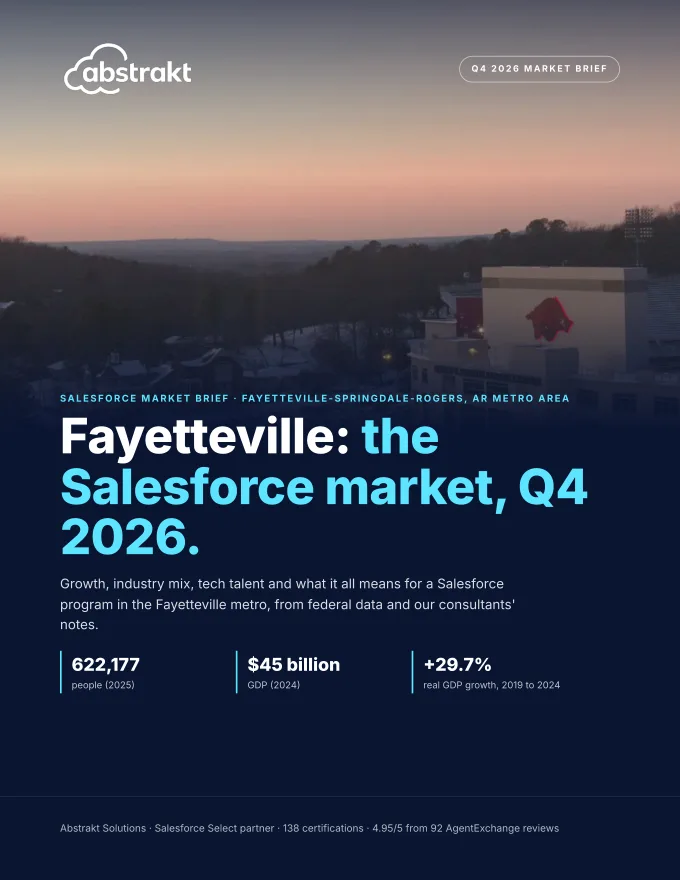
A free 22-page PDF with Fayetteville's growth ranked against 100 metros, its industry mix, tech wages and nearby markets. It is offered on the public Fayetteville page; send your customer there or get a copy for your own prep.
Get the Fayetteville brief →Co-sell with Abstrakt in Fayetteville
Working a Fayetteville account? Bring in a named consultant for discovery, scoping or a health check. We reply within 4 business hours.