
Salesforce consulting for Minneapolis–St. Paul companies
Abstrakt Solutions is a Salesforce Consulting Partner that serves Minneapolis–St. Paul manufacturers, medtech companies, financial firms and corporate headquarters. We implement, integrate, optimize and manage Salesforce across the Twin Cities region. Minneapolis–St. Paul is one of our focus markets.
The Minneapolis–St. Paul business landscape
Few metros have as many large corporate headquarters for their size as Minneapolis–St. Paul. Those head offices span health care and insurance, retail, industrial manufacturing, packaged foods, banking and agribusiness. Several major medical-technology companies also operate in the Twin Cities.
Manufacturing and finance and insurance are the metro’s two largest private sectors, nearly equal in size. Greater MSP, the regional economic development partnership, targets health and life sciences, food and water, headquarters and business services, financial services and insurance, and advanced manufacturing and technology. It describes the University of Minnesota as a top-10 research university and ranks the region sixth among the world’s most inventive metro areas.
Figures cover the Minneapolis-St. Paul-Bloomington, MN-WI Metro Area (MN–WI).
- Manufacturing11.0%Share of 2024 metro GDP Salesforce for manufacturing →
- Finance and insurance10.6%Share of 2024 metro GDP Financial Services Cloud →
- Professional, scientific, and technical servicesat least 8.6%Share of 2024 metro GDP Salesforce for professional services →
- Health care and social assistanceat least 8.0%Share of 2024 metro GDP Salesforce for health & life sciences →
- Wholesale tradeat least 7.7%Share of 2024 metro GDP
Regional target sectorsHealth & Life Sciences, Food & Water, Headquarters & Business Services, Financial Services & Insurance, Advanced Manufacturing & TechnologyGreater MSP
Where Salesforce fits in Minneapolis–St. Paul’s economy (4)
The largest private sectors by share of 2024 metro GDP, and what Salesforce work usually looks like in each.
| Sector | Share of 2024 GDP | Where Salesforce fits |
|---|---|---|
| ManufacturingSalesforce for manufacturing → | 11.0% | Medical-device, food and industrial manufacturers need distributor and account management, quoting and service tied to ERP, and often regulated complaint and service processes. |
| Finance and insuranceFinancial Services Cloud → | 10.6% | Banks, insurers and health plans need relationship views, compliant marketing and service at scale, which is where Financial Services Cloud and Service Cloud fit. |
| Professional, scientific, and technical servicesSalesforce for professional services → | at least 8.6% | Business services firms supporting the region’s headquarters need pipeline, delivery and account planning across large enterprise clients. |
| Health care and social assistanceSalesforce for health & life sciences → | at least 8.0% | Health systems and healthcare services companies use Salesforce for patient and member engagement, referral management and service, with privacy designed in. |
Source: U.S. Bureau of Economic Analysis, GDP by county (CAGDP2), 2024, summed to the metro area; private sectors only, excluding real estate and government. “At least” marks sectors where BEA suppresses some county figures.
Minneapolis–St. Paul by the numbers: the trend, not just the size (3)
The Twin Cities economy has grown modestly since 2019, with manufacturing and financial services still at its core.
Business applications rose 55.3%, a little under the national 62.2%. New firms add to steady demand from the region's many established corporate headquarters and their suppliers.
Census Business Formation Statistics, county data summed to the metro, 2019–2025Real output grew 8.3%, behind the national 12.8%. Steady, mature markets like this one tend to spend on Salesforce optimization, consolidation and integration more than on new builds.
BEA real GDP by county (CAGDP9), summed to the metro, 2019–2024Private employment is slightly below 2019 (−0.7%). Productivity, not headcount growth, is the usual case for Salesforce investment here.
BLS Quarterly Census of Employment and Wages, 2019 and 2024Leading private sectors in Minneapolis–St. Paul, 2024: concentration, growth and pay
| Sector | Concentration vs U.S. | Job growth 2019–2024 | U.S. job growth | Average annual pay |
|---|---|---|---|---|
| Manufacturing | 1.25 | -0.5% | -0.3% | $90,450 |
| Finance and insurance | 1.30 | -13.1% | +4.4% | $148,461 |
Finance and insurance (1.30) and manufacturing (1.25) are both more concentrated than nationally, though finance employment fell 13.1% since 2019. Insurers, medical-device makers and industrial firms set most of the Salesforce agenda. BLS withholds the metro's computer systems design figures, so they are not shown.
BLS Quarterly Census of Employment and Wages for Minneapolis–St. Paul, 2019 and 2024 · How these measures work
Across the Minneapolis–St. Paul metro (25)
We work with companies throughout the metro area as the Census Bureau defines it, which spans 2 states.
Principal cities (10)
- Bloomington, MN
- Burnsville, MN
- Eagan, MN
- Eden Prairie, MN
- Edina, MN
- Minneapolis, MN
- Minnetonka, MN
- Plymouth, MN
- St. Louis Park, MN
- St. Paul, MN
Counties (15)
- Anoka County, MN
- Carver County, MN
- Chisago County, MN
- Dakota County, MN
- Hennepin County, MN
- Isanti County, MN
- Le Sueur County, MN
- Mille Lacs County, MN
- Ramsey County, MN
- Scott County, MN
- Sherburne County, MN
- Washington County, MN
- Wright County, MN
- Pierce County, WI
- St. Croix County, WI
Salesforce in Minneapolis–St. Paul, service by service (7)
Each service has its own page for Minneapolis–St. Paul: what the work involves here, the industries it applies to and the questions local teams ask.
Health Check
An independent audit for large Twin Cities orgs: data exposure, packages, custom code and automation debt, compared across orgs and ranked.
See Minneapolis–St. Paul health check →Optimization
Making long-lived Twin Cities Salesforce orgs easier to use: dependency-checked cleanup, agreed metric definitions and changes rolled out in waves.
See Minneapolis–St. Paul optimization →Managed Services
For mature Twin Cities orgs: change-controlled admin work, release regression tests for regulated processes and steady technical debt reduction.
See Minneapolis–St. Paul managed services →Implementation
Twin Cities manufacturers, medtech firms and headquarters teams get Salesforce designed to pass enterprise review, then launched one unit at a time.
See Minneapolis–St. Paul implementation →Integration
Fitting Salesforce into Twin Cities enterprise landscapes: distribution ERP pricing, core financial systems, approved middleware and Data 360 (formerly Data Cloud).
See Minneapolis–St. Paul integration →Migration
Moving Twin Cities divisions, acquired businesses and marketing data into Salesforce with relationships, consent and history carried over accurately.
See Minneapolis–St. Paul migration →Implementation Rescue
Recovering Twin Cities Salesforce programs that stalled at compliance review, lost momentum or never connected marketing to CRM data.
See Minneapolis–St. Paul implementation rescue →Salesforce products we implement for Minneapolis–St. Paul teams
Agentforce fit for Twin Cities insurers, makers, and clinics
Two sectors run close together in Minneapolis: manufacturing at 11.0% of metro GDP in 2024 and finance and insurance at 10.6%. For carriers and benefits administrators, the realistic starting point is document reading, where an agent pulls policy numbers, dates, and claim details from submitted forms into Service Cloud fields for an adjuster to confirm. Manufacturers get more from summarizing long distributor cases and suggesting the next step. Health systems can use grounded self-service for scheduling and billing questions, provided protected information stays behind proper access controls. In every one of these, the limit is the knowledge base and the permission model, so we audit both before switching anything on.
- Claim form data extraction
- Distributor case summaries
- Scheduling and billing self-service
Salesforce for Minneapolis–St. Paul’s leading industries (4)
Manufacturing
Salesforce for Twin Cities manufacturers: consolidating divisional orgs, new product launches, and service and consumables on installed equipment.
See Salesforce for manufacturing in Minneapolis–St. Paul →Health & Life Sciences
Salesforce for Twin Cities medical device and health companies: surgical case coverage, complaint intake for quality and consent-aware marketing.
See Salesforce for health & life sciences in Minneapolis–St. Paul →Insurance
Salesforce for Twin Cities insurers, health plans and agencies: employer group sales, broker management and member or policyholder service.
See Salesforce for insurance in Minneapolis–St. Paul →Professional Services
Salesforce for Twin Cities agencies, consultancies and IT services firms: enterprise account plans, procurement steps and master agreement renewals.
See Salesforce for professional services in Minneapolis–St. Paul →Common Salesforce challenges in these industries (3)
- 01
Enterprise-scale orgs
Large, mature Salesforce orgs accumulate technical debt: overlapping automation, unused fields and customizations nobody owns. A health check and a steady cleanup plan pay off.
- 02
Medtech and regulated service
Medical-device companies need complaint handling, service history and field activity captured in ways that support their quality processes.
- 03
Marketing to many audiences
Companies selling to providers, payers and consumers need segmentation and consent handled carefully across channels.
What Salesforce should look like for Minneapolis–St. Paul companies (2)
Starting points for the industries that lead this market, not templates. Every org differs; these show the systems and the order they usually connect in.
A Twin Cities medical device company selling into health systems
- ERP: contract pricing, consigned inventory, orders
- MuleSoft integration
- Sales Cloud accounts by integrated delivery network and GPO contract
- Procedure case coverage scheduling for field reps
- Service Cloud complaint intake with audit trail
- Handoff to the quality system of record
- Agentforce summaries of long service and complaint histories
Complaint intake has to hand off cleanly to the quality system, with Salesforce capturing the event and the quality system owning the investigation. Map that boundary with regulatory affairs before building.
A Twin Cities health plan or insurer with employer group business
- Financial Services Cloud: employer groups, brokers, members
- Policy or claims administration system via MuleSoft
- Experience Cloud broker portal
- Service Cloud member and policyholder contact center
- Marketing Cloud with consent by audience
- Agentforce extraction of claim form details for adjuster review
Plans here market to employers, brokers and members at once, each with different consent and messaging rules. Model those audiences separately from the start so marketing does not depend on manual list scrubbing.
How Minneapolis–St. Paul revenue teams connect Salesforce to the rest of the stack (4)
Manufacturing and finance and insurance are nearly equal in size here, and the region's many large headquarters mean mature, often multi-org Salesforce estates. Integration work tends to focus on tying divisional orgs, ERPs and policy systems into reporting leadership trusts.
- 1
Business units → Leadership
Data 360 or MuleSoft combining accounts and pipeline from separate divisional orgs, reported in Tableau without forcing an immediate org merge.
- 2
Sales → Operations
Quotes and contracts pass to the ERP with contract pricing tiers, and order and shipment status flow back to Sales Cloud.
- 3
Brokers → Underwriting
Experience Cloud portal submissions create quote and enrollment work in Financial Services Cloud, with status visible to the broker.
- 4
Service → Quality
Service Cloud complaint cases pass required fields to the quality system and receive investigation status back.
Our work in these industries (3)
Client names are anonymized and these projects are not specific to Minneapolis–St. Paul.
Salesforce guides from our team (3)
Written by the consultants delivering the work.

Salesforce mobile app for field sales: setup that reps will use
How to set up the Salesforce mobile app so outside reps log visits and deals: phone pages, compact layouts, quick actions, sync, offline, maps, security, piloting and adoption.
Salesforce Manufacturing Cloud: when it fits and how to implement it
What Manufacturing Cloud adds over Sales Cloud, when Sales Cloud is enough, and how to implement it: run-rate modeling, sales agreements, forecasting, ERP integration, partner portals and phase-one scope.
Industry GuidesSalesforce for wholesale distributors: accounts, pricing and ERP data
How wholesale and industrial distributors set up Salesforce for ship-to hierarchies, inside and outside sales, ERP pricing, order history, reorder signals, rebates, portals and returns.
Industry guides for Minneapolis–St. Paul companies (3)
- Health & Life Sciences Health Cloud implementation: patient data, care teams and compliance
- Insurance Salesforce for insurance agencies: policies, renewals and producers
- Professional Services Salesforce for professional services firms: pipeline to delivery
Cost, staffing and partner choice in Minneapolis–St. Paul (3)
What drives the cost
In the Twin Cities, cost tends to come from history and regulation. Mature orgs at large headquarters carry technical debt that has to be assessed before new work, consolidating divisional orgs is a project of its own, and medtech complaint handling or health plan data adds design and validation time.
How Salesforce consulting is priced →Hire, outsource or both
Many large companies here already employ Salesforce teams and bring in a partner for architecture, org consolidation or a specific rollout. Mid-sized manufacturers and agencies more often rely on managed services for daily administration.
Managed services vs. an in-house admin →Choosing a partner
Ask for experience with large, long-lived orgs and multi-org strategy, medtech complaint handling or health plan data models where relevant, and how the partner works alongside an internal Salesforce team. Ask for a sample health check report.
Compare partners with the free scorecard →What Salesforce-related talent costs in Minneapolis–St. Paul (5)
Salesforce administrators and consultants have no occupation code, so the table shows the closest occupations measured in the Minneapolis–St. Paul metro and nationally.
Annual wages for related occupations, Minneapolis–St. Paul and United States, May 2025
| Occupation (SOC code) | Minneapolis–St. Paul mean | Minneapolis–St. Paul median | U.S. mean | Minneapolis–St. Paul jobs |
|---|---|---|---|---|
| Computer systems analysts(15-1211) | $114,770 | $112,090 | $114,610 | 8,580 |
| Network and computer systems administrators(15-1244) | $108,800 | $102,790 | $103,680 | 3,200 |
| Database administrators(15-1242) | $103,410 | $101,610 | $110,090 | 790 |
| Software developers(15-1252) | $130,410 | $130,920 | $148,100 | 27,410 |
| Computer and information systems managers(11-3021) | $192,670 | $178,080 | $192,160 | 8,780 |
BLS Occupational Employment and Wage Statistics, May 2025: Minneapolis–St. Paul metro and U.S. estimates · About these figures
Twin Cities pay is close to the national averages: systems analysts and IT managers match them, administrators earn about 5% more and developers about 12% less. National salary benchmarks work well for budgeting here.
Planner: in-house admin or outside support?
Compare the yearly cost of employing Salesforce staff in Minneapolis–St. Paul with a quote you have for outside support · How the planner works
In-house cost per year:$155,475
Enter an outside quote to compare.
Managed services vs an in-house admin → · Managed services in Minneapolis–St. Paul →
The Minneapolis Salesforce market brief, Q4 2026.
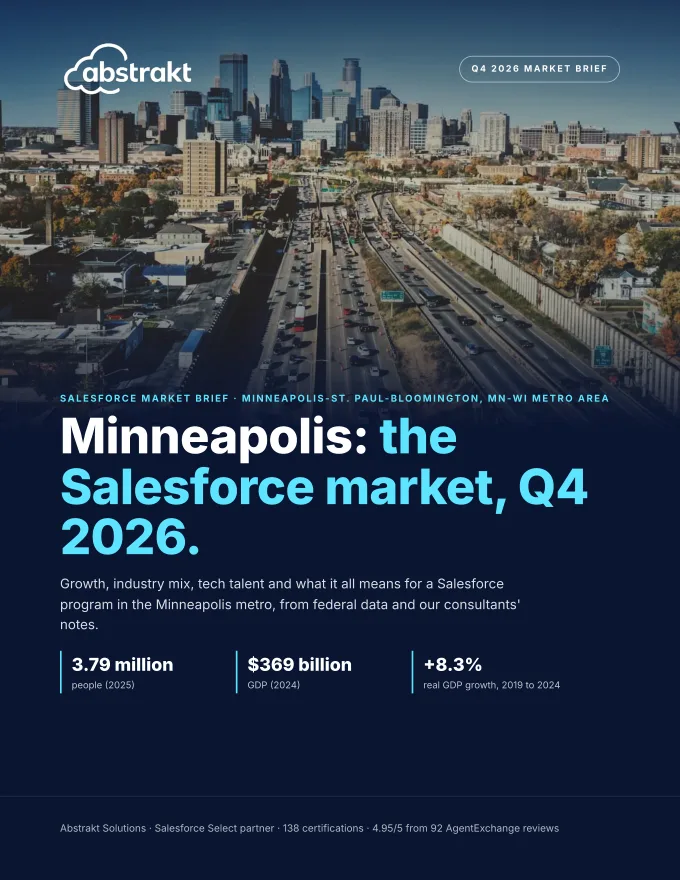
Everything on this page and more in one 23-page download for your planning: Minneapolis's growth since 2019 ranked against 100 metros, its industry mix, what related tech roles pay here compared with the U.S., the Minneapolis industry and service guides, and how Minneapolis compares with nearby metros.
A new edition of the Minneapolis brief is posted here each quarter, after the federal data refresh.
Salesforce consulting in Minneapolis–St. Paul: questions (10)
What does Salesforce look like for a Twin Cities medical technology company selling into hospitals and integrated delivery networks?
Structure accounts around integrated delivery networks and group purchasing contracts, since pricing and access are often decided above the individual hospital. Reps who support procedures need case coverage scheduling, and companies with consigned inventory benefit from tracking it by location. Life Sciences Cloud adds provider engagement features, while Service Cloud handles complaints with the audit trail regulators expect. Abstrakt usually integrates contract pricing from the ERP so quotes reflect the correct tier.
How do food and agribusiness companies in the Greater MSP region use Salesforce to manage retail and trade relationships?
Consumer Goods Cloud is designed for this work. It supports retail execution, with store visit planning and audits on mobile, and trade promotion management for planning and measuring promotions with each retailer. Syndicated and retailer sales data can be loaded into Data 360 (formerly Data Cloud) to compare promotion spend against lift. For ingredient or commodity businesses selling to other manufacturers, Manufacturing Cloud sales agreements are often the better fit.
Our Minneapolis headquarters runs separate Salesforce orgs for different business units. Should we consolidate them?
Not always. Consolidation makes sense when units share customers, need a single view of accounts or duplicate the same processes. Separate orgs can be right when units have different regulatory requirements or truly independent customers. A health check on each org shows how much technical debt a merge would carry. If a full merge is too disruptive, Data 360 (formerly Data Cloud) or MuleSoft can give leadership combined reporting while each unit keeps its own org.
What tends to drive Salesforce consulting costs for a Twin Cities company?
For headquarters with older orgs, the amount of technical debt that must be cleaned or worked around. For medtech and health plans, the regulated processes, such as complaint handling or member data, that add design and validation. The number of ERPs, policy systems and divisional orgs in scope sets the integration effort. A health check is often the cheapest way to size it.
We already have a Salesforce team in Minneapolis. When does managed services still make sense?
When your team is busy with daily requests and needs specialist depth for architecture, integration, release testing or a new cloud. Managed services can also cover a specific product, such as Marketing Cloud or Field Service, that your team does not use often enough to master. Your team keeps ownership and approves changes.
Does our Salesforce consultant have to be in our Twin Cities office?
No. The build, configuration and testing all happen inside your Salesforce org, with working sessions on a set schedule for your team to review and decide. Day-to-day presence in your office isn't required for that to work.
How should a Twin Cities manufacturer connect Salesforce to an ERP after an acquisition added a second one?
Keep both ERPs as systems of record for now and present a consistent account, product and order view in Salesforce through MuleSoft. Agree on one customer and product key across both, which is the hard part. When the ERPs are later consolidated, the Salesforce side changes far less.
Where should a Twin Cities insurer or benefits administrator apply Agentforce first?
Document intake is a practical start: reading submitted claim or enrollment forms and filling Service Cloud fields for a person to confirm. It saves time without letting the agent make decisions. Audit the permission model and field-level security first, since the agent reads whatever its user can.
How should a Minneapolis food or packaged goods company handle retail and distributor accounts in one org?
Use record types and separate processes for retail chains, distributors and foodservice buyers, while sharing one product catalog from the ERP. Account plans for large retail customers should show promotions and line reviews alongside orders. Reporting by channel only works if every account carries a consistent channel field.
Our Twin Cities org is large and slow. How do we decide what to clean up first?
Start with a health check that inventories automation, unused fields, permissions and integrations, then rank issues by user impact and risk. Overlapping automation on high-volume objects usually comes first because it causes errors and slowness. Remove what nobody uses before adding anything new.
Planning a Salesforce project? Read how Salesforce consulting is priced, the questions to ask a Salesforce consulting partner, or compare partners with our free scorecard.
Salesforce community groups in Minneapolis–St. Paul (5)
Salesforce's Trailblazer Community lists these local groups, where admins, developers and Salesforce owners meet to compare notes.
Upcoming community events
- Data 360 (formerly Data Cloud) 101 - We have it, now what? November 12, 2026 · Salesforce Marketer Group, Twin Cities
- 2026 User Extravaganza November 12, 2026 · Salesforce Nonprofit User Group, Twin Cities
- Salesforce Architect Group, Twin Cities, United States · last meetup October 1, 2026
- Salesforce Marketer Group, Twin Cities, United States · last meetup October 14, 2026
- Salesforce Nonprofit User Group, Twin Cities, United States · last meetup September 24, 2026
- Salesforce User Group, Twin Cities, United States · last meetup July 16, 2026
- Salesforce Women in Tech Group, Twin Cities, United States · last meetup August 5, 2026
Events and meetup dates checked on the official group pages on October 15, 2026.
Working across the Midwest? (3)
The same team works with companies in these nearby metros. All 100 markets →
Sources and review (12)
Sources for the figures on this page
- U.S. Census Bureau, Population Estimates Program, Vintage 2025 (cbsa-est2025-alldata), July 1, 2025 estimate (accessed 2026-09-25)
- U.S. Bureau of Economic Analysis, CAGDP2 GDP by county (line 1, All industry total, current dollars), 2024; summed over the CBSA's component counties per Census Vintage 2025 delineation (accessed 2026-09-25; metro total summed from county figures)
- U.S. Census Bureau, County Business Patterns 2023, MSA file (NAICS total '------', ESTAB) (accessed 2026-09-25)
- Greater MSP
- Greater MSP - Manufacturing and Technology
- U.S. Census Bureau, Core Based Statistical Areas delineation files (July 2023), lists 1 and 2
- U.S. Census Bureau, Business Formation Statistics, county-level annual business applications (2019-2025; retrieved 2026-10-20; Sum of component-county applications; growth computed as latest/base - 1. Published only when every component county matches.)
- U.S. Bureau of Economic Analysis, CAGDP9 Real GDP by county, chained 2017 dollars, all industry total (2019-2024; retrieved 2026-10-15; Sum of component-county real GDP; growth computed as latest/base - 1. Published only when every county matches (independent cities and combined areas need manual mapping).)
- U.S. Bureau of Labor Statistics, Quarterly Census of Employment and Wages, annual averages, private ownership (2019 and 2024 annual averages; retrieved 2026-10-15; Employment growth computed as latest/base - 1. Location quotients and pay as published by BLS. Suppressed values stored as null.)
- U.S. Bureau of Labor Statistics, Occupational Employment and Wage Statistics, May 2025 (May 2025; retrieved 2026-10-20; Related occupations only. BLS publishes no Salesforce Administrator occupation; these figures are not Salesforce salaries.)
- U.S. Bureau of Labor Statistics, Employer Costs for Employee Compensation, private industry workers (2026 2nd Quarter; retrieved 2026-10-15; benefitsOnWages = benefits cost per hour / wages and salaries cost per hour (national average, all private industry).)
- Salesforce Trailblazer Community Groups, Official group pages (public, robots.txt-permitted paths only) (verified 2026-10-15)
Last reviewed October 5, 2026. See how Minneapolis–St. Paul compares with the other 99 markets in the U.S. Salesforce market report.