

How Salesforce work starts in Minneapolis–St. Paul
Abstrakt Solutions is a Salesforce Consulting Partner that serves Minneapolis–St. Paul manufacturers, medtech companies, financial firms and corporate headquarters. We implement, integrate, optimize and manage Salesforce across the Twin Cities region. Minneapolis–St. Paul is one of our focus markets.
What buyers here usually run into
- 1
Enterprise-scale orgs
Large, mature Salesforce orgs accumulate technical debt: overlapping automation, unused fields and customizations nobody owns. A health check and a steady cleanup plan pay off.
- 2
Medtech and regulated service
Medical-device companies need complaint handling, service history and field activity captured in ways that support their quality processes.
- 3
Marketing to many audiences
Companies selling to providers, payers and consumers need segmentation and consent handled carefully across channels.
Budget, team and partner questions
What drives cost
In the Twin Cities, cost tends to come from history and regulation. Mature orgs at large headquarters carry technical debt that has to be assessed before new work, consolidating divisional orgs is a project of its own, and medtech complaint handling or health plan data adds design and validation time.
Admin or partner
Many large companies here already employ Salesforce teams and bring in a partner for architecture, org consolidation or a specific rollout. Mid-sized manufacturers and agencies more often rely on managed services for daily administration.
What buyers ask a partner
Ask for experience with large, long-lived orgs and multi-org strategy, medtech complaint handling or health plan data models where relevant, and how the partner works alongside an internal Salesforce team. Ask for a sample health check report.
The local economy and its biggest industries (4)
| Sector | Share of 2024 GDP | Where Salesforce fits |
|---|---|---|
| Manufacturing Salesforce for manufacturing → | 11.0% | Medical-device, food and industrial manufacturers need distributor and account management, quoting and service tied to ERP, and often regulated complaint and service processes. |
| Finance and insurance Financial Services Cloud → | 10.6% | Banks, insurers and health plans need relationship views, compliant marketing and service at scale, which is where Financial Services Cloud and Service Cloud fit. |
| Professional, scientific, and technical services Salesforce for professional services → | at least 8.6% | Business services firms supporting the region’s headquarters need pipeline, delivery and account planning across large enterprise clients. |
| Health care and social assistance Salesforce for health & life sciences → | at least 8.0% | Health systems and healthcare services companies use Salesforce for patient and member engagement, referral management and service, with privacy designed in. |
Source: U.S. Bureau of Economic Analysis, GDP by county (CAGDP2), 2024, summed to the metro area; private sectors only, excluding real estate and government. “At least” marks sectors where BEA suppresses some county figures.
Regional target sectors named by local economic development groups: Health & Life Sciences, Food & Water, Headquarters & Business Services, Financial Services & Insurance, Advanced Manufacturing & Technology.
Salesforce products that fit Minneapolis–St. Paul (6)
In the order we lead with them here, from the industries above.
Salesforce Sales Cloud
The CRM where sales pipeline lives, when it is built right.
Salesforce Service Cloud
The operating system for modern customer service, case, knowledge, voice, and AI agent assist together.
Salesforce Financial Services Cloud
Industry CRM for wealth management, banking, insurance, and lending, built for compliance from the start.
Salesforce Marketing Cloud
Cross-channel marketing, email, mobile, journey, and Data 360-powered personalization at scale.
Salesforce Data 360 (Data Cloud)
Unify customer data into a real-time profile that powers segmentation, analytics, and AI.
Salesforce Agentforce
AI agents that handle real work inside Sales Cloud, Service Cloud, and Marketing Cloud.
Agentforce fit for Twin Cities insurers, makers, and clinics
Two sectors run close together in Minneapolis: manufacturing at 11.0% of metro GDP in 2024 and finance and insurance at 10.6%. For carriers and benefits administrators, the realistic starting point is document reading, where an agent pulls policy numbers, dates, and claim details from submitted forms into Service Cloud fields for an adjuster to confirm. Manufacturers get more from summarizing long distributor cases and suggesting the next step. Health systems can use grounded self-service for scheduling and billing questions, provided protected information stays behind proper access controls. In every one of these, the limit is the knowledge base and the permission model, so we audit both before switching anything on.
- Claim form data extraction
- Distributor case summaries
- Scheduling and billing self-service
Services buyers here usually need (7)
Salesforce Health Checks in Minneapolis–St. Paul
In Minneapolis–St. Paul, a health check is often the first step for a large org with years of layered customization. Using read-only access, we review permissions and sharing, measure data quality, inventory automation, code and packages, test integration behavior and interview users across teams. You receive findings ranked by risk and effort, with a recommended sequence, and a clear view of whether the data and access model can safely support Agentforce or Data 360 (formerly Data Cloud).
By industry in Minneapolis–St. Paul
- 1
Health care and social assistance
Health care and social assistance contributes at least 8% of metro GDP, and health systems, health plans and healthcare services companies here hold sensitive member and patient data in Salesforce. A health check focuses first on exposure: profiles with export rights, broad sharing, portal and guest user access, and integration users with excess permissions. It also checks whether encryption and field audit settings match your policies. Findings are written for privacy officers as well as admins.
- 2
Headquarters & Business Services
Large headquarters companies in this Greater MSP target sector often run several Salesforce orgs, each with its own admins and conventions. A health check applied consistently across them shows where security models diverge, which technical debt is shared and which integrations duplicate work. That comparison gives enterprise architecture teams evidence for decisions about standards, shared services and whether any orgs should eventually combine. Repeating the same review later shows which orgs actually improved.
- 3
Advanced Manufacturing & Technology
Manufacturers and technology companies here often extended Salesforce with custom code and managed packages during earlier growth phases. A health check measures code coverage and quality, flags packages that are unused or unsupported, and identifies Apex that could now be replaced by Flow. It also reviews how product and pricing data moves from ERP, since stale or incomplete catalog data undermines quoting and any AI built on top of it later.
Raise before scoping
Scope multiple orgs together
When a company runs several orgs, reviewing them in one engagement with one method produces comparable findings. Separate reviews by different teams tend to apply different criteria, which makes enterprise decisions about standards and consolidation harder to support with evidence.
Test data before AI pilots
Agentforce and Data 360 (formerly Data Cloud) amplify whatever data they are given. Before a pilot, the health check samples the records an agent would use, measures completeness and duplication and checks knowledge articles for accuracy, so the pilot tests the AI rather than exposing old data problems.
Include managed packages
Installed packages accumulate in older orgs, some from vendors no longer used. Each one can hold permissions, data and code. The review lists every package, its usage and its access, so unused ones can be removed and required ones reviewed for security.
Salesforce Optimization in Minneapolis–St. Paul
Many Minneapolis–St. Paul orgs have been built on for years by successive admins and partners. Optimization is the work of making that accumulated org easier to use and trust again. We measure adoption by role, simplify layouts and required fields, consolidate automation from different eras into maintainable Flows, clean duplicates, and rebuild reports and dashboards around agreed definitions. Improvements reach users in stages, each paired with a brief session on what changed, so progress is visible and nobody faces a single big-bang switch.
By industry in Minneapolis–St. Paul
- 1
Professional, scientific, and technical services
Firms in professional, scientific and technical services, which account for at least 8.6% of metro GDP, often sell to the headquarters companies clustered in the region. Their orgs often suffer from account plans, pipeline and delivery data spread across tools and inconsistently maintained. Optimization tightens opportunity stages and required fields, links engagements to the accounts that buy them and rebuilds the dashboards practice leaders actually review, so pipeline meetings start from Salesforce instead of slides.
- 2
Financial Services & Insurance
Greater MSP lists financial services and insurance among its target sectors. Institutions here often run Financial Services Cloud or heavily customized Service Cloud orgs where advisors and service staff face crowded screens. Optimization focuses on role-specific layouts, action plans that replace manual checklists and Flow consolidation, so a household or policy update triggers one reliable process instead of several overlapping ones. Reports then reflect advisor activity accurately enough for managers to coach from them.
- 3
Advanced Manufacturing & Technology
Advanced manufacturing and technology, another Greater MSP target sector, includes companies whose distributor and direct sales channels share one org. Adoption usually suffers where distributor activity and direct pipeline are tracked in different ways. We standardize account and opportunity use across channels, clean duplicate distributor accounts and rebuild forecast reports, so leaders see total demand by product line rather than separate channel views that never quite reconcile with each other.
Raise before scoping
Map dependencies before removal
In long-lived orgs, fields and automation feed integrations, Marketing Cloud segments and reports owned by other departments. We trace those dependencies before simplifying anything, so removing a field in sales does not quietly break a marketing journey or a finance extract.
Agree metric definitions first
Dashboards disagree because teams define pipeline, active customer or resolved case differently. We settle those definitions with leaders before rebuilding reports, then enforce them with validation and picklists so the data keeps matching the definition after the project ends and new admins arrive.
Roll changes out in waves
Large user populations absorb change better in waves than all at once. We release improvements by team or region with brief training and a feedback channel, adjusting later waves based on what the first groups report about the new layouts.
Salesforce Managed Services in Minneapolis–St. Paul
Managed services in Minneapolis–St. Paul often supports orgs that have been live for years and carry the weight of it: several clouds, many integrations and customizations whose authors have moved on. We handle user and admin requests, test each Salesforce release against your automation, retire unused fields and automation on a schedule, and deliver backlog items with the right specialist.
By industry in Minneapolis–St. Paul
- 1
Finance and insurance
Finance and insurance accounts for about 10.6% of metro GDP, nearly equal to manufacturing. Banks, insurers and health plans running Financial Services Cloud or Service Cloud generate a constant stream of changes: new products, revised disclosures, updated routing. Managed services absorbs those under change control, with each change tested in a sandbox, documented for audit and reviewed for access implications, so compliance teams can trace what changed and why at any point.
- 2
Health & Life Sciences
Greater MSP targets health and life sciences, and medtech and healthcare companies here depend on Salesforce processes that touch regulated records. Release management matters more for them: a seasonal Salesforce update that alters a screen flow or email behavior can affect complaint intake or patient communication. We test those processes in preview sandboxes before each release and keep validation evidence that quality or compliance teams can file with their own records.
- 3
Manufacturing
Manufacturers in the region often run Salesforce beside an ERP that changes on its own schedule. When the ERP team adds plants, product lines or pricing structures, Salesforce needs matching updates to products, integrations and reports. A managed services team coordinates those changes with ERP owners, maintains the integration mappings and keeps distributor and account data clean, so sales and service reporting stays reliable as operations evolve. Changes are timed to ERP release dates.
Raise before scoping
Reduce technical debt steadily
Mature orgs rarely need one big cleanup project; they need a standing allocation of effort for retiring unused fields, obsolete automation and inactive packages. We reserve part of each cycle for that work, so the org gets simpler over time instead of accumulating more debt.
Work within enterprise change control
Twin Cities headquarters companies often have change-advisory boards, deployment windows and identity teams. Our release process adapts to them, with change requests submitted in your format and deployments made in approved windows, so Salesforce work never becomes an exception to internal controls.
Keep marketing and CRM in step
Where Marketing Cloud and Sales or Service Cloud share customer data, changes on one side can break segments or triggers on the other. Managed services covers both, reviewing field and data extension changes together so journeys, consent and reporting keep working after each update.
Salesforce Implementation in Minneapolis–St. Paul
Implementations in Minneapolis–St. Paul often happen inside large, mature enterprises: a division adopting Salesforce for the first time, or a new cloud added beside established ERP, marketing and compliance systems. We run discovery workshops with that unit's leaders, design the data model and security around its customers and regulatory needs, build in a sandbox and go live in phases.
By industry in Minneapolis–St. Paul
- 1
Manufacturing
Roughly 11% of 2024 metro GDP comes from manufacturing, the largest private sector, and local makers range from medical devices to food and industrial products. For these manufacturers, implementation decisions revolve around distributor and direct accounts, service processes that may feed quality systems, and quoting tied to ERP pricing. We design complaint and service records so they can be handed to quality teams cleanly, and plan the ERP integration pattern before building opportunity and product structures.
- 2
Food & Water
Greater MSP lists food and water among its target sectors, a group that includes food processors, ingredient suppliers and water technology companies. Implementations for them often center on account structures that separate retailers, distributors and industrial buyers, plus agreement and volume tracking for ongoing supply. We design those structures in discovery, deciding whether Sales Cloud alone is enough or whether industry-specific features are justified by how the business actually sells.
- 3
Headquarters & Business Services
Headquarters and business services is another Greater MSP target sector, reflecting the region's concentration of large corporate headquarters. Implementing Salesforce inside a headquarters company usually means working within enterprise architecture standards, identity management and data governance that already exist. We plan single sign-on, integration through approved middleware and a release process your IT organization recognizes, so the new org passes internal review instead of becoming a shadow system that IT later has to absorb.
Raise before scoping
Align with enterprise governance
Large Twin Cities companies often require architecture review, security sign-off and change-advisory approval before anything reaches production. Building those checkpoints into the project plan from the start avoids a finished org waiting on approvals nobody scheduled. We prepare the documentation reviewers expect as we go.
Design for both states
The metro spans Minnesota and Wisconsin, and companies with customers or operations on both sides may need territories, tax-related fields or regulatory variations handled by state. Settling territory and ownership rules in design keeps assignment and reporting consistent across the state line.
Launch one business unit first
In a multi-division company, a pilot with one business unit proves the data model and support process before others join. Later units adopt the same core design with their own record types and automation, which keeps the org consistent while respecting real differences between them.
Salesforce Integration in Minneapolis–St. Paul
For Minneapolis–St. Paul companies, integration usually means fitting Salesforce into an established enterprise landscape. Distributors and manufacturers need orders, inventory and contract pricing from ERP; financial firms need core account data in advisor and service views; headquarters organizations often require that everything pass through approved middleware. We settle which system owns each record, design the pattern and error handling, build with MuleSoft, Workato or APIs, and consider Data 360 (formerly Data Cloud) where many sources must be unified.
By industry in Minneapolis–St. Paul
- 1
Wholesale trade
Wholesale trade adds at least 7.7% of metro GDP, and distributors here serve manufacturers, retailers and other buyers across the Upper Midwest. Their key integration shares ERP data with Salesforce: customer-specific pricing, credit status, open orders and shipment tracking. Reps need that on the account page without logging into the ERP, while orders placed in the field should flow back without re-keying. We design for high line-item volumes and nightly reconciliation.
- 2
Financial Services & Insurance
Banks, insurers and health plans in Greater MSP's financial services and insurance sector hold account, policy and claims data in core systems that Salesforce should not replace. Integration shows advisors and service agents that data in context, by syncing summaries or displaying it on demand, and writes service outcomes back where required. Security review is central: which fields leave the core system, how they are encrypted and who can see them in Salesforce.
- 3
Health & Life Sciences
Medtech and life sciences companies often need Salesforce connected to ERP, quality management and, for procedure support, scheduling systems. The integration design must keep regulated records authoritative in their validated systems while giving commercial and service teams the context they need. We document interfaces in a form quality teams can review and build error handling that leaves an audit trail for every failed or corrected transaction. Changes to those interfaces then follow your validation process.
Raise before scoping
Use approved middleware
Enterprise IT groups in the Twin Cities often standardize on one integration platform and expect new connections to use it. We design within that platform, whether MuleSoft or another tool, and follow its logging and security conventions so operations teams can support the integrations after launch.
Unify before you analyze
When customer data sits in several orgs, an ERP and a marketing platform, Data 360 (formerly Data Cloud) can build unified profiles without forcing every system into one. Matching rules and identifiers need careful design, and consent data should travel with each profile from the start.
Plan for batch windows
Many ERP and core systems in mature enterprises still exchange data in scheduled batches. Salesforce processes and user expectations should reflect when data refreshes, and integrations should handle late or partial batches gracefully rather than overwriting good data with incomplete files.
Salesforce Migration in Minneapolis–St. Paul
Minneapolis–St. Paul migrations are frequently about consolidation as much as a new platform: a division leaving an older CRM, an acquired business joining the corporate org, or marketing data moving into Marketing Cloud. We inventory every source, map fields with each team, clean and deduplicate before loading, and run trial loads into a sandbox with counts reconciled. The final cutover is scheduled around your business calendar, with close support for users in the days after they switch.
By industry in Minneapolis–St. Paul
- 1
Health & Life Sciences
Health and life sciences companies moving data into Salesforce must decide carefully what belongs there. Provider contacts, accounts and service history usually do; clinical or device-specific data governed by quality systems may not. We classify fields before mapping, mask sensitive data in test loads and document the migration so it can be referenced during audits of the systems involved. Consent and communication preferences are migrated and then verified record by record.
- 2
Financial Services & Insurance
Financial firms migrating into Financial Services Cloud need their relationship structures rebuilt, not just copied: households, beneficial owners, advisors and financial accounts. Legacy systems often store these as flat contacts with notes. We design the target relationship model, write transformation rules that build households and connections from the old data and have advisors validate samples before cutover, so the first client meeting after launch shows the relationships advisors expect to see.
- 3
Food & Water
Food and water companies, a Greater MSP target sector, often hold buyer relationships in older CRMs, trade spreadsheets and distributor reports. Migration brings these into one account model covering retailers, distributors and industrial customers, with agreements and volume history attached. The hardest part is matching the same retail buyer or distributor branch across sources, which we handle with rules your sales operations team approves before anything is loaded into Salesforce.
Raise before scoping
Merge orgs deliberately
Moving a business unit's Salesforce org into another is a migration too, with extra complexity: conflicting record types, automation and user IDs. Map both orgs' configuration before data, decide which design survives and rebuild what the incoming unit needs, rather than importing its customizations wholesale.
Archive rather than discard
Some history is too old to migrate but too important to delete, such as closed service records or prior agreements. We export it to an archive linked from the Salesforce account, searchable by users with the right access, and keep storage and load effort for records people use every day.
Reconcile with finance numbers
After a migration, leaders compare Salesforce reports with figures they already trust, such as revenue by customer from the ERP. We run that comparison during trial loads, explain every variance and fix mapping gaps before cutover, so the first reports after launch match what finance expects.
Salesforce Implementation Rescue in Minneapolis–St. Paul
Rescues in Minneapolis–St. Paul can involve large programs rather than small projects: a multi-cloud rollout that lost momentum, a Financial Services Cloud build that compliance never approved, or a Marketing Cloud setup that never connected to CRM data. Our first step is an independent look at what was built, what data exists and what was promised. From there we clear the blockers that stop daily work, rule on each component, finish the outstanding scope and relaunch with training that reflects how people actually work.
By industry in Minneapolis–St. Paul
- 1
Financial Services & Insurance
In financial services and insurance, a Greater MSP target sector, projects often stall at the compliance gate: a finished build that fails security review, lacks audit trails or exposes data too broadly. Rescue begins by working through the reviewers' findings item by item, redesigning sharing and field access where needed and documenting controls. Once the org passes review, we complete the remaining scope and prepare advisors and service teams for launch.
- 2
Health & Life Sciences
Medtech and healthcare organizations sometimes launch Salesforce service or engagement processes that their quality or privacy teams later restrict. Rescue here means reconciling the build with those requirements: complaint and service records that feed quality systems correctly, consent that matches communication rules and permissions aligned with the minimum necessary standard. We stabilize these processes, with sign-off from quality and privacy leads, before reopening them to the wider user base and partners.
- 3
Headquarters & Business Services
Headquarters organizations sometimes run Salesforce programs across several business units with competing priorities, and those programs stall when no one can settle the conflicts. Recovery sets a single governance model with decision owners, separates shared foundations from unit-specific needs and delivers the shared layer first. Business units then join on a clear schedule, rather than each waiting for every other unit to agree. Executive sponsors see progress at each stage.
Raise before scoping
Get an independent baseline
Internal teams and the previous partner may disagree about why a program failed. An outside assessment of configuration, code, data and scope establishes what exists and what works, giving leadership a factual basis for recovery decisions instead of competing narratives.
Clear compliance findings early
If security, privacy or quality teams blocked the original launch, their findings define the critical path. Addressing them first, with documentation they can review, prevents a second finished build waiting at the same gate. We invite those reviewers into design checkpoints throughout.
Rebuild user confidence deliberately
Users who watched a failed launch will be skeptical. A relaunch that starts with a small group, fixes their issues quickly and publishes what changed builds credibility before the wider rollout, and hands-on training at relaunch shows the organization is serious this time.
Industry plays in Minneapolis–St. Paul (4)
Salesforce for Minneapolis–St. Paul Manufacturers
Twin Cities manufacturers with several divisions frequently adopted Salesforce years ago, one business unit at a time. The result is often several orgs or one crowded org with overlapping automation and inconsistent customer data. We help untangle that: assess what exists, consolidate or connect divisional instances, and establish a shared account model. On that foundation, Revenue Cloud or CPQ standardizes quoting, Service Cloud supports installed equipment, and Data 360 (formerly Data Cloud) gives leadership one view of customers who buy from several divisions.
Manufacturing edges out finance and insurance as the Twin Cities' largest private sector, 11% of 2024 metro GDP against 10.6% in Bureau of Economic Analysis county data. Greater MSP counts advanced manufacturing and technology, food and water, and headquarters and business services among the region's target industries, and describes the metro as the sixth most inventive in the world, with innovation in R&D, advanced manufacturing, energy and data centers. That profile points to large, long-established manufacturers with mature systems and a pipeline of new products, rather than young firms setting up a CRM for the first time.
Use cases to open with
- 1
Consolidating divisional orgs
When divisions run separate Salesforce orgs, the same customer appears several times with different names, owners and terms. We assess each org, define a shared account and product model, and either merge orgs or connect them through Data 360 (formerly Data Cloud) and MuleSoft, depending on how independently the divisions operate. Leadership then sees total revenue and pipeline by customer across the company, and cross-selling between divisions becomes practical.
- 2
New product introduction
Inventive companies launch products often, and sales teams need training, pricing and target accounts ready on day one. Salesforce can manage launch readiness with product records, price books, enablement content and target lists, then track early pipeline and win rates against launch goals. Product managers get quick feedback from the field instead of waiting for quarterly revenue reports to show whether a launch worked.
- 3
Installed equipment and consumables
Manufacturers of food processing, water treatment and industrial equipment often earn recurring revenue from service contracts and consumables. Tracking installed assets with their service history and consumable usage lets Service Cloud schedule preventive maintenance and prompt reorders, and shows account managers which customers are under-buying consumables, a sign of a competitor or a performance issue worth investigating. Reorder reminders can also go straight to plant contacts.
Raise before scoping
Technical debt before new features
Mature orgs accumulate unused fields, overlapping flows and customizations nobody owns. Run a health check first, retire what is unused, document ownership and fix data quality, so new capabilities are not built on a fragile base that slows every future release.
Governance across divisions
Divisions value their autonomy and will resist a central design that ignores their processes. Set up a governance group with representatives from each division, agree on shared standards such as account, product and stage definitions, and leave room for division-specific fields and processes.
ERP diversity after acquisitions
Long-established manufacturers often run several ERPs from past acquisitions. Map which system owns customers, items and prices for each division, and plan MuleSoft or other integrations that normalize the data, so Salesforce shows consistent customer and order information. Divisions can move onto shared integrations one at a time.
Salesforce for Twin Cities Health and Life Sciences
For Twin Cities medical technology companies, the relationship with a hospital does not end at the sale: they support devices in procedures and service them for years. Salesforce can coordinate case coverage by field representatives, capture complaints and hand them to quality systems, and track installed devices and service. Marketing Cloud supports outreach to providers, payers and patients with consent handled carefully, and Agentforce can help service teams answer routine device and account questions.
Greater MSP names health and life sciences as a target industry, alongside advanced manufacturing and technology and financial services and insurance. In the Bureau of Economic Analysis's 2024 county data, health care and social assistance is at least 8% of Twin Cities GDP, while manufacturing, where device production is counted, is the largest private sector at 11%. With device makers counted in the region's biggest sector and care delivery close behind, CRM work here tends to span commercial coverage of hospitals, post-market obligations and outreach to several audiences at once.
Use cases to open with
- 1
Surgical case coverage
Device representatives often support procedures in person, and coverage must be planned around surgeon schedules and product availability. Salesforce can track scheduled cases by hospital and surgeon, assign representatives and loaner kits, and record outcomes. Managers see coverage gaps and utilization by territory, and representatives manage their week from mobile devices between hospitals. Case history also shows which surgeons are adopting new products.
- 2
Complaint intake for quality
Any contact that suggests a device malfunction may be a complaint that quality teams must investigate and potentially report. Service Cloud can capture those contacts with required fields, flag possible complaints automatically and hand them to the quality management system with full context. Service agents keep a record of every customer contact, and quality receives complete, timely information. Trends by product and lot help engineering spot issues earlier.
- 3
Consent-aware multi-audience marketing
Device and health companies market to surgeons, hospital buyers, payers and sometimes patients, each with different rules. Marketing Cloud can segment these audiences, respect consent and communication preferences, and track engagement against accounts and contacts. Separate programs for professionals and consumers keep messages appropriate and consent records clear. Engagement data also tells field teams which surgeons attended education events and which content they viewed, which helps plan the next visit.
Raise before scoping
Quality system integration
Complaint handling must fit your quality management system and regulatory obligations. Decide where complaints are recorded, how information flows between Salesforce and the quality system, and how changes to that process are validated. Involve quality and regulatory teams from the start, not after build.
Patient data boundaries
Case coverage and service records can include patient information. Define what patient data, if any, Salesforce stores, apply HIPAA safeguards and a business associate agreement where needed, and restrict access so commercial users see only what their role requires. Audit logs should confirm access.
Aligning with the enterprise org
Device companies with several business units often run one large, mature Salesforce org shared among them. New health and life sciences features should fit the enterprise data model and governance, so a new product line or service team does not create another disconnected set of processes.
Salesforce for Twin Cities Insurers and Agencies
Twin Cities insurance organizations may write property and casualty, life, or health and benefits coverage sold through employers, so a Salesforce design often has to handle group sales as well as individual service. The typical build covers broker and consultant relationships, employer group quoting and renewals, enrollment support, and member or policyholder service with strict data controls. We work on Financial Services Cloud and Service Cloud, integrate policy, enrollment and claims systems, and fit the project into the governance of a mature enterprise org.
Manufacturing edges out finance and insurance for first place in the Twin Cities economy, 11% to 10.6% of 2024 GDP by federal BEA estimates, so insurers here belong to one of the region's two anchor sectors. Greater MSP counts financial services and insurance among its target industries, next to health and life sciences and headquarters and business services. Large enterprises in this market often run mature Salesforce orgs with years of customization, and insurers are no exception: cleanup and governance frequently come before new capabilities.
Use cases to open with
- 1
Employer group sales and renewals
Group health, life, disability and benefits products are sold to employers through brokers and consultants. Salesforce can manage each employer group's census, current coverage, quotes, proposals and renewal dates, with renewal opportunities created automatically from policy data. Proposal documents and benefit summaries attach to the opportunity for later reference. Sales teams see which groups are shopping, which brokers are involved, and how rate actions affect retention by segment and region, which informs pricing conversations with underwriting before the next cycle.
- 2
Broker and consultant management
Brokers and benefits consultants influence most group decisions. Salesforce can track each firm's appointments, commissions, production, cases in progress and service issues, and give distribution leaders a clear picture of relationship health. An Experience Cloud portal lets brokers request quotes, check case status, access materials and view commission statements without phoning the sales office for every question. Distribution leaders can see which firms use the portal and which still rely on email.
- 3
Member and policyholder service
Service representatives answer questions about eligibility, claims, billing and coverage across many products. Service Cloud gives them a single view of the member or policyholder with data retrieved from enrollment and claims systems, routes requests by product and urgency, and records every interaction. Agentforce can address routine requests, such as ID cards or claim status, with complex matters handed to licensed or clinical staff.
Raise before scoping
HIPAA for health plan data
Health plans and benefits administrators handle PHI, so HIPAA requirements shape the design. Limit PHI to the users who need it, sign the business associate agreement, encrypt sensitive fields where appropriate, and have your privacy office review access models, integrations and AI use before launch.
Mature org technical debt
An insurer's org that has served several product lines for years usually carries flows that fire twice, fields no one fills in and custom code whose author has left. Start with a health check, agree on what to retire, and put release management and ownership in place, so new insurance capabilities do not add to the tangle.
Enrollment and policy integrations
Group quotes, enrollment and policy data live in specialized systems. Decide what Salesforce displays, what it creates and what remains read-only, and plan for annual enrollment peaks, when volumes of cases and data updates can rise sharply across a short period.
Salesforce for Twin Cities Professional Services Firms
Many Twin Cities professional services firms build their business around a few large corporate clients headquartered in the region. Salesforce should support that model: enterprise account plans across divisions, procurement and vendor requirements tracked on each client, master agreements with renewal dates, and statements of work flowing into delivery. We connect Sales Cloud with CPQ and PSA tools, add marketing automation for thought leadership where it drives work, and keep the design simple enough for partners and account leads to maintain.
Consultancies, agencies, engineering and IT services firms sit in a sector the Bureau of Economic Analysis put at a minimum of 8.6% of Twin Cities GDP in 2024, behind only manufacturing and finance among private industries. Greater MSP names headquarters and business services as one of its target industries. For services firms, those headquarters are the core client base: large enterprises with formal procurement, many departments and long relationships that must be managed deliberately.
Use cases to open with
- 1
Enterprise account planning
A large corporate client may buy from a services firm in marketing, IT, finance and operations at once. Salesforce account plans can map divisions, sponsors, current engagements, agreement terms and whitespace, with relationship owners for each area. Partners review plans regularly, align pursuits across service lines, and avoid surprising the client with uncoordinated proposals from different teams. New leaders joining an account can read its history in one place.
- 2
Procurement and vendor requirements
Corporate procurement teams require supplier onboarding, security assessments, insurance certificates, diversity reporting and preferred-vendor status reviews. Salesforce can track each requirement per client with owners and expiration dates, and link them to opportunities so a new statement of work is not blocked by an expired document. Leaders see which clients have upcoming vendor reviews and prepare in advance, gathering performance evidence before procurement asks for it.
- 3
Master agreements and renewals
Master service agreements and retainers set rates, terms and scope boundaries for years. Salesforce can record each agreement, its rate schedule and renewal date, and link every statement of work issued under it. Renewal opportunities open automatically ahead of expiration, with utilization and satisfaction data attached, so renegotiation starts from facts rather than recollection. Scope creep outside the agreement becomes visible too.
Raise before scoping
Keep partner effort low
Partners and senior account leads are the key users but the busiest. Capture activity automatically from email and calendars, keep required fields minimal, and provide account plan views that help them prepare for client meetings, so the CRM saves time rather than consuming it.
Clean CRM to PSA handoff
Define exactly what passes from a closed opportunity to the PSA or project system: client, agreement, rates, roles, budget and milestones. Automate the handoff, reconcile identifiers between systems, and report on handoff errors so delivery starts on time with accurate information.
Enterprise client security reviews
Large clients often assess their suppliers' data security, including CRM and collaboration tools. Document how client data is stored, accessed and protected in Salesforce, apply least-privilege permissions, and keep evidence ready for security questionnaires and audits. Review integrations too, since they often hold broad access.
Case studies to send (3)
From the industries this market leans on. Client names are anonymized and these projects are not specific to Minneapolis–St. Paul.
The Minneapolis–St. Paul Salesforce market brief, Q4 2026
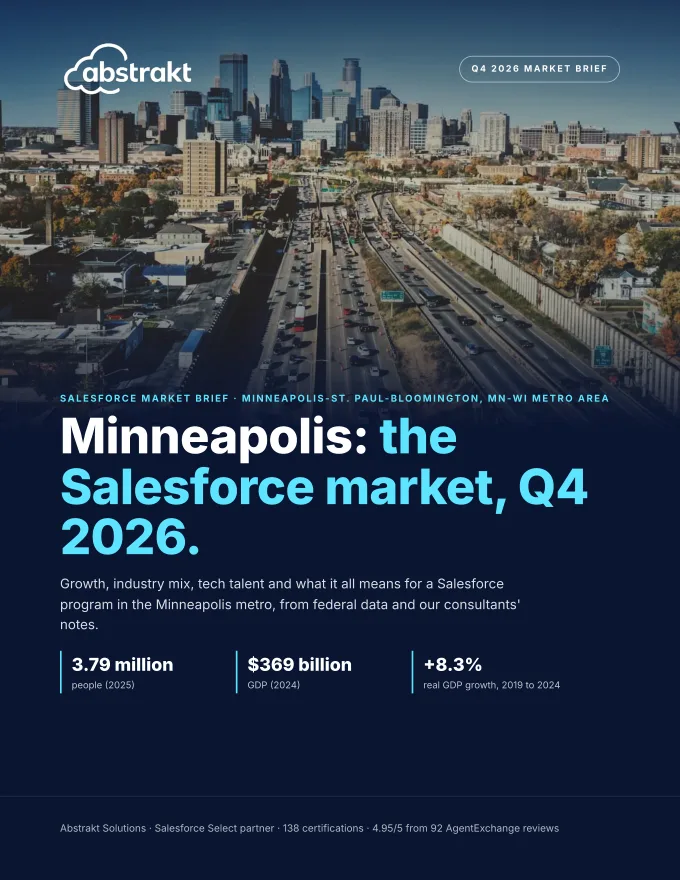
A free 23-page PDF with Minneapolis–St. Paul's growth ranked against 100 metros, its industry mix, tech wages and nearby markets. It is offered on the public Minneapolis–St. Paul page; send your customer there or get a copy for your own prep.
Get the Minneapolis–St. Paul brief →Co-sell with Abstrakt in Minneapolis–St. Paul
Working a Minneapolis–St. Paul account? Bring in a named consultant for discovery, scoping or a health check. We reply within 4 business hours.