

How Salesforce work starts in Atlanta
Throughout metro Atlanta, Abstrakt Solutions helps companies get more from the platform as a Salesforce Consulting Partner. We implement, integrate, optimize and manage Salesforce across the region. Atlanta is one of our focus markets.
What buyers here usually run into
- 1
HubSpot-to-Salesforce growth moments
Technology and services firms that started on lighter CRMs reach a point where reporting, territories and integrations outgrow them. Planning the migration well avoids carrying old data problems forward.
- 2
High-volume service
Payments and software companies handle large case volumes. Routing, knowledge and AI-assisted responses matter as much as the sales side.
- 3
Partner and merchant networks
Fintech and payments businesses sell and support through partners, which calls for portals, onboarding workflows and careful permissions.
Budget, team and partner questions
What drives cost
In Atlanta the main cost drivers are partner and merchant portal scope, integrations with risk, processing or ERP systems, and migration from a starter CRM such as HubSpot. High service volume also adds routing and knowledge design that a sales-only project would not need.
Admin or partner
Technology and payments companies here often have engineers who can build integrations but no one dedicated to Salesforce design. A partner usually owns architecture, release testing and admin work, while internal engineering keeps the APIs on their side.
What buyers ask a partner
Ask for references in high-volume service and partner portals, and for a HubSpot-to-Salesforce migration plan with field mapping. Ask how the partner restricts fraud-sensitive data and who supports the org after launch.
The local economy and its biggest industries (4)
| Sector | Share of 2024 GDP | Where Salesforce fits |
|---|---|---|
| Professional, scientific, and technical services Salesforce for professional services → | at least 9.0% | Consulting, marketing and technology services firms need pipeline, delivery and client reporting in one system, and often migrate to Salesforce from HubSpot as they scale. |
| Finance and insurance Financial Services Cloud → | at least 8.9% | Atlanta’s fintech and payments cluster needs Salesforce for merchant and partner onboarding, agent portals and service at volume, alongside insurers and lenders with compliance requirements. |
| Information Sales Cloud → | at least 8.2% | Software, media and telecom companies run subscription and account-management motions where Sales Cloud, Service Cloud and CPQ need to share one view of the customer. |
| Wholesale trade Integration → | at least 7.8% | As a logistics hub, Atlanta has many distributors and supply-chain firms whose sales and service depend on ERP and warehouse data being visible in Salesforce. |
Source: U.S. Bureau of Economic Analysis, GDP by county (CAGDP2), 2024, summed to the metro area; private sectors only, excluding real estate and government. “At least” marks sectors where BEA suppresses some county figures.
Regional target sectors named by local economic development groups: Technology, Fintech, Supply Chain & Advanced Manufacturing, Life Sciences & Healthcare, Aerospace, Creative Industries.
Salesforce products that fit Atlanta (6)
In the order we lead with them here, from the industries above.
Salesforce Sales Cloud
The CRM where sales pipeline lives, when it is built right.
Salesforce Service Cloud
The operating system for modern customer service, case, knowledge, voice, and AI agent assist together.
Salesforce Experience Cloud
Customer, partner, and employee portals built on Salesforce.
Salesforce Revenue Cloud / CPQ
Configure-price-quote, billing, subscription management, and quote-to-cash on Salesforce.
Salesforce Agentforce
AI agents that handle real work inside Sales Cloud, Service Cloud, and Marketing Cloud.
Salesforce Data 360 (Data Cloud)
Unify customer data into a real-time profile that powers segmentation, analytics, and AI.
Atlanta payments, media and consulting teams meet Agentforce
Atlanta's largest private sectors are professional and technical services, finance and insurance, and information, a mix that produces heavy inbound volume through chat, email and web forms. Payments and fintech support teams are a natural first test: an agent grounded in approved help articles can resolve routine card, billing or onboarding questions and pass disputes to a person with a summary attached. Media and software companies often start with Sales Cloud lead triage, ranking trial sign-ups by fit so reps call the right accounts first. Before either goes live, fraud-sensitive fields need tight permissions, and every knowledge article the agent may cite should be current and owned by someone accountable.
- Self-service for billing and onboarding
- Dispute handoffs with case summaries
- Ranking trial sign-ups by fit
Services buyers here usually need (7)
Salesforce Migration in Atlanta
Many Atlanta migrations come from technology and services companies that started on HubSpot or another lighter CRM and now need territories, complex reporting or deeper integrations. Others are manufacturers leaving Dynamics or an aging on-premise system. In each case we inventory the source data, agree the mapping and what history to keep, deduplicate and standardize before loading, run trial loads in a sandbox with count reconciliation, and plan cutover so sales and marketing are never split across two systems.
By industry in Atlanta
- 1
Manufacturing
Manufacturing produces about 7.0% of metro GDP. Manufacturers moving to Salesforce often bring customer data from Dynamics, an older CRM or the ERP's own customer module, along with distributor and rep information kept in spreadsheets. Migration has to reconcile those into one account structure with ERP customer numbers attached, so that orders, quotes and service history line up correctly as soon as the integration is switched on. Distributor and rep relationships are loaded as their own records, so channel reporting works from the start.
- 2
Technology
Technology companies, a Metro Atlanta Chamber key industry, commonly migrate from HubSpot when they add enterprise sales, partner channels or investors who expect detailed pipeline metrics. The work includes mapping lifecycle stages to Salesforce lead and opportunity processes, carrying over consent and subscription status, and deciding how product usage data links to accounts. Marketing automation usually moves at the same time so campaign attribution does not break in the middle.
- 3
Creative Industries
Creative industries are on the chamber's key-industry list, and agencies and production companies often run on a mix of project tools, spreadsheets and a basic CRM. Migrating them is mostly about untangling clients, projects and prospects that were stored as the same thing. We separate those into accounts, opportunities and delivery records, keep past project history for reference, and give producers a view of each client that no single old tool provided.
Raise before scoping
Redefine lifecycle stages
HubSpot lifecycle stages rarely match Salesforce lead status and opportunity stages one to one. Agree the new definitions with marketing and sales together before mapping, or migrated records land in the wrong stage and funnel reports look broken from the first week after cutover.
Reconcile consent separately
Email opt-outs, subscription types and the legal basis for contact must carry over precisely. Treat consent fields as their own reconciliation step with a separate sign-off, because an error there creates a compliance problem rather than a mere reporting annoyance.
Freeze the source system briefly
Set a short freeze on the source system before the final load, capture any late changes in a delta migration, and switch integrations over in a planned order. A clear freeze keeps teams from editing records in the old system after the migration snapshot has been taken.
Salesforce Implementation in Atlanta
In metro Atlanta, a Salesforce implementation often serves a company that sells into large enterprises, through partners, or both. The region's economy leans toward professional services, finance and technology, so the key design questions concern account hierarchies, partner visibility and how quotes are built. We run discovery with the people who sell and serve, agree the data model and security before building, configure in a sandbox, load cleaned data and train each role, with hands-on workshops at kickoff and again at launch.
By industry in Atlanta
- 1
Professional, scientific, and technical services
BEA data put consulting, engineering, legal and other technical services at no less than 9.0% of 2024 metro output, the top private share in the region. Consulting, engineering and IT services firms implementing Salesforce need pursuit tracking that connects to delivery. We model opportunities around how engagements are actually sold, whether by practice, by client or under a master agreement, and decide early whether project and resource tracking lives in Salesforce or a separate PSA tool, because that choice shapes the rest of the build.
- 2
Fintech
The Metro Atlanta Chamber names fintech as a key industry, and payments and lending companies here implement Salesforce to run merchant or borrower pipelines alongside underwriting and onboarding. The decisions that carry the most weight are how an application record is structured, how risk decisions arrive from outside systems, and which data sales staff may see. We settle those with compliance and risk leaders in the first workshops, before a single screen is configured.
- 3
Information
Software, media and telecom companies in the information sector usually implement Sales Cloud and Service Cloud together, often with CPQ for subscription pricing. The core design work is a single account record that sales, support and renewals all rely on, with products and entitlements modeled so a renewal quote reflects what the customer actually owns. We phase the build so pipeline goes live first and quoting follows once the product catalog is settled.
Raise before scoping
Map enterprise buying structures
Selling into the large corporate headquarters around the region means many divisions, procurement groups and subsidiaries. Decide how parent and child accounts roll up, and who owns each level, before loading data. Reshaping hierarchies after launch breaks reports and territory assignments that users have already learned.
Settle the product catalog first
CPQ work stalls when products, bundles and price rules are still being debated during the build. Agree the catalog structure, discount approvals and subscription terms before configuration begins, and bring finance into those sessions, since billing and revenue recognition depend on the same decisions.
Launch sales, then service
When both clouds are in scope, launching everything at once overloads users and internal support. Put pipeline and account management live first, stabilize, then add service queues and case processes. Service teams then inherit clean account data instead of fixing it while also learning a new console.
Salesforce Integration in Atlanta
Atlanta's weight in logistics and payments makes integration central to many Salesforce projects here. Distributors need ERP orders and invoices in the account view, logistics providers need shipment performance from their TMS, and payments companies need underwriting and risk decisions flowing into onboarding. We map which system owns each record, choose MuleSoft, Workato or direct APIs based on volumes and who will maintain them, build with realistic data in a sandbox and set up alerts for failed syncs.
By industry in Atlanta
- 1
Wholesale trade
Wholesale trade accounts for at least 7.8% of metro GDP, and distributors here depend on ERP data for pricing, credit and order history. The pattern that works for most is simple: the ERP stays master for items, prices and invoices, Salesforce owns prospects, opportunities and activities, and a scheduled or near-real-time sync connects the two at whatever freshness reps actually need. Matching customer numbers across both systems is the step that decides whether reporting holds up.
- 2
Supply Chain & Advanced Manufacturing
The Metro Atlanta Chamber pairs supply chain with advanced manufacturing in one key-industry category. Freight, warehousing and manufacturing companies often need Salesforce connected to transportation management, warehouse and production systems. We bring in the data that sales and service act on, such as shipment exceptions, delivery performance or production status, and leave operational transactions in the systems built for them. That keeps integrations smaller, faster and easier to support over time, and it means a change to a warehouse workflow rarely requires touching Salesforce at all.
- 3
Fintech
Fintech companies integrate Salesforce with processing, underwriting and identity verification platforms, which makes security and error handling as important as field mapping. We use authenticated, logged API connections, pass only the fields each workflow needs, and design retries and exception queues for failed calls, so an outage in a risk service pauses onboarding cleanly instead of leaving half-finished application records behind. Every call is traceable, which helps when a partner or examiner asks why an application was delayed or declined.
Raise before scoping
Match sync speed to need
Not every integration needs to be real time. Payment status on a merchant account might matter within minutes, whereas last quarter's invoices can arrive in a batch after hours. Matching latency to the actual need for each data type keeps middleware costs and API consumption under control.
Watch API limits at volume
High-volume businesses such as payments and logistics can hit Salesforce API limits when every transaction syncs on its own. Batch where possible, use platform events or change data capture for time-sensitive updates, and monitor usage so growth does not trigger failures at peak periods.
Name a business owner per entity
Each integrated entity needs a business owner who decides what happens when records conflict. Without one, IT resolves mismatches ad hoc and the rules shift with whoever is on call. Write down the owner and the conflict rule during design, and revisit both when systems change.
Salesforce Managed Services in Atlanta
Managed services suits Atlanta companies whose Salesforce org has grown into several clouds, a partner portal and a handful of integrations, while the in-house team stayed at one admin or none. We take ownership of the request queue and a ranked backlog, test each Salesforce release against your customizations in a sandbox, keep price books, entitlements and partner access current, and bring in developers or architects only when a task calls for them. Progress is reviewed with a business owner on a regular cadence.
By industry in Atlanta
- 1
Finance and insurance
Finance and insurance makes up at least 8.9% of metro GDP, and the region includes insurers, lenders and payments processors running Salesforce under compliance scrutiny. What they need from managed services is change that can be traced: every enhancement documented, permission changes reviewed before they go live, and release testing that covers the automation auditors care about. We keep a change log your risk team can read, rather than a list of ticket numbers that only makes sense to us.
- 2
Technology
Technology is one of the Metro Atlanta Chamber's key industries, and software companies here revise pricing, packaging and sales territories often. Each revision touches CPQ rules, assignment logic, dashboards and sometimes the partner portal. A managed team handles those adjustments as a steady stream of work, testing them in a sandbox first, so sales operations is not waiting on a contractor or pulling an internal admin off another project. Each change is logged against the pricing or territory decision that prompted it.
- 3
Supply Chain & Advanced Manufacturing
Another chamber key industry combines supply chain with advanced manufacturing. Companies in it that use Salesforce depend on ERP and transportation data syncing reliably every day. Our managed services coverage includes watching those integrations, resolving failed records, updating quote templates and price changes, and supporting field and service teams when case processes or dispatch rules need to shift with the business. When an ERP or transportation system is upgraded, we retest the affected connections in a sandbox before the change reaches production users.
Raise before scoping
Regression-test quotes and portals
Salesforce releases can affect quote templates, price rules and Experience Cloud pages in ways generic testing misses. Keep a short regression script for your most-used quotes and portal flows, run it in a preview sandbox before each release, and brief users on anything visible that changes.
Document every change
Orgs maintained by rotating contractors lose track of why fields and Flows exist. Require a short description on every new component, record the business reason in a change log, and review unused items on a regular schedule, so the org stays understandable to whoever supports it next.
Reserve capacity for acquisitions
Growing companies that acquire smaller firms need to bring new users, customers and territories into Salesforce. Set aside managed services capacity for onboarding those teams, merging their data and adjusting assignment rules, rather than treating each acquisition as a separate emergency project.
Salesforce Optimization in Atlanta
The Atlanta orgs that need optimizing most often belong to the companies that grew fastest. New teams, new products and sometimes acquired businesses get added to Salesforce one request at a time, until reps work around the system and leaders question the numbers. Login history and conversations with reps tell us where the friction is; from there we pare back layouts, merge duplicate accounts, collapse overlapping automation and rebuild reports on definitions everyone signs off. The org stays in place throughout, and changes ship in small, tested releases.
By industry in Atlanta
- 1
Information
The information sector, covering software, media and telecommunications, contributes at least 8.2% of the metro's 2024 GDP. Subscription businesses in this sector often have renewal, expansion and support data spread across record types added by different teams. Optimization gives account managers one view of what each customer owns and how they are being served, and replaces competing renewal reports with a single forecast that sales and finance both accept. Customer success teams then work from the same health and usage signals as account executives.
- 2
Life Sciences & Healthcare
Among the chamber's key industries is life sciences and healthcare, which in Salesforce terms usually means regulated service and field processes. Device, diagnostics and healthcare services companies tend to accumulate separate processes for field sales, customer service and complaints, sometimes built by different vendors. Optimization aligns those processes on shared account and product records, removes duplicate case types, and rebuilds reporting so quality and commercial leaders are looking at the same data when they meet. Field reps also get simpler screens that show open complaints on their accounts before a visit.
- 3
Fintech
Payments and fintech companies grow partner and merchant volumes quickly, and their orgs often show the strain: onboarding steps tracked in several places, assignment rules patched repeatedly and dashboards that disagree on how many merchants are live. We map the real onboarding flow, consolidate its automation, and define status values once, so operations, sales and leadership report from the same numbers and stop reconciling them by hand. Partner managers then see where each merchant sits in onboarding without asking operations.
Raise before scoping
Decide on merging orgs first
A company that bought another business may be running two Salesforce orgs or a second CRM. Decide whether they will be merged before optimizing either, since cleaning both separately doubles the work. Where a merge is planned, optimize the surviving org's data model first and fold the other in afterward.
Measure adoption before and after
Capture logins, record updates and field completion by team before changes start, then compare after each release. Figures from the org itself settle arguments about whether a change helped, and they show which teams need a follow-up session rather than retraining everyone.
Archive reports nobody opens
Report folders tend to fill with copies of copies, most of which no one has opened in a long time. Archive what nobody runs, rebuild the few leadership relies on around written definitions, and keep them in a clearly named folder. A small set of trusted reports gets used; hundreds of near-duplicates get ignored.
Salesforce Health Checks in Atlanta
The request for a health check in Atlanta tends to arrive with a specific event attached: a headquarters relocation or acquisition that brought a second org, a compliance review, a renewal, or plans for Agentforce. We review security and access, data quality, automation, custom code, integrations and adoption, and interview the teams who use the org daily. You receive findings ranked by risk and effort, naming the specific settings or components involved, so internal staff or a partner can start on the most important fixes at once.
By industry in Atlanta
- 1
Finance and insurance
Insurers, lenders and payments firms face audits that ask who can see customer data and how changes are controlled. Our review maps profiles, permission sets and sharing against job roles, checks field history and audit trail settings on sensitive data, and identifies users and integration accounts with more access than they need. The output is written so compliance and IT can work through it together rather than translating a technical report for each other.
- 2
Information
Software and media companies with years of customization often carry substantial Apex, managed packages and automation layered by different teams. We measure test coverage and code quality, list packages that are unused or overlapping, and flag automation that fires in conflicting order. That tells you which technical debt is slowing change and what can be removed safely before the next major project begins. Findings are ranked so engineering leaders can schedule cleanup alongside product work rather than instead of it.
- 3
Aerospace
Aerospace shows up on the Metro Atlanta Chamber's key-industry roster alongside fintech and supply chain. Suppliers and service providers in the sector often work under export-control and customer data-handling requirements that affect how Salesforce should be configured. A health check verifies that restricted accounts and documents are shared only with authorized users, that portals do not expose them, and that integrations carrying technical data are logged and limited to what they need. Where gaps exist, we name the exact sharing rule, profile or site setting responsible.
Raise before scoping
Review every org you run
Companies that relocated or acquired another business sometimes run a second Salesforce org that nobody reviews. Include every org in scope, compare their security models, and note where customer data overlaps, since any later consolidation depends on understanding both environments.
Add AI readiness checks
If Agentforce is on the roadmap, add specific checks: knowledge article quality, case data consistency, duplicate rates and whether permissions would let an agent reach records it should not. Those findings decide whether an AI pilot can start soon or needs cleanup first.
Test CPQ and pricing logic
Quoting configurations accumulate price rules, product rules and custom scripts that few people understand. A health check should test them for conflicts and performance, since slow or inconsistent quotes affect revenue directly and are often the first thing sales complains about.
Salesforce Implementation Rescue in Atlanta
Troubled Salesforce projects in Atlanta tend to fail at their most complex parts: CPQ that cannot produce a correct quote, a partner portal nobody can log into, or integrations that were cut in a rush to launch. We begin with an assessment of the build, data and original scope, stabilize whatever is blocking daily work, decide for each component whether to keep, fix or rebuild it, and complete the remaining scope with documentation and a relaunch plan your own team owns.
By industry in Atlanta
- 1
Fintech
Payments and fintech rescues often center on onboarding: a flow that was supposed to take merchants or borrowers from application to approval but stalls on missing data or failed calls to risk systems. We stabilize the flow first so applications keep moving, then correct the object design and integration error handling, and bring the partner portal up to the standard that was originally promised. Partners who stopped using the portal get a clear message about what changed and why it is worth another try.
- 2
Information
Subscription companies that tried to launch CPQ or Revenue Cloud alongside Sales Cloud sometimes end up building quotes outside the system again. Recovery means simplifying the product catalog, rebuilding the price rules that produce wrong totals, and testing against real renewal and upsell scenarios before anything is released. Once quotes come out right, reps return to the system without much persuasion from management. Renewal forecasts become reliable again because they come from the same quote data.
- 3
Supply Chain & Advanced Manufacturing
Manufacturers and logistics companies see projects stall when ERP integration proves harder than planned. The org goes live without orders or pricing, and sales keeps checking the ERP directly. A rescue revisits the integration design, agrees data ownership with operations and finance, and completes a smaller, reliable connection first, adding scope only once the core sync has proven stable. Sales gets order and pricing visibility early, which is usually the capability that decides whether reps log in at all.
Raise before scoping
Recover the original scope
Collect the statement of work, requirements and sign-offs from the first project. Comparing them with what was built shows which gaps are defects and which are new scope, a distinction that matters for budget conversations and for any discussion with the original partner.
Keep revenue operations running
Rescue work happens while teams still sell and serve. Protect production by making all changes in a sandbox, fix blockers first, and schedule releases around month-end and quarter-end, so recovery work does not disrupt billing, forecasting or commission calculations that depend on accurate Salesforce data.
Assign an internal decision-maker
Many failed projects lacked a client-side owner with the authority to decide. Name one before recovery starts, protect time on their calendar for decisions, and include them in weekly reviews, so the second attempt does not repeat the first one's pattern of stalled choices.
Industry plays in Atlanta (4)
Salesforce for Atlanta Professional Services Firms
Many Atlanta professional services firms sell technology-heavy work: implementation projects, managed services, staff augmentation and advisory engagements for software, fintech and supply chain clients. Their revenue blends one-time projects with recurring contracts, and much of their pipeline comes through software vendor alliances. Salesforce can track both revenue types in one pipeline, manage renewals and support for managed services clients, and record which alliance partners sourced or influenced each deal, so leadership sees where growth is actually coming from.
In 2024, professional, scientific and technical services contributed at least 9% of Atlanta metro GDP, the largest private share in the Bureau of Economic Analysis's county data, with finance and insurance at no less than 8.9% and information at no less than 8.2% close behind. The Metro Atlanta Chamber targets technology, fintech, supply chain and advanced manufacturing, and creative industries, and cites more than 30 corporate innovation centers in the region. Those are natural clients for consulting and technology services, and they tend to buy through structured vendor programs with security reviews and master agreements.
Use cases to open with
- 1
Projects and recurring contracts together
A single client may buy an implementation project, a monthly managed services agreement and occasional advisory hours. Salesforce opportunities with products and revenue schedules can represent each type correctly, so forecasts separate one-time from recurring revenue, renewal opportunities are created automatically ahead of each contract end date, and account managers see total contract value instead of a list of unrelated deals.
- 2
Software alliance attribution
Technology services firms often win work alongside the software vendors whose products they implement. Recording alliance partners on each opportunity, with whether they sourced, co-sold or only influenced the deal, lets alliance managers show partners their joint pipeline, qualify for partner program benefits and decide which vendor relationships deserve more investment from the firm's leadership and sales teams. Partner-sourced deals can also carry the vendor's deal registration number for easy reconciliation.
- 3
Managed services client support
Managed services clients raise tickets, change requests and escalations that affect renewals. Service Cloud can track cases against each contract's entitlements and service levels, alert account managers when a client's cases spike, and show support history before a renewal conversation. Clients can log and follow requests through a portal instead of emailing individual engineers. Recurring issues by product or client become input for the next statement of work.
Raise before scoping
Moving off a lighter CRM
Fast-growing firms often reach Salesforce after outgrowing a marketing-led or starter CRM. Clean and deduplicate before migrating, rebuild pipeline stages rather than copying them, and decide which marketing automation stays, so reporting starts accurate instead of inheriting the old system's problems.
Security reviews and vendor programs
Enterprise and fintech clients put vendors through security questionnaires, insurance checks and master agreement renewals. Tracking those requirements and expiration dates on the account in Salesforce keeps sales from pursuing work the firm cannot yet sign, and prevents lapses that would stop billing.
PSA and delivery data
Utilization, project margins and backlog usually live in a PSA or project accounting tool. Integrate the summaries account managers need, not every timesheet, and agree how often they refresh, so client reviews reflect delivery health as well as sales activity.
Salesforce for Atlanta Lenders
For lenders in Atlanta, much of the borrower journey now begins in a digital application, a partner's app or an online rate comparison. Salesforce helps by picking up abandoned applications, routing borrowers who need help to a loan officer, and sending status updates as the loan moves through the origination system. Financial Services Cloud holds borrowers, loans and partners, Marketing Cloud drives follow-up, and Agentforce can answer routine status questions. After closing, the same data supports retention and repeat lending.
Atlanta's financial sector runs almost even with professional services at the top of the metro economy: banks, lenders, insurers and payment firms together produced at least 8.9% of 2024 output, per Bureau of Economic Analysis county data. The Metro Atlanta Chamber singles out fintech as a target industry in its own right, separate from technology broadly, which signals how much of the region's financial activity is built on software and partner networks. Lenders here therefore frequently operate alongside, or as part of, technology-driven channels, where speed of response and partner integrations matter as much as loan officer relationships.
Use cases to open with
- 1
Recovering abandoned applications
Many borrowers start an online application and stop partway through. When the point-of-sale or origination system sends that event to Salesforce, Marketing Cloud can follow up by email or text with a link back to the application, while a loan officer task is created for high-value or complex cases. Reports show where applicants drop off, which helps product teams fix the form itself.
- 2
Partner and embedded channels
Some lenders receive borrowers from fintech apps, comparison sites, employers or financial advisors rather than their own marketing. Modeling each partner as an account with its referred leads, funded loans and agreement terms shows which channels produce loans that actually close, supports partner payouts and gives partner managers the data they need for quarterly reviews with each source. Channel performance can also inform which partners receive better pricing.
- 3
Status updates without calls
Borrowers and real estate agents call when they do not know where a loan stands. Syncing milestones from the LOS into Salesforce lets journeys send updates automatically at each stage, and an Agentforce agent on the website or in messaging can answer where-is-my-loan questions from the same data, leaving processors and loan officers to handle exceptions and conditions. Agents receive updates on shared clients too.
Raise before scoping
Consumer data and consent
Borrower data is covered by GLBA privacy rules and federal limits on calls and texts. Design consent capture, opt-outs and data sharing with partners carefully, keep a record of every consent, and have your compliance team confirm the approach before journeys go live. Counsel, not your CRM partner, has the final word on what the regulations require.
Integration driven by loan events
Digital lending depends on timely events from the point-of-sale system, the LOS and partner platforms. Plan which events Salesforce receives, how quickly, and what happens when an integration fails, so borrowers do not receive outdated updates and loan officers do not miss handoffs.
Service volume and automation
High application volume creates high contact volume. Decide which questions automation can answer safely, when a conversation must move to a licensed loan officer, and how every automated answer is logged, so efficiency never comes at the cost of accuracy or regulatory expectations.
Salesforce for Atlanta Insurers and Agencies
Insurance organizations in Atlanta often combine traditional agency distribution with digital partners, from comparison sites to software platforms that offer coverage at checkout. Salesforce can manage all of those channels in one model, give policyholders fast service across phone, chat and self-service, and provide agents and partners with portals for quotes, documents and commissions. We typically build on Financial Services Cloud and Service Cloud, connect policy and claims systems, and add Agentforce for routine inquiries once knowledge and data are ready.
The Bureau of Economic Analysis's 2024 county estimates credit finance and insurance with a minimum of 8.9% of Atlanta metro GDP, a hair behind professional services at a minimum of 9% and ahead of information. The Metro Atlanta Chamber counts fintech among its target industries, next to technology and supply chain, and the region hosts a Georgia university incubator in Tech Square and more than 30 corporate innovation centers. Payments and software firms here handle large case volumes and sell through partners, and insurers and insurtechs operating in that environment face the same pressure for fast, digital service.
Use cases to open with
- 1
Policyholder service at volume
Billing questions, ID card requests, coverage changes and claim status make up most contacts. Service Cloud routes each request by type, policy and urgency across phone, chat, email and messaging, with policy and claim details displayed from core systems. Agentforce can resolve routine requests such as document retrieval or payment date changes, handing off complex ones to licensed staff with the full conversation recorded for them.
- 2
Digital and embedded partners
Insurtechs and carriers increasingly distribute through software platforms, lenders and retailers that offer coverage within their own customer journeys. Salesforce can manage each partner's agreement, integration status, product set, volumes and commissions, and track onboarding from contract to first policy. Partnership managers see which channels are growing, which have integration problems, and which partners need support to reach expected volume.
- 3
Agent portal and support
Independent agents want quick answers, quote status and commission statements without calling the carrier. An Experience Cloud portal gives them submissions, documents, training materials and case creation, with requests routed to underwriting or service teams. Carriers can see agent engagement and production in the same system, and field representatives can focus visits on agencies with growing or declining production. Portal usage also shows which training topics agents actually open, which guides future content.
Raise before scoping
Licensed versus unlicensed tasks
Some policyholder requests require a licensed representative, while others do not. Define which requests an unlicensed agent or AI assistant may handle, enforce it in routing and permissions, and ask compliance to confirm the rules for each state where you write business.
Integration with policy and claims
Service agents need live policy, billing and claim information. Decide which data is shown in Salesforce, which is retrieved on demand from core systems, and how updates flow back. Real-time integration costs more to build, so reserve it for data that changes during a conversation.
Partner data and privacy
Embedded and digital partners exchange customer data through APIs and files. Document what each partner may receive, apply GLBA and state privacy requirements to that flow, and monitor integrations for failures so policies and payments are not lost between systems without anyone noticing.
Salesforce for Atlanta Retailers and Consumer Brands
For consumer goods companies in Atlanta, Salesforce usually has to serve two customers: the retail partners who stock their products and the shoppers who buy them. Account teams need joint business plans, promotions and order visibility for each retailer; service teams need to resolve delivery and product issues quickly; marketing needs one view of direct shoppers. We connect Salesforce to ERP, order management and commerce systems, then build retailer planning, service and shopper data on that shared foundation.
Retail trade does not appear among the five largest private sectors for the Atlanta metro in the Bureau of Economic Analysis's 2024 figures, so no retail share is quoted here. Consumer businesses show up instead through wholesale trade, at a minimum of 7.8% of GDP, and manufacturing at 7%. The Metro Atlanta Chamber lists supply chain and advanced manufacturing among its seven target industries, along with technology and fintech. Brands and distributors that rely on that logistics base sell to national retailers and online shoppers at once, which shapes their CRM priorities.
Use cases to open with
- 1
Retailer account planning
Each national or regional retailer relationship involves annual plans, promotions, new item launches and shelf commitments. Salesforce can hold joint business plans with volume and margin targets, track promotion calendars and results, and log buyer meetings and category reviews. Key account managers prepare for line reviews with sell-in and sell-through data in one place, and leadership can compare plan versus actual performance for every retailer.
- 2
Delivery exception service
Short shipments, damaged goods and late deliveries create retailer chargebacks and frustrated buyers. Service Cloud can log each exception against the order and shipment, pull tracking and warehouse data through integration, and route cases to logistics or customer service teams. Recurring issues by lane, carrier or distribution center become visible, and deductions can be disputed with documentation already gathered. Customer service leaders can report exception rates to each retailer before the buyer raises them.
- 3
Direct and wholesale data together
Brands selling both through retailers and direct to consumers hold customer data in commerce platforms, loyalty programs and service systems. Data 360 (formerly Data Cloud) can unify direct shopper profiles while retailer sales data adds context by region and product. Marketing Cloud then targets launches and replenishment reminders to the right shoppers, and product teams see which items perform in each channel. Service history appears on the same profile, so a shopper with an open complaint is not sent a promotion.
Raise before scoping
Retailer data varies widely
Point-of-sale and inventory data from retailers comes in different formats, frequencies and levels of detail. Decide which retailers' data is worth integrating first, standardize product and store identifiers, and assign an owner for data quality before building dashboards that account teams will rely on.
ERP owns orders and pricing
Orders, invoices, pricing and deductions belong in the ERP or trade management system. Salesforce should display that information for account teams and service agents, not maintain a second version. Agree on sync frequency and which system resolves conflicts, particularly for promotional pricing.
Shopper consent and privacy
Direct-to-consumer marketing requires consent tracking by channel, honoring opt-outs across systems, and respecting state privacy laws for shoppers outside Georgia. Record consent sources and dates in Salesforce, and have your privacy counsel review data sharing with retail partners and agencies.
Case studies to send (3)
From the industries this market leans on. Client names are anonymized and these projects are not specific to Atlanta.
The Atlanta Salesforce market brief, Q4 2026
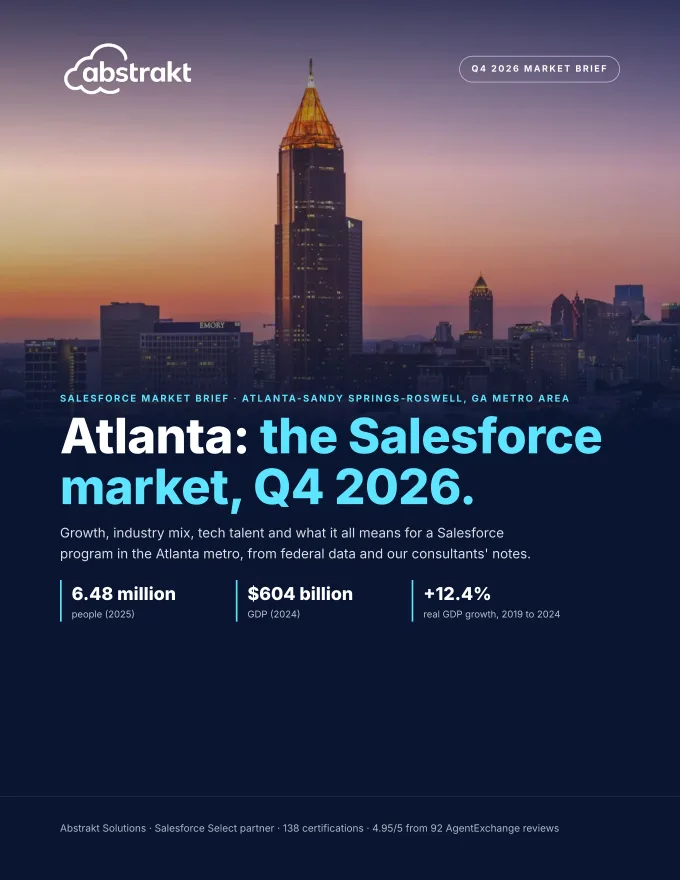
A free 25-page PDF with Atlanta's growth ranked against 100 metros, its industry mix, tech wages and nearby markets. It is offered on the public Atlanta page; send your customer there or get a copy for your own prep.
Get the Atlanta brief →Co-sell with Abstrakt in Atlanta
Working a Atlanta account? Bring in a named consultant for discovery, scoping or a health check. We reply within 4 business hours.