

How Salesforce work starts in Greenville
Abstrakt Solutions is a Salesforce Consulting Partner helping manufacturers, suppliers and distributors in Greenville and across the Upstate get more from their orgs. Greenville is one of our focus markets.
What buyers here usually run into
- 1
Supplier relationships with large OEMs
Automotive and aerospace suppliers manage a few very large customers with many programs, contacts and plants, which standard account setups do not capture well.
- 2
Dealer and distributor visibility
Manufacturers selling through dealers and distributors often lack a shared view of pipeline and inventory, which a partner portal and clean integration can fix.
- 3
Reporting spread across plants and systems
Multi-site manufacturers commonly assemble sales and service reports by hand from ERP exports, so leaders see results late and inconsistently.
Budget, team and partner questions
What drives cost
Upstate project scope depends on OEM account complexity, how quotes handle engineering changes, and how many plants and ERP instances feed reporting. Dealer or distributor portals add licensing and sharing design.
Admin or partner
Large manufacturers here may have an internal Salesforce team and bring in partners for quoting or integration projects. Fast-growing firms often rely on managed services as their admin team until hiring catches up.
What buyers ask a partner
Ask for OEM account hierarchy examples, quoting designs that handle revisions, and multi-plant reporting work. Ask how the partner documents roles and lead routing so new reps follow the same process as veterans.
The local economy and its biggest industries (4)
| Sector | Share of 2024 GDP | Where Salesforce fits |
|---|---|---|
| Manufacturing Salesforce for manufacturing → | 16.9% | Tire, turbine, aerospace and automotive-supplier manufacturers in Greenville County work through OEM programs, dealer networks and aftermarket service, where CPQ and ERP integration make the biggest difference. |
| Wholesale trade Sales Cloud → | at least 9.0% | Distributors supplying the Upstate's plants need account plans, pricing agreements and order visibility that sales reps and inside sales can share. |
| Professional, scientific, and technical services Salesforce for professional services → | 7.2% | Engineering, research and technology firms, including those working with CU-ICAR's industry partners, need a CRM that handles projects and partnerships as well as sales. |
| Health care and social assistance Salesforce for health & life sciences → | 7.0% | Health care is a smaller slice of Greenville's economy than manufacturing, but life sciences is on the county development corporation's target list, so Salesforce work here often means patient engagement, referrals and service designed around privacy requirements. |
Source: U.S. Bureau of Economic Analysis, GDP by county (CAGDP2), 2024, summed to the metro area; private sectors only, excluding real estate and government. “At least” marks sectors where BEA suppresses some county figures.
Regional target sectors named by local economic development groups: Advanced Materials, Mobility (Automotive), Aviation/Aerospace, Life Sciences, Professional and Tech Services.
Salesforce products that fit Greenville (6)
In the order we lead with them here, from the industries above.
Salesforce Sales Cloud
The CRM where sales pipeline lives, when it is built right.
Salesforce Revenue Cloud / CPQ
Configure-price-quote, billing, subscription management, and quote-to-cash on Salesforce.
Salesforce Experience Cloud
Customer, partner, and employee portals built on Salesforce.
Salesforce Field Service
Scheduling, dispatch, mobile work orders and parts for teams that work on site.
Salesforce Service Cloud
The operating system for modern customer service, case, knowledge, voice, and AI agent assist together.
Tableau
Executive analytics, embedded dashboards, and CRM Analytics built on Tableau.
Upstate AI use cases for Greenville mobility suppliers
Manufacturing accounts for 16.9% of Greenville's metro GDP (2024), and much of the region's strategy centers on automotive, aerospace, and advanced materials supply chains. Suppliers in those chains live on engineering change notices, quality claims, and customer portals. An agent can read a nonconformance report, summarize it into a case, and propose a routing based on part family. Wholesale distributors, the second-largest sector, can use lead triage to separate real RFQs from catalog browsing. The prerequisites are specific: consistent part and account hierarchies, clear rules on what customer drawings the agent may access, and an engineer signing off on anything technical before it goes out.
- Nonconformance report case summaries
- Part-family case routing
- RFQ lead triage
Services buyers here usually need (7)
Salesforce Implementation in Greenville
Greenville implementations tend to revolve around a few very large customers. An automotive or aerospace supplier may sell to one OEM through several plants, programs and buying centers, each with its own contacts and timelines. We design the account hierarchy, program objects and quoting model around that reality first, then configure opportunity stages, approvals and service processes in a sandbox, migrate cleaned records and train each team on its own accounts and programs. Launches are phased so sales sees value early while integrations follow.
By industry in Greenville
- 1
Manufacturing
Factories account for about 16.9% of Greenville's 2024 metro GDP, and no other private sector comes close. For tire, turbine, component and materials producers, implementation work focuses on how volumes and prices are committed: annual agreements, program awards and spot orders all look different in Salesforce. We decide early whether run-rate business is forecast through agreements or opportunities, how part numbers and price books mirror the ERP, and which plant each customer relationship rolls up to.
- 2
Mobility (Automotive)
The Greenville Area Development Corporation lists mobility among the county's target sectors, and automotive suppliers here often serve OEMs and higher-tier suppliers at once. The implementation must capture program launches, part-level awards, engineering change requests and production forecasts without burying reps in fields. We model programs as their own records linked to the customer plants involved, so leaders can see awarded, quoted and at-risk business by vehicle program instead of hunting through generic opportunities.
- 3
Professional, scientific, and technical services
Engineering, IT and consulting firms in the Upstate usually need Salesforce to handle delivery and relationships as much as pipeline. A useful implementation connects the pursuit to the engagement that follows: proposals, statements of work, staffing needs and client satisfaction, all tied to one account. We keep the first release focused on the sales-to-delivery handoff and basic utilization reporting, then add resource planning or client portals once the core process has proven itself with the partners who use it.
Raise before scoping
Map OEM hierarchies first
A single automaker or aircraft builder can appear as corporate purchasing, several plants and a handful of engineering centers. Decide how those levels relate in Salesforce before any build, because forecasts, territory assignments and account-team visibility all depend on the hierarchy you choose.
Match the ERP part master
Upstate manufacturers typically keep a large, frequently revised part catalog in the ERP. Agree which parts, price books and units of measure Salesforce needs and how they stay synchronized, so a quote never references a part that engineering has already superseded.
Schedule around plant shifts
We anchor workshops, go-live support and training to your plant schedules, including shift changes, so production supervisors and inside sales can attend without leaving the floor at a bad moment.
Salesforce Integration in Greenville
Integration in Greenville generally starts with the ERP and quickly extends to the systems around it: EDI feeds from OEM customers, product lifecycle data from engineering, and portals where distributors place orders. We map each flow by owner, direction, frequency and failure handling, then build with MuleSoft where several systems share data or with native connectors where one link will do. The aim is simple: reps, service staff and partners see current orders, parts and shipments without asking someone to pull a report.
By industry in Greenville
- 1
Wholesale trade
Wholesale trade represents at least 9.0% of the metro's 2024 GDP, and distributors serving Upstate plants live on accurate stock, pricing and delivery data. Integration makes Salesforce the place where that data is visible: availability by warehouse, contract pricing per customer, open orders and backorders on the account page. Quotes accepted in Salesforce become ERP orders automatically, and Experience Cloud pages give customers the same order status reps see, which cuts the calls that fill inside-sales queues.
- 2
Mobility (Automotive)
Automotive suppliers in this GADC target sector exchange releases, forecasts and advance ship notices with OEMs through EDI, while sales teams track programs in Salesforce. Integrating the two gives account managers a view of actual release volumes against quoted program volumes, which is often the earliest warning that a program is running light or heavy. We usually bring summarized EDI data into Salesforce rather than every transaction, keeping storage manageable and reports quick.
- 3
Life Sciences
Life sciences is a GADC target sector, and device and life-science suppliers here usually sell through distributors as well as directly. Integration brings distributor sales and inventory reports into Salesforce so reps see end-customer demand, and links product and lot information from the ERP so service teams can identify affected customers quickly if a recall or field notice occurs. Regulated records stay in their validated systems, and only the references Salesforce needs are passed across.
Raise before scoping
Summarize high-volume feeds
EDI releases, machine data and distributor point-of-sale files can generate enormous volumes. Decide what level of detail sales and service actually need in Salesforce, usually daily or weekly summaries, and leave transaction-level data in the source systems or a data warehouse.
Agree on customer and part keys
Integrations need stable identifiers. Agree how customers, ship-to locations and part numbers are keyed across ERP, EDI and Salesforce, including how superseded or renumbered parts are handled, before building any interface, so every update lands on the right record and nothing is orphaned.
Write an integration runbook
Someone at your company must own each integration after launch. Define who receives error alerts, who can restart a failed job and who approves mapping changes when the ERP or a customer's EDI format changes, and keep those answers in a short runbook.
Salesforce Optimization in Greenville
Optimization for a Greenville company usually starts with reporting, because that is where problems surface. Plant leaders, sales managers and finance pull different numbers, and each blames the data. We trace those disagreements back to their causes: duplicate accounts, inconsistent stages, automation that overwrites fields, reports built on different filters. Then we fix the causes, simplify layouts and quoting steps, consolidate automation into maintained Flows and rebuild core dashboards in Salesforce or Tableau. The engagement is fixed in scope.
By industry in Greenville
- 1
Wholesale trade
Upstate distributors often run a Salesforce org where inside sales works one way, outside reps another and branch managers a third. Optimization brings those together: a shared account plan layout, pricing agreements visible where quotes are built, and reorder or lapsed-customer alerts that give reps a reason to open the system. Customers entered separately at each branch get merged under agreed rules, so a customer's full spend finally shows on one record.
- 2
Advanced Materials
Advanced materials is a GADC target sector, and in these companies the people closest to customers are often application engineers rather than salespeople. They avoid Salesforce when it asks for commercial data they do not have. Optimization gives them a role-specific view: trial requests, test results and customer feedback captured quickly from mobile or email, with commercial fields hidden until they matter. Sales and technical staff then work the same record instead of reconciling notes in meetings.
- 3
Health care and social assistance
Health organizations in the Greenville area frequently use Salesforce for patient access, referral coordination or community programs, often added one department at a time. Optimization looks for the duplicate processes that result: several intake paths, overlapping communication rules and reports defining an active patient differently. We consolidate those into shared flows, check that simplification does not widen access to sensitive information, and give care coordinators a cleaner console that reflects how they actually handle a referral.
Raise before scoping
Start with the disputed numbers
Ask leadership which figures they argue about most, such as backlog, forecast or on-time delivery. Tracing those disputes back through reports and automation is the fastest way to find the configuration and data problems that matter, and it gives the project an immediate, visible payoff.
Respect plant-level differences
Plants and branches in the Upstate may run slightly different processes for good reasons. Standardize where differences add no value, but keep variations that reflect real customer or product needs, and document them, so simplification does not break a legitimate local workflow.
Retire unused reports openly
Mature orgs usually hold far more reports than anyone opens. We identify dashboards and reports untouched for a long stretch, confirm with their owners, and archive them, telling users where the maintained replacements live so trust shifts to a smaller, reliable set.
Salesforce Health Checks in Greenville
In Greenville, health checks are often requested at a turning point: a new cloud, a partner portal, an acquisition or an Agentforce pilot. Using a login that cannot edit anything, we test dealer and patient portal exposure, integration credentials, Apex and Flow sprawl, and the completeness of account and contact data. You receive ranked findings with a plain explanation of each risk and the effort to fix it, plus a view on whether the org is ready for the next step.
By industry in Greenville
- 1
Health care and social assistance
Upstate care providers account for about 7.0% of 2024 metro output, rounding out BEA's top five private sectors here. For health organizations, the review centers on patient data: which profiles can view, report on or export protected information, how encryption and field-level security are configured, whether portal users are properly isolated, and whether audit and field history settings would support an investigation. Anything touching protected records tops the remediation list.
- 2
Manufacturing
Manufacturers in the Upstate often learn through a health check that dealer or distributor portals expose more than intended, integration users hold administrator rights, and product and pricing data has drifted from the ERP. We also measure automation load on quote and order objects, where years of rules can slow saves and cause errors. The report separates security items that need immediate action from technical debt that can be retired gradually through normal releases.
- 3
Professional and Tech Services
Professional and tech services is one of GADC's target sectors, and firms in it often hold client-confidential information in Salesforce: contracts, pricing and project details. A health check reviews whether sharing reflects client confidentiality, whether files and notes are exposed to the wrong teams, how connected apps and third-party tools reach data, and whether sandbox copies are masked. For technology providers that answer customer security questionnaires, the findings translate directly into stronger answers.
Raise before scoping
Inspect partner portal exposure
Dealer, distributor and patient portals are common in Greenville orgs and a frequent source of unintended access. Review guest-user settings, sharing sets and file links specifically, because permissions granted for one partner program can quietly widen as new objects and fields are added.
Check before Agentforce, not after
AI agents read and act through a user's permissions and the org's data. Stale knowledge, duplicate accounts and loose sharing all shape what an agent says. Running the health check first means the pilot is scoped on a trustworthy base rather than debugging problems in front of customers.
Use it for acquisition diligence
When a Greenville company acquires or is acquired, Salesforce orgs need to be understood quickly. A health check provides a factual inventory of configuration, integrations, data quality and licenses that supports consolidation planning and avoids surprises after the deal closes.
Salesforce Managed Services in Greenville
For Greenville clients, managed services typically covers everything between a password reset and a new module. Plant supervisors, sales managers, customer service and finance all submit to the same list, and a person you designate decides its order with us at a monthly review. We ship changes in small tested releases, check each seasonal Salesforce upgrade in a sandbox, keep Tableau and Salesforce reports working after changes, and watch the integrations to your ERP.
By industry in Greenville
- 1
Professional, scientific, and technical services
Professional, scientific and technical services represent about 7.2% of the metro's 2024 GDP, and the county's development corporation counts professional and tech services among its targets. Firms in this group, from engineering consultancies to IT providers, change their service lines often, and each change ripples into Salesforce: new opportunity types, revised proposal templates, updated utilization reports. A managed team handles that churn inside a governed backlog, so partners get the reports they need without the org sprouting a new object for every idea.
- 2
Aviation/Aerospace
Aviation and aerospace is one of GADC's target sectors, and suppliers and service businesses in it tend to run long contracts with strict documentation expectations. Managed support keeps the org aligned with that: permission changes approved and recorded, field changes tested against contract and compliance reports, and seasonal upgrades reviewed before they reach users. We also maintain the asset and service-contract data behind aftermarket work, since errors there turn directly into missed service revenue.
- 3
Wholesale trade
Distributors supplying Upstate plants rely on Salesforce for account plans, pricing agreements and inside-sales queues that change every month. Ongoing support means adjusting territories as reps come and go, updating agreement templates, keeping the ERP order feed healthy, and tuning the Experience Cloud pages customers use to reorder or check status. We batch routine changes into a predictable release rhythm, so branch managers know when updates will land instead of discovering them mid-morning.
Raise before scoping
Align releases with plant calendars
Manufacturers often have shutdown periods, model changeovers and quarter-end shipping pushes. Schedule Salesforce deployments around them, and agree a freeze window when order entry and customer service cannot absorb change, so improvements land when people actually have time to learn them.
Split capacity between run and change
Decide how much monthly effort goes to keeping things running, such as user requests, fixes and release testing, versus improvements like new automation or dashboards. Making that split explicit stops urgent small tickets from consuming everything and keeps the roadmap moving forward.
Keep Tableau in scope
Many Greenville companies report through Tableau as well as Salesforce. Include dashboard upkeep in the managed agreement, since object and field changes often break extracts, and a separate analytics owner tends to find out only after a leadership meeting goes wrong.
Salesforce Migration in Greenville
Migrations for Greenville companies often combine a legacy CRM with customer data that has lived inside the ERP for years, and the two rarely agree. We profile both, decide which one wins for each field, and restructure records into the new model: corporate parents, plants and ship-to locations as proper hierarchies; programs or agreements as their own objects; contacts deduplicated and assigned. Trial loads in a sandbox let sales and service leaders check familiar accounts before the cutover, which we schedule around your production calendar.
By industry in Greenville
- 1
Manufacturing
Upstate manufacturers moving to Salesforce frequently carry customer records shaped by the ERP's billing needs rather than by how sales works. One OEM might exist as many ship-to accounts with no parent at all. We rebuild the hierarchy during migration, linking plants and buying centers to corporate parents, and carry over quote and order history at a level that helps reps. Engineering contacts and their project roles, often buried in email, are captured where possible so relationships survive the move.
- 2
Health care and social assistance
Health providers and community organizations in the Greenville area migrating into Salesforce have to handle patient and client data with care. We classify fields before extraction, move only what care coordination or outreach genuinely needs, keep consent and communication preferences attached to each person, and run transfers through encrypted, logged channels. Historical clinical detail generally stays in the clinical record system, with Salesforce holding references and engagement history, which keeps the CRM's privacy footprint deliberately small.
- 3
Aviation/Aerospace
Aerospace suppliers and service firms in this GADC target sector often migrate from a CRM that tracked only sales, while contract, certification and aftermarket data sat elsewhere. The migration is a chance to link those: customers to contracts, contracts to the parts or assets they cover, and service history to specific units. We verify identifiers carefully, because aerospace part and serial numbers follow strict formats and a single transcription error can break traceability.
Raise before scoping
Reconcile CRM and ERP customers
When both systems hold customer data, expect conflicts in names, addresses and ownership. Agree which system wins for each field, build a crosswalk of IDs, and keep it after go-live, because the future integration will depend on the same matching decisions.
Time cutover to production calendars
Avoid migrating during quarter-end shipping pushes, model changeovers or plant shutdowns, when the people who must validate data are busiest. A quieter window gives users time to check their accounts and gives the project team room to correct issues before normal volume returns.
Preserve engineering relationships
Buying decisions at Upstate manufacturers often involve engineers and quality staff as well as purchasing. Migrate contact roles and relationships, not just names, and ask reps to add missing key contacts during validation, so account teams start with a realistic picture of who influences each award.
Salesforce Implementation Rescue in Greenville
A Greenville rescue starts with evidence, not blame. We review the org, statement of work, design documents and backlog, then interview sponsors, the delivery team if available, and the users who were supposed to benefit. Most troubled projects fail on a few root causes: a model that ignored how OEM or distributor relationships work, integrations left to the end, or nobody with authority to decide. We stabilize what is live, recommend what to keep or replace, and lay out a realistic path to adoption.
By industry in Greenville
- 1
Manufacturing
Stalled projects at Upstate manufacturers often involve a quoting tool configured from a product list that did not reflect how parts are really priced: tooling, volume breaks, material indexes. Reps quietly return to spreadsheets and pipeline data decays. Recovery starts with the pricing logic itself, validated against real recent quotes, and then the product catalog and approvals are rebuilt to match. Only once quotes are trusted do we revisit dashboards and forecasting, which depend on that data.
- 2
Wholesale trade
Distributors sometimes launch Salesforce with a customer portal or inside-sales process that customers and staff reject because order data is stale or incomplete. In a rescue, the first step is usually the ERP connection: which data is missing, how often it refreshes and where it fails. With accurate stock, pricing and order status in place, we simplify the portal and inside-sales screens so they answer the questions customers actually call about.
- 3
Mobility (Automotive)
Automotive suppliers in this GADC target sector sometimes end up with an org that treats each vehicle program as a single opportunity, so awards, launches and engineering changes cannot be tracked separately. Forecasts become unreliable and leadership stops using them. Rescue restructures the model around programs and part-level awards, moves existing records into it, and reconnects release data from customer EDI so actual volumes can finally be compared with quoted ones.
Raise before scoping
Separate bugs from design flaws
Users report many problems during a troubled rollout, but they differ in kind. Some are defects that can be fixed quickly; others reflect a design that does not fit the business. Sorting complaints into those categories early prevents spending the recovery budget patching symptoms of a structural issue.
Protect live operations first
If the org already runs orders, quotes or service in Greenville, keep those processes working while changes are made. Use sandboxes for every fix, release in small batches outside shipping peaks, and have a rollback ready, so the rescue does not add a second disruption.
Measure recovery by usage
Define up front how you will know the rescue worked: users logging in and completing key records, quotes produced in Salesforce, reports used in leadership meetings. Tracking those measures during recovery keeps the effort focused on adoption rather than on closing a list of tickets.
Industry plays in Greenville (3)
Salesforce for Greenville Manufacturers
Greenville-area manufacturers frequently sell materials and components that customers must test before approving, such as engineered materials, coatings, machined parts and assemblies. That makes sample requests, trials and approval documentation central to the sales process. Salesforce should track trials by customer plant and application, keep supplier quality submissions organized, and show volume commitments after approval. We configure Sales Cloud, CPQ and Experience Cloud around that flow and connect it to the ERP each plant runs.
The Upstate's factories set the pace for the local economy, and manufacturing's 16.9% share of 2024 Greenville-Anderson-Greer GDP in Bureau of Economic Analysis data is the largest of any private sector. Advanced materials, mobility, aviation and aerospace, and life sciences all appear on the county development corporation's target list, alongside professional and tech services. A university automotive research campus of 250 acres in Greenville hosts more than 20 industry partners focused on mobility research. Wholesale trade ranks second at no less than 9.0%, so distribution is also a meaningful part of the regional economy that manufacturers sell into and through.
Use cases to open with
- 1
Sample and trial management
Customers evaluating a new material or component request samples, run trials on their own lines and approve or reject based on results. Salesforce trial records linked to opportunities capture sample lots, customer test conditions, results and next steps, so technical service and sales share one history and leaders see which applications are closest to commercial volume. Failed trials keep their findings so the next sample improves.
- 2
Supplier quality submissions
Automotive and aerospace customers require formal approval packages, certifications and change notifications before parts ship. Tracking each submission, its required documents, due dates and customer approval status in Salesforce, linked to the quality system for the documents themselves, keeps account teams from promising shipments before the customer has actually signed off on the part or process. Resubmissions keep a history of what the customer asked to change.
- 3
Aerospace aftermarket and spares
Aviation customers buy spares and replacement parts for years after a program launches, often through distributors and repair stations. Salesforce with part-level opportunities, distributor accounts and quote templates for aftermarket pricing captures that demand, and lets sales compare aftermarket revenue by platform against original equipment volumes to see where the long tail is growing. Stocking programs with each distributor sit on that distributor's account, next to its sell-through history.
Raise before scoping
Trial data ownership
Technical service teams may already record trials in lab notebooks or quality systems. Agree on what belongs in Salesforce, usually status, a results summary and next steps, and link to detailed technical records, so salespeople see progress without duplicating laboratory data.
Change notification discipline
Customers expect advance notice of process, material or site changes. Build a change notification process in Salesforce that identifies affected customers and parts, tracks acknowledgments and deadlines, and reports open items to quality leadership on a regular schedule, before any customer deadline passes.
Keep automation maintainable
Manufacturers often add flows and triggers quickly after launch, then struggle to change them. Set naming standards, document every automation, and review new requests against existing ones, so the org stays understandable when the original administrator moves on or a second plant joins.
Salesforce for Greenville Professional Services Firms
Professional services in Greenville include engineering and design firms, IT and technology consultancies, accounting and advisory practices, and marketing agencies, including many that serve manufacturers. Salesforce helps these firms track pursuits and proposals, see relationships across client plants and divisions, forecast staffing needs from the pipeline and understand which clients are most profitable. We configure Sales Cloud with CPQ or proposal tools, integrate professional services automation or project accounting, and build Tableau dashboards for partners.
Engineers, consultants, accountants and IT firms add up to a meaningful slice of the Upstate economy: the Bureau of Economic Analysis puts professional, scientific and technical services at 7.2% of 2024 metro GDP, fourth among the private sectors it ranks. The Greenville Area Development Corporation lists professional and tech services as a target industry and notes that several large technology companies have a presence in the area. Manufacturing, the largest sector at 16.9%, is a natural client base for engineering, IT and consulting firms. Entrepreneurs are also supported by a Greenville innovation center offering mentorship, growth labs and investor access.
Use cases to open with
- 1
Pursuit and proposal tracking
Larger engagements involve qualification, go or no-go decisions, proposals, presentations and negotiations. Sales Cloud pursuit stages with decision checklists, proposal team assignments and win-loss reasons give leaders an honest view of pipeline quality, and reveal which service lines, clients and proposal types win often enough to justify the effort a proposal team puts in. Debriefs from lost pursuits are stored for the next bid.
- 2
Pipeline-based staffing forecasts
Consulting and engineering firms need to know when upcoming work will require specific skills. Adding role and hour estimates to opportunities, weighted by probability and start date, lets resource managers see demand ahead of time, and integration with professional services automation tools compares it with current bench capacity so hiring and subcontracting decisions rest on evidence rather than guesswork. Bench reports highlight people about to roll off projects.
- 3
Client relationship mapping
Manufacturing clients often buy separately at each plant, division and corporate function. Account hierarchies with contact relationships across locations, plus activity history from every partner and manager, show where the firm already has trust and where a new service line could be introduced, supporting account planning with facts instead of hallway conversations. Relationship gaps become explicit tasks for named partners.
Raise before scoping
Integrate project delivery data
Hours, invoices and project margins are normally tracked in a PSA or accounting tool rather than the CRM. Bring summary figures into Salesforce for account planning, keep time entry and billing where they are, and agree who reconciles differences between forecast and actual revenue.
Getting partners to adopt
Senior partners and principals control key relationships and often resist data entry. Offer email and calendar integration that logs activity automatically, give them a short dashboard of their own accounts, and have firm leadership review pipeline in Salesforce during regular meetings.
Conflict and confidentiality checks
Accounting, legal and some engineering firms must check conflicts and protect client confidentiality. Decide how conflict checks connect to opportunity creation, and set sharing rules so sensitive engagements stay visible only to the assigned teams and firm leadership, with access reviewed periodically.
Salesforce for Greenville Health and Life Sciences
In Greenville, health organizations serve a region where manufacturing employs many residents, so employer relationships matter alongside patient care. Health systems run occupational health, on-site clinics and wellness programs for plants, while life sciences companies sell products and services to providers and manufacturers alike. Salesforce helps by managing employer accounts, patient access and referrals in one platform. We configure Service Cloud and Experience Cloud for patient and employer service, Sales Cloud for employer and B2B relationships, and Agentforce for routine questions, with access designed around HIPAA.
Care providers and social service agencies close out the BEA's top five for the Upstate metro in 2024 at 7% of output, well under half the manufacturing share of 16.9%. Life sciences, though, is one of the five fields the Greenville Area Development Corporation actively recruits, which brings device, diagnostics and research firms into the same market as the hospitals. GADC covers Greenville County only, while the metro also includes Anderson, Laurens and Pickens counties, so providers and life sciences firms here routinely serve patients and customers beyond the county that recruits them.
Use cases to open with
- 1
Employer health program sales
Health systems selling occupational health, on-site clinics and wellness programs to Upstate manufacturers need a real B2B pipeline. Sales Cloud can track employer accounts, plant locations, decision makers in HR and safety, contract terms and renewal dates. Before each renewal, the account owner can review open service tickets and program usage together; executives, meanwhile, track contract value by sector to decide where to add clinic capacity.
- 2
Referral access across counties
Patients referred from Anderson, Laurens or Pickens county practices into Greenville specialists can fall through the gaps. Service Cloud tracks each referral from receipt to scheduled appointment, alerts coordinators when follow-up stalls, and reports completion by referring practice and county, so liaisons know where to focus visits and where access problems, such as long waits for a specialty, need attention from leadership.
- 3
Life sciences customer service
Life sciences companies supplying devices, diagnostics or materials to providers and manufacturers handle orders, technical questions and complaints. Service Cloud routes each case by product and issue type, captures lot and serial details, and escalates potential quality events to the right team. Account managers see open cases before visiting customers, and product and quality teams see complaint trends by lot, product family and customer type.
Raise before scoping
Employer and patient data apart
Employer programs involve aggregate utilization reports, while the underlying visits are protected health information. Design the data model and sharing so employer contacts never see individual patient details, and make sure every report sent to a plant's HR or safety team uses de-identified or aggregated data only.
Four counties, one view
GADC's figures and programs cover only Greenville County, but patients and customers come from Anderson, Laurens and Pickens as well. Capture county, referring practice and service area on every referral and account, so leaders can plan access, clinic sites and outreach for the whole region.
Quality events need a path
Life sciences companies must route potential complaints and adverse events to quality and regulatory staff promptly and completely. Define intake criteria, required fields and escalation rules in Service Cloud, train agents on them, and integrate with the quality system rather than duplicating official records in two places.
Case studies to send (3)
From the industries this market leans on. Client names are anonymized and these projects are not specific to Greenville.
The Greenville Salesforce market brief, Q4 2026
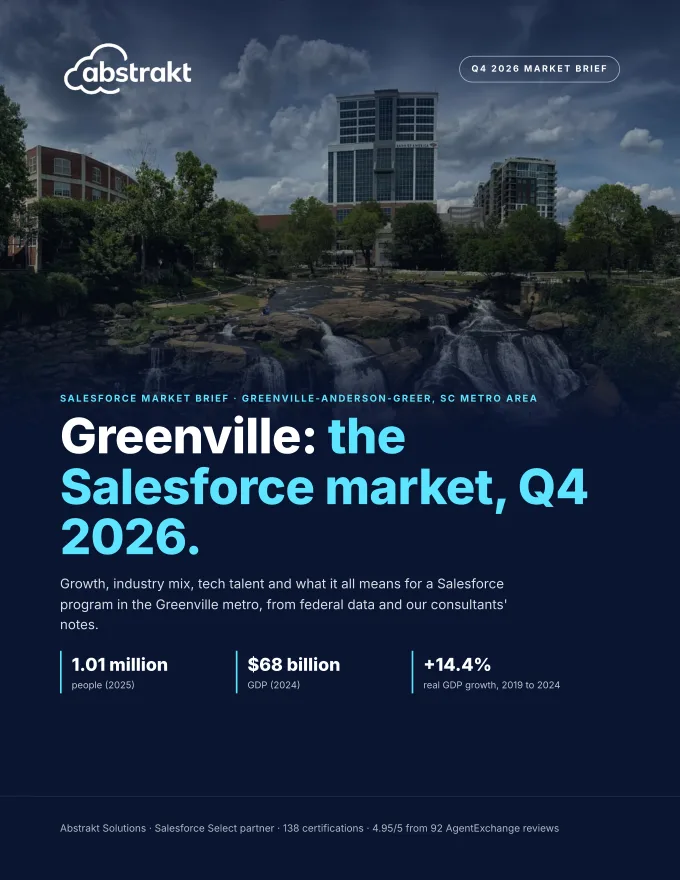
A free 21-page PDF with Greenville's growth ranked against 100 metros, its industry mix, tech wages and nearby markets. It is offered on the public Greenville page; send your customer there or get a copy for your own prep.
Get the Greenville brief →Co-sell with Abstrakt in Greenville
Working a Greenville account? Bring in a named consultant for discovery, scoping or a health check. We reply within 4 business hours.