

How Salesforce work starts in Charlotte
Across the Charlotte region, on both sides of the state line, Abstrakt Solutions acts as Salesforce Consulting Partner to banks, insurance carriers, industrial producers and distributors. Charlotte is one of our focus markets.
What buyers here usually run into
- 1
Compliance and supervision
Regulated financial firms need record access, marketing consent and communications workflows that pass compliance review before launch, not after.
- 2
Relationship data across lines of business
Banks and insurers often hold the same customer in several systems. Unifying the relationship view is usually the first valuable step.
- 3
Advisor and banker adoption
Relationship managers adopt Salesforce when it saves them time. Activity capture, meeting prep and simple layouts matter more than extra fields.
Budget, team and partner questions
What drives cost
Charlotte projects cost more when exam readiness is in scope: audit trails, field-level security, retention and access reviews add design and testing. Bank and fintech mergers add org consolidation. Manufacturing and distribution projects here are driven mostly by ERP integration and portal scope.
Admin or partner
Banks often keep Salesforce ownership internal for control reasons and bring in partners for architecture, integration and peak delivery. Smaller fintechs and manufacturers more often outsource administration until the platform settles.
What buyers ask a partner
Ask for Financial Services Cloud references, how the partner documents access for examiners, and how they handle a merger of orgs. Ask what changes they would refuse to make without your compliance team's sign-off.
The local economy and its biggest industries (4)
| Sector | Share of 2024 GDP | Where Salesforce fits |
|---|---|---|
| Finance and insurance Financial Services Cloud → | 18.1% | Banks, insurers, wealth managers and fintech firms need client and household views, onboarding workflows, supervised communications and service at scale. This is where Financial Services Cloud and careful sharing models matter most. |
| Manufacturing Salesforce for manufacturing → | 7.3% | Industrial manufacturers in the region sell through distributors and service installed equipment, so account planning, quoting and service history need to connect to ERP. |
| Professional, scientific, and technical services Salesforce for professional services → | at least 7.0% | Consulting, technology services and engineering firms serving the banking sector need pipeline, delivery and client reporting in one place. |
| Wholesale trade Integration → | 6.4% | Logistics and distribution businesses along the I-85 corridor need customer service, order visibility and portals tied to operational systems. |
Source: U.S. Bureau of Economic Analysis, GDP by county (CAGDP2), 2024, summed to the metro area; private sectors only, excluding real estate and government. “At least” marks sectors where BEA suppresses some county figures.
Regional target sectors named by local economic development groups: Financial Services, Advanced Manufacturing, IT/Technology, Life Sciences, Logistics & Distribution.
Salesforce products that fit Charlotte (6)
In the order we lead with them here, from the industries above.
Salesforce Financial Services Cloud
Industry CRM for wealth management, banking, insurance, and lending, built for compliance from the start.
Salesforce Sales Cloud
The CRM where sales pipeline lives, when it is built right.
Salesforce Service Cloud
The operating system for modern customer service, case, knowledge, voice, and AI agent assist together.
Salesforce Marketing Cloud
Cross-channel marketing, email, mobile, journey, and Data 360-powered personalization at scale.
Salesforce Data 360 (Data Cloud)
Unify customer data into a real-time profile that powers segmentation, analytics, and AI.
Salesforce Agentforce
AI agents that handle real work inside Sales Cloud, Service Cloud, and Marketing Cloud.
How Charlotte financial teams can adopt AI with control
Finance and insurance made up 18.1% of Charlotte's metro GDP in 2024, more than double the next sector, manufacturing, at 7.3%. That concentration dictates the order of operations for any AI rollout. Banks, lenders, and wealth teams face compliance review on nearly every client message, so drafting assistance with mandatory human approval is a better first project than an autonomous agent. Relationship managers benefit from pre-meeting summaries that pull recent cases, product holdings, and open requests into one view. Regional manufacturers and distributors can use lead scoring to sort dealer inquiries. The preparation is unglamorous: field-level security, audit trails, retention policies, and a Data 360 (formerly Data Cloud) model that knows which household each record belongs to.
- Compliance-reviewed reply drafting
- Relationship manager meeting prep
- Dealer inquiry lead scoring
Services buyers here usually need (7)
Salesforce Implementation in Charlotte
Finance and insurance carries more weight in Charlotte's economy than almost anywhere else we work, and that shapes how implementations here are scoped. Even manufacturers and software firms in the region often sell to banks or answer to bank-grade security reviews. We begin with the relationship model and the permission design, because examiners and customers will both test them. The build then proceeds in phases: core pipeline and client records first, followed by service, marketing and AI features on a proven foundation.
By industry in Charlotte
- 1
Finance and insurance
Finance and insurance generated about 18.1% of the metro's 2024 GDP, which makes it the anchor for most Salesforce work in the region. Bank and insurer implementations here usually involve Financial Services Cloud, with commercial relationships, households and referral paths between business lines modeled explicitly. The hardest decisions concern who sees what: role hierarchies, sharing sets and field-level security are designed on paper and reviewed with compliance before any configuration starts.
- 2
Advanced Manufacturing
The Charlotte Regional Business Alliance lists advanced manufacturing among its target sectors, and the region's manufacturers often run plants in both Carolinas. An implementation for them sets up one account hierarchy for customers that buy from several sites, product and price book structures that reflect plant-level pricing, and opportunity types for new programs versus reorders. We design those pieces with the ERP team in the room, since the ERP will stay the source of pricing and orders.
- 3
IT/Technology
IT and technology is another Alliance target sector, and many of the region's software and fintech companies sell into regulated buyers. Their implementations need more than a standard pipeline: vendor due-diligence stages, security questionnaire tracking, renewal and expansion forecasting, and partner referral paths. We build those into Sales Cloud from the start, with reporting that shows how long deals sit in procurement review, since that is often where the forecast slips.
Raise before scoping
Design sharing for examiners
Bank and insurer projects in Charlotte are judged partly by whether auditors can see who accessed which records. Settle role hierarchy, permission sets and field-level security in design, and document the reasoning, so the first exam after launch does not force a redesign.
Plan for two states
Companies operating in North and South Carolina may face different licensing, tax or regulatory fields by state. Capture state as structured data on accounts and products from the first release, so territory rules, reporting and future automation can rely on it.
Keep the first release narrow
Large enterprises in the region can generate long requirement lists. Pick the smallest set of processes that delivers value to one group, go live with that, and let real usage decide what the next phase should contain instead of the original wish list.
Salesforce Integration in Charlotte
For Charlotte organizations, integration usually means connecting Salesforce to systems that are larger and older than it is: core banking, loan origination, policy administration, plant ERPs and warehouse platforms. We decide field by field which system owns the data, then pick a pattern that fits the volume and the governance: MuleSoft for firms with many systems and an API program, lighter tools or direct APIs for a few connections. Monitoring, error queues and a runbook ship with every integration.
By industry in Charlotte
- 1
Manufacturing
Plants and industrial producers, a sector worth about 7.3% of Charlotte's 2024 output, typically need Salesforce tied to ERP for pricing, availability, orders and invoices, and sometimes to plant or quality systems for service. We keep the ERP as the owner of pricing and orders, pass approved quotes across automatically, and show shipment and invoice status on the account, so sales and service no longer have to phone the plant for answers.
- 2
Logistics & Distribution
Logistics and distribution is one of the Alliance's target sectors, and the region's distributors and carriers depend on warehouse, transportation and order systems that Salesforce users need to see. Integrations for them are event-driven where timing matters, such as a delayed shipment opening a case, and scheduled where it does not, such as nightly account balances. Clear retry and alert rules keep a failed message from turning into an angry customer.
- 3
Financial Services
For banks, insurers and fintechs, the integration question is how much of the core platform to expose inside Salesforce and how. Balances, loan status and policy details usually flow in read-only through an API layer, while onboarding tasks and service requests flow back out. Security reviews focus on the integration user, network controls and what is cached in Salesforce, so we document those choices for your risk team before build starts.
Raise before scoping
Work within enterprise API standards
Large Charlotte companies often have an API gateway, naming standards and an integration team of their own. Design Salesforce connections to use those shared services rather than building point-to-point links, so the integrations are supported by the same people who run everything else.
Decide what Salesforce may cache
Showing core banking or ERP data in Salesforce can mean storing copies or fetching on demand. Stored copies are faster and reportable but must be secured and refreshed; live lookups avoid duplication. Choose per field, with your risk team's input.
Test with realistic volumes
Integrations that work with a few records can fail at month-end or during a bulk reprice. Test against production-like volumes in a full sandbox, and confirm that API limits, batch sizes and timeouts hold up at the busiest point of your cycle.
Salesforce Managed Services in Charlotte
In a banking center like Charlotte, managed services is as much about control as capacity. Our team takes requests from your users, sizes and ranks them with your owner, and delivers through sandboxes with peer review and documented approvals, so every production change can be traced. We test each Salesforce release against the processes your bankers, agents and sellers use daily. The same team handles admin tickets, Flow work, integration fixes and occasional architecture decisions, so you do not hire for each skill separately.
By industry in Charlotte
- 1
Financial Services
Financial services is the first target sector on the Charlotte Regional Business Alliance's list, and financial firms here expect vendors to follow their change-management policies. Our managed-services model fits that: requests are logged with a business owner, changes are built and tested in a sandbox, deployments go out on scheduled windows, and evidence of approval is kept for audit. Emergency fixes follow a separate, documented path rather than bypassing review.
- 2
Wholesale trade
Wholesale trade adds about 6.4% of metro GDP, and distributors along the I-85 corridor keep changing territories, price lists and customer programs. Their Salesforce backlog is full of small but urgent items: a rep reassignment, a new product family, a report for a supplier review. A managed-services team clears those quickly and keeps an eye on data quality, so account ownership and pricing references stay accurate as the business shifts around them.
- 3
Life Sciences
Life sciences is on the Alliance's target list, and companies in that sector often run lean commercial and medical teams with no full-time Salesforce staff. For them, managed services covers administration, validation of changes that touch regulated processes, and help with the medical-information or sample-request workflows that need careful handling. We document each change so quality and compliance reviewers can follow what was altered and why, without having to read Salesforce configuration themselves.
Raise before scoping
Align with your change policy
Many Charlotte enterprises already have change advisory boards and deployment windows. Fold Salesforce work into that process instead of running a parallel track that auditors will question, and agree up front which request types count as standard changes that skip the full board.
Separate build from deploy rights
Regulated firms often require that the person who builds a change is not the one who promotes it to production. Set up deployment permissions and a pipeline that enforce that split, even for small teams, so audits find the control working in practice.
Budget for release review
Seasonal platform upgrades regularly touch screens and automation your people use daily. Reserve backlog capacity for reviewing release notes, testing in a preview sandbox and adjusting automation, rather than treating release work as a surprise that pushes planned enhancements back by a sprint.
Salesforce Health Checks in Charlotte
In Charlotte, the question behind most health checks is whether the org would survive scrutiny: from an examiner, a customer's security team or an AI rollout. The work spans four strands: access, including connected apps; the automation, code and packages that make up technical debt; completeness and duplication on core objects; and whether executive dashboards tell the truth. Findings come back ranked by risk and effort, with the specific setting, the affected users and the recommended fix for each.
By industry in Charlotte
- 1
Finance and insurance
For banks and insurers, a health check is often a rehearsal for an audit. We trace who can view, edit and export client and account data, look for dormant users and admin rights that outlived their purpose, check whether field history and event monitoring cover sensitive fields, and verify that sharing rules match the documented access model. The resulting report is structured so internal audit and compliance can map each finding to a control.
- 2
IT/Technology
Technology companies selling to the region's banks and enterprises face security questionnaires that ask how customer data is protected in their CRM. A health check gives them evidence: who has access, how integrations authenticate, whether multi-factor authentication and session policies are enforced, and where sensitive data sits. The same review flags technical debt that slows the sales team, such as unused fields, conflicting automation and managed packages nobody at the company still uses.
- 3
Logistics & Distribution
Distributors and logistics companies often have orgs shaped by fast growth, where integrations were added quickly and automation built under deadline. A health check for them concentrates on data quality and integration reliability: duplicate accounts from multiple feeds, stale ownership after territory changes, and syncs that fail without alerting anyone. Fixes are ranked so the ones that affect customer-facing service come first. We also check that integration users are not holding broader rights than their feeds require.
Raise before scoping
Review connected apps and tokens
Older integrations and third-party tools often authenticate through connected apps with broad scopes and long-lived tokens. Include them in the review, confirm each is still needed and owned, and tighten permissions before an auditor or an AI project finds them first.
Check readiness before AI pilots
Agentforce and Data 360 (formerly Data Cloud) work from the records and permissions you already have. A health check before an AI pilot identifies duplicate data, loose sharing and outdated knowledge content that would make an agent's answers unreliable or expose data unexpectedly.
Get findings a board can read
Technical findings should come with a plain-language summary for leadership in Charlotte: what is at risk, what fixing it involves and what happens if it waits. That summary is often what turns a report into a funded remediation plan with a clear owner.
Salesforce Optimization in Charlotte
Charlotte optimization projects usually begin with relationship managers and commercial sellers, because their adoption drives every downstream report. We measure how they actually use the org, then remove fields nobody fills in, merge overlapping automation into maintainable Flows, and add the time-savers they will notice: activity capture, call-prep pages, referral shortcuts. Once the data improves, we rebuild pipeline and service dashboards on agreed definitions, so executives stop requesting side spreadsheets before every meeting.
By industry in Charlotte
- 1
Professional, scientific, and technical services
Professional, scientific and technical services contributed at least 7.0% of metro GDP in 2024, and many of these firms consult for the region's banks. Their orgs often suffer from opportunity records that no longer reflect how work is won: master agreements, task orders and renewals all crammed into one stage path. We restructure opportunity types, retire stale fields and rebuild the forecast so partners can see pipeline by client and by service line.
- 2
Finance and insurance
Banks and insurers in the region frequently own mature orgs shaped by years of acquisitions, reorganizations and different admins. Optimization there focuses on making the relationship view trustworthy: merging duplicate client records, clarifying which team owns each relationship, and simplifying the pages bankers open before a call. We also consolidate automation, since legacy rules can reassign records or send client notices in ways nobody remembers configuring. Each consolidation is tested in a sandbox against real client scenarios before release.
- 3
Retail trade
Retail trade contributes about 5.7% of the metro's output, and retailers with home-improvement, automotive or specialty lines often use Salesforce for commercial accounts, service and loyalty. Common problems are duplicate customer records split across store and online channels and service reports nobody trusts. We clean up customer identity across channels, streamline case handling for store and contact-center agents, and rebuild service reporting so regional managers can compare locations on the same basis every month.
Raise before scoping
Start with the heaviest users
Relationship managers and inside sellers spend the most time in Salesforce and feel every extra click. Interview and observe a few of them before designing changes, because their daily frustrations point to the fixes with the largest return on the effort spent.
Inventory automation before changing it
Mature Charlotte orgs can carry a long tail of workflow rules, processes and Flows layered over each other. Build a full inventory, including what each one updates, before consolidating anything, so no quiet dependency breaks a regulated notification or data feed.
Tie dashboards to decisions
Rebuild each dashboard around a decision someone actually makes, such as where to add bankers or which accounts need attention. Dashboards without an owner and a decision tend to drift back into disuse after the optimization project ends. Name that owner on the dashboard itself.
Salesforce Migration in Charlotte
Charlotte migrations often follow a merger or reorganization, so the job is frequently org-to-org: two or more Salesforce instances, each with its own fields and habits, folding into one. Just as often it is a mid-sized firm moving from an older CRM or spreadsheets. In both cases we inventory the sources, agree which definitions win, cleanse and deduplicate customers across systems, and rehearse loads in a sandbox until counts reconcile. The cutover plan is dated, with a short data freeze and a named support contact for every team through the first week.
By industry in Charlotte
- 1
Financial Services
Bank and insurer consolidations bring a particular migration challenge: the same client exists in several orgs with different owners, product codes and consent histories. We match clients across sources, choose a surviving record with clear rules, and carry consent and communication preferences forward with timestamps, since regulators may ask when permission was given. Relationship owners review a sample of merged records before the final load so surprises surface while there is still time to adjust the rules.
- 2
Wholesale trade
Distributors moving onto Salesforce typically bring customer data spread across an ERP, a legacy CRM and reps' own spreadsheets. The migration is a chance to fix account structure: one parent account per customer, ship-to locations as children, and ownership that matches current territories. We load order history summaries rather than every line item, and keep detail in the ERP, where it already lives and stays accurate, with the ERP customer number stored on each account for lookups.
- 3
IT/Technology
The region counts a tech workforce of more than 67,000, and fast-growing software and fintech firms here often start on a lightweight CRM before moving to Salesforce. Their migrations involve subscription and renewal data, product usage fields and marketing automation history. We map subscriptions to a structure that supports renewal forecasting, migrate marketing consent first, and preserve deal history so the sales team can still see how each customer was won.
Raise before scoping
Agree definitions across orgs
When merging orgs, each side has its own meaning for fields like customer type, stage or segment. Agree the target definitions with both business owners before mapping, otherwise the migration quietly carries two incompatible vocabularies into the new org, where they are far harder to untangle.
Carry consent with timestamps
Marketing and communication consent needs to arrive in Salesforce with its source and date, not just a yes or no. Financial firms in particular may need to prove when and how a client opted in, long after the old system is retired.
Rehearse the cutover weekend
Run the full cutover sequence at least once in a sandbox, including freeze, final extract, load, reconciliation and user access. A rehearsal shows how long each step actually takes and exposes dependencies that a written plan alone will miss, while there is still time to fix them.
Salesforce Implementation Rescue in Charlotte
Stalled Charlotte projects we see often got caught between ambitious scope and strict governance: a large requirements list met a security review late, and the build stopped while access rules were redesigned. We start with triage, sorting what works from what does not and what the governance teams still need. Blocking defects get fixed first so users can operate. Then each component receives a keep, fix or rebuild call, and we complete the scope and relaunch team by team.
By industry in Charlotte
- 1
Financial Services
Financial Services Cloud projects at banks and insurers sometimes stall because the relationship model was built before the business agreed how households, companies and referrals relate. The result is records that do not match how bankers think about clients. Our rescue work re-establishes that model with the business, maps existing data onto it, and reuses as much of the original configuration as possible, so the investment already made is not lost.
- 2
Manufacturing
Manufacturing rescues in the region usually center on quoting and ERP integration. A common failure is a configure-price-quote build that cannot reproduce plant pricing, so sellers revert to spreadsheets. We stabilize by letting quotes pull prices from the ERP directly, simplify product rules to the ones that matter, and relaunch quoting with a small group of sellers before rolling it out to every plant and region, adding sellers as confidence and quote accuracy grow.
- 3
Life Sciences
Life sciences companies sometimes launch Salesforce under deadline pressure and find that compliance reviewers will not approve how medical-information requests, samples or consent are handled. We pause only the contested workflows, write down exactly what quality and compliance reviewers will accept, and rework those pieces alone. The rest of the org keeps running, and documentation is prepared so the next review can proceed smoothly. We also train the business owner to keep that documentation current after we step back.
Raise before scoping
Bring governance teams in early
Security, compliance and architecture review boards may have caused the original delay. Meet them at the start of the rescue, learn exactly what they need to approve, and plan the recovery around their requirements rather than hoping for a different answer.
Separate defects from scope gaps
Some complaints are bugs in what was built; others are features that were never in scope. Sort them explicitly, because defects should be fixed first while scope gaps belong in a funded plan agreed by the business owner. Mixing the two lists stalls both.
Preserve what users already trust
Even failed projects usually contain something people rely on, such as a report, a queue or a page layout. Keep those stable during the rescue, so the recovery does not take away the few things that already work well. Tell users explicitly which of those will not change.
Industry plays in Charlotte (4)
Salesforce for Charlotte Wealth Managers
In Charlotte, wealth management often lives next to banking, whether as a wealth division inside a larger institution or as an independent firm competing for the same families and business owners. Salesforce has to connect those relationships: referrals from commercial and retail bankers, household and business entities, and advisors who need a complete picture before every meeting. We implement Financial Services Cloud with referral tracking, relationship groups and supervision controls, and integrate it with the core, custodial and planning systems each team relies on.
Charlotte's economy leans on finance more than almost any other part of its mix: finance and insurance produced 18.1% of metro GDP in 2024 in Bureau of Economic Analysis county data, well over twice the 7.3% share of manufacturing, the next-largest private sector. The Charlotte Regional Business Alliance lists financial services first among its target sectors. An uptown innovation district tied to a state university focuses partly on fintech, AI and data science, which shapes how local firms think about data and automation.
Use cases to open with
- 1
Bank-to-wealth referral pipeline
Many wealth clients arrive through a banker who knows the family or the business. Salesforce can capture those referrals with the source banker, the client's banking relationship and the reason for introduction, route them to the right advisor, and track outcomes. Referral reports then show which bankers and branches send qualified clients, which supports incentive programs and makes partnership between the two sides measurable instead of anecdotal.
- 2
Business owner relationships
Business owners are often both commercial banking clients and wealth prospects, especially around a sale or succession. Financial Services Cloud relationship groups can link the owner, the family, the company and its advisers, so the wealth team sees a liquidity event coming and coordinates with commercial colleagues. Shared visibility must respect information barriers, so access rules are designed with compliance before anything is shared.
- 3
Advisor meeting preparation
Advisors spend real time assembling information before client reviews. Data 360 (formerly Data Cloud) can pull together holdings, recent service cases, planning milestones and banking activity into one profile, and Agentforce can draft a meeting brief and follow-up notes for the advisor to review. That gives advisors a consistent starting point for each conversation and leaves a clean record of what was discussed.
Raise before scoping
Respect information barriers
Institutions that combine banking, wealth and sometimes investment banking must control who sees what. Map information barriers, consent rules and data-sharing policies before designing shared views, and use Salesforce sharing, restriction rules and field-level security to enforce them rather than relying on user discretion.
Reconcile client identities
The same person may appear in the core banking system, the brokerage platform and a planning tool under different identifiers. Plan a matching and survivorship approach, whether through Data 360 (formerly Data Cloud) or an existing master data service, so households are not split or double-counted in reports.
Earn advisor and banker adoption
Experienced advisors and bankers often keep their own notes and resist new systems. Involve respected producers in design, automate activity capture from email and calendars, and give them something they could not get before, such as referral credit or consolidated client views, to win daily use.
Salesforce for Charlotte Insurers and Agencies
Insurance in the Charlotte region sits inside a large financial services economy and serves an industrial client base of manufacturers, distributors and logistics operators. For commercial brokers and carriers, Salesforce is most useful for managing complex accounts with many coverage lines, locations and contacts, running renewals as structured projects, and coordinating producers with account managers. For agencies affiliated with banks, it also carries referrals from bankers. We build around your book and connect Salesforce to your agency management or policy systems.
The Bureau of Economic Analysis does not separate insurance from banking in the record, but finance and insurance together account for 18.1% of Charlotte's 2024 metro GDP, by far the largest private share. Manufacturing adds 7.3% and wholesale trade 6.4%. The Charlotte Regional Business Alliance targets financial services, advanced manufacturing and logistics and distribution, among others, so the region has both a deep finance workforce and a large pool of industrial and distribution businesses that buy property, casualty, fleet and benefits coverage. The Alliance also cites a tech workforce of more than 67,000 people.
Use cases to open with
- 1
Commercial renewal workflows
A commercial renewal for a manufacturer or distributor can involve property schedules, fleet lists, loss runs and several markets. Salesforce can run each renewal as a project with milestones, assign tasks to account managers and marketing staff, track submissions to carriers and store quotes for comparison. Producers see status at a glance, and fewer renewals slip into a last-minute scramble with the client.
- 2
Cross-selling benefits and specialty lines
Brokers often insure a company's property and casualty risks but not its employee benefits, cyber or management liability exposures. A Salesforce account view that shows coverage by line, with gaps flagged automatically, gives producers a structured cross-sell conversation at each renewal. Marketing Cloud can send targeted content on specialty topics to the right roles, like finance leaders or HR directors.
- 3
Bank referral programs
Agencies affiliated with banks rely on bankers to introduce commercial and personal clients. Capturing referrals in Salesforce with the referring banker, product interest and outcome makes the program measurable, supports referral incentives, and lets the agency follow up quickly. Where a bank and agency share a Salesforce org, sharing rules keep insurance and banking data separated as policies require. Monthly reports show conversion by branch.
Raise before scoping
Model complex commercial accounts
Commercial clients have parent companies, subsidiaries, locations and many contacts. Design account hierarchies, coverage records and relationships to fit how your brokers actually manage accounts, and settle how policies from the agency management system attach to them, before building renewal automation on top.
Plan agency system integration
Agency management systems usually remain home to policy servicing, commissions and accounting. Decide which data Salesforce needs, such as policy summaries, expiration dates and premium, how it synchronizes and which system owns contacts, so producers are not maintaining the same client in two places.
Separate bank and insurance data
When insurance and banking share customers, privacy rules, consent and internal policies govern what can be shared. GLBA applies to consumer financial data. Work through those constraints with compliance early, and enforce them with Salesforce sharing and restriction rules instead of training alone.
Salesforce for Charlotte Lenders
In Charlotte, many lending teams sit inside larger financial organizations, so a mortgage or consumer loan often begins as a referral from a banker, advisor or branch. Salesforce is most valuable when those referrals are captured and credited, borrowers get consistent updates from application to closing, and funded customers are tracked for refinance, equity and cross-sell opportunities later. We connect it to the loan origination system and core banking data, and design permissions that respect how each line of business shares customer information.
Finance and insurance is the Charlotte-Concord-Gastonia metro's defining industry, producing 18.1% of 2024 GDP according to the Bureau of Economic Analysis, far above manufacturing at 7.3% and every other private sector. The Charlotte Regional Business Alliance lists financial services first among its target industries, and the uptown North Tryon Tech Hub names fintech among its focus areas, alongside AI and cybersecurity. Lending here therefore tends to sit within large, multi-product institutions where customer data spans several systems and compliance review is part of every workflow.
Use cases to open with
- 1
Referrals from bankers and advisors
When a branch banker or wealth advisor learns a client is buying a home, the handoff to a loan officer should take seconds. Financial Services Cloud can capture the referral from any line of business, assign it by territory or specialty, and track it through application and funding. Referral sources see status and receive credit, which keeps them sending the next client instead of losing interest.
- 2
Borrower updates from application to close
Borrowers want to know what is needed, by whom and by when, especially first-time buyers. Milestone data from the loan origination system can trigger Marketing Cloud messages for document requests, appraisal scheduling and closing preparation, while loan officers see the same timeline in Salesforce. Fewer status calls reach processors, and any borrower who stops responding surfaces as a task before the file stalls.
- 3
Retention after funding
Lenders here compete to keep a borrower for the next transaction, not just this one. Data 360 (formerly Data Cloud) can combine loan terms, payment history from servicing and deposit relationships into a single profile, then flag customers likely to benefit from a refinance, home equity line or other product when conditions change. Loan officers receive prioritized lists with the reason each customer was flagged, and marketing respects consent and the customer's preferred channel.
Raise before scoping
Respect information barriers
Sharing customer data between banking, lending and wealth teams may be limited by policy, consent and privacy rules such as GLBA. Define sharing rules and consent capture with compliance before build, and document the reasoning, so auditors and business leaders understand who can see which relationship.
Synchronize with the LOS
Underwriting conditions, disclosures and closing packages all stay in the LOS. Decide which milestones sync, in which direction, how often, and how loans are matched to Salesforce contacts, then test with co-borrowers, withdrawn applications and duplicate records, which cause most integration errors.
Review marketing before launch
Mortgage advertising and borrower communications face fair lending and disclosure requirements. Build approval steps into campaign creation, keep an archive of sent content, and have compliance review templates and targeting logic. Your compliance officers own those decisions, and we build to what they approve.
Salesforce for Charlotte Manufacturers
Charlotte-region manufacturers often reach customers through several routes at once: direct sales to large accounts, independent reps and stocking distributors. Salesforce helps when it brings those channels into one account view, handles quoting consistently whoever submits the request, and converts accepted quotes into ERP orders without re-keying. For companies with installed equipment, service and parts history belongs on the same record. We design the integration first, so sales, customer service and the plant rely on the same numbers.
Factories and industrial producers generate 7.3% of Charlotte-Concord-Gastonia output in the Bureau of Economic Analysis's 2024 county data, a distant second to banking and insurance at 18.1% but ahead of every other private sector. Wholesale trade adds another 6.4%, reflecting the distribution networks that move industrial goods. The Charlotte Regional Business Alliance targets advanced manufacturing along with logistics and distribution, life sciences and IT, and the North Tryon Tech Hub counts energy among its focus areas. That makes the region a mix of established industrial producers and newer technology-driven manufacturing, much of it selling across the Southeast and beyond.
Use cases to open with
- 1
Representative and distributor channels
Independent reps and stocking distributors often own the customer relationship while the manufacturer owns the product. An Experience Cloud partner portal gives them deal registration, quote requests, literature and order status, while Salesforce records commissions, territory assignments and the agreements that govern each partner. Channel managers see which partners are active, which deals conflict and where direct coverage is needed.
- 2
Quote to ERP order
Re-keying accepted quotes into the ERP introduces errors in part numbers, pricing and ship dates. Revenue Cloud or CPQ can build quotes from ERP item and price data, enforce configuration rules and discount approvals, and send accepted quotes to the ERP as orders through an integration. Customer service sees order confirmations and shipments in Salesforce without logging into the ERP.
- 3
Aftermarket parts and service
Replacement parts, repairs and preventive maintenance can be steadier revenue than new equipment. Field Service tracks installed assets by serial number, schedules technicians and records parts consumed, while Service Cloud manages warranty claims. Reps receive alerts when equipment ages toward replacement, turning service history into a sales signal rather than a separate department's concern, and giving product teams failure data by model.
Raise before scoping
Clean up account hierarchies
Distributors, end customers, ship-to locations and rep agencies often exist as duplicates across ERP and spreadsheets. Agree on account structure, naming conventions and matching rules before migration, because partner visibility, commissions and reporting all depend on which record is the parent.
Choose middleware deliberately
Some ERPs offer native Salesforce connectors; others need MuleSoft or another integration platform. Consider how many systems will exchange data, the volume of orders and whether the ERP may be replaced, then choose tooling your team or a managed services partner can maintain.
Train customer service too
Inside sales and customer service teams answer most order and quote questions. Include them in design sessions and training, not only field sales, and give them screens that show order, shipment and case history together so they stop switching between systems.
Case studies to send (3)
From the industries this market leans on. Client names are anonymized and these projects are not specific to Charlotte.
The Charlotte Salesforce market brief, Q4 2026
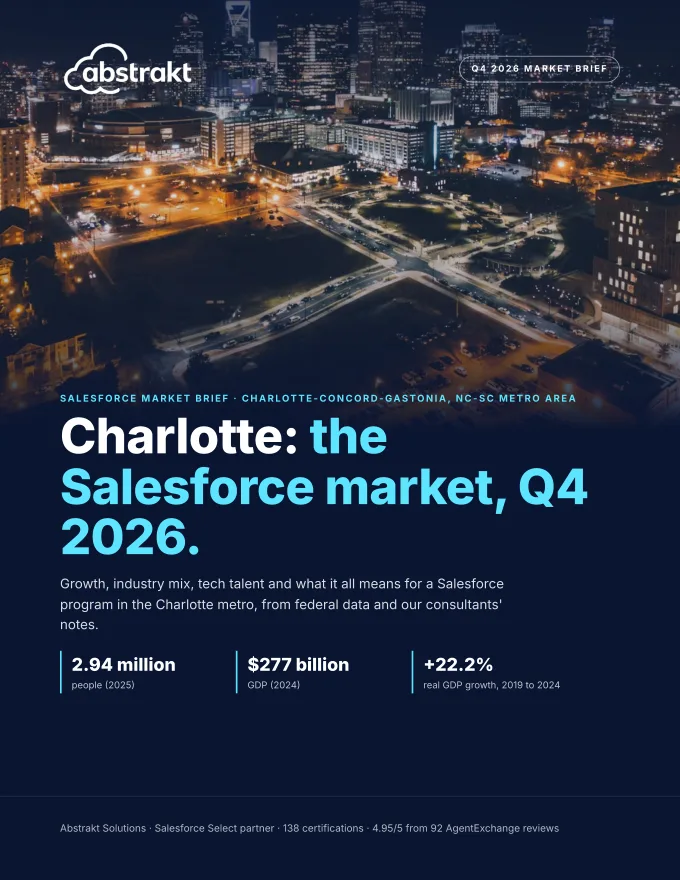
A free 24-page PDF with Charlotte's growth ranked against 100 metros, its industry mix, tech wages and nearby markets. It is offered on the public Charlotte page; send your customer there or get a copy for your own prep.
Get the Charlotte brief →Co-sell with Abstrakt in Charlotte
Working a Charlotte account? Bring in a named consultant for discovery, scoping or a health check. We reply within 4 business hours.