

How Salesforce work starts in Birmingham
As a Salesforce Consulting Partner, Abstrakt Solutions supports banks, health systems, distributors and manufacturers from downtown Birmingham out to Bessemer and across the seven counties BBA calls Greater Birmingham. Birmingham is one of our focus markets.
What buyers here usually run into
- 1
Release schedules that live in EDI
Automotive suppliers commonly receive schedules and changes from automakers through EDI, and sales teams without that data in Salesforce cannot see volume shifts coming.
- 2
One owner, several entities
Regional banks and insurers often serve a business owner personally and through several companies, and a flat account model hides those links from bankers and underwriters.
- 3
Health outreach under privacy rules
Health and life sciences organizations frequently want marketing automation but must separate protected health information from campaign data and document consent carefully.
Budget, team and partner questions
What drives cost
Birmingham budgets are shaped by core-system integration and relationship modeling for banks and insurers, privacy separation for health organizations, and ERP and portal scope for distributors. Automotive suppliers add EDI integration.
Admin or partner
Regional banks and insurers here often keep Salesforce ownership internal for control and use partners for architecture and integration. Distributors, health startups and suppliers more often outsource administration until usage settles.
What buyers ask a partner
Ask for Financial Services Cloud references with owner and entity modeling, how the partner keeps PHI out of marketing data, and for distributor portal examples tied to ERP. Ask how they hand off documentation.
The local economy and its biggest industries (4)
| Sector | Share of 2024 GDP | Where Salesforce fits |
|---|---|---|
| Finance and insurance Financial Services Cloud → | 10.3% | As the metro's largest private sector, banking and insurance call for Salesforce designs that connect personal and commercial relationships, keep regulated outreach auditable and pass new loans or policies cleanly to servicing teams. |
| Health care and social assistance Salesforce for health & life sciences → | at least 9.9% | BBA calls the region a recognized healthcare and life sciences hub, and providers, venture-backed digital health startups and device companies need outreach and service tools that keep patient information protected. |
| Wholesale trade Experience Cloud → | at least 8.9% | Distributors reaching the Southeast from central Alabama, a group BBA courts under distribution and logistics, depend on account-level pricing, reorder patterns and order status that customers can look up themselves. |
| Manufacturing Salesforce for manufacturing → | 7.8% | Seating and wiring suppliers to automakers, beverage bottlers and machinery builders all run on ERP data, and their account teams need releases, quotes and quality issues surfaced in Salesforce. |
Source: U.S. Bureau of Economic Analysis, GDP by county (CAGDP2), 2024, summed to the metro area; private sectors only, excluding real estate and government. “At least” marks sectors where BEA suppresses some county figures.
Regional target sectors named by local economic development groups: Advanced Manufacturing, Automotive, Life Sciences (healthcare, biotech, pharma, medtech, medical devices), Technology, Headquarters & Business Services, Distribution & Logistics.
Salesforce products that fit Birmingham (6)
In the order we lead with them here, from the industries above.
Salesforce Financial Services Cloud
Industry CRM for wealth management, banking, insurance, and lending, built for compliance from the start.
Salesforce Sales Cloud
The CRM where sales pipeline lives, when it is built right.
Salesforce Service Cloud
The operating system for modern customer service, case, knowledge, voice, and AI agent assist together.
Salesforce Marketing Cloud
Cross-channel marketing, email, mobile, journey, and Data 360-powered personalization at scale.
Salesforce Revenue Cloud / CPQ
Configure-price-quote, billing, subscription management, and quote-to-cash on Salesforce.
Salesforce Experience Cloud
Customer, partner, and employee portals built on Salesforce.
Finance-first AI opportunities across the Birmingham market
Finance and insurance produced 10.3% of Birmingham's metro GDP in 2024, per BEA, which makes banking and insurance service the obvious place to test AI. Useful jobs include summarizing a long claims or servicing case for the next rep, and drafting routine letters that an adjuster or officer signs off. Health care, also a leading sector, can apply the same drafting to billing inquiries while keeping clinical questions with people. For the metro's distributors, the better fit is an agent that separates repeat orders from genuinely new buyers so reps work the right list. Before launch, we check that knowledge articles are accurate and owned, that sharing rules match job roles, and that reviewers have time to check outputs.
- Claims and servicing case summaries
- Routine letters for officer sign-off
- Sorting reorders from new prospects
Services buyers here usually need (7)
Salesforce Implementation in Birmingham
Implementation in Birmingham most often starts with financial and health organizations, which lead the metro's private economy, and both need a careful security design before anything else. We run discovery on how client, patient or dealer relationships are really structured, decide whether Financial Services Cloud or Sales Cloud is the right foundation, then build in a sandbox, migrate cleaned data and train each role. Rollouts go live in phases, each beginning with design workshops and ending with a launch your teams have been trained for.
By industry in Birmingham
- 1
Finance and insurance
At 10.3% of 2024 metro GDP, finance and insurance leads Birmingham's private economy. For regional banks, insurance carriers and agencies implementing Salesforce, the defining choices are whether households and business relationships are modeled through Financial Services Cloud, how referrals pass between retail, commercial and wealth teams, and how record access is restricted by line of business. We document those decisions for compliance review before configuration starts, which prevents costly redesign after launch.
- 2
Life Sciences
BBA describes the region as a recognized hub for healthcare and life sciences, anchored by medical and research institutions. Biotech, medtech and digital health companies implementing Salesforce often need to track research partners, clinical sites, grant or investor contacts and early customers in one org without mixing them. We design separate record types and sharing for each audience, keep any protected health information out of sales objects and plan Service Cloud for later phases as products reach market.
- 3
Headquarters & Business Services
Headquarters and business services operations are one of BBA's key industries, and firms that run shared services from Birmingham usually need one Salesforce org to serve several divisions or client groups. The implementation priority is a role hierarchy and sharing model that lets each group see its own customers while leadership sees the whole picture. Getting that right in phase one avoids the separate orgs and duplicate licenses that tend to appear when divisions go their own way.
Raise before scoping
Choose the foundation cloud early
Deciding between Financial Services Cloud, Health Cloud or plain Sales Cloud changes the data model, licenses and training. Settle it in discovery with real client and account examples in front of you, since switching clouds after the build has started means rework across objects, layouts and reports.
Write down line-of-business boundaries
Banks and insurers here often run retail, commercial and wealth lines, or personal and commercial lines, that share customers but not information. Agree on exactly what each group may see about the others before building sharing rules, and have compliance sign the document.
Launch where adoption is likeliest
Pick a first-phase team that has a clear pain point and a manager who will use the dashboards. An early, visible success in one department makes later phases easier to staff and fund, especially in organizations where Salesforce is replacing familiar tools.
Salesforce Integration in Birmingham
For Birmingham companies, integration usually means connecting Salesforce to the systems that already run the business: an ERP for distributors and manufacturers, a core platform for banks and insurers, and billing or practice systems for services firms. We start by mapping data flows and naming a system of record for each shared field, then pick the method, from native connectors to middleware or custom APIs, that fits the volume and change rate. Monitoring, error handling and documentation are part of the build, not an afterthought.
By industry in Birmingham
- 1
Wholesale trade
Wholesale trade represents at least 8.9% of 2024 metro GDP, and BBA recruits distribution and logistics operations to the region. Distributors need Salesforce to show account-level pricing, credit status, open orders and invoice history from ERP, while orders captured in the field or through a portal flow back without rekeying. We define which data syncs on a schedule and which is fetched on demand, so reps see current information without the org carrying millions of transaction lines.
- 2
Finance and insurance
Banks and insurers in Birmingham typically want core system data, such as balances, policies and product holdings, visible to relationship managers inside Salesforce without making the CRM the system of record. We design read-mostly integrations with tight integration-user permissions, log what is displayed for audit purposes and pass new-business events from Salesforce to origination or policy systems. Every flow is documented for your information security review before it goes live.
- 3
Automotive
Automotive suppliers serving assembly plants run their operations on ERP and EDI transactions, and account teams need a digest of that activity to manage each customer relationship. Our integration work surfaces planned-versus-shipped quantities on each account, alerts the owner when a customer's schedule swings sharply and ties quality or engineering issues to the account. Detailed transactions stay in ERP, since Salesforce only needs the view that informs commercial decisions. Account plans then reflect real volumes.
Raise before scoping
Limit integration user permissions
Integration accounts are often given administrator rights to get a project working quickly, then never reduced. Scope each connection to the minimum objects and fields, change its credentials on a schedule and recheck its access whenever the integration itself changes.
Decide sync or on-demand
Not every value needs to be copied into Salesforce. Frequently changing, high-volume data such as order lines or account balances can often be displayed on demand from the source system, which keeps storage down and avoids stale copies in the CRM.
Plan for upgrades on both ends
ERP and core platform upgrades change field names, APIs and authentication methods. Keep a map of every integration touchpoint and include Salesforce testing in each upstream upgrade plan, so the sales and service teams are not the first to notice a broken feed.
Salesforce Optimization in Birmingham
Optimization suits Birmingham organizations whose Salesforce org grew by accumulation: a field for every request, automation from several admins and reports each department built for itself. Usage data and interviews come first; after that we strip clutter from layouts, fold workflow rules and Process Builder into Flow, merge duplicate accounts and rebuild reporting around the measures leaders use in meetings. The work proceeds in short cycles, each ending with training for the affected team, so improvements reach users steadily instead of in one large release.
By industry in Birmingham
- 1
Manufacturing
Manufacturing contributes 7.8% of 2024 metro GDP, and BBA also lists advanced materials and machinery among its key industries. Manufacturers that adopted Salesforce for sales often end up with quotes, forecasts and customer complaints tracked in different ways by different plants. Optimization standardizes those processes across locations, simplifies quote approvals, cleans product and account data and builds forecast views that plant managers and sales leaders read the same way. Reps see fewer fields and clearer next steps.
- 2
Automotive
BBA says the region plays a key role in Alabama's automotive industry. Suppliers in that chain often have orgs where program pursuits, customer contacts and pricing changes were recorded inconsistently across account teams. We restructure opportunities around vehicle programs, remove fields that duplicate ERP data, add dashboards showing pursuits by customer and phase, and train account managers on the simplified layouts. The outcome is a pipeline leadership can review without asking each manager to explain their own numbers.
- 3
Finance and insurance
Banks and insurers that implemented Salesforce several years ago frequently carry automation built with tools Salesforce has since retired. Migrating those rules to Flow, removing the ones that conflict and testing referral and onboarding processes end to end are typical optimization tasks here. We also rebuild relationship-manager dashboards around agreed definitions of pipeline, cross-sell and retention, so branch and regional leaders stop exporting data to fix numbers in spreadsheets. Adoption is measured afterward by branch.
Raise before scoping
Fix definitions before dashboards
Leadership disputes over reports usually come from undefined terms, such as what counts as a qualified opportunity or an active customer. Agree on those definitions in writing with each department first; rebuilt dashboards will only be trusted if everyone reads the numbers the same way.
Move legacy automation to Flow
Workflow rules and Process Builder no longer receive new features, and orgs mixing them with Flow are hard to troubleshoot. Consolidating every automation for an object into a small number of well-documented Flows makes behavior predictable and future changes much safer to make.
Train on what changed
After an optimization cycle, give each team a short session covering only the changes that affect them in their role, plus a one-page reference. Long refresher courses on the whole system rarely stick; focused guidance on new layouts and fewer steps does.
Salesforce Migration in Birmingham
Birmingham organizations migrating to Salesforce are commonly leaving a legacy CRM, a line-of-business system that doubled as one, or years of spreadsheets. The work that determines success happens before anything loads: agreeing on what to keep, mapping each source field, standardizing values and merging duplicate clients or accounts. We run trial loads into a sandbox, reconcile counts with your team and schedule cutover to avoid month-end or other busy periods, so bankers, agents and sales staff open Salesforce to records they recognize.
By industry in Birmingham
- 1
Finance and insurance
Insurance agencies and banks moving to Salesforce often carry decades of client notes, policy or account relationships and household links in older systems. Migration for them centers on preserving those relationships accurately, mapping them into Financial Services Cloud structures where it applies, and retaining consent and privacy preferences on every contact. Before cutover, we reconcile record counts and sample client histories with the staff who know them, so nothing a regulator might ask about is lost.
- 2
Health care and social assistance
Health and social service organizations migrating into Salesforce may be moving referral lists, program enrollments or donor data out of older databases. The priority is classifying which fields contain protected information before any data moves, restricting access in the target org from the first load and dropping records the organization no longer has a reason to keep. We validate the final migration with privacy staff, and files that fail checks are corrected at the source.
- 3
Distribution & Logistics
BBA counts distribution and logistics among the region's key industries. Distributors and logistics providers migrating from an older CRM tend to have customers duplicated across branches and reps, with ship-to locations stored as separate accounts. We merge those into parent accounts with related locations, standardize addresses and territories, and bring over open opportunities and recent activity, leaving transaction history in the ERP where it already lives. Reps then start with one clean list per territory.
Raise before scoping
Inventory every source
Beyond the main CRM, customer information often lives in email folders, mailing lists, event spreadsheets and departmental databases. List every source at the start and decide which are migrated, which are archived and which are simply retired, so no team is surprised at go-live.
Standardize picklists before loading
Older systems frequently allow free-text values for fields like industry, status or product. Map every variant to a controlled list before migration; otherwise the new org inherits the same inconsistency and reports stay unreliable from day one. Document the mapping for later audits.
Avoid month-end cutovers
Financial and sales teams are busiest at period close. Schedule the final data freeze and cutover for a quieter window, give users training shortly before and plan extra support for the first days after launch, when questions spike and small data corrections are most likely.
Salesforce Health Checks in Birmingham
Birmingham leaders use a health check to see the org they already own through evidence rather than anecdotes. The review covers view and export rights on sensitive records, completeness of key data, the volume of custom code and overlapping automation, integration authentication and actual use by each team. The findings come in a ranked report with recommended fixes. For banks and health organizations, it often precedes an Agentforce pilot or a regulatory review, when proof of control matters most.
By industry in Birmingham
- 1
Health care and social assistance
Birmingham's hospitals, clinics and care providers trail only finance in size, with health care and social assistance at a floor of 9.9% of 2024 GDP. Providers, health services companies and the digital health startups BBA highlights hold sensitive data that Salesforce must protect. Our review traces how patient or member information moves between objects, which profiles can export it, whether field history and encryption are configured where needed and whether marketing tools can reach clinical fields they should not.
- 2
Finance and insurance
Banks and insurers face examinations that ask how customer data is protected and how system changes are controlled. A health check assesses login policies, multi-factor enforcement, access to nonpublic personal information, change management practices and retention settings. It also measures technical debt in Financial Services Cloud customizations, giving technology and compliance teams one prioritized list they can use to schedule remediation ahead of their next review cycle. Each item cites the setting it concerns.
- 3
Advanced Manufacturing
Advanced manufacturing is a BBA key industry, and manufacturers' orgs often accumulate custom objects for quotes, warranties and service requests added by different partners. The health check inventories that customization, flags code with little test coverage and identifies integrations with ERP that run under overly broad accounts. It also shows where product and account data is incomplete, which becomes critical before adding AI features that summarize customer history or recommend next actions.
Raise before scoping
Scope the review with compliance
Ask your compliance or privacy officer which regulations, audit findings or policies matter most before the review starts. Tailoring the security portion to those requirements produces findings that directly support your next examination or audit rather than a generic checklist.
Treat AI readiness as data
Readiness for Agentforce depends less on licenses than on record quality and permissions. Measure duplicate rates, missing values on key fields and how broadly records are shared, since whatever conditions exist on the day an agent goes live are the conditions it will operate under.
Repeat the review periodically
A health check is a snapshot. Orgs change with every release and request, so plan a lighter follow-up review at regular intervals or after major projects, to confirm fixes held and new debt is caught early, before it becomes expensive.
Salesforce Managed Services in Birmingham
Birmingham organizations that choose managed services often have a single administrator, or none since the last one left, supporting an org that banking, service or sales teams depend on daily. We take ownership of the request queue, make configuration and Flow changes, handle development when needed, test each Salesforce release in a sandbox and keep integrations running. Priorities are set monthly with your business owner, so the queue reflects what the bank, the service desk or the sales floor needs most right now.
By industry in Birmingham
- 1
Professional, scientific, and technical services
BEA counts professional, scientific and technical services as no less than 6.7% of Birmingham's 2024 GDP, a sizable base of firms. Engineering, accounting, legal and consulting firms rarely justify a full-time Salesforce developer, yet they need changes as practice areas, billing rules and client teams shift. Managed services gives them access to administrators, developers and an architect as needed, with small requests handled promptly and larger ones scoped against a monthly plan agreed with firm leadership.
- 2
Finance and insurance
Regulated firms need every Salesforce change documented, tested and approved before it reaches production. For Birmingham banks and insurers, managed services includes a change log compliance can read, sandbox testing of each release against Financial Services Cloud customizations and periodic access reviews as staff join, move and leave. Examiners and auditors then get a clear trail of who changed what and why, without the admin team reconstructing it by hand.
- 3
Technology
BBA says Birmingham's tech sector is growing, supported by a pipeline of skilled talent. Software and services companies scaling here tend to change sales motions often, adding partner channels, renewals and usage-based pricing within a few years. Managed services keeps the org in step with each change: new opportunity types, updated quoting rules, cleaner handoffs to customer success and dashboards that reflect how revenue is now earned. That avoids a rebuild every time the go-to-market plan changes.
Raise before scoping
Agree on response expectations
Before starting, define which requests count as urgent, such as a user locked out before a client meeting, and which wait for the monthly plan. Written response targets by category keep expectations realistic and stop minor requests from displacing important work.
Keep compliance in the loop
For financial and health organizations, route permission changes, new data fields holding sensitive information and integration updates through a lightweight approval step. A monthly summary for your compliance officer turns what could be an annual scramble into a routine review.
Plan capacity for release months
Salesforce's seasonal releases can change interfaces and automation behavior. Reserve part of each release month's hours for sandbox regression testing and user communication, so enhancement work pauses briefly rather than a surprise change reaching bankers, clinicians or sales staff unannounced.
Salesforce Implementation Rescue in Birmingham
Birmingham Salesforce projects that need rescue usually share a pattern: scope expanded during the build, security or integration design was deferred, and the launch date held while testing was cut. We begin with a structured assessment of the org, the agreed requirements and user experience, then separate what can stay from what must be fixed or rebuilt. Stabilizing the processes people rely on each day comes first. The remaining work is re-planned into smaller releases, each with clear acceptance criteria your team signs off.
By industry in Birmingham
- 1
Finance and insurance
Banking and insurance projects most often stall on data and security: relationship structures that do not match how clients are served, or sharing rules that failed compliance review at the last minute. Recovery starts by fixing the model and access design with compliance present, then reloading clean data. Features such as referrals, onboarding and campaigns come back in stages once the foundation is approved, so relationship managers are not asked to adopt a system twice.
- 2
Life Sciences
Life sciences and digital health companies, a BBA target sector, sometimes launch Salesforce quickly to support a product release, then find the org cannot handle distributors, clinical partners or service requests. Rescue separates immediate commercial needs from the redesign: we stabilize pipeline and customer records first, correct any mixing of protected data, then rebuild the partner and service areas properly. Documentation is created as we go, since fast-moving teams rarely had time to write it.
- 3
Headquarters & Business Services
Shared-service and headquarters teams, one of BBA's key industries, often inherit Salesforce projects that tried to satisfy every division in one release. The usual symptom is a sprawling org where no group's process works well. Our triage identifies the division with the clearest need, completes its processes first and establishes governance for the rest, so later divisions join a working system instead of an unfinished one. Scope decisions are recorded and signed.
Raise before scoping
Measure the current state honestly
Before planning recovery, gather defect lists, user complaints, usage data and the original requirements in one place. An honest baseline prevents disputes about what was promised, helps sponsors see the full picture and gives the recovery plan measurable goals for everyone.
Shrink the next release
Failed projects often tried to launch everything at once. Define the smallest release that restores a working process for one team, deliver it well and use that success to rebuild confidence with the same sponsors before tackling the remaining scope.
Settle contract questions separately
Disputes with the previous vendor over scope or payment can consume recovery meetings. Keep commercial discussions on a separate track with the right executives, so the technical team can focus on fixing the org and users see steady, visible progress.
Industry plays in Birmingham (4)
Salesforce for Birmingham Insurers and Agencies
For insurers and agencies around Birmingham, Salesforce is most useful as a retention and cross-sell system that sits beside the agency management or policy platform. It shows each client's coverage across lines, flags renewals early enough to remarket, and gives service staff one place to log changes and certificate requests. We usually build on Financial Services Cloud, integrate the system that holds policies, and add Marketing Cloud only once the data is clean enough to segment reliably.
Banks and insurers head Birmingham's sector ranking: finance and insurance produced 10.3% of 2024 metro GDP by Bureau of Economic Analysis county data, while health care, partly withheld in that data, registers at least 9.9%. The Birmingham Business Alliance's target list emphasizes headquarters and business services and technology, and its Accelerate 2030 plan counts financial services among the areas where the region has momentum, while cautioning that Southeast peer metros are growing far faster. For insurers and agencies, that describes a mature, relationship-driven market where retention and rounding out accounts matter as much as winning new ones.
Use cases to open with
- 1
Renewal pipeline by line
Renewals are predictable, yet many agencies still discover them from a download list. We generate renewal opportunities automatically from policy expiration dates, assign them by line and account manager, and track remarketing, quote comparison and client decisions, so producers see retention risk well ahead of the date and leaders can report retention by book rather than by instinct. Lost renewals get a required reason, which feeds coaching.
- 2
Coverage gap cross-selling
A client with auto and home coverage but no umbrella, or a business with property but no cyber policy, is an obvious conversation. Financial Services Cloud household and business relationships, combined with coverage records, make those gaps visible in list views and targeted campaigns, and producers log outcomes so the same gap is not pitched every quarter. Service staff see the same gaps during routine calls.
- 3
Benefits enrollment support
Benefits brokers field employer and employee questions around open enrollment in heavy bursts. Service Cloud queues, an employer portal on Experience Cloud and knowledge articles let brokers publish plan documents, collect census changes securely and track every request by employer group, which keeps small service teams from drowning in email during their busiest season. Employers see request status without phoning the broker.
Raise before scoping
Pick the policy system of record
Agency management and carrier policy platforms should own policy terms, premiums and documents. Decide which fields Salesforce mirrors, whether updates ever flow back and how renewals are triggered, because agencies that let two systems edit the same policy data spend their time reconciling instead of selling.
Consumer data and consent rules
Personal lines outreach touches consumer financial information that GLBA and state insurance privacy rules protect, and phone and text campaigns carry consent requirements of their own. Store consent and opt-out preferences in Salesforce and enforce them in Marketing Cloud, with your compliance advisers confirming the details.
Measure producer adoption early
Producers adopt Salesforce when it helps them close renewals and new business, not when it adds data entry. Launch with a small set of dashboards they asked for, track logins and activity by producer, and adjust layouts after the first renewal cycle rather than waiting for complaints.
Salesforce for Birmingham Health and Life Sciences
Birmingham's health and life sciences organizations range from provider groups and health systems to digital health startups and biotech, pharma and medtech firms. Salesforce use splits accordingly: providers manage referrals, patient access and physician outreach, while life sciences companies track clinical partners, investigators and commercial accounts. We decide early which records may hold protected health information, integrate the electronic health record or research systems carefully, and build the smallest org that serves each team well.
Care delivery and life sciences carry real weight in Birmingham, where Bureau of Economic Analysis county data puts health care and social assistance at a floor of 9.9% of 2024 metro output, listed just after finance and insurance. The Birmingham Business Alliance defines its life sciences target broadly, covering healthcare, biotech, pharma, medtech and medical devices, and its Accelerate 2030 plan lists both life sciences and healthcare among the region's areas of momentum. Alliance materials also highlight digital health companies, a reminder that software companies selling to providers are part of this sector here, alongside care delivery itself.
Use cases to open with
- 1
Referral intake and follow-up
Specialty practices and hospital service lines depend on referrals that arrive by fax, portal and phone. Service Cloud or Health Cloud centralizes intake, checks for missing documents and insurance details, and tracks each referral to a scheduled visit, so leaders can see which referring practices send the most patients and where requests stall before an appointment exists. Referring offices can receive automatic status updates.
- 2
Physician liaison outreach
Health systems competing for referrals send liaisons to independent practices across central Alabama. Sales Cloud gives liaisons visit planning, practice profiles and referral trends from integrated data, so outreach focuses on offices where referrals are slipping rather than those already loyal, and service line leaders can connect liaison effort to volume without assembling spreadsheets. Visit notes stay with the practice record.
- 3
Digital health customer success
Startups selling software to providers must show adoption after the contract is signed. Sales Cloud plus Service Cloud tracks implementations, onboarding tasks, support cases and usage signals by client site, and renewal opportunities open with that history attached, so a small team can spot a struggling hospital customer long before the renewal conversation arrives. Product teams also see which features generate tickets.
Raise before scoping
Draw the PHI boundary
Decide which objects may contain protected health information and which never will, then configure field-level security, encryption options and audit settings to match. Keep referral marketing and liaison data apart from clinical records. HIPAA and business associate terms apply, so involve your privacy officer from the first workshop.
Plan the EHR connection
Most useful provider scenarios need appointment, encounter or referral status from the electronic health record. Start with a narrow set of events, use standard interfaces your EHR supports, and agree on how often data refreshes, because broad clinical integration raises cost and review effort quickly.
Separate research and commercial work
Life sciences firms often run research collaborations and commercial sales in parallel. Model investigators, sites and studies apart from customer accounts, with different sharing rules, so commercial teams cannot see research relationships they should not influence and reporting stays clean for both.
Salesforce for Birmingham Manufacturers
Birmingham manufacturers often serve very different buyers from the same region: automotive assemblers that send schedules by EDI, grocery and beverage customers who order weekly, and industrial clients who buy engineered machinery. Salesforce is most useful when each of those motions gets the right structure rather than one generic pipeline. We set up Sales Cloud for account planning, CPQ for configured equipment, Service Cloud for quality and warranty cases, and MuleSoft to bring release, order and shipment data from the ERP so reps are not working from stale spreadsheets.
Manufacturing produced 7.8% of Birmingham metro GDP in 2024, per the Bureau of Economic Analysis, fourth among private sectors behind finance and insurance, health care and wholesale trade. The Birmingham Business Alliance, which covers a seven-county region, still ranks it near the top of its agenda: advanced manufacturing, automotive, food and beverage, and advanced materials and machinery all appear on its key-industry list, and it says the region plays a key role in Alabama's automotive industry. BBA also reports 222 announced projects since 2018, though announcements are commitments rather than jobs already on payrolls.
Use cases to open with
- 1
Automotive release visibility
Suppliers to vehicle assembly plants receive forecasts and firm releases by EDI, and changes ripple into staffing and materials. Bringing summarized release and shipment data from the ERP into Salesforce lets account managers compare what the customer scheduled against the annual plan, spot volume shortfalls early, and discuss them with the buyer before they become a margin problem. Engineering change requests can be tracked on the same account.
- 2
Food and beverage account management
Beverage and packaged food producers sell to distributors, grocers and foodservice operators on recurring schedules. Sales Cloud can hold volume targets by account and product, promotional calendars and new-item presentations, while order history from the ERP shows which customers are slipping. Sales leaders get a weekly view of volume against plan by channel, without waiting for a finance report at month's end.
- 3
Configured machinery quotes
Makers of machinery and advanced materials often quote options, spare parts and installation together. Revenue Cloud or CPQ enforces valid combinations, pulls current costs, and routes discounts beyond a threshold for approval. After the sale, the installed configuration becomes an asset record, so the service team knows exactly what was shipped when a customer calls for parts or a repair.
Raise before scoping
Separate each selling motion
Automotive programs, weekly food orders and one-off machinery deals should not share one opportunity type. Give each its own record type, stages and forecast category so reports compare like with like, forecasts stay honest, and reps are never forced through fields that have nothing to do with their customers.
Keep EDI in the ERP
Release transactions from vehicle assemblers can be frequent and highly detailed. Leave the raw EDI traffic in the ERP or integration layer and bring only summarized schedules, week-over-week variances and shipments into Salesforce, which keeps the org fast and avoids data storage surprises.
Plan for new plant launches
Expansion projects of the kind BBA announces can bring new facilities online over several years. Build plant and ship-from location into the account and opportunity model from the start, so that as capacity shifts between sites, reporting by plant and region keeps working without a redesign.
Salesforce for Birmingham Construction Firms
Construction companies in Birmingham sell differently from most businesses: a relationship with an owner or developer may produce one project every few years, while bids with general contractors are constant. Salesforce helps when it tracks both, connecting owner relationships and upcoming projects to the bids, subcontractor quotes and change orders that follow. We configure Sales Cloud for preconstruction pipeline, CPQ for trades that price repeatable scopes, and Field Service for service and maintenance crews, connected to your estimating and accounting systems.
Construction is not among the five largest private sectors the Bureau of Economic Analysis ranks for the Birmingham metro in 2024, nor is it on the Birmingham Business Alliance's target list. It shows up instead as the work behind other sectors. BBA reports 222 announced projects since 2018 with nearly $5B in capital investment, and its target list spans advanced manufacturing, automotive, distribution and logistics, and life sciences. It also hosts a page answering community questions about proposed data center developments in the region. For contractors, that means demand tied to industrial, health care and logistics owners rather than a standalone construction boom.
Use cases to open with
- 1
Project pursuit pipeline
Industrial and health care projects are often known long before bids are due. Sales Cloud can track upcoming projects by owner, sector, estimated value and bid date, record which general contractors are pursuing each, and show preconstruction leaders where to invest estimating time. When an economic development announcement names a new facility, the team can add it as a pursuit and assign relationship owners the same day.
- 2
Bid and subcontractor tracking
For general contractors, each bid involves many subcontractor invitations and quotes by trade, often under a tight deadline. Salesforce can manage invitation lists, track responses and coverage by scope, and store quote amounts and qualifications. After award, the same records show which trade partners were selected and how they performed, which improves the next invitation list, supports prequalification reviews and gives estimators evidence when choosing between close numbers.
- 3
Service and maintenance crews
Trade firms in the mechanical and electrical disciplines frequently keep a service group busy between construction jobs. Field Service schedules technicians by skill and location, tracks parts used and time on site, and records equipment serviced at each facility. Recurring maintenance agreements generate visits automatically, and service history becomes a steady lead source when aging equipment at a plant, warehouse or hospital needs replacement.
Raise before scoping
Connect estimating and accounting
Estimates, job costs and progress billing usually live in construction-specific tools. Decide which figures Salesforce actually needs, such as bid amount, awarded value and change-order totals, and sync them through integration rather than asking project managers and accountants to enter the same numbers twice.
Model owners and contractors
A single project involves an owner, an architect, engineers, a general contractor and many subcontractors. Use account relationships or a custom project object to connect them, so leadership can see every job the firm has shared with a given architect, developer or owner over the years.
Win over project managers
Superintendents and project managers will not live in Salesforce, and they should not have to. Give them mobile access to a few key fields, surface information they need such as owner contacts and change orders, and keep detailed project management in the tools they already use daily.
Case studies to send (3)
From the industries this market leans on. Client names are anonymized and these projects are not specific to Birmingham.
The Birmingham Salesforce market brief, Q4 2026
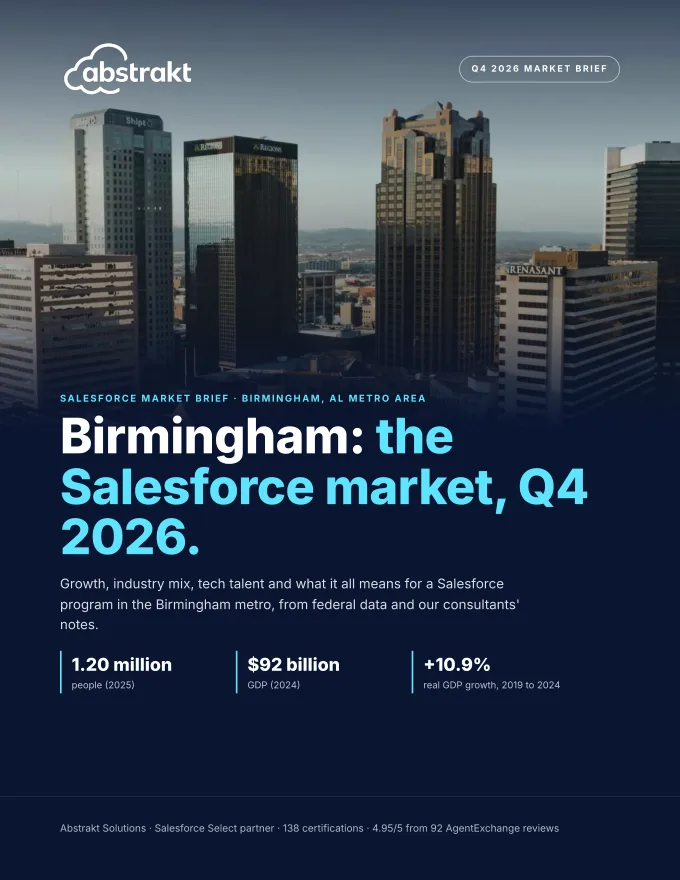
A free 24-page PDF with Birmingham's growth ranked against 100 metros, its industry mix, tech wages and nearby markets. It is offered on the public Birmingham page; send your customer there or get a copy for your own prep.
Get the Birmingham brief →Co-sell with Abstrakt in Birmingham
Working a Birmingham account? Bring in a named consultant for discovery, scoping or a health check. We reply within 4 business hours.