
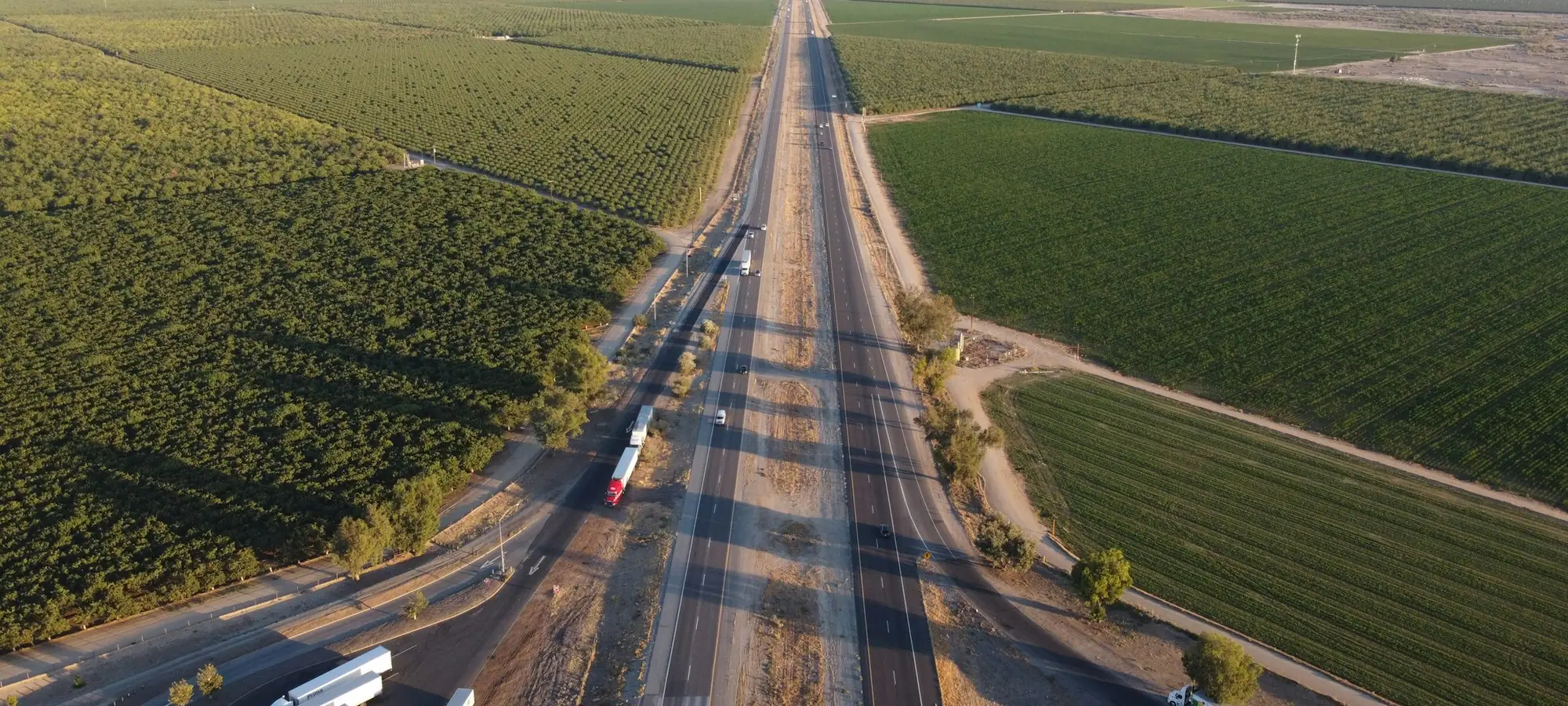
How Salesforce work starts in Bakersfield
Abstrakt Solutions is a Salesforce Consulting Partner for Kern County's utilities, oil and gas operators, growers and health providers, from Bakersfield out to East Kern. Bakersfield is one of our focus markets.
What buyers here usually run into
- 1
Field work across long distances
Energy, utility and agricultural operations spread across a large county need mobile work orders and scheduling that hold up when crews are far from the office.
- 2
ERP and operational data
Growers, producers and utilities often keep the real numbers in ERP, billing or production systems. Salesforce only earns trust once those systems are connected.
- 3
Seasonal and contract-driven sales
Agricultural and energy sales often run on contracts, seasons and commodity pricing, which standard pipeline stages do not capture without some redesign.
Budget, team and partner questions
What drives cost
Bakersfield scope is shaped by field operations: how many crews and service lines Field Service must schedule, whether mobile work must run offline across a large county, and how many billing, ERP or production systems need connecting. Agricultural projects add seasonal pricing and program tracking.
Admin or partner
Energy and utility firms here often have strong operations and IT staff but little Salesforce depth, so a partner usually handles Field Service design and integration while internal staff own crew processes. Growers and packers more often outsource administration entirely.
What buyers ask a partner
Ask for Field Service references with offline mobile, how the partner tests scheduling rules before rollout, and how they keep safety procedures under version control if an agent will cite them. Agricultural buyers should ask how the partner has modeled seasonal programs.
The local economy and its biggest industries (4)
| Sector | Share of 2024 GDP | Where Salesforce fits |
|---|---|---|
| Utilities Field Service → | 10.7% | Utility and power companies in Kern County manage large customer bases, interconnection requests and field crews, which calls for case management and scheduling tied to billing and asset systems. |
| Mining, quarrying, and oil and gas extraction Field Service → | 8.6% | Oil and gas producers and the service companies that support them need work orders, crew dispatch and customer contracts in one system instead of spreadsheets and radio calls. |
| Agriculture, forestry, fishing and hunting Sales Cloud → | 8.3% | Agriculture accounts for about 8.3% of Kern's 2024 GDP, and the growers and packers behind that figure sell to retail and food-service buyers, so account management, pricing and order history need to connect to ERP. |
| Health care and social assistance Salesforce for health & life sciences → | 6.5% | Health care and social assistance produced about 6.5% of Kern's 2024 GDP, and Salesforce projects in the sector usually center on patient outreach, referral tracking and service, built around privacy requirements. |
Source: U.S. Bureau of Economic Analysis, GDP by county (CAGDP2), 2024, summed to the metro area; private sectors only, excluding real estate and government. “At least” marks sectors where BEA suppresses some county figures.
Regional target sectors named by local economic development groups: Aerospace & Defense, Energy & Natural Resources, Advanced Manufacturing, Healthcare Services, Transportation & Logistics, Value-Added Agriculture.
Salesforce products that fit Bakersfield (6)
In the order we lead with them here, from the industries above.
Salesforce Field Service
Scheduling, dispatch, mobile work orders and parts for teams that work on site.
Salesforce Sales Cloud
The CRM where sales pipeline lives, when it is built right.
Salesforce Service Cloud
The operating system for modern customer service, case, knowledge, voice, and AI agent assist together.
MuleSoft
Enterprise API platform, for connecting Salesforce, ERP, data warehouses, and the rest of your stack.
Salesforce Experience Cloud
Customer, partner, and employee portals built on Salesforce.
Tableau
Executive analytics, embedded dashboards, and CRM Analytics built on Tableau.
Field-heavy AI use cases for Bakersfield energy and agriculture
Utilities generated 10.7% of Bakersfield's metro GDP in 2024 in the BEA figures, oil and gas extraction 8.6%, and agriculture 8.3%. That profile is dominated by equipment, crews and compliance paperwork rather than call centers. The sensible AI role is a field-tech assistant that retrieves procedures, safety notes and asset history for a technician, plus summaries of inspection work orders for supervisors. Growers and packers can use document reading on certifications and buyer specifications. Customer-facing utility teams can draft outage and billing replies for approval. Safety-critical guidance should never come from an agent alone, so procedures must be version-controlled and every recommendation traceable to its source.
- Procedure and asset-history lookup
- Inspection work order summaries
- Reading certifications and buyer specs
Services buyers here usually need (7)
Salesforce Implementation in Bakersfield
Few Bakersfield companies sell the way a textbook CRM assumes. Growers and packers commit volume to retail and foodservice buyers before harvest, oilfield and energy contractors run on master service agreements and job tickets, and health providers juggle referrals across a very large county. An implementation here starts by modeling those realities, such as programs, sites, contracts and referral sources, before any screen is designed. Configuration happens in a sandbox, reconciled data is loaded before a staged go-live, and each crew office, packing-shed sales desk or clinic team is trained on its own workflows.
By industry in Bakersfield
- 1
Agriculture, forestry, fishing and hunting
The BEA credits agriculture with about 8.3% of 2024 output in Kern County, and Kern EDC names value-added agriculture as one of its target sectors. For them, Salesforce has to represent seasonal buyer programs by commodity, pack type and volume, with planned and actual quantities side by side. We design those program records first, decide which harvest and shipping figures come from ERP, and launch the sales side before adding quality claims or buyer portals.
- 2
Energy & Natural Resources
Energy and natural resources is one of Kern EDC's target industries, covering oil and gas producers, the service companies around them and newer energy ventures. Contractors in this space implement Salesforce to manage master service agreements, rate sheets, bids and field work in one place. We model customers, leases or sites and contracts before configuring pages, because dispatch, invoicing and safety reporting all depend on knowing exactly where work happened and under which agreement.
- 3
Healthcare Services
Kern EDC also targets healthcare services, a sector that generated about 6.5% of the county's 2024 GDP. Clinics and provider groups implementing Salesforce usually want referral intake, patient access and outreach across communities far apart from each other. We decide early what stays in the EHR, design referral and location records that reflect the county's geography, from valley towns to mountain and desert communities, and set field-level security with the privacy team before any patient-related information is loaded.
Raise before scoping
Account for distance in design
Kern County covers a lot of ground, from the valley floor to the desert communities in the east. Record location precisely on accounts, sites and work orders, and plan mobile access for staff who spend their day far from an office, because that geography affects routing, territories and reporting.
Model contracts, not just deals
Growers and energy contractors often earn revenue through programs and master agreements rather than one-time sales. Build agreement and program objects into the first release, so pipeline, committed volume and work performed under each contract can be reported together from day one.
Stage the rollout by season
Harvest peaks and field work surges are poor times for go-live. Schedule releases around your operating calendar, launching sales and account management in a quieter window and adding field or service features once the core system is steady and users have time to learn it.
Salesforce Integration in Bakersfield
The systems Kern County companies most want joined to Salesforce are the ones that run trucks, rigs, packing lines and meters, not marketing software. Energy contractors connect job tickets and invoicing, growers and processors connect harvest, packing and ERP data, utilities connect billing and asset systems, and logistics operators connect dispatch and warehouse software. We map each flow, decide which system owns every shared field, bring summaries and exceptions into Salesforce rather than raw operational detail, and build with MuleSoft or lighter tools as volume warrants, with monitoring and a named owner for failures.
By industry in Bakersfield
- 1
Mining, quarrying, and oil and gas extraction
Oil and gas extraction and related activity generate about 8.6% of the county's 2024 GDP. Producers and oilfield service companies need Salesforce linked to job ticket, invoicing and ERP systems, so account managers see work performed, open invoices and contract status by customer and lease. We integrate completed field tickets into billing automatically, which shortens the time between finishing a job and invoicing it, and bring payment status back to the account team.
- 2
Value-Added Agriculture
Packers and processors in Kern EDC's value-added agriculture sector depend on harvest, packing, inventory and shipping data held in ERP and specialized agricultural systems. Integration brings committed versus shipped volume, lot information and shipment status onto buyer program records in Salesforce. When a buyer calls about a delivery or quality issue, account managers can see the relevant lot and shipment without phoning the packing house, and claims link back to the right product.
- 3
Transportation & Logistics
Carriers and fulfillment operations, which Kern EDC targets under transportation and logistics, keep shipment, rate and warehouse data in their own systems. Integration pushes new customers, contracts and rates from Salesforce to operations and brings volume, on-time performance and exceptions back to the customer account. Account managers then walk into renewal conversations with the service record in hand instead of assembling it from emails and exports, and dispatchers stop fielding sales questions about shipments.
Raise before scoping
Plan for connectivity limits
Some field locations in Kern County have limited connectivity. Design integrations and mobile sync to tolerate delays, queue updates when a connection drops and reconcile afterward. Test from the field, not only from the office, so crews are not left with stale work orders.
Keep operational detail at home
Production volumes, meter readings and harvest records can be enormous. Bring the summaries, status and exceptions that sales and service need into Salesforce, and link to the operational system for detail. That keeps the CRM fast, the integration manageable and storage costs sensible.
Secure integration accounts
The login an integration runs under is easy to forget once it works. Give each integration its own account with only the permissions it needs, rotate credentials on a schedule and log activity. Utilities and energy firms in particular face questions about who and what can reach customer data.
Salesforce Implementation Rescue in Bakersfield
In Bakersfield, stalled Salesforce projects often come from designs that did not fit how local businesses work. A generic sales pipeline could not represent buyer programs or master service agreements, Field Service launched without offline settings crews needed, or the ERP integration was left until the end and never finished. First comes a clear-eyed look at what was built, what was promised and how users feel about it. Anything stopping daily work gets fixed, and every remaining component is then marked keep, repair or rebuild in a phased plan.
By industry in Bakersfield
- 1
Energy & Natural Resources
Energy companies and oilfield contractors, part of Kern EDC's energy and natural resources focus, sometimes launch Field Service without the mobile, offline and scheduling configuration their crews require. Technicians return to paper tickets, dispatchers go back to phones and radios, and the licenses sit idle while renewal approaches. Recovery starts in the field: we observe how crews work, fix offline and mobile settings, simplify work order flows and retune scheduling before relaunching with one service line at a time.
- 2
Agriculture, forestry, fishing and hunting
Growers and packers occasionally receive a Salesforce org built around standard opportunities, which cannot represent seasonal buyer programs with committed and shipped volumes. Sales desks fall back to spreadsheets organized by commodity, and management loses the view it paid for. In a rescue we add the program structure the business needs, migrate existing opportunities into it, connect shipped volume from ERP and relaunch with the sales desk before the next season's negotiations start.
- 3
Advanced Manufacturing
Manufacturers in Kern EDC's advanced manufacturing sector sometimes stall on quoting or ERP integration, with product data and pricing that never reconcile between systems. Reps stop trusting quotes, orders get re-keyed by hand, and errors reach customers. We freeze new features, reconcile products and pricing line by line with finance, stabilize the order handoff to ERP and reintroduce advanced functionality in small releases that sales and order-entry staff test before each goes live.
Raise before scoping
Secure access first
Before changing anything, confirm who holds administrator rights, rotate credentials used by the previous partner, back up metadata and data, and collect all available documentation. Stalled projects often leave access scattered among people who are no longer involved, including contractors who never handed back their logins.
Fix the field experience early
When crews or field staff are the ones who stopped using Salesforce, prioritize their fixes. Mobile and offline problems cause visible failures that erode trust across the organization, and resolving them quickly shows office staff and crews alike that the recovery is real.
Keep the relaunch modest
Relaunch with one team, service line or region rather than everyone at once. A smaller rollout that works rebuilds credibility with users and sponsors, and it creates a proven pattern, including training and support steps, to extend across the rest of the county.
Salesforce Health Checks in Bakersfield
Bakersfield organizations usually commission a health check when the stakes of their Salesforce org rise: a utility adding customer programs, a defense-related supplier facing a customer security review, a health provider expanding referrals, or leadership considering Agentforce. Our reviewers trace every route into your records, from profiles and sharing rules to login policies, then turn to data quality, Flows, Apex and the credentials each integration uses. The result is a prioritized list of risks and improvements, each assigned a suggested owner and grouped by the initiatives it affects.
By industry in Bakersfield
- 1
Aerospace & Defense
Aerospace and defense is a Kern EDC target industry, anchored by two military test installations in East Kern, with suppliers and accelerator-backed startups working around them. Companies selling into that community face customer security questions about their systems. The health check documents authentication, admin rights, export permissions and audit trails, and looks for technical data or controlled documents stored in Salesforce files, notes or attachments, where they should not be.
- 2
Utilities
Utility and power organizations hold large volumes of customer data and are accountable to regulators for protecting it. The health check reviews who can reach customer, account and program records, how portal and guest access is configured, whether sensitive fields are encrypted and tracked, and what each integration with billing, asset or outage systems can read or change. Findings are ranked by exposure, so the most significant risks are addressed first.
- 3
Healthcare Services
Health providers in Kern County, a sector Kern EDC targets, use Salesforce for referrals, patient outreach and access. The health check confirms that protected information is limited to the right people, that referral and outreach processes do not copy clinical details into notes or emails, and that consent is captured properly for marketing. We also assess data quality in patient and provider records, which determines whether AI features could be used safely.
Raise before scoping
Bring customer security requirements
Defense-related suppliers and utilities often answer to customer or regulatory security requirements. Share those with us before the review starts, so findings map directly to the questions you will be asked and the report can be used as evidence rather than rewritten.
Check files and attachments
Sensitive material often ends up in Salesforce files, email attachments and notes rather than structured fields. Ask the health check to scan for it, whether technical drawings, patient details or customer documents, since these are the hardest items to control and the easiest to overlook.
Tie readiness to one AI pilot
If Agentforce is under consideration, use the health check to choose a first use case where data is complete and permissions are clean, such as answering routine service questions. Treat other findings as prerequisites for broader rollout rather than reasons to delay every AI experiment.
Salesforce Managed Services in Bakersfield
Plenty of Kern County organizations run their org with one part-time admin, or with nobody clearly in charge of it. Managed services covers the gap: user changes, new fields and reports, Flow maintenance, Field Service configuration, integration monitoring and preparation for Salesforce's three yearly releases, all worked from one ranked backlog with your internal owner. Changes are tested in a sandbox and logged, and larger work is scheduled around harvest, maintenance seasons and other peaks in your operating year.
By industry in Bakersfield
- 1
Utilities
Utilities are the largest private sector in the Bakersfield metro by output, about 10.7% of 2024 GDP, and utility and power organizations generate steady Salesforce work: interconnection request processes change, service territories shift, customer programs launch and field crews need new work types. Managed services keeps those updates moving through a controlled process, tests each change against existing automation and integrations, and documents approvals, which matters for organizations answering to regulators.
- 2
Value-Added Agriculture
Value-added agriculture, a Kern EDC target sector, covers packers, processors and food producers selling to retail and foodservice buyers. Their Salesforce orgs need adjustment every season: new commodities and pack types, updated buyer programs, revised price lists and quality claim categories that reflect what buyers rejected last year. We prepare those changes ahead of each season, load updated program data, keep ERP synchronization healthy and fix reports that category and account managers use in buyer negotiations.
- 3
Transportation & Logistics
Transportation and logistics is another of Kern EDC's target industries, and carriers, warehouses and fulfillment operations need their Salesforce orgs to keep pace with changing customers, lanes and rates. Managed services handles account and rate updates, maintains integrations with dispatch or warehouse systems, monitors failed syncs, keeps shipper portal access current and adjusts service case routing as volumes shift, so commercial and operations teams keep working from the same current information.
Raise before scoping
Protect operating seasons
Agree which weeks are closed to major changes, whether harvest, peak shipping or planned maintenance periods. Break-fix work carries on regardless; redesigns are parked until the rush passes. Planning the backlog around those windows keeps the org stable when your people have the least time to absorb anything new.
Watch Field Service settings closely
Over months, the rules that decide which crew gets which job slowly fall out of step with reality as people, trucks and customers change. Include regular reviews of those settings in managed services, since small misconfigurations in Field Service quickly turn into missed appointments or wasted drive time across a large county.
Document regulatory changes
Utilities, energy producers and food processors often change Salesforce because a regulation or customer requirement changed. Record the reason, approver and date with each change. When an auditor or customer asks why a process works as it does, the answer is already written down.
Salesforce Optimization in Bakersfield
Kern County orgs rarely become unwieldy overnight; the clutter builds through years of one-off additions. An energy contractor added service lines, a retailer added stores, a health provider added clinics, and each addition left extra fields, record types and automation. Reps and coordinators now work around the system, and leaders pull numbers from elsewhere. We start with usage data and interviews, remove what is not used, simplify pages for each role, consolidate automation into maintainable Flows and rebuild the reports each manager relies on.
By industry in Bakersfield
- 1
Retail trade
Retail trade, about 6.7% of the metro's 2024 GDP, spans regional chains, auto and equipment dealers and neighborhood stores. Customer-facing retail teams in Kern County often run service and marketing in Salesforce with years of inconsistent case categories and duplicate customers. We clean up case reasons so reports reveal why people contact you, merge duplicate records, and align marketing preferences, so service and marketing work from one accurate customer record.
- 2
Mining, quarrying, and oil and gas extraction
Oilfield service companies and energy contractors frequently find their Salesforce orgs carrying separate processes for each service line, built at different times. Bids, job tickets and customer contracts are tracked inconsistently, and managers cannot compare margin or activity across lines. Optimization standardizes the core process, keeps genuine differences as record types, and rebuilds reporting so leadership can see work performed and revenue by customer, lease and service line in one place.
- 3
Health care and social assistance
Health providers here use Salesforce for referrals, outreach and patient access, and as clinics are added, the org fills with location-specific fields, duplicate queues and reports that count the same referral in different ways. We consolidate queues and routing, simplify referral records so a coordinator can log one without hunting through tabs, and rebuild reporting around consistent definitions, so leaders can compare referral volume and conversion across communities without reconciling spreadsheets first.
Raise before scoping
Start with field usage
Before redesigning anything, measure which fields are filled, which reports are run and which users log in. Many Kern County orgs carry fields added for one project years ago. Tuck those out of sight for a while, and delete them only after nobody has asked where they went.
Make mobile screens lean
Field staff across a large county work on phones and tablets, often with weak signal. Keep mobile layouts short, use quick actions for common tasks and confirm offline behavior for the objects crews need. A lean mobile experience does more for adoption than any desktop improvement.
Rebuild reports with managers
Sit with each manager to learn which decisions their reports should support, then rebuild those reports and dashboards together. Reports designed with the person who uses them get opened every week; reports built from a requirements list written by someone else often do not.
Salesforce Migration in Bakersfield
Many Bakersfield migrations start from systems built for a smaller business: a homegrown Access or SQL database, a small-business CRM, or spreadsheets kept by each sales desk or clinic. Nothing moves until the old records have been inspected: we settle a history cutoff, merge duplicate buyers and patients, fix ranch and lease addresses, and give each field a home in the new model. The full migration is rehearsed in a sandbox, and cutover is scheduled to avoid harvest, peak field work or other busy periods.
By industry in Bakersfield
- 1
Health care and social assistance
Kern County's care sector is smaller by output than energy or farming, at about 6.5% of 2024 GDP, yet its migrations carry the heaviest compliance load. Referral logs and outreach spreadsheets kept by clinic staff hold patient names, so a business associate agreement, encrypted handling of export files and locked-down fields all have to exist before the first import runs. We also recommend migrating only what outreach and access teams need, leaving clinical detail in the EHR.
- 2
Advanced Manufacturing
Advanced manufacturing is one of Kern EDC's target industries, and manufacturers migrating to Salesforce usually combine customer records from an older CRM with order history and product data from ERP. The critical step is reconciling customer names, ship-to locations and part numbers across systems before loading, so accounts are not duplicated and opportunities connect to the right products. We validate with sales and order-entry staff using customers they know well.
- 3
Agriculture, forestry, fishing and hunting
Growers and packers often keep buyer history in spreadsheets organized by season and commodity, with the same buyer entered under several names. Migration consolidates those buyers into single accounts with proper hierarchies, converts past seasons into program records with committed and shipped volumes, and keeps contacts linked to the right buying desk. The result gives sales managers several seasons of comparable history on day one, which makes the next round of buyer negotiations far better informed.
Raise before scoping
Standardize locations early
Kern County addresses for ranches, leases, fields and remote sites are often inconsistent or incomplete. Standardize them and add coordinates where useful before migration, because territories, routing and Field Service scheduling will all depend on accurate location data in the new org.
Decide how many seasons to keep
Agricultural and energy businesses often want historical comparisons, but not every old record is useful. Agree how many seasons or years of history come across in detail, summarize older periods, and archive the rest where it can still be searched if someone needs it.
Plan cutover around operations
Avoid switching systems during harvest, peak field work or month-end close. Rehearse the full migration in a sandbox to time it precisely, then schedule the final load for a quieter window, with the old system left available read-only for reference afterward.
Industry plays in Bakersfield (2)
Salesforce for Bakersfield Health Care Providers
For Bakersfield-area health organizations, distance shapes the patient relationship. Many patients live far from specialists, rely on phone and video visits, and need help navigating referrals and follow-up. Salesforce can support that work: an access center that sees each caller's history, referral tracking that shows where patients drop off, and outreach that reaches rural communities in their preferred language and channel. We connect it to scheduling and the EHR carefully, and keep protected health information limited to what each workflow needs.
In an economy powered first by utilities, oil and gas and farming, Kern County's providers and social service agencies still generate 6.5% of 2024 GDP by the Bureau of Economic Analysis count. Healthcare services also sits on the Kern Economic Development Corporation's target list, beside energy, aerospace, logistics and value-added agriculture. Kern County and the metro share one boundary, so providers here serve a single, very large county with population centers far apart. The corporation also lists a state university campus and several community colleges in the county, natural partners for providers building a nursing and allied health pipeline.
Use cases to open with
- 1
Patient access across distance
Patients far from a clinic depend on the phone, patient portal and video visits. Service Cloud can give access center agents one view of each caller's appointments, referrals and past requests, route calls by service line and language, and log callbacks. After hours, an Agentforce agent handles simple web questions, such as which clinic is closest or what to bring, and queues everything else for staff in the morning.
- 2
Specialty referral follow-through
When a primary care provider refers a patient to a specialist hours away, the referral can stall on authorization, scheduling or transportation. Salesforce can track each referral's status, flag those without an appointment after a set time, and assign follow-up to navigators. Leaders see where referrals leak and which specialties have the longest waits, and can target recruitment or telehealth accordingly.
- 3
Clinical placement partnerships
Health organizations and local colleges share an interest in training nurses and allied health workers. Salesforce can manage school partnerships, student placements, preceptors and hiring outcomes, so workforce teams know which programs produce hires and where preceptor capacity is short. Recruiters stay in touch with promising students before graduation and track offers accepted, which matters whenever clinical hiring is competitive.
Raise before scoping
Minimize PHI in Salesforce
Salesforce can hold PHI under a signed BAA, yet each field copied from the EHR is one more to secure, audit and explain to a patient who asks. Map every clinical field with your privacy officer and keep the EHR as the clinical record.
Language and channel preferences
Kern County communities differ in language and in how they prefer to be reached. Store language and channel preferences with consent, route contacts to agents who speak the patient's language, and test outreach templates with community staff before large campaigns.
Integrate scheduling reliably
Referral tracking and access center work depend on current appointment data. Confirm what the scheduling and EHR interfaces can provide, how often, and what happens during outages, then test with real scenarios and outage drills so staff trust the status they see.
Salesforce for Bakersfield Manufacturers
Manufacturing in Kern County is a mix of very different businesses: young aerospace and defense firms commercializing technology in the east of the county, processors turning crops into packaged products, and fabricators and machine shops supporting energy operations. Salesforce should fit each. Startups need a first real pipeline and investor-ready reporting. Processors need buyer programs and specifications. Fabricators need fast, consistent quotes for repeat industrial customers. In every case, the ERP or accounting system stays the source for cost and inventory, with Salesforce reading from it.
Kern County's manufacturers do not register in the Bureau of Economic Analysis top five for the Bakersfield-Delano metro, where utilities lead at 10.7% of 2024 GDP. The sector's presence comes through targeting. The Kern Economic Development Corporation names advanced manufacturing, aerospace and defense, and value-added agriculture among its six target industries. In East Kern, an innovation hub funded by a $2 million federal appropriation in the 2024 NDAA, announced in August 2024, promotes commercialization of work from the region's defense and civil research installations, and an aerospace accelerator fund held its 2025 awards in Mojave. Both programs aim to grow small technical manufacturers locally.
Use cases to open with
- 1
From prototype to customer
A hardware company emerging from an accelerator or tech transfer program usually has a prototype, a few interested agencies or primes, and no sales system. A lean Sales Cloud setup gives founders accounts, contacts, pilot agreements and a simple forecast, plus a record of grant milestones and demonstrations. When investors or award committees ask about traction, the numbers come from the system rather than from a founder's inbox and memory.
- 2
Processor buyer programs
Value-added agriculture companies sell packaged or processed products to retailers, foodservice and ingredient buyers under specifications and seasonal agreements. Sales Cloud can hold each buyer's specifications, program volumes and pricing, compare commitments against shipments recorded in the ERP and flag shortfalls while there is still time to act. Quality complaints route through Service Cloud with lot references attached, so sales and quality teams work from the same facts.
- 3
Fabrication quotes and repeat work
Machine shops and fabricators serving energy customers quote custom parts, repairs and recurring orders, often under tight deadlines. Revenue Cloud or CPQ can standardize pricing for materials, labor and finishing, route unusual quotes for approval and track win rates by customer. Repeat orders are easier to price consistently, and account managers see which customers are ordering less before revenue drops.
Raise before scoping
Draw the ITAR line early
A young defense-technology firm can accidentally pour controlled drawings into email attachments that sync to a CRM. Write a short rule for what never enters Salesforce, enforce it with file and field settings, and revisit it whenever a new contract arrives with its own data clauses.
Different businesses, one design
A company that fabricates for energy customers and also supplies aerospace programs runs two sales motions with different buyers and cycles. Use record types and processes for each, while keeping shared accounts, products and reporting, so leadership sees the whole business on one dashboard.
Grow into integration
Early-stage manufacturers may run on accounting software and spreadsheets rather than a full ERP. Choose a Salesforce data model that can later connect to an ERP for items, costs and orders, so adding one does not force a rebuild of quotes and reports.
Case studies to send (2)
From the industries this market leans on. Client names are anonymized and these projects are not specific to Bakersfield.
The Bakersfield Salesforce market brief, Q4 2026
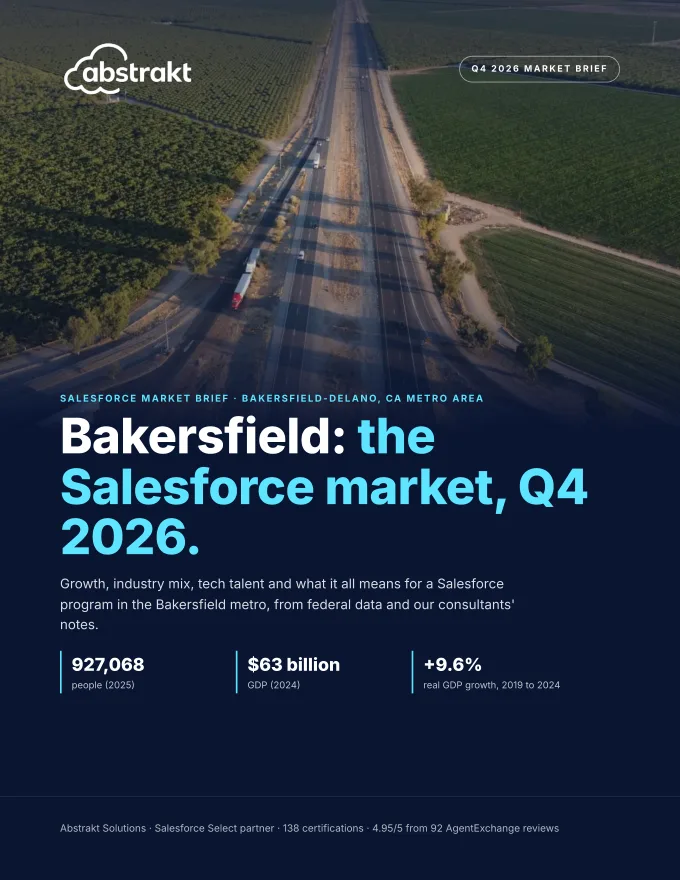
A free 21-page PDF with Bakersfield's growth ranked against 100 metros, its industry mix, tech wages and nearby markets. It is offered on the public Bakersfield page; send your customer there or get a copy for your own prep.
Get the Bakersfield brief →Co-sell with Abstrakt in Bakersfield
Working a Bakersfield account? Bring in a named consultant for discovery, scoping or a health check. We reply within 4 business hours.