

How Salesforce work starts in Fresno
Growers, health providers, contractors and energy developers from central Fresno out to Clovis and Reedley are the Fresno County organizations Abstrakt Solutions supports as a Salesforce Consulting Partner. Fresno is one of our focus markets.
What buyers here usually run into
- 1
Harvest calendars drive the sales cycle
Farm and food businesses usually commit volumes and prices months before harvest, so forecasts built for steady monthly sales misread what the pipeline actually holds.
- 2
Clinic growth outpacing intake processes
Provider groups adding locations often keep phone, fax and portal referrals in separate queues, which makes wait times hard to measure and lets patients slip between sites.
- 3
Project developers juggling many stakeholders
Renewable energy and construction firms tend to manage landowners, utilities, permitting agencies and subcontractors in spreadsheets that break once several projects run at the same time.
Budget, team and partner questions
What drives cost
Fresno projects grow with seasonality and privacy. Versioned seasonal pricing, weekly volume tracking and packing-system integration shape agriculture scope, while clinic groups spend most of their effort on referral intake, consent tracking and access by location.
Admin or partner
Agriculture businesses here often run lean sales teams with no internal Salesforce role, so outsourced administration that flexes around harvest is common. Growing provider groups may hire an admin once intake is unified and keep a partner for integrations and Marketing Cloud.
What buyers ask a partner
Ask agriculture partners how they have modeled seasonal programs and planned versus shipped volume. Ask health care partners how they restrict patient data by location and what they need from you before a business associate agreement is signed.
The local economy and its biggest industries (4)
| Sector | Share of 2024 GDP | Where Salesforce fits |
|---|---|---|
| Health care and social assistance Salesforce for health & life sciences → | 11.4% | Health care and social assistance produced 11.4% of Fresno's 2024 GDP, the largest private share, and the EDC expects hiring in the sector to keep climbing this decade. Growing provider groups need patient access, referral intake and outreach records that stay HIPAA-appropriate as new clinics open. |
| Agriculture, forestry, fishing and hunting Sales Cloud → | 10.4% | Agriculture ranks second in the metro’s private output, and the EDC treats agtech as both a target sector and an innovation asset alongside the state university’s water and energy technology center. Growers, packers and agtech vendors need buyer contracts, seasonal volumes and grower relationships tracked in one account view. |
| Manufacturing Salesforce for manufacturing → | 5.7% | Manufacturing is on the EDC’s recruiting list, and its Good Jobs Central Valley program offers FAME training at Reedley College. Producers that sell through distributors generally need distributor pricing, order status from ERP and warranty cases visible to the same sales team. |
| Construction Salesforce for construction → | 5.5% | Construction is one of the metro’s five largest private sectors, and Good Jobs Central Valley trains workers for it directly. Contractors bidding public and private work use Salesforce to move from estimate to awarded job, then schedule crews and track change orders. |
Source: U.S. Bureau of Economic Analysis, GDP by county (CAGDP2), 2024, summed to the metro area; private sectors only, excluding real estate and government. “At least” marks sectors where BEA suppresses some county figures.
Regional target sectors named by local economic development groups: Agriculture / Agricultural Technology (agtech), Distribution & Logistics, Healthcare, Renewable Energy, Manufacturing, Professional and Business Services.
Salesforce products that fit Fresno (6)
In the order we lead with them here, from the industries above.
Salesforce Sales Cloud
The CRM where sales pipeline lives, when it is built right.
Salesforce Service Cloud
The operating system for modern customer service, case, knowledge, voice, and AI agent assist together.
Salesforce Field Service
Scheduling, dispatch, mobile work orders and parts for teams that work on site.
Salesforce Revenue Cloud / CPQ
Configure-price-quote, billing, subscription management, and quote-to-cash on Salesforce.
Salesforce Marketing Cloud
Cross-channel marketing, email, mobile, journey, and Data 360-powered personalization at scale.
MuleSoft
Enterprise API platform, for connecting Salesforce, ERP, data warehouses, and the rest of your stack.
AI that fits Fresno's farms, clinics, and retailers
Agriculture ranks second among Fresno's private sectors, at 10.4% of 2024 metro GDP, just behind health care at 11.4%. Growers, packers, and ag-input suppliers usually run lean sales teams, so AI that sorts buyer inquiries and drafts quotes saves real hours. Seasonal peaks also make case summarization useful when temporary staff join mid-harvest. Clinics and community health organizations can offer grounded answers about appointments and coverage in plain language. Before any of that, product and pricing data must be accurate in Salesforce, and grower or patient records must be permissioned correctly. We recommend a single pilot queue with daily human spot checks during the first season.
- Buyer inquiry sorting and quotes
- Case summaries for seasonal staff
- Plain-language coverage answers
Services buyers here usually need (7)
Salesforce Implementation in Fresno
A Fresno implementation often begins by deciding what the central record is. For a packer it may be a buyer program with weekly volumes; for a contractor, a bid that becomes a job; for an energy developer, a project with parcels and permits attached. Once that record is agreed, everything else hangs off it: security, automation, the sandbox build, the cleaned data we load and the training each role receives. Rollout is phased, with workshops, go-live and role-based training planned around the harvest, bid or project calendar that drives your year.
By industry in Fresno
- 1
Agriculture, forestry, fishing and hunting
Agriculture, forestry, fishing and hunting produces about 10.4% of 2024 metro GDP, second only to health care among private sectors. For growers, packers and shippers, the early design choices are whether a buyer program is an opportunity, a contract or a custom object, how ranches and blocks relate to the accounts they supply, and which commodity and variety fields sales actually reports on. Those choices shape every later forecast, so we settle them before building any screens.
- 2
Renewable Energy
Fresno County EDC lists renewable energy among its target sectors, naming electrification, biomass, biofuel and hydrogen producers. Developers adopting Salesforce benefit from a rollout that puts origination and stakeholder tracking live first, so land and utility conversations stop living in inboxes. Approvals, document links and stage reporting come in a second phase, once the first real projects have tested whether the site and agreement structure matches how deals actually progress.
- 3
Construction
Specialty and general contractors across the county pursue a steady flow of bids, and the ones that win must then coordinate crews, subcontractors and change orders across several sites at once. An implementation ties the estimate, the awarded job and every later change order to one record that estimators and project managers share. We usually launch bid tracking and account management first, adding Field Service scheduling or Revenue Cloud quoting once the data model has proven itself.
Raise before scoping
Build in the quiet months
If revenue concentrates around harvest or the building season, plan design and testing for the slower part of your year and schedule go-live when the people who must learn the system have time. Launching in the middle of peak packing or bidding almost guarantees workarounds that are hard to undo.
Keep packing and ERP upstream
Packing, inventory and accounting systems should stay the record for what shipped and what was invoiced. Design Salesforce to reference that data through a planned integration instead of asking staff to key shipments twice, which is the fastest way to lose their cooperation.
Launch one team at a time
Fresno companies that roll out to sales, field and office staff in a single launch often overwhelm a small internal support team. Starting with one group, learning from its questions and then adding the next produces cleaner data and a steadier adoption curve.
Salesforce Integration in Fresno
Integration projects in Fresno usually link Salesforce with systems built for physical operations: ERP for pricing and invoices, packing and warehouse platforms for shipments, and sometimes sensor or equipment data from agtech products. Ownership of each record is written down before anything is built, and the tooling, whether MuleSoft, a lighter platform or direct APIs, is sized to volume and to who will support it. Account pages then show order and shipment status, and approved quotes flow back to ERP as orders.
By industry in Fresno
- 1
Manufacturing
Manufacturing makes up about 5.7% of metro GDP, and the city's economic profile names it as a growth driver. Manufacturers selling through distributors need ERP price lists, order status and invoice history visible in Salesforce, with approved quotes returned to ERP without retyping. We map products, customers and pricing field by field, decide which system wins each conflict and build reconciliation reports so finance and sales see the same totals at month end.
- 2
Distribution & Logistics
Distribution and logistics operations, another Fresno County EDC target sector, depend on warehouse and transportation systems that must stay the operational record. Integration brings shipment milestones, delivery confirmations and exceptions into Salesforce against each customer account, so service agents can answer where-is-my-order questions without switching screens. We design for late and out-of-order events, and alert a named person when a feed stops, rather than letting stale data mislead customers during peak season.
- 3
Agriculture / Agricultural Technology
Agtech companies around Fresno sell hardware, software and services to growers and often collect device or usage data in their own platforms. Integrating that data with Salesforce lets customer success teams see which growers are active, which devices need attention and which accounts are ready for renewal. We bring in summaries rather than raw sensor readings, which keeps storage manageable and gives sales and support a usable signal instead of noise.
Raise before scoping
Keep the packing system authoritative
Packing and warehouse platforms know what actually shipped. Let them remain the source for quantities and dates, and have Salesforce display that data, rather than allowing sales staff to edit shipment details in two places and reconcile the difference later.
Size the tool to the job
A contractor or packer with one ERP connection may not need MuleSoft; a distributor linking ERP, warehouse, carrier and portal data probably does. Choose after mapping systems and volumes, since the cheapest build can become the most expensive one to support.
Name an integration owner
Every connection needs someone on your side who receives failure alerts and decides how to fix mismatched records. In smaller Fresno companies this is often an operations or finance lead rather than IT, so include them in design and give them a simple runbook.
Salesforce Optimization in Fresno
Optimization in Fresno is for orgs that are live but underused: estimators still bidding from spreadsheets, sales teams forecasting the season outside Salesforce, clinic staff skipping half the intake fields. We start with usage data and interviews, then simplify page layouts, move old workflow rules into Flow, deduplicate accounts and rebuild the reports managers review each week. Nothing is rebuilt from scratch, and each role's training covers just the screens that moved.
By industry in Fresno
- 1
Construction
Many Fresno-area builders, part of a construction sector worth about 5.5% of metro GDP, first used Salesforce for bids and only later stretched it to jobs and change orders. The usual result is duplicated project fields, stages that do not match how bids are won and reports estimators ignore. We align stages with the bid process, remove redundant fields, connect change orders to the original job and rebuild win-rate and backlog dashboards that owners can act on.
- 2
Agriculture, forestry, fishing and hunting
Farm and food businesses often end up forecasting in spreadsheets because their Salesforce pipeline treats a season-long program as a single deal. Optimization restructures reporting around commodity, buyer and period, cleans duplicate buyer and grower accounts and removes fields nobody fills in during harvest. Sales managers get a view of committed volume they trust, and reps spend less of the busy season entering data that never informs a single decision.
- 3
Health care and social assistance
Provider groups adding clinics tend to copy intake screens and routing rules for each new site, and before long the org carries several versions of the same process. We consolidate them into one design with location-based routing, trim required fields to what reporting uses and rebuild dashboards showing referral volume and time to first contact by site, all without disturbing the privacy settings already in place to protect patient data at every site.
Raise before scoping
Start with the doubted report
Ask executives which report they doubt most and trace why. The answer usually leads to duplicate accounts, inconsistent stages or automation overwriting fields, and fixing that one report visibly builds support among skeptical managers for the rest of the optimization work.
Release outside your crunch
Layout and process changes land best when teams have time to absorb them. Release major updates during quieter months for your business rather than during harvest, peak bidding or staffing crunches, and keep the smaller fixes flowing steadily through the rest of the year.
Retire fields, don't hide them
Hiding unused fields clears screens but leaves them in reports, integrations and automation. Confirm nothing depends on each field, archive its data if needed and delete it, so future admins in Fresno inherit a leaner org instead of the same clutter.
Salesforce Migration in Fresno
Many Fresno companies come to Salesforce from a patchwork: a contact database from the previous decade, grower or bid spreadsheets owned by individual managers, a marketing email tool and accounting exports. Migration starts with an inventory of every source and its quality, then field mapping agreed with the people who use the data, cleanup and deduplication, and rehearsal loads in a sandbox with reconciled counts. Cutover is scheduled for a slow stretch of your year, with support during the first live days.
By industry in Fresno
- 1
Agriculture / Agricultural Technology
Growers, packers and agtech vendors frequently hold their most valuable relationships in spreadsheets: ranch contacts, buyer programs, trial results and field notes. Migrating them means standardizing commodity and variety names, matching growers who appear under different business entities and deciding how many seasons of history to keep. We clean before loading, so the new org starts with one record per grower and one per buyer program instead of carrying the confusion forward.
- 2
Professional and Business Services
Accounting, staffing, engineering and consulting firms across the county often outgrow an entry-level CRM once several partners share clients. Their migrations merge contacts that different partners entered separately, map engagement types to Salesforce opportunities and settle which notes and emails deserve to move. We test reports built on migrated data against what partners already know, so the firm trusts the pipeline and revenue numbers during its first week on Salesforce.
- 3
Construction
Valley contractors typically migrate bid logs, customer lists and project records kept for years in spreadsheets or estimating tools. The hard part is linking them: which bids became jobs, which general contractors or owners sit behind each project and which change orders belong where. We build those relationships during mapping and test them in a sandbox, so win-rate and backlog reports work correctly from the day the estimating team switches over.
Raise before scoping
Collect the personal spreadsheets
In many Fresno businesses the most current customer data lives in files owned by one manager. Ask every team for the spreadsheets they rely on, include them in the source inventory and agree who resolves conflicts, or those files stay open long after go-live.
Standardize names before loading
Commodity names, business entities, addresses and job types entered freely over years produce dozens of variants. Agree on standard values and picklists before loading, then enforce them with validation rules, so reports group records correctly from the very first day of use.
Avoid a harvest-season cutover
Switching systems during harvest, packing or the busiest building months forces staff to learn new screens under pressure. Choose the window with operations leaders, freeze edits briefly in the old tools and plan for extra support during the first live week.
Salesforce Health Checks in Fresno
Fresno organizations order a health check when they need facts about an org rather than opinions about it. We review who can view and export sensitive records, measure duplicates and incomplete data on key objects, inventory Flows, older workflow rules and custom code, check integration users and compare licenses with actual use. Findings come back in priority order, weighing exposure against the work involved. It is often the first step before Agentforce, a managed services engagement or a renewal decision.
By industry in Fresno
- 1
Healthcare
Healthcare is a Fresno County EDC target sector, and the EDC's labor data expects the field to keep hiring through 2030. That growth means new users, new sites and new fields in provider orgs, and each addition is a chance for access to drift. The review traces who can see or export patient details, checks field encryption and history where they matter and confirms that marketing users cannot reach clinical information.
- 2
Manufacturing
Manufacturers in the Valley frequently carry orgs shaped by more than one partner. We count custom objects and Apex classes, check which ones still have users, look at test coverage on code that touches orders or warranties and review what the ERP integration user is allowed to do. We also score product and account records for completeness, since quoting tools and AI features both depend on that data being whole and current.
- 3
Renewable Energy
Renewable energy developers in the EDC's target sector store landowner agreements, interconnection details and commercial terms in Salesforce, often shared with outside counsel or partners. The review checks which external users and connected apps can reach those records, whether document links expose files publicly and how approvals are logged. For fast-growing developers, it also shows where custom project tracking has outgrown its original design and should be consolidated before more projects are added.
Raise before scoping
Bring privacy and finance in
Ask your privacy officer and finance lead which policies, audits or contracts the review should test against. When the security and data sections test those specific obligations, the findings double as usable evidence for the next audit or contract review.
Check licenses against use
Ahead of a license renewal, the review compares assigned licenses, add-ons and active users by team, showing where seats sit unused and where people share logins, a practice that is both a security problem and a sign the license mix is wrong.
Measure data before AI
Agentforce and other AI features rely on complete, current records with sensible sharing. Find out how many repeated, blank or outdated records sit where an agent would look, and clean up the worst of them ahead of a pilot, so early results reflect the tool rather than the data.
Salesforce Managed Services in Fresno
Managed services for Fresno organizations usually means one queue for everything Salesforce needs after launch: new users as clinics or branches open, report changes, Flow updates, integration repairs and testing before each Salesforce release. We document the org first, then handle requests and planned enhancements against a monthly plan agreed with your business owner. Working sessions are booked at times that suit your business owner, and progress against the monthly plan is reviewed together each month.
By industry in Fresno
- 1
Health care and social assistance
BEA puts health care and social assistance near 11.4% of 2024 metro output, the biggest private slice of the Fresno economy. As provider groups add locations, their Salesforce orgs need new queues, routing rules, user permissions and outreach templates each time a site opens. Managed services absorbs that steady flow of change, reviews access as staff join and leave, and tests every release against privacy settings, so expansion does not quietly loosen the controls around patient information.
- 2
Distribution & Logistics
Distribution and logistics is a Fresno County EDC target sector, and operators here often run Salesforce beside warehouse, transportation and ERP systems. Their admin needs are constant but uneven: new customer accounts, revised rate agreements, broken syncs and extra reports for peak shipping periods. A managed team covers the everyday requests and has developers ready when an integration fails, which spares a small internal IT group from learning Salesforce internals under pressure.
- 3
Professional and Business Services
EDC labor data projects growth in professional and business services, a group spanning staffing, accounting, engineering and consulting firms. Few of them could keep a Salesforce developer busy full time, even though their service lines, fee arrangements and client teams keep shifting. Managed services gives them administrators for daily changes and a developer or architect when a larger enhancement comes up, ranked monthly with firm leadership so the backlog mirrors what the partners care about.
Raise before scoping
Separate urgent from planned
List in advance which issues interrupt planned work, such as a failed integration or staff unable to log in, and which wait for the monthly plan. Clear categories keep a busy harvest or open-enrollment stretch from turning every Fresno request into an emergency.
Protect patient data as you grow
Each new clinic or program adds users, queues and sometimes new data fields. Route every permission change and new sensitive field through a short approval, and send your privacy officer a monthly summary, so access stays deliberate as the organization expands across the county.
Test releases against your connections
When Salesforce ships a seasonal update, the Valley's integrations are often where breakage shows first. Run each release in a sandbox against your ERP, warehouse or practice management connections, and warn users about visible changes ahead of time, so nothing surprises staff halfway through a busy week.
Salesforce Implementation Rescue in Fresno
Fresno rescue projects often share a root cause: a design copied from another industry that never fit seasonal programs, project-based energy work or multi-site clinics. We open with a review of the build, the data and what was originally promised, fix whatever is blocking daily operations, then decide piece by piece what to keep, repair or replace. Unfinished work is then delivered phase by phase, written up so your admin can support it, and every group is retrained as its piece relaunches.
By industry in Fresno
- 1
Renewable Energy
Developers in this EDC target sector sometimes commission a custom project-tracking build that grows faster than anyone can maintain: overlapping objects for sites, parcels and permits, approvals that stall and reports that disagree. We map what each object actually holds, merge redundant structures and rebuild the stage model around how projects move from origination to construction, keeping the stakeholder history teams have already entered so no landowner conversation is lost.
- 2
Health care and social assistance
Provider organizations occasionally launch Service Cloud intake that staff find slower than the phone and fax process it replaced. Rescue starts by sitting with schedulers to watch how referrals really arrive, measuring where cases stall and checking whether routing rules match the clinic network. We simplify the intake path, repair routing, confirm privacy settings survived the original build and relaunch site by site so front-desk staff at each clinic see improvement quickly.
- 3
Manufacturing
Manufacturers sometimes end up with a Field Service or quoting rollout that technicians and reps avoid because schedules misfire or quotes need manual fixes. The assessment reproduces those failures with real work orders and quotes, separates configuration errors from design flaws and sets a recovery order. Often, correcting a handful of scheduling or pricing rules unlocks most of the value, and the remaining rebuild turns out far smaller than feared.
Raise before scoping
Get control of the org first
Before recovery starts, confirm that your company, not the departed partner, holds the admin logins, integration credentials, code repositories and sandbox access. Missing any one of these can halt a rescue for weeks while ownership is sorted out with lawyers.
Separate symptoms from causes
Complaints from the field describe effects, like a technician sent to the wrong ranch or a quote total that looks off. Trace each one to its cause, whether a design choice, bad migrated data or conflicting automation, before fixing anything, because patching symptoms in a flawed build tends to create the next round of complaints.
Relaunch site by site
After a failed launch, a second big-bang release risks the same outcome. Bring back one team or clinic at a time, collect feedback and fix issues before the next group joins, so each relaunch adds credibility instead of spending it.
Industry plays in Fresno (3)
Salesforce for Fresno Health and Life Sciences
Health care is the Fresno metro's largest private sector, and local projections call for substantial growth. Salesforce helps providers handle what that growth strains: recruiting clinicians and staff, keeping patient access consistent across new locations, and running outreach programs that connect patients to care. We configure Service Cloud or Health Cloud for access and navigation, use pipeline tools for recruitment, and integrate with the EHR and applicant systems while keeping protected health information narrowly scoped.
Hospitals and clinics top Fresno's private economy, with health care and social assistance at 11.4% of 2024 metro GDP in Bureau of Economic Analysis county data, ahead of agriculture at 10.4%. The Fresno County Economic Development Corporation targets healthcare and cites labor market projections that the sector will add 14,400 jobs, or 21.1% growth, between 2020 and 2030. The EDC's Clovis profile names healthcare and information technology as key industries there, and its strategy counts healthcare among the county's innovation assets, alongside agtech.
Use cases to open with
- 1
Clinician recruitment pipeline
Growing providers compete for physicians, nurses and allied health staff. A recruitment pipeline in Salesforce tracks candidates from sourcing through site visits, credentialing and start date, records incentives offered and connects with applicant tracking systems, so leaders see which roles are hardest to fill and which sources produce hires who stay. Residents and students can be nurtured long before they are available.
- 2
Multi-site patient access
As clinics open, access processes tend to diverge by location. Service Cloud with a shared queue model, consistent intake forms and routing by specialty and site gives patients the same experience wherever they call, and gives managers comparable measures such as time to appointment and abandoned calls across the whole network, which makes staffing decisions far easier to defend. Patients can also request appointments online and see the same options staff see.
- 3
Community outreach programs
Health organizations run screenings, enrollment assistance and education events across urban and rural communities. Salesforce campaign and program records, mobile sign-in at events and follow-up tasks for community health workers let teams show who was reached, which referrals resulted, and which programs deserve continued grant or operating funding in the next budget cycle. Volunteers can record outcomes on phones at the event itself.
Raise before scoping
Recruiting data is sensitive
Candidate records include compensation, licensure and sometimes background details. Restrict access by role, define retention periods, and confirm how employment and privacy laws apply, including California's privacy rules for applicant data, with your HR and legal teams before launch, and log every access exception.
Consistency across new sites
Every new clinic tempts managers to customize intake and routing. Set a standard process with limited local options, govern changes centrally, and report by site from the first day, so growth does not create a patchwork of workflows nobody can support.
EHR remains the clinical record
Salesforce should reference appointments, referrals and care team information, not duplicate clinical documentation. Agree on the minimum clinical data required, integrate it through standard interfaces, and keep HIPAA safeguards and business associate terms in place for any protected health information.
Salesforce for Fresno Manufacturers
Manufacturing in Fresno is closely linked to what comes off the surrounding farms. Processors and packers turn crops into products for retail and foodservice buyers, while equipment makers and fabricators sell machinery, irrigation and parts to growers, often through dealers. Salesforce works best here when forecasts follow the harvest calendar and service follows the equipment into the field. We configure Sales Cloud for buyer and dealer accounts, Field Service for installed equipment, CPQ for configured machinery, and MuleSoft to bring ERP order and inventory data into view.
Fresno's plants contribute a modest 5.7% of 2024 metro output in BEA county data, trailing health care (11.4%), farming itself (10.4%) and retail (7.2%). Its tie to farming is plain: the Fresno County EDC cites $8.6 billion in 2023 agricultural production and treats agtech as a target, while manufacturing appears on the city government's own recruiting profile rather than the county-wide list. The county's development strategy also names the state university's water and energy technology center among its innovation assets, relevant to irrigation and processing equipment makers.
Use cases to open with
- 1
Harvest-driven demand planning
Processors and packers see orders swing with crop size and timing. Sales Cloud can hold buyer programs with seasonal volume commitments, while ERP data on intake, inventory and shipments shows where supply will fall short or run long. Sales leaders can have earlier conversations with buyers about allocations and substitutions, rather than surprising them when the season comes in lighter than planned.
- 2
Dealer and grower equipment sales
Equipment makers often reach growers through dealers who need quotes, availability and promotions quickly during the buying season. An Experience Cloud dealer portal lets partners configure and quote standard equipment, check inventory and register deals, while Sales Cloud tracks direct sales to large farming operations. Manufacturers see dealer performance, open quotes and regional demand in one place, and can shift inventory toward the areas where orders are building.
- 3
Field service during peak season
A breakdown in the middle of harvest can cost a grower dearly. Dispatchers working in Field Service can send the nearest qualified technician with the right parts already on the truck, and every repair is written back to that machine's history. Service contracts with priority response during harvest can be honored consistently, and service history helps sales identify growers whose aging machinery is due for replacement before next season.
Raise before scoping
Build seasonality into forecasts
Standard monthly forecasting misses the shape of a harvest year. Add season, crop and region fields to opportunities and buyer programs, and compare against prior seasons rather than prior months, so forecasts reflect how demand actually moves in the Valley and leadership can plan labor and inventory with more confidence.
Make dealer data usable
Dealers may report sales and inventory in different formats and at different times. Agree on a minimum data set and a regular submission method, then load it into Salesforce consistently so channel reporting is reliable enough to guide production planning and territory decisions.
Bilingual field and service teams
Field technicians, dealer staff and grower contacts may prefer English or Spanish. Configure page layouts, knowledge articles and customer messages to support both where needed, and record each contact's preferred language so service and marketing communications land with the right person in the right form.
Salesforce for Fresno Construction Firms
Construction in Fresno spans a wide territory and a varied mix: distribution buildings along the highway corridors, health care facilities, public works, housing in growing communities such as Clovis, and renewable energy projects involving landowners, utilities and permitting agencies. Salesforce helps contractors and developers manage long pursuits with many stakeholders, then keep crews and service work organized. For Valley builders, that usually means Sales Cloud holding every pursuit and its stakeholders, CPQ where a trade prices standard scopes, Field Service for callback crews, and a link to the estimating and accounting platforms already in place.
Construction accounts for 5.5% of Fresno metro GDP in the Bureau of Economic Analysis's 2024 county figures, the fifth-largest private sector, just behind manufacturing at 5.7%. The Fresno County EDC lists renewable energy, distribution and logistics, and health care among its target sectors, all of which generate building and infrastructure work. Its Good Jobs Central Valley program runs construction training alongside manufacturing and logistics tracks, and the EDC's Clovis profile points to health care, information technology and a growing tourism sector. Contractors here follow that demand across a mostly single-county metro.
Use cases to open with
- 1
Renewable project stakeholder tracking
Solar, storage and other renewable projects involve landowners, utilities, permitting agencies, financiers and engineering firms. Sales Cloud can track each project with its stakeholders, permit milestones, interconnection status and contract stages, so developers and contractors know what is blocking progress. Leadership sees the full portfolio by stage and expected construction start without chasing updates by email, and can spot projects stuck waiting on a single agency or utility.
- 2
Public and private bid management
Fresno contractors bid for public agencies, school districts and private owners, each with different requirements. Salesforce can track upcoming bids, prequalification status, bonding capacity and results, while subcontractor invitations and quotes are logged by trade. Over several seasons, results by owner type show where the firm wins at a healthy margin, which guides which invitations to accept when estimators are stretched thin.
- 3
Warranty and service crews
After turnover, owners call about punch-list items, warranty issues and maintenance. Callback requests become work orders in Field Service, routed to a crew that is already nearby in the Valley, and the technician's photos and the owner's sign-off attach to the original job. Warranty trends by trade and supplier then help project managers raise recurring problems during the next job's buyout, before the same defect is built in again.
Raise before scoping
Many stakeholders per project
Renewable and public projects involve far more parties than a typical private job. Use a project object with related contacts and roles for owners, agencies, utilities and design firms, so the whole team can see who is involved and what each party needs next.
Connect estimating and accounting
Your estimating package and construction accounting system should remain the home for takeoffs, cost codes and pay applications. Pass only headline values, like awarded amount and approved change orders, into Salesforce on a schedule, which gives owners of the business a combined view of pursuits and backlog.
Mobile use across long distances
Crews and supervisors may drive long distances between sites with patchy coverage. Configure the Salesforce mobile app with offline access, keep forms short, and prioritize photos and signatures that document work, so updates happen on site rather than days later from the office.
Case studies to send (3)
From the industries this market leans on. Client names are anonymized and these projects are not specific to Fresno.
The Fresno Salesforce market brief, Q4 2026
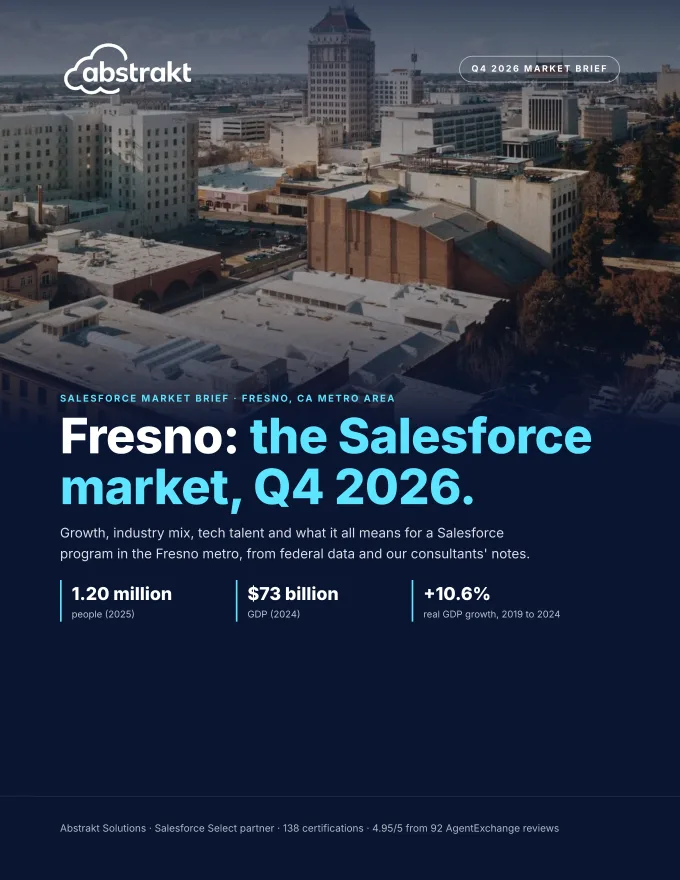
A free 20-page PDF with Fresno's growth ranked against 100 metros, its industry mix, tech wages and nearby markets. It is offered on the public Fresno page; send your customer there or get a copy for your own prep.
Get the Fresno brief →Co-sell with Abstrakt in Fresno
Working a Fresno account? Bring in a named consultant for discovery, scoping or a health check. We reply within 4 business hours.