

How Salesforce work starts in Buffalo
Abstrakt Solutions is a Salesforce Consulting Partner for Western New York organizations on both sides of the Erie-Niagara county line, from downtown Buffalo and Cheektowaga into Niagara County. Buffalo is one of our focus markets.
What buyers here usually run into
- 1
Payer and provider data kept apart
Health insurers and health systems both want member or patient service in Salesforce, and each must strictly limit who can see clinical and claims details.
- 2
Startups outgrowing their first org
Venture-funded software companies often configure Salesforce quickly for early sales, then struggle once partner channels, usage billing and customer success teams arrive.
- 3
Engineered products with long service lives
Makers of precision aerospace and energy components commonly support installed products for years, so quotes, serial numbers and service history need to sit together.
Budget, team and partner questions
What drives cost
Buffalo scope depends on case volume and routing design for insurance and back-office teams, privacy separation for payers and providers, and installed-base and ERP integration for manufacturers. Wholesalers add portal and pricing work.
Admin or partner
Banks, insurers and health plans here usually keep Salesforce ownership internal and use partners for integration and privacy-sensitive builds. Manufacturers, wholesalers and startups more often outsource administration until the org settles.
What buyers ask a partner
Ask for high-volume Service Cloud references, how the partner separates clinical and claims data by role, and how they model serialized installed bases. Ask how they test routing changes before release.
The local economy and its biggest industries (4)
| Sector | Share of 2024 GDP | Where Salesforce fits |
|---|---|---|
| Finance and insurance Financial Services Cloud → | 12.9% | A hometown commercial bank and a large auto-insurance operation show two sides of the sector here, and banks, insurers and back-office service operations in Erie County need policyholder or client views, compliant outreach and case handling that scales with volume. |
| Manufacturing Salesforce for manufacturing → | 11.5% | Flight-control and actuation makers and the other plants building for aerospace, defense, automotive and energy customers need engineered quotes, long program histories and after-sale service records connected to ERP. |
| Health care and social assistance Salesforce for health & life sciences → | 7.8% | With two hospital networks and a cancer research center working alongside a pair of Western New York health insurers, both providers and payers need privacy-controlled member and patient service plus referral and outreach tracking. |
| Wholesale trade Salesforce for retail & consumer goods → | 6.0% | Wholesalers of food ingredients, industrial gas and equipment rely on repeat business, so reorder alerts, rep territories and a portal for order status earn more than new-lead tracking does. |
Source: U.S. Bureau of Economic Analysis, GDP by county (CAGDP2), 2024, summed to the metro area; private sectors only, excluding real estate and government. “At least” marks sectors where BEA suppresses some county figures.
Regional target sectors named by local economic development groups: Advanced Business Services (data processing, technology, insurance, back office), Advanced Manufacturing, Life Sciences, Food & Beverage Processing, Logistics & Distribution, Health Care.
Salesforce products that fit Buffalo (6)
In the order we lead with them here, from the industries above.
Salesforce Sales Cloud
The CRM where sales pipeline lives, when it is built right.
Salesforce Financial Services Cloud
Industry CRM for wealth management, banking, insurance, and lending, built for compliance from the start.
Salesforce Service Cloud
The operating system for modern customer service, case, knowledge, voice, and AI agent assist together.
Salesforce Revenue Cloud / CPQ
Configure-price-quote, billing, subscription management, and quote-to-cash on Salesforce.
Salesforce Experience Cloud
Customer, partner, and employee portals built on Salesforce.
Salesforce Field Service
Scheduling, dispatch, mobile work orders and parts for teams that work on site.
Buffalo's case for careful, practical Agentforce adoption
Finance and insurance is Buffalo's largest private sector, producing 12.9 percent of metro GDP in 2024, followed by manufacturing at 11.5 percent. The region's back-office and insurance operations are a natural fit for AI that reads correspondence, classifies requests and drafts responses for an adjuster or service representative to approve. Manufacturers and food processors can use AI-assisted forecasting to spot pipeline gaps, provided sales teams record opportunities consistently. Health care providers, the third-largest sector, can offer patients answers drawn from approved articles and route anything sensitive to people. Before any of that, it pays to audit who can see which records, since an agent inherits the permissions of the user or integration it runs under.
- Insurance correspondence classification
- Pipeline gap forecasting support
- Approved-article patient answers
Services buyers here usually need (7)
Salesforce Implementation in Buffalo
In Buffalo, a Salesforce implementation frequently serves either a regulated financial or health organization or an engineering-driven manufacturer, and each needs different foundations. Financial and health teams need security and relationship design settled first; manufacturers need products, quotes and installed equipment modeled correctly. Discovery workshops happen at your site; data model and access rules come next, then sandbox configuration, loading of cleaned records and training by role. Each team launches separately, and its experience informs the design for the team that follows.
By industry in Buffalo
- 1
Finance and insurance
BEA puts finance and insurance at 12.9% of Buffalo's 2024 GDP, the top private share and the reason so many local implementations start with policyholders and clients. Banks, insurers and back-office operations implementing Salesforce need to decide early how policyholders or clients relate to households and businesses, which service processes belong in Service Cloud and how access is separated between sales and servicing teams. We document those choices for risk and compliance review before configuration, because they shape every object, report and integration that follows.
- 2
Advanced Manufacturing
Plants serving aerospace, defense, automotive, industrial gas and energy buyers make up much of the advanced manufacturing base Invest Buffalo Niagara promotes. For engineered-product makers, implementation means modeling configurable products and quotes, linking opportunities to long program timelines and tracking installed units by serial number for later service. We plan the ERP connection and product catalog in the first phase, since both decide how quoting and service can work later.
- 3
Advanced Business Services
Advanced business services, covering data processing, technology, insurance and back-office work, is one of InBN's target industries, with a cluster of more than 3,800 companies. Operations centers in this group often implement Service Cloud for high-volume case handling. We design queues, routing and entitlements around service commitments, build knowledge articles into the agent console and plan reporting that supervisors can use from the first day of launch. Omni-Channel capacity rules are set per team.
Raise before scoping
Schedule go-live early in the day
Workshops and standups follow your team's calendar, and go-live windows sit early in the day. That leaves the afternoon for issue triage while both teams are still at their desks.
Model installed products from the start
Manufacturers that service equipment for years should decide in phase one how assets, serial numbers and service contracts relate to accounts. Adding asset tracking after launch usually means reworking layouts, reports and integrations that were built without it, and retraining the field team.
Separate sales and servicing access
In financial and health organizations, the people who sell and the people who service often need different views of the same customer. Define those boundaries in writing and have risk or compliance approve them before the sharing model is built.
Salesforce Optimization in Buffalo
Optimization for Buffalo organizations tends to focus on orgs that have been in place long enough to collect clutter: dozens of unused fields, automation from several eras and reports that each department defines differently. We measure what people actually use, interview users in sales, service and operations, then simplify layouts, merge duplicates, consolidate automation into Flow and rebuild the dashboards leadership relies on. Each change is released with short training for the affected team, and adoption is tracked afterward to confirm it worked.
By industry in Buffalo
- 1
Retail trade
Retail trade makes up 6.1% of 2024 metro GDP. Retailers using Salesforce for customer service, loyalty or B2B accounts often find agents working around slow consoles and marketers unable to trust customer segments. Optimization streamlines the service console, removes redundant case fields, merges duplicate customer records and aligns segments with the data agents see, so service and marketing work from the same customer view instead of separate exports. Seasonal case surges get their own queue rules.
- 2
Food & Beverage Processing
InBN calls food and beverage processing a cornerstone of New York State's $3.6 billion agribusiness and food and beverage processing industries. Processors selling to retailers and foodservice distributors often have orgs cluttered with promotion fields and account plans nobody maintains. We simplify account plans by customer, remove unused promotional objects, add dashboards comparing plan to shipments and train brokers and reps on a shorter workflow they can keep current. Broker activity becomes visible to managers too.
- 3
Advanced Business Services
Technology and back-office services firms, part of InBN's advanced business services cluster, often reach a point where the org mirrors how they sold years ago. Stages are vague, renewals mix with new business and lead routing relies on manual assignment. Optimization defines stages with exit criteria, separates renewal and expansion pipelines, automates routing and builds forecasts that finance and sales both accept, keeping the history already captured. Old opportunities are remapped, not deleted.
Raise before scoping
Start with the users' complaints
Collect specific complaints from each team, such as too many clicks to log a call or a report that never matches finance, and pair them with usage data. Fixing the most-cited problems first shows users quickly that feedback leads to change.
Set data quality rules going forward
Cleanup without prevention decays within months. After merging duplicates and correcting values, add duplicate rules, validation rules and required fields only where a process genuinely needs them, and assign someone to review a data quality dashboard each month and act on it.
Consolidate reports, not just dashboards
Many orgs contain hundreds of reports that are near copies of each other. Retire unused ones, rebuild a small certified set per department and point dashboards only at those, so every leader sees numbers produced the same way, from the same definitions.
Salesforce Integration in Buffalo
Integration projects in Buffalo usually connect Salesforce to systems of record that are not going away: ERP for manufacturers and processors, policy administration and claims platforms for insurers, and eligibility or billing systems for health organizations. We map each data flow, name the owning system for every shared field and choose native connectors, middleware or custom APIs based on volume and complexity. Error handling, monitoring and documentation are included in the build, so your team can see and resolve problems quickly.
By industry in Buffalo
- 1
Manufacturing
Manufacturing contributes 11.5% of 2024 metro GDP, the second-largest private share after finance. Aerospace, defense and energy suppliers need Salesforce to show order status, shipment dates and installed-base details from ERP, while accepted quotes become ERP orders without rekeying. For defense work, the integration design also decides which technical or export-controlled data should stay out of Salesforce entirely, which we settle with your compliance team before any field is mapped.
- 2
Finance and insurance
Insurers and banks need policy, claim or account data on Salesforce records so service agents can answer questions without switching systems. Rather than copy entire claim histories, we typically display summaries retrieved on demand and store only what drives workflow, such as open claim status or renewal dates. Integration accounts receive narrowly scoped permissions, and every flow is documented for information security and audit review before launch. Nightly reconciliations confirm nothing was missed.
- 3
Logistics & Distribution
Logistics and distribution is one of InBN's five target industries. Distributors and carriers here need Salesforce connected to warehouse, transportation or ERP platforms so reps and service agents can see inventory, order and delivery status. We decide which events warrant writing to Salesforce, such as a late shipment that should open a case, and which can be looked up when needed, keeping the org responsive without storing every transaction. Customer portals draw from the same feeds.
Raise before scoping
Map fields before choosing tools
Teams often pick an integration platform before knowing what data must move. Mapping objects, fields, direction and frequency first reveals whether a native connector is enough or a middleware layer is justified, and it prevents paying for capabilities you will not use.
Keep sensitive data where it belongs
Claims details, clinical information and controlled technical data may not belong in a CRM at all. Decide with compliance which fields Salesforce should display, which it should store and which it should never receive, and enforce that in the integration layer.
Test with production-like volumes
An integration that works on a few test records can fail under a full nightly load or month-end spike. Test in a full or partial sandbox with realistic volumes, confirm API limits and batch sizes, and measure how long each job takes before go-live.
Salesforce Health Checks in Buffalo
For Buffalo organizations, a health check is usually requested at a turning point: a new leader wants to know what they inherited, an audit is approaching or an AI project is being planned. We review access and sharing, authentication settings, data quality, custom code and automation, integrations and usage by team. The report ranks each finding by risk and effort and recommends a fix, so leadership can decide what to address with internal staff, a project or ongoing support.
By industry in Buffalo
- 1
Health care and social assistance
Health care and social assistance accounts for 7.8% of 2024 metro GDP, and InBN calls health care the region's largest employment sector. Health systems and insurers running Salesforce for member or patient service need proof that clinical and claims details are visible only to the right roles. We test sharing, permission sets, field-level security and export rights, and identify integrations or reports that expose protected information more widely than intended.
- 2
Advanced Business Services
Companies in InBN's advanced business services cluster, including back-office and technology operations, often run Salesforce orgs that several partners have extended. A health check measures custom code coverage, identifies overlapping automation and managed packages no longer in use, and reviews connected apps and API access. The result is a technical debt inventory the internal team can budget for, with the riskiest items flagged for immediate action. Security gaps come first.
- 3
Life Sciences
Life sciences organizations, one of InBN's target industries, manage research partners, clinical relationships and commercial contacts that need different handling. Our review checks whether those audiences are properly separated, whether consent and communication preferences are recorded consistently and whether any research or patient data sits in free-text fields where it should not. Findings help compliance and commercial leaders agree on corrections before the next audit or product launch. Each finding lists its owner.
Raise before scoping
Include integration and API users
Service accounts used by integrations and apps often hold broad rights and are rarely reviewed. Make sure the health check lists every integration user, its permissions and its last activity, so unused or over-privileged accounts can be removed safely and documented.
Set a baseline for AI projects
Record duplicate rates, completeness of key fields and the breadth of record sharing before any AI pilot starts. Those baseline measures show whether the data is ready and give you a way to judge later whether an agent's answers improved or reflected existing gaps.
Agree on scope and audience
Decide who the findings are for, whether IT, compliance, a new executive sponsor or all three. The report's emphasis, depth and format should match what those readers need to decide, so the results lead to action rather than sitting unread.
Salesforce Migration in Buffalo
Buffalo organizations migrating to Salesforce often bring data from systems that grew over many years: a legacy CRM, a custom database maintained by IT and spreadsheets kept by individual teams. Each source is profiled for duplicates and gaps, and departments decide what history is worth carrying forward. Field mappings are approved in writing, cleanup rules run in a repeatable script, and rehearsal loads continue until totals and sampled records reconcile with the originals. Cutover avoids your busiest weeks, and users are trained shortly before it.
By industry in Buffalo
- 1
Health Care
Health care is the region's largest employment sector, according to InBN. Health systems, insurers and care organizations moving member, patient or referral data into Salesforce must classify protected fields before migration, restrict who can access them from the first load and carry consent preferences accurately. We run migration jobs under tightly controlled accounts, validate results with privacy staff and document every transformation so auditors can trace any record back to its source.
- 2
Finance and insurance
Banks and insurers here often migrate from older CRMs or agent tools with clients duplicated across products and lines of business. The migration merges those into single client records with related policies or accounts, maps household and business relationships and keeps communication preferences intact. Record counts and client samples are reconciled with operations staff, and legacy systems remain available read-only so historical questions can still be answered after cutover. Old notes are kept where regulators may ask.
- 3
Advanced Manufacturing
Manufacturers migrating to Salesforce frequently have customer, distributor and installed-equipment data scattered across an old CRM, service spreadsheets and engineering files. We bring accounts and contacts together, load installed assets with serial numbers where the data supports it and link open service issues, so account teams and technicians see one history. Records too incomplete to migrate are listed for review rather than loaded with gaps. Distributor relationships are mapped as partner accounts.
Raise before scoping
Assign data owners per department
Migration decisions, such as which duplicate wins or what an old status means, need someone with authority. Name an owner in each department who can answer those questions quickly, or mapping will stall while the project team guesses and rework follows later.
Keep legacy record IDs
Every migrated record should carry the identifier it had in the old system. It makes reconciliation, delta loads and troubleshooting far easier, and it lets legacy reports or archived files be traced to their Salesforce equivalents long after the old system is retired.
Freeze the old system briefly
Changes made in the legacy system during cutover are easily lost. Agree on a short freeze, communicate it widely, load the final changes and make the old system read-only afterward so nobody keeps entering data where no one will look.
Salesforce Managed Services in Buffalo
Buffalo organizations that use managed services typically run established orgs with a steady flow of requests from sales, service and operations teams, plus integrations that need regular attention. We work from a shared backlog prioritized monthly with your owner, handle configuration, Flow and development work, test each Salesforce release in a sandbox and keep documentation current. Releases and urgent fixes are planned for early in your day, so there is time to confirm each change together before the afternoon.
By industry in Buffalo
- 1
Wholesale trade
Wholesale trade accounts for 6.0% of 2024 metro output. Distributors in the region depend on Salesforce territories, price books and reorder reports that shift whenever product lines or rep coverage change. Managed services keeps those structures current, monitors the ERP sync behind them and adjusts assignment rules when a rep leaves, so accounts are never orphaned and managers are not waiting for an overloaded internal admin. Seasonal price updates are loaded and tested too.
- 2
Health Care
More people in the region work in health care than in any other sector, InBN reports. Health systems, insurers and care providers change Salesforce frequently as programs, referral paths and member services evolve, and each change carries privacy risk. Our managed services process routes permission and data changes through documented approval, tests them in a sandbox and keeps an audit trail of what changed, when and at whose request, which simplifies internal and external reviews. Release reviews focus on protected fields.
- 3
Life Sciences
InBN reports that the region ranks fourth in America for per-capita share of life sciences workers. Research, biotech and device organizations often run lean commercial teams with Salesforce managed by a single operations lead. Managed services adds the development, integration and architecture skills that lead cannot cover alone, whether that means connecting a new data source, adjusting approval processes for regulated content or preparing the org for a product launch. Work is planned monthly with that lead.
Raise before scoping
Document before handing over
When an internal admin or previous partner has run the org for years, much of its logic lives in their memory. Start managed services by recording integrations, scheduled jobs, key automations and known quirks, so support no longer depends on any one person.
Separate support from projects
Break-fix requests and larger enhancements need different handling. Reserve part of each month for user support and small changes, and scope larger work such as new objects or integrations separately, so a big project never stalls urgent fixes and vice versa.
Review value every quarter
Every quarter, compare what was delivered with the goals set at the start: fewer workarounds, faster case handling, cleaner data or new capabilities. A regular look at outcomes, not just hours used, keeps the engagement focused on what the business needs next.
Salesforce Implementation Rescue in Buffalo
Rescue work in Buffalo often involves projects that combined too much at once: a service console, an integration with policy, claims or ERP systems and a data migration, all due on one date. We look at the org, the agreed requirements, open defects and user feedback, and grade each component by whether it can stay as built, needs repair or must be redone. Anything stopping daily work gets fixed first. The remaining scope becomes a sequence of modest releases, and your staff test and approve each one before the next starts.
By industry in Buffalo
- 1
Finance and insurance
Insurance and banking projects here frequently stall at the integration with policy, claims or core systems, leaving service agents without the data they expected in Salesforce. Recovery isolates that integration, fixes error handling and field ownership, and delivers the summaries agents need first. Only when the service team trusts what it sees do we return to deferred features such as agent portals, campaigns or relationship views. Compliance staff review each restored flow before release.
- 2
Health Care
Health organizations, part of what InBN describes as the region's largest employment sector, sometimes launch Salesforce with privacy controls incomplete, prompting leaders to restrict use until they are fixed. A rescue begins with an access review and remediation, then rebuilds intake, referral or member service workflows with frontline staff. The relaunch proceeds team by team, with privacy officers signing off on each release. Data captured during the first launch is checked for misplaced protected details.
- 3
Advanced Manufacturing
Manufacturers' troubled implementations often center on quoting: configuration rules that did not match engineering reality, or pricing that conflicted with ERP. We stabilize by simplifying quotes to what reps can trust, fixing the ERP connection and retiring Apex that re-implements ERP pricing rules. Once quoting is reliable, deferred features such as installed-asset tracking or distributor access are rebuilt in controlled releases, each tested with the reps and engineers who depend on it.
Raise before scoping
Protect the data during recovery
Stalled projects often leave partial or duplicate data from trial loads. Before more records are entered, identify what came from testing, what is real and what needs correction, and pause further imports until the data model is stable again for everyone.
Communicate progress openly
Users and sponsors who lived through a failed launch expect bad news. Share a short, regular update on what was fixed, what is next and what is still at risk; steady, honest communication rebuilds more confidence than an optimistic date.
Reset the success measures
The original project's goals may no longer fit the business. Agree on a few concrete measures for the recovery, such as cases handled in Salesforce or quotes produced without manual fixes, so everyone knows exactly what finished looks like for this phase.
Industry plays in Buffalo (4)
Salesforce for Buffalo Insurers and Agencies
Much of Buffalo's insurance work happens in service and operations: contact centers, claims support, policy servicing and back-office processing for carriers based here and elsewhere. Salesforce fits when it routes that work well, gives agents a full view of the policyholder or member, and records every interaction for audit. We design Service Cloud around queues and skills, connect policy and claims platforms, and add AI assistance only where answers can be grounded in approved knowledge.
Insurers, banks and other financial firms lead Buffalo's private economy, with finance and insurance at 12.9% of 2024 metro GDP in the Bureau of Economic Analysis county series and manufacturing close behind at 11.5%. Invest Buffalo Niagara folds insurance into its advanced business services target alongside data processing, technology and back-office work, and it cites a pool of more than 12,000 software developers within a 60-mile radius. Health care is also on its target list, so health plans and their service operations sit comfortably within the region's insurance footprint.
Use cases to open with
- 1
Omnichannel service center routing
Service centers handle calls, chats, emails and web forms from policyholders, agents and providers. Service Cloud's omnichannel routing sends each item to agents with the right license, language and line-of-business skills, balances workload across teams, and gives supervisors live queue views, so service levels stop depending on who happens to be watching a shared inbox. Overflow rules shift work between teams during spikes.
- 2
Member service for health plans
Health plan members call about eligibility, claims status, prior authorizations and ID cards. Integrating eligibility and claims summaries into Service Cloud lets representatives answer most questions on the first call, create cases for the rest and trigger follow-up tasks, while access rules keep clinical details visible only to staff who need them. Repeat-contact reports show which issues deserve a process fix.
- 3
Back-office work management
Endorsements, cancellations, reinstatements and document indexing often run through spreadsheets and email folders in operations teams. We model those requests as cases with service-level targets, checklists and approval steps, so managers can measure turnaround, spot bottlenecks by transaction type and show carrier clients exactly where each request stands. Quality sampling and rework tracking can be built into the same flow.
Raise before scoping
Design for service at scale
High-volume operations expose weak data models quickly. Plan case record types, routing rules and archiving from the start, test with realistic volumes, and keep automation simple enough for administrators to debug, because a routing error during a busy period affects thousands of customers at once.
Grounded AI, not guesswork
Generative replies and case summaries can save agents time, but insurance responses must match policy language and approved scripts. Ground any assistant in curated knowledge articles, log what it suggested, and keep a person approving customer-facing answers until accuracy has been proven on real contacts.
Multi-client operations models
Service operations supporting several carriers or plans need clear data separation by client. Decide whether each client gets its own org, business unit or sharing model early, since that choice drives reporting, security reviews and licensing for as long as the contracts run.
Salesforce for Buffalo Manufacturers
Buffalo-area manufacturers often sell engineered equipment or components that stay in service a long time, and processors run private-label and co-manufacturing programs for brand owners. In both cases, the valuable revenue repeats. Salesforce should capture installed products and customer programs, make parts and reorders easy to quote, and show account teams which customers are buying less than expected. We connect it to the ERP so quotes, orders and pricing come from one trusted source.
At 11.5% of 2024 metro GDP in Bureau of Economic Analysis county data, manufacturing is Buffalo's second-largest private sector, trailing finance and insurance. Invest Buffalo Niagara lists advanced manufacturing and food and beverage processing among its target industries, together with logistics and distribution, life sciences, health care and advanced business services. That combination points to a base that mixes engineered industrial products with food production, and to sales teams handling both project-style quotes and steady replenishment orders. The same organization counts more than 12,000 software developers within a 60-mile radius, a useful pool for supporting integrations after launch.
Use cases to open with
- 1
Aftermarket parts quoting
Equipment owners order spare and wear parts for years after the original sale. Linking installed assets to bills of material lets inside sales look up the right part by serial number, quote it with CPQ at current ERP pricing and suggest related wear items, which turns a reactive parts desk into a steady revenue line with measurable growth by account.
- 2
Private-label program management
Food and beverage processors producing for brand owners manage specifications, trial runs, approvals and recurring volume commitments. We model each customer program with its specifications, sample approvals and forecast volumes, link it to production orders from the ERP, and track changes the brand owner requests, so account managers and plant schedulers always work from the same version of the program.
- 3
Service history by serial number
When a machine fails, the service team needs its configuration, warranty status and past repairs immediately. Service Cloud and Field Service with asset records keep that history in one place, schedule technicians with the right skills and parts, and feed recurring failure data back to engineering for design improvements and to sales for timely replacement conversations on the oldest, most expensive units.
Raise before scoping
Clean asset data first
Installed-base records often live in old spreadsheets, warranty registrations and ERP shipment history, with gaps and duplicates. Budget time to consolidate and validate serial numbers before launch, because parts quoting and service scheduling only work when the asset list is trustworthy enough to act on.
Specifications need version control
Customer specifications for processed foods change with recipes, packaging and labeling rules. Store them as versioned records or linked documents with approval history, so a sales conversation never relies on an outdated specification and quality can see exactly which version a customer accepted.
Plan adoption team by team
Parts desks, field technicians and plant schedulers each need different screens. Design role-specific layouts and training for each group, start with the team feeling the most pain, and review usage weekly after launch so gaps surface before habits drift back to email and spreadsheets.
Salesforce for Buffalo Health and Life Sciences
Health care employs more people than any other sector in Buffalo Niagara, and its life sciences companies often grow out of the same hospitals and research centers. That creates two Salesforce needs that share a campus: providers managing referrals, access and community outreach, and young life sciences firms tracking research partners, investors and early customers. We design Service Cloud and Experience Cloud for the first and Sales Cloud for the second, with MuleSoft connecting EHR and lab systems and permissions set for protected health information from the start.
Health care and social assistance made up 7.8% of the Buffalo metro's GDP in 2024 according to the Bureau of Economic Analysis, behind finance and insurance and manufacturing. Invest Buffalo Niagara does not list health care among its five target industries, yet it calls health care the region's largest employment sector, and it does list life sciences, saying the region ranks fourth in America for per-capita share of life sciences workers. InBN also points to incubators on and beside the downtown medical campus, where clinicians, researchers and startups work within a few blocks of each other.
Use cases to open with
- 1
Referral network management
Hospital-based specialists depend on referrals from primary care practices across Erie and Niagara counties. Salesforce can profile referring practices, log liaison visits, and report referral volume and leakage by practice and service line. When a practice's referrals drop, the liaison sees it quickly and can find out whether the cause is scheduling, communication or a competing program, then follow up with the right physician.
- 2
Research partner tracking
Startups spun out of local research labs juggle academic collaborators, sponsored research agreements, pilot customers and investors. Sales Cloud can keep each relationship with its agreements, milestones and next steps, so founders stop relying on memory, inbox searches and email threads when a partner or investor calls. As the company grows, the same records become a proper customer pipeline for its first commercial products or services.
- 3
Clinical study outreach
Research programs need to reach eligible participants without mishandling health information. Marketing Cloud and Service Cloud can manage interest forms, screening calls and consent status, with each study's contacts kept apart from general patient marketing and newsletters. Coordinators see which outreach channels, referring clinics and community events bring in qualified participants, and principal investigators get enrollment progress without chasing spreadsheets.
Raise before scoping
Payer and provider boundaries
Western New York has health insurers as well as providers, and some organizations work with both. Keep plan-supplied member data separate from patient records in the data model and sharing rules, and document which agreement governs each source before it enters Salesforce.
Right-size early for startups
A life sciences startup does not need a hospital-grade org on day one. Start with Sales Cloud and simple objects for partners and agreements, but choose naming and record types that will still make sense when clinical or commercial operations begin.
Validate systems where required
Companies moving toward regulated products may need documented configuration and change control for any system touching quality records. Decide early whether complaints or adverse events will ever live in Salesforce, and plan validation steps, test scripts and release procedures if they will, rather than retrofitting them.
Salesforce for Buffalo Professional Services Firms
Buffalo's professional services firms often look more like operations businesses than consultancies. Many run data processing, compliance review, software or back-office functions for clients elsewhere, which means revenue comes from multi-year service contracts and expansions rather than individual projects. Salesforce should track the client relationship, the contracted services and the service levels behind them. We configure Sales Cloud for renewals and expansions, Service Cloud for client operations requests, and Tableau for account health, with integration to billing and delivery systems.
Professional, scientific and technical services do not appear among the five largest private sectors the Bureau of Economic Analysis ranks for the Buffalo metro in 2024. The work shows up instead in Invest Buffalo Niagara's advanced business services target, which groups data processing, technology, insurance and back-office operations and counts a cluster of more than 3,800 such companies. InBN says it has assisted more than 60 advanced business services firms and cites 12,000+ software developers within a 60-mile radius. The 43North accelerator, which awards $5 million annually, rounds out a growing tech scene.
Use cases to open with
- 1
Service contracts and renewals
Back-office and data processing providers sign multi-year agreements with volume tiers and service levels. Sales Cloud can store each contract with its services, pricing tiers and renewal date, alert account owners well ahead of expiration, and track expansion opportunities such as a new line of business or state. Leadership sees revenue up for renewal by quarter and which clients are growing.
- 2
Client operations requests
Clients of outsourced operations send change requests, escalations and questions every day. Service Cloud can take these in by email or through an Experience Cloud portal, route them to the right delivery team and shift, track response against contracted service levels, and show clients the live status of every request they have raised. Account managers see open issues before every business review, not afterward.
- 3
Scaling a SaaS sales team
Software firms born in the local startup scene often outgrow their first CRM setup fast. We rebuild lead routing, opportunity stages and product catalogs to support new segments, connect product usage data so customer success can see adoption, and set up renewal forecasting. The result is a pipeline that investors, finance and a quickly growing sales team can all rely on.
Raise before scoping
Contract data belongs somewhere
Service agreements often live only as signed PDFs in a shared drive. Before building renewal alerts, extract key terms, such as start and end dates, volume tiers, pricing and service levels, into structured fields, and decide who on the account team keeps them current after amendments.
Match service levels to reality
If Salesforce reports on contracted response times, the clocks and business hours must match the signed contract. Configure entitlements and milestones carefully, including holidays, severity levels and client time zones, so internal dashboards reflect what the client will actually measure at the next business review.
Protect client-owned data
Firms processing data for insurers or banks may be bound by their clients' security requirements. Keep client-owned records out of the CRM unless needed, restrict access by account team, and be ready to show clients how their information is handled.
Case studies to send (3)
From the industries this market leans on. Client names are anonymized and these projects are not specific to Buffalo.
The Buffalo Salesforce market brief, Q4 2026
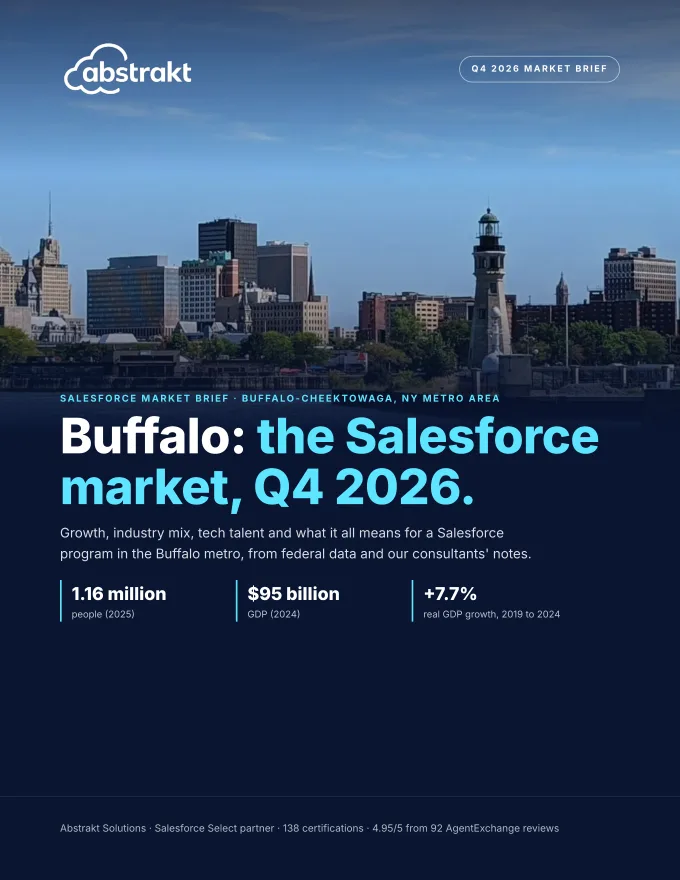
A free 23-page PDF with Buffalo's growth ranked against 100 metros, its industry mix, tech wages and nearby markets. It is offered on the public Buffalo page; send your customer there or get a copy for your own prep.
Get the Buffalo brief →Co-sell with Abstrakt in Buffalo
Working a Buffalo account? Bring in a named consultant for discovery, scoping or a health check. We reply within 4 business hours.