

How Salesforce work starts in Syracuse
Abstrakt Solutions is a Salesforce Consulting Partner whose Central New York work covers utilities, manufacturers and insurers in Syracuse, the town of Clay and the rest of Onondaga County, plus Madison and Oswego counties. Syracuse is one of our focus markets.
What buyers here usually run into
- 1
Getting suppliers ready for large projects
When a major manufacturing investment comes to a region, local suppliers often need to track certifications, audits and bids far more formally than their current spreadsheets allow.
- 2
Crews, contractors and appointments
Utility and energy-service work depends on scheduling people and equipment. Customer updates, asset history and dispatch need to share one record to avoid repeat visits.
- 3
University and academic medical rules
Organizations tied to universities or academic medical centers juggle student privacy, patient privacy and grant terms, which shapes sharing models and integrations from the start.
Budget, team and partner questions
What drives cost
Syracuse costs are driven by Field Service scope for utilities and installers, the number of billing, ERP and policy systems to connect, and the access rules that come with regulated or export-controlled data. Organizations tied to universities or academic medical centers add privacy and grant-related design.
Admin or partner
Utilities and larger insurers here often have internal IT teams and bring in a partner for Field Service, integration and releases. Smaller manufacturers and drone or climate tech firms usually outsource administration until the platform and team settle.
What buyers ask a partner
Ask for Field Service references with crew scheduling and mobile checklists, and for experience splitting government and commercial pipelines if you sell to both. Ask how the partner restricts agent access when data is regulated.
The local economy and its biggest industries (4)
| Sector | Share of 2024 GDP | Where Salesforce fits |
|---|---|---|
| Utilities Field Service → | 10.1% | Utilities' 10.1% share of 2024 metro GDP and CenterState CEO's climate tech focus point to power and gas providers, energy-service contractors and clean-tech firms that manage customer programs, contractor networks and service requests in volume. |
| Manufacturing Salesforce for manufacturing → | 9.4% | Suppliers aiming to serve the region's growing semiconductor supply chain, and defense and uncrewed aerial systems contractors working on long government programs, need qualification tracking, quoting and account plans that span several years. |
| Finance and insurance Salesforce for insurance → | 8.9% | Insurers, banks and other financial firms in the metro's third-largest private sector need household and policyholder views, compliant outreach and clean handoffs between sales and service. |
| Health care and social assistance Salesforce for health & life sciences → | at least 7.1% | In BEA figures, health care and social assistance contributes no less than 7.1% of metro output, fourth among private sectors. Salesforce projects in this sector usually address referral networks, patient access and community outreach, with privacy designed in. |
Source: U.S. Bureau of Economic Analysis, GDP by county (CAGDP2), 2024, summed to the metro area; private sectors only, excluding real estate and government. “At least” marks sectors where BEA suppresses some county figures.
Regional target sectors named by local economic development groups: Advanced Manufacturing, Uncrewed Aerial Systems, Smart Systems, Climate Tech, Transportation and Logistics, Agriculture.
Salesforce products that fit Syracuse (6)
In the order we lead with them here, from the industries above.
Salesforce Sales Cloud
The CRM where sales pipeline lives, when it is built right.
Salesforce Field Service
Scheduling, dispatch, mobile work orders and parts for teams that work on site.
Salesforce Service Cloud
The operating system for modern customer service, case, knowledge, voice, and AI agent assist together.
Salesforce Revenue Cloud / CPQ
Configure-price-quote, billing, subscription management, and quote-to-cash on Salesforce.
Salesforce Experience Cloud
Customer, partner, and employee portals built on Salesforce.
Salesforce Financial Services Cloud
Industry CRM for wealth management, banking, insurance, and lending, built for compliance from the start.
Utilities and manufacturing shape Syracuse AI priorities
Utilities account for 10.1% of Syracuse metro GDP in 2024, an unusual lead sector that points AI toward customer service and field operations. Outage, billing, and service-connection questions are repetitive enough for an agent to answer from approved content, with complex accounts routed to staff alongside a summary. Field technicians can receive AI-suggested steps drawn from equipment history. Manufacturers and insurers, the next two sectors, fit order support and claim document reading. Utility and insurance data carry regulatory weight, so we limit agent access tightly, keep responses within approved language, and have people review changes to accounts or payment arrangements.
- Outage and billing question answers
- Equipment-history repair guidance
- Claim document reading
Services buyers here usually need (7)
Salesforce Implementation in Syracuse
In Syracuse, an implementation often has to serve two very different customer bases at once: households and contractors on the energy side, and industrial buyers on the manufacturing side. We start by agreeing which objects represent customers, sites, assets and programs, because that choice drives reporting for years. Then we phase the rollout, usually sales or service first, build and test in a sandbox, load cleaned data and train each role before its go-live.
By industry in Syracuse
- 1
Utilities
Utilities produce about 10.1% of 2024 metro GDP, a larger share than any other private sector and an unusual lead for a U.S. metro. Utilities and the energy-service contractors around them tend to implement Service Cloud and Field Service together, so the first design question is how premises, meters or installed equipment relate to customer accounts. We settle that structure and the case categories before configuring screens, and we phase dispatch in only after the service console is stable, since crews depend on clean site records.
- 2
Advanced Manufacturing
Advanced manufacturing heads CenterState CEO's list of target sectors, and semiconductor supply-chain growth has many Onondaga County suppliers rethinking how they sell. For a manufacturer implementing Salesforce here, the data model has to carry qualification status, customer-specific part numbers and multi-year program forecasts, not just opportunities. We usually launch account management and quoting in the first phase, add portal or service features later, and design the ERP connection points up front so pricing never has to be typed twice.
- 3
Finance and insurance
Insurers, credit unions and banks in Central New York often come to Salesforce with policyholder or member data spread across a core system, an agency management tool and marketing lists. Implementation starts with deciding whether the household and relationship structures in Financial Services Cloud fit, then designing field-level security that compliance can sign off on. We keep the first release narrow, usually service and referral handling, so staff build confidence before sales and marketing processes arrive in a later phase.
Raise before scoping
Size the model for supplier growth
Suppliers positioning for semiconductor work around Clay may see customer, certification and bid records multiply as pursuits progress. Build account hierarchies, certification objects and approval paths that scale, so each additional large customer program fits the existing design instead of forcing a redesign soon after launch.
Plan field territories early
Crews and sales reps covering Onondaga, Madison and Oswego counties work long rural stretches as well as city streets. Settle territories, service areas and mobile access during design, and test the mobile app where coverage is weak before rolling Field Service or Sales Cloud out to everyone.
Keep a written decision log
We book build reviews for the hours your teams can actually give, and keep a written decision log so questions raised late in the day are answered first thing the next morning.
Salesforce Integration in Syracuse
Syracuse integration projects usually connect Salesforce to an ERP on the manufacturing and distribution side, or to billing, outage and work-management systems in energy and utility services. We start by naming the system of record for each type of data, then choose a pattern and tool, whether MuleSoft, Workato or a direct API connection, based on volume and how many systems are involved. Error handling, reconciliation reports and alerts are part of every build, so your staff hear about a failed sync before a customer does.
By industry in Syracuse
- 1
Manufacturing
At about 9.4% of the metro's 2024 GDP, manufacturing trails only utilities among private sectors, and plants here usually keep item masters, pricing, orders and shipments in ERP while sales works in Salesforce. We connect the two so quotes use current ERP pricing, order status and invoices show on the account, and new customers created in Salesforce flow to ERP with the fields finance needs. For suppliers pursuing semiconductor work, certification and quality data can be exposed the same way.
- 2
Transportation and Logistics
Transportation and logistics is on CenterState CEO's list of target sectors, and carriers, warehouses and freight brokers in the region depend on operational systems that Salesforce rarely replaces. The useful integration pulls shipment exceptions, claims and account activity into Salesforce so service agents answer customers from one screen, and pushes new accounts and rate agreements back out. Latency matters here, so we decide which events need near-real-time updates and which can move in scheduled batches.
- 3
Utilities
Utility and energy-service organizations usually run customer information, billing and work-management systems that predate their CRM. Integrating them with Service Cloud means deciding which premise, account and meter data Salesforce should mirror, how outage or service-order status flows back to agents, and how contractor completions reach billing. We keep sensitive usage and payment data in the source system where possible and show only what agents need, which keeps both storage and security review manageable.
Raise before scoping
Map ownership before choosing tools
Teams often start by debating middleware. Decide first which system owns accounts, products, prices, orders and invoices, and what happens when records disagree. Once ownership is written down, the choice between MuleSoft, Workato and direct APIs usually becomes obvious, and later disputes have a written answer.
Test with real plant volumes
A sync that behaves with a handful of sample records may buckle under month-end order volume or a full catalog reprice. Load realistic volumes from your ERP into a sandbox, including odd part numbers and old customer codes, before any Central New York user relies on the data.
Assign someone to watch errors
Alerts are useless if nobody reads them. Name a person on your team, or in a managed services arrangement, who owns the error queue and the reconciliation report, and agree how quickly failed records must be corrected so problems never pile up unseen.
Salesforce Optimization in Syracuse
Optimization in Syracuse tends to follow years of gradual growth by a small internal team: fields added for one request, automation built by a departed admin, and reports that each department defines differently. Our first step is evidence: login and field-completion data, plus conversations with the people who avoid the system. Then come simpler layouts, merged duplicates and old workflow rules moved into maintainable Flows. Dashboards are rebuilt around definitions leadership agrees on, and each team gets short training on what changed.
By industry in Syracuse
- 1
Wholesale trade
Distributors in Central New York often run Salesforce beside an ERP that holds the real order history, so reps see a CRM full of stale accounts and ignore it. Optimization here means pruning dormant accounts, setting clear ownership rules, and surfacing recent orders and open quotes on the account page. We also cut the fields reps are asked to fill in after each call, which tends to do more for adoption than any new feature or training session.
- 2
Utilities
Customer service teams at utilities and energy-program contractors deal with high case volume, and small inefficiencies multiply fast. We look at how many clicks it takes to log a common request, whether case categories match what agents actually hear, and which automation fires more than once. Consolidating assignment rules and building quick actions for routine requests usually shortens handling time, and rebuilt dashboards give supervisors backlog and response views they can act on during the day.
- 3
Uncrewed Aerial Systems
Drone companies in CenterState CEO's uncrewed aerial systems cluster often set up Salesforce quickly while growing, and the org shows it: government and commercial pipelines mixed in one set of stages, demo requests tracked in notes, and forecasts nobody believes. Optimization separates those sales motions, turns demonstrations and pilot programs into reportable records, and cleans up stage definitions so leadership can forecast each market honestly without asking reps for a separate spreadsheet.
Raise before scoping
Start with usage evidence
Before interviewing teams in Syracuse and the surrounding counties, pull login history, field fill rates and report views for each role and team. Workshop time then goes to the reasons behind the numbers instead of debating whether a problem exists at all.
Retire before you rebuild
A succession of part-time admins leaves behind fields, reports and Flows with no clear owner. Archive what has sat unused for a long time, with a record of what was removed, before building replacements. Smaller orgs are faster to fix and easier for your team to understand.
Agree metric definitions first
Departments in mid-sized companies often calculate pipeline, bookings or case resolution differently. Settle one definition for each headline number with leadership before rebuilding dashboards, or the new reports will be argued over just like the old ones. Write the definitions into each report's description so they survive staff changes.
Salesforce Managed Services in Syracuse
For Syracuse organizations, managed services usually replaces a lone administrator who also has another job. Your requests land in one queue that we rank with your backlog owner; each seasonal Salesforce release is tried in a sandbox before users meet it; and developers or integration specialists join only for tickets that call for them. Work is logged so auditors and new staff can see what changed and why. You get one named lead, a regular review of what shipped, and a clear path for escalating anything urgent.
By industry in Syracuse
- 1
Finance and insurance
With finance and insurance generating about 8.9% of 2024 metro GDP, insurers and credit unions here tend to need a controlled change process more than new features: permission requests approved in writing, field changes tested against regulatory reports, and marketing consent settings kept intact through every release. Under managed services we run those as routine tickets with an audit trail, and we review sharing rules on a schedule so access does not quietly widen as staff move between teams.
- 2
Health care and social assistance
Hospital networks, home care agencies and community service organizations in the metro rarely keep a Salesforce specialist on staff for long. The ongoing work is steady and detail-heavy: new referral sources, intake form changes, outreach lists and dashboards for grant or program reporting. We handle those requests while keeping patient data behind the permission model agreed at design time, and we recheck scheduling and records integrations after each release so referrals keep moving.
- 3
Smart Systems
Smart systems is one of CenterState CEO's target clusters, covering the sensors, controls and connected products that Central New York engineering firms build. Their Salesforce orgs keep changing as products do: new device models, subscription or support plans, and partner channels. A managed team keeps the product catalog and asset records aligned with engineering releases, adjusts service entitlements when plans change, and maintains the automation that turns device alerts or warranty claims into cases.
Raise before scoping
Plan around audit calendars
Insurers, health organizations and grant-funded groups in the metro face periodic examinations and funder reviews. Tell us when those fall so we can pause nonessential changes, pull permission and change reports ahead of time, and brief the people who will answer auditors on every recent change.
Decide how requests arrive
A request mentioned in a corridor or buried in an inbox rarely gets done. Agree on one intake path, whether a form in Salesforce or a shared queue, and on who approves work above a set size. That keeps smaller Syracuse teams from spending managed hours on requests nobody has endorsed.
Hand off knowledge continuously
Staff turnover at mid-sized Central New York employers often takes Salesforce knowledge with it. We record each change in the org and in a shared log, and we run short working sessions with your internal users, so the next person hired into an operations role can pick up where the last one stopped.
Salesforce Health Checks in Syracuse
Syracuse organizations usually request a health check at a turning point: a new administrator inheriting an unfamiliar org, a renewal decision, or plans for Agentforce and other AI features. The review covers who can see what through profiles, permission sets and sharing; how many duplicate and incomplete records sit on key objects; what automation and code exist; whether integrations and reports hold up; and how people really use the system. The result is a ranked list of risks and fixes, with a clear view of what to repair first.
By industry in Syracuse
- 1
Health care and social assistance
Because health care and social assistance produces at least 7.1% of 2024 metro GDP (the BEA figure is a floor), many hospitals, clinics and social service agencies here use Salesforce for referrals or outreach and need assurance that patient-related data is visible only to the right roles. A health check tests that directly: who can view, export or report on sensitive fields, whether guest or partner access is too broad, and whether integrations copy more data than intended.
- 2
Finance and insurance
Insurers and lenders have usually layered Salesforce customizations for years, each one passing a compliance review at the time. A health check looks at the cumulative result: permission sets that grant more than any one role needs, stale users who still hold access, audit history settings, and field encryption where it matters. We also check whether client data is clean enough for AI features to summarize accurately, because inaccurate records become inaccurate recommendations.
- 3
Climate Tech
Climate tech is one of CenterState CEO's target clusters, and young companies in it often build Salesforce fast around grants, pilots and first customers. A health check for them focuses on technical debt accumulated under deadline: unmanaged packages, overlapping Flows, custom objects that duplicate standard ones, and grant data mixed with sales data. The findings show which shortcuts will block growth, such as adding Field Service for installations, and which can safely wait.
Raise before scoping
Review access before AI
An AI assistant inherits the reach of the user it works for. Before switching them on, confirm that sharing rules, permission sets and field-level security match what each role should know, especially in health and insurance orgs where overexposure carries regulatory weight.
Include integration users
Connected apps and integration users tend to be the forgotten corner of an access review. List every connected app and integration user in the Syracuse org, what each can read and write, and who owns it, and retire any that no longer serve a system still in use.
Turn findings into a plan
A long report that nobody acts on is wasted effort. Ask for findings grouped by risk and effort, with a short set of fixes your team or a partner can finish first, and schedule a review of progress a few months later.
Salesforce Migration in Syracuse
Migrations in the Syracuse market often start from long-lived systems: an agency management tool, a homegrown database or a CRM installed years ago and customized by staff who have since left. We inventory what is there, agree with each department what to bring and what to archive, deduplicate and standardize records before loading, and run test loads into a sandbox with reconciliation. Cutover follows a dated plan with a short freeze, and we stay for go-live so questions about missing data get answered quickly.
By industry in Syracuse
- 1
Wholesale trade
With wholesale trade adding about 6.5% of 2024 metro GDP, distributors are a steady source of migrations, and most hold decades of customer records in an ERP or older CRM, with the same buyer entered under several names and ship-to addresses. We match and merge those accounts before loading, carry over recent order summaries rather than every line item, and map sales territories so reps open Salesforce to a book of business that looks right on the first morning.
- 2
Agriculture
Agriculture appears on CenterState CEO's target-sector list, and farms, cooperatives and agricultural suppliers in the surrounding counties often run customer and grower relationships from spreadsheets, paper and memory. A migration for them is as much about structure as data: defining growers, buyers and suppliers as account types, capturing seasonal contracts, and converting notes into activity history that someone else can follow. We keep the first release simple so field staff with little CRM experience actually use it.
- 3
Finance and insurance
Insurance agencies and smaller financial firms in Central New York frequently migrate from agency management systems or aging CRMs where policies, households and contacts are loosely linked. We untangle those relationships before loading, decide how much policy and activity history should come across, and preserve consent and communication preferences exactly. Test loads are reconciled record by record for sensitive fields, and access is configured before any data lands in production.
Raise before scoping
Find every shadow spreadsheet
Departments keep lists outside the main system: renewal trackers, contractor rosters, event sign-ups. Ask each team in Syracuse and the outlying counties for theirs during discovery, decide which belong in Salesforce, and fold them into the migration rather than discovering them after go-live.
Decide what history is worth moving
Moving every old email and note makes the new org slower and harder to search. Agree on a cutoff for activity history, keep older records in an archive people can still reach, and bring over the summaries that sales and service actually use.
Plan cutover around busy periods
Insurers face renewal peaks, agricultural businesses face seasonal crunches and distributors have month-end close to protect. Choose a cutover window outside those periods, schedule the data freeze with each team's leader, and keep the old system read-only for a while after launch.
Salesforce Implementation Rescue in Syracuse
Troubled projects in the Syracuse market often share a cause: a small internal team leaning on one outside contractor, then losing that person partway through. We start by securing admin access and documentation, then sort issues into what blocks daily work, what corrupts data and what can wait. Blocking defects get fixed first. Each remaining component is kept, repaired or replaced based on evidence, and we relaunch in stages with training so staff see the system improve rather than restart.
By industry in Syracuse
- 1
Manufacturing
Manufacturers here sometimes end up with a quoting or order-tracking build that passed testing but fails on real orders: prices that do not match ERP, product bundles configured wrong, or approvals that route to people who left. We reproduce each failure in a sandbox, trace it to configuration or data, and fix the ones that stop quotes going out. Only after sales can quote reliably do we revisit the rest of the scope, including any supplier qualification tracking left unfinished.
- 2
Health care and social assistance
When a referral or intake project stalls at a health or social service organization, staff usually fall back on phone calls, faxes and spreadsheets, and the Salesforce org drifts out of date. Rescue begins by checking that sensitive data is properly restricted, since unfinished builds often leave access too open. We then restore the core intake and referral path, reload corrected data and relaunch to one program or clinic before extending it to others.
- 3
Uncrewed Aerial Systems
Fast-growing drone companies in CenterState CEO's uncrewed aerial systems cluster sometimes commission a large Salesforce build, then change their business model before it finishes. The result is an org designed for a market the company no longer leads with. Triage separates what still fits, often account and contact data plus the commercial pipeline, from what should be retired. We then rebuild government pursuit and fleet support processes around how the company actually sells today.
Raise before scoping
Freeze changes during triage
When several people have been patching a failing org, their fixes can collide. Pause nonessential changes in the Syracuse org while triage runs, route every urgent request through one person, and take a full metadata backup so the starting point is known.
Separate data damage from design flaws
Some failures come from bad data loads, others from a design that cannot represent the business. Classifying each problem correctly avoids rebuilding objects that only needed cleaner data, or cleaning data in a model that will be replaced anyway. Each issue on the triage list carries that label.
Rebuild trust with visible fixes
Staff who have watched a project fail expect the next attempt to fail too. Publish a short list of fixes with target dates, deliver them on schedule, and invite frontline users to confirm each one, so confidence in the org returns before the larger recovery work begins.
Industry plays in Syracuse (3)
Salesforce for Syracuse Manufacturers
Many Syracuse-area manufacturers build technical products, from uncrewed aircraft and sensors to energy equipment and precision components. Salesforce helps them manage demonstrations and evaluations, government and commercial sales, connected product service and installer or dealer networks. We design around your product and channel mix, connect Salesforce to ERP and product data, and leave room in the design for larger customers with stricter supplier requirements, so the org can grow with the business rather than be rebuilt.
Bureau of Economic Analysis county figures put manufacturing at 9.4% of the Syracuse metro's 2024 GDP, second only to utilities and ahead of finance and insurance. CenterState CEO names advanced manufacturing, uncrewed aerial systems, smart systems and climate tech among its target clusters for Central New York. The metro counts 13 colleges and universities, a steady source of engineering graduates, and state investment in semiconductor manufacturing has put chip supply chains on local manufacturers' agendas. The mix leans toward technical products that need demonstrations, service and specialized channels.
Use cases to open with
- 1
Demonstrations and evaluations
Uncrewed systems and smart device makers usually win deals after live demonstrations, field trials or paid pilot programs. Sales Cloud can track each evaluation with the equipment loaned, agreed success criteria, customer feedback and next steps. Sales leaders see which evaluations convert, how long they take and which configurations customers prefer, which helps plan inventory for demo units and focus effort on prospects with real buying intent and budget.
- 2
Connected product service
Sensors, controls and energy equipment increasingly report their own performance data back to the manufacturer. Service Cloud with asset records, integrated device alerts and Field Service scheduling lets service teams respond to problems before customers notice them. Warranty status, firmware versions and service history sit on each asset record, giving account managers useful context for renewals, service contracts and upgrade conversations with each customer.
- 3
Installer and dealer networks
Climate tech and building systems products are often sold and installed by independent contractors rather than the manufacturer's own staff. An Experience Cloud portal can support dealer registration, training records, lead distribution, warranty claims and marketing materials in one place. Manufacturers see which partners perform well and where coverage gaps exist across the region, while partners get faster answers without calling the factory for every question.
Raise before scoping
Government and export controls
Uncrewed systems and related technologies may fall under export controls or government contract requirements. Decide what technical data Salesforce may store, how users are vetted and whether a government-grade environment is needed before building any processes around controlled programs or foreign customers.
Device data volume
Connected products can generate far more data than a CRM should ever hold. Send only meaningful events and summaries into Salesforce, keep raw telemetry in dedicated platforms built for it, and use Data 360 (formerly Data Cloud) or an integration layer when richer analysis across devices and customers is required.
Growing into new supply chains
If semiconductor investment brings new customers with strict supplier requirements, local manufacturers will need to show certifications, audit results and qualification progress on request. Structure accounts and qualification records now so Salesforce can support those relationships without a redesign when larger customers arrive.
Salesforce for Syracuse Insurers and Agencies
For Syracuse-area insurers and agencies, the commercial book is changing as contractors and suppliers pursue work tied to large manufacturing investment in the region. Those clients need faster certificates, bonding support, higher limits and documentation for demanding project owners. Salesforce helps agencies keep up. Financial Services Cloud organizes businesses, policies and contacts; Service Cloud manages certificate and endorsement requests with deadlines; Experience Cloud lets clients request documents themselves. Personal lines and household service run in the same org.
Across Onondaga, Madison and Oswego counties, banking and insurance produce 8.9% of 2024 output by the BEA's count, just behind the utility sector's 10.1% and factories' 9.4%. CenterState CEO's target clusters for Central New York do not include insurance, so the industry appears through that finance share rather than a recruitment strategy. What connects it to the targets is the client base: advanced manufacturing, logistics and the semiconductor manufacturing the state is courting for the region. Local contractors and suppliers pursuing that work need coverage and documentation that match.
Use cases to open with
- 1
Certificate and endorsement requests
Contractors on large projects may need dozens of certificates of insurance, additional insured endorsements and waivers, often on short notice. Every request becomes a case holding the project name, the owner's wording for additional insured status and the date the general contractor needs it. An Experience Cloud site lets clients submit requests and download certificates, so turnaround becomes measurable and fewer requests arrive by frantic phone call.
- 2
Supplier readiness reviews
Suppliers pursuing work with large manufacturers face insurance requirements higher than their current program. Account managers can use Salesforce to schedule readiness reviews, compare current limits with typical project requirements, track submissions to markets for higher limits or new coverage, and record decisions. Clients get a clear plan with timing, and the agency builds a documented advisory relationship that strengthens retention and makes the case for moving the whole program to one agency.
- 3
Household renewals and cross-sell
Personal-lines households renew on staggered dates across auto, home and umbrella policies. Financial Services Cloud tracks each household's policies and life events, and Marketing Cloud sends consented reminders and coverage reviews ahead of renewal. Producers see which households are missing coverage or have multiple carriers and can offer consolidated reviews rather than waiting for a price-shopping call, and Central New York homeowners get timely reminders about water and roof coverage before winter.
Raise before scoping
DFS security program alignment
New York licensees must maintain a cybersecurity program under Department of Financial Services rules. Configure Salesforce access, authentication, logging and data retention to support that program, document the setup, and let your compliance officer decide how the CRM is described in your policies and certifications.
Project-driven demand spikes
Certificate and endorsement volume may rise sharply as regional projects mobilize. Design queues, templates and automation to absorb spikes, measure turnaround by client and project, and consider self-service before hiring, so service quality holds when major bid deadlines cluster together.
Agency system of record
Policies, commissions and agency accounting stay in your management platform, which carriers and auditors already rely on. Map which fields Salesforce reads, keep certificate issuance in the approved tool if required by carriers, and store only links or copies needed for service, so records never conflict.
Salesforce for Syracuse Health and Life Sciences
Health organizations around Syracuse often combine care delivery with teaching and research, which means the same person may be a patient, a study participant and an alumnus with different rules for each. Salesforce can coordinate those relationships if the data model and sharing rules respect the differences. Service Cloud handles referrals and patient access, Experience Cloud supports referring physicians and study participants, and Tableau reports on outreach and recruitment. The EHR and research systems remain authoritative.
Because the BEA suppresses some county detail, 7.1% is a floor for how much Syracuse-area care delivery added to 2024 GDP. The metro's educational base shapes the sector: it has 13 colleges and universities, including a public medical university, an environmental science and forestry college and a private research university, with 85 colleges within 100 miles. CenterState CEO's target clusters focus on advanced manufacturing, smart systems, climate tech and uncrewed aerial systems rather than health care, so the sector's local character comes mostly from academic medicine and research.
Use cases to open with
- 1
Physician referral networks
Academic and community specialists depend on referrals from primary care across a wide Central New York service area. Service Cloud captures each referral, tracks scheduling and sends status back to the referring office. Physician liaisons see which practices refer, which have slowed and which complain about access, so outreach visits target real problems rather than a rotating list of offices.
- 2
Clinical study recruitment
Research teams need to identify, contact and screen potential participants, then track consent and enrollment. Salesforce can manage inquiries from study web pages, screening questionnaires and follow-up tasks, while keeping research data separate from clinical records with strict access. Study coordinators see recruitment funnels by study and source, and investigators know early whether enrollment targets are realistic or whether the protocol team should add sites or adjust criteria.
- 3
Community health outreach
Screening events, chronic disease programs and community partnerships generate contacts and follow-ups that often live in spreadsheets. Salesforce can track participants, consent, referrals to care and outcomes, and Marketing Cloud can send consented reminders. Program managers report results to funders and leadership from live data, and Tableau dashboards show reach by neighborhood or county, including rural Madison and Oswego County communities that are harder to serve from the city.
Raise before scoping
Overlapping privacy regimes
HIPAA governs patient information, research participants have consent-based protections, and student data at affiliated universities carries separate rules. Design separate record types, sharing rules and permission sets for each population, and have privacy, research compliance and registrar offices approve the model.
Research versus clinical data
Study data belongs in research systems and approved repositories, not in general CRM fields. Store recruitment and relationship information in Salesforce, link to research records where allowed, and confirm with your institutional review board which fields may be stored and who may see them.
Governance across institutional partners
Academic medical organizations often involve hospital IT, university IT, research offices and sometimes foundations. Agree early on who owns the org, how changes are approved and how licensing costs are shared, so projects do not stall between committees after the first release goes live.
Case studies to send (3)
From the industries this market leans on. Client names are anonymized and these projects are not specific to Syracuse.
The Syracuse Salesforce market brief, Q4 2026
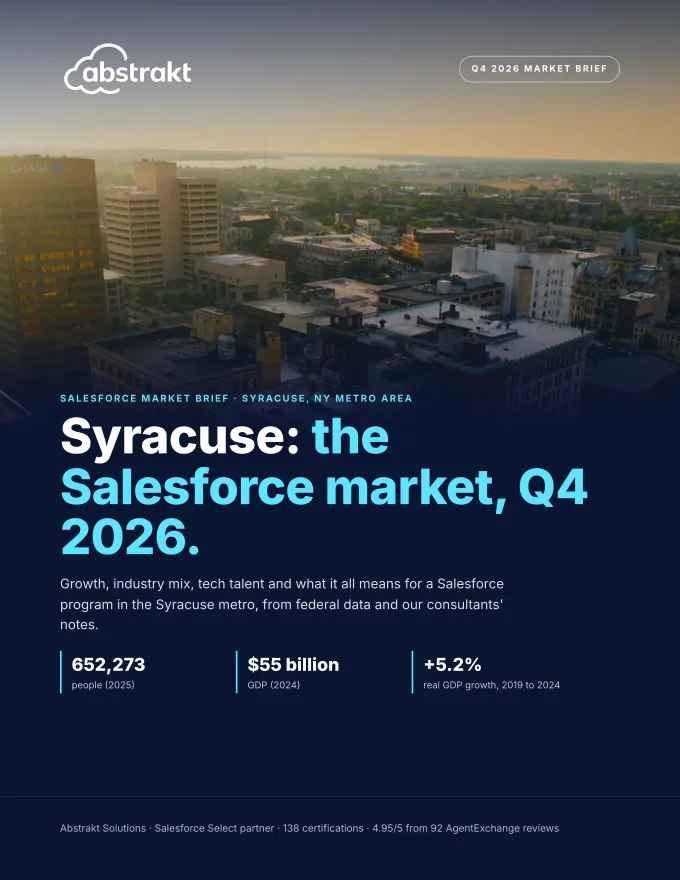
A free 22-page PDF with Syracuse's growth ranked against 100 metros, its industry mix, tech wages and nearby markets. It is offered on the public Syracuse page; send your customer there or get a copy for your own prep.
Get the Syracuse brief →Co-sell with Abstrakt in Syracuse
Working a Syracuse account? Bring in a named consultant for discovery, scoping or a health check. We reply within 4 business hours.