

How Salesforce work starts in Rochester
Abstrakt Solutions works as a Salesforce Consulting Partner for businesses in the city of Rochester, around the University of Rochester and RIT, and throughout the nine counties Greater Rochester Enterprise markets. Rochester is one of our focus markets.
What buyers here usually run into
- 1
Qualification cycles longer than quarters
Precision optics and semiconductor suppliers commonly spend months on samples and customer qualification before volume orders arrive, a stretch a standard stage-based pipeline underrepresents.
- 2
Installed bases spanning product generations
Companies with long-established product lines often support customers across many generations of equipment, which makes asset and entitlement data hard to consolidate in one place.
- 3
Startups outgrowing spreadsheets
Companies coming out of incubators and university programs frequently begin on spreadsheets or a free CRM, then need a migration once investors and larger customers expect disciplined reporting.
Budget, team and partner questions
What drives cost
Rochester scope is driven by how qualification and samples are modeled, whether custom configurations need Revenue Cloud, and how much installed-base data must be consolidated across product generations. Insurers and credit unions add core integration and privacy design.
Admin or partner
Established manufacturers and insurers here often have IT staff but few Salesforce specialists, so partners usually handle design and integration. Startups from local incubators and university programs more often outsource administration until they hire a dedicated owner.
What buyers ask a partner
Ask for examples of long-cycle design-in pipelines, installed-base consolidation and Financial Services Cloud with core integration. Ask how the partner migrates a startup off spreadsheets without carrying over bad data.
The local economy and its biggest industries (4)
| Sector | Share of 2024 GDP | Where Salesforce fits |
|---|---|---|
| Manufacturing Salesforce for manufacturing → | 13.5% | Optics, photonics, imaging and semiconductor manufacturers sell precision components that go through long customer qualification. Quotes, engineering samples and ERP order data need to sit together for sales and engineering to stay aligned. |
| Finance and insurance Salesforce for insurance → | 10.1% | Rochester's second-largest private sector includes insurers, banks and credit unions whose policyholders and members expect quick, accurate answers. Financial Services Cloud with Service Cloud handles that service load without losing the relationship history. |
| Health care and social assistance Salesforce for health & life sciences → | 9.5% | A regional hospital network and a university medical center appear among the employers GRE lists. Salesforce work in this sector centers on patient access, referral coordination and community outreach, with permissions designed around privacy rules. |
| Professional, scientific, and technical services Salesforce for professional services → | at least 5.9% | Data-protection software makers and security consultancies, along with research and engineering services tied to local universities, sell recurring contracts that Sales Cloud and Tableau can follow from pipeline to renewal. |
Source: U.S. Bureau of Economic Analysis, GDP by county (CAGDP2), 2024, summed to the metro area; private sectors only, excluding real estate and government. “At least” marks sectors where BEA suppresses some county figures.
Regional target sectors named by local economic development groups: Software & IT, Optics, Photonics, Imaging & Lasers, Life Sciences, Advanced Manufacturing, Food & Beverage Manufacturing, Semiconductor.
Salesforce products that fit Rochester (6)
In the order we lead with them here, from the industries above.
Salesforce Sales Cloud
The CRM where sales pipeline lives, when it is built right.
Salesforce Revenue Cloud / CPQ
Configure-price-quote, billing, subscription management, and quote-to-cash on Salesforce.
Salesforce Service Cloud
The operating system for modern customer service, case, knowledge, voice, and AI agent assist together.
Salesforce Field Service
Scheduling, dispatch, mobile work orders and parts for teams that work on site.
Salesforce Experience Cloud
Customer, partner, and employee portals built on Salesforce.
Tableau
Executive analytics, embedded dashboards, and CRM Analytics built on Tableau.
Optics makers, insurers and AI in Rochester
What should a Rochester optics or imaging manufacturer ask an AI agent to do? Usually something modest: read an RMA request, pull the product and serial details, and summarize the fault history for a support engineer. Manufacturing was 13.5% of metro GDP in 2024 in BEA's tally, finance and insurance 10.1%, and health care 9.5%, so the list extends beyond the factory. Health insurers and providers can use grounded self-service for coverage and billing questions, provided member data is locked down. Semiconductor and photonics sales teams can get forecasting support on long, technical deal cycles. Data hygiene, permission design and human review sit underneath all of it.
- RMA intake and fault summaries
- Coverage and billing self-service
- Forecast notes on technical deals
Services buyers here usually need (7)
Salesforce Implementation in Rochester
Many Rochester implementations begin with technical products sold to technical buyers. An optics or semiconductor supplier may win a design-in long before any production revenue appears, and an imaging or life-science company then supports that equipment across several generations. So the data model needs more than opportunities: design-in projects, samples, qualified parts, installed assets and entitlements. We define those objects with your sales, applications and service leads, then launch in phases, starting with pipeline and customer data.
By industry in Rochester
- 1
Manufacturing
Manufacturing contributed about 13.5% of the metro's 2024 GDP, and Greater Rochester Enterprise lists advanced manufacturing, food and beverage manufacturing and semiconductors among its target sectors. For manufacturers, implementation decisions center on the product catalog, how quotes relate to ERP pricing, and whether Revenue Cloud and CPQ are needed from launch or later. We also define how distributors and direct accounts coexist, because channel conflicts show up quickly in reports once the system is live.
- 2
Optics, Photonics, Imaging & Lasers
Optics and photonics companies often sell custom or semi-custom components where each opportunity carries specifications, drawings and test results. An implementation for them usually adds structured objects for design-in projects and samples, linked to the opportunity and account, so applications engineers and sales share the same view. Forecasts then separate qualified programs from speculative ones, which gives leadership a more realistic picture of when production revenue from each program will actually arrive.
- 3
Life Sciences
Life-science companies in the region, from research tools to clinical products, sell to labs, hospitals and distributors with different buying processes. Implementation typically sets up separate record types and sales processes for each channel, account hierarchies for institutions with many departments, and service processes that capture product and lot details. Where regulated complaints are involved, we design case fields and audit history with quality teams from the start instead of adding them later.
Raise before scoping
Model pre-revenue programs explicitly
Standard opportunity stages treat everything before a purchase order as pipeline. For suppliers that go through design-in and customer evaluation, create a separate program or project record so early engagement is tracked and reported properly without inflating the near-term revenue forecast.
Capture assets from day one
Equipment makers get more from service later if installed products, serial numbers and warranty terms are captured when orders ship. Plan that link to ERP or shipping data in the first phase, even if Field Service itself arrives in a later release.
Involve applications engineers early
Technical sales depends on engineers who rarely attend CRM workshops. Include them in discovery, since they hold the details about specifications, samples and test results that determine whether Salesforce reflects how deals actually progress through a long, technical buying process.
Salesforce Integration in Rochester
For Rochester companies, integration usually means joining Salesforce to the systems where products and orders are managed: ERP for pricing, orders and shipments, quality systems for complaints and corrective actions, and sometimes engineering or product-lifecycle tools for specifications. Software firms add billing and product-usage data. Every flow gets a written design and a system of record, the tooling matches the job, from MuleSoft to a simple scheduled sync, and alerts reach a person when a transfer breaks.
By industry in Rochester
- 1
Semiconductor
Semiconductor suppliers and equipment makers need part numbers, customer-specific qualifications and order backlogs visible in Salesforce without duplicating the ERP. We integrate orders, shipments and backlog summaries into the account view, sync qualified part lists so sales knows what each customer can buy, and pass won opportunities to operations for planning. Because part and revision data changes often, the design pays special attention to keeping versions aligned between the two systems.
- 2
Life Sciences
Life-science companies usually need Salesforce and a quality management system to exchange complaint information reliably. Cases captured by service must reach quality with product, lot and event details intact, and investigation status should flow back so agents can update customers. We also link ERP data on shipments and lots, which lets service confirm what a customer received. Each exchange is logged, because auditors may ask to see the complete chain.
- 3
Software & IT
Software and IT firms want Salesforce to reflect how customers actually use the product and what they are billed. Integration brings usage summaries, subscription details and invoices onto the account, so account managers see adoption risk before renewal and support sees entitlement status. We keep raw usage events in the data warehouse and send only the metrics teams act on, which keeps the org fast and storage costs under control.
Raise before scoping
Keep product revisions aligned
Engineering-driven products change revisions frequently. Decide how Salesforce stores part and revision information, which system updates it and how quotes referencing an outdated revision are flagged, so sales never commits to a version that operations no longer builds or supports.
Close the loop with quality
A complaint that leaves Salesforce needs a confirmation that it arrived and status updates when it changes. Design both directions from the start, with alerts on failed transfers, so no complaint can sit unacknowledged between service and quality while the clock on reporting runs.
Size integration to your team
A small IT group cannot support an elaborate middleware estate. Choose tools your staff or a managed partner can realistically maintain, and document each integration well enough that someone new could troubleshoot it without calling the original developer back in.
Salesforce Migration in Rochester
Rochester migrations range from young companies leaving spreadsheets and free CRMs behind to established manufacturers replacing a legacy system that has held customer records for years. In each case, the project stands or falls on data quality. We inventory the sources, profile duplicates and gaps, agree mapping rules with the people who use the data, and decide which history to bring. Trial loads in a sandbox and reconciliation with your team come before a planned, reversible cutover.
By industry in Rochester
- 1
Professional, scientific, and technical services
Engineering, consulting, research and design firms sit within professional, scientific and technical services, which BEA credits with no less than 5.9% of the metro's 2024 output. Many run client relationships across an older CRM, project tools and partner spreadsheets. Migration consolidates clients, contacts and engagement history into Salesforce, separates active work from archival records and preserves which partner or practice owns each relationship, so revenue and pipeline reporting works immediately after cutover.
- 2
Software & IT
Young software companies in the region commonly reach Salesforce after their first enterprise customers make ad hoc tracking untenable. The migration turns loosely kept deal notes, trial sign-ups and support emails into structured accounts, opportunities, subscriptions and cases. We define lifecycle stages and renewal dates carefully, since those drive the metrics a growing company reports, and we clean contact data so marketing starts with an accurate, consented list instead of a pile of form submissions.
- 3
Food & Beverage Manufacturing
Food and beverage manufacturers often keep customer, broker and distributor records in an ERP, a legacy CRM and spreadsheets maintained by individual sales staff. Migration reconciles those into one account structure that reflects how products reach retailers and food-service buyers, with brokers and distributors linked appropriately. We also carry over contract pricing references and open complaints, so sales and quality teams can work in Salesforce from the first day without reopening the old system.
Raise before scoping
Define lifecycle stages before moving
Every source system uses its own stages and statuses. Agree on Salesforce's lead, opportunity and customer stages first, then map old values to them deliberately, so historical reports remain meaningful and nobody inherits a catch-all status carried over from the old system.
Assign data owners for review
Sales managers, service leads and finance each know where their data is weak. Give each a sample of migrated records to review after the trial load, with a clear deadline, because their sign-off catches business errors that automated reconciliation cannot.
Keep attachments in proportion
Legacy systems often hold years of attachments that would consume significant Salesforce file storage. Decide which documents users truly need in the CRM, link others from an existing repository, and archive the rest, rather than paying to store files nobody opens.
Salesforce Optimization in Rochester
Rochester orgs that need optimization often date from an early rollout that was never revisited. Applications engineers keep sample notes in spreadsheets, service teams cannot see which product generation a customer owns, and leaders review pipeline in Tableau exports that disagree with Salesforce. We study how each role works, remove fields and steps nobody needs, consolidate automation, connect asset and service data to accounts and rebuild the core dashboards on shared definitions, releasing improvements in small, trained increments.
By industry in Rochester
- 1
Retail trade
In 2024, about 5.7% of the metro's GDP came from retail trade. Retailers and consumer-product companies using Salesforce often run marketing, loyalty and service processes that grew separately and now overlap. Optimization merges duplicate customer records, straightens out case categories so reporting shows why customers contact you, and removes automation that sends overlapping messages. Service leaders then get dashboards on contact reasons and resolution that match what agents actually experience.
- 2
Optics, Photonics, Imaging & Lasers
Optics and imaging companies often have Salesforce pipelines full of opportunities that are really engineering conversations, which distorts forecasts and frustrates sales leaders. Optimization separates technical engagement from revenue opportunities, adds simple structures for samples and evaluations, and gives applications engineers a faster way to log their work. The result is a pipeline leaders can believe and a clear record of which customer programs are actually consuming scarce engineering time each quarter.
- 3
Life Sciences
Life-science organizations frequently find their Salesforce service processes lagging behind their products: case types that no longer match the portfolio, knowledge articles out of date, and complaint information captured in free text. Optimization restructures case categories and required fields around current products and regulatory needs, updates knowledge, and builds reports that quality and service teams can both use. Agents spend less time searching and quality staff receive cleaner information for trend review.
Raise before scoping
Separate engineering work from pipeline
When every technical inquiry becomes an opportunity, forecasts inflate and reps stop updating them. Give engineering engagement its own lightweight record, and create opportunities only when commercial intent is real, so pipeline reviews focus on likely deals rather than on every conversation.
Clean asset data before service fixes
Better case screens accomplish little when the installed-product list is wrong. If those records are incomplete or duplicated, clean and link them to accounts first; otherwise even well-designed case screens still leave agents guessing about models, versions and warranty status.
Choose Tableau or standard reports deliberately
Standard Salesforce reports suit operational lists and quick dashboards; Tableau suits analysis across ERP, quality and CRM data. Decide which questions belong where, so teams stop maintaining parallel versions of the same metric in different tools and arguing over which one is right.
Salesforce Health Checks in Rochester
A Rochester health check typically comes before something important: a Field Service rollout, an Agentforce pilot, new regulatory expectations or a change of Salesforce partner. We review who can access and export what, test sharing on sensitive objects, inventory code, flows and packages, measure data completeness on accounts, assets and cases, and examine integrations with ERP and quality systems. You receive a written report that rates each finding for risk and effort, plus a readout with your leadership.
By industry in Rochester
- 1
Health care and social assistance
Health care and social assistance produced around 9.5% of 2024 metro GDP, and health organizations here use Salesforce for patient outreach, referrals, community programs and fundraising. A health check tests whether protected information is limited to the right roles, reviews portals and guest access, confirms encryption and audit settings, and looks for automation that might message patients inappropriately. It also checks integrations with clinical or billing systems for overly broad access.
- 2
Optics, Photonics, Imaging & Lasers
Optics, photonics and imaging companies often hold export-controlled or customer-confidential technical details in Salesforce, attached to opportunities or cases. A health check reviews who can see those files and records, how sharing works with distributors and partners, and whether sensitive attachments are stored where policies say they should be. It also measures CPQ and product data quality, since outdated catalogs and pricing rules are a common source of technical debt.
- 3
Advanced Manufacturing
Advanced manufacturers considering Agentforce for service or quoting need to know whether their asset, case and knowledge data can support it. A health check measures duplicates and gaps in installed-product records, reviews knowledge article coverage and accuracy, and checks what an agent would be permitted to access. The resulting readiness assessment separates use cases that could be piloted soon from those that require data work first, so investment follows evidence.
Raise before scoping
Protect technical and controlled data
Drawings, specifications and test results attached in Salesforce can carry export or confidentiality obligations. Include file sharing, libraries and partner access in the review scope, and confirm that attachments live where your policies require, not wherever a rep happened to upload them.
Measure asset data before AI
An Agentforce service agent is only as reliable as the equipment records behind it. Before investing in AI or heavier automation, measure how complete and accurate installed-product records are, because gaps there undermine every downstream use, from entitlements and warranty checks to predictive maintenance.
Prioritize by consequence, not count
A pile of equal-weight findings paralyzes a small team. Insist that the review ranks items by consequence, security and compliance first, then operational risk and user impact, so your team knows which handful of fixes matter most and in what order to tackle them.
Salesforce Managed Services in Rochester
Rochester organizations often reach managed services after their first Salesforce project, when a single admin is handling user requests, CPQ changes, service processes and integration errors on top of other duties. We take on a shared monthly backlog, ranked with your business owners, and deliver configuration, Flow, reporting and development work through tested, scheduled releases. Our consultants also prepare your org for Salesforce's seasonal updates. You decide what matters most each month; we bring the hands and the platform knowledge to deliver it.
By industry in Rochester
- 1
Finance and insurance
Roughly 10.1% of 2024 metro GDP came from finance and insurance, the second-largest private sector after manufacturing. Banks, credit unions, insurers and advisory firms tend to need a steady trickle of Salesforce changes: new products, branch staff, regulatory fields and member or client reports. A managed team handles that work through documented requests and approvals, so every permission and configuration change carries a trail your compliance function can review without chasing people for explanations.
- 2
Software & IT
Software companies in the region often run lean operations teams while growing quickly, and their Salesforce org has to keep pace with pricing changes, new products and support processes. Greater Rochester Enterprise cites BLS data putting local software developer wages 19% below the national figure. Even so, developer time is usually better spent on the product than on CRM tickets. Managed services covers that backlog instead, including renewals automation, support queues and product-usage reporting.
- 3
Semiconductor
Semiconductor and related suppliers face frequent changes in parts, customer requirements and program status. A managed services team keeps Salesforce aligned: updating product catalogs and price books, maintaining qualification or program tracking objects, adjusting reports as leadership asks new questions and supporting distributor users. With regular releases instead of ad hoc changes, the org stays consistent even as the business moves quickly and customer requirements shift from one quarter to the next.
Raise before scoping
Protect product and price data
Catalog and price book changes affect every quote. Route them through a controlled process with sandbox testing and a second reviewer, especially for CPQ rules, so a well-meaning update does not quietly produce wrong prices on every open quote in the pipeline.
Plan around fiscal and model years
Manufacturers and technology firms often change pricing, territories and quotas at fiscal year-end or new product launches. Schedule the bigger Salesforce updates for those moments and prepare them well ahead, so the system is ready on the first working day of the new period.
Agree how urgent issues escalate
A monthly backlog works for improvements, but outages and blocked users need a faster route. Define severity levels, contact channels and expected response for each at the start, so nobody debates priorities while a sales team cannot quote or a service queue has stopped routing.
Salesforce Implementation Rescue in Rochester
Troubled Rochester projects often fail at the points where Salesforce meets engineering reality: CPQ that cannot represent configurable products, Field Service launched without clean asset data, or an ERP integration that never stabilized. Diagnosis combines three views: what the org and its interfaces actually do, what the open ticket list says is broken, and what the intended beneficiaries tell us in interviews. Then we identify what to keep, stabilize the processes people rely on daily, and complete remaining scope in smaller releases with users testing each one.
By industry in Rochester
- 1
Optics, Photonics, Imaging & Lasers
For optics and imaging manufacturers, rescues often involve quoting. A CPQ build that tried to encode every optical specification may produce slow, unreliable quotes, pushing sales back to spreadsheets. Recovery simplifies the product model to the options that affect price, moves engineering detail into attached specifications, and restores dependable quoting for the core product families first, extending coverage to more specialized products only after reps trust the results again and quoting volume has returned to Salesforce.
- 2
Advanced Manufacturing
Equipment makers sometimes launch Field Service before installed-asset and entitlement data is ready, leaving dispatchers and technicians with incomplete information. Rescue pauses expansion, cleans and links asset records to accounts, and corrects scheduling and work order setups that were built on flawed assumptions. Once technicians can trust what the mobile app shows them, we resume rollout to additional regions or service lines in controlled, measured steps, with technician feedback gathered after each one.
- 3
Software & IT
Growing software companies occasionally rush a Salesforce build that tangles subscriptions, renewals and support in a way no report can untangle. Rescue maps what the business actually needs to measure, such as recurring revenue, renewals and support entitlement, then restructures objects and automation to support it with minimal disruption. We migrate existing records into the corrected model, so historical data remains usable for board and investor reporting going forward, without a painful restatement of prior periods.
Raise before scoping
Freeze nonessential changes
During recovery, new feature requests compete with fixes and slow everything down. Agree with sponsors to pause nonessential changes until the org is stable, and keep a visible list of deferred requests so business teams know they have not been forgotten.
Rebuild trust with engineers and reps
Technical staff who were burned by a bad launch are skeptical. Involve a few respected engineers and sales leaders in testing recovery releases, and let them report results to their peers; peer endorsement brings people back faster than management announcements.
Document what the last team didn't
Many stalled projects lack documentation of design decisions, integrations and custom code. Recreate that documentation during the rescue, not after it, so the recovered org can be supported by your staff or any future partner without repeating the same discovery.
Industry plays in Rochester (4)
Salesforce for Rochester Manufacturers
Rochester manufacturers often sell components that must be designed into a customer's product: lenses, lasers, imaging assemblies, sensors or precision parts. Revenue follows a design win, which may come after extensive engineering engagement. Salesforce should track those design-in efforts by customer project, support custom quotes with engineering review, and connect catalog sales through distributors. We configure Sales Cloud and CPQ around that motion and integrate ERP data so forecasts reflect real production demand.
Rochester's largest private sector is still manufacturing, which the Bureau of Economic Analysis's 2024 county data sizes at 13.5% of metro GDP, ahead of finance and insurance and health care. Greater Rochester Enterprise, the regional economic development organization, names optics, photonics, imaging and lasers as a target industry, along with advanced manufacturing, semiconductors, and food and beverage manufacturing. It also points to incubators, university commercialization programs and an accelerator devoted to optics and imaging startups, so the manufacturing base includes young technology companies as well as long-established producers.
Use cases to open with
- 1
Tracking design wins
A design-in opportunity ties a component to a customer's product program, with prototypes, evaluation units and engineering sign-off before any production order. We model design projects with expected annual usage and production start, link samples and engineering tasks, and convert wins into forecast lines, so sales, engineering and operations agree on which programs deserve scarce prototype capacity. Lost designs keep a reason so product managers learn from them.
- 2
Custom optics quoting
Custom lenses, coatings and assemblies need specifications, tolerances and quantity breaks reviewed by engineering before pricing. CPQ with guided specification capture, engineering approval steps and quote templates that carry technical notes turns email-driven quoting into a tracked process, and shows how long custom quotes take from request to customer, which is often the first metric leadership asks for. Repeat custom parts can be requoted from history in minutes.
- 3
Distributor and catalog sales
Standard components often sell through distributors and web catalogs alongside direct accounts. Point-of-sale data loaded from distributors, deal registration through an Experience Cloud portal and territory reporting reveal end customers who buy through channels, helping direct reps spot accounts that are ready for a design-in conversation and protecting distributors who registered them first. Distributor inventory reports can flag parts that are about to run short.
Raise before scoping
Export control screening
Optics, lasers and imaging products can fall under export control regulations such as the EAR or ITAR, depending on specifications and end use. Add screening checkpoints and classification fields to accounts and quotes, and have trade compliance staff confirm the rules rather than relying on sales judgment.
Engineering time is the bottleneck
Application engineers support many opportunities at once. Give them a clear queue of technical requests ranked by priority and revenue potential, keep their required inputs short, and report on request aging, so sales leaders make visible trade-offs about where scarce engineering hours go.
Forecasting long-horizon revenue
Design wins produce revenue on the customer's production schedule, which can shift. Keep forecast lines editable by program, record the customer's stated schedule and your confidence in it, and compare forecasts with ERP orders regularly, so plant planning works from realistic expectations.
Salesforce for Rochester Health and Life Sciences
In Rochester, health and life sciences includes large care delivery organizations and a steady stream of life sciences companies emerging from university research and incubators with wet labs. Providers use Salesforce for patient navigation, access and philanthropy. Life sciences firms use it to manage research collaborators, early customers and eventually commercial teams. We design each org around its regulatory context, keeping protected health information limited and research relationships separate from sales pipelines.
The Bureau of Economic Analysis's 2024 county figures give health care and social assistance 9.5% of Rochester metro GDP, third among private sectors behind manufacturing and finance and insurance. Greater Rochester Enterprise lists life sciences as a target industry and highlights entrepreneurial resources that include a downtown incubator with wet labs and a university commercialization program. The region's imaging and optics strength, another target industry, can overlap with medical devices and diagnostics, which makes product-oriented life sciences companies an important part of the local market alongside hospitals and clinics.
Use cases to open with
- 1
Grateful patient philanthropy
Health system foundations cultivate donors among patients and families, which requires careful coordination with privacy rules. Nonprofit Cloud or a tailored Sales Cloud setup tracks prospects, gifts and campaigns, while approved data-sharing processes flag potential donors, giving development officers structured pipelines instead of spreadsheets passed between departments and a clear record of every stewardship touch. Event invitations and gift acknowledgments run from the same records.
- 2
Research collaboration tracking
Early-stage life sciences companies juggle academic collaborators, sponsored research agreements, grant deadlines and material transfer agreements. Custom objects for agreements, milestones and collaborators, with document storage and renewal reminders, keep that information organized, so founders can report progress to investors and hand clean, complete records to the commercial team when products approach market. Investor updates can be generated from the same milestone records.
- 3
Patient navigation and follow-up
Oncology, cardiology and other complex service lines rely on navigators who guide patients through tests, appointments and support services. Health Cloud care plans and tasks, integrated with scheduling data, give navigators a clear list of open steps for each patient and let leaders see where delays occur between diagnosis and treatment, service line by service line. Navigators can also log barriers such as transportation or insurance problems for follow-up.
Raise before scoping
Fundraising privacy limits
Foundation access to patient data is narrow under HIPAA's fundraising provisions, and every solicitation must offer a way to opt out. Build opt-out tracking into Salesforce, limit data shared from clinical systems to what the rules permit, and have your privacy officer approve the data flow before development begins.
Plan for regulated growth
A startup's first CRM rarely anticipates the complaint handling, adverse event reporting or quality obligations that arrive with commercial products. Design the org so those processes can be added cleanly, with room for audit trails and quality system integrations when the company reaches the market.
Integrate scheduling carefully
Navigation and access workflows depend on appointment data from the EHR. Start with read-only scheduling feeds, confirm refresh frequency with clinical operations, and avoid writing appointments back until workflows stabilize, since scheduling errors affect patients directly and erode staff confidence quickly.
Salesforce for Rochester Insurers and Agencies
Insurance in Rochester is a mix of regional carriers and health plans, independent agencies, and benefits brokers serving local employers, many of them manufacturers and health organizations. Salesforce helps when policyholder service, producer relationships and renewals live on one platform instead of in the policy administration system, email and spreadsheets. We configure Financial Services Cloud with its insurance data model, Service Cloud for member and policyholder contact centers, and Marketing Cloud for renewal and retention programs, integrated with core policy and claims systems.
Carriers, banks and agencies together generated 10.1% of Rochester's 2024 output in BEA county data, enough to rank second behind the region's factories (13.5%) and a step ahead of its hospitals and clinics (9.5%). Greater Rochester Enterprise does not name insurance among its targets, which center on software and IT, optics and photonics, life sciences, advanced manufacturing, food and beverage, and semiconductors. That leaves insurers here serving a largely industrial and health care employer base. GRE also reports local software developer wages 19% below the national figure, a cost advantage for any employer hiring developers, carriers included.
Use cases to open with
- 1
Employer benefits service
Benefits brokers and health plans serving Rochester employers handle enrollment questions, plan changes and renewals for groups of every size. Financial Services Cloud can model each employer group with its plans, contacts and renewal dates, while Service Cloud tracks member and HR questions as cases. Account managers see open issues before every renewal meeting and can show the employer how service performed during the year.
- 2
Producer and agency management
A regional carrier's marketing reps may cover agencies from the Finger Lakes to the Pennsylvania line, and each agency's mix of lines and loss experience looks different. Salesforce can hold agency appointments, licensing, production and loss ratio data from core systems, and log every visit by the carrier's marketing representatives. Underwriting and sales leadership can then target agency planning and appointment decisions where they will make the most difference to growth and profitability.
- 3
Renewal retention programs
For personal and small commercial lines, retention at renewal often matters more than new sales. Marketing Cloud journeys can reach policyholders before renewal with coverage reviews, bundling offers or payment reminders, while agents receive tasks for high-value or at-risk accounts. Reports show retention by product, agency and customer segment, and which outreach, whether email, text or an agent call, actually kept customers on the books.
Raise before scoping
New York regulatory expectations
New York insurance regulators set expectations for cybersecurity, complaint handling and consumer communications. Work with your compliance team to reflect those requirements in data access, audit trails and marketing consent, and document how Salesforce supports them without treating the CRM as your compliance program.
Policy data stays in core
Nothing about a Salesforce rollout should move ownership of policies, invoices or claims away from the core platforms. Bring summaries such as policy status, premium, renewal date and open claims into Salesforce through integration on a clear schedule, and avoid manual copies that quickly go stale and mislead service staff.
Group and individual in one
Benefits businesses serve both employers and their employees, often with different service teams for each. Design account and contact relationships so an employee's questions link back to the employer group, while personal health or financial details remain restricted to the staff who genuinely need them.
Salesforce for Rochester Professional Services Firms
Professional services in Rochester are closely tied to the region's technical economy. Engineering consultancies, IT and security firms, testing labs and advisors often sell to manufacturers and research organizations, which means technical proposals, long evaluation cycles and repeat project work. Salesforce should track those proposals and the technical relationships behind them, not just sales stages. We configure Sales Cloud for pursuits and repeat business, CPQ for rate-based and fixed-fee proposals, Marketing Cloud for technical content, and Tableau for backlog and utilization reporting.
Engineering, legal, research, IT and consulting firms, grouped by the BEA as professional, scientific and technical services, account for a floor of 5.9% of Rochester's 2024 output, the fourth-ranked private line. Greater Rochester Enterprise lists software and IT as a target sector alongside optics, photonics, imaging and lasers, and says software, game design and IT make up a large sector of the region's businesses. GRE's list of entrepreneurial resources includes a downtown incubator with prototype and wet labs, a university commercialization office and an accelerator for optics and imaging startups, and it notes that one local computing college alone enrolls more than 4,000 students.
Use cases to open with
- 1
Technical proposal tracking
Engineering and testing firms often write detailed proposals with scopes, assumptions and rates that take days to prepare. Sales Cloud can track each proposal's technical lead, reviewers, due date and version history, while CPQ or Revenue Cloud builds consistent fee estimates from rate cards. Leadership sees proposal volume, effort spent and win rates by client type and service line, and can stop chasing work the firm rarely wins.
- 2
Manufacturer client programs
Firms serving optics, semiconductor and advanced manufacturing clients often work across several plants, labs and engineering groups inside one company. Account hierarchies and contact roles show who sponsors each project, while activity history records technical discussions. Account leads can see repeat work patterns, such as annual calibrations or line upgrades, and propose follow-on projects before the client issues a new request to competitors.
- 3
From incubator to established firm
Many Rochester services firms start as small teams near incubators and university programs, then outgrow spreadsheets and email as they win their first larger clients. A focused Sales Cloud setup gives them pipeline, contacts and basic forecasting quickly, with a data model that can expand to marketing, CPQ and analytics as the firm grows and hires its first dedicated salespeople.
Raise before scoping
Engineers as sellers
In technical firms, principal engineers and lab leads often own the most important client relationships. Keep Salesforce quick to update, capture meetings from calendars automatically, and limit required fields to what drives staffing and forecasting, or senior staff will simply work around the system.
Integrate project accounting
Project budgets, time entry and billing usually live in separate accounting or project systems. Bring summary data such as backlog, budget consumed and invoiced revenue into Salesforce on a regular schedule, so account leads understand each client's profitability without logging into another tool or waiting for finance.
Protect client technical information
Clients in optics, semiconductors and defense-related work may impose strict confidentiality or export-control requirements on their suppliers. Keep technical files in controlled repositories, store only references and metadata in Salesforce, and restrict record access to the people cleared for each client and program.
Case studies to send (3)
From the industries this market leans on. Client names are anonymized and these projects are not specific to Rochester.
The Rochester Salesforce market brief, Q4 2026
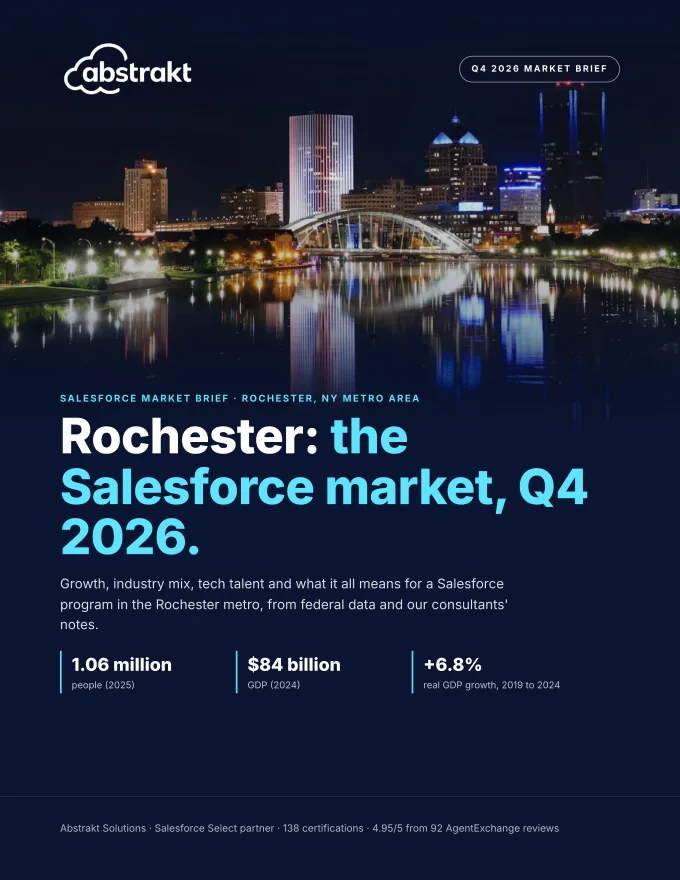
A free 24-page PDF with Rochester's growth ranked against 100 metros, its industry mix, tech wages and nearby markets. It is offered on the public Rochester page; send your customer there or get a copy for your own prep.
Get the Rochester brief →Co-sell with Abstrakt in Rochester
Working a Rochester account? Bring in a named consultant for discovery, scoping or a health check. We reply within 4 business hours.