

How Salesforce work starts in Cleveland
From Cleveland's banks to the industrial manufacturers and health systems of Northeast Ohio, Abstrakt Solutions provides Salesforce consulting as a Salesforce Select partner. Cleveland is one of our focus markets.
What buyers here usually run into
- 1
Legacy orgs at established companies
Long-established companies often run Salesforce orgs built up over many years by different teams. A health check and cleanup usually come before new clouds or AI.
- 2
Field service and distribution
Industrial manufacturers support equipment and distributors across wide territories. Field Service and partner tools only work when they match how technicians and distributors actually operate.
- 3
Marketing data quality
Health and financial organizations with large contact databases often carry invalid records and broken syncs, which undermine compliant marketing until they are fixed.
Budget, team and partner questions
What drives cost
In Cleveland, the history of the org is often the largest variable: years of automation, custom fields and overlapping work from different teams. Core banking or policy integration and Field Service scope come next. A health check before new clouds usually narrows the estimate.
Admin or partner
Banks, insurers and large manufacturers here often have internal Salesforce staff and need a partner for cleanup, integration or a Field Service rollout. Professional services firms and smaller manufacturers more often outsource administration entirely.
What buyers ask a partner
Ask how the partner assesses an older org and decides what to keep. Ask for experience with core banking integration, distributor portals and Field Service across large territories.
The local economy and its biggest industries (4)
| Sector | Share of 2024 GDP | Where Salesforce fits |
|---|---|---|
| Finance and insurance Salesforce for insurance → | 14.5% | With an auto insurer and a bank holding company in Team NEO’s top 10 management and professional services employers, insurers, banks and lenders here need policyholder and client service, agent tools and marketing that passes compliance review. |
| Manufacturing Salesforce for manufacturing → | 12.3% | Manufacturing is the Cleveland metro’s second-largest private sector, and manufacturers here need distributor management, quoting and field service tied to ERP. |
| Health care and social assistance Salesforce for health & life sciences → | 9.7% | Large hospital systems and the region’s biotech and health-tech startups need patient, referral and partner engagement built around privacy and clean data. |
| Professional, scientific, and technical services Salesforce for professional services → | 6.9% | Team NEO treats headquarters and professional services as a target industry, and firms in it need pursuit pipelines, client history and project handoffs that don’t depend on one partner’s inbox. |
Source: U.S. Bureau of Economic Analysis, GDP by county (CAGDP2), 2024, summed to the metro area; private sectors only, excluding real estate and government. “At least” marks sectors where BEA suppresses some county figures.
Regional target sectors named by local economic development groups: Advanced Manufacturing, Healthcare & Biotechnology, Financial Services, Headquarters & Professional Services, Information Technology, Microelectronics & Semiconductor.
Salesforce products that fit Cleveland (6)
In the order we lead with them here, from the industries above.
Salesforce Sales Cloud
The CRM where sales pipeline lives, when it is built right.
Salesforce Service Cloud
The operating system for modern customer service, case, knowledge, voice, and AI agent assist together.
Salesforce Field Service
Scheduling, dispatch, mobile work orders and parts for teams that work on site.
Salesforce Financial Services Cloud
Industry CRM for wealth management, banking, insurance, and lending, built for compliance from the start.
Salesforce Marketing Cloud
Cross-channel marketing, email, mobile, journey, and Data 360-powered personalization at scale.
Salesforce Data 360 (Data Cloud)
Unify customer data into a real-time profile that powers segmentation, analytics, and AI.
Cleveland's banks, plants, and hospitals weigh AI
Three sectors shape AI planning in Cleveland. Finance and insurance, at 14.5% of 2024 metro GDP, fits reply drafting and case summaries for servicing teams that answer account and claims questions. Manufacturing, at 12.3%, fits distributor support and quote follow-up, where an agent pulls order history so reps spend less time searching. Health care, at 9.7%, fits scheduling and billing questions answered from approved material. The common thread is preparation. Customer and account records need deduplication, permission sets need review, and each agent needs a named owner who checks its output and decides when it has earned more responsibility.
- Claims and account case summaries
- Distributor quote follow-up support
- Billing questions from approved material
Services buyers here usually need (7)
Salesforce Optimization in Cleveland
Optimization is often the most useful Salesforce service for Cleveland companies, because many orgs here were implemented long ago and extended by successive admins and partners. The symptoms are familiar: crowded layouts, conflicting automation, dashboards nobody quotes in meetings. Our approach pairs usage statistics with role-by-role interviews, then trims page layouts, folds old workflow rules and Process Builders into documented Flows, merges duplicates and rebuilds the leadership reports. Short, role-based training explains every change, so adoption rises instead of resetting.
By industry in Cleveland
- 1
Finance and insurance
No private industry in the Cleveland metro outproduces banking, lending and insurance, which BEA puts at 14.5% of 2024 output. Banks and insurers here often run orgs that have absorbed years of compliance additions: extra required fields, approval steps and record types for products long discontinued. Optimization asks which controls are still needed, automates the rest in the background and trims what agents and bankers see, so data quality improves because entering it has become easier.
- 2
Manufacturing
Industrial companies across the metro commonly have quoting and opportunity processes layered with automation built by different teams. Rules conflict, approvals route unpredictably and reps keep their own spreadsheets to be safe. We map every automation that fires on quotes and opportunities, consolidate it into a small set of Flows with clear ownership and rebuild pipeline and distributor reports so plant and sales leaders finally look at the same numbers.
- 3
Healthcare & Biotechnology
Healthcare and biotechnology appears on Team NEO's list of Northeast Ohio's key industries. Health organizations and biotech firms tend to have large contact databases in Salesforce and Marketing Cloud, with invalid records and sync errors that quietly damage outreach. Optimization here combines data cleanup, consent validation and a review of how contacts move between the two platforms, so marketing and patient or customer engagement reach the right people without compliance surprises. Suppression lists are rebuilt from the cleaned consent data.
Raise before scoping
Find the shadow spreadsheets
When Cleveland teams keep side spreadsheets, each one marks a place Salesforce failed them. Collect those files during interviews and treat them as requirements, because replacing them with better views or reports is often the quickest adoption win available. Ask owners of each file what question it answers.
Retire automation in order
Workflow rules, Process Builders, Flows and Apex triggers frequently overlap on a single object in long-running Cleveland orgs. Map the full execution order before changing anything, then consolidate one object at a time, testing with real records, so behavior users rely on does not silently disappear.
Measure after relaunch
Agree a few adoption measures, such as login frequency, field completion and dashboard views, before changes go live. Checking them in the following weeks shows whether optimization worked and where a second round of simplification is still needed. Share the results with the teams involved.
Salesforce Health Checks in Cleveland
Health checks suit Cleveland, where many Salesforce orgs have grown for years under different admins and partners. Before adding Data 360 (formerly Data Cloud), Agentforce or another cloud, leaders want to know what they are building on. The scope spans access design, automation layers, custom code, connected systems, record quality and how heavily each team uses the org, informed by conversations with users in several roles and summarized as findings ranked by risk and effort. The report is designed to be acted on, whether your team does the work, we do or another partner does.
By industry in Cleveland
- 1
Finance and insurance
Examiners and internal auditors at Cleveland banks and insurers now ask about CRM controls as routinely as core systems. Our review for these firms lists every route to viewing, editing or exporting client records: overly broad profiles, users whose roles changed long ago, integration users with administrator rights and reports shared across the whole company. Each finding comes with a recommended fix and priority, so risk teams can close gaps before an examiner raises them.
- 2
Healthcare & Biotechnology
Health systems and biotech companies, part of a Team NEO key industry, often find protected or sensitive information stored in fields and notes where it was never meant to be. The health check traces where that data sits, reviews field-level security, sharing and encryption settings and checks whether a Business Associate Agreement and Shield are in place where needed. The result is a clear list of privacy exposures and the order in which to fix them.
- 3
Headquarters & Professional Services
Corporate headquarters teams, which Team NEO counts among the region's strengths, often run orgs shared by several divisions and changed by many admins. A health check maps the overlapping automation, unused custom objects, installed packages nobody owns and Apex code without test coverage. It gives leaders a realistic measure of technical debt, so they can decide whether to fund cleanup before a new cloud or AI project. Each item is tagged with the division that owns it.
Raise before scoping
Check readiness before Agentforce
Agentforce works from the records and permissions already in place, so a Cleveland org with duplicate accounts or loose sharing hands those flaws to every agent conversation. Settle the readiness question with a review before an AI contract is signed, and fix the blocking items first.
Review installed packages
Mature orgs often contain managed packages from past projects that nobody uses but that still hold permissions and data. Include them in the review, confirm owners and licenses, and plan removal of anything unused, since each package adds upgrade and security risk.
Repeat the check periodically
A single review is a snapshot. Organizations with regulated data or frequent changes benefit from a lighter follow-up review each year, which confirms earlier fixes stayed in place and catches new risks before they grow. Tie it to your annual audit calendar.
Salesforce Implementation in Cleveland
A Cleveland implementation usually has to respect how long-established companies already operate. Industrial manufacturers sell through distributors and support installed equipment, banks manage deep commercial relationships, and software firms want a pipeline that scales. We begin with discovery workshops that map those processes, then design accounts, channels and security before any configuration, build in a sandbox against real scenarios and release in phases. Each phase ends with role-based training, so reps, bankers and technicians use the system from their first day rather than after a long wait.
By industry in Cleveland
- 1
Advanced Manufacturing
Team NEO names advanced manufacturing among Northeast Ohio's key industries, and the region is home to coatings, welding and motion-control producers with national reach. For these companies an implementation lives or dies on the account hierarchy: end users, distributors, contractors and buying groups all need a place. We model those relationships first, decide how distributor sales will be tracked and plan the product catalog around ERP part numbers, before any page layout is designed.
- 2
Financial Services
Financial services is another Team NEO key industry, and finance and insurance is Cleveland's largest private sector at 14.5% of 2024 GDP. A bank or insurer implementing Salesforce here needs relationship and household structures, referral tracking between lines of business and permissions strict enough for examiners. We settle whether Financial Services Cloud fits during discovery and design sharing around branches and teams before a single user is loaded.
- 3
Information Technology
Information technology rounds out the Team NEO industries we see most often in first-time builds, supported by local accelerators for software and health-tech founders. Young software companies need a Sales Cloud org that handles trials, subscriptions and renewals without heavy customization. We implement a clean opportunity process, product and pricing setup that fits recurring revenue and dashboards investors will recognize, keeping the design simple enough for a small team to administer.
Raise before scoping
Define the channel early
Cleveland manufacturers often sell direct to large accounts and through distributors everywhere else. Decide in design whether distributors become accounts, partner users or both, because that choice drives sharing, forecasting and any future portal, and changing it after launch means reworking security.
Tie product data to ERP
Industrial catalogs can run to thousands of part numbers with customer-specific pricing. Plan how products and price books will flow from ERP into Salesforce as part of the implementation, not as a later integration, so quotes are right from the first day.
Include field teams in design
Technicians and service coordinators know how equipment work really happens. Bring them into workshops alongside sales leaders, so service territories, work orders and asset records reflect real jobs and do not require a redesign once Field Service reaches the field.
Salesforce Integration in Cleveland
Integration work in Cleveland usually involves established systems that are not going anywhere: ERPs running manufacturing operations, core banking platforms and clinical or scheduling systems in health care. The goal is to give sales and service teams the data they need without making Salesforce a competing copy. We map systems and owners, agree which system is authoritative for each entity, choose MuleSoft, a connector or custom Apex according to volume and complexity, test with realistic data and deliver alerting and a runbook so failures are found early.
By industry in Cleveland
- 1
Manufacturing
Manufacturing contributes 12.3% of Cleveland metro GDP, second only to finance and insurance. Coatings, welding and motion-control producers keep orders, inventory, pricing and service parts in ERP, while sales and service work in Salesforce. We connect accounts, products, quotes and orders so reps can see availability and order status, approved quotes flow into ERP without re-keying and technicians see parts information on their work orders, with every failed transaction logged and alerted.
- 2
Financial Services
Banks and insurers in Team NEO's financial services sector rely on core and policy systems that are tightly controlled. Integrations must respect change windows, security reviews and strict limits on what data leaves the core. We usually start read-only, bringing balances, products or policy summaries into Financial Services Cloud, and add write-back only for narrow, audited cases such as updated contact details once the data model and controls have proved reliable.
- 3
Health care and social assistance
Health organizations need Salesforce connected to scheduling, EHR and referral systems while keeping protected information to a minimum. We agree field by field what crosses into Salesforce, use middleware with audit logging and encryption where required and document the authoritative source for demographics and referral status. Privacy officers can then approve the design before build, rather than reviewing an integration after it already moves data. Test data is de-identified wherever the source system allows it.
Raise before scoping
Inventory existing point connections
Long-lived Cleveland orgs often have integrations built by several vendors over the years, some undocumented. List every connection, its owner and its schedule before designing new ones, so the new architecture replaces old links instead of adding to a tangle.
Test with realistic volumes
Industrial price books, order histories and patient or client records can be large. Test integrations against production-scale data in a full or partial sandbox, because designs that work with a few hundred records can hit API and governor limits in production.
Assign an owner for errors
Every integration will occasionally fail. Decide who receives alerts, who can reprocess failed records and who contacts the other system's team, and write it into a runbook, so failures are resolved quickly rather than discovered by customers. Review failure patterns monthly with the owners of each system.
Salesforce Managed Services in Cleveland
Many Cleveland organizations have used Salesforce for years, and the challenge now is keeping a mature org reliable while the business keeps requesting changes. Managed services gives them a standing team: an intake queue with agreed priorities, sandbox testing of each Salesforce release, monitoring of ERP and marketing integrations, steady retirement of old automation and a monthly review with the business owner. Your internal admin stays close to users while we supply development, integration and architecture skills that are hard to hire in one person.
By industry in Cleveland
- 1
Health care and social assistance
Hospitals, clinics and social-service providers account for 9.7% of Cleveland's 2024 metro output. Those organizations revise referral pathways, outreach programs and consent language all year, and any one revision can widen who sees patient details. Through managed services we route those requests through permission review, test in a sandbox, document who approved each change and check every Salesforce release for effects on patient-related data, keeping privacy officers informed without slowing the teams that depend on the system.
- 2
Headquarters & Professional Services
Team NEO highlights headquarters and professional services as a key industry and credits the region with headquarters employment growth ahead of the nation since 1990. Corporate teams at these headquarters often own a single org shared by several divisions, each with different priorities. We give such teams a shared intake board, a monthly session where division leads trade off priorities openly and plain-language notes after each release, which ends the sense that one division always goes last.
- 3
Manufacturing
At Cleveland manufacturers, daily ERP updates to prices, stock and customer terms have to land in Salesforce without anyone noticing the handoff. When a sync fails or a sales territory is redrawn, reps and distributors feel it quickly. Our managed services team monitors those integrations, updates assignment rules and price books as they change and maintains Field Service configuration as technician teams and service areas shift, so small changes do not pile up into a disruptive project later.
Raise before scoping
Document the long-tenured org
Cleveland orgs built over many years usually carry decisions that live only in someone's memory. Starting managed services is the moment to record why key fields, automations and integrations exist, so support continues smoothly when staff move on or retire.
Protect time for technical debt
Request queues rarely leave room for retiring old workflow rules and unused fields. Reserve a portion of each month for cleanup, agreed with the business owner, so the org gets gradually simpler instead of heavier with every quarter of new requests.
Coordinate marketing and CRM owners
Marketing Cloud and the CRM are often managed by different Cleveland teams. Bring both into the same managed services review, because broken syncs and invalid contacts usually sit between the two platforms, where neither team alone is accountable for fixing them.
Salesforce Implementation Rescue in Cleveland
Cleveland rescues often start with a project that tried to modernize an old org at once, or a new cloud layered onto unresolved technical debt. When the go-live slips or users reject the result, we step in with a recovery assessment covering the build, the data and the original scope. While the plan forms, we clear the defects that keep people from doing their jobs. Next, components are sorted by whether they survive as built, need repair or must be replaced, and the finish happens in documented phases your staff can maintain.
By industry in Cleveland
- 1
Microelectronics & Semiconductor
Microelectronics and semiconductor companies, a Team NEO key industry, sell complex products with long qualification cycles and strict quality documentation. Their Salesforce projects stall when a generic pipeline ignores design-in stages, samples and customer qualification. Recovery reshapes opportunities around those steps, links quality documents to accounts and products and stabilizes any ERP connection feeding orders, so sales and engineering can plan from the same records. Field application engineers review the rebuilt stages before release.
- 2
Health care and social assistance
Some Cleveland health organizations contact us after an outreach or service rollout left gaps in security, queue design or intake. Staff drift back to phones and paper, and privacy officers become wary. We correct access and consent settings first, then redesign intake and case handling alongside the nurses, coordinators and support staff who will use it. Privacy officers review the corrected design before anyone is invited back, and each unit gets its own training session.
- 3
Financial Services
Financial services projects in the region, a Team NEO key industry, often stall at core system integration or at a Financial Services Cloud data model that never matched the bank's structure. We test integrations to see what really moves, stabilize the data bankers rely on and decide whether the model can be corrected or needs partial redesign. The first goal is a relationship view bankers trust, before new features are added.
Raise before scoping
Freeze new scope
During a Cleveland rescue, stakeholders often add requests to make up for lost time. Pause new scope until the org is stable and the recovery plan is agreed, otherwise the project keeps moving targets and the same slippage repeats. Log new ideas for a later phase.
Hear from the users directly
Sponsors and project teams see a troubled build differently from the people using it every day. Interview reps, bankers or care staff early in the assessment, because their workarounds reveal which defects actually block work and which are cosmetic. Visit their desks if you can.
Secure vendor handover materials
If the original partner is leaving, request credentials, deployment pipelines, design documents and open defect lists before their access ends. Rotate passwords and integration keys they held, and confirm your company owns every account needed to run the org. Do this in the first week.
Salesforce Migration in Cleveland
Cleveland migrations often involve older systems with long histories: a CRM chosen well over a decade ago, a desktop database built by a former employee, or spreadsheets maintained by each sales territory. Moving that history is less about tools than decisions. Each source gets profiled, the owning teams approve the mappings, duplicates and formats are fixed in staging, and sandbox trial loads are reconciled with you. Cutover follows a dated plan with a freeze window, so nothing entered late is lost.
By industry in Cleveland
- 1
Professional, scientific, and technical services
In Cleveland, law, accounting, engineering and consulting practices form a sector worth 6.9% of 2024 metro GDP. Law, accounting, engineering and consulting firms in Cleveland frequently move from an older CRM or practice-management tool where client contacts, matters or projects are tangled together. Migration means separating clients from engagements, merging duplicate contacts across partners' lists and deciding how much past activity to carry forward, so client relationships stay visible without importing decades of clutter. Conflict-check data usually stays in the practice system.
- 2
Information Technology
Technology companies, one of Team NEO's key industries, often start on HubSpot or a starter CRM and move to Salesforce once sales complexity grows. Their migrations bring deals, subscription data and marketing engagement across platforms that model them differently. We map deal stages to a clean opportunity process, carry product and renewal data into structures that support recurring revenue and decide which marketing history belongs in the CRM and which should stay in marketing tools.
- 3
Advanced Manufacturing
Advanced manufacturers in Northeast Ohio often hold customer data in an ERP, a legacy CRM and regional reps' spreadsheets. The biggest migration task is reconciling accounts: the same distributor or plant can appear under different names and numbers in each source. We match on ERP customer numbers, build a single account hierarchy and load contacts and open opportunities against it, so reps and service teams start from one agreed list of customers.
Raise before scoping
Find every data source
Older Cleveland companies often have customer data in places nobody listed at kickoff, such as a regional office database or a departed rep's files. Survey each team early so late discoveries do not force another load after users are already working in Salesforce.
Use ERP numbers as anchors
When customers appear under different names across systems, ERP customer numbers are usually the most reliable key. Carry them into Salesforce as external IDs, which makes matching easier during migration and keeps later integrations straightforward. Flag records with no ERP number for manual review.
Reconcile before users see it
After each trial load, check counts, dollar totals and a set of well-known customer records in both systems. Have business owners sign off on the reconciliation before cutover, so disputes about missing data are settled before go-live, not after. Keep the reconciliation sheets for audit purposes.
Industry plays in Cleveland (4)
Salesforce for Cleveland Manufacturers
Northeast Ohio manufacturers often sell engineered parts and systems through a mix of direct accounts and industrial distributors, and much of their revenue comes from replacement parts and repeat orders. Salesforce helps when it shows sell-through as well as sell-in, supports quotes for custom and made-to-print parts, and gives inside sales and customer service the same order and quality history. We connect it to the ERP and design the account model around distributors, end users and the engineers who specify your product.
Behind finance and insurance, factories are the Cleveland metro's second pillar, generating 12.3% of 2024 GDP in the Bureau of Economic Analysis's county data, while wholesalers add 6.6%. Team NEO, which markets a larger Northeast Ohio region, targets advanced manufacturing and a newer microelectronics and semiconductor sector, alongside information technology and healthcare and biotechnology. Cleveland's university research programs and startup accelerators give established plants access to engineering talent and young technology suppliers.
Use cases to open with
- 1
Distributor sell-through visibility
Industrial distributors carry much of the region's component volume, but manufacturers often see only their own shipments to the distributor. We load point-of-sale or sell-through data into Salesforce by end customer and territory, so regional managers know which plants are actually buying, which distributors are growing your line, and where a direct call from an application engineer could win a specification that is up for review.
- 2
Quoting custom made-to-print parts
Custom and made-to-print parts require engineering review, routing estimates and material costs before a price goes out. Revenue Cloud or CPQ can gather the request, route it through engineering and costing with clear due dates, and produce a quote tied to ERP cost data. Sales stops chasing status by email, and management sees quote turnaround and win rates by customer, part family and estimator.
- 3
Quality and returns handling
When a customer reports a nonconforming part, service, quality and sales all need the same facts. Service Cloud logs the complaint against the order, lot and part number, routes it for root-cause work, and tracks credits or replacements. Recurring issues become visible by product and plant, and account managers walk into reviews knowing exactly what happened and what was fixed.
Raise before scoping
Model end users and distributors
Distributors, OEM customers and the engineers who specify your parts are different records with different owners. Define how they relate, how sell-through data is matched to end users, and which team owns each relationship before you build forecasts or commission rules.
Link to quality systems
Nonconformance, corrective action and certification records usually live in a quality management system. Pull summaries and status into Salesforce so customer-facing teams can answer questions, but keep the controlled documents, signatures and approvals where your auditors and customer quality engineers expect to find them.
Plan for legacy ERP data
Many long-established plants run older ERP versions with inconsistent customer and part data. Budget time to clean and de-duplicate accounts before migration, and agree on a matching rule, or reports in Salesforce will inherit the same confusion your team already works around.
Salesforce for Cleveland Insurers and Brokers
Insurance in Cleveland spans direct-to-consumer carriers with large service operations and commercial brokers covering the region's manufacturers, health systems and professional firms. Salesforce supports both: service teams handle high-volume policyholder contacts from one view, and commercial producers manage complex accounts with many lines, locations and renewal dates. We build on Financial Services Cloud, integrate with policy, billing and agency management systems, and set up reporting that shows retention and cross-sell rather than just new business.
The Bureau of Economic Analysis's 2024 county data shows finance and insurance as the leading private sector around Cleveland, at 14.5% of metro GDP, just ahead of manufacturing. Financial services appears on Team NEO's list of regional target industries. For insurers and brokers, the industrial base matters as much as households: manufacturers, wholesalers and health care providers, which together account for a large share of the economy, are the commercial clients that buy property, casualty, workers' compensation and benefits coverage here.
Use cases to open with
- 1
Commercial account planning
A single manufacturing client may carry property, general liability, auto, workers' compensation, cyber and benefits across several carriers and locations. Financial Services Cloud can model the account with every policy, location and renewal date, and account teams build renewal plans that start well ahead of expiration. Producers see coverage gaps and cross-sell openings, and leadership tracks retention by client segment and producer.
- 2
High-volume policyholder service
Direct carriers field large numbers of calls, chats and emails about billing, policy changes and claims. Service Cloud routes contacts by type and customer value, gives agents policy context from core systems, and suggests next steps. Agentforce can resolve simple requests such as ID card copies or payment dates, freeing licensed staff for changes that require judgment and a license.
- 3
Renewal and remarketing workflow
Brokers and independent agencies need to collect updated exposures, market accounts to carriers and present options before renewal. Salesforce can generate renewal tasks at set intervals, track carrier submissions and quotes, and store proposals with the account. Managers see which renewals are behind schedule, and producers stop relying on personal calendars to manage their largest clients. Carrier responses and declinations are stored too, which helps when the account is marketed again next year.
Raise before scoping
Integrate agency management systems
Brokers keep policies, commissions and documents in an agency management system. Decide what Salesforce will own, typically relationships, pipeline and service activity, and sync policy data in on a schedule so producers do not update two systems with the same information.
Segment consumer and commercial
Personal lines and commercial accounts behave differently and often have separate teams. Use distinct record types, page layouts and sharing so each group sees relevant fields, and keep household and business account models from colliding in reports and marketing lists.
Secure claims and health data
Workers' compensation and benefits files can contain medical information. Restrict access with field-level security and permission sets, consider encryption for sensitive fields, and review data retention with compliance before migrating historical claims into Salesforce. Claims advocates may need more access than producers, so design roles around the actual job.
Salesforce for Cleveland Health Care and Life Sciences
Cleveland's health sector pairs large hospital systems with a steady flow of startups trying to sell into them. Salesforce serves both sides. Hospital service lines track which outside physicians send them patients, answer access-center calls and run outreach, all drawing on EHR data rather than retyping it. Research and commercialization offices track licensing and industry partners. Health-tech companies manage pilots, health system buyers and support. We build permissions around protected health information first, then shape each process around how the organization actually earns referrals, partners or customers.
Cleveland's hospitals, clinics and social service agencies account for 9.7% of the metro economy in BEA's 2024 county figures; only financial firms, at 14.5%, and factories, at 12.3%, contribute more. Team NEO counts healthcare and biotech on its industry roster for the fourteen-county region. A major health system is based on Euclid Avenue, a private research university counts among the nation's top 25 private universities in federal research spending and runs a 50,000-square-foot innovation center, and a Cleveland nonprofit operates a health-tech accelerator. That combination produces a steady pipeline of ventures that need hospital partners.
Use cases to open with
- 1
Referring physician relations
Specialty programs depend on physicians across Northeast Ohio and beyond who send patients for complex care. Salesforce can track each referring practice, its physicians, referral volume and liaison visits, and alert the physician relations team when a practice's referrals decline. Referral coordinators log closing-the-loop communication, so referring doctors hear back about their patients, which is often what keeps the referrals coming.
- 2
Health-tech pilot management
A startup selling to hospitals often runs a pilot first, involving clinical champions, IT security reviews, data agreements and success measures. Sales Cloud can treat each pilot as a structured opportunity with milestones and stakeholders, while Service Cloud tracks issues raised during the pilot. Founders see which pilots are close to converting into enterprise contracts and which have quietly stalled in security or legal review.
- 3
Technology licensing and partners
Commercialization offices field interest from companies wanting to license inventions, sponsor research or collaborate. Salesforce can record each technology, interested company, agreement stage and inventor contact, with documents attached. Licensing associates avoid contacting the same company twice about different inventions, leadership sees the whole licensing pipeline in one dashboard, and inventors get clearer updates on where their work stands with each prospective licensee.
Raise before scoping
Clean the contact data
Large health organizations accumulate duplicate physician and patient contacts across departments. Before migrating, agree on matching rules, a master source for provider data such as NPI registries, and ownership for ongoing cleanup, or reports on referral volume will never reconcile.
Security review for startups
Health-tech firms selling to Cleveland hospitals face detailed security questionnaires. Keep patient data out of your CRM unless required, document access controls and integrations, and be ready to show how Salesforce settings support the answers you give prospective hospital customers.
Separate licensing from care
Research commercialization data, donor relationships and patient engagement carry different confidentiality rules. If they share an org, keep them in distinct objects with separate permission sets, and confirm with privacy and legal teams which staff may see across those boundaries.
Salesforce for Cleveland Professional Services Firms
Professional services firms in Cleveland tend to win and keep business through deep relationships with a limited number of large regional headquarters, from industrial companies to insurers and banks. Salesforce helps those firms see every relationship and open matter across a client, manage proposals and pursuits, and plan growth for key accounts. It also supports thought-leadership marketing and event follow-up. Billed fees and work in progress flow in from the practice management system, so a partner opening a client record sees money earned and money pursued side by side.
Accountants, consultants, engineers, lawyers and agencies, grouped by BEA as professional, scientific and technical services, produced 6.9% of Cleveland's 2024 output, fourth among private sectors. Team NEO pairs headquarters with professional services as a single target, and it reports that corporate headquarters jobs in the region have grown faster than the national rate since 1990. Insurers, banks and industrial manufacturers all run corporate headquarters here, so much professional work happens inside those offices. Those headquarters are also the firms' main buyers.
Use cases to open with
- 1
Key account growth plans
When a handful of headquarters clients produce much of a firm's revenue, each deserves a written growth plan. Salesforce can hold relationship maps, active engagements, whitespace by service line and planned next conversations for every key account. Partners review plans in client team meetings from one dashboard, and leadership can see whether cross-selling across audit, tax, advisory or engineering practices is actually happening.
- 2
Proposals and pursuit tracking
Requests for proposal from corporate procurement teams arrive with tight deadlines and many contributors. Sales Cloud can track each pursuit, the client's decision team, competing firms and fee assumptions, and store past proposals, résumés and qualifications for reuse. Revenue Cloud or CPQ can standardize fee estimates by role and phase, giving partners consistent pricing and finance a view of margin before submission.
- 3
Thought leadership to pipeline
Firms invest in webinars, research reports and client events aimed at executives in finance, operations and technology. Marketing Cloud or Account Engagement can capture registrations and engagement, score interest by account, and send warm follow-ups to the right partner. Practice leaders can finally connect specific events and publications to the meetings, proposals and new engagements that followed, rather than guessing at their return.
Raise before scoping
Conflict and independence checks
Audit, legal-adjacent and advisory firms often run conflict or independence checks before accepting work. Decide whether those checks stay in a dedicated system or feed Salesforce, and make sure no proposal advances past a defined stage until clearance is recorded.
Relationship data from inboxes
Partner relationships live largely in email and calendars. Einstein Activity Capture or similar tools can log activity automatically, but set rules about which emails sync, how confidential client messages are handled, and who can see relationship notes for sensitive accounts.
Tie to time and billing
Revenue, realization and work in progress come from time and billing systems. Integrate the key figures into client records on a regular schedule, and agree on definitions, so partners and finance discuss the same numbers in account reviews instead of debating reports.
Case studies to send (3)
From the industries this market leans on. Client names are anonymized and these projects are not specific to Cleveland.
The Cleveland Salesforce market brief, Q4 2026
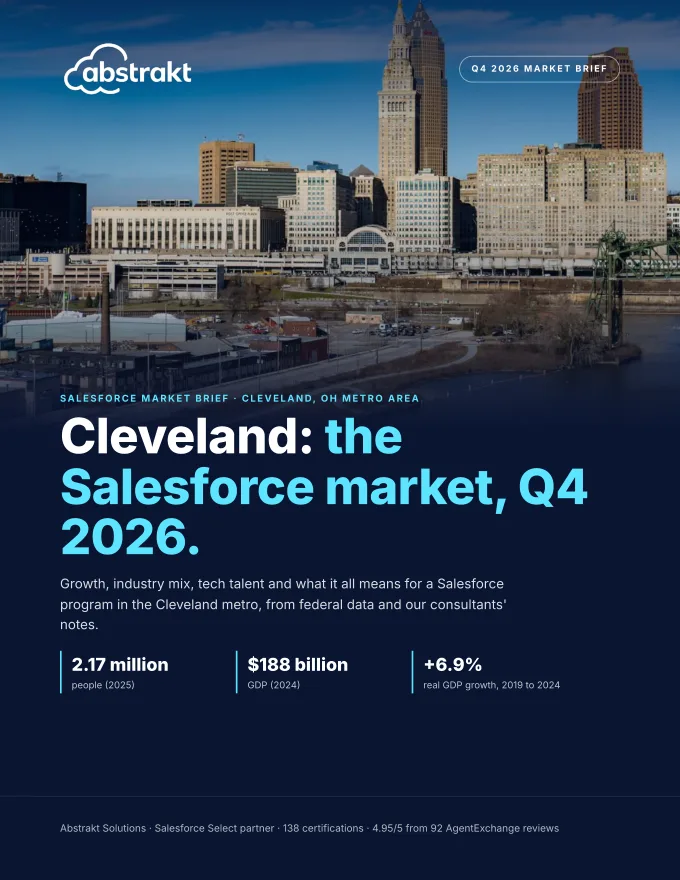
A free 25-page PDF with Cleveland's growth ranked against 100 metros, its industry mix, tech wages and nearby markets. It is offered on the public Cleveland page; send your customer there or get a copy for your own prep.
Get the Cleveland brief →Co-sell with Abstrakt in Cleveland
Working a Cleveland account? Bring in a named consultant for discovery, scoping or a health check. We reply within 4 business hours.