

How Salesforce work starts in Indianapolis
Central Indiana manufacturers, life-sciences companies and insurers are where Abstrakt Solutions, a Salesforce Consulting Partner, concentrates its work in this market. Indianapolis is one of our focus markets.
What buyers here usually run into
- 1
Aftermarket and dealer service
Equipment makers often manage warranty, parts and dealer questions by email. Service Cloud and a partner portal can give dealers answers without a phone call.
- 2
Regulated life-sciences engagement
Pharmaceutical, diagnostics and device companies need consent, audit trails and approved content built into Salesforce from the first release.
- 3
ERP and CRM out of step
When orders, pricing and inventory live only in ERP, reps quote from stale numbers. Integration is usually the step that makes the rest of the system trusted.
Budget, team and partner questions
What drives cost
Indianapolis scope is usually driven by ERP integration depth, configured-product quoting and the size of the dealer network that needs portal access. Life sciences companies add validation documentation and complaint handling. Health plans add core system integration and role-based restrictions on member data.
Admin or partner
Large manufacturers and insurers here often have internal Salesforce staff and use a partner for architecture, MuleSoft work or a Field Service rollout. Mid-sized makers and IT firms more often use managed services for administration and releases.
What buyers ask a partner
Ask for experience with ERP-connected quoting, dealer portals and installed-base data. Life sciences buyers should ask how the partner handles complaint intake and audit trails.
The local economy and its biggest industries (4)
| Sector | Share of 2024 GDP | Where Salesforce fits |
|---|---|---|
| Manufacturing Salesforce for manufacturing → | 17.1% | With powertrain and aircraft engine producers among the region’s manufacturers, industrial companies here often need quoting, dealer and distributor management, and aftermarket service connected to ERP. |
| Health care and social assistance Salesforce for health & life sciences → | at least 8.4% | Academic and community health systems and the region’s pharmaceutical, diagnostics and medical-device companies need patient, provider and customer service built around privacy and regulated communication. |
| Professional, scientific, and technical services Salesforce for professional services → | at least 8.1% | Software, IT and research firms, including those around 16 Tech and the universities, run subscription and project sales where pipeline, renewals and delivery handoffs need to live in one system. |
| Finance and insurance Salesforce for insurance → | at least 7.5% | Insurers, health plans and financial firms in Central Indiana need member and policyholder service, agent tools and marketing that passes compliance review. |
Source: U.S. Bureau of Economic Analysis, GDP by county (CAGDP2), 2024, summed to the metro area; private sectors only, excluding real estate and government. “At least” marks sectors where BEA suppresses some county figures.
Regional target sectors named by local economic development groups: Advanced Manufacturing, Life Sciences (Pharmaceuticals; Medical Devices), I.T. & Data, Automotive & Mobility, Sports Business, Logistics.
Salesforce products that fit Indianapolis (6)
In the order we lead with them here, from the industries above.
Salesforce Sales Cloud
The CRM where sales pipeline lives, when it is built right.
Salesforce Service Cloud
The operating system for modern customer service, case, knowledge, voice, and AI agent assist together.
Salesforce Revenue Cloud / CPQ
Configure-price-quote, billing, subscription management, and quote-to-cash on Salesforce.
Salesforce Experience Cloud
Customer, partner, and employee portals built on Salesforce.
Salesforce Agentforce
AI agents that handle real work inside Sales Cloud, Service Cloud, and Marketing Cloud.
MuleSoft
Enterprise API platform, for connecting Salesforce, ERP, data warehouses, and the rest of your stack.
Agentforce on Indianapolis factory floors and in pharma support
Manufacturing is the heavyweight in Indianapolis, generating 17.1% of metro GDP in 2024 according to BEA. That points AI toward service and field operations first. An agent can read maintenance notes and parts history, then suggest likely fixes to a technician working an equipment work order in Field Service. Pharmaceutical and medical device companies, part of the region's life sciences focus, can use case summaries to speed up product inquiry intake, though adverse event reports must still route to qualified reviewers. Logistics operators may start with forecasting support for shipper accounts. All three require consistent asset and product records, because an agent guesses badly when serial numbers and part codes disagree.
- Fix suggestions from maintenance history
- Product inquiry intake summaries
- Shipper account forecasting support
Services buyers here usually need (7)
Salesforce Implementation in Indianapolis
In Indianapolis, a Salesforce implementation frequently begins on the industrial side of the business: an equipment or components maker that needs quoting, dealer relationships and aftermarket service in one system. Life-sciences and insurance companies bring a different priority, regulated communication and member or provider records. We run discovery with sales, service and compliance leads, design objects and security around those realities, configure in a sandbox, connect the ERP where quoting depends on it, and go live in phases with role-based training.
By industry in Indianapolis
- 1
Manufacturing
BEA's county figures credit manufacturing with about 17.1% of 2024 metro GDP, more than any other private sector here, and Indy Partnership lists advanced manufacturing as a target. Powertrain, engine and component makers here typically sell through dealers and distributors and support equipment for years after the sale. Their implementations work best when the installed-base model is designed alongside accounts and opportunities, so warranty, parts and service history attach to the right machine and the right dealer from day one.
- 2
Life Sciences
Pharmaceutical and medical-device companies make up the life-sciences sector Indy Partnership targets. For a device or diagnostics firm implementing Salesforce, the complaint path usually drives the design more than the sales process does. We define which cases may be reportable, what fields and timestamps they require and how they reach the quality system, then build sales and account management around that foundation. Validation documentation is planned from the start rather than written after the build is finished.
- 3
Sports Business
Indy Partnership names sports business among the region's target sectors. Teams, venues, governing bodies and event organizers implementing Salesforce juggle sponsors, ticket buyers, members and volunteers, each with a different relationship to the organization. The key implementation decision is a data model where one person can hold several of those roles without duplicate records. We usually phase sponsorship sales first, then fan or member service, then event-specific portals once the core data is stable.
Raise before scoping
Model the installed base early
Equipment makers in Central Indiana support products long after the sale. Decide in the first design sessions whether assets, serial numbers and warranty terms live in Salesforce or are read from ERP, because service, dealer access and renewal forecasting all depend on that single choice.
Give dealers a portal plan
If dealers or distributors will eventually log in, design the sharing model with them in mind even when the portal ships in a later phase. Adding external users after launch tends to mean redoing roles, record ownership and sharing rules at the worst possible time.
Plan validation for regulated teams
Life-sciences companies may need documented testing evidence for Salesforce functions that touch complaints or regulated communication. Agree with quality staff which features fall in scope, write test scripts alongside user stories, and budget time for execution and sign-off before each phase can go live.
Salesforce Integration in Indianapolis
Integration projects in Indianapolis tend to follow the flow of physical goods. Manufacturers need Salesforce connected to ERP for pricing, orders and warranty; logistics companies want shipment status beside customer accounts; life-sciences firms need complaint cases handed cleanly to quality systems. We document which system owns each data element, choose MuleSoft, Workato or direct APIs based on scale and maintenance, build with production-sized test data, and add monitoring so failures surface in your team's alerts rather than in customer calls.
By industry in Indianapolis
- 1
Logistics
The Indy Chamber and Indy Partnership both put logistics on their list of target sectors. For distribution and freight companies, integration usually means bringing shipment, tracking and billing events from a transportation or warehouse system into Salesforce, so account managers and service reps can answer customers without switching screens. Event volumes can be high, so we summarize and filter them before they reach Salesforce, keeping storage and API usage under control while still flagging exceptions quickly.
- 2
Manufacturing
Industrial companies in the region often run one ERP per plant or acquisition. Integrating Salesforce with several ERPs means deciding which customer number wins, how product codes map across systems and where orders originate. We design a canonical customer and product model in MuleSoft, map each ERP to it, and give Salesforce a single view of orders and invoices. Adding a new plant later then means mapping one more system, not rebuilding the whole integration.
- 3
Life Sciences
For pharmaceutical and device companies in Indy Partnership's life-sciences sector, integration carries regulatory weight. A service case that may describe an adverse event or device complaint has to reach the quality or safety system intact, with timestamps and required fields preserved. We design those handoffs together with quality and regulatory staff, log every transfer and set alerts for failures, so there is evidence of what moved and when if an inspector asks.
Raise before scoping
Plan one integration layer
Several point-to-point connections built over time are hard to monitor and harder to change. For Indianapolis companies with multiple ERPs or warehouses, a shared API layer in MuleSoft lets each system connect once and serve several consumers, including Salesforce, portals and analytics tools.
Size for peak volumes
Month-end orders, seasonal shipping peaks and bulk price updates can push integrations past Salesforce API limits. Test with the highest realistic volumes, not averages, and design batching and retries so a busy day does not leave records half-synced and users confused about which figures are current.
Keep dealer portals in sync
When dealers or distributors see orders or warranty status in an Experience Cloud portal, that data comes through the same integrations reps rely on. Design once for both audiences, with sharing rules that limit each dealer to its own records and its own end customers.
Salesforce Optimization in Indianapolis
Indianapolis clients typically ask for optimization after several years of expansion. New products, acquisitions or a shift to subscription sales have added fields, record types and automation faster than anyone could tidy them. We measure how each team actually uses the org, remove clutter, consolidate automation into a few documented Flows, clean the data that reports depend on and rebuild dashboards around agreed numbers. Improvements reach users one at a time, each introduced with a brief walkthrough.
By industry in Indianapolis
- 1
Professional, scientific, and technical services
Professional, scientific and technical services represent at least 8.1% of metro output. Consulting, engineering, IT and research firms in the region often ask Salesforce to cover pipeline, resource planning and renewals at once, and the org grows tangled. Optimization for them usually means separating new business from renewals and change orders, simplifying opportunity stages to match how work is actually won, and giving delivery leads a clear view of what has sold and when it starts.
- 2
Manufacturing
For manufacturers, the most common optimization target is the handoff between quoting and ERP. Reps may re-enter quote details into order screens, or discount approvals may route through email instead of Salesforce. We trace that path end to end, remove duplicate entry, move approvals into the system with clear thresholds, and rebuild the dashboards plant and sales leaders use to compare booked orders against forecast. The aim is fewer steps for reps and fewer surprises for operations.
- 3
Finance and insurance
Insurers and health plans in Central Indiana often run service and agent teams in the same org, each with separate page layouts and processes added over the years. Optimization reviews case routing, entitlements and agent-facing screens together, since fixes in one area often affect another. We simplify the queues, retire unused record types and give supervisors reports that show response times and backlog by team, rather than raw case counts that invite argument.
Raise before scoping
Start with the loudest workaround
Every org has a workaround everyone knows about, such as a shared spreadsheet or a weekly export. Find it, ask why it exists, and fix the underlying gap in Salesforce. Retiring one visible workaround does more for credibility than dozens of changes users never notice.
Consolidate automation by object
Review every workflow rule, Process Builder, Flow and trigger on each key object together. Moving them into one or two Flows per object, with a clear order of execution, prevents conflicting updates and makes later changes safer for whoever maintains the org next.
Train on the change, briefly
Users do not need a full course after an optimization release. Short sessions or recorded walkthroughs showing only what changed, and why, keep adoption moving.
Salesforce Health Checks in Indianapolis
Indianapolis companies usually request a health check at a turning point: a regulated product launch, an insurer's audit cycle, a merger, or a plan to put Agentforce in front of customers. We examine permissions and sharing, external user access, integration users, automation, Apex and Lightning components, data quality and storage, and compare them with current Salesforce guidance. Findings arrive in a ranked report, walked through with your team in a results session, with clear next steps and the option to have us remediate.
By industry in Indianapolis
- 1
Life Sciences
Pharmaceutical and medical-device firms in Indy Partnership's life-sciences sector often use Salesforce for provider engagement and product inquiries, which can put regulated information inside the CRM. A health check confirms field history and audit trail settings, looks for sensitive data in free-text fields and attachments, and reviews who can export records. It also identifies validated functions whose configuration has drifted since their last documented test, which matters before the next inspection.
- 2
Finance and insurance
Insurers and health plans in Central Indiana give brokers, agents and sometimes members access to Salesforce through portals. The review concentrates on that external exposure: sharing sets, guest user permissions, Experience Cloud settings and API access. We also test whether internal roles still reflect current job functions, since org charts change faster than profiles do, and list every user with modify-all or export permissions for your security team to confirm.
- 3
I.T. & Data
Software and data firms, part of the I.T. and data sector Indy Partnership targets, tend to build heavily on Salesforce with custom code and many integrations. Their health check leans toward technical debt: Apex test coverage and quality, hard-coded IDs, triggers without a framework, deprecated APIs and connected apps nobody owns. Each finding carries a risk rating and a suggested fix, giving engineering leaders a backlog they can schedule against product work.
Raise before scoping
Review before Agentforce goes live
An agent answering customers can surface anything its permissions allow. Before a pilot, confirm which objects, fields and knowledge articles it can reach, remove stale or contradictory articles, and check that sensitive fields are protected. A focused pre-AI review costs far less than correcting an exposure afterward.
Include external users
Dealer, broker and patient portals widen the audience that can reach your data. Make sure the health check covers Experience Cloud sharing, guest access and self-registration settings, not only internal profiles, since external access is where misconfigurations are most likely to matter.
Repeat the review yearly
Orgs change every month through new fields, flows and integrations. A yearly health check, or one before each major initiative, catches drift early. Comparing results from one year to the next also shows leadership whether technical debt is shrinking or quietly growing.
Salesforce Managed Services in Indianapolis
Indianapolis organizations that choose managed services usually have Salesforce running and a growing list of changes nobody has time to make. Health organizations need access and consent updates handled carefully, suppliers need dealer and service changes, and technology firms want new features shipped each month. We take one queue of requests, rank it with you, test each Salesforce release against your customizations, maintain MuleSoft and other integrations, and report monthly on what shipped and what comes next.
By industry in Indianapolis
- 1
Health care and social assistance
At least 8.4% of metro GDP comes from health care and social assistance, and Indy Partnership lists life sciences, including medical devices, among its focus industries. Providers who use Salesforce for outreach or referral intake need small changes made often, and made safely. Our managed services team documents each request, tests it in a sandbox with realistic records, and checks every Salesforce release for impacts on consent, sharing and patient-facing communications before users see anything new.
- 2
Automotive & Mobility
Automotive and mobility is one of Indy Partnership's target sectors, covering vehicle, powertrain and component suppliers. Their Salesforce orgs carry dealer networks, program forecasts and warranty cases that change as models launch or programs end. A managed services arrangement handles those ongoing adjustments, such as onboarding a new dealer, revising territories or adding forecast fields for a new program, and keeps the ERP and MuleSoft integrations healthy while the business moves on.
- 3
I.T. & Data
Indy Partnership lists I.T. and data among its target sectors, and software and data firms in the region tend to change pricing, packaging and support models more often than other businesses. Each change reaches Salesforce through products, quote templates, entitlements or case routing. Managed services lets them keep releasing on a monthly rhythm without hiring a full platform team, with architects involved whenever a change touches the data model or integrations.
Raise before scoping
Budget release months differently
Salesforce's three yearly releases each need sandbox testing and sometimes remediation. Plan lighter enhancement work in those months so capacity goes to regression checks, especially for orgs with custom code, heavy Flow automation or dealer portals that external users rely on.
Watch integration health monthly
Many Central Indiana orgs depend on MuleSoft or other connections to ERP and warehouse systems. Include integration error rates and API usage in each monthly review, so slow degradation is spotted before it turns into a missed order or an unhappy dealer.
Document every change
A running change log, with the requester, the reason and the test evidence, protects regulated health and life-sciences teams during audits. It also means a new admin or consultant can understand the org without relying on memory, which matters as staff and partners change over the years.
Salesforce Migration in Indianapolis
Migrations for Indianapolis companies often come from consolidation: an acquired business on Microsoft Dynamics, a division on HubSpot, and a sales team that never left spreadsheets. We catalog every source, measure duplicates and gaps, agree field by field what moves and what is archived, and clean before loading. Trial loads run in a sandbox and are reconciled against source counts. The final cutover follows a dated plan with a short freeze, and our consultants support users through their first days on the new system.
By industry in Indianapolis
- 1
Finance and insurance
Finance and insurance represents at least 7.5% of 2024 metro output, and the region's insurers and health plans carry large volumes of member, agent and policy data. Migrating that into Salesforce means preserving relationships between agents, agencies and policyholders, not just contact fields. We map those links carefully, carry over consent and complaint history where regulations require it, and reconcile record counts by type after each trial load so compliance staff can confirm nothing went missing.
- 2
Professional, scientific, and technical services
Consulting, engineering and IT firms frequently migrate from a CRM bundled with their project or accounting software. Those systems mix clients, projects and invoices in ways Salesforce separates, so the mapping work matters more than the load itself. We decide with partners and finance which past projects become closed opportunities, how active engagements appear, and what billing data stays in the accounting system, giving account leaders useful history without copying everything.
- 3
Automotive & Mobility
Automotive and mobility suppliers, a target sector for Indy Partnership, often hold program and customer data in spreadsheets maintained by individual account managers. A migration to Salesforce for them includes standardizing OEM and plant hierarchies, program names and model years, so forecasts can later roll up correctly. We clean and structure that data before load and set validation rules so it stays consistent once people start entering new programs directly in Salesforce.
Raise before scoping
Agree on what not to migrate
Old leads with no activity, test records and duplicate contacts inflate storage and clutter search. Set cutoff rules with each department, such as activity age or record status, and archive the rest somewhere reachable. Every record you leave behind is one less to map, test and explain.
Standardize hierarchies before loading
Parent and child account structures, such as corporate groups, plants or agencies, are hard to fix after the fact. Build the hierarchy in a staging spreadsheet or database, review it with account owners, and load it first so contacts, opportunities and cases attach to the right level.
Keep the old system readable
After cutover, users will want to check something in the old system. Keep it read-only for a defined period, or export an archive, instead of switching it off on go-live day. That reduces anxiety and support tickets during the first weeks in Salesforce.
Salesforce Implementation Rescue in Indianapolis
Indianapolis rescue engagements often involve a project that tried to do everything at once: dealer portals, CPQ, service and an ERP integration launched together, with none quite finished. We start with a short, independent triage covering the org, the plan, open defects and user sentiment, then separate what can be kept from what must change. The recovery plan narrows scope into phases, each with a real go-live, so the business sees working features again before the remaining work resumes.
By industry in Indianapolis
- 1
Automotive & Mobility
Suppliers in the automotive and mobility sector, one of Indy Partnership's targets, sometimes reach us after a forecasting or program-management build that users rejected. Typical causes are forecast structures that did not match how OEM programs are awarded, or volumes that never tied to ERP shipments. Triage checks those foundations first. Recovery usually rebuilds the sales agreement or forecast model with the planners who use it, then reconnects actuals before asking account managers to trust it again.
- 2
Health care and social assistance
Health organizations sometimes launch Salesforce for referrals, patient outreach or community programs and find that staff avoid it because screens are crowded or access is too restricted to be useful. Rescue here balances privacy with usability. We review profiles and sharing, simplify intake and case screens around real workflows, and fix integrations with scheduling or clinical systems where they fail, then relaunch with training for each care or outreach team.
- 3
Professional, scientific, and technical services
Engineering, consulting and research firms often start Salesforce with pipeline tracking and then bolt on resource planning, time entry or project delivery without a clear design. The result is an org that serves nobody well. Our triage decides which of those functions belong in Salesforce and which should stay in dedicated tools, then stabilizes pipeline and account management first, since that is where firm leaders feel the failure most and where trust can be rebuilt fastest.
Raise before scoping
Name a single decision-maker
Many stalled projects have several sponsors with conflicting priorities. Before recovery begins, agree on one person who can settle scope and design questions within days. Without that owner, even a well-planned rescue slows down at every disagreement between departments or sponsors.
Stabilize integrations first
In Central Indiana manufacturing and logistics orgs, a failing ERP or warehouse sync is often what users blame for everything. Fix or temporarily pause broken integrations early in the rescue so data stops getting worse while the rest of the recovery plan proceeds.
Relaunch in visible steps
Users who lived through a failed go-live need proof, not promises. Deliver the recovery in short phases, each with something they can see working, such as accurate account data or a faster quote, and share progress openly with every affected team.
Industry plays in Indianapolis (4)
Salesforce for Indianapolis Manufacturers
Manufacturing is the backbone of the Indianapolis economy, and many producers here build durable, engineered products sold through dealers, distributors and fleet customers. Salesforce fits when it connects that channel to the factory: dealer portals for orders and warranty, configure-price-quote tied to the ERP, and service records for every serial number in the field. We design the data model around your channel structure and the aftermarket, which is often where margin and customer loyalty are won or lost.
No other private industry in Central Indiana comes close: county figures from the Bureau of Economic Analysis put factories and plants at 17.1% of the Indianapolis metro's 2024 output, about twice the health care share. Indy Partnership, the Indy Chamber's regional development arm, targets advanced manufacturing, automotive and mobility, and logistics, and its broader industry list also covers aerospace and defense, robotics and automation, and food and beverage. With wholesale trade adding at least 6.0% of GDP, a large share of local producers sell through distribution networks rather than directly.
Use cases to open with
- 1
Dealer and distributor portal
Equipment and component makers that sell through dealers need a shared place for orders, pricing, literature and warranty claims. Experience Cloud gives each dealer a login tied to its own accounts and territory, while your channel managers see dealer performance, open claims and inventory questions in Salesforce. Fewer requests arrive by email and phone, and dealer scorecards come from data rather than anecdotes gathered at quarterly reviews.
- 2
Configured product quoting
Engines, drivetrains, automation cells and aerospace assemblies come in many option combinations. Revenue Cloud or CPQ enforces which options are valid together, prices them from ERP cost data and produces a quote document engineering will accept. Sales moves faster, fewer orders bounce back from the plant for correction, and product managers learn which configurations customers actually buy and at what discount.
- 3
Serialized aftermarket service
Products built in Indianapolis often stay in service for many years. Service Cloud and asset records track each serial number with its build configuration, warranty terms and service history, so support agents can diagnose issues quickly and parts teams can see which fleets are due for overhaul. Agentforce can answer routine parts and warranty questions for dealers, leaving harder cases to technical support staff.
Raise before scoping
Get channel hierarchy right
Dealers, distributors, fleet owners and end users often all need records. Decide who the account is, who owns the relationship and how sharing works in the portal before building, because changing the hierarchy later forces rework in reports, commissions and every sharing rule.
Integrate with MuleSoft deliberately
ERP, product lifecycle, warranty and dealer management systems all hold part of the picture. MuleSoft or similar middleware keeps those connections reusable, but scope the first release to the few flows that matter most, such as orders, pricing and serial numbers.
Keep configuration rules maintained
CPQ rules drift as engineering changes products. Assign a product owner who updates options and pricing whenever engineering changes are released, and schedule regular rule reviews with engineering and sales, otherwise reps lose trust in the configurator and drift back to spreadsheets.
Salesforce for Indianapolis Health and Life Sciences
Indianapolis combines large hospital and health plan operations with a deep pharmaceutical, diagnostics and medical device base. Salesforce work here spans both worlds: patient access centers and referral tracking for providers, member service for plans, and field engagement with clinicians for life sciences companies. We build on Service Cloud and Experience Cloud, connect to clinical and commercial systems through middleware, and design sharing, consent and audit settings around protected health information from the first sprint.
Hospitals, clinics and other care providers account for at least 8.4% of Indianapolis-area GDP in the Bureau of Economic Analysis's 2024 county series, trailing only manufacturing among private industries. Drug development and device manufacturing both fall under the life sciences sector that Indy Partnership is recruiting. The region is home to two R1 research universities and a medical school. The downtown innovation district reports more than 300 innovation-related entities, and the region adds districts focused on animal and human health and another along the I-65 corridor. Health IT and data work also benefit from the chamber's IT and data target.
Use cases to open with
- 1
Patient access and referrals
Scheduling, referral intake and prior authorization calls often run through separate queues. Service Cloud centralizes those requests with patient and referring provider context, tracks each referral until the appointment is kept, and reports leakage by specialty. Agentforce can handle routine requests such as directions, preparation instructions or appointment confirmations, while staff focus on authorizations and complex scheduling across multiple clinics.
- 2
Clinician and account engagement
Pharmaceutical, diagnostics and device companies need to track interactions with physicians, labs and hospital accounts within compliance rules. We configure account plans, call logging and sample or evaluation tracking, then connect them to commercial data sources through MuleSoft. Medical affairs and sales can see interactions without breaching the separation your compliance policies require, and managers see coverage by territory, specialty and account tier across Indiana and neighboring states.
- 3
Portals for patients and partners
Experience Cloud can give patients a place to complete intake forms and check request status, or give clinical trial sites, distributors and hospital buyers a secure portal for documents, orders and support cases. Each audience sees only what its role allows, and every access is logged, which helps when auditors or partners ask who viewed a record and when. Branding, language and navigation can differ by audience on the same platform.
Raise before scoping
Design for HIPAA from start
Before any patient data moves, confirm your business associate agreement with Salesforce is signed and plan field-level security and audit trails. Decide which clinical data truly needs to live in Salesforce and which should stay in the electronic health record with only a reference or summary brought across.
Separate commercial and medical
Life sciences firms must keep promotional and medical affairs activity apart. Build distinct record types, permission sets and reporting for each group, and have compliance review the design so field teams cannot accidentally see or log interactions they should not handle.
Plan clinical system integration
Electronic health records, scheduling and lab systems each have their own interfaces and release cycles. Use middleware, prioritize the few events that matter most such as referrals and appointments, and test each interface against realistic volumes before switching users over.
Salesforce for Indianapolis Professional Services Firms
Professional services firms in Indianapolis often grow by serving the region's manufacturers, pharmaceutical and device companies and logistics operators, where one client relationship spans many projects and buying groups. Salesforce can track pursuits from first conversation to signed statement of work, price engagements consistently, and hand won work to delivery with scope and staffing notes intact. Recurring managed services and data subscriptions renew on schedule. We connect it to time, billing and project systems so partners see pipeline and utilization together.
Behind factories at 17.1% and health care, the consulting, engineering, legal and technical firms that BEA groups as professional services generated at least 8.1% of Indianapolis output in 2024, third among private industries. Indy Partnership treats IT and data as a target in its own right, and most of its other targets, from pharmaceuticals to mobility and logistics, are exactly the clients local firms serve. That overlap shapes how firms here sell. The region's tech scene has a downtown innovation district that reports more than 300 innovation-related entities, so buyers here often know what good systems look like.
Use cases to open with
- 1
Pursuits across client divisions
A large manufacturer or drug maker may buy engineering, validation, data and change management work from separate divisions. Sales Cloud can model each client's business units and buying contacts, tie every pursuit to the right sponsor, and show partners where the firm already has relationships. Proposal teams reuse past qualifications and see which offers win in which divisions, instead of rebuilding context for every bid.
- 2
Consistent statements of work
Rate cards, blended roles, fixed-fee milestones and travel assumptions vary by partner when quotes live in spreadsheets. Revenue Cloud or CPQ can price engagements from approved roles and rates, apply discount approvals, and generate statements of work from templates. Finance sees projected margin before signature, and delivery leads receive the scope, assumptions and staffing plan that the pursuit team actually sold to the client.
- 3
Managed services and data renewals
IT and data firms increasingly sell monitoring, support and analytics subscriptions alongside projects. Salesforce can track each contract's term, service levels and usage, open renewal opportunities early and flag accounts with rising support volume or falling usage. Account leads then walk into renewal meetings with facts about usage and tickets, and leadership sees recurring revenue reported separately from one-time project fees.
Raise before scoping
Connect to PSA and billing
Hours, assignments and invoices tend to sit in a separate PSA product or the finance team's accounting package. Decide which data Salesforce shows, such as utilization, backlog and billed-to-date, and move it through MuleSoft or native connectors so partners do not maintain numbers twice.
Partners must see value
Senior partners who own the biggest client relationships adopt CRM only when it saves them time in the week. Give them mobile-friendly account summaries, automatic email and calendar capture, and pipeline views built for their meetings, and keep data entry for coordinators wherever possible.
Client confidentiality walls
Firms serving competing manufacturers or drug makers may need to keep teams and documents apart. Design account sharing, restricted record types and document access so confidential engagements stay visible only to the people staffed on them, and review that model when teams change.
Salesforce for Indianapolis Insurers and Agencies
Insurance in Indianapolis covers several distinct businesses: health benefits sold to employers, commercial property and casualty for industrial and logistics clients, and personal lines for households. Salesforce can support each with its own processes in a shared org. Group sales teams track employer renewals and broker relationships, service teams handle member or policyholder requests, and producers see every line an account carries. We integrate with policy administration, enrollment and agency systems so service agents stop switching screens.
Finance and insurance made up at least 7.5% of 2024 Indianapolis metro GDP in BEA county data, fourth among private sectors. Indy Partnership does not list insurance as a target industry, yet health benefits work overlaps heavily with the life sciences identity the region promotes. Commercial lines follow the economy's heavy industrial tilt: manufacturing is the largest private sector at 17.1%, and advanced manufacturing, automotive and mobility, and logistics are all regional targets, creating steady demand for property, liability, cargo and fleet coverage.
Use cases to open with
- 1
Employer group renewals
Benefits carriers and brokers renew employer groups on fixed cycles, with census data, quotes and plan changes moving between several parties. Financial Services Cloud can track each group's renewal timeline, broker of record, plan mix and open tasks, and alert account managers when paperwork is late. Sales leaders forecast renewals and new business separately, and brokers can check status through an Experience Cloud portal.
- 2
Member and policyholder service
Members call about ID cards, claims status, provider networks and billing, and policyholders ask about certificates and endorsements. Service Cloud brings those requests into routed queues with policy or eligibility data from core systems, and Agentforce can answer routine questions from approved content. Agents see prior contacts on one screen and escalate complex cases to specialists with the full history already attached.
- 3
Commercial lines for industrial clients
Manufacturers and warehouse operators carry property, product liability, cargo, fleet and workers' compensation policies with frequent exposure changes. Salesforce can hold each account's schedules of locations and vehicles from the agency system, track loss-control visits and renewal submissions, and show producers which lines are written elsewhere. Account teams start renewal submissions weeks ahead with current exposure data rather than reacting to expiration notices.
Raise before scoping
HIPAA versus GLBA data
Health plan data is protected health information, while property and casualty files carry financial privacy obligations. If both live in one org, separate them with record types, permission sets and encryption choices, and have your privacy officers review the access model before migration.
Integrate core policy systems
Enrollment, claims and policy administration systems hold the facts service agents need. Choose the few data points each queue depends on, integrate them through MuleSoft or vendor APIs, and avoid copying entire claim histories into Salesforce when a lookup will do.
Producer and broker licensing
Carriers and agencies must track licenses, appointments and commission agreements for producers and brokers across states. Store those on the producer record with expiration alerts, and confirm with compliance which checks must happen before a broker can be credited or paid on new business.
Case studies to send (3)
From the industries this market leans on. Client names are anonymized and these projects are not specific to Indianapolis.
The Indianapolis Salesforce market brief, Q4 2026
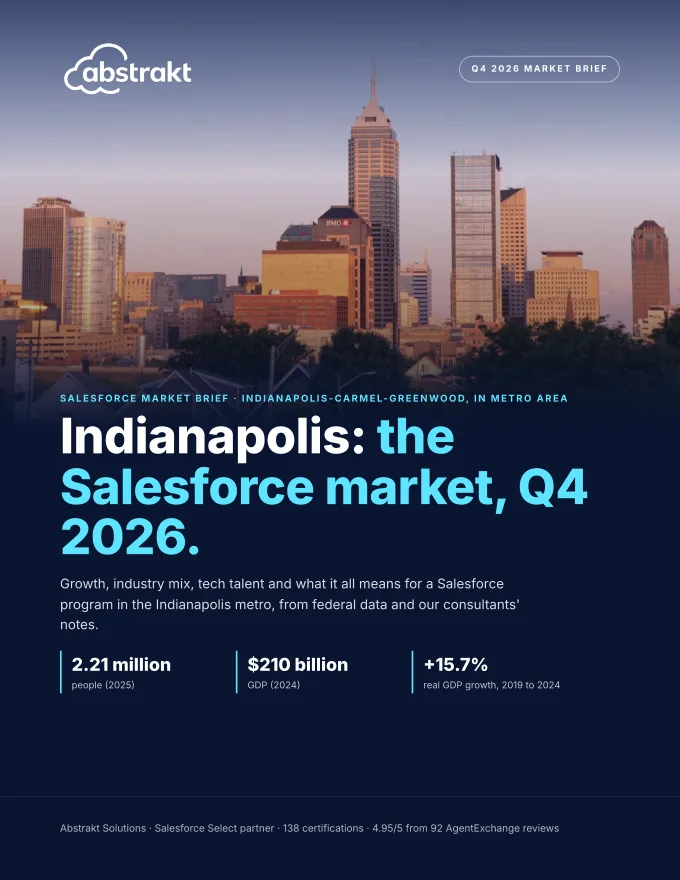
A free 24-page PDF with Indianapolis's growth ranked against 100 metros, its industry mix, tech wages and nearby markets. It is offered on the public Indianapolis page; send your customer there or get a copy for your own prep.
Get the Indianapolis brief →Co-sell with Abstrakt in Indianapolis
Working a Indianapolis account? Bring in a named consultant for discovery, scoping or a health check. We reply within 4 business hours.