

How Salesforce work starts in St. Louis
Abstrakt Solutions is a Salesforce Consulting Partner headquartered in downtown St. Louis. We implement, integrate, fix and manage Salesforce for St. Louis manufacturers, financial firms, healthcare organizations and distributors, with an onshore team that can be in your office for workshops, go-lives and training. St. Louis is our home market.
What buyers here usually run into
- 1
CRM and ERP that do not talk
In a manufacturing and distribution economy, the most common gap we see is sales working in Salesforce while orders, pricing and inventory live in an ERP. Reps re-key data and leaders reconcile two sets of numbers.
- 2
Orgs built up over many years
Long-established companies often have Salesforce orgs shaped by several admins and partners. Low adoption and untrusted dashboards are usually symptoms of that history, not of the platform.
- 3
Regulated customer data
Financial services and healthcare firms need Salesforce designs where sharing, audit and marketing consent are right before anything goes live.
Budget, team and partner questions
What drives cost
In St. Louis the biggest cost swings come from integration and history: how many ERPs a company runs after acquisitions, how much custom automation a long-lived org has collected, and whether health or financial data adds review steps. A health check before a rebuild often narrows the scope.
Admin or partner
Headquarters-heavy St. Louis companies often already employ an admin or two. One admin can run day-to-day configuration well; architecture, integration and release testing are where a managed services partner usually supplements rather than replaces that person.
What buyers ask a partner
Ask any partner for manufacturing and ERP integration references, Financial Services Cloud experience if you are a financial firm, and the names of the people who will do the work. In St. Louis, you can also ask to meet the delivery team in person.
The local economy and its biggest industries (4)
| Sector | Share of 2024 GDP | Where Salesforce fits |
|---|---|---|
| Manufacturing Salesforce for manufacturing → | at least 11.1% | Manufacturers here often sell through distributors and dealers and quote from ERP data. Salesforce helps when account, pricing and service history finally sit in one place, with ERP integration and, where crews go on site, Field Service. |
| Health care and social assistance Salesforce for health & life sciences → | at least 9.5% | Health systems, medical-device makers and life-sciences firms use Salesforce for referral and patient engagement, field sales and service, where access controls and data privacy shape the design from the start. |
| Finance and insurance Financial Services Cloud → | 8.5% | With wealth managers, insurers and lenders headquartered here, relationship data, compliance-aware marketing and advisor productivity are recurring needs, which is where Financial Services Cloud and Account Engagement fit. |
| Wholesale trade Experience Cloud → | at least 7.5% | Distributors need order history, rep territories and customer portals connected to the ERP that runs the warehouse, which makes integration and Experience Cloud as important as the CRM itself. |
Source: U.S. Bureau of Economic Analysis, GDP by county (CAGDP2), 2024, summed to the metro area; private sectors only, excluding real estate and government. “At least” marks sectors where BEA suppresses some county figures.
Regional target sectors named by local economic development groups: Aerospace, Geospatial/GEOINT, Plant Science / AgTech, Food & Beverage, Pharmaceuticals & Medical Devices, Finance & Insurance, Corporate Operations.
Salesforce products that fit St. Louis (6)
In the order we lead with them here, from the industries above.
Salesforce Sales Cloud
The CRM where sales pipeline lives, when it is built right.
Salesforce Service Cloud
The operating system for modern customer service, case, knowledge, voice, and AI agent assist together.
Salesforce Field Service
Scheduling, dispatch, mobile work orders and parts for teams that work on site.
Salesforce Financial Services Cloud
Industry CRM for wealth management, banking, insurance, and lending, built for compliance from the start.
Salesforce Marketing Cloud
Cross-channel marketing, email, mobile, journey, and Data 360-powered personalization at scale.
Salesforce Agentforce
AI agents that handle real work inside Sales Cloud, Service Cloud, and Marketing Cloud.
Grounded AI uses for St. Louis manufacturers and hospitals
Three sectors carry the St. Louis economy, and the smallest of them, finance and insurance, still reached 8.5% of metro GDP in 2024, behind manufacturing and health care. Across that mix, the common thread is paperwork. Plants and distributors field quote requests that arrive as attachments; an agent can extract quantities and specs and stage an opportunity for a rep to check. Hospital and clinic groups often want patient-facing answers about billing or referrals, which only works when the content is approved and current. Insurers and banks can use call summaries to cut after-call work. We scope these pilots around one queue, measure accuracy against human handling, and expand only when the data holds up.
- Quote request attachment extraction
- Billing and referral answers
- Call summaries for insurers
Services buyers here usually need (7)
Salesforce Implementation in St. Louis
For most St. Louis companies, implementation begins with the product and account structure, not the screens. The regional economy leans on manufacturers, financial firms and long-established headquarters, so the first design question is usually how dealers, parent companies, households or growers relate to one another. We settle that model in discovery sessions at your site, build in a sandbox, load cleaned data and release in phases. Because our consultants are based here, workshops, user testing and go-live days happen in the room with your team.
By industry in St. Louis
- 1
Manufacturing
Plants and factories here generate the biggest slice of private output, with BEA putting manufacturing at a floor of 11.1% of the metro's 2024 total. A plant-heavy company implementing Salesforce needs to decide early whether quotes, sales agreements and forecasts live in the CRM or stay in the ERP, and how dealer and distributor accounts roll up. We sketch that hierarchy on a whiteboard with sales operations before building anything, then phase the rollout so inside sales goes live first and field teams follow.
- 2
Finance and insurance
The region is home to wealth managers, insurers and lenders with national client bases. Their implementations turn on Financial Services Cloud decisions: whether a household or an individual is the anchor record, how advisors and service staff share visibility, and which fields compliance needs to see locked. We design the sharing model and audit fields in the first phase, because a relationship-management rollout that leaks visibility across branches or books of business is very hard to unwind.
- 3
Plant Science / AgTech, Food & Beverage
Greater St. Louis, Inc. lists plant science and agtech, along with food and beverage, among the region's target sectors. Companies in this cluster often have several kinds of commercial relationships that a standard sales pipeline does not capture: growers, seed and input dealers, research collaborators and licensing partners. An implementation for them starts by defining those relationship types and the seasonal selling calendar, then configuring Sales Cloud so each team sees the records that matter to it.
Raise before scoping
Model the account hierarchy first
St. Louis has many corporate headquarters, and their customers are often parent companies with plants, branches or dealers underneath. Agree on how parents, subsidiaries and locations relate before configuring anything, because reporting, territory assignment and sharing all depend on that structure.
Plan for Missouri and Illinois sites
Metro companies often run sites in Missouri and in the Illinois Metro East. If territories, tax handling or service areas differ by state, capture those rules during discovery so they become fields and assignment logic rather than notes that reps keep in their heads.
Release in small phases
Start with the core sales process and trusted data, then add service, marketing and portals in later releases. Each release is small enough to train properly, and early feedback from users shapes the next phase instead of arriving after everything is locked.
Salesforce Managed Services in St. Louis
Managed services for St. Louis companies is mostly about keeping mature orgs healthy while the business keeps asking for changes. Many organizations here have run Salesforce for years, with a single admin fielding requests from sales, service and finance. We take on the backlog, review each seasonal Salesforce release against your customizations, maintain integrations and deliver small improvements every month. Because our team is based in St. Louis, quarterly roadmap sessions can happen at your offices, while day-to-day work runs through a shared queue.
By industry in St. Louis
- 1
Health care and social assistance
BEA's 2024 county figures put hospitals, clinics and social-service agencies at a minimum of 9.5% of regional output. Providers and care organizations change access rules, referral workflows and consent handling often, and every change carries privacy risk. Under managed services we handle those permission and process updates through a documented change log, test them in a sandbox first and review each Salesforce release for effects on patient or member data. Clinical and administrative leaders see what changed before it reaches users.
- 2
Corporate Operations
Greater St. Louis, Inc. includes corporate operations among its target sectors. Shared-service and headquarters teams tend to own a Salesforce org used by several business units, each with its own priorities. A managed services arrangement gives them one intake queue, a monthly prioritization meeting with the business owners and release notes that explain what changed for which group. Each unit sees its own requests progress rather than waiting behind the loudest one.
- 3
Wholesale trade
Distributors rely on Salesforce staying in step with pricing, inventory and customer changes that arrive from the ERP every day. When a sync fails or a territory shifts, reps notice within hours. Our managed services team monitors those integrations, adjusts assignment rules when territories are redrawn and keeps the product catalog aligned, so the distribution business is not waiting on a single overloaded administrator. Pricing exceptions and new branches get handled in the same steady rhythm.
Raise before scoping
Decide who owns the backlog
Before handing work to a partner, name one person inside the company who sets priorities. Without that owner, requests from sales, service and finance compete by volume rather than value, and the monthly hours go to whoever emails most often.
Plan around the release calendar
Salesforce ships three major releases a year. Organizations with heavy customization, common among older St. Louis orgs, should budget review time before each one so sandbox testing catches changes to Flow, permissions or the interface before users see them. Changes that break are fixed before launch day.
Keep internal knowledge written down
Long-tenured admins in the region often hold years of undocumented decisions. Part of starting managed services is recording why fields, automations and integrations exist, so coverage no longer depends on one person being available. Written notes also make audits and onboarding of new staff far quicker.
Salesforce Integration in St. Louis
Integration work in St. Louis is dominated by ERP connections. The region's distributors and manufacturers typically run orders, pricing, inventory and invoicing outside Salesforce, so the job is deciding which system owns each record and how quickly changes must flow. We map those ownership rules, pick an integration approach that fits your data volumes and IT team, build and test in a sandbox and add monitoring so failed syncs are caught early. Our St. Louis-based consultants can sit with your ERP and IT staff while the mappings are worked out.
By industry in St. Louis
- 1
Wholesale trade
Distribution businesses, which BEA counts at a floor of 7.5% of 2024 regional output, feel ERP gaps first. For distributors, the integration that matters most brings customer-specific pricing, open orders, back-orders and invoice status from the ERP into the account record. Reps then answer customer questions without calling the warehouse. We also send new accounts and quotes back to the ERP under clear rules, so customer data is not keyed twice or allowed to drift apart. Credit holds become visible too.
- 2
Manufacturing
Manufacturers need Salesforce to reflect what the plant can actually deliver. Common integrations pull product catalogs, lead times and installed-equipment records from ERP or production systems, and push signed agreements and forecasts back for planning. Where field technicians service equipment, Field Service needs parts and warranty data from the same source. We design those flows around the few records that must be exact and keep everything else on a slower schedule.
- 3
Pharmaceuticals & Medical Devices
Greater St. Louis, Inc. names pharmaceuticals and medical devices as one of its target sectors. Companies in this space connect Salesforce to quality, complaint-handling and order systems, often under validation and privacy requirements. Integrations for them need an audit trail showing what data moved and when, limits on which fields leave regulated systems at all and error handling that raises problems to a named owner instead of failing silently. We document each flow for quality reviewers.
Raise before scoping
Name a system of record
For each shared object, such as customers, products, prices and orders, agree which system is authoritative and which only displays a copy. Most integration failures we are asked to fix trace back to two systems both believing they own the same field.
Match sync speed to need
Timing can reasonably differ by record type. Order status might sync in near real time while product catalogs update overnight. Choosing the right timing for each flow keeps API usage, cost and troubleshooting effort in proportion to the business value.
Budget for monitoring and ownership
Integrations need someone watching them after launch. Decide who receives error alerts, who fixes rejected records and how failures are logged, whether that is your IT staff or a managed services partner, before the first connection goes live. Clear runbooks shorten every outage.
Salesforce Optimization in St. Louis
Optimization in St. Louis usually means tidying an org that has been extended for many years by different admins and partners. Typical symptoms are reps logging activity in spreadsheets, automation that fires twice and forecasts that finance rebuilds by hand. We start by watching users work, then simplify layouts, consolidate old workflow rules and process builders into Flow, remove duplicate records and rebuild the dashboards leaders rely on. Changes ship in small releases, with short training at your location so each team sees what changed.
By industry in St. Louis
- 1
Manufacturing
Manufacturers here often added Salesforce objects and fields every time a product line, acquisition or new sales channel appeared. The result is record pages with dozens of fields no one fills in and opportunity stages that mean different things in different divisions. Optimization for them means agreeing one set of stage definitions, hiding what reps do not need and rebuilding pipeline and forecast reports so plant and sales leaders read the same numbers.
- 2
Professional, scientific, and technical services
Consulting, engineering and IT services firms, part of a category worth at least 7.5% of 2024 metro GDP here, depend on Salesforce for pipeline, resource planning signals and client history, yet utilization pressure means partners rarely update records. We streamline data entry to what billing and forecasting actually require, automate follow-up tasks and give practice leaders dashboards that answer their weekly questions without an analyst. Opportunity records then carry the detail billing needs without extra effort.
- 3
Finance and insurance
Advisors, agents and bankers adopt Salesforce when it saves them time with clients. Many orgs in the region were set up for managers and compliance, not for the people meeting customers. Optimization here focuses on quicker household or policy views, fewer clicks to log an interaction and marketing consent that stays accurate, so the org serves both the advisor and the review team. We validate the changes with a few advisors or agents before they reach everyone.
Raise before scoping
Measure adoption before changing anything
Pull login, record-update and report-usage data first. It shows which teams have drifted back to spreadsheets and which features nobody touches, so the optimization plan targets real friction rather than the loudest complaint in a meeting. It also gives a baseline for measuring improvement later.
Retire legacy automation carefully
It is common to find three generations of automation stacked on a single object in a mature org. Inventory them, map what each actually does and consolidate into Flow one object at a time, testing in a sandbox so nothing a downstream team relies on disappears quietly.
Fix definitions, then dashboards
A dashboard is only trusted when everyone agrees what a qualified lead, a closed deal or a resolved case means. Settle those definitions with sales, service and finance leaders first, then rebuild reporting around them. Document each definition where every team can find it later.
Salesforce Health Checks in St. Louis
Before St. Louis organizations put more money into Salesforce, a health check shows what they already have. We review who can see and export what, how clean the data is, how much custom code and overlapping automation has built up, how integrations behave and whether people actually use what was built. The result is a ranked list of risks and fixes. Many local clients request one before rolling out Agentforce, since AI agents inherit every loose permission and duplicate record already present.
By industry in St. Louis
- 1
Health care and social assistance
Health and social-service organizations hold sensitive personal information in Salesforce, frequently spread across referral, intake and service records. A health check for them concentrates on profile and permission-set access, sharing rules that expose more than intended, field-level encryption and audit history coverage and integrations that copy protected data into other systems. Findings are ranked by privacy exposure first, so the riskiest gaps are closed before anything else is changed. Each finding names the setting involved.
- 2
Geospatial/GEOINT
Greater St. Louis, Inc. counts geospatial intelligence among the region's target sectors. Firms serving government and defense customers in this field have to show that commercial systems handle sensitive contract information carefully. Our review for them checks login policies, multi-factor enforcement, connected apps and data export permissions, and identifies which records should not be in the CRM at all, giving security and contracts leaders documented evidence rather than assumptions. Remediation steps are listed in priority order.
- 3
Finance & Insurance
Financial firms in the region, one of the target sectors Greater St. Louis, Inc. highlights, often run Salesforce orgs that several partners have customized. A health check tells them where custom code has no tests, where automation conflicts, which consent and retention settings need attention and how ready their data is for Agentforce. It gives technology and compliance leaders a shared, prioritized list to fund and schedule. Estimates of effort accompany each recommendation.
Raise before scoping
Review access before adding AI
Any AI agent you deploy inherits the reach of the user or integration account it runs under. Audit profiles, permission sets and sharing rules first, so an agent cannot surface records a user should never see or act on data that is duplicated or out of date.
Count the technical debt
Years of changes leave behind fields nobody fills in, switched-off automation, Apex classes without tests and managed packages no one uses. Measuring them turns a vague sense that the system is fragile into a list you can budget for and pay down in stages. Prioritize whatever blocks upgrades or new features.
Include the people who use it
Configuration metadata shows what was built, not whether it helps. Short interviews with users in each department, which our St. Louis-based consultants can do at your site, reveal the workarounds that data alone cannot show. Their feedback often changes which findings matter most.
Salesforce Migration in St. Louis
Many St. Louis businesses have decades of customer history spread across an aging CRM, shared spreadsheets and a marketing tool that nobody fully owns. Migration here is mostly a data-quality project: agreeing which records and history are worth keeping, merging duplicates, standardizing addresses and ownership, then loading into Salesforce in the right order and reconciling counts. We rehearse the load in a sandbox, plan a cutover that avoids month-end or seasonal peaks and archive what stays behind so it can still be found.
By industry in St. Louis
- 1
Finance and insurance
Money management, lending and insurance together produced 8.5% of the region's 2024 output by BEA's count. Advisory firms, agencies and lenders moving into Financial Services Cloud usually bring client files from older CRMs, portfolio or policy systems and spreadsheets kept by individual advisors. Migration for them means rebuilding households and relationships accurately, carrying over the interaction history compliance may need to reference and mapping consent flags so marketing does not contact clients who opted out. Account ownership by advisor or agent is preserved exactly.
- 2
Plant Science / AgTech, Food & Beverage
Agtech and food companies in the region often grew out of research programs, so commercial data sits in spreadsheets, trial databases and email rather than in a CRM. Moving to Salesforce starts with deciding which grower, dealer and partner records are commercial and which should stay in research systems. We then deduplicate contacts shared across programs and load only the history the commercial team will actually use. Grower records are matched by farm and region, not just by name.
- 3
Professional, scientific, and technical services
Consulting, engineering and technical firms frequently run on a lightweight CRM or a practice-management tool that outgrew its purpose. Their migration challenge is contacts: the same client appears under several partners, with different titles and firm names. We merge those records, keep a clean link between people and the companies they have worked with and bring over the engagement history that business development relies on. Old contact owners are reassigned to current staff before loading.
Raise before scoping
Decide how much history to move
Moving every record since the company was founded slows the load and clutters the new org. Agree with each department how many years of activity, cases and closed deals are useful, then archive the rest somewhere searchable instead of discarding it.
Clean data before the load
Duplicate companies, stale contacts and inconsistent picklist values are cheaper to fix in a staging file than inside Salesforce. Cleaning first also means users see trustworthy records on their first day, which matters for adoption. Keep a log of every merge so questions can be answered afterward.
Time the cutover around peaks
Choose a cutover window away from month-end close, open enrollment, planting seasons or your own busiest selling period. A short freeze on the old system, a final delta load and dedicated support the next morning keep the switch orderly. Plan communication so every team knows the date.
Salesforce Implementation Rescue in St. Louis
When a Salesforce project in St. Louis goes wrong, the usual story is an ambitious scope, a partner that changed staff midway and a go-live date that forced launch before testing finished. Rescue starts with a short assessment: we read the build, review the requirements that were agreed and talk to the people trying to use it. Then we stabilize what is breaking daily work, decide what to keep or rebuild and finish the project in phases, with our St. Louis-based consultants on site whenever your team needs them.
By industry in St. Louis
- 1
Aerospace
Aerospace is one of the target sectors named by Greater St. Louis, Inc., and suppliers in this field typically work under strict quality and contract requirements. Their Salesforce projects tend to stall when the design ignores long program cycles, contract requirements and export-controlled data. A rescue for them resets the data model around programs and contracts and tightens access before adding more features. Only then does the team add quoting, forecasting or partner features back in controlled releases.
- 2
Manufacturing
Manufacturing rescues frequently involve an ERP integration that never worked reliably or a quoting build too complex for reps to use. Our triage separates problems in the integration from problems in the process design, stabilizes the data feeds that sales depends on and removes custom features no one asked for. Then we rebuild quoting or forecasting in a simpler form that reps will actually adopt. Each fix is tested with the reps and planners who use it daily.
- 3
Health care and social assistance
Health and care organizations often come to us after a Service Cloud or referral project launched with incomplete security design or missing intake steps. Staff revert to paper and phone logs, and privacy officers lose confidence. Recovery begins with access and consent fixes, then rebuilds intake and case workflows with frontline staff in the room, so the second launch reflects how care teams really work. Training is repeated for each unit before the relaunch goes live.
Raise before scoping
Assess before you rebuild
A failed project usually contains usable parts. A structured assessment of the data model, automation, code and user feedback shows what to keep and what to replace, and prevents a costly restart that repeats the original mistakes. Share the findings openly with the sponsors.
Put one decision-maker in charge
Troubled builds frequently drift because every open question waits for a committee. Name one owner who can make those calls quickly and who attends every recovery checkpoint, so decisions stop bouncing between departments and vendors. That person also signs off on scope changes.
Recover documentation and access first
When the previous partner leaves, credentials, integration settings and design documents often leave with them. Secure admin access, integration accounts and whatever documentation exists at the start, before anyone changes the org further. Change passwords that a departing vendor held.
Industry plays in St. Louis (4)
Salesforce for St. Louis Manufacturers
Plenty of manufacturers in this region have used a CRM for years, and the system has grown in layers: custom fields for each plant, reports nobody trusts, and spreadsheets bridging the gap to ERP. Salesforce can do far more for them when the foundation is fixed. We rationalize the data model, connect pricing, orders and inventory from the ERP, and then add what matters for your business, such as dealer and distributor portals, aftermarket parts sales or field service on installed equipment.
In 2024 Bureau of Economic Analysis county data, factories contributed at least 11.1% of metro GDP, more than any other private industry; the true share is likely higher, since some county values are suppressed. Greater St. Louis, Inc. lists aerospace, plant science and agtech, food and beverage, and pharmaceuticals and medical devices among its target sectors, and its broader list of twelve also names chemicals and machinery. The result is a manufacturing base that is diverse, long established in many cases and tied into national supply chains.
Use cases to open with
- 1
Dealer and distributor networks
When a dealer owns the farmer, contractor or plant manager who buys your machine, you see demand only secondhand. An Experience Cloud dealer portal can handle lead distribution, quote requests, warranty claims and marketing materials, while Sales Cloud gives territory managers a view of dealer performance and inventory. Manufacturers finally see end-customer demand without having to take over the dealer's role. Warranty trends reach engineering sooner.
- 2
Aftermarket parts and service revenue
Parts and service often earn higher margins than new equipment. Salesforce can use installed-base records to predict parts needs, trigger service reminders and route parts inquiries to inside sales with ERP availability and pricing in view. Field Service can schedule technicians for maintenance and repairs, and service history feeds replacement opportunities back to the sales team at the right time.
- 3
Food and ingredient account planning
Food, beverage and ingredient manufacturers selling to processors, brands and retailers manage annual contracts, promotions and product specifications. Sales Cloud with account plans, contract records and volume forecasts helps key account teams track commitments against shipments, prepare business reviews and spot accounts falling behind plan before the contract period ends and volume is lost. Specification changes stay attached to each account's history.
Raise before scoping
Clean up before adding
Years of customization leave duplicate fields, conflicting automation and unused objects. Start with a health check, document what each component does, and retire what is not used, so new features sit on a stable foundation rather than more technical debt.
Make ERP the pricing source
Sales teams lose trust in CRM quotes that differ from invoices. Pull price lists, customer-specific pricing, credit status and order history from the ERP, decide sync frequency with finance, and keep manual price overrides behind approvals. Show credit holds on the account page.
Bring plant and quality teams in
Customer issues in manufacturing often trace back to production and quality. Involve plant and quality leads in design, connect complaint cases to corrective action processes, and give them read access to customer history so fixes are prioritized by impact. Share defect trends by customer monthly.
Salesforce for St. Louis Health and Life Sciences
Health organizations in this region sit on both sides of the market. Health systems and specialty groups need patient access, referral management and outreach built around privacy rules. Pharmaceutical and medical device companies need account-based selling, customer service and compliant engagement with clinicians. Salesforce supports both when the data model and security design match the regulatory context. We design for your side of that market and integrate with EHR, ERP or quality systems.
Health care and social assistance makes up at least 9.5% of St. Louis metro GDP for 2024 in Bureau of Economic Analysis figures, a lower-bound estimate that ranks it second among private sectors after manufacturing. Greater St. Louis, Inc. names pharmaceuticals and medical devices as a target sector, and its broader list includes neuroscience. The same organization highlights innovation districts, including 39 North, an agri-food technology district in Creve Coeur that has drawn more than $120M in public and private investment. Life sciences here therefore spans human health, devices and plant science, alongside a large care delivery sector.
Use cases to open with
- 1
Physician referral networks
Specialty service lines depend on referring physicians across Missouri and Illinois. Salesforce can track referral volume by practice, log liaison visits and issues, and flag practices whose referrals are dropping so outreach teams can respond. Integration with scheduling data shows whether referred patients are seen promptly, and leaders can measure network growth by service line rather than guessing from anecdotes.
- 2
Device and pharma account selling
Medical device and pharmaceutical companies sell to hospitals, surgery centers and group purchasing organizations with many stakeholders. Sales Cloud can model buying committees, contracts and product evaluations, and track in-service training and case support for devices. Forecasts by account and product help commercial leaders plan inventory and field coverage, while compliance rules keep interactions properly documented. Reps see open service issues before visits.
- 3
Patient and caregiver support programs
Hub services for new therapies juggle enrollment paperwork, insurance checks and refill reminders for each patient. Service Cloud and Experience Cloud can manage enrollment, benefits verification tasks, reminders and case follow-up, with Agentforce answering routine questions and escalating clinical ones to qualified staff. Every interaction is logged, which supports adverse event handling and program reporting. Program managers see drop-off points by therapy.
Raise before scoping
Classify regulated data early
Health systems handle PHI under HIPAA, while life sciences companies may also handle adverse event reports and interactions subject to industry codes. Classify data types in discovery, design access and retention around them, and involve privacy and compliance officers from the start.
Separate commercial and medical roles
Sales, medical affairs and patient support teams may share accounts but must follow different rules. Use record types, permission sets and sharing to keep each function's data appropriately separated, and document the design for audits and internal reviews. Review access quarterly.
Plan integrations with source systems
EHR, ERP, quality and safety systems remain authoritative for clinical, order and complaint data. Define what Salesforce needs from each, how often it refreshes, and how cases flow into safety or quality processes, then test with realistic scenarios before launch.
Salesforce for St. Louis Wealth Managers
St. Louis has a deep bench of financial advisors, from teams inside large brokerage organizations to independent RIAs formed by advisors who went out on their own. Salesforce helps each of them the same way: one household view with custodial data, onboarding that moves accounts open without chasing paperwork, and review and outreach programs that compliance can supervise. St. Louis is also where our consultants live, which means discovery with your advisors, operations staff and compliance officer can happen around a conference table rather than a screen.
Finance and insurance produces 8.5% of St. Louis metro GDP in the Bureau of Economic Analysis's 2024 county figures, third behind manufacturing and health care, both of which are reported as lower bounds. Greater St. Louis, Inc. names finance and insurance as one of its target sectors, alongside corporate operations, aerospace, geospatial and plant science. For wealth firms, that combination means a large local base of corporate executives, business owners and retirees, and a competitive market for experienced advisors who can move their practices between firm models.
Use cases to open with
- 1
Household view with custodial data
Advisors should not open four systems to prepare for a review. Financial Services Cloud brings custodial balances, holdings summaries, beneficiaries, goals and recent service requests onto one household record, with related entities such as trusts and closely held businesses linked. Advisors can see at a glance what changed since the last meeting, and associates can prepare agendas from the same information without asking the advisor.
- 2
Account opening that tracks itself
Transfers and new accounts stall on missing signatures, incorrect forms and unanswered custodian questions. In Salesforce, each new relationship gets a checklist: data gathered one time, custodian forms generated from it, e-signature envelopes sent, and every item watched until the transfer settles. Operations sees a queue by status and age, and clients receive updates instead of calling to ask whether their money has moved.
- 3
Supervised client communications
Marketing Cloud can send market commentary, event invitations and planning reminders from approved templates, segmented by life stage and service tier. Messages are archived for supervision, and approvals are recorded before content goes out. Engagement flows back to the household, so advisors know who opened the retirement income piece and can call the clients who may be ready for that conversation.
Raise before scoping
Plan for advisor transitions
Advisors joining or leaving a firm raise questions about who owns client data and what may move with them. Define ownership, access and archiving rules before launch, align them with your agreements and compliance policies, and make sure departing users can be removed without breaking household history.
Match the supervision model
Broker-dealer representatives work under FINRA rules, while RIAs are overseen by the SEC or state regulators, and hybrid teams face both. Map which communications, approvals and complaints Salesforce must capture for each channel, and let your compliance officer confirm retention and review requirements.
Integrate what advisors use daily
Custodial feeds, planning software, portfolio reporting and email archiving each carry part of the picture. Prioritize the integrations advisors rely on every day, confirm data refresh timing, and postpone lower-value connections so the first release arrives while the team's enthusiasm is still high.
Salesforce for St. Louis Insurers and Agencies
Insurance in St. Louis is closely tied to the industries around it. Commercial agencies write property, casualty and benefits programs for manufacturers, distributors and health care employers, while carriers and managing general agents need service at scale. Salesforce supports renewal planning for complex commercial accounts, producer and agency management, and policyholder service with self-service options. St. Louis is home for our consultants as well, and we integrate Salesforce with agency management, policy administration and billing systems so producers and service teams share one view of each client.
The Bureau of Economic Analysis's 2024 county data put finance and insurance at 8.5% of St. Louis metro GDP, the third-largest private sector after manufacturing, which is at least 11.1%, and health care, at least 9.5%. Greater St. Louis, Inc. lists finance and insurance among its target sectors, and its broader list includes aerospace, pharmaceuticals and medical devices, chemicals and machinery. Those target industries are also demanding insurance buyers, with product liability, property and workers' compensation exposures that call for careful renewal work. For agencies, the local economy produces a commercial book weighted toward industrial and health care risks rather than consumer lines alone.
Use cases to open with
- 1
Commercial renewal planning
Large commercial renewals for manufacturers and distributors need months of preparation: exposure updates, loss runs, loss control reports and market submissions. A renewal record can open automatically at a set lead time before expiration, carrying a task plan for the account manager, the producer and the loss control contact, with each market's response logged beside it. Leadership sees which renewals are at risk and which accounts need a stewardship meeting before quoting begins.
- 2
Producer and agency management
Carriers and managing general agents working through independent agencies need to know which agencies produce, which lines they write and how their loss ratios look. Financial Services Cloud can track agency appointments, licenses, production and contacts, while an Experience Cloud portal gives agents quoting resources, underwriting guidelines, forms and case status. Territory managers plan visits around data rather than habit.
- 3
Policyholder service and self-service
Requests for a certificate or an invoice copy fill service queues at renewal season. Service Cloud routes those requests to the right team with the policy context attached, and a portal lets commercial clients request certificates or download documents themselves. An Agentforce agent can answer routine billing and document questions, handing coverage questions to licensed staff with the conversation summarized, so nobody asks the client to start over.
Raise before scoping
Keep policy systems authoritative
The AMS or policy administration platform keeps ownership of coverage, premium, commission and loss records. Decide exactly which data Salesforce displays, how clients and policies are matched and how often data refreshes, so producers trust renewal dashboards and do not maintain parallel spreadsheets.
Track licensing and appointments
Producers and agencies need current licenses and carrier appointments in every state where they sell. Track them in Salesforce with expiration alerts, restrict quoting or assignment when something lapses, and keep an audit trail for compliance review and market conduct questions.
Protect benefits and claims data
Benefits work and some claims involve health or financial information that carries privacy obligations, including HIPAA in some cases. Limit which users see sensitive fields, avoid free-text notes containing health details, and have counsel confirm requirements for each line of business.
Case studies to send (3)
From the industries this market leans on. Client names are anonymized and these projects are not specific to St. Louis.
The St. Louis Salesforce market brief, Q4 2026
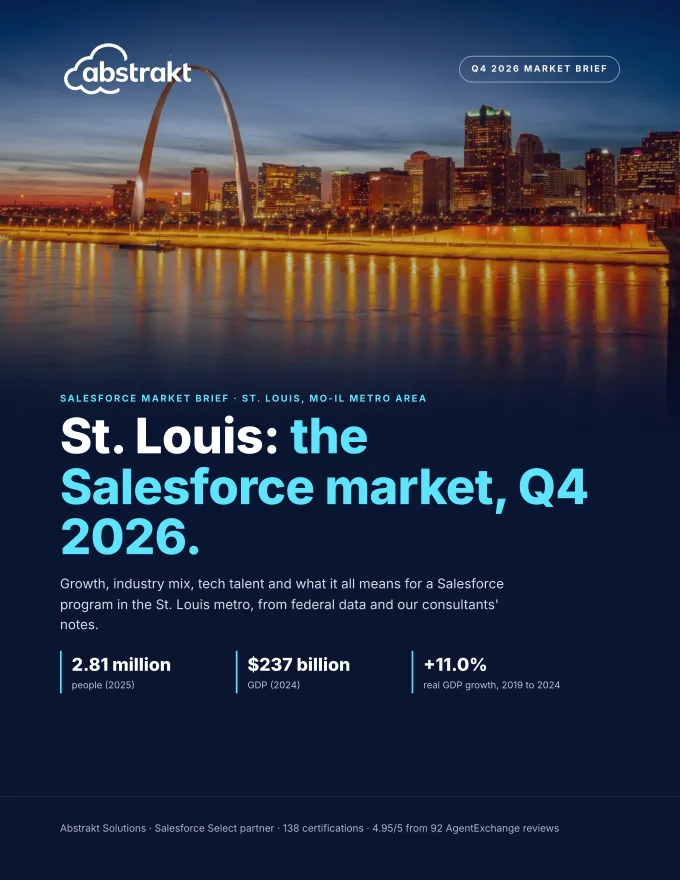
A free 24-page PDF with St. Louis's growth ranked against 100 metros, its industry mix, tech wages and nearby markets. It is offered on the public St. Louis page; send your customer there or get a copy for your own prep.
Get the St. Louis brief →Co-sell with Abstrakt in St. Louis
Working a St. Louis account? Bring in a named consultant for discovery, scoping or a health check. We reply within 4 business hours.