

How Salesforce work starts in Dallas–Fort Worth
For Dallas–Fort Worth banks, insurers, manufacturers and distributors, Abstrakt Solutions acts as a Salesforce Consulting Partner from first design through ongoing support. We implement, integrate, optimize and manage Salesforce across the Metroplex. Dallas–Fort Worth is one of our focus markets.
What buyers here usually run into
- 1
Relocations and consolidations
Companies moving or consolidating headquarters often inherit several CRMs and processes at once. Rationalizing them into one Salesforce org is a common first project.
- 2
Scaling fast
Fast-growing firms outgrow starter CRMs and spreadsheet processes. The risk is rebuilding the same mess in Salesforce, which a clear data model and scope avoid.
- 3
Agents and partners outside the company
Payments, insurance and distribution businesses often sell through independent agents. They need portals and permissions that give partners what they need and nothing more.
Budget, team and partner questions
What drives cost
In DFW the cost drivers we see most are consolidation after a relocation or acquisition, external users such as agents and partners who need portals and licenses, and regulated financial data that adds review. Merging two orgs costs more than building one from scratch, so scope it explicitly.
Admin or partner
Fast-growing DFW companies often outgrow a single admin quickly. Hire when you need someone embedded with the business every day; add a partner when the backlog includes integrations, portals or a merger of orgs.
What buyers ask a partner
Ask partners how they have handled org consolidation, which financial services projects they can reference, and how they design sharing for external agents and partners. Ask who will own the work after go-live.
The local economy and its biggest industries (4)
| Sector | Share of 2024 GDP | Where Salesforce fits |
|---|---|---|
| Finance and insurance Financial Services Cloud → | 9.6% | Banks, brokerages, insurers and payments companies need relationship data, onboarding workflows and supervised communications. We implement Financial Services Cloud and build partner and agent portals for payments firms. |
| Professional, scientific, and technical services Salesforce for professional services → | 9.6% | Relocated headquarters bring large professional services, engineering and real-estate services firms. Their Salesforce needs center on pursuit pipelines, client relationships across offices and resource planning. |
| Manufacturing Salesforce for manufacturing → | 8.9% | Aerospace, semiconductor and industrial manufacturers need long sales cycles, service contracts and ERP data connected in Salesforce, and often field service for installed equipment. |
| Wholesale trade Integration → | 7.7% | DFW’s logistics role supports a large wholesale sector. Distributors benefit most from Salesforce connected to order and inventory systems, with portals for customers who want to self-serve. |
Source: U.S. Bureau of Economic Analysis, GDP by county (CAGDP2), 2024, summed to the metro area; private sectors only, excluding real estate and government. “At least” marks sectors where BEA suppresses some county figures.
Regional target sectors named by local economic development groups: Aviation and Aerospace, Financial Activities, High-Tech, Life Sciences, Logistics, Semiconductors.
Salesforce products that fit Dallas–Fort Worth (6)
In the order we lead with them here, from the industries above.
Salesforce Sales Cloud
The CRM where sales pipeline lives, when it is built right.
Salesforce Financial Services Cloud
Industry CRM for wealth management, banking, insurance, and lending, built for compliance from the start.
Salesforce Experience Cloud
Customer, partner, and employee portals built on Salesforce.
Salesforce Service Cloud
The operating system for modern customer service, case, knowledge, voice, and AI agent assist together.
Salesforce Field Service
Scheduling, dispatch, mobile work orders and parts for teams that work on site.
Salesforce Agentforce
AI agents that handle real work inside Sales Cloud, Service Cloud, and Marketing Cloud.
Where AI earns its place in Dallas finance and industry
In 2024, finance and insurance and professional services each produced about 9.6 percent of Dallas-area GDP, with manufacturing close behind at 8.9 percent, according to BEA county data. That mix points to three practical openings for Agentforce. Insurance and lending service desks can have an agent summarize a policyholder's case history before a representative picks up the file. Consulting and engineering firms can let AI sort inbound inquiries by fit and route them to the right practice lead. Manufacturers can ground a self-service assistant in approved product documentation so distributors find answers faster. None of it works on messy records, loose sharing rules or a stale knowledge base, and a person should read every customer-facing draft first.
- Policyholder case history summaries
- Inbound inquiry routing for consultancies
- Distributor self-service from product documentation
Services buyers here usually need (7)
Salesforce Implementation in Dallas–Fort Worth
A Salesforce implementation in Dallas–Fort Worth usually starts with consolidation rather than a blank org. Relocations and fast growth leave many DFW companies running two or three CRMs, spreadsheets and a partner portal at once. We decide which of those survive, design one data model around how your teams sell and serve, build in a sandbox, migrate clean data and train each role before go-live.
By industry in Dallas–Fort Worth
- 1
Finance and insurance
Finance and insurance is tied with professional services as the largest private sector in the metro, at about 9.6% of 2024 GDP, and several national financial firms have moved their headquarters to the region in recent years. For banks, wealth firms and insurers here, the implementation decisions that matter are Financial Services Cloud versus Sales Cloud, how households and relationships are modeled, and permissions tight enough for compliance review. We settle those in design, before anything is built, because they are expensive to change later.
- 2
Manufacturing
Manufacturing contributes about 8.9% of metro GDP, and the Dallas Regional Chamber names semiconductors and aviation and aerospace among its target sectors. Manufacturers implementing Salesforce usually need quoting tied to ERP pricing, visibility into distributor and rep activity, and service history on installed equipment. We plan the ERP integration pattern and the product catalog early, since both shape the data model more than any screen layout does.
- 3
Wholesale trade
Wholesale trade adds about 7.7% of 2024 metro GDP, and logistics is one of the chamber's target sectors. Distributors in the region tend to arrive with account data split between an ERP, a quoting tool and individual reps' spreadsheets. For them, implementation is largely an account and pricing clean-up with a CRM attached: one account hierarchy, clear ownership rules, and order history visible to sales without anyone re-keying it.
Raise before scoping
Consolidate before you configure
Companies that relocated to or merged into DFW often carry a separate CRM for each business unit. Choose the surviving data model first and map every source system to it, instead of lifting each org's customizations across unchanged and inheriting all of their workarounds.
Scope partner access in phase one
Payments, insurance and distribution businesses here often sell through independent agents and resellers. Experience Cloud portals and sharing rules belong in the first phase, because partner visibility shapes the whole security model and is painful to retrofit after launch.
Phase go-lives to keep momentum
Growing firms get more from a phased rollout: core sales process and clean data first, then service, portals and automation. Each phase goes live on its own, so teams are working in Salesforce within weeks instead of waiting for the full roadmap.
Salesforce Migration in Dallas–Fort Worth
Dallas–Fort Worth migrations rarely have a single source system. A company that moved its headquarters or bought competitors may have a legacy CRM, a marketing tool, a support desk and years of spreadsheets, all describing the same customers differently. We inventory each source, agree on field mappings and what not to bring, deduplicate before loading, run trial loads in a sandbox and reconcile record counts. We set a firm date for the switch and keep the freeze on the old system brief.
By industry in Dallas–Fort Worth
- 1
Financial Activities
Banks, lenders and insurers moving onto Salesforce carry sensitive records with retention obligations, so a migration here is as much about what stays behind as what moves. We identify which client, household and interaction history must come across for service continuity, which should remain archived in the old platform, and which fields need encryption or restricted access once loaded. Links between individuals, businesses and accounts are rebuilt deliberately, since flattening them during the move is the most common and costly mistake.
- 2
Professional, scientific, and technical services
Consulting, engineering and real-estate services firms often run client relationships out of a legacy CRM, a proposal database and each partner's own contacts. Migrating them to Salesforce means merging those into one account and contact set, preserving which partner owns each relationship, and carrying over proposal and project history so pursuit teams can see past work with a client. We usually migrate active clients and recent pursuits first and archive older records in a form staff can still search.
- 3
Aviation and Aerospace
Aviation and aerospace is one of the Dallas Regional Chamber's target sectors. Suppliers and service providers in it usually carry long customer histories: programs spanning years, contracts with many amendments, and support records tied to specific aircraft or components. Moving that history into Salesforce requires careful parent-child relationships between accounts, programs, contracts and installed assets. We test these loads in sequence, verify that relationships survive intact, and confirm with program managers that the history they rely on is where they expect it.
Raise before scoping
Deduplicate in staging
Merged and relocated companies across the Metroplex frequently hold the same customer several times across systems. Resolve those duplicates in a staging area, using matching rules agreed by sales and finance, instead of loading everything and hoping Salesforce duplicate rules will catch it afterward.
Decide how much history moves
Not every email, note and closed opportunity from the last decade is worth migrating. Agree which activity history serves current work, archive the rest where it can still be searched, and keep the load small enough to test repeatedly before the final cutover.
Time cutover around peak periods
Finance teams in DFW close quarters, distributors have seasonal peaks and insurers have renewal cycles. Choose a cutover window outside those periods, freeze edits in the old system for the shortest workable time, and have support on hand for the first days.
Salesforce Integration in Dallas–Fort Worth
Which systems get connected in Dallas–Fort Worth depends heavily on the industry. Producers and wholesalers want stock levels, order status and ERP price lists visible to reps; lenders and insurers need servicing and policy data on the client record; logistics companies need shipment exceptions next to the account. We start by naming a system of record for each data set, then pick a pattern and tool, whether MuleSoft, another middleware platform or direct APIs. Every connection ships with error handling and alerts, so a failed sync is caught quickly.
By industry in Dallas–Fort Worth
- 1
Logistics
Logistics is one of the Dallas Regional Chamber's target sectors, and it shapes how integration projects here are scoped. Freight, warehousing and third-party logistics firms keep shipment events in operational platforms that will never move into Salesforce. The real question is which of those events belong on the account or case: delays, exceptions and claims usually do, routine status pings usually do not. Filtering at the middleware layer keeps Salesforce responsive and gives service agents context without flooding them with noise.
- 2
Manufacturing
Aerospace, semiconductor and industrial manufacturers in DFW rely on ERP for pricing, product configuration and order status. Integration here usually moves product and price data into Salesforce on a schedule, sends won quotes back as orders, and exposes order and shipment status to reps in real time. Engineering-heavy catalogs need special care: part numbers, revisions and customer-specific pricing must map cleanly, or quotes built in Salesforce will disagree with what the ERP will actually ship.
- 3
Finance and insurance
Lenders, insurers and wealth firms here run core banking, loan origination, policy administration and document platforms that remain the systems of record. Salesforce joins them as the engagement layer: balances, policies and application status shown on the client record, with only the fields that drive workflow copied in. That line matters for compliance reviews and data retention. We also plan identity matching carefully, since the same household or business often appears under slightly different names across source systems.
Raise before scoping
Pick a system of record
Relocated and merged DFW companies often run two ERPs or two billing systems during a transition. Decide which one Salesforce talks to for each data set, and for how long, before building anything, so integrations are not rebuilt the moment the second system is retired.
Plan for volume and limits
High-volume distributors and payments firms can push more updates than a naive sync handles. Batch changes that are not urgent, reserve real-time calls for what reps truly need immediately, and test with production-sized data in a full sandbox rather than with a handful of sample records.
Assign an owner for failures
Every integration eventually fails on a bad record. Agree who receives alerts, who corrects data at the source and how retries work. Without that agreement, errors pile up quietly and sales and service teams slowly lose trust in what Salesforce shows them.
Salesforce Managed Services in Dallas–Fort Worth
For most Dallas–Fort Worth clients, managed services means taking over a backlog that grew while the company did. New offices, acquired teams and relocated departments each arrive with requests, and one admin cannot triage them all. We run the queue on an agreed priority list, review every Salesforce release in a sandbox before it reaches users, and bring in developers or architects only when a ticket needs them. Your team keeps one named point of contact and a monthly summary of what shipped and what comes next.
By industry in Dallas–Fort Worth
- 1
Professional, scientific, and technical services
Engineering, consulting and real-estate services firms form a large part of the Metroplex economy, and their Salesforce orgs rarely sit still. Every new practice area or acquired office wants its own pipeline stages, fields and reports. In a managed services arrangement we keep those requests from multiplying: we check each one against the existing data model, reuse what is already there, and log the design decision so the next admin understands why a field exists. Utilization and pursuit dashboards stay consistent across offices instead of drifting apart.
- 2
Financial Activities
Financial activities appear on the Dallas Regional Chamber's list of target sectors, and for banks, lenders and insurers the ongoing work is mostly controlled change. Permission requests need an approval trail, edits to client record fields need testing against compliance reports, and seasonal Salesforce releases can alter screens that advisors rely on. We handle those as routine tickets with documented approvals, so examiners and internal auditors can see who changed what and when, without your operations team keeping a separate log.
- 3
Semiconductors
Semiconductor and electronics suppliers in North Texas tend to accumulate Salesforce automation around design registrations, distributor claims and sample requests. When those flows break after a release or a product-line change, reps notice before anyone else does. Ongoing support here means monitoring that automation, keeping part and pricing data aligned with the ERP feed, and handling the steady stream of new report requests from product marketing. We also merge flows that overlap as product families are added, so the org does not slow down with age.
Raise before scoping
Reserve capacity for acquisitions
Growth by acquisition is common in the Metroplex, and each deal lands new users, record types and integration requests at once. Agree up front how much of the monthly capacity is held back for work after a deal closes, so routine requests do not stall for weeks.
Name one backlog owner
The arrangement runs smoothly only if a single person at your company decides the order of requests. In companies that moved leadership to DFW, sales, service and finance often each assume someone else holds that role. Naming an owner at kickoff keeps priorities from being set by whoever emails loudest.
Pair with an internal admin
Many DFW teams keep a part-time admin inside the business for password resets, list views and quick coaching. We work alongside that person, take the development, release reviews and integration fixes, and document everything so knowledge stays with your company when people change roles.
Salesforce Optimization in Dallas–Fort Worth
Optimization for a Dallas–Fort Worth company usually begins with the question of why people avoid the system. In a metro where many organizations have grown quickly or merged, the answer is often layers: fields added by each team, automation built by successive admins, and dashboards defined differently by each department. We measure usage and field completion, interview reps and managers, then simplify layouts, move old automation into maintainable Flows and rebuild reporting around agreed definitions. It is a defined project, not a retainer.
By industry in Dallas–Fort Worth
- 1
Professional, scientific, and technical services
For engineering, consulting and real-estate services firms in DFW, low adoption usually shows up as partners keeping their relationships in inboxes and personal spreadsheets. Optimization here means making the opportunity record worth opening: fewer required fields, pursuit stages that match how proposals really move, and automatic activity capture so relationship history builds without typing. We then rebuild the pipeline and win-rate dashboards so practice leaders review the same numbers in their meetings that reps see on their own screens.
- 2
Wholesale trade
Distributors in North Texas often have a working Salesforce org that reps treat as a reporting chore. The fix is usually to give back more than it asks for: order and invoice history on the account page, reorder alerts, and territory views that replace the spreadsheet a sales manager maintains by hand. We also retire duplicate accounts created when customers were keyed separately by each branch, which is frequently the main reason regional sales totals never reconcile with finance.
- 3
High-Tech
High-tech is one of the Dallas Regional Chamber's target sectors, and technology companies here tend to layer tools quickly: sales engagement apps, intent data, product usage feeds and competing forecast methods. Optimization means deciding which of those signals actually reach the rep, removing automation that fires on the same records from different tools, and settling on one forecast definition. The result is a leaner org where pipeline reviews start from a single dashboard instead of a debate about whose numbers are right.
Raise before scoping
Measure before you simplify
Usage evidence comes first: which pages Dallas–Fort Worth reps never open, which fields stay blank and which reports nobody runs. Gather it before removing anything, so decisions about fields and layouts rest on facts rather than on the loudest complaint in the room.
Trace legacy automation first
Years of different administrators tend to leave old and new generations of automation stacked on one object, from legacy rules to recent Flows. Consolidating them is worth doing, but each old rule must be traced to the business rule it enforces, or a quiet approval step disappears along with it.
Agree on metric definitions
In companies that merged teams from different cities, a qualified opportunity or an active customer can mean several different things. Settle those definitions with finance and sales leaders before dashboards are rebuilt, otherwise the new reports will reproduce the old arguments with better charts.
Salesforce Health Checks in Dallas–Fort Worth
A health check for a Dallas–Fort Worth company is usually triggered by change: an acquisition, a new leadership team after a relocation, an admin who left, or plans to put AI agents on top of the org. We review profiles and permission sets, sharing, integrations, automation, unused customization and data quality on the objects that matter most, then interview the people who use the system. You receive a ranked list of risks and fixes with effort estimates, which you can act on yourself or with us.
By industry in Dallas–Fort Worth
- 1
Finance and insurance
Banks, lenders and insurers across the Metroplex face examiner and auditor questions about who can see client data. For these firms the review centers on who can reach what: profiles with broad view-all rights, permission sets granted and never revoked, integration users with more reach than their job requires, and field history tracking on sensitive data. We rank findings by exposure so compliance and IT leaders can close the largest gaps first and document the remediation ahead of their next review.
- 2
High-Tech
Technology companies in the region tend to move fast and install freely, so their orgs collect managed packages, custom code and experimental automation. A health check separates what still runs from what only adds cost: packages with no active users, Apex classes with thin test coverage, and flows that fire on the same records as older triggers. For high-tech firms planning Agentforce, we also assess whether the data an agent would read is complete and consistent enough to be trusted.
- 3
Life Sciences
Life sciences is on the Dallas Regional Chamber's target-sector list, and companies in it often move from research into commercial operations with a Salesforce org designed for a smaller team. A health check at that point reviews whether any patient or protected health information has entered the system, whether consent is recorded, and whether access and audit settings match the obligations that come with commercial scale. Fixing those foundations before a sales force expands is far easier than retrofitting them.
Raise before scoping
Audit before adding Agentforce
AI agents act with the permissions and data they are given. Before a DFW team switches one on, confirm that sharing rules are tight, duplicates are under control and automation does not conflict, because an agent will amplify every weakness it inherits from the org.
Include integration users
Integration and service accounts are often the most privileged users in an org and the least reviewed. In companies that have changed partners or merged systems, several may belong to tools no longer in use. Inventory them, deactivate the unused ones and restrict the rest.
Interview people, not just metadata
Metadata shows what was built; conversations show what is avoided. Short interviews with reps, service agents and managers in each DFW business unit reveal workarounds, shadow spreadsheets and distrusted reports that no scan will flag, and they often reset the priority list.
Salesforce Implementation Rescue in Dallas–Fort Worth
Many troubled Dallas–Fort Worth projects were simply rushed. Projects launched during a relocation, a merger or a rapid hiring push tend to skip design decisions, and the org ends up built around assumptions nobody agreed to. We begin with triage: what users need working this week, what data is wrong and what the original scope promised. After that, every component is judged on its merits, kept, repaired or rebuilt, and we deliver what is left with documentation your admins can follow.
By industry in Dallas–Fort Worth
- 1
Finance and insurance
Stalled projects at lenders and insurers usually stall on data and security rather than screens. A common pattern is a Financial Services Cloud rollout where households and relationships were modeled inconsistently, so advisors see incomplete client pictures and stop trusting the system. Recovery starts by correcting that model and the sharing rules around it, then reloading repaired data. We keep the parts that work, such as intake forms or service processes, and relaunch to one team before the rest.
- 2
Logistics
For logistics firms, a failed Salesforce project usually means shipment or service data that never arrived because the integration was deferred or built without error handling. Service agents then juggle Salesforce and the operational system side by side, and the CRM loses. Triage focuses on getting reliable exception data onto cases, even through a simple interim feed, while the permanent integration is redesigned. Once agents stop switching screens for every call, adoption tends to recover on its own.
- 3
Manufacturing
Manufacturers in North Texas sometimes inherit a field service or quoting build that looked complete at sign-off but fails on real work: technicians double-booked, quotes that ignore ERP pricing, or service contracts that do not match installed equipment. Rescue means reproducing those failures in a sandbox, tracing each to configuration or data, and fixing the highest-impact ones first so dispatchers and sales engineers can operate. The remaining scope is then re-planned against what plant and field teams actually need.
Raise before scoping
Stabilize before re-planning
People stuck with a failing org cannot wait months for a fix. Fix the handful of defects that block daily work first, even with temporary workarounds, and only then negotiate the full recovery plan. Credibility with DFW sales and service teams depends on visible improvement early in the engagement.
Recover documentation and access
An outgoing partner often takes passwords, sandbox knowledge and design notes along with it. Secure admin access, integration credentials and any source code repositories on day one, and reconstruct missing documentation from the org itself before making any changes to production.
Relaunch to one team first
After a failed start, a company-wide relaunch invites skepticism. Pick one team in the Metroplex whose leader is committed, relaunch there with training and close support, and let their results persuade the next group rather than a mandate from headquarters.
Industry plays in Dallas–Fort Worth (4)
Salesforce for Dallas–Fort Worth Lenders
For a mortgage lender in Dallas–Fort Worth, Salesforce sits in front of the loan origination system. It captures leads from web forms, rate sites, referral partners and past borrowers, routes them to licensed loan officers quickly, and nurtures the ones not ready to apply. Once an application starts, milestone updates flow back from the LOS so borrowers, agents and loan officers stay informed. We build that loop on Financial Services Cloud and Marketing Cloud, with reporting leadership can trust by branch and channel.
Two industries share the top spot in Dallas–Fort Worth's private economy: finance and insurance and professional services each produced 9.6% of metro output in 2024, going by Bureau of Economic Analysis county data. The Dallas Regional Chamber lists financial activities among the region's target industries. Lending is not reported separately, but it sits inside that sector, and the chamber's guide pairs it with a regional emphasis on growth, relocations and scale. For mortgage teams, that usually translates into multi-branch operations, loan officers joining from other lenders and lead volume that swings with rates.
Use cases to open with
- 1
Fast lead response and routing
Borrowers who submit a form on several sites often go with whoever calls first. Salesforce can assign each lead to a loan officer licensed in the borrower's state, by branch, product or round robin, alert them on mobile and escalate if nobody responds within your target window. Managers then see response times and conversion by source, which shows which lead vendors are worth renewing.
- 2
Referral partner relationships
Purchase loans frequently begin with a recommendation from a real estate agent, a builder's sales office or a planner the borrower already trusts. Modeling partners as accounts with their referred loans, closings and co-marketing activity shows loan officers who their best sources are, prompts regular touchpoints and lets marketing send partners milestone updates on shared clients without extra phone calls from the processing team. Partner scorecards also help branch managers decide where to spend co-marketing budgets.
- 3
Loan officer recruiting
Growing lenders compete for producing loan officers. A recruiting pipeline in Salesforce can track candidates, their production history and conversations, then turn a hire into an onboarding checklist covering licensing, systems access and a ramp plan. Leadership sees where each recruit stands and how new loan officers perform against expectations during their first year. Recruiters can also see which conversations have gone cold and which candidates are waiting on an offer.
Raise before scoping
LOS integration boundaries
The loan origination system stays the record for the loan file, disclosures and conditions. Decide which milestones and fields sync into Salesforce, in which direction and how often, so loan officers are not updating two systems and compliance data never gets edited outside the LOS.
Licensing and marketing rules
Lenders licensed in several states need routing and campaigns that respect where each loan officer can originate, plus consent handling for calls and texts under federal telemarketing rules. Build those checks into assignment and journey logic, and have compliance review them; this is a design input, not legal guidance.
Planning for rate-driven swings
Refinance waves and slowdowns change lead volume and staffing quickly. Design queues, assignment rules and nurture journeys that can scale up or switch focus from refinance to purchase without a rebuild, and keep past borrowers in long-term nurture for the next rate move.
Salesforce for Dallas–Fort Worth Insurers and Agencies
Insurance distribution in Dallas–Fort Worth leans heavily on independent agents, brokers and managing general agents. Salesforce gives carriers and MGAs a portal where producers submit business, check status and download materials, while underwriting and service teams work submissions and policy changes as tracked cases. Agencies use the same platform for cross-selling and renewals. We connect Salesforce to the policy administration and rating systems so producer, policy and claim context sit together without duplicating the core system.
The Bureau of Economic Analysis's 2024 county figures put finance and insurance at 9.6% of Dallas–Fort Worth GDP, level with professional, scientific and technical services and ahead of manufacturing at 8.9%. The Dallas Regional Chamber includes financial activities in its target industries, and the market page for this region lists independent agents and partners outside the company as a common challenge. Insurers here therefore tend to care most about how producers are onboarded, supported and measured, and how quickly service requests move between agent, carrier and policyholder.
Use cases to open with
- 1
Producer portal and onboarding
Independent agents want appointments, commission statements, underwriting guidelines and submission status in one place. Experience Cloud gives each agency a secure login that shows only its own business, while onboarding workflows track licensing, appointments and contracts. Distribution managers can see which agencies are producing, which are dormant and where appetite and submissions do not match. Producer questions logged through the portal become cases, so the carrier can spot confusing guidelines quickly.
- 2
Submission intake and triage
Commercial submissions arrive by email, portal and broker platforms with inconsistent attachments. Service Cloud can turn each into a case, extract key fields, check appetite rules and route it to the right underwriter by line and territory. Underwriters get a queue with deadlines, and producers see progress without calling. Agentforce can summarize long submissions for triage. Declinations are recorded with a reason, giving product teams a view of demand outside current appetite.
- 3
Renewals and cross-sell for agencies
For agencies, the book of business is the asset. Financial Services Cloud can track households and commercial accounts with all their policies, flag upcoming renewals early, and suggest coverage gaps, such as umbrella or cyber, based on what a client already holds. Marketing Cloud then runs remarketing and review outreach that producers approve. Account managers see each client's claims history before renewal conversations begin.
Raise before scoping
Policy system stays core
Policy administration, rating and billing systems remain the record for coverage, premium and claims. Decide which summary data Salesforce needs, such as policies in force, renewal dates and open claims, and integrate through MuleSoft or APIs rather than rebuilding policy logic in Salesforce.
Producer data and permissions
Agencies must never see each other's business, and producers often belong to more than one agency or hierarchy. Map agency structures, sub-producers and commission relationships carefully before build, since sharing rules and portal access depend on them and are difficult to change after launch.
State licensing and privacy
Producers must be licensed and appointed in each state they sell in, and policyholder data falls under state insurance privacy rules and federal consumer finance rules. Build license checks into onboarding and routing, and confirm retention and access requirements with compliance; this is design guidance, not legal advice.
Salesforce for DFW Professional Services Firms
Professional services firms in Dallas–Fort Worth are often growing faster than their systems. Acquired practices arrive with their own CRMs, new offices open before processes are written down, and partners in different service lines sell to the same clients without knowing it. Salesforce gives the firm one client record, a shared pipeline across service lines, and a clean handoff into delivery. We consolidate inherited systems first, then add quoting, marketing and capacity reporting once the foundation is trusted.
Two sectors share first place in Dallas–Fort Worth's 2024 output: professional, scientific and technical services and finance and insurance each produced 9.6% of metro GDP, by Bureau of Economic Analysis county estimates, and manufacturing followed at 8.9%. The Dallas Regional Chamber's guide lists advanced services among the industries it promotes, and companies relocating or consolidating headquarters into the region are a familiar pattern here. Services firms here therefore sell into a changing client base, where new arrivals need auditors, lawyers, consultants and technology partners quickly.
Use cases to open with
- 1
Folding in acquired practices
A firm that buys a regional practice inherits its client list, pipeline and contact history, often in another CRM or in spreadsheets. We map the acquired data to the firm's model, match clients that both firms already serve, migrate open opportunities with their owners, and retire the old system on a set date. Partners from both sides then see one relationship history per client and can plan joint pursuits.
- 2
Cross-selling across service lines
Tax, advisory, technology and risk teams frequently serve the same client without coordinating. Salesforce can show every active engagement and open opportunity on the client record, suggest adjacent services based on what similar clients buy, and route introductions to the right partner. Leadership can measure revenue per client and how many service lines each relationship spans, which is often the clearest sign of a durable client.
- 3
Capacity planning against pipeline
Fast growth breaks when the firm sells work it cannot staff. We convert weighted pipeline into expected hours by role and office, compare it with capacity from the PSA or resource system, and show gaps several periods ahead in a dashboard. Office leaders can plan hires, move people between offices or adjust start dates while there is still time, rather than discovering the shortfall at kickoff.
Raise before scoping
Independence and conflict checks
Before a new client is accepted, audit practices need an independence review and law practices a conflicts search. Build that check into the opportunity process with a clear owner and status, connect it to the system that holds restricted entities, and prevent engagement setup until clearance is recorded.
Avoid rebuilding old habits
When firms grow quickly, the temptation is to replicate every legacy field and report. Start from the decisions leaders need to make, retire fields nobody uses, and agree on common stage definitions across offices, or the new org inherits the same confusion as the old ones.
Integration with PSA and finance
Engagement setup, time, billing and revenue recognition belong in PSA and finance systems. Define what Salesforce sends when a deal closes, what flows back, and how often. Consistent client identifiers across systems make profitability reporting possible later and simplify every future acquisition.
Salesforce for DFW Manufacturers
Many Dallas–Fort Worth manufacturers sell components and systems that must be designed into a customer's product long before any volume ships. Salesforce should track those design wins from first engagement through qualification and production ramp, attribute distributor sales back to the design, and connect aftermarket service to each installed product. We integrate the ERP for pricing and orders, bring distributor point-of-sale data into account records, and give engineering and sales a shared view of which designs will turn into revenue.
Manufacturing makes up 8.9% of the region's GDP in 2024 Bureau of Economic Analysis figures, just behind the two leading sectors, finance and professional services, which each account for 9.6%. The Dallas Regional Chamber's target list for the region includes semiconductors, high-tech, and aviation and aerospace, plus logistics, which ties in with wholesale trade's 7.7% share. That combination favors manufacturers with engineered products, distribution channels and long qualification cycles, rather than simple transactional selling. A research alliance founded by the chamber also connects companies with university research capabilities in the region.
Use cases to open with
- 1
Design-win tracking to revenue
Component makers engage a customer's engineers years before production. Salesforce can record each design opportunity with the customer's end product, expected annual volume, qualification milestones and production start, then track actual shipments against the forecast once the design ramps. Sales leaders see which wins are converting to revenue and which have stalled in qualification, and product managers see demand by part family.
- 2
Distributor registrations and sales data
When distributors carry much of the volume, manufacturers lose sight of the end customer. An Experience Cloud portal lets distributors register opportunities, request special pricing and see approvals, while point-of-sale data loaded through an integration ties resale back to the design and the end account. Channel managers can then reward the distributors who create demand, not only those who fill orders.
- 3
Aftermarket support for aviation
Aviation and aerospace suppliers support parts and systems across long service lives. Service Cloud can track serialized units, warranty status and repair returns, while Field Service schedules technicians for on-site support. The account team sees repair history and spare parts demand for each operator, which informs renewals of support agreements and spares planning with operations and the ERP. Recurring failure patterns can be shared with engineering for design fixes.
Raise before scoping
Clean distributor data feeds
Point-of-sale reports arrive in different formats, with inconsistent customer names and part numbers. Plan matching rules, a data steward role and exception handling before building channel reports, or sales leaders will stop trusting distributor figures within the first quarter of use.
Export and security rules
Semiconductor and aerospace products may be subject to export controls, and customers may impose their own security requirements. Work with your compliance team to decide which technical data Salesforce may hold, who can view it, and how access is audited.
Long cycles in forecasting
Design wins generate revenue far in the future, and standard opportunity close dates do not capture that. Separate design pipeline from booking forecasts, model expected volume by year, and agree with finance how design-win data feeds planning without inflating near-term forecasts.
Case studies to send (3)
From the industries this market leans on. Client names are anonymized and these projects are not specific to Dallas–Fort Worth.
The Dallas–Fort Worth Salesforce market brief, Q4 2026
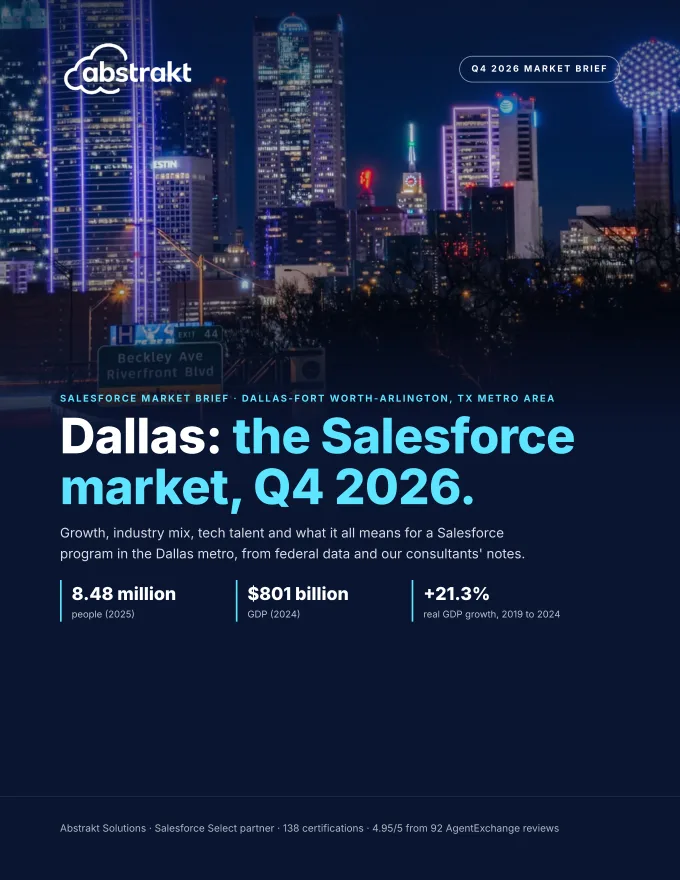
A free 24-page PDF with Dallas–Fort Worth's growth ranked against 100 metros, its industry mix, tech wages and nearby markets. It is offered on the public Dallas–Fort Worth page; send your customer there or get a copy for your own prep.
Get the Dallas–Fort Worth brief →Co-sell with Abstrakt in Dallas–Fort Worth
Working a Dallas–Fort Worth account? Bring in a named consultant for discovery, scoping or a health check. We reply within 4 business hours.