

How Salesforce work starts in Oklahoma City
Abstrakt Solutions is a Salesforce Consulting Partner working with organizations in Oklahoma City, Norman and the communities around the metro’s large Air Force installation, across Oklahoma, Cleveland and Canadian counties. Oklahoma City is one of our focus markets.
What buyers here usually run into
- 1
Relationships that sit outside the CRM
Oil and gas companies commonly track landowners, working-interest partners and vendors in land and accounting systems, so commercial teams lack a shared view of who they deal with.
- 2
Contact centers at national scale
Shared-services and regional headquarters sites often handle volume for an entire company, which demands routing, knowledge and reporting that work across many products and queues.
- 3
Aerospace work with tight access rules
Aviation and aerospace suppliers frequently mix commercial jobs with government programs, so permissions and data placement have to be decided before records are loaded.
Budget, team and partner questions
What drives cost
In Oklahoma City the cost swings on how many operational systems Salesforce has to read from: land and accounting for energy firms, the EHR for health systems, point-of-sale and loyalty for retailers. Contact-center rollouts add design time for routing, knowledge and training sandboxes, and messy well, site or asset records add cleanup before anything else can start.
Admin or partner
Shared-services centers and larger health systems here usually keep an internal admin team and bring in a partner for integration, new sites or a major release. Mid-sized producers, oilfield service firms and retailers more often rely on managed services until Salesforce work fills a full-time role.
What buyers ask a partner
Ask for experience with land or accounting system integration if you are in energy, privacy-controlled data models if you are in health care, and omni-channel routing at volume if you run a contact center. Ask to see how the partner documents sharing rules and hands the release calendar to your team.
The local economy and its biggest industries (4)
| Sector | Share of 2024 GDP | Where Salesforce fits |
|---|---|---|
| Health care and social assistance Salesforce for health & life sciences → | 9.4% | Care delivery generated 9.4% of the metro's 2024 GDP, more than any other private industry, and GreaterOKC also courts bioscience companies. Hospitals, clinics and home-health agencies use Salesforce for referral intake, care coordination and patient outreach under privacy controls. |
| Mining, quarrying, and oil and gas extraction Field Service → | 7.4% | Oklahoma City oil and gas producers and the service companies around them need one record of land, partner, vendor and field-service relationships alongside operational systems. |
| Retail trade Salesforce for retail & consumer goods → | 7.4% | Oklahoma City multi-location retailers use Salesforce for loyalty and guest service, store operations cases, and marketing driven by purchase history. |
| Professional, scientific, and technical services Salesforce for professional services → | at least 5.8% | An S&P 500 payroll software company and shared-services operators in government IT and outsourced customer care reflect the metro’s pull for technology and business-services work. Service firms here need pipeline, delivery capacity and client health visible in one place. |
Source: U.S. Bureau of Economic Analysis, GDP by county (CAGDP2), 2024, summed to the metro area; private sectors only, excluding real estate and government. “At least” marks sectors where BEA suppresses some county figures.
Regional target sectors named by local economic development groups: Aviation and Aerospace (described as the largest sector in both employment and economic impact), Bioscience / Biotech, Energy, Shared Services / Regional HQ and back-office operations, Logistics.
Salesforce products that fit Oklahoma City (6)
In the order we lead with them here, from the industries above.
Salesforce Service Cloud
The operating system for modern customer service, case, knowledge, voice, and AI agent assist together.
Salesforce Sales Cloud
The CRM where sales pipeline lives, when it is built right.
Salesforce Field Service
Scheduling, dispatch, mobile work orders and parts for teams that work on site.
Salesforce Experience Cloud
Customer, partner, and employee portals built on Salesforce.
Salesforce Marketing Cloud
Cross-channel marketing, email, mobile, journey, and Data 360-powered personalization at scale.
MuleSoft
Enterprise API platform, for connecting Salesforce, ERP, data warehouses, and the rest of your stack.
Oklahoma City: AI for energy, health care and retail teams
Health care led Oklahoma City's private sectors in 2024 at 9.4 percent of metro GDP, while oil and gas extraction and retail trade each contributed 7.4 percent. Energy producers and oilfield service companies handle lease and vendor correspondence; an AI agent can read those documents and flag the fields that need updating, leaving the final call to staff. Field Service crews can ask an assistant for equipment history and procedures before a job. Retailers can use Agentforce to answer order and return questions from store policies, and health care organizations can summarize patient service cases for faster handoffs. Clean well, site and asset records are the prerequisite; without them, the assistant has nothing trustworthy to work from.
- Lease and vendor document review
- Equipment history for field crews
- Retail order and return answers
Services buyers here usually need (7)
Salesforce Implementation in Oklahoma City
In Oklahoma City, a first Salesforce build usually has to reconcile two worlds: operational systems that already hold the truth about wells, patients or aircraft parts, and commercial teams who track relationships by hand. Implementation starts by deciding which records Salesforce owns and which it only displays. From there we design objects, security and phases, configure in a sandbox, load cleaned data and train each role. Each role's go-live is paired with training built on the records that team will actually use.
By industry in Oklahoma City
- 1
Mining, quarrying, and oil and gas extraction
Oil and gas extraction accounts for about 7.4% of 2024 metro GDP, and several producers keep their headquarters in the metro. For an operator, the core design question is how mineral owners, working-interest partners, vendors and service crews map to accounts and contacts without copying the land system. We usually model owners and partners as person or business accounts linked by reference to wells or units, so Salesforce holds the conversation history while division orders stay in the system of record.
- 2
Aviation and aerospace
The Greater Oklahoma City Chamber calls aviation and aerospace the region's largest sector for both employment and economic impact, and counts more than 338 firms in it. Repair, overhaul and parts suppliers implementing Salesforce need serialized assets, customer programs and contract types in the data model from the first sprint. We split commercial and government work into separate record types and sharing groups during design, since moving controlled records after launch means reworking permissions across every object.
- 3
Shared services and regional headquarters
GreaterOKC recruits national companies to run regional headquarters and back-office centers in the metro. When one of those sites implements Salesforce, it is often standing up a new Service Cloud org or a new business unit inside the parent's existing one. Phase one covers queues, case types, knowledge and the supervisor dashboards needed on the first day of calls. Later phases add self-service and deflection once real case volumes show which requests are worth automating.
Raise before scoping
Pick a system of record
Land, accounting, clinical and maintenance platforms already own much of the data Oklahoma City organizations depend on. Write down, object by object, whether Salesforce creates the record, receives a copy or only links out, and let that list drive both the data model and the integration scope.
Approve access rules before loading
Where defense-related, patient or royalty-owner information is involved, compliance should approve the sharing model and field-level security before the first import. Loading records into an open org and locking it down afterward leaves an access history you may later have to explain to an auditor.
Phase by team, not feature
Give each department a complete working process at its own go-live, for example owner relations first and field service second, instead of switching on scattered features company-wide. Teams adopt faster when everything they need for daily work arrives together rather than in pieces spread over months.
Salesforce Integration in Oklahoma City
Most Salesforce integration work in Oklahoma City connects the CRM to systems that arrived first: land and revenue accounting for producers, electronic health records for providers, transportation and warehouse platforms for logistics firms. We map which system owns each field, choose between native connectors, direct APIs and MuleSoft based on volume and system count, then build with error logging and retry handling. The aim is that nobody re-keys data, and when a sync fails, a named owner knows before a customer does.
By industry in Oklahoma City
- 1
Energy
The Greater Oklahoma City Chamber lists energy among its target sectors. An energy integration usually brings ownership, well and payment summaries from land and revenue systems into Salesforce as read-only data, so owner relations staff answer questions without opening three applications. Sensitive payment detail stays in the source system, and agents see only what they need. Field data can flow the other way, with work orders created in Salesforce and their costs posted back to the accounting platform.
- 2
Logistics
Logistics is another GreaterOKC target sector, and carriers, brokers and warehouses here run daily operations on transportation management and warehouse systems. Integrating those with Salesforce gives sales and customer service a view of shipments, exceptions and billing disputes on the account record. We usually push status events into Salesforce as they occur and pull only summaries of older history, which keeps API consumption predictable and storage from ballooning as shipment volumes grow.
- 3
Health care and social assistance
Providers in the metro rarely want clinical data duplicated into a CRM. The pattern that works is narrow: referral and scheduling events flow into Salesforce to drive intake and outreach, while charts stay in the electronic health record. We document every field that crosses that boundary for the privacy officer, get the mapping signed off before build begins and confirm the business associate agreement with Salesforce covers the data involved.
Raise before scoping
Choose middleware by system count
Connecting Salesforce to one accounting platform may need nothing more than a native connector or a well-built API integration. Once three or four systems share customer data, MuleSoft or a similar layer earns its keep by holding mappings, monitoring and error handling in one place instead of scattered scripts.
Build alerts for silent failures
Most integration failures make no noise; a rotated password, a retired API version or a renamed field simply stops records from arriving. Send alerts to a named owner and keep a queue of failed records that can be reprocessed, so operations staff are not the first to notice that yesterday's data never arrived.
Respect source-system upgrade calendars
Land, clinical and ERP platforms are often maintained by separate teams or vendors on their own upgrade schedules. Coordinate integration testing with those calendars early, because an upgrade on the other side can change payloads without warning and hold up a planned Salesforce release.
Salesforce Optimization in Oklahoma City
Optimizing Salesforce in Oklahoma City usually means working on an org that has been live for years and grew one urgent request at a time. We start by measuring what people actually use, then remove clutter, consolidate old workflow rules and Process Builder into maintainable Flows, and rebuild the reports leadership relies on. For contact centers, retailers and energy companies alike, the goal is fewer clicks for frontline staff and numbers managers no longer export to spreadsheets to double-check.
By industry in Oklahoma City
- 1
Shared services and regional headquarters
Contact centers handling work for a national parent often inherit case types, queues and macros designed for another site. Optimization here focuses on agent effort: fewer required fields on routine cases, knowledge articles suggested automatically and routing that reflects this center's skills. We also rebuild supervisor dashboards around handle time, backlog age and transfer rates, because many centers still track those figures in exported spreadsheets after the Salesforce versions lost credibility.
- 2
Retail trade
Retailers generate about 7.4% of the metro's 2024 GDP, from travel-center chains to craft and home-decor stores. Those that bought Marketing Cloud and Service Cloud frequently use a fraction of what they pay for: journeys never extended past a welcome series, and guest cases with no link to purchase history. Optimization connects those pieces, merges duplicate guest profiles and adds reporting that ties service issues to specific stores and regions, so operations leaders act on patterns instead of anecdotes.
- 3
Energy
Energy is one of GreaterOKC's target sectors, and energy companies in the region often adopted Salesforce for a single group, such as owner relations or a midstream commercial team, then stretched it to others. The result is page layouts crowded with fields only one team uses and automation firing on records it was never written for. We separate record types by team, retire what nobody touches and simplify approvals so field and office staff see only what their job requires.
Raise before scoping
Measure usage before redesigning
Where Salesforce is being bypassed shows up in the data: who logs in, which fields stay blank and which reports nobody opens. Start from that evidence rather than a survey of opinions, because the teams that complain loudest are not always the ones who have quietly stopped entering data.
Consolidate automation object by object
It is common to find three generations of automation, from workflow rules to Process Builder to Flow, firing on one object alongside a former developer's triggers. Move them to Flow one object at a time, with tests, so the cleanup does not break assignments and notifications people depend on each morning.
Design dashboards from real questions
Ask executives which few questions they need Salesforce to answer every week, then build dashboards backward from those. Most orgs hold hundreds of reports; the handful that matter should be accurate, quick to load and owned by a named person who keeps them current.
Salesforce Managed Services in Oklahoma City
Managed services for Oklahoma City organizations usually replaces a thin arrangement: one administrator, or an IT generalist, fielding every request while larger changes wait. We take over the queue of user requests, triage it with your business owner, review each Salesforce release in a sandbox and work through enhancements and technical debt in agreed order. Admins, developers and an architect share the load, so a Flow change and an integration fix never wait on the same person. Monthly reviews keep the roadmap honest.
By industry in Oklahoma City
- 1
Health care and social assistance
At about 9.4% of 2024 output, health care tops the private economy of the Oklahoma City metro. Hospitals, clinics and home-health agencies running Salesforce tend to pile up requests around referral sources, intake forms and outreach lists faster than one admin can clear them. Our team handles those requests while checking each change against privacy rules, so a new field or report never exposes protected information to staff who should not see it. Every release is tested against intake flows before users receive it.
- 2
Retail trade
Multi-location retailers in the metro, from highway travel centers to specialty stores, lean on Salesforce for guest service cases, loyalty records and campaign lists. Managed services for them is mostly steady operational upkeep: new store records, routing adjustments when a region reorganizes, journey updates for seasonal campaigns and cleanup of duplicate customer profiles. We keep store and marketing requests on one monthly plan, so a holiday promotion is never blocked by a routing change sitting in the same queue.
- 3
Professional, scientific, and technical services
Payroll software, IT and business-services firms in Oklahoma City change their sales motion often, adding products, territories or partner channels. Each change creates Salesforce work: new opportunity stages, quote templates, commission reports and revised leadership dashboards. A managed bench lets these firms ship such changes in regular releases instead of freezing the org until a contractor is found, and it supplies developer time for the occasional Apex or integration change that configuration alone cannot handle.
Raise before scoping
Agree who ranks the backlog
Name one business owner who orders the request list each month. Without that person, operations, marketing and leadership compete informally for admin time and the loudest department wins. With one, our team works from a single sequence everyone can see and challenge in the open.
Plan around seasonal releases
Each Salesforce seasonal release changes features your users rely on. We read the release notes against your org, run regression tests in a preview sandbox and tell your team what will change before the update arrives, rather than letting users discover it through a support ticket.
Keep org knowledge in-house
Even with outside support, someone on staff should understand why the org is built as it is. We document each change in plain language and pair with your internal admin or power user, so that understanding stays with your organization if the engagement ever ends.
Salesforce Health Checks in Oklahoma City
A Salesforce health check for an Oklahoma City organization is a fixed-scope review of the org as it stands. With read-only access, we examine profiles and permission sets, sharing, automation, custom code, installed packages, data quality and usage, and interview a few people who rely on it. Every finding comes with a risk rating and an effort estimate. Teams here commonly ask for one when an admin leaves, before renewing licenses, or before letting Agentforce act on records whose permissions nobody has reviewed in years.
By industry in Oklahoma City
- 1
Aviation and aerospace
For aerospace and defense suppliers, the review leads with access control. We verify that commercial customers cannot see government program data, that export-sensitive fields are restricted, and that departed employees and contractors no longer hold active licenses. We also inventory connections to maintenance and ERP systems, because an unmonitored integration user with broad permissions is one of the most frequent findings in these orgs and one of the simplest to correct once someone sees it.
- 2
Health care and social assistance
Providers and home-health agencies in the metro need assurance that patient information in Salesforce is protected. A health check reviews field-level security on clinical and demographic fields, report and list view exposure, public file links and Experience Cloud guest access. We also flag automation that emails record details, since a well-meaning notification can leak protected data. Findings are written so a privacy officer can follow them without any Salesforce training.
- 3
Shared services and regional headquarters
Service centers operating at national scale accumulate technical debt quickly: queues, macros and case record types added for individual programs, many of them now idle. The health check measures which ones still carry volume, where routing logic conflicts and how much custom code sits behind the console. The result is a cleanup list sized so the center's own admins can work through it between program launches without pausing operations. Agents see a cleaner console as a side effect.
Raise before scoping
Review permissions before any AI
Agentforce and other AI features act with the access of the user or agent they run as. If profiles are overly broad or sharing has loosened over time, AI extends that exposure to more records. Tighten and document access before switching any agent on, not afterward.
List every integration user
Connection accounts for ERP, land and clinical systems are often created with administrator rights and never revisited. A health check should list each integration user, its permissions and when it last authenticated, then recommend a narrower permission set for every one of them.
Talk to users, not just metadata
Metadata shows how Salesforce is built; conversations show how it is used. A short session with a few frontline users reveals workarounds, abandoned features and side spreadsheets that no automated scan will ever detect, and those often explain the worst data problems.
Salesforce Migration in Oklahoma City
Oklahoma City migrations often begin with data that has lived in several places for a long time: a legacy CRM for sales, a separate ticketing tool for service and spreadsheets for everything else. We profile each source, agree on field mappings and deduplication rules with the people who know the data, then run trial loads in a sandbox until counts and spot checks reconcile. Cutover happens in a planned window, and the old system stays read-only for reference while users settle in.
By industry in Oklahoma City
- 1
Professional, scientific, and technical services
Consulting, engineering and software work accounts for at least 5.8% of metro GDP in 2024 BEA figures. Firms in that group frequently move to Salesforce from a lightweight CRM they outgrew, carrying contacts, deals and project notes of uneven quality. The migration work is largely judgment: which old opportunities are still worth keeping, how to reassign account ownership after years of turnover, and which attachments deserve space in the new org rather than an archive.
- 2
Retail trade
Retailers migrating customer data face volume and duplication together: loyalty records, e-commerce accounts and in-store service logs that describe the same shopper differently. We set matching rules on email, phone and loyalty number, test them on a sample until merge results look right, and load the surviving profiles with purchase history summarized. Stores keep serving customers during cutover because the legacy tools remain available until the final load is verified.
- 3
Bioscience
Bioscience is among the target sectors GreaterOKC pursues. Research-stage and lab-services companies commonly track partners, grants, study sites and investors in spreadsheets or a basic contact manager. Moving that into Salesforce means designing objects for those relationships first and migrating into them, because loading everything as generic accounts and notes recreates the spreadsheet inside a costlier tool. Sensitive study information is flagged during mapping so access is restricted from the very first load.
Raise before scoping
Clean data at the source
Deduplicate, standardize addresses and retire obviously dead records before migrating, not after. Fixing a spreadsheet or legacy table is far cheaper than repairing relationships and automation that bad records have already triggered once they are live in Salesforce. Your staff know which records are dead faster than any script does.
Decide how much history moves
Not every closed ticket or long-dormant contact belongs in the new org. Agree on a cutoff for each object and archive the rest somewhere searchable. You get a faster migration, lower storage consumption and reports that reflect the business as it operates today.
Rehearse the cutover weekend
Run at least one full trial migration in a sandbox with production-sized data, time it and reconcile record counts. The rehearsal exposes mapping errors and load-order problems while they are still cheap to fix, and it shows how long the real cutover window needs to be.
Salesforce Implementation Rescue in Oklahoma City
Rescue work in Oklahoma City usually begins with an org that is half built and a team that has lost confidence in it. The first weeks go to triage: reading configuration and code, comparing it with what was promised, and listening to the people who were meant to use it. Stabilizing whatever blocks daily work comes next. After that, every component is sorted into keep, repair or replace, and the remaining scope ships in smaller releases, each with progress users can see.
By industry in Oklahoma City
- 1
Mining, quarrying, and oil and gas extraction
Oil and gas projects tend to stall on integration. A partner promises owner and well data inside Salesforce, the land system connection proves harder than expected, and owner relations staff are left with a CRM full of empty records. Recovery separates the integration from everything else: we launch the service processes that can stand on their own, then rebuild the data connection with proper error handling, so agents get value before the hardest piece is finished.
- 2
Retail trade
Retail rescues often follow an overambitious first phase that tried to launch service, loyalty and marketing journeys at once across every store. Guest data arrived duplicated, journeys misfired and store managers stopped trusting the system. We pause campaigns that are sending on bad data, fix identity matching, then relaunch in a sequence the operations team can support, usually starting with service cases before marketing automation is switched back on. Store managers are invited to test first.
- 3
Logistics
Carriers and warehouse operators, a group GreaterOKC actively recruits, often need Salesforce to keep pace with high-volume operational systems. Projects stall when shipment events flood the org, hit API limits or trigger automation never designed for that load. Triage looks at what data truly needs to live in Salesforce, trims the feed to events customer teams act on and rewrites automation to run in bulk, which usually restores performance without a full rebuild.
Raise before scoping
Stabilize before adding scope
Pressure to deliver the missing features is strong after a failed launch, but piling scope onto an unstable org compounds the damage. Freeze new requests, fix what breaks daily work, and only then reopen the backlog with priorities the sponsor has signed off.
Take back credentials and access
When a previous partner exits, admin logins, integration credentials and sandbox access may still sit with them. Inventory every privileged account on day one, rotate anything the old team held and confirm your organization owns the connected apps and middleware subscriptions.
Win back frontline users early
Staff who lived through a failed launch need to see change quickly. Ship one visible fix for them in the first release, explain what is coming next, and invite a few skeptical users into testing so they become advocates rather than critics of the relaunch.
Industry plays in Oklahoma City (3)
Salesforce for Oklahoma City Health and Life Sciences
Health care is the largest private sector in the Oklahoma City metro, and providers whose patients come in from smaller Oklahoma communities face particular coordination work. Salesforce helps those organizations manage referrals from rural clinics, coordinate access and follow-up for patients far from the city, and keep referring providers informed. For bioscience firms, it supports research partnerships, grants and early commercial relationships. Privacy settings are drafted with your compliance officer during discovery, not bolted on before launch.
More of Oklahoma City's private output comes from caring for patients than from drilling for oil: the Bureau of Economic Analysis's 2024 county data puts health care and social assistance at 9.4% of metro GDP and energy extraction at 7.4%. The Greater Oklahoma City Chamber lists bioscience among its target industries, and its shared-services target covers regional back-office operations, including insurance and customer service functions. That combination creates demand for patient access centers, referral management and research partnership tools across providers, payers and bioscience companies.
Use cases to open with
- 1
Rural referral management
Specialty programs depend on referrals from primary care clinics and critical access hospitals in smaller towns. Service Cloud can receive and track each referral from submission to scheduled visit, record missing information, and notify the referring clinic when the patient is seen. Physician outreach teams see which communities send patients and where referrals stall, and they plan visits to the clinics that need support.
- 2
Patient access and travel coordination
Patients driving long distances need appointments grouped, preparation instructions clear and follow-up planned before they leave. A centralized access team working in Service Cloud can coordinate multiple appointments, lodging referrals and reminders in one case, while Agentforce answers routine questions about directions, parking or preparation. Fewer missed appointments means better outcomes and less wasted clinical capacity. Post-visit follow-up can then be handled by phone or telehealth closer to the patient's home.
- 3
Bioscience research partnerships
Bioscience firms and research programs manage relationships with academic investigators, sponsors, grant agencies and early customers. Salesforce can track agreements, milestones, grant deadlines and contacts in one place, and Experience Cloud can give partners a secure space for documents and updates. Leadership sees the full partnership pipeline instead of relying on scattered spreadsheets and inboxes, and grant reporting deadlines stop sneaking up on the team.
Raise before scoping
Confirm HIPAA configuration upfront
List the exact patient fields each team needs, get the business associate agreement executed, and switch on encryption and field history for those fields first. Everything else stays in the medical record system, where clinicians already document care, and the two systems exchange only status.
Support low-bandwidth partners
Rural clinics may have limited staff and older systems. Offer simple referral submission through a portal or secure form, accept faxed documents through a digital intake process, and avoid requiring partners to adopt new software just to send a patient.
Integrate scheduling and EHR events
Referral tracking only works when appointments and visit completion flow back automatically. Plan interfaces with the EHR and scheduling systems through middleware, prioritize the few events that close the loop, and test them with real referral volumes and timing before go-live, since late updates erode clinic trust.
Salesforce for Oklahoma City Retailers and Consumer Brands
Several Oklahoma City retailers run large store networks from headquarters here, and some serve business customers and consumers through the same locations. Travel-center operators, for instance, typically sell to trucking fleets on negotiated terms while also running loyalty programs for professional drivers and families on road trips. Salesforce can keep those fleet accounts, consumer members and store operations in one org with separate views. We connect it to point-of-sale, loyalty and fleet billing systems so every team sees consistent data.
Retail trade generated 7.4% of Oklahoma City metro GDP in 2024 by the Bureau of Economic Analysis's county count, tied with oil and gas extraction just behind health care. Oklahoma City retail spans highway travel centers as well as multi-location specialty chains. A national warehouse club also appears on the chamber's shared-services page. Logistics is also one of the chamber's target industries. Retail here is less about a single downtown district and more about chains managing locations, fleets and customers across wide regions.
Use cases to open with
- 1
Fleet accounts and driver loyalty
Travel-center operators sell fuel, maintenance and services to trucking companies on fleet agreements, while individual drivers earn loyalty rewards. Sales Cloud can manage fleet accounts, contracts, pricing tiers and account reviews, and link drivers to their carriers. Marketing Cloud can run driver and traveler loyalty programs with consent, and service teams see both relationships when a fleet manager or a driver calls with a billing question.
- 2
Store issue and vendor tracking
Chains with locations across many states face constant equipment, facilities and inventory issues, from failed fuel pumps to broken freezers. A store manager can report the problem from a phone in a few taps, and Salesforce assigns it to regional maintenance or the contracted vendor, starts the service-level clock and escalates when it runs out. Operations leaders see repeat failures by store and equipment type, and district managers know which locations have unresolved issues before their next visit.
- 3
Guest service across channels
Customers contact specialty retailers about orders, product availability, returns and store experiences by phone, chat, email and social media. Service Cloud can bring those contacts into one queue with purchase history from point-of-sale and e-commerce systems, and Agentforce can answer store hours, order status and return policy questions. Agents focus on complaints and complex orders that need a person. Social complaints are linked to the same customer record.
Raise before scoping
Business and consumer records together
A trucking company's account, the drivers who carry its fuel cards and the families collecting loyalty points each call for a different data model, privacy treatment and service path. Decide how drivers relate to their carriers, how person accounts are used, and which teams see what, before migrating any loyalty or fleet data.
Point-of-sale and loyalty integration
Transaction and loyalty data arrive in huge volumes from many stores. Decide what Salesforce actually needs, such as summarized spend and recent visits rather than every transaction, and use Data 360 (formerly Data Cloud) or middleware to aggregate data before it reaches service and sales users.
Store hierarchy and ownership
Regional, district and store structures change as chains open, close and reorganize locations. Model stores and hierarchies in a way administrators can update easily, so case routing, reporting and access follow reorganizations without custom development each time. Closed stores should keep their history.
Salesforce for Oklahoma City Insurers and Agencies
Insurance in Oklahoma City shows up in three forms: locally headquartered finance and insurance companies, national carriers and motor clubs that run shared-service operations here, and agencies writing coverage for energy, aviation and other local industries. Salesforce can support enrollment and policyholder service for benefits providers, high-volume contact centers for carriers, and commercial account management for agencies. Each of those needs a different slice of policy, enrollment or agency data, and we wire in only the slice each team uses.
In BEA's 2024 ranking of Oklahoma City's private sectors, finance and insurance falls outside the top five, behind health care, oil and gas, retail, wholesale and professional services. The industry shows up in other ways. The Greater Oklahoma City Chamber's shared-services page points to insurers and motor clubs running regional headquarters or back-office operations in the metro. Shared services is a chamber target, as are energy and aviation and aerospace, both sizable buyers of commercial coverage.
Use cases to open with
- 1
Worksite benefits enrollment
Carriers and brokers selling voluntary and supplemental benefits through employers juggle enrollment windows, employer contacts, eligibility files and a flood of employee questions. Salesforce can track each employer group's enrollment timeline, participation rate and open tasks, while an Experience Cloud portal lets HR administrators upload files and check status on their own. Enrollment counselors see which employees still need a conversation before the window closes.
- 2
National contact center operations
Shared-service centers in Oklahoma City often answer policyholders from every state, across many products and brands. Omni-Channel in Service Cloud can match each call or chat to an agent licensed for that state and trained on that product, with billing and claim details already on screen. Agentforce can resolve simple requests such as payment dates or document copies, and supervisors manage queues, handle times and quality scores across teams in real time.
- 3
Energy and aviation commercial accounts
Oil and gas operators, oilfield service firms and aviation businesses carry unusual exposures: well sites, pollution liability, heavy equipment, hangars and aircraft hulls. Salesforce can keep each client's well, rig and aircraft schedules current from the agency platform, log safety inspections and underwriting submissions, and flag coverages another broker still writes. Account teams walk into renewal with exposure data that matches the field, not last year's spreadsheet.
Raise before scoping
Multi-state licensing at scale
A center answering calls from many states must connect every agent's licenses and appointments to the policyholder's state before the call is routed. Keep that data on the user record by state and line, refresh it from your licensing vendor, and let compliance define the few tasks unlicensed staff may handle.
Integrate policy and claims data
Agents lose minutes on every call when billing or claim details sit in another window. Pick the handful of fields agents check most, connect those systems of record through MuleSoft or vendor APIs, and display a last-updated time so nobody quotes stale information to a caller.
Enrollment surge readiness
A benefits enrollment window or a severe hail and wind season can bury a service center in contacts within days. Rehearse those peaks with load tests of routing and automation, set up seasonal staffing profiles ahead of time, and give supervisors live dashboards for moving agents between queues.
Case studies to send (2)
From the industries this market leans on. Client names are anonymized and these projects are not specific to Oklahoma City.
The Oklahoma City Salesforce market brief, Q4 2026
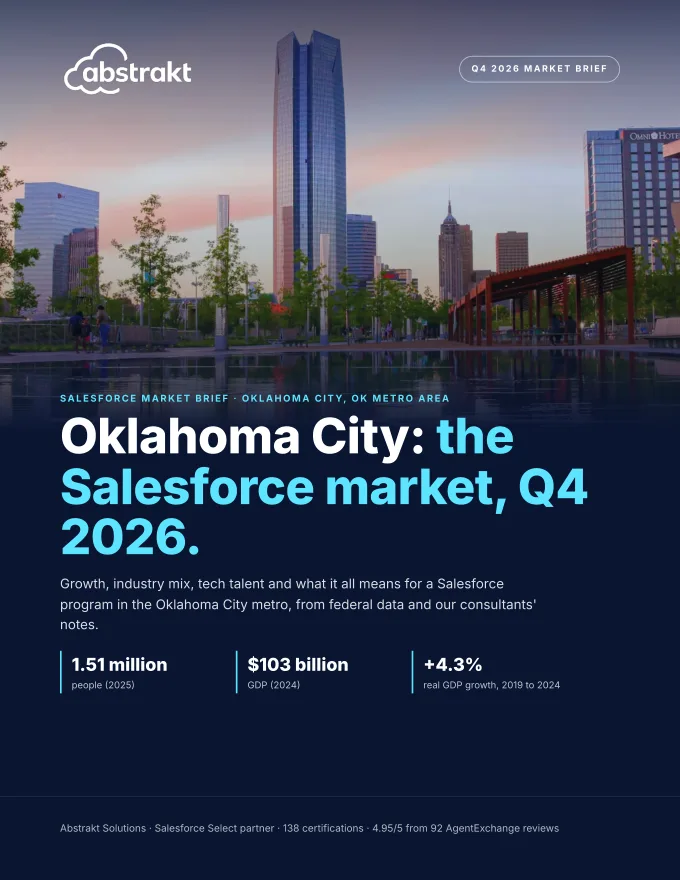
A free 22-page PDF with Oklahoma City's growth ranked against 100 metros, its industry mix, tech wages and nearby markets. It is offered on the public Oklahoma City page; send your customer there or get a copy for your own prep.
Get the Oklahoma City brief →Co-sell with Abstrakt in Oklahoma City
Working a Oklahoma City account? Bring in a named consultant for discovery, scoping or a health check. We reply within 4 business hours.