

How Salesforce work starts in Grand Rapids
Abstrakt Solutions brings Salesforce Consulting Partner experience to manufacturers, health systems and distributors in Grand Rapids, Wyoming and Kentwood, and to firms west toward Holland and Zeeland in Ottawa County. Grand Rapids is one of our focus markets.
What buyers here usually run into
- 1
Dealer networks and project quotes
Furniture and equipment makers commonly quote large projects through independent dealers, and without a shared portal and CPQ, pricing and specifications drift between the two sides.
- 2
Traceability for food producers
Food processors often need lot, customer and complaint history connected, so quality issues and recalls can be traced quickly from the service desk.
- 3
Device service under regulation
Medical device manufacturers typically must record complaints, field repairs and returns in ways auditors can follow, which calls for disciplined case design instead of free-text notes.
Budget, team and partner questions
What drives cost
Grand Rapids costs come from quoting complexity, dealer portal scope and ERP integration on the manufacturing side, plus regulated case design for device makers and lot traceability for food processors. Catalog and account cleanup often precedes any AI work.
Admin or partner
Large manufacturers here often have internal Salesforce owners and use partners for CPQ, portals and integration. Mid-sized makers, distributors and software firms more often rely on managed services until the platform stabilizes.
What buyers ask a partner
Ask for dealer-channel CPQ and portal references, regulated complaint handling examples and food traceability designs. Ask how the partner cleans up duplicate dealer and account records.
The local economy and its biggest industries (4)
| Sector | Share of 2024 GDP | Where Salesforce fits |
|---|---|---|
| Manufacturing Salesforce for manufacturing → | 20.7% | Contract furniture companies sit beside makers of vacuums and cleaning products, direct-sales household brands and molded plastic parts. Many sell through dealers or distributors, which puts CPQ, partner portals and ERP integration at the center of a Salesforce build. |
| Health care and social assistance Salesforce for health & life sciences → | 9.1% | With both health sciences and medical device manufacturing on The Right Place's target list, providers and device companies here need referral tracking, clinician relationships and regulated service records kept in order. |
| Wholesale trade Sales Cloud → | 8.0% | Distributors supplying West Michigan's factories and food processors manage reorders, rep territories and customer-specific pricing. Salesforce serves them best when inventory and price lists flow straight from ERP. |
| Finance and insurance Salesforce for insurance → | 5.5% | Banks, credit unions and insurance agencies that lend to and insure the region's manufacturers and households can use Financial Services Cloud to see commercial and personal relationships side by side. |
Source: U.S. Bureau of Economic Analysis, GDP by county (CAGDP2), 2024, summed to the metro area; private sectors only, excluding real estate and government. “At least” marks sectors where BEA suppresses some county figures.
Regional target sectors named by local economic development groups: Advanced Manufacturing, Information Technology, Health Sciences, Food Processing & Agribusiness, Medical Device Manufacturing, Office Furniture Manufacturing.
Salesforce products that fit Grand Rapids (6)
In the order we lead with them here, from the industries above.
Salesforce Sales Cloud
The CRM where sales pipeline lives, when it is built right.
Salesforce Revenue Cloud / CPQ
Configure-price-quote, billing, subscription management, and quote-to-cash on Salesforce.
Salesforce Experience Cloud
Customer, partner, and employee portals built on Salesforce.
Salesforce Service Cloud
The operating system for modern customer service, case, knowledge, voice, and AI agent assist together.
Salesforce Field Service
Scheduling, dispatch, mobile work orders and parts for teams that work on site.
MuleSoft
Enterprise API platform, for connecting Salesforce, ERP, data warehouses, and the rest of your stack.
Grand Rapids manufacturing gets a realistic AI plan
At 20.7% of 2024 metro GDP, manufacturing is the center of gravity in Grand Rapids, from office furniture and medical devices to food processing. Dealer and distributor networks send constant questions about lead times, specs, and orders, and an agent can answer the routine ones from product data while flagging unusual requests for a rep. Sales Cloud forecasting improves when AI highlights stalled deals and missing next steps, though managers still set the number. Health care providers and wholesalers round out the picture with service inquiries. Expect early work on product catalogs and account hierarchies; AI cannot reason well about dealers that appear several times under different names.
- Dealer order and spec answers
- Stalled deal forecasting signals
- Wholesale service inquiry handling
Services buyers here usually need (7)
Salesforce Implementation in Grand Rapids
In Grand Rapids, a Salesforce implementation is usually a manufacturing project first. Furniture and equipment makers sell through dealers, device companies track complaints for regulators, and food producers need lot-level history when a customer calls. Our design work starts with the product catalog, the account structure for dealers and end customers, and which ERP data sales needs. Then we build in phases, core selling and service first, portals and field work later, with training organized by role.
By industry in Grand Rapids
- 1
Manufacturing
Manufacturing supplied about 20.7% of the metro's 2024 GDP, by far its largest private sector, and The Right Place lists aerospace and defense, medical devices and office furniture within advanced manufacturing. Implementations for these companies revolve around configurable products and long project sales. We decide early whether Revenue Cloud and CPQ handle configuration or the ERP does, how opportunities represent multi-phase projects, and how quotes, orders and installed products relate, because those choices fix the shape of everything built afterward.
- 2
Medical Device Manufacturing
The Right Place says West Michigan has the state's highest concentration of medical device manufacturers. For these companies, the implementation must treat complaint intake seriously from the first release: Service Cloud cases with structured fields for product, lot and event type, clear escalation into quality review, and history nobody can quietly edit. Sales processes for hospital accounts and distributors come alongside, but the case model is designed first because auditors will eventually look at it.
- 3
Food Processing & Agribusiness
Food processors and agribusinesses in the region sell to grocers, distributors and food-service buyers with contract pricing, specifications and seasonal volumes. A Salesforce implementation for them connects accounts to the products and lots they purchase, so service agents can trace a complaint back to production quickly. We usually phase this: account and opportunity management with clean customer data first, then case handling tied to lot records once the ERP link is in place.
Raise before scoping
Model dealers and end customers separately
Office furniture and equipment makers often sell a single project through a dealer to an end customer who also needs service. Represent both parties and the relationship between them in the data model from the start, or reporting on who actually bought what will never line up.
Decide where configuration rules live
Complex products invite duplicate pricing logic in CPQ and the ERP. Agree during design which system owns options, pricing and approval rules, and pass the result across, so quoting stays consistent and an engineering change only needs to be entered in one place.
Plan training around shift schedules
Service, customer care and plant-adjacent teams in manufacturing businesses often work shifts. Schedule training sessions that reach each shift, and prepare short role-based guides, so second-shift staff are not learning Salesforce secondhand from whatever the day team happened to remember.
Salesforce Integration in Grand Rapids
Integration in Grand Rapids nearly always centers on the ERP. Sales wants inventory, pricing and order status inside Salesforce; the plant wants accurate orders flowing back without re-entry; service needs shipment and serial-number history. We map each of those flows, decide which system owns every field, and pick MuleSoft or a lighter approach depending on how many systems are involved. Medical device and food companies add quality systems to that map, which raises the bar on traceability.
By industry in Grand Rapids
- 1
Manufacturing
For the region's manufacturers, the essential integration links Salesforce opportunities and CPQ quotes to ERP sales orders, then brings order status, shipments and invoices back to the account. We design how part numbers, customer numbers and price lists stay in sync, and what happens when a quote references an item the ERP does not recognize. MuleSoft suits companies connecting several plants or ERPs; a single-plant manufacturer may need something simpler.
- 2
Wholesale trade
Distributors depend on accurate availability and pricing, often across large catalogs and customer-specific price agreements. Integrating Salesforce with the ERP and warehouse systems lets reps check stock and contract pricing on the account before they call, and lets inside sales see open orders and backorders. We keep high-volume data such as full inventory tables in the ERP and expose it on demand, rather than copying it into Salesforce every night.
- 3
Medical Device Manufacturing
Device makers need the complaint captured in Salesforce to reach the quality system intact and on time, with product, lot and patient-safety details preserved. Integration here is less about data volume than about completeness, timing and audit trails. We define the handoff, including acknowledgments and status updates flowing back to the case, log every transmission and set alerts for failures, so a missed transfer cannot leave a reportable event sitting unnoticed.
Raise before scoping
Align part and customer numbers first
Mismatched identifiers cause many of the integration defects we see in manufacturing orgs. Before development, reconcile how the ERP and Salesforce identify customers, ship-to locations and parts, and decide how new records get created on each side so duplicates do not multiply after launch.
Expose inventory rather than copying it
Stock levels change constantly, and copying them into Salesforce creates stale numbers and storage costs. Show availability through a live lookup or an external object where possible, and sync only the summary values that reports genuinely need, such as monthly totals by product family.
Plan for multiple plants or ERPs
Companies that have acquired plants often run more than one ERP. Design integrations so Salesforce can accept orders and history from each, with a consistent customer identity across them, instead of wiring a separate point-to-point connection every time a site joins.
Salesforce Optimization in Grand Rapids
Most Grand Rapids orgs we review for optimization were built for one division or product line and then stretched to cover others. Reps enter quotes twice, service agents search several screens for an order, and plant leaders export data to spreadsheets because dashboards disagree. We observe how people really work, then cut unused fields, rebuild page layouts by role, consolidate automation into maintainable flows and redefine the handful of metrics leadership relies on. Changes ship in small, trained releases.
By industry in Grand Rapids
- 1
Retail trade
Retailers here, from grocery chains to specialty brands, account for close to 6.3% of the metro's 2024 output. Retailers and consumer brands with Salesforce frequently accumulate marketing lists, loyalty data and service processes built by different teams at different times. Optimization streamlines case handling so agents see order and customer history on one page, retires duplicate automation that sends customers conflicting emails, and rebuilds service and sales dashboards around a small set of agreed measures that store and online teams both accept.
- 2
Advanced Manufacturing
Aerospace and defense suppliers and other advanced manufacturers often find their opportunity pipeline cluttered with stale quotes and projects that ended long ago. Optimization cleans stages and required fields so forecasts reflect real demand, automates follow-up on expiring quotes and connects opportunities to the products and programs they belong to. Engineering and sales leaders then get reports that show backlog and pipeline by product family, instead of reconciling exports every month.
- 3
Food Processing & Agribusiness
Food producers commonly use Salesforce for account management but handle complaints and quality questions in email. Optimization closes that gap by adding structured case types for quality, delivery and specification issues, linking them to lots and products, and reporting on repeat problems by customer and plant. Small changes like guided screens and sensible defaults raise completion rates, which makes the resulting quality data trustworthy enough for plant managers to act on.
Raise before scoping
Start with the most-used screens
Improvements to the opportunity, quote and case pages that people open many times a day pay back fastest. Review those layouts with actual users before touching administrative settings, so the first release visibly saves time and builds goodwill for the later, less visible work.
Consolidate automation by object
When an opportunity save triggers a workflow rule, a process and two flows, nobody can predict the outcome. Rebuild each object's logic as a few documented flows, test execution order, and delete what they replace so later edits stay predictable.
Report from Salesforce, not exports
If plant, sales and finance leaders each keep their own spreadsheet version of pipeline or service data, dashboards have already lost the argument. Identify why exports happen, fix the underlying fields or definitions, and retire the side spreadsheets deliberately, one at a time.
Salesforce Health Checks in Grand Rapids
Grand Rapids companies usually ask for a health check before a significant change: adding Field Service or a dealer portal, piloting Agentforce, switching partners or absorbing a second org after an acquisition. We examine access and sharing, measure the condition of account, product and case data, inventory automation, code and CPQ configuration, and test how ERP and quality integrations handle errors. Every finding carries a risk rating and effort estimate, so leadership can sequence the fixes with confidence.
By industry in Grand Rapids
- 1
Health care and social assistance
Health care and social assistance contributed roughly 9.1% of the metro's 2024 GDP, and health sciences is one of The Right Place's target sectors. Providers using Salesforce for patient engagement, referrals or community programs need confidence that protected information is visible only to the right roles. A health check tests sharing rules, portal and guest settings, field history and data exports, and it flags automation that could send communications to the wrong patient or program participant.
- 2
Medical Device Manufacturing
For device makers, a health check focuses on whether complaint records would withstand an audit: required fields enforced, edits tracked, closed cases protected and handoffs to the quality system logged. We also review who can change case data after submission, and whether service and sales users can see information they should not. Findings are ranked by regulatory exposure first and operational inconvenience second, so the riskiest gaps get attention before cosmetic ones.
- 3
Advanced Manufacturing
Aerospace, defense and industrial suppliers often run CPQ configurations that have grown with every product family and customer contract. We catalog price and product rules, flag ones that contradict each other or have not fired in a long time, and time quote calculations on real configurations. For defense-related work, the review also checks whether access to controlled or export-sensitive information is appropriately restricted, since permissive sharing in a sales org can become a compliance issue.
Raise before scoping
Review acquired orgs together
When an acquisition brings a second Salesforce org or a different CRM, assess both at once. Compare their data models, automation and security, then decide whether to merge, connect or keep them separate based on evidence rather than on which team argues loudest.
Test integration error handling
An integration that works on the happy path can still lose orders or complaints when a record fails validation. Ask the review to trace a few deliberately bad records through each interface, so you know exactly what happens when things go wrong.
Set AI readiness criteria upfront
Before an Agentforce pilot for service or quoting, define what good enough data means: acceptable duplicate rates, required fields, knowledge coverage. The health check then measures against those criteria, and the distance between today's data and the target becomes a concrete cleanup plan.
Salesforce Migration in Grand Rapids
Many Grand Rapids companies arrive at Salesforce from a CRM module bolted onto their ERP, a legacy on-premises system or years of rep spreadsheets. The migration work is mostly cleanup: identifying the real customer list, merging duplicates created by different plants or divisions, and deciding which quote and service history to keep. We map every field to the new data model, run trial loads in a sandbox, reconcile totals with your team and cut over in a quiet window.
By industry in Grand Rapids
- 1
Finance and insurance
Finance and insurance accounted for about 5.5% of 2024 metro GDP, spread across banks, credit unions, lenders and insurance agencies. These institutions often migrate from a core-system add-on or a lending tool that holds contact and pipeline data. We move relationships, referral sources and loan pipeline stages into Salesforce, preserving consent flags and record ownership, and we verify that sensitive fields land with the right visibility before anyone logs in.
- 2
Office Furniture Manufacturing
Furniture makers moving to Salesforce often carry years of project history in a legacy CRM or dealer spreadsheets: specifications, quotes and installations tied to end customers. Migration separates dealer accounts from end-customer accounts, links historical projects to both and decides how much quote detail to bring. Reps care most about recent and open projects, so those are migrated in full, while older history can be summarized or archived where it remains searchable.
- 3
Information Technology
Software and IT services firms in the region, a sector The Right Place is actively working to grow, frequently start on a free or starter CRM and move once they need forecasting, contracts or support processes. Migration translates their pipeline stages, custom properties and email history into Salesforce objects, cleans up contacts that accumulated from marketing forms, and sets the account structure needed for renewals and support entitlements from the outset.
Raise before scoping
Find the real customer master
In manufacturing, customer data often lives in the ERP, the old CRM and rep spreadsheets, with different spellings in each. Choose which source is authoritative for account names and addresses, match the others to it, and resolve conflicts before anything loads.
Keep open work moving across cutover
Open quotes, active projects and unresolved service issues must arrive in Salesforce complete, or reps will keep using the old tool. Freeze changes briefly, migrate open records last and verify them with their owners during the first morning after go-live.
Retire the old system on purpose
If the legacy CRM stays writable after cutover, people will keep updating it. Switch it to read-only on go-live day, announce that date well ahead, and set a firm retirement date once archived data has been verified, exported and signed off by the business.
Salesforce Managed Services in Grand Rapids
Grand Rapids companies usually come to managed services when their Salesforce org carries more than a single admin can maintain: CPQ price updates, dealer portal accounts, service queues and integration errors, all arriving at once. Under a monthly engagement we keep a ranked backlog with your business owners, handle routine administration, make configuration and Flow changes in a sandbox, and deploy on a predictable cadence. Model-year changes, new product lines and seasonal Salesforce releases get planned instead of rushed.
By industry in Grand Rapids
- 1
Wholesale trade
Wholesale trade represented about 8.0% of 2024 metro GDP, and distributors here tend to have thin internal IT benches. Their Salesforce requests are steady and practical: new territories when a rep leaves, price book updates, account merges after an acquisition, reports for a supplier review. Managed services keeps that stream moving without a hiring cycle, and the same consultants learn your pricing and account rules well enough that routine changes stop requiring long explanations.
- 2
Office Furniture Manufacturing
Furniture makers revise product lines, finishes and price lists regularly, and each change ripples into CPQ rules, dealer portal content and quote templates. A managed team maintains those updates on a schedule tied to your product releases, tests quotes against real configurations before deployment, and supports dealer users who cannot log in or find a product. That keeps the quoting system current without pulling engineers or product managers into Salesforce administration.
- 3
Health Sciences
Health systems and life-science organizations in West Michigan use Salesforce for patient outreach, referral management and grant or program tracking, often with small internal teams stretched across several systems. Managed services provides the administration, reporting and Flow work those teams need, with changes reviewed for privacy impact before deployment. Permission requests pass through a documented approval step, so access grows deliberately rather than by exception, which simplifies later compliance reviews.
Raise before scoping
Tie releases to product launches
Manufacturers introduce new models and price lists on their own calendar. Align Salesforce release planning with that calendar so CPQ rules, catalogs and dealer materials update together, rather than leaving quotes wrong for days after an announcement, which sales teams and dealers notice immediately.
Keep integration errors on someone's desk
ERP and MuleSoft connections throw errors that nobody sees until a rep complains about a missing order. Make monitoring those failures an explicit part of the managed services scope, with a named responder and a routine for clearing the error queue each week.
Budget hours for a variable load
Demand for Salesforce changes rises around product launches, acquisitions and year-end planning. Choose an arrangement that flexes between months, and review usage every quarter, so a heavy stretch does not stall important work and quieter months are not simply wasted hours.
Salesforce Implementation Rescue in Grand Rapids
In Grand Rapids, rescued projects often stall on the hardest manufacturing pieces: CPQ rules that never produced correct quotes, an ERP integration that duplicates orders, or a dealer portal launched before the data was ready. Our first step is triage, reviewing the org, integration logs and backlog and interviewing the people who stopped using it. We then separate what can be kept from what must be redone, fix the blockers to daily selling and service first, and finish remaining scope in planned phases.
By industry in Grand Rapids
- 1
Office Furniture Manufacturing
A stalled furniture-industry project frequently centers on quoting: CPQ rules that could not represent the product line, so reps went back to legacy tools while the portal sat half used. Rescue starts by testing real configurations against the rules, identifying which product families work and which do not, and deciding whether to repair the configuration or narrow its scope. We restore dependable quoting for the most common products first, then extend coverage in stages.
- 2
Wholesale trade
Distributors often see a failed launch when the ERP integration creates duplicate accounts or stale pricing, and reps stop trusting anything on screen. Rescue pauses the faulty syncs, cleans the duplicates, and rebuilds the integration with clear ownership rules and error monitoring. Once reps can rely on pricing and order status again, we revisit the features that were cut or never finished, such as territory management or inside sales dashboards.
- 3
Health Sciences
Health organizations sometimes launch Salesforce for outreach or referrals and then discover that sharing and consent were never fully configured, forcing a partial shutdown. Rescue reviews access and consent handling first, fixes what exposes sensitive data, and restores the workflows staff depend on under the corrected model. Only then does the project resume its original roadmap, with privacy review built into each subsequent release rather than tacked on at the end.
Raise before scoping
Stop the bleeding before redesigning
If an integration is corrupting records or a flow is sending wrong notifications, switch it off or contain it before planning anything else. Stabilizing data and user trust comes first; redesign discussions go better once the org has stopped generating new problems every day.
Interview users who gave up
The people who quietly returned to spreadsheets know exactly where the system failed them. Interview them early, record specific pain points and use their input to rank fixes, then bring them back first when the repaired process is ready for real work.
Reset scope and expectations openly
Rescues tend to go better when the next release is narrower than the original plan. Agree with leadership on what that release must deliver and what waits, and tell users plainly, so the project regains credibility instead of repeating earlier promises.
Industry plays in Grand Rapids (3)
Salesforce for Grand Rapids Manufacturers
Grand Rapids manufacturing covers office furniture, medical devices, food processing and a broad base of advanced manufacturers. Many sell through influence rather than direct orders: architects and designers specify products, dealers install them, and end clients pay. Others build to customers' specifications under contract. Salesforce should record who influences each project, support quotes with many configured items, and pass orders cleanly to the ERP. We design the data model around your channel first, then the screens.
Factories anchor the local economy: manufacturing generates 20.7% of Grand Rapids metro GDP in 2024 Bureau of Economic Analysis county data, more than double health care at 9.1%. The Right Place, the regional economic development organization, lists office furniture manufacturing and medical device manufacturing as targets in their own right, alongside advanced manufacturing and food processing and agribusiness. It also targets information technology, citing more than 39,000 tech jobs, which gives manufacturers a regional pool of software and integration talent.
Use cases to open with
- 1
Design firm influence tracking
In contract furniture, architects and interior designers often decide which brand gets specified long before a dealer quotes. Sales Cloud with influencer roles on each project records which design firms specified the product, tracks presentations and showroom visits, and reports win rates by firm, so reps know where specification effort actually converts into orders and where it simply generates goodwill.
- 2
Large project coordination
A headquarters fit-out can involve hundreds of configured items, phased deliveries and changes right up to installation. We model projects with phases, linked quotes and change orders, give dealers status through a portal, and connect orders to the ERP so installation dates and backorders appear in Salesforce before the end client calls to ask where the chairs are. Punch-list items after installation become service cases.
- 3
Contract manufacturing RFQs
Contract manufacturers for medical device and industrial customers quote to customer drawings, validation requirements and annual volumes. A structured RFQ process in Salesforce captures technical documents, routes cost questions to engineering, records validation milestones and converts wins into forecasted production, so leadership sees how newly awarded programs will load each line in the plant. Lost bids keep their reasons for future pricing reviews.
Raise before scoping
Separate influencer and buyer roles
Designer, dealer and end client each play a different role, and crediting revenue to all three can distort reports. Define how credit is assigned, which role drives commission or incentive programs, and how reports count each project, before configuring opportunity splits or partner fields.
Quality obligations for device work
Contract manufacturers serving medical device customers operate under quality system requirements, and customer complaints must reach quality staff promptly. Decide which system owns complaints and corrective actions, and connect Salesforce so customer-facing teams can see status without editing controlled records.
Test CPQ with the real catalog
Furniture and equipment catalogs contain large numbers of options, finishes and pricing rules. Test CPQ performance with your actual catalog early, consider whether configuration should stay in a specialized tool, and plan how catalog updates will flow into Salesforce with each product release.
Salesforce for Grand Rapids Health and Life Sciences
Health and life sciences in Grand Rapids combines care delivery with a strong medical device manufacturing base and a growing technology sector. Providers use Salesforce for patient access, contact centers and community outreach. Device makers use it for customer service, field repairs and complaint intake auditors can follow. Health technology companies use it to sell and support provider customers. We keep protected health information tightly scoped and integrate with the clinical, quality and ERP systems each group already relies on.
Second only to manufacturing, health care and social assistance supplies 9.1% of Grand Rapids metro GDP according to the Bureau of Economic Analysis's 2024 county-level estimates. The Right Place lists health sciences among its target industries and names medical device manufacturing as a separate target, which signals how much of the region's life sciences activity involves making and servicing products. Its information technology target, and a tech strategy aiming to grow tech to 10% of regional employment, add software companies that sell into health organizations to the mix.
Use cases to open with
- 1
Patient access center
Scheduling, prescription refill requests and billing questions often arrive through separate phone trees. Service Cloud unifies calls, web requests and messages into one queue, shows staff the patient's upcoming appointments from the EHR, and measures abandonment and handle time by service line, giving access leaders the data to staff phones where demand actually falls during the week. Callback requests keep their place in line.
- 2
Device service and returns
Device manufacturers must capture every service request, repair and returned unit with enough detail for trending and investigation. Service Cloud cases linked to asset serial numbers, return authorizations and Field Service work orders keep that history complete, and potential complaints route to quality automatically instead of waiting in someone's inbox while reporting deadlines approach. Trend reports group returns by lot and failure mode.
- 3
Community health outreach
Providers running screenings, wellness programs and community events need to track who attended and what follow-up happened. Salesforce engagement tools, fed by consented contact data, manage invitations and reminders, while outcomes return to Salesforce so program leaders can report participation by neighborhood and adjust where they invest staff time and grant dollars. Community partners can refer residents through a simple form.
Raise before scoping
Scope PHI by team
Clinical detail should reach only the teams that use it. Contact centers may need appointments; outreach staff often need only consented contact details. Map required data by role, apply field-level security and encryption accordingly, and document the decisions for the HIPAA reviews your privacy officer leads.
Align service with quality systems
Device complaint handling usually has a system of record in quality management software. Design the hand-off from Salesforce so required fields are captured at intake, timestamps are preserved and investigation outcomes flow back for customer communication, without duplicating controlled records.
Consent by channel and purpose
Patients may agree to texts about appointments but not about programs or fundraising. Record consent by channel and purpose, enforce it in every automated journey, and review the model with compliance, because mistakes here damage patient trust quickly and are hard to undo.
Salesforce for Grand Rapids Consumer Brands
West Michigan is home to consumer product companies that reach households in several ways at once: through national retailers, through their own websites and, for some, through networks of independent sellers. Salesforce helps when those channels share one view of the customer and the product. We configure Service Cloud for product support and warranties, Marketing Cloud and Data 360 (formerly Data Cloud) for owner and shopper marketing, and Experience Cloud for independent seller or retail partner portals, integrated with commerce and ERP systems.
Retail trade contributed 6.3% of Grand Rapids metro GDP in 2024 in the Bureau of Economic Analysis's county figures, fourth among private sectors, while manufacturing at 20.7% and wholesale trade at 8% carry much of the consumer products story. Much of the region's consumer goods activity, from household cleaning products to direct-sales brands, is counted under manufacturing even though the end customers are households. The Right Place's tech strategy aims to grow technology to 10% of regional employment, a local talent pool for brands building digital sales and service teams.
Use cases to open with
- 1
Product registration and support
Appliance and household product owners register purchases, ask how-to questions and file warranty claims. Service Cloud can hold each registered product with serial number and purchase date, answer common questions through Agentforce using approved articles, and route warranty cases to agents who can approve replacements or parts. Product and engineering teams see failure and question trends by model and production date, which feeds design changes and clearer instructions.
- 2
Independent seller portals
Direct-selling companies support large networks of independent business owners who need training, orders, customer lists and commission statements. An Experience Cloud portal can give each seller their own dashboard, content and support cases, while Salesforce records the seller's sponsorship line and status. Corporate staff can target communications by rank, region and product interest, and support agents see a seller's full history before answering a question.
- 3
Owner marketing after purchase
Once a customer registers a product, the brand can suggest accessories, filters and replacements at the right time. Marketing Cloud journeys driven by registration date and model, with Data 360 (formerly Data Cloud) unifying web, registration and service data, keep messages relevant and respect each owner's consent. Retail partners benefit too when journeys send owners back to their stores for filters, bags and replacement parts.
Raise before scoping
Separate sellers from shoppers
A person may be a consumer, an independent seller and a sponsor at once. Design the data model so each role is clear, with the right sharing and consent rules, and so reports do not double count people who hold several roles.
Respect retailer relationships
Brands selling through major retailers must avoid undercutting those partners with their own direct marketing. Agree internally on which offers go direct and which point shoppers back to retail, and reflect those rules in Marketing Cloud journeys, service scripts and any Agentforce answers about where to buy.
Plan for volume spikes
Product launches, recalls and holiday gift seasons can multiply service contacts almost overnight. Build knowledge articles, routing rules and self-service options ahead of time, and load-test how queues, staffing plans and Agentforce responses hold up before the busiest weeks arrive rather than during them.
Case studies to send (2)
From the industries this market leans on. Client names are anonymized and these projects are not specific to Grand Rapids.
The Grand Rapids Salesforce market brief, Q4 2026
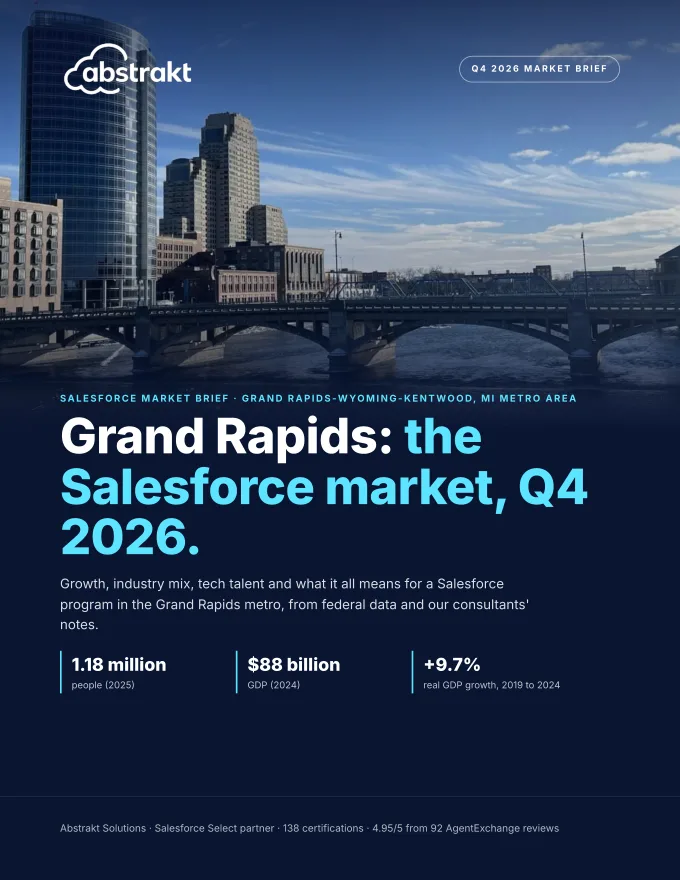
A free 21-page PDF with Grand Rapids's growth ranked against 100 metros, its industry mix, tech wages and nearby markets. It is offered on the public Grand Rapids page; send your customer there or get a copy for your own prep.
Get the Grand Rapids brief →Co-sell with Abstrakt in Grand Rapids
Working a Grand Rapids account? Bring in a named consultant for discovery, scoping or a health check. We reply within 4 business hours.